
손님은 떠났다. 청구서는 남았다:오픈AI가 할리우드를 떠난 뒤 — 무엇이 바뀌었고 무엇이 남았나
by
2026년 3월 25일
The shift in LLM citation sources demands a fundamental restructuring of content strategy
As AI search seizes control, the center of gravity of the internet is quietly shifting. On top of the 'human-viewed internet' designed to capture human attention, a 'machine-read internet' that LLMs like ChatGPT, Gemini, and Perplexity read and cite is being built layer by layer.
Reddit, once the most trusted social platform for AI, lost its throne in just one year, with YouTube taking its place. Data from four analytics firms—Profound, Bluefish, Goodie AI, and Emberos—consistently shows that the center of gravity for LLM citations has now moved from Reddit comment threads to the captions, descriptions, and metadata surrounding YouTube videos.
 Jung Han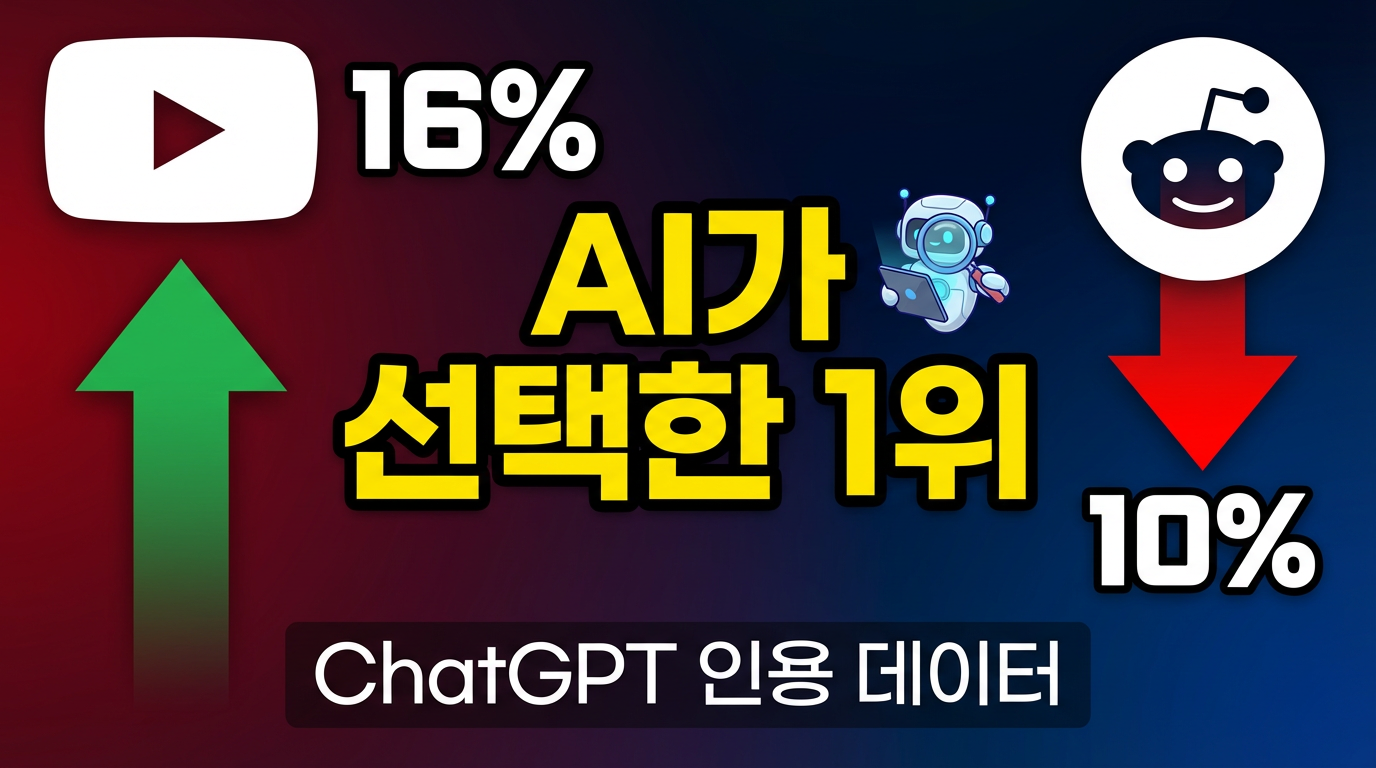
LLMs don't 'watch' videos so much as read the structured text surrounding them. This means YouTube's rise isn't a victory for the video format itself, but rather a victory for 'parsable text infrastructure' represented by captions and scripts containing information-rich how-tos and reviews, along with rich metadata.
The traditional content value system measured by views, likes, and watch time is now shifting from 'how many people watch' to 'how well AI understands and re-cites this content.' The fact that YouTube has surpassed Reddit to become the frontline of LLM citations poses a single question to brands, media, and creators: Content strategy criteria must now be reset not to virality, but to 'Can machines read it, and are they reading it accurately?'
The numbers clearly reveal the scale of this change. Synthesizing research from four analytics firms yields the following:
According to Bluefish analysis, over the past six months, YouTube was cited in 16% of LLM responses, far surpassing Reddit's 10%. This is a dramatic reversal compared to just one year ago when Reddit monopolized over 40% of social platform citations. Bluefish also revealed that overall social media AI citation share nearly doubled between July and November, accounting for 7% of total LLM citations.
Recent data from Emberos shows this gap in detail. After analyzing tens of thousands of AI responses, YouTube was being cited about 40% more frequently than Reddit across major AI chatbots including ChatGPT, Gemini, and Perplexity. Notably, Google's AI Overview is citing its own platform, YouTube, in 18% to 25% of eligible responses. ChatGPT similarly cites YouTube in about 18% of responses, demonstrating this phenomenon isn't limited to a specific AI service.
Goodie AI's analysis, which specializes in AI search optimization for brands, most clearly reveals the speed of this trend. Analyzing 6.1 million citations (including 236,126 social citations) across 66 brands in consumer goods, gaming, healthcare, fintech, and pharmaceuticals, YouTube's social citation share surged from 18.9% in August to 39.2% in December—more than doubling in just four months. During the same period, Reddit was cut in half from 44.2% to 20.3%. The positions of the two platforms completely reversed.
YouTube's dominance becomes even more overwhelming when compared to competing video platforms. According to Profound's analysis of billions of AI-generated citations, YouTube recorded approximately 18 times more citations than Instagram, nearly 50 times more than TikTok, and over 500 times more than Vimeo. Bluefish data also showed a stark gap with YouTube, with Instagram and LinkedIn each at 2% and TikTok at just 1%.
As of January 2026, Profound ranked YouTube as the most cited domain in Google AI Overview and Gemini, and the second most cited domain in Google AI Mode and Perplexity.
To understand this reversal, we need to first grasp how LLMs process information.
In an interview with Adweek, Emberos CEO Justin Inman emphasized, "YouTube provides clean, long-form, indexable captions," while "Reddit content is fragmented across threads and comments."
What had been Reddit's strength—'rich discussions with diverse perspectives'—has become a weakness from the LLM's perspective. Extracting key information from dozens of comments and replies is much harder than reading information from structured captions.
Changes in user query patterns are also important. Questions posed to LLMs are increasingly shifting toward 'how-to' and 'step-by-step explanation' formats. For questions like "How do I do this?" or "Please explain in order," tutorial video structured scripts are much more suitable than Reddit's scattered opinion threads.
Bluefish CEO Alex Sherman offered a more fundamental insight in an interview: "Visibility depends more on how cleanly content can be indexed than on creator influence or view counts." Even an influencer's video with 1 million subscribers is unlikely to be cited by LLMs if it lacks captions or has poor descriptions.
Conversely, even a channel with 10,000 subscribers can gain an advantage in AI search if it has accurate captions and systematic descriptions. In an Adweek interview, Sherman CEO noted, "Social media citations nearly doubled between July and November, but still only accounted for 7% of total LLM citations," adding "this means AI doesn't use social media as its default."
He added, "LLMs only pull content when it adds substantial explanatory value. YouTube's lead demonstrates exactly this difference."
The latest data shows each platform is differentiating into distinct roles within the AI search ecosystem.
YouTube has established itself as the default source for tutorials, product explanations, and commentary content. For questions like "How do I use this software?" or "What's this product really like?", LLMs reference YouTube first.
Reddit still maintains strength in opinion threads and troubleshooting questions. Reddit's value remains intact for community-based answers like "How did others handle this situation?" or "Has anyone solved this error message?"
Instagram's role is "episodic," as CEO Inman describes it. It appears intermittently for questions related to culture, trends, and real-time issues, but has minimal presence in everyday information searches.
TikTok and LinkedIn remain on the periphery of LLM citations. Their respective characteristics—short video format and text-based professional networking—don't align with current LLM parsing methods.
CEO Inman forecasted, "Social media citations in AI responses will continue to grow over the next 12 months, but unevenly across platforms. YouTube will continue to grow as the default source for how-to and product-related questions, while Instagram's role will remain episodic, centered on culture, trends, and real-time issues."
It's also noteworthy that the companies producing this data are themselves forming a new industry ecosystem. As the era of keywords and blue links shifts to LLMs, startups are rapidly emerging to meet brands' AI visibility optimization demands. ADWEEK has selected these as "7 Hot Startups Shaping the Future of AI Search Optimization."
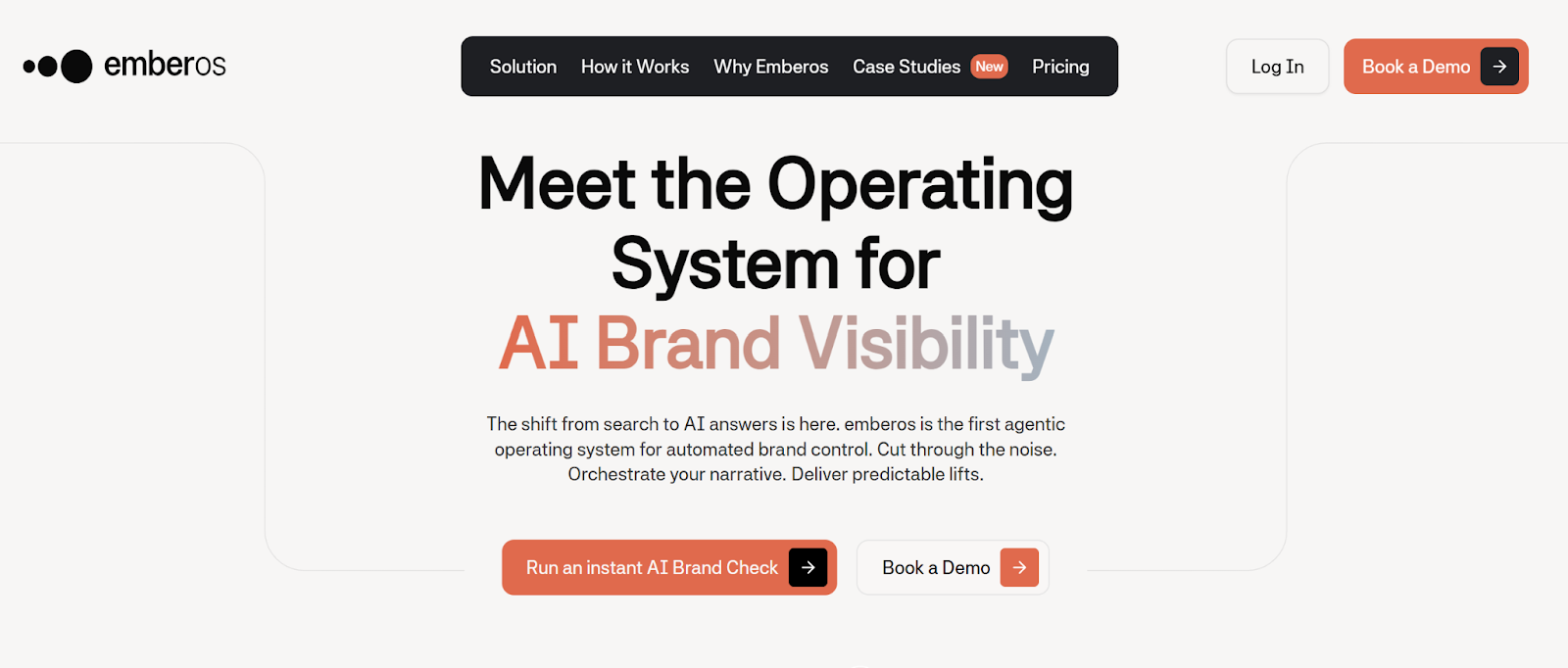
The most prominent AI visibility optimization company in this analysis is Emberos (emberos.ai). Founded by Google alumnus Justin Inman, the company secured $1.2 million in pre-seed investment from a single angel investor in January 2026. CEO Inman asserts, "The next battlefield where brands will compete fiercely won't be search rankings or social feeds, but inside the answers generated by AI."
Emberos currently covers five major AI platforms—ChatGPT, Gemini, Claude, Perplexity, and Grok—and is also planning expansion to voice assistants like Alexa. This 14-employee startup has secured entertainment studios, advertising agencies, consumer goods brands (including celebrity-owned brands), and political organizations as clients, targeting a seed round in Q1 2026.
CEO Inman explained, "Our core is helping brands understand and control how they're represented in AI answers. This includes not just visibility, but recommendations across all major models. We're the infrastructure layer for what we call 'AI brand orchestration.'"
Emberos's differentiator is 'predictive capability.' In an interview, CEO Inman mentioned, "Many competitors approach from a reactive perspective, reporting what has already happened. But we have predictive capabilities and provide solutions we call 'fix packs.'"
He explained, "I want to demystify that black box and make it more accessible and automated. This helps at both the executive level and the practitioner level."
Fix packs integrate with work tools like Slack, HubSpot, and Jira to deliver recommendations directly to social, marketing, and agency teams. Emberos also includes a governance layer focused on hallucination, intellectual property concerns, and brand safety.
The technical core of Emberos is its proprietary 'Brand Knowledge Graph.' It maps entities including brands, products, creative assets, and narratives across the internet, tracks how they evolve, and predicts future outcomes. CEO Inman explained, "Once an entity is mapped to our brand knowledge graph, we can understand how all major influence factors on the internet connect to that specific entity, like a city map. This is the foundation of our predictive capability."
These predictions span from macro-level outcomes like box office performance to detailed business impacts when a brand makes specific changes. "If you make this change, we predict an increase of X. And when the change actually happens, we can compare what we predicted to what actually occurred."
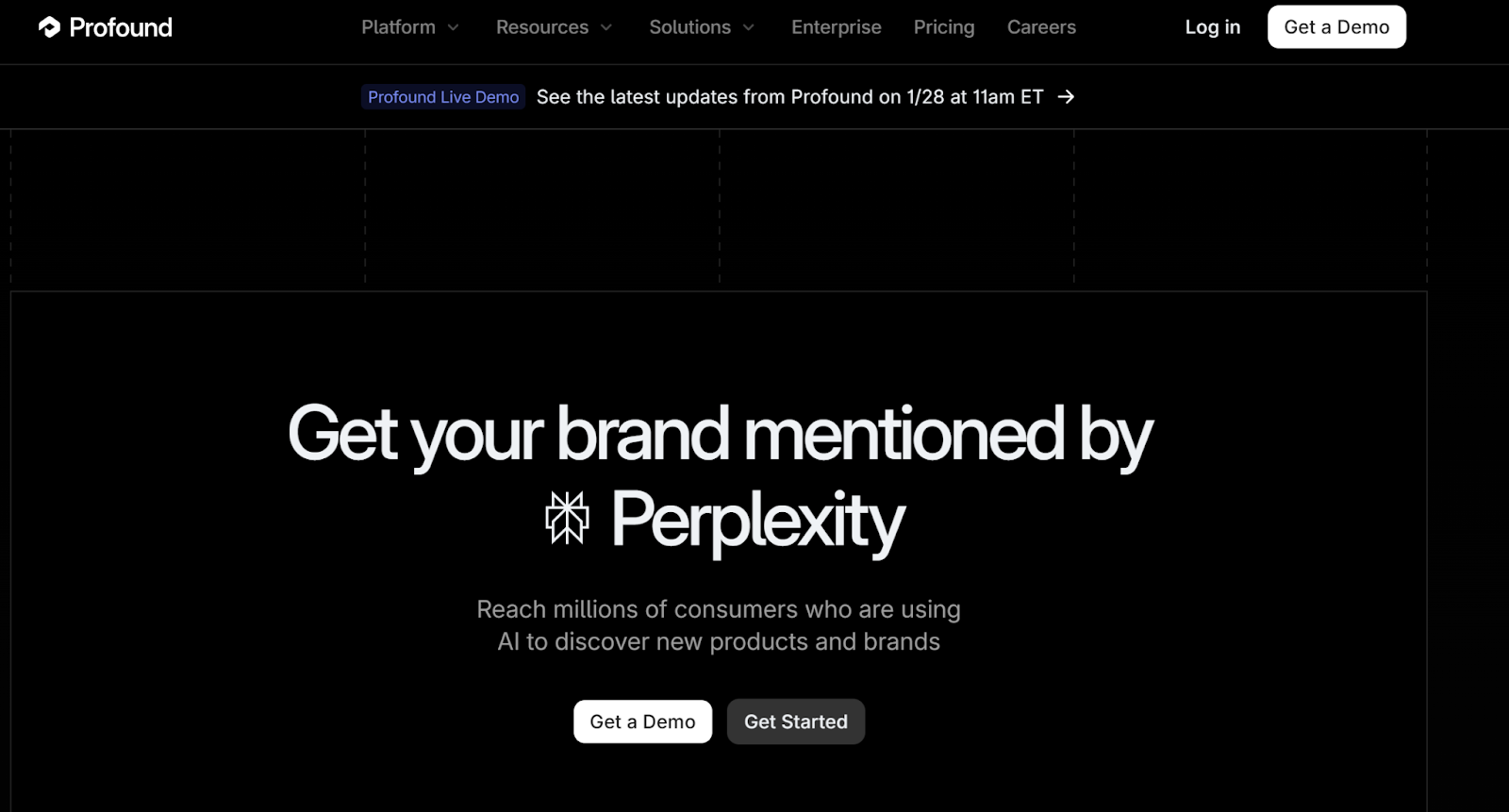
Profound (tryprofound.com) is another major player. The company has attracted market attention by raising $35 million in AI search optimization. Profound's client Airbyte is known for tripling its visibility in ChatGPT from 9% to 26% in just one week and converting this into a $100,000 customer contract. This demonstrates that AI visibility can be directly linked to actual revenue, not just a branding metric.
Bluefish (bluefishai.com) and Goodie AI (higoodie.com) have also established themselves as core data providers in this market. The common business model of these startups stems from the need for marketers to fundamentally readjust their strategies as information discovery shifts from traditional search to summarized chatbot responses.
BlueDot AI (CEO Lee Sung-kyu) is a Korean startup specializing in AI Search Optimization, playing the role of managing 'AI exposure' for companies and media in an environment where generative AI like ChatGPT is becoming a new search gateway. Through 'BlueDot Intelligence,' the company measures how much and in what context brands and content are mentioned in AI answers, and analyzes which sources and signals influence AI responses.
Furthermore, BlueDot connects BlueDot CMS with generative AI tools for journalism and marketing, linking measured data to a workflow that guides how to rewrite content and where to distribute it for better AI recognition.
Behind this new industry's rapid growth lies an uncomfortable reality. According to Emberos data, 90% of the 500 brands surveyed have at least one factual error in a major language model.
CEO Inman emphasizes, "This is an enormous scale." These errors include incorrect pricing information, outdated product details, and conflicting recommendations between models. The problem is that once entrenched, errors are not easily corrected.
"Once an AI system understands a particular narrative, that narrative solidifies quite rapidly." This is CEO Inman's warning. "Our suggestion is to come in right now and start shaping these, and prepare your brand for this discovery point that has moved upstream."
This isn't just a marketing problem. If a consumer asks AI "What's the price of Brand A's product?" and gets a wrong answer, it becomes a matter of brand trust and potential revenue loss. In an era where AI becomes the first point of contact for search, how a brand 'reads' to AI is no longer an optional concern.
Meanwhile, CEO Inman warns against indiscriminate content production. In an interview, he said, "What I see a lot in this space is approaches that focus only on content and publishing. This is creating a lot of 'AI slop' (low-quality AI-generated content)." Emberos evaluates signals across owned, earned, and paid channels including website FAQs, PR placements, influencer partnerships, and paid campaigns.
Recent changes are demanding changes from brands and content creators. The very goal of content creation must be redefined.
From 'View Optimization' to 'Parsing Optimization'
CEO Sherman's core message is that "views, followers, and creator influence don't necessarily translate to AI influence." Content that wins in AI search is educational clarity—well-structured content that models can easily parse, such as product usage guides, reviews, and target audience explanations.
Content Requirements for AI Visibility
Goodie AI specifically outlines characteristics of content likely to be cited by LLMs. In particular, information-dense videos with captions and scripts, commentary and troubleshooting guide formats, and comparative analysis and long-form how-to content fall into this category. The common thread is that all have 'machine-readable structured text.'
Need for Dual Measurement Systems
This demands that marketers establish dual measurement systems.
CEO Sherman summarizes: "For marketers, this means video and social strategies can no longer be measured by human engagement alone. You also need to consider whether AI systems can understand the content."
These research findings have special significance for K-content producers and Korean creators targeting global markets. As AI search emerges as a new discovery channel, a new window of opportunity is opening to expand the global reach of Hallyu content.
Strategic Importance of Multilingual Subtitles
Until now, multilingual subtitles were tools for 'human viewer accessibility.' But in the AI search era, subtitles gain entirely new strategic value. LLMs read subtitles rather than watching videos. Therefore, K-content with multilingual subtitles in English, Spanish, Japanese, etc., has a higher chance of being cited in AI searches within those language zones. English subtitle quality and accuracy in particular are directly tied to visibility on global AI platforms.
Importance of Structured Metadata
For K-drama, K-pop, and K-beauty content, systematically organizing video descriptions and metadata is key to AI search visibility. Providing episode summaries, cast information, and related product information in structured form makes it easier for LLMs to parse and cite. For AI to accurately answer questions like "What brand is the jacket BTS members wore?", that information must exist in searchable text form.
Opportunity in 'How-To' Content
As the data shows, LLMs particularly favor 'how-to' and 'step-by-step explanation' content. Educational content like K-beauty tutorials, K-pop dance cover lessons, and Korean recipe videos have high potential for AI search citations. However, conditions apply: accurate subtitles, clear step divisions, and systematic explanations must be in place.
Paradoxical Opportunity for Small-Medium Channels
As mentioned earlier, AI visibility doesn't correlate with subscriber count or view numbers. This provides a paradoxical opportunity for small-to-medium K-content channels rather than major MCNs or entertainment companies. Even a channel with 10,000 subscribers can outperform a 1-million subscriber channel in AI search if equipped with accurate subtitles, systematic metadata, and information-dense descriptions.
Brand Information Accuracy Management
According to Emberos data, "90% of brands are inaccurately represented in AI." K-brands are likely no exception. K-beauty, K-fashion, and K-food brands targeting global markets should check how they're being represented on major AI platforms and correct errors early. CEO Inman's warning that "once an AI system understands a particular narrative, that narrative solidifies quite rapidly" should be heeded.
Synergy Between FAST Channels and AI Search
FAST (Free Ad-Supported Streaming TV) channels, gaining attention as a global expansion strategy for K-content, should also consider synergy with AI search. If content distributed on FAST platforms has structured metadata and multilingual subtitles, additional discovery pathways through AI search can open up.
However, it's difficult to conclude this trend will continue forever. In an Adweek interview, CEO Inman warned, "If LLMs determine social content is too noisy or legally risky, a rapid reversal could occur. We're at an inflection point where social platforms either become the new search results or are entirely excluded."
Indeed, copyright issues, misinformation problems, and legal risks could trigger policy changes by LLM developers at any time. The fact that social media citations are growing rapidly but still account for only 7% of the total suggests AI still treats social media as a 'supplementary' information source.
Emberos's inclusion of a governance layer focused on hallucination, intellectual property concerns, and brand safety reflects these risks. AI search optimization isn't simply about 'getting more exposure' but also about 'being accurately represented.'
In conclusion, the era of virality is waning. Content that records millions of views but can't be read by AI disappears from search. Conversely, content seen by only a few but structured for machine parsing can be infinitely reproduced through AI citations.
YouTube's rise can be seen as the first signal of this change. And the emergence of startups like Emberos, Profound, Bluefish, and Goodie AI proves this change is not a temporary phenomenon but a structural transformation.
Going forward, content creators will need to ask three questions simultaneously before creating content: "Will people watch this?", "Can AI read this?", and "Is AI reading this 'accurately'?"
As CEO Inman said, "Once an AI system understands a particular narrative, that narrative solidifies quite rapidly." Now is the last chance to shape that narrative.
Appendix: Key Company Profiles
─────────────────────────────────────────
This report is based on ADWEEK article.
Original: https://www.adweek.com/media/youtube-reddit-ai-search-engine-citations/
January 2026
![[SXSW 2026]AI 파일럿 95%는 왜 실패하는가: '성공하는 AI 시스템의 7가지 패턴'](https://cdn.media.bluedot.so/bluedot.kentertechhub/2026/03/9wheq7_202603201341.png)
![[투비]The Stream 2026: When Intention Becomes Attention](https://cdn.media.bluedot.so/bluedot.kentertechhub/2026/03/6h3xe4_202603220154.png)
![[SXSW2026]에이미 웹 트렌드 리포트(Convergence
Outlook 2026)](https://cdn.media.bluedot.so/bluedot.kentertechhub/2026/03/kty3s8_202603152312.png)
![[보고서]전통 언론사의 크리에이터 전략 대전환](https://cdn.media.bluedot.so/bluedot.kentertechhub/2026/02/0nwc9z_202602100212.png)