
![[CES 2026]Variety Business of Creators Summit: Meets the Creator Era](https://cdn.media.bluedot.so/bluedot.kentertechhub/2026/01/vid660_202601161658.jpg)
The Creator Economy Finally Gets a Seat at Hollywood's Main Table
Samsung TV Plus FAST Strategy | The MrBeast Empire Lesson | Living Room TV Battle | 'Trust Economy' in the AI Era | Rise of Live Shopping | The New Brand Marketing Formula
Introduction: The Creator Economy Comes of Age
On January 8, the first-ever Variety Business of Creators Summit was held at the Aria Resort and Casino in Las Vegas. With Samsung Ads as the presenting partner, and TalkShopLive and LV8 as official and supporting partners respectively, this event was hailed as the most successful in Variety's 11-12 year history of hosting summits at CES.
Variety Co-Editor-in-Chief Cynthia Littleton emphasized in her opening remarks, "The convergence of the creator economy with traditional mainstream media, each leveraging the other's power, is happening in real time. There couldn't be a better moment to have thoughtful discussions about how this business is working, how people are making money, and how people are leveraging fandom and community and engagement in new ways."
Andy Wallenstein, Chief Media Analyst at Luminate and former Co-Editor-in-Chief of Variety, provided even deeper historical context. Having written the first-ever story about YouTube in any Hollywood entertainment publication—four to six months before Google acquired it—he recalled, "Fifteen years ago, we didn't even have the terms 'influencers' or 'digital natives.'"
"Every year I wrote 'it's going to explode next year,' but it never quite broke through. But now in 2026, the maturation of this space is amazing. You cannot talk about anything in Hollywood—the core business of film and television—without talking about the creator economy. The creator economy finally has a seat at every table in this industry."
Keynote: "The Next Generation of Entertainment Talent Is Creators"
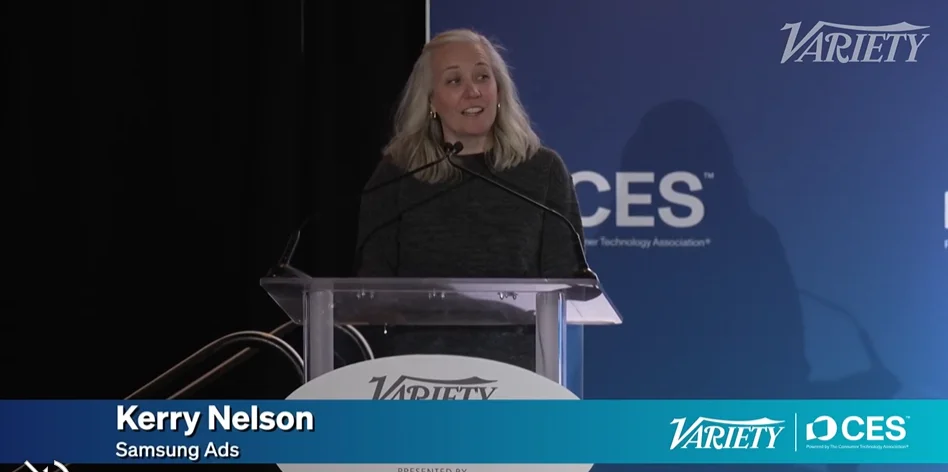
▲ Kerry Nelson, Head of Brand Marketing at Samsung Ads, delivering the keynote at the Variety Business of Creators Summit at CES 2026
Kerry Nelson, Head of Brand Marketing at Samsung Ads, took the stage as the keynote speaker and declared a new era for the creator economy.
"At Samsung Ads, we believe that the next generation of entertainment talent is creators. Creators are revolutionizing how stories are told, how communities form, how audiences connect, and how brands show up in those moments. It's a redefinition of what entertainment can be and who gets to shape it."
— Kerry Nelson, Head of Brand Marketing, Samsung Ads
Nelson pointed to Samsung TV Plus, Samsung's FAST (Free Ad-Supported Streaming TV) service, as where this shift is most clearly visible. With over 88 million monthly active users, the platform now operates dedicated channels from top creators including MrBeast, Dhar Mann, Michelle Khare, and the Try Guys.
"As more creators expand into longer-form programming, we've made Samsung TV Plus the leading global home for premium creator-driven channels. For advertisers, the opportunity is huge: premium, brand-safe environments paired with authentic storytelling and measurable outcomes, all in one place."
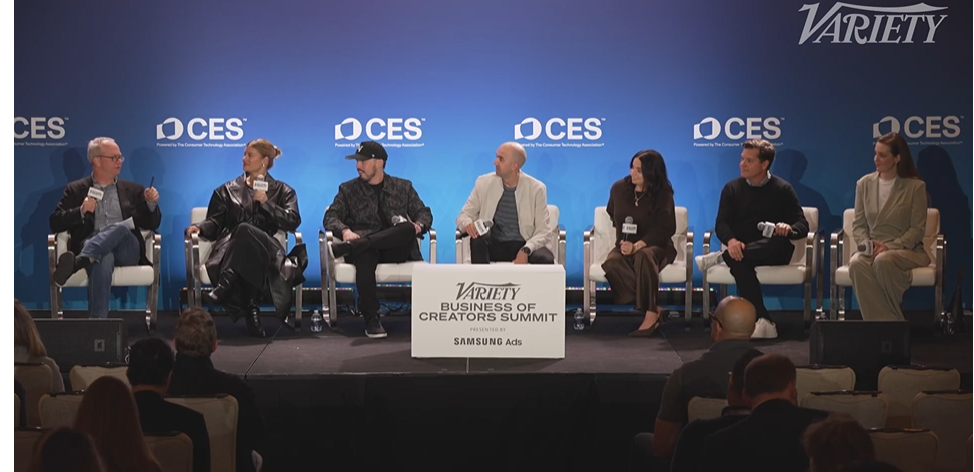
The MrBeast Empire: The Platform Is Just the Foundation
Wallenstein cited MrBeast (Jimmy Donaldson) as the quintessential example of the creator economy's new paradigm. "He is no longer someone who is just a creature of these social platforms or strictly on YouTube. He has really built a massive business."
The key insight is this: Creators build their foundation on social platforms, but the real business kicks in with everything they do off-platform—merchandise, business diversification, and traditional media ventures. MrBeast's reality series "Beast Games" on Amazon Prime Video exemplifies this. With Season 2 coming soon, the show proves that creators can succeed in traditional unscripted television.
"In not-so-distant Hollywood history, these kinds of shows were very hard to either get going or to succeed. There was a long list of failures," Wallenstein recalled. He also mentioned Lilly Singh, who built her brand on YouTube before hosting a late-night show on NBC for several years, as another breakthrough example.
The 2026 Battleground: The Living Room TV Wars
Wallenstein identified the "living room invasion" as the most important shift in the creator economy for 2026. "If you're not already watching social platforms like YouTube on your television set as opposed to just your mobile, I think this is going to be the year where that changes."
Instagram has already begun putting its content on the big screen via Amazon Fire TVs. TikTok, which has flirted with this space in the past, is expected to make a move soon as well. "The shift to the living room really represents the next big maturation point for the creator economy," Wallenstein emphasized.
In this context, YouTube securing the rights to broadcast the Oscars in 2029 is symbolic. "I say that out loud and I still can't believe that's actually happening. But if that isn't a sign of the times in terms of the maturation of the creator economy, I don't know what is."
New FAST Channel Stars: Mark Rober and the Family Co-Viewing Strategy
Takashi Nakano, VP of Content and Programming for Samsung TV Plus, explained the characteristics of creators who successfully transition to TV. "Not every YouTuber is going to be right for television. Those who do make the leap are those who create content in a prolific manner, who are engaged with the data, who can adapt and change quickly, and produce relatively inexpensively."
One of Samsung's key creator partners is Mark Rober, a former NASA engineer who specializes in science-related videos. Rishita Patel, Head of Media for Rober's CrunchLabs, explained the strategic rationale behind their FAST deal with Samsung.
"Mark has grown this incredibly authentic and organic audience, but it's a co-viewing audience—a family audience. Being present in the living room and expanding our audience that way made a ton of strategic sense for us. It's lean-back viewing, but there are so many opportunities to still make it lean-forward and expand."
The Reality of Full-Time Creators: "It's a 24/7 Rat Race"
Digital creator Hannah Stocking, who appeared on the "Masters of the Creator-Verse" panel, double-majored in biology and chemistry in college and even did embryonic stem-cell research. Starting with 6-second Vine videos, she's now 13 years into her career and describes it as "a complete rat race."
"It really is a 24/7 job. Even if I'm having a conversation with someone, I'm still thinking of ideas for how I can elevate myself and create more IP. Consistency is key in this space. If you take some time off, your engagement takes a severe hit, and when you come back, you need to make sure you come back with a banger video. My dad's still confused at what I do."
The Creator DNA: Born 'Oversharers'
Raina Penchansky, CEO and Co-founder of influencer management agency DBA and Co-head of UTA Creators, shared fascinating observations about the essential nature of successful creators.
"Something interesting about the creator economy is, we all know those people—whether in high school or present day—who have that personality where they're oversharers. Whether or not Instagram existed, this was going to happen—in living rooms, on group chats, wherever. That's the essence of the most successful creators, I think."
Clea Shearer and Joanna Teplin, co-founders of lifestyle brand The Home Edit (part of Reese Witherspoon's Hello Sunshine media company), said Monday is their favorite day of the week. "We just love the excitement of like, 'We now have five days to create.' We have five full days of emails and business to happen. The weekends just suck!"
The AI Paradox: 'Trust' Becomes the Ultimate Currency
So-called AI "virtual influencers" have already cropped up on the internet. But Aleen Dreksler, Founder and CEO of digital media company Betches, predicted that in a world saturated with AI-generated content, the value of human creators will paradoxically increase.
"I think audiences might get sick of AI video and will want to go back to finding real human connection, whether online or offline. Trust is going to be the number one form of currency for brands to reach audiences and for creators to reach their own audiences."
The 'Affinity Economy': Depth Over Scale
Evan Shapiro, a veteran producer and entertainment industry exec who now calls himself a "media cartographer," argued for moving away from traditional metrics like followers, comments, shares, and likes toward "what I call the affinity economy built around key passion indices."
"How quickly does a fan go from 'first view' to 'buying a T-shirt'? You can measure that. BBC Studios does it all the time with 'Bluey.' ITV does it all the time with 'Love Island.' You don't need scale for scale's sake. Once you build an audience, you'll be able to monetize it in a way where you and your fans are in agreement."
Live Shopping Meets the Creator Era
Sandie Hawkins, who previously led TikTok's live shopping business in North America, is now one month into her role as CEO of TalkShopLive—a platform that lets brands and creators host livestreamed entertainment events designed to sell products. She analyzed why live shopping, which has been huge in Asia, has struggled in North America.
"The problem I saw with live shopping in North America is that when you go live, you're stuck on one platform. TalkShopLive helps creators make content in one place and syndicate it out to many publishers and platforms."
Success in live shopping requires "a highly energetic, big personality" and the ability to sustain it for 60+ minutes, Hawkins emphasized. "When you're going live, that personality has to go from a 10 to 100, and you have to be constantly engaging."
Substack: The Creator Economy for Journalists
Newsletter and podcasting platform Substack has garnered attention as a destination for big-name journalists who have left their outlets, including Paul Krugman (ex-New York Times), Jim Acosta (ex-CNN), and Mehdi Hasan (ex-MSNBC). Co-founder Hamish McKenzie said, "All that stuff gets a lot of attention and we love it," but what excites him most is something else.
"What we're most excited about is a new generation of voices that can succeed now in the media ecosystem because there are no barriers to starting and there's this really simple, transparent business model that actually works."
On differentiating from rivals like Patreon and Beehiiv, McKenzie explained, "Substack is much more like YouTube. It's a place you can go as a publisher to create and distribute your work and find an audience and monetize, all in the same place."
Wallenstein added, "I almost don't want you to think about the creator economy strictly in this narrow silo of Hollywood and talent. Journalists like myself have a platform where they can build a pretty solid business on their own. The creator economy really means so many other things."
Why Marriott Sees Creators as Key to Breaking Through
Peggy Roe, Chief Customer Officer at Marriott International, said the hotel operator wants to move "social first" in its marketing "because it's such a platform to tell the story in different ways and even from different perspectives. The same hotel and the same experience can come to life in multiple different ways."
SVP of Marketing Behnaz Ghahramani pointed to an even more fundamental competitive reality: "We're not just competing with other brands on social. We're competing with everyone who's posting about your cousin, your favorite dog, and all the AI content that's now flooding our feeds. We want to cut through in a really meaningful way, and we need creators at the heart of that to be telling our stories in an authentic way across all platforms."
The New Brand Marketing Formula: 'Co-Authorship'
In the summit's final panel, industry experts discussed best practices and emerging trends for brands working with creators as integral marketing partners.
Cameron Curtis, EVP of Global Digital Marketing at Warner Bros. Studio Group, defined the relationship with creators as "co-authorship." "That's probably the biggest change for us. We work with creators at every step of our campaigns. We bring creators into the fold and we want them to be part of the storytelling."
Dara Treseder, CMO of Autodesk, summarized the industry-wide shift: "The biggest change is that creator marketing is now a core part of the go-to-market launch plan. Gone are the days where this is an afterthought."
Jared Shulman, SVP and Head of Strategy and Creator Marketing at CAA Brand Consulting, emphasized the foundation of it all: "This is really a relationship business. We have relationships with our own agents at CAA, relationships with managers, and relationships with creators themselves, and we build these relationships very early on with brands."
Key Takeaways: Strategic Implications for Global Content Players
This summit officially declared that the creator economy, after 15 years of preparation, has finally become core infrastructure for Hollywood and the media industry. Five key trends emerge as critical strategic reference points for content companies worldwide.
First, FAST is the gateway to the living room. Samsung TV Plus achieving 88 million MAU with top creator channels like MrBeast and Mark Rober demonstrates that FAST has evolved beyond simple free streaming to become a premium distribution channel for creator content. This presents a model for global content expansion into TV markets.
Second, the real business is beyond the platform. As MrBeast's empire shows, social platforms are just the foundation—real revenue comes from merchandise, traditional media ventures, and diversified businesses. Creators and content IP holders must build multi-faceted business models beyond platform dependency.
Third, heed the AI paradox. As AI-generated content floods the market, 'authenticity' and 'trust' become the ultimate currency. The shift from 'scale for scale's sake' to an 'affinity economy'—measuring how quickly fans move from first view to buying merchandise—presents opportunities for content with strong, loyal fanbases.
Fourth, live shopping is breaking into Western markets. The live commerce model proven in Asia is expanding in North America through platforms like TalkShopLive. This opens new opportunities for combining content with commerce, particularly in beauty, fashion, and lifestyle categories.
Fifth, creators are now co-authors. In brand marketing, creators are no longer just advertising channels but partners involved at every stage of campaigns. Entertainment companies must shift their paradigm to view creators not as marketing tools but as content co-creators.
YouTube's 2029 Oscar broadcast rights, Instagram's TV expansion, and Samsung TV Plus's creator channel buildout all point in the same direction: The era when creator content becomes mainstream living room TV has arrived. Entertainment companies must now reconsider creator strategy as a core part of their business.