
손님은 떠났다. 청구서는 남았다:오픈AI가 할리우드를 떠난 뒤 — 무엇이 바뀌었고 무엇이 남았나
by
2026년 3월 25일

Google, OpenAI, Walmart, Shopify, PayPal Form Unprecedented Alliance
As chatbot-based shopping emerges as the next frontier, tech giants, retailers, and payment companies are forging partnerships at an unprecedented scale
AI companies are aggressively promoting shopping as a new growth frontier for chatbots. OpenAI's ChatGPT and Google's Gemini are rapidly rolling out AI shopping features that enable one-stop experiences from product discovery to checkout—all within the chat interface. For retail giants and payment companies, joining this wave is no longer optional; it's a matter of survival.
This urgency has produced what can only be described as an unprecedented coalition. The Information has mapped partnerships among ten key players at the center of high-profile AI shopping efforts, revealing that their shared target is none other than Amazon, the dominant force in online retail.
"You're seeing these types of partnership announcements and the willingness to work with everybody that you have not traditionally seen, because Amazon's dominance just gets stronger every day," said Michael Morton, an e-commerce analyst at MoffettNathanson. "This is looking like the one opportunity to try to dislodge them."
 Jung Han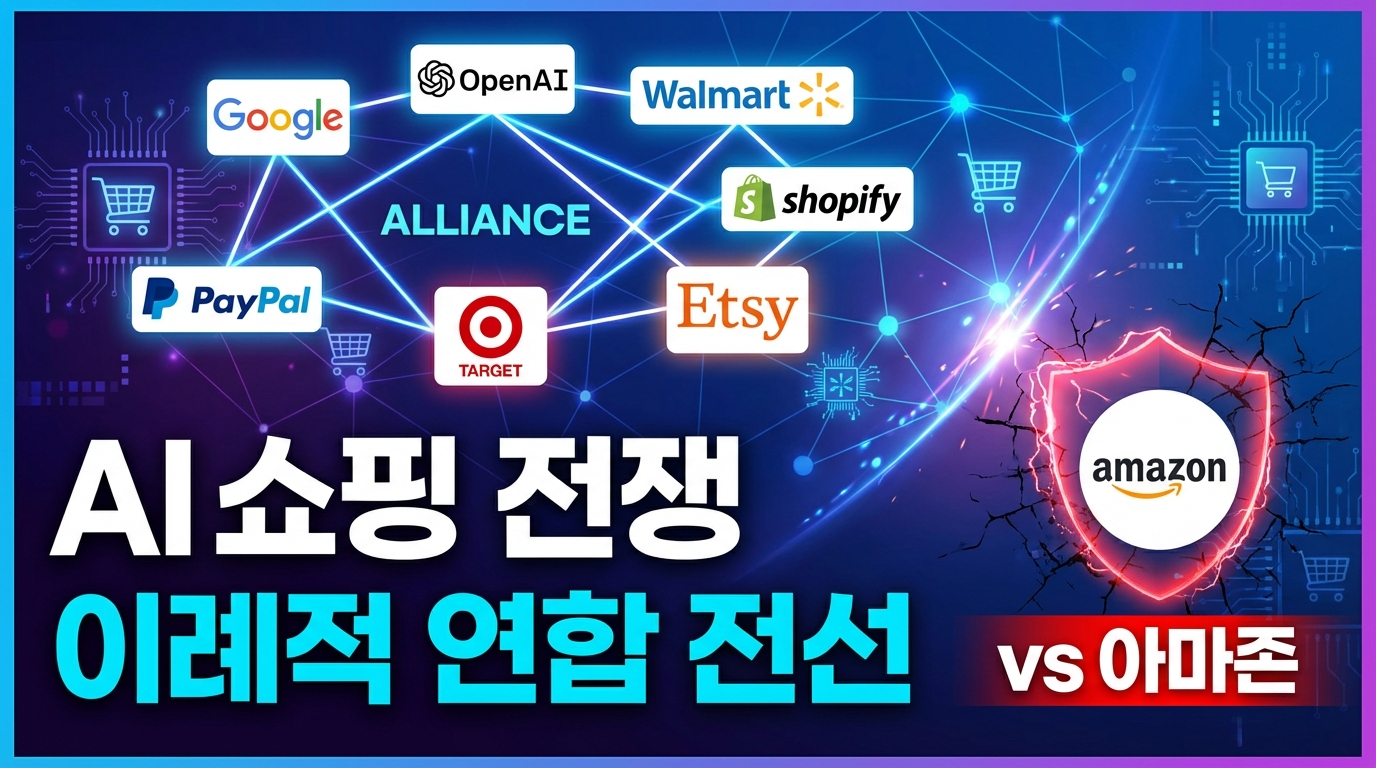
The most striking development in the AI shopping wars is major retailers listing their products directly on AI chatbot platforms.
Walmart operates a substantial advertising business that generated more than $4 billion in revenue in its most recent fiscal year. Target and Etsy also sell sponsored product promotions—essentially ads—on their own sites. These are retail powerhouses with their own advertising ecosystems.
Yet all three have recently partnered with ad behemoth Google to sell their goods through new checkouts in Google's Gemini chatbot and AI Mode search results. They've also joined forces with OpenAI, which is in the early stages of introducing ads into ChatGPT, making their products available to consumers through yet another AI channel.
The sight of major retailers—each operating their own ad platforms—listing products on Google's AI platform and an emerging AI startup would have been unthinkable just one or two years ago. This convergence signals that survival strategies against a common competitor are driving cooperation at an unprecedented level.
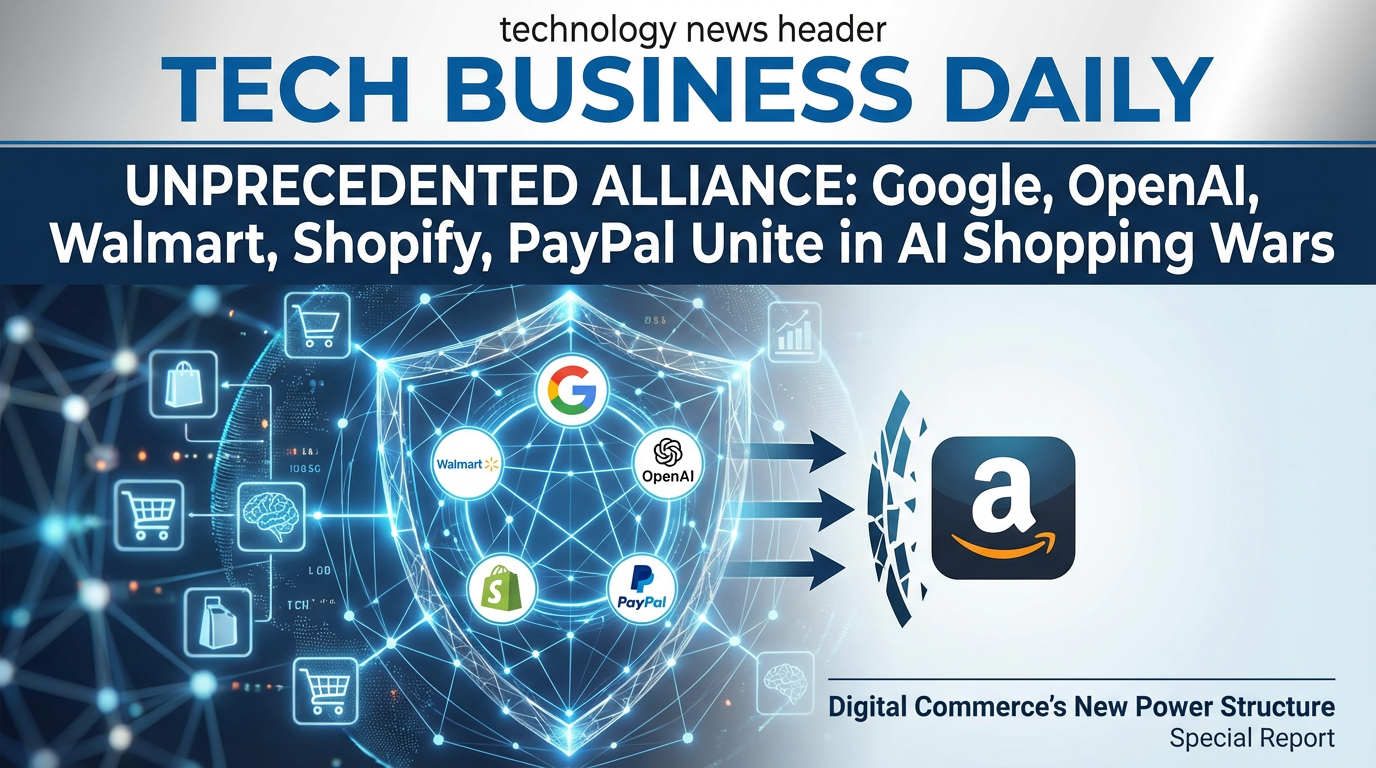
Shopify, which provides commerce software and payment services to millions of online shops, has built the most extensive partnership network in the AI shopping alliance. It has teamed up with virtually every major player except Amazon, Target, Walmart, and Etsy—companies that don't use Shopify's services and operate competing marketplaces for independent sellers.
Shopify's aggressive approach to AI shopping alliances is straightforward: when its merchants sell products through AI apps like ChatGPT or Gemini, Shopify takes a slice of those payments—in addition to whatever OpenAI charges. In fact, Shopify's payments business generates more revenue than its software subscriptions, though it operates at lower margins because Shopify passes a portion of that revenue on to payment processors.
However, Shopify faces a structural risk in the long run. If AI shopping becomes mainstream, consumers may visit individual online stores less frequently, which could undermine the very foundation of Shopify's core business: software for building online shops. As traditional retail websites become less important, Shopify's software business could come under pressure.
PayPal and Stripe have secured extensive partnerships across the AI commerce ecosystem, leveraging their large merchant networks and digital wallets that enable quick checkouts. PayPal, in particular, has announced AI commerce partnerships with every major retailer on the map except Amazon, with approximately 430 million total users who have stored payment information in PayPal wallets.
For now, these partnerships make sense for AI apps. They need goods to sell but lack an easy way to recruit merchants quickly themselves. Leveraging existing payment infrastructure like PayPal or Stripe allows AI chatbots to offer instant checkout capabilities.
However, over time, AI companies could develop more direct relationships with retailers and also build out their own payment capabilities, such as digital wallets. If that happens, payment processors' share of merchant sales would shrink. The value distribution within the AI shopping ecosystem is expected to shift over time.
AI Shopping Partnership Landscape
The following table summarizes the partnership dynamics among the ten key companies mapped by The Information.
* Reconstructed by K-EnterTech Hub based on The Information analysis
Amazon stands as the sole exception to the partnership approach. This aligns with Amazon's historical practice of maintaining tight control over key aspects of its retail business: pioneering one-click checkout to store payment information, building a $60 billion advertising business closely tied to its retail site, and developing massive proprietary logistics operations.
Amazon has blocked shopping bots and agents operated by OpenAI and Google from accessing its site. At the same time, Amazon has added automated features that let its shoppers buy products on other retailers' websites, and it operates its own chatbot on its retail platform.
An Amazon spokesperson stated: "We see significant opportunity to innovate and further improve the online shopping experience for customers as both an online store and agentic AI shopping assistant that shops other stores across the web."
The current cooperative structure is essentially a tactical alliance against a common enemy: Amazon. The Information notes that this alliance is likely to be reshuffled over time.
First, as AI companies develop their own payment capabilities (such as digital wallets), the fee share for existing payment processors like PayPal and Stripe will shrink. Second, if AI chatbots become consumers' primary shopping interface, traffic to traditional retail websites will decline, threatening Shopify's core software business. Third, if Amazon joins the AI shopping alliance through its OpenAI investment, the current "Amazon vs. everyone else" dynamic could completely dissolve.
Ultimately, once AI shopping begins to meaningfully change consumer behavior, today's cooperative relationships will likely evolve into 'frenemy' dynamics—simultaneously friends and rivals. Each company will move aggressively to maximize its share of the AI shopping value chain.
The partnership reshuffling in the AI shopping ecosystem carries direct implications for media and entertainment industries.
Rise of AI Retail Advertising and Content Monetization: As OpenAI introduces ads to ChatGPT and Google integrates shopping into AI Mode search results, AI platforms are emerging as new advertising media. This is a crucial reference case for K-content companies pursuing FAST (Free Ad-Supported Streaming TV) channel strategies. The AI shopping ad model is likely to expand into AI content recommendation and advertising models.
Platform Dependency and Distribution Diversification: Just as retailers are listing products on Google and OpenAI to avoid Amazon dependency, K-content companies need strategies that go beyond Netflix or YouTube dependency to proactively secure AI-based content discovery and distribution channels.
Convergence of Commerce and Content: AI chatbots becoming shopping channels also means the same technology can handle subscriptions, PPV, and merchandising as one-stop experiences. The scenario of K-pop merchandise, K-beauty products, and K-drama goods being sold globally through AI chatbots is no longer a distant future.
Original Source: The Information, "In AI Shopping Wars, Rivals Team Up to Take On Amazon" (Ann Gehan, Feb 1, 2026)
Original URL: theinformation.com/articles/ai-shopping-wars-rivals-team-take-amazon
This article has been reconstructed and analyzed by K-EnterTech Hub for global readers based on the original report.
© 2026 K-EnterTech Hub. All rights reserved.
www.kentertechhub.com


![[SXSW 2026]AI 파일럿 95%는 왜 실패하는가: '성공하는 AI 시스템의 7가지 패턴'](https://cdn.media.bluedot.so/bluedot.kentertechhub/2026/03/9wheq7_202603201341.png)
![[투비]The Stream 2026: When Intention Becomes Attention](https://cdn.media.bluedot.so/bluedot.kentertechhub/2026/03/6h3xe4_202603220154.png)
![[SXSW2026]에이미 웹 트렌드 리포트(Convergence
Outlook 2026)](https://cdn.media.bluedot.so/bluedot.kentertechhub/2026/03/kty3s8_202603152312.png)


![[보고서]전통 언론사의 크리에이터 전략 대전환](https://cdn.media.bluedot.so/bluedot.kentertechhub/2026/02/0nwc9z_202602100212.png)