
손님은 떠났다. 청구서는 남았다:오픈AI가 할리우드를 떠난 뒤 — 무엇이 바뀌었고 무엇이 남았나
by
2026년 3월 25일
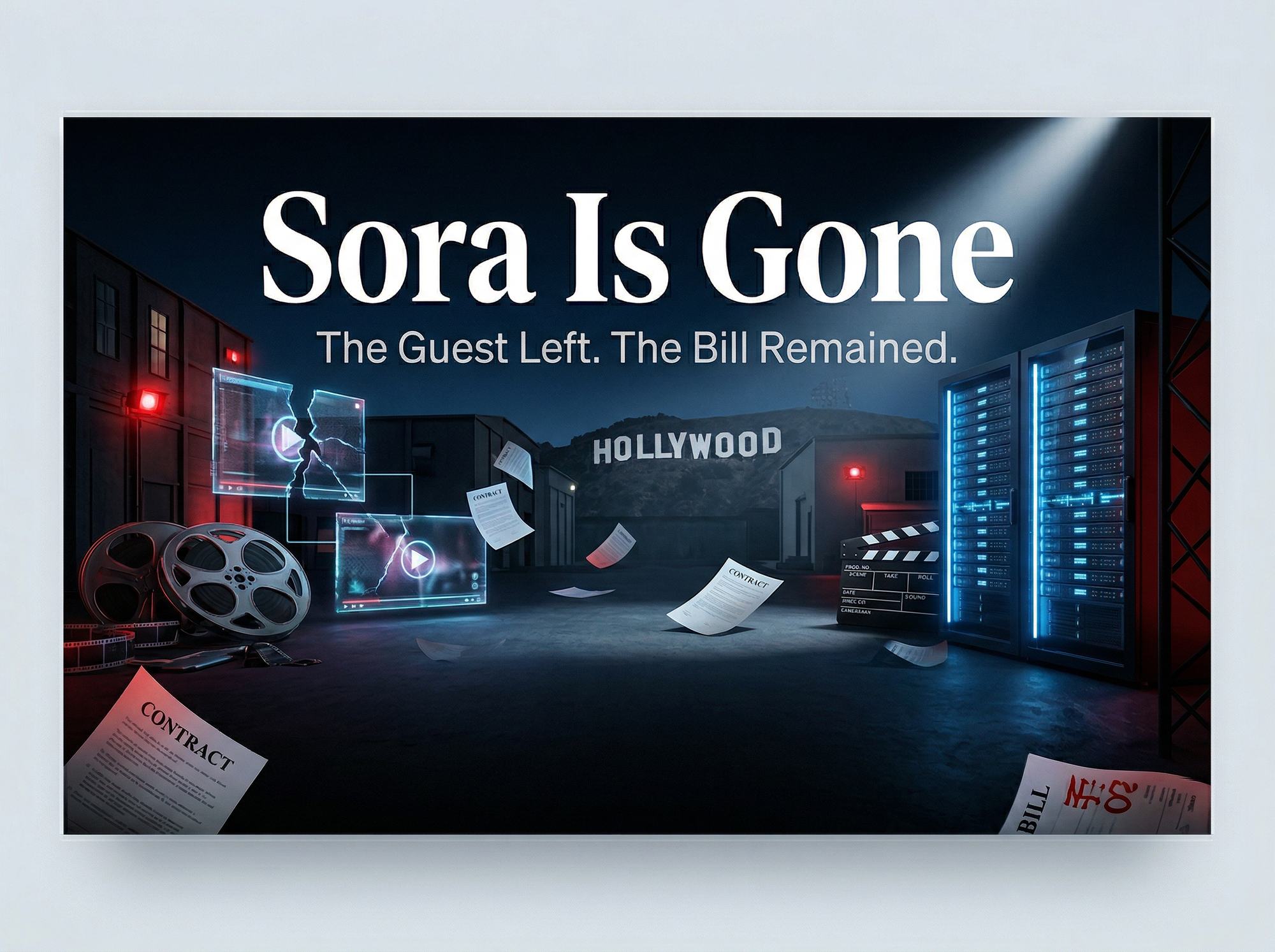
How the Mouse House Is Rewriting Streaming's Playbook with a Two-Track Strategy of Partnership and Legal Warfare
December 11, 2024 — The Walt Disney Company is reshaping the landscape of the AI era with a bold double-edged strategy. On December 11, Disney announced a $1 billion investment in OpenAI, granting exclusive access to over 200 iconic characters to OpenAI's video generation AI "Sora" for three years. Mickey Mouse, Elsa, Iron Man, and Darth Vader will now be reborn at AI's fingertips.
On the same day, Disney sent Google a stark message: "Remove all Disney content generated by AI from YouTube." While opening its vault to contracted partners, Disney is drawing legal lines against companies that use its IP without permission—a sophisticated two-track strategy of collaboration and confrontation.
The rules of the streaming wars are changing. As subscriber growth at Netflix, Disney+, Max, and Amazon Prime Video plateaus, the industry's focus has shifted from "acquiring new subscribers" to "maximizing loyalty and spending from existing subscribers." Enter the superfan strategy—securing passionate fans who deeply engage with brands, actively participate, and willingly open their wallets has become the key to survival.
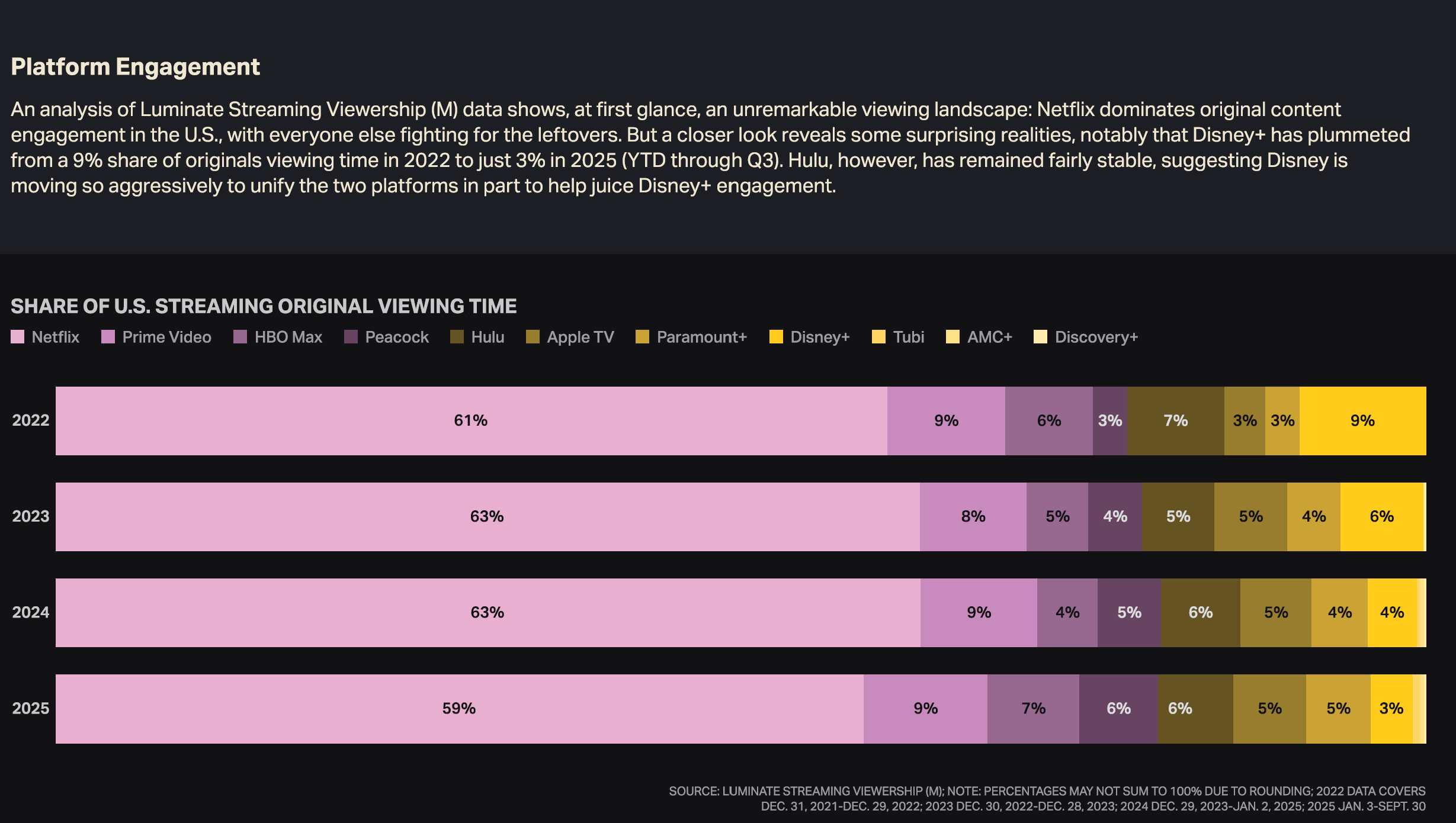
Disney+ is sounding the alarm. According to data analytics firm Luminate, Disney+'s share of original content viewing time in the U.S. has plummeted from 9% in 2022 to just 3% in 2025 (YTD)—the steepest decline among major paid platforms. Original series viewing time has nearly halved from 44.3 billion minutes in 2022 to 20.2 billion minutes in 2025.
Experts attribute this decline to Disney+'s reduced original production and franchise consolidation strategy. As major franchises like Avengers and Star Wars face delayed or postponed production, superfan enthusiasm is rapidly cooling.
So how do you transform viewers into superfans? Disney's answer is clear: AI.
Disney CEO Bob Iger described this deal in a CNBC interview as "an opportunity to participate in truly breathtaking growth." This isn't just a tech partnership—it's a strategic declaration of where Disney intends to position itself in the AI era.
This marks the first time Disney has licensed its IP to an AI company. Starting in early 2026, Sora and ChatGPT Images will be able to generate short videos and images featuring Disney characters. With just a few prompts, users will create content featuring Disney characters in seconds.
Disney's licensing scope is remarkably broad, covering "masked characters, animated characters, and creature characters" from Disney, Pixar, Marvel, and Star Wars, along with costumes, props, vehicles, and iconic backgrounds.
Included Characters (partial list):
What's Excluded:
The clause stating "Disney IP cannot be used for AI model training" is particularly noteworthy. Even after the three-year contract expires, this prevents the AI from "remembering" Disney's style and creating similar characters—a preemptive safeguard.
Disney's superfan strategy is now ramping up. Through its partnership with OpenAI, Disney+ will curate AI-generated content from Sora within its streaming platform. The vision is to equip users with tools to create content directly and share it within fan communities, evolving streaming into a participatory platform.
Iger previewed this in a recent earnings call: "AI will provide Disney+ users with much more immersive experiences, including features where users can create their own content and consume short-form content created by other users." This signals a shift from traditional viewing-centric streaming to an interactive platform combining participation and creation. TikTok-generation superfans will be able to create and share videos using Disney characters, opening a new era of fandom culture.
Another dimension of this deal is integration with Disney+. Disney+ users will be able to stream curated Disney character videos generated by Sora. OpenAI and Disney also plan to jointly develop "new experiences for Disney+ subscribers."
Iger hinted at this last month during an earnings call: "AI will enable us to provide Disney+ users with far more immersive experiences—including features where users can create their own content and consume short-form content made by others." This heralds a transformation from traditional viewing-only streaming to an interactive platform blending participation and creation. A new fandom culture where the TikTok generation creates and shares videos featuring Disney characters is on the horizon.
Disney's dual strategy became crystal clear in its letter to Google on the same day. Disney accused Google's AI platforms of "massively" infringing Disney IP copyrights and demanded removal of all related content from YouTube and YouTube Shorts.
This isn't Disney's first rodeo. Disney has already sent similar legal warnings to Meta and Character.AI. Going further, Disney has joined forces with NBCUniversal and Warner Bros. Discovery to sue AI companies Midjourney and Minimax for copyright infringement.
The message is unmistakable: Disney will open its IP vault to partners who sign formal licensing agreements and pay fair compensation, but companies that use content for unauthorized training will face courtroom battles.
For OpenAI, this deal is a crucial milestone. As generative AI copyright controversies escalate globally, securing an official licensing agreement with the world's largest IP holder validates the legitimacy of its business model.
OpenAI CEO Sam Altman stated: "Disney is the global standard for storytelling. This agreement demonstrates how AI companies and creative leaders can collaborate responsibly."
OpenAI's Sora has been viewed with caution in Hollywood since its September launch. The opt-out model of Sora2—requiring IP owners to proactively request exclusion of their work—sparked controversy. Last month, the Content Overseas Distribution Association (CODA), which includes Studio Ghibli, sent OpenAI a letter demanding: "Stop using our content for Sora2 training."
Against this backdrop, the official partnership with Disney gives OpenAI powerful ammunition to claim: "We operate legally."
As part of this deal, Disney will invest $1 billion (approximately ₩1.4 trillion) in equity in OpenAI and secure warrants for additional share purchases. Both companies stated the investment is subject to final contract negotiations, board approval, and customary closing conditions. However, at OpenAI's current $500 billion valuation, Disney's $1 billion represents a relatively modest stake.
Disney CEO Bob Iger told CNBC: "This OpenAI deal provides an opportunity to participate in truly remarkable growth."
For Bob Iger, this investment is a significant strategic move as he approaches retirement. Early in his tenure, he built Disney's content empire through IP-centric mega-acquisitions: Pixar (2006), Marvel (2009), and Lucasfilm (2012). Now he's pivoting toward strategic investments in tech companies.
Following last year's $1.5 billion investment in Epic Games, this OpenAI investment continues the trend. During his "final" tenure, Iger appears determined to reposition Disney for the AI era. While Disney's $1 billion is a small fraction of OpenAI's $500 billion valuation, securing additional purchase warrants signals the long-term partnership nature of this deal.
The Disney-OpenAI partnership is undoubtedly reshaping the global content industry landscape. This isn't merely a technology collaboration—it establishes new standards for intellectual property (IP) strategy in the AI era. These changes pose critical questions for Korean content companies.
First: AI-Era IP Utilization Strategy
Disney formally licenses its own content to OpenAI while establishing new revenue models. Simultaneously, it includes "AI model training prohibition" clauses to ensure robust IP protection. K-content—including BTS, Blackpink, and Squid Game—also needs concrete strategies for how to utilize and protect global IP on AI platforms.
Second: Securing Negotiating Power
Disney didn't just provide IP—it secured equity investment and warrants from OpenAI, establishing itself as a strategic partner rather than a mere supplier. With K-content's rising global prominence, now is the golden opportunity to build equal partnership models.
Third: Licensing Scope and Contract Structure Design
Like Disney's approach, contract terms should include structural safeguards such as AI model training prohibitions and usage period limitations to preserve IP's future value. A strategic approach prioritizing long-term IP ecosystem sustainability over short-term revenue is essential.
Disney's current actions demonstrate "sophisticated balance between collaboration and confrontation." The $1 billion investment, three-year limited license, actor likeness exclusions, AI learning prohibition clauses—every detail reflects meticulous calculation. As Iger stated, "The rapid advancement of AI represents a critical moment for our industry."
At this juncture when AI is restructuring global content industry dynamics, K-content companies need neither vague fear of technology nor unconditional acceptance. What's required is strategic acumen to clearly recognize their IP value and negotiate on equal footing with AI companies. How will Korean content companies respond to Disney's challenge?
Alongside major deals like Disney-OpenAI, the AI startup market is entering a correction phase. The "multiple"—valuing companies at multiples of their revenue—serves as the industry's thermometer.
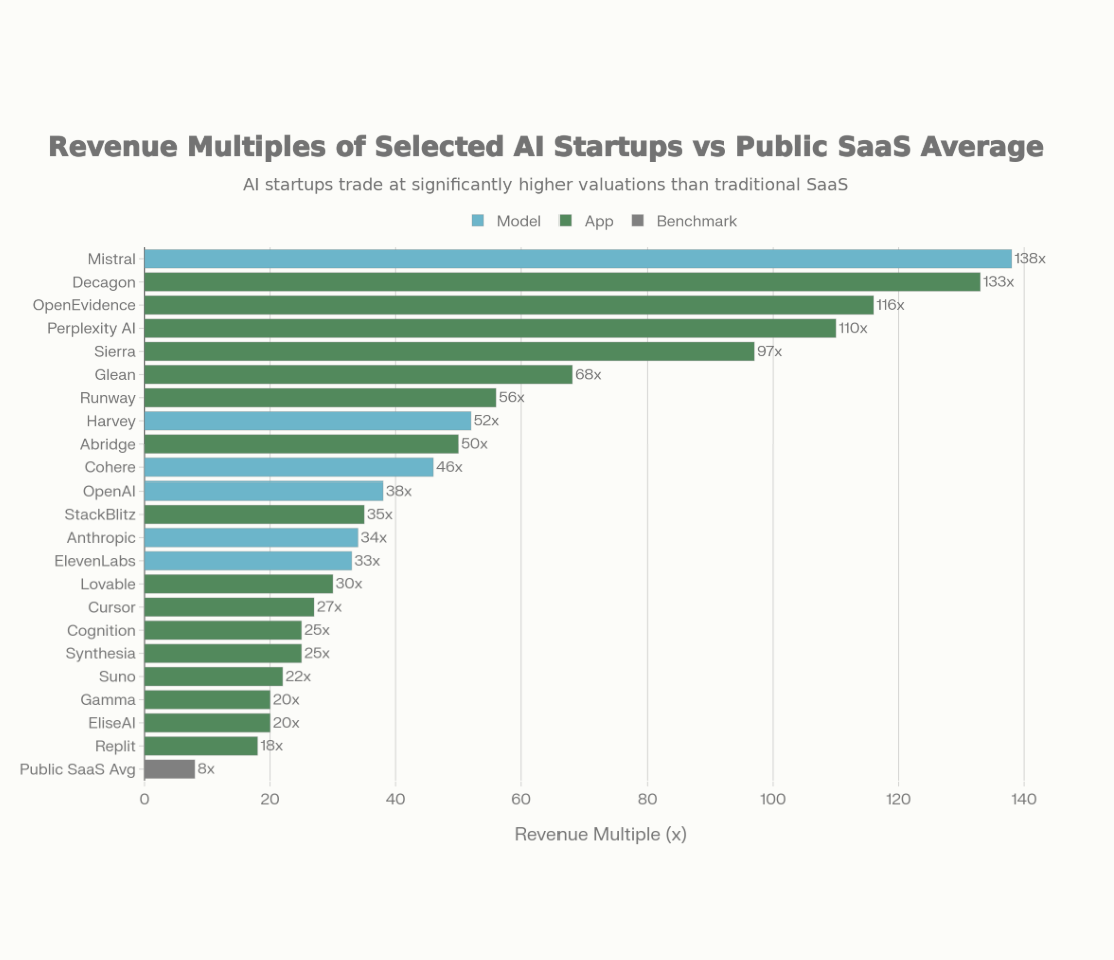
According to The Information, major AI model developers like OpenAI and Anthropic currently average around 36x multiples. This represents approximately 30% decline from February's 51x, showing the market is gradually shifting toward realistic valuations. Public software companies average only 8x multiples. Meanwhile, early-stage AI startups led by prominent founders still receive investments at 100x+ multiples, deepening polarization within the AI investment ecosystem.
Despite cool corrections, AI market momentum remains strong. As technological innovation reshapes content industry value chains, both investors and content companies need "strategy over hype."
Sources:
![[투비]The Stream 2026: When Intention Becomes Attention](https://cdn.media.bluedot.so/bluedot.kentertechhub/2026/03/6h3xe4_202603220154.png)
![[SXSW2026]에이미 웹 트렌드 리포트(Convergence
Outlook 2026)](https://cdn.media.bluedot.so/bluedot.kentertechhub/2026/03/kty3s8_202603152312.png)
![[보고서]전통 언론사의 크리에이터 전략 대전환](https://cdn.media.bluedot.so/bluedot.kentertechhub/2026/02/0nwc9z_202602100212.png)