슈퍼팬이 스트리밍을 다시 쓴다...NBCU 피콕(Peacock), 2년 AI 실험 끝에 '팬덤 플랫폼' 전면 선언
by
2026년 3월 14일
Integrated Workflow Platform Emerges for Generative AI Filmmaking Era... Mounting Pressure on K-Content Production Paradigm Shift
Artificial intelligence is shaking up video production. The startup MITO AI is rolling out a new platform to help filmmakers storyboard, organize, and generate AI assets in one place. It's a project management tool for the era of generative AI filmmaking. The company exclusively told Business Insider that it had raised $4.5 million in a pre-seed round led by Lightspeed Venture Partners. It's launching its product on Thursday after testing with about 200 beta partners.
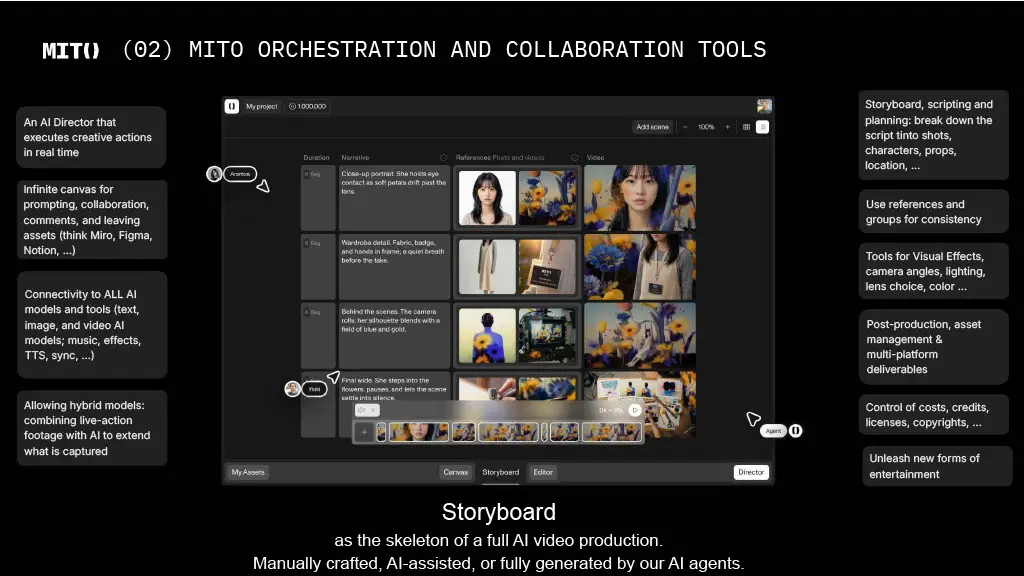
MITO cofounder Iñaki Berenguer said, 'Our tools are connected to video models, image models, audio models, and voice models, and then everything is brought together into our infinite canvas for collaboration and experimentation.'
 Jung Han
While many AI video generators, such as OpenAI's Sora or Google's Veo, are limited to short-form clips, MITO wants to help creators piece together short AI assets into a longer project. It also offers collaborative features, such as commenting. MITO users can create new AI assets that align with their film's style via integrations with platforms including Runway, Veo 3, ComfyUI, and Pika. Beyond its workflow platform, the startup also makes AI content for partners via its studio team.
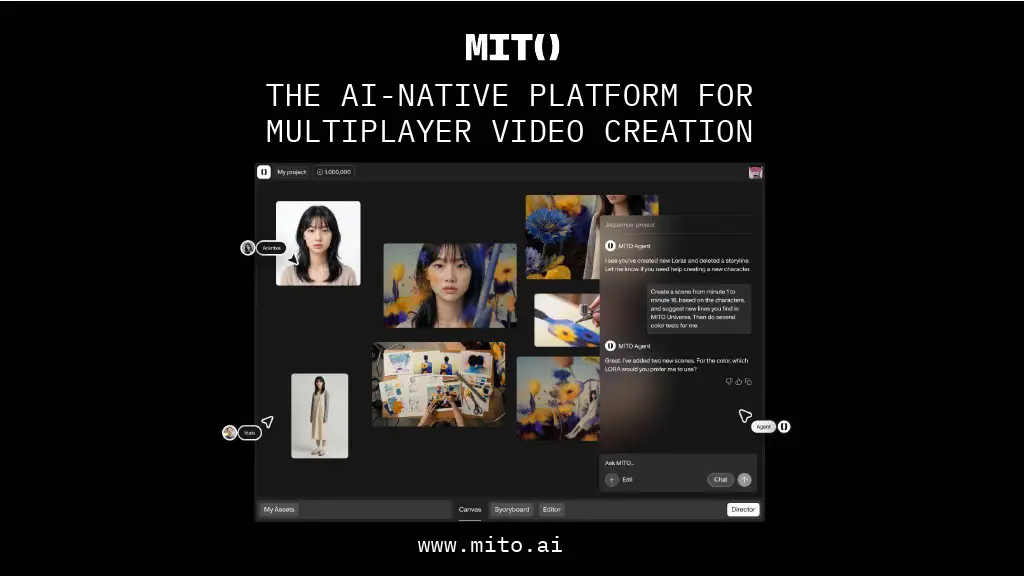
MITO arrives at a moment of flux in the media industry. Hollywood and advertising executives are testing AI tools for digital effects and commercials. Independent creators are using the tech to spruce up their videos without breaking the bank. Actors, animators, and other creatives, meanwhile, are raising eyebrows at the technology that some fear could wipe out jobs. The AI production market is fiercely competitive. It's dominated by incumbents like Adobe, with new upstarts like FLORA—which recently raised a $42 million funding round led by Redpoint Ventures—also entering the market.
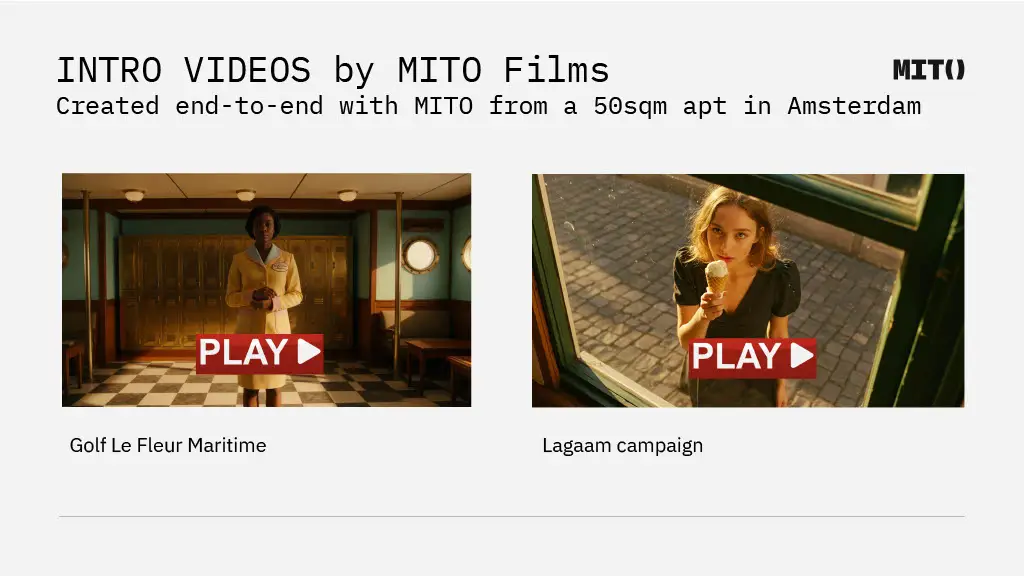
MITO Films: An AI-native studio currently working with global brands and production companies. The team has delivered multiple real brand campaigns and music videos, including 50 Cent's '21 Questions' and the Willy Chavarria campaign. The company states it operates the studio 'to eat our own dog food, generate revenue, and market what's possible.'
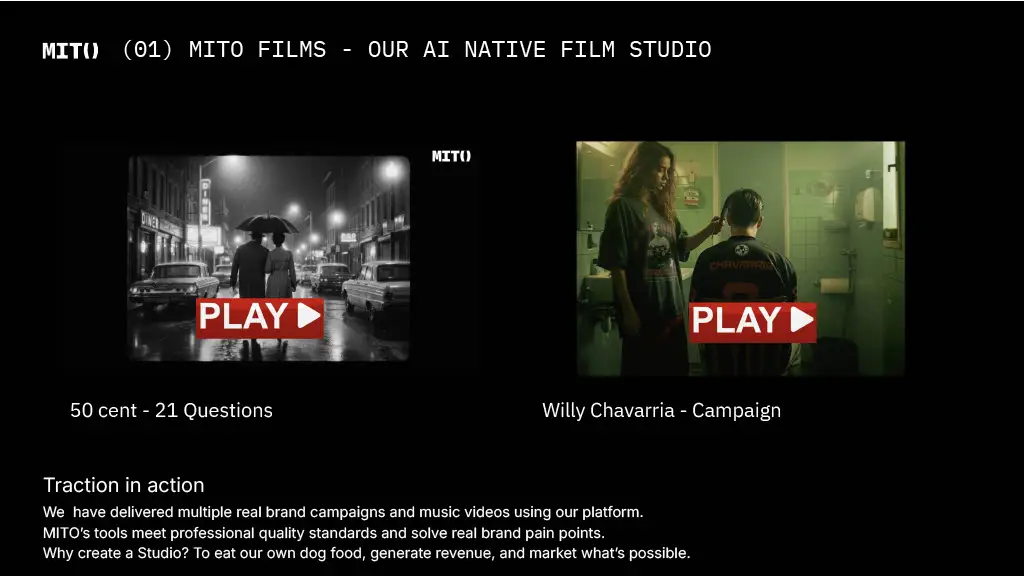
MITO Orchestration Tools:
MITO Orchestration Tools is an AI-native video production environment for creators—an 'AI Copilot + Infinite Canvas' platform built on top of your favorite AI models. Users can handle prompt writing, collaboration, commenting, and asset organization all in one place on a browser-based infinite canvas reminiscent of Miro, Figma, and Notion, while directing an AI Director to execute creative actions like storyboarding, editing, and asset generation in real time.
The canvas can connect not only text, image, and video generation models but also various AI tools for music, sound effects, TTS, and sync, and supports hybrid production combining live-action footage with AI-generated video. It breaks down scenarios into shots, characters, props, and locations for use in storyboards, scripts, and planning, maintains style and tone consistency through reference images and grouping functions, and allows adjustment of camera angles, lighting, lenses, color, and VFX settings all within the same workflow.
In post-production, it supports asset management and multi-platform version creation, tracking project-specific costs, credits, licenses, and copyright status for production management with commercial distribution in mind. Overall, MITO is not a 'single AI video generator' but rather an integrated creative and collaborative infrastructure that orchestrates multiple AI tools and live-action workflows for real-time team collaboration, experimentation, and version control.
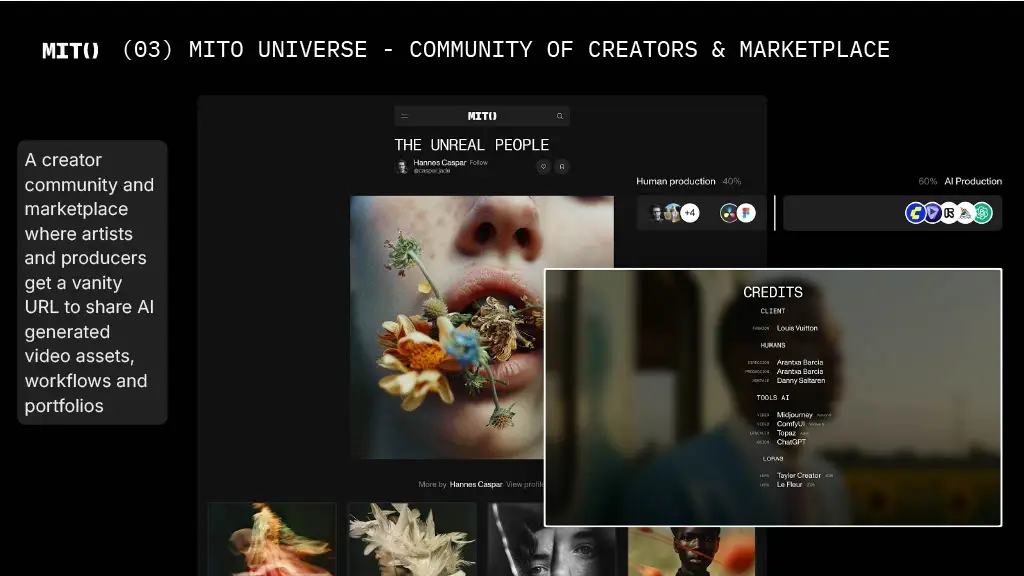
MITO Universe:
MITO Universe is a creator community and marketplace designed to let artists and producers showcase their AI-based creative worlds. Users receive individual vanity URLs to display and share AI-generated video assets, work workflows, and completed portfolios all at once, building 'case study-style portfolios' that show not just final outputs but also the models, tools, and processes used. These published works form a curated community within the MITO ecosystem, serving as a marketplace where creators can reference each other's styles and pipelines or meet collaboration partners and clients.
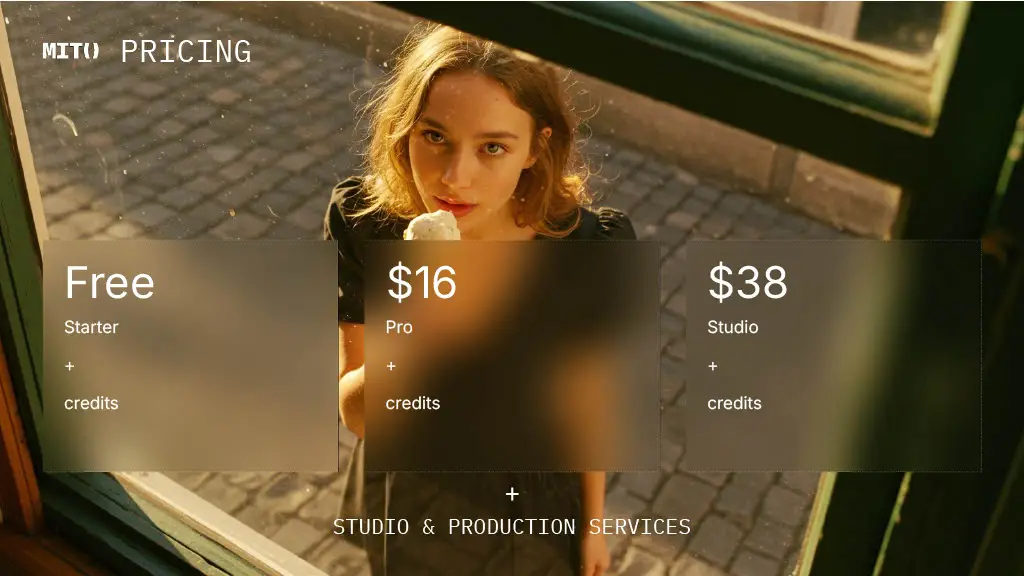
MITO operates a three-tier pricing structure: a Free tier, a $16/month Pro tier, and a $38/month Studio tier. Additional costs in the form of 'credits' are charged based on AI content generation frequency.
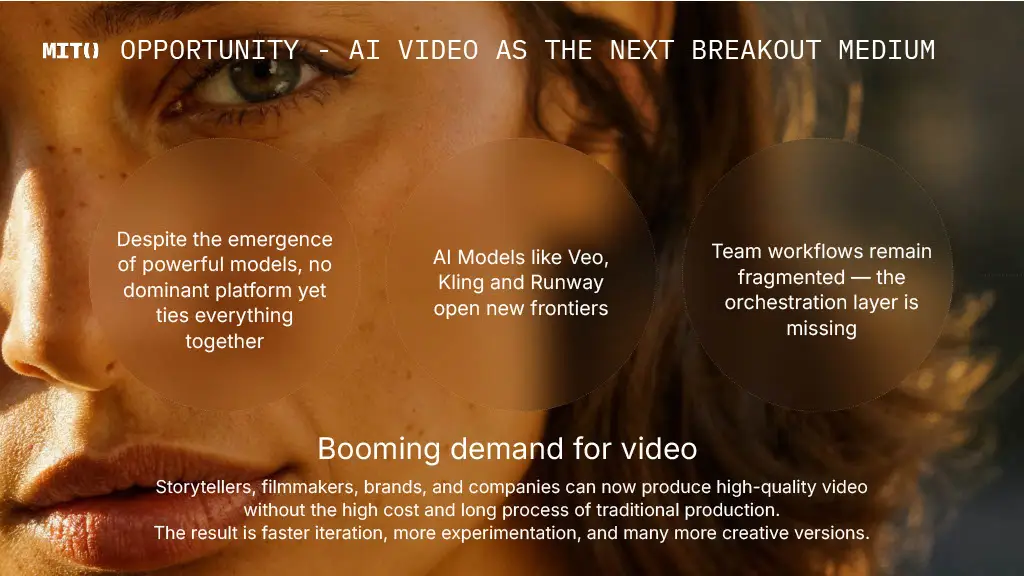
Despite the emergence of powerful generative video models, no dominant platform yet ties everything together into a single working environment. Models like Google's Veo, China's Kling, and Runway are opening new possibilities, but team workflows in actual production settings remain fragmented, with the orchestration layer that ties multiple tools together still missing.
Meanwhile, demand is exploding. Storytellers, filmmakers, brands, and companies can now produce high-quality video without the high cost and long process of traditional production. The result is faster iteration, more experimentation, and many more creative versions.
The global brand market requiring 30-second to 5-minute videos alone is estimated at over $100 billion, with approximately 80,000 brands currently spending at least $100,000 per year on video. As AI lowers the cost per video, a 'professional video production boom' will accelerate—with 10x more brands producing 10x more content per brand at lower costs.
MITO is targeting this gap. The company started from the recognition that 'powerful new AI video models are transforming massive existing categories while simultaneously opening entirely new ones,' with a Q1 2026 launch target and the slogan 'Unleashing video creativity & myth-making in the age of AI.'
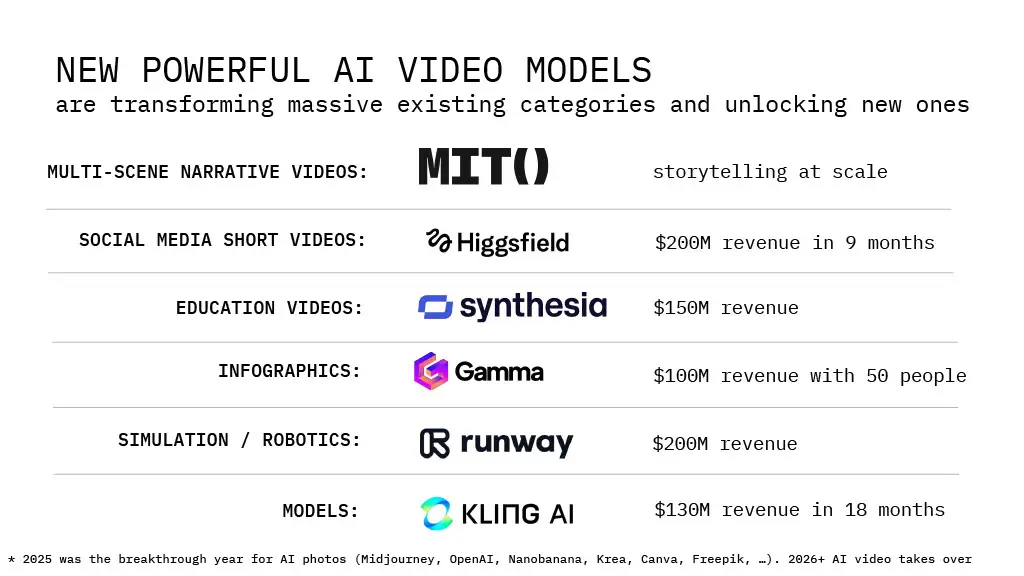
Pressure to Innovate Production Costs and Timelines
MITO's vision of '10x more videos at lower costs' serves as both powerful pressure and opportunity for Korean drama, film, and music video production companies already competing head-to-head with global OTTs. By adopting integrated AI workflows across pre-production (planning, storyboarding), VFX, and version delivery, simultaneous reduction in production costs and lead times becomes possible, potentially serving as infrastructure supporting K-Content's distinctive production strategy of high-variety, small-batch, high-frequency content creation.
Upgrade Opportunities for Independent Creators and MCNs
MITO's three-tier subscription model (free, $16/month, $38/month) offers lower entry costs compared to Adobe's toolchain and the ability to orchestrate multiple AI models at once, making it a realistic alternative for YouTube and TikTok-based Korean solo creators and small-to-medium MCNs. Once 'professional studio-grade pipelines' become directly accessible in the browser, the gap with major studios in format competition narrows, and creator/fandom-centered K-Content experimentation is likely to increase significantly.
K-POP Music Video Production Paradigm Shift
MITO's involvement in producing AI-powered music videos for global hip-hop artist 50 Cent sends a direct signal to K-POP agencies as well. SM, JYP, HYBE, and YG are already combining in-house R&D with external tool utilization, and there's a high likelihood of actively adopting AI-based production for certain concepts and versions (teasers, fan-exclusive clips, performance visualizers, etc.) going forward. However, rather than 'fully AI main titles,' hybrid strategies combining AI with live-action footage and version diversification are likely to be central.
Reorganization of Advertising and Branded Content Markets
The '80,000 global brands spending over $100,000 annually on video production' that MITO targets includes Korean conglomerates like Samsung, LG, Hyundai, and Kia, as well as major domestic advertisers. As brands and in-house marketing teams directly utilize orchestration tools like MITO and FLORA, the role of existing Korean advertising agencies and production houses is likely to shift from 'full production outsourcing' toward strategy, creative direction, and IP management.
Workforce Restructuring and Job Transition Issues
As with the Hollywood case, concerns about job structure changes for actors, animators, CG/VFX artists, motion graphics designers, and editors will inevitably be raised in Korea as well. Simple repetitive tasks and low-value-added areas will be replaced by AI tools, making job redefinition inevitable in the direction of increasing emphasis on pipeline design, prompt engineering, supervision, and creative direction capabilities. Proactive discussion of guidelines and retraining programs at the level of film industry associations, animation academia, and labor unions is needed.
Opportunities for Korean 'Orchestration Layer' Startups
MITO's $4.5 million pre-seed and competitor FLORA's $42 million Series A demonstrate that global capital is rapidly flowing into AI video orchestration tools. For Korean startups, opportunities have opened to develop local orchestration layers optimized for Korean language and K-Drama/K-POP production practices, or creative tools integrated with the Naver and Kakao ecosystems. Products that understand K-Content's distinctive formats (variety shows, music broadcasts, fan-participatory live content) could become differentiation points against global competitors.
Proactive Policy and Regulatory Response Challenges
The commercialization of AI video production simultaneously raises issues of copyright, performance rights, training data, and credit/revenue distribution. The Ministry of Culture, Sports and Tourism, Korean Film Council, and Korea Creative Content Agency need to urgently prepare comprehensive roadmaps including the legal status and labeling requirements for AI-generated video, guidelines for source IP and data usage, and retraining and transition support programs for small production companies and freelancers. Through this, guiding the ripple effects of global tools like MITO and FLORA toward 'restructuring and advancement' rather than 'de-industrialization' will be a core challenge for Korean content industry policy.
─────────────────────────────────────────
Original: Business Insider, Dan Whateley | Korea Impact Analysis: K-EnterTech Hub



![[SXSW2026]에이미 웹 트렌드 리포트(Convergence
Outlook 2026)](https://cdn.media.bluedot.so/bluedot.kentertechhub/2026/03/kty3s8_202603152312.png)

![[보고서]전통 언론사의 크리에이터 전략 대전환](https://cdn.media.bluedot.so/bluedot.kentertechhub/2026/02/0nwc9z_202602100212.png)