

Warner Music Group Acquires Revelator, a B2B Independent Music Platform
WMG fires back at UMG's Downtown acquisition — the three-way war for the artist services platform market has officially begun
Warner Music Group (WMG) officially announced Wednesday morning, April 1, 2026, that it will acquire Revelator, the independent B2B music platform. The deal reflects the record industry's accelerating structural shift toward serving independent artists — and arrives just as Universal Music Group (UMG) has moved to acquire Downtown, a platform playing a comparable role. The acquisition makes WMG a significantly stronger competitor in the rapidly expanding independent music distribution market. Financial terms were not disclosed. The transaction is subject to customary closing conditions and is expected to close in Q2 2026.
 Jung Han
What Is Revelator? A Cloud-Native, Full-Stack Music OS
Founded in 2012, Revelator is a cloud-based, full-stack B2B platform built for independent labels, artists, and distributors. Designed not merely as a distribution conduit but as an integrated operating system for music businesses, it currently serves hundreds of global clients spanning content delivery, contract administration, financial accounting, and real-time data analytics — all within a single environment.
Its core services span four domains. Digital Music Distribution connects clients to all major global DSPs — Spotify, Apple Music, YouTube Music — as well as regional platforms. Rights Management centralizes metadata, ownership records, and licensing terms to prevent rights conflicts. Royalty Accounting automates complex multi-territory revenue splits and tiered percentage structures. Real-Time Analytics delivers streaming figures, revenue flows, and per-platform performance through intuitive dashboards.
The platform's flagship products are Revelator Pro, an all-in-one operating suite for labels and distributors; Revelator API, enabling flexible integration with existing systems; and White Label Solutions, which allow other distributors and labels to deploy Revelator's full technical infrastructure under their own brand — building a proprietary distribution platform without bespoke development. This B2B model gives Revelator a distinctive competitive moat.
Why Revelator, Why Now — WMG's Long-Game Strategy
WMG's move is rooted in a strategic imperative that goes beyond a simple technology purchase. WMG has long operated ADA (Alternative Distribution Alliance), a dedicated independent distribution subsidiary with decades of accumulated operational expertise. Yet as the industry has reorganized itself around streaming, the competitive advantage of a distribution network alone has been eroding. The ability to process data at scale, automate royalty settlements, and manage rights in real time has become equally critical.
WMG CEO Robert Kyncl signaled from 2025 onward a clear ambition to build out artist services capabilities — moving beyond a traditional label model toward a more scalable service platform. That intent was visible as early as 2024, when WMG actively explored acquiring French digital distributor Believe before stepping back. The Believe episode made unmistakably clear that WMG had identified 'global digital distribution plus data platform' as a strategic priority. Revelator is the answer.
More broadly, the acquisition signals WMG's intent to evolve from a content company into a platform operator. Revelator's White Label solution and API-first architecture open the door for WMG to extend its B2B services beyond its own labels to external distributors, indie publishers, and the creator economy — directly addressing a structural gap relative to UMG and Sony Music.
Downtown's Blueprint: The $775M Validation That Changed the Game
To fully appreciate WMG's move, one must first understand the strategic template laid down by Downtown. Downtown was the first large-scale company to put most of its resources into artist services — providing infrastructure and solutions rather than holding rights. At the time, this was unconventional. In retrospect, it was the most prescient read of where the industry was heading.
Downtown once held a substantial publishing catalog spanning Beyoncé, Jay-Z, Lady Gaga, Stevie Wonder, Marvin Gaye, Mötley Crüe, New Order, and Booker T. & the MGs. Yet roughly five years ago, the company divested that entire portfolio, selling it to Concord in a blockbuster $300 million deal, then channeled the proceeds back into building out its artist services platform and technology infrastructure.
That bet paid off spectacularly. UMG acquired Downtown for $775 million, cementing the deal as the event that placed artist services platforms at the center of the industry's competitive map — albeit after more than a year of EU antitrust review given the transaction's scale.
WMG's Revelator deal is assessed as leaner and more agile. Revelator is smaller and technology-centric rather than publishing-asset-heavy, limiting regulatory exposure. And because royalty accounting, rights management, and analytics are fully operational at close, the path to synergy is direct. WMG is executing a condensed version of UMG's playbook — and doing it fast.
The Structural Shift: Why Artist Services Are the New Battlefield
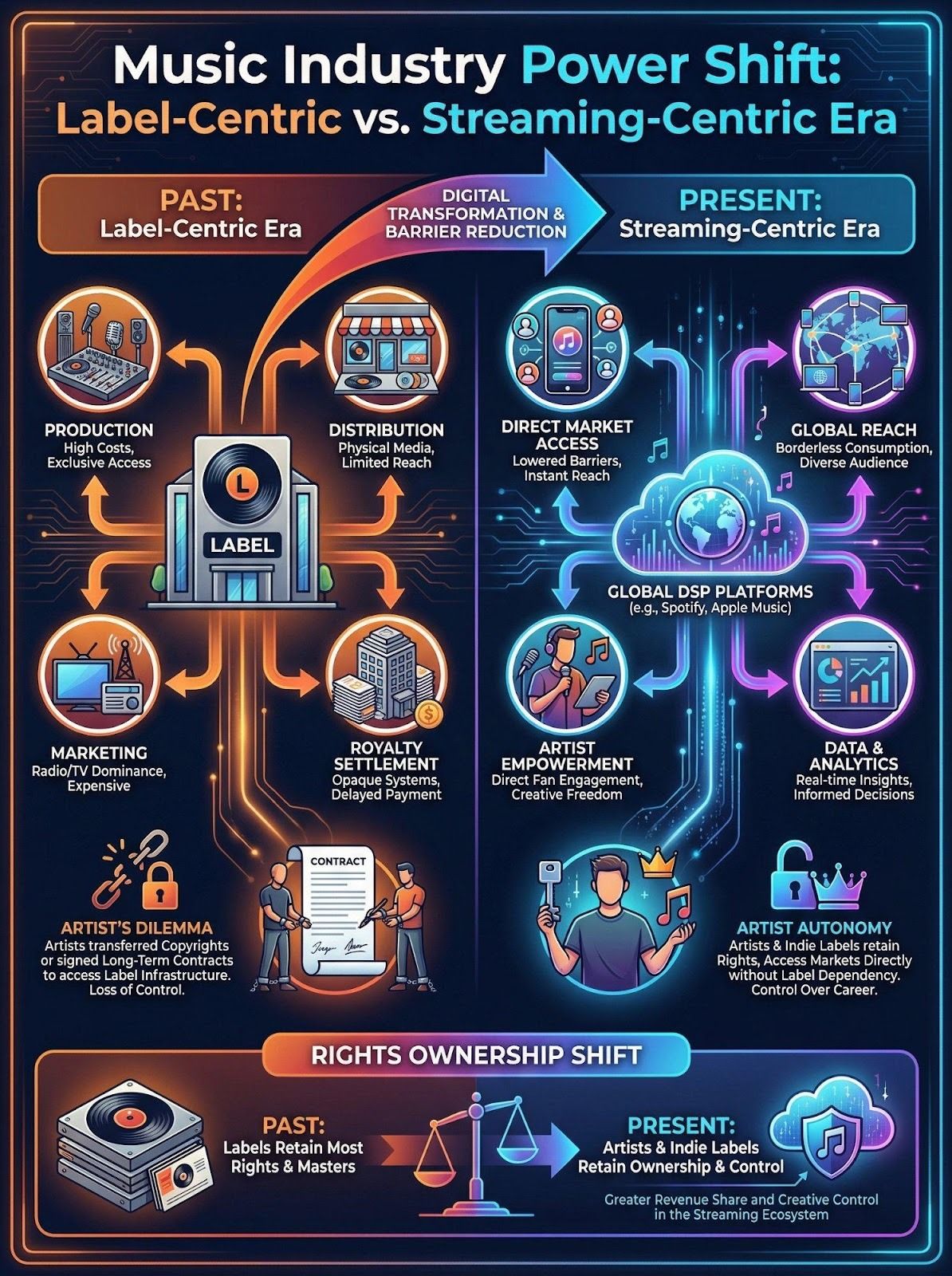
Music Industry Power Shift: Label-Centric vs. Streaming-Centric Era
The rise of streaming has fundamentally reorganized the music industry's power dynamics. Under the physical-media model, record labels controlled virtually the entire value chain — production, distribution, marketing, royalty settlement — and artists typically surrendered rights through long-term contracts to gain access to that infrastructure.
Digital transformation has dismantled that structure. As barriers to content production and distribution have fallen and global DSPs have standardized audience access, artists can now go to market without a major label. The most consequential consequence of this shift is the migration of rights ownership. An expanding cohort of artists and indie labels is actively choosing to retain their master and publishing rights — a trend that has moved from novelty to structural norm.
But owning rights is not the same as efficiently monetizing them. Global distribution, complex multi-territory royalty settlement, licensing management, and performance analytics still demand high levels of technical expertise and infrastructure. The result: explosive demand for label-quality services without a label contract. Artists want autonomy and infrastructure simultaneously.
This has forced a rethink of the major label value proposition. The traditional 'lock-in' model is giving way to a service platform model in which artists opt in not because they must, but because the tools are genuinely superior. Real-time data, transparent royalty accounting, precise rights management, and global distribution reach — delivered through a platform the artist controls — are becoming the new competitive currency.
The Three-Way Race: UMG, WMG, and Sony Music
The competitive landscape among the three global majors has now sharpened considerably. UMG moved first, acquiring Downtown to build a comprehensive artist services infrastructure spanning publishing administration, distribution, and management. WMG is answering with Revelator — merging ADA's distribution network with a cutting-edge B2B technology stack. Sony Music has yet to announce a comparable platform acquisition, though it has been steadily building live streaming, digital distribution, and fan experience capabilities. A more aggressive move from Sony is widely expected.
The core competition is about who gains the deepest and earliest hold on the loyalty and data of independent artists and indie labels. In the streaming era, the scarcity value of any individual track has diminished. What determines the depth of an artist relationship — and the long-term leverage in that relationship — is which platform consistently owns the distribution, settlement, and analytics data across that artist's entire business.
Viewed through an EnterTech lens, this competition reads as a race by legacy content companies to reinvent themselves as SaaS and data platform businesses. The competitive stakes have shifted: the winner is not whoever has the best roster, but whoever becomes the indispensable operating system for the independent music economy.
Post-Close Integration: Opportunity and Risk
Following deal closure, WMG plans to integrate Revelator's cloud-native platform into its label services and ADA's infrastructure on a phased basis. Revelator's existing client base will continue receiving service without interruption — WMG has committed to continuity — giving the combined entity a dual-track posture: strengthening its own ecosystem while sustaining trust with the indie community.
Two integration challenges will be decisive. The first is technical: migrating Revelator's cloud-native infrastructure into WMG's considerably larger and more complex global operating, financial, and legacy systems. Done poorly, the integration could generate the operational confusion and payment delays it is designed to eliminate.
The second challenge is relational: Revelator has built its reputation as a neutral, transparent service provider for the independent community. WMG must design governance structures that credibly reassure independent clients that being part of WMG does not mean being subject to WMG's commercial interests.
Global Majors vs. Korean Entertainment — The Platform War Has Two Fronts
For Korean music and content companies, WMG's Revelator acquisition is more than an industry headline — it is a structural signal about where the competitive environment is heading. As K-pop, K-drama OSTs, webtoon and game IP soundtracks continue expanding through global DSPs, the ability to handle cross-border royalty settlement, rights management, and performance data at scale becomes an increasingly urgent operational need.
Structurally, this creates a two-front dynamic. The global majors are racing to own the B2B backend — distribution, settlement, rights management, data — for the independent artist ecosystem. Korea's four major entertainment companies are racing to own the B2C frontend — fandom communities, commerce, ticketing, and content consumption. The vectors are different; the underlying logic is identical: whoever owns the operating system wins the next round.
HYBE — The Closest Korean Analog to WMG's Platform Ambition

HYBE comes closest among the Korean four to the major-label structural model. Its Weverse platform integrates content, community, commerce, and ticketing into a unified fandom OS — analogous to how UMG is using Downtown and WMG is using Revelator to integrate artist business backends. Where the global majors say 'we own your business infrastructure,' HYBE says 'we own your fans' daily digital life.' The recent appointment of Kevin Mayer — the executive architect of Disney+ — to HYBE's board underscores the company's platform ambitions.

SM Entertainment is pursuing an IP-federation model, combining its proprietary worlds (Kwangya, Aespa universe) with Kakao and Melon's distribution ecosystem to maximize IP utilization across multiple touchpoints rather than through a single owned platform. SM C&C extends the model into entertainment IP, variety, and fan commerce.
JYP & Blue Garage — Building the Next-Generation K-Pop Engine
Blue Garage (JYP Entertainment's tech subsidiary) — 'Enhancing Fan Experiences Through Technology'
JYP, through Blue Garage (formerly JYP360), is running both the FANS fandom platform and a set of AI-artist and AI-IP experiments — effectively designing the next-generation operating system for K-pop. If the global majors are using artist service platforms to build data-driven investment and marketing infrastructure for a future label model, JYP is combining FANS and AI projects to stress-test a 'digital engine' that drives the entire JYP artist IP ecosystem.
YG & Buffz! — Fandom Commerce Meets Real-Time Data Strategy

YG, through YG PLUS and Buffz!, is stress-testing a model where fan-driven commerce generates value independently of artist activity. Buffz! connects YG's MD production, distribution, and logistics directly with fandom communities — testing a 'fandom-first' business model in which community momentum precedes rather than follows artist output.
YG is simultaneously reinforcing this with Sprinklr-powered global social media and platform data analytics, tracking fan reactions across countries, regions, and platforms in real time — a structural echo of how the global majors use artist service platform data to manage and deepen artist relationships. YG also operates FAST (Free Ad-Supported Streaming TV) channels, adding another layer to its digital distribution stack.
Conclusion
Warner Music Group's acquisition of Revelator is more than a corporate transaction. It is a marker event in the industry's transition from a content business to an Entertainment tech platform business.
Three forces are operating simultaneously: expanding artist autonomy in the streaming era, the rapid growth of the independent music market, and intensifying competition around data-driven services. Together, they are compelling major labels to fundamentally redefine what they are and what they offer.
WMG has thrown its strategic weight behind a clear thesis: competitive strength will no longer be determined by catalog size or roster depth alone, but by the sophistication of the technology infrastructure through which content is distributed, monetized, and managed. The companies that control those data and royalty flows in real time will hold the power in artist and label relationships for years to come.
For Korean music and content companies, the message is direct: the EnterTech OS competition is not a distant trend to monitor. It is the architecture within which all future global distribution partnerships will be negotiated. The question is no longer only which platform to partner with — it is which layers of that architecture Korean companies will build themselves, and which they will cede to the global majors.