
Health fund insolvency, an exhausted staff, and the $6.5B memory of 2023 drove both sides to agree a month early. The urgency of the AI training compensation clause has a ground-level explanation: assistants have long been processing writers' scripts through unauthorized AI tools — and no one told them to stop.
The Writers Guild of America reached a tentative four-year agreement with the Alliance of Motion Picture and Television Producers on April 5, 2026 — nearly a month before its May 1 contract expiration. The deal centers on a four-year contract term, a multi-million dollar infusion into the guild's health plan, strengthened AI training data compensation provisions, increased streaming residuals, and pension improvements.
Three structural forces made an early settlement not just possible but necessary: the health fund was on track to exhaust its reserves within three years; a seven-week-plus staff strike at WGA West had made it physically impossible for the guild to organize a work stoppage; and the memory of the industry's 148-day, $6.5 billion ordeal in 2023 had left neither side with any appetite for a repeat.
 Jung Han
To understand why the AI compensation clause was among the hardest-fought provisions in the deal, it helps to look at what has been happening on the studio floor — because Hollywood's assistants were already using AI to read scripts, and no one was watching.
[ Deal at a Glance ]
■ A Deal Without a Strike: Three Structural Forces
The 2023 strike left marks that have not faded. The combined WGA and SAG-AFTRA walkout cost the film and television industry an estimated $6.5 billion and lasted 148 days. Going into 2026 negotiations, both sides were operating under an unspoken but widely understood premise: another strike was not an option. The health fund was the most concrete pressure: $37 million in additional costs were absorbed in 2025 alone, and at current trends the fund would run dry within three years. The AMPTP was prepared to supply a significant cash infusion; in exchange, it pushed for five years. The final agreement landed at four.
The WGA West staff strike added an operational constraint that made a work stoppage nearly impossible regardless of intent. With staff on the picket line for more than seven weeks, the guild could not organize and run a full-scale strike. In a break from recent practice, the WGA did not even seek a strike authorization vote from its membership. As one industry source summarized: this ain't 2023.
■ 'A Relationship Reset': New Leadership, Different Room
AMPTP, now led by Greg Hessinger following the long tenure of Carol Lombardini, telegraphed its intentions before talks began. 'We want a reset in the relationship, and we're going to do our part,' a labor insider told Deadline. WGA Executive Director and chief negotiator Ellen Stutzman — who had taken over mid-strike in 2023 and helped deliver that settlement — led the negotiations again alongside committee co-chairs John August and Danielle Sanchez-Witzel. With 97% of WGA membership supporting the bargaining approach, talks began in mid-March 2026 and concluded in roughly three weeks.
■ The AI Clause: From 'Guardrails' to 'Compensation Rights'
The 2023 WGA contract established the first contractual framework for AI: companies cannot require writers to use AI tools; AI-generated content cannot be used as source material; and the WGA reserves the right to assert that exploitation of writers' literary material for AI training is prohibited. This was the language of prohibition and reservation — not yet the language of compensation.
The 2026 agreement advances to the next stage, strengthening and expanding the legal and contractual basis for writers to seek payment when their work is used in AI training datasets. WGA West President Michele Mulroney and Stutzman had publicly identified AI protections as one of three priority agenda items alongside streaming residual adjustments and development room employment guarantees. SAG-AFTRA chief negotiator Duncan Crabtree-Ireland has stated that robust AI protections are a precondition for his union accepting any longer contract term — making WGA's provisions the floor for the next round of talks.
■ Why AI Protections Mattered: The Studio Floor Reality
The urgency behind the WGA's AI training compensation push has a specific ground-level explanation. While the contract was being negotiated, a parallel reality was unfolding inside the studios themselves — and The Hollywood Reporter documented it in a deeply reported piece published April 3, 2026, based on interviews with more than a dozen assistants and support staff, all of whom spoke anonymously.
The most significant finding: assistants are routinely using AI to generate script coverage — the development report that represents the first step on a screenplay's path from page to screen. They are uploading PDFs of unpublished manuscripts, unproduced scripts, and optioned source material to ChatGPT, Claude, and similar platforms. AI notetakers have been run during studio meetings with senior creatives on streaming projects. And the data being entered includes not just creative material but confidential deal terms, client schedules, and internal notes.
"When they say, 'You should be using AI,' the first thought in your head is: 'Are you asking me to teach you how to replace me with technology?'" — studio assistant, anonymous
This behavior is a rational response to an impossible workload. Headcounts have been slashed. A single assistant now routinely supports two or three executives. Pay has not kept pace with Los Angeles costs over the past decade. In a 2025 survey of more than a hundred representatives and executives from THR's Next Gen list, half reported sharing an assistant or having none at all.
■ Shadow AI: The Security Gap No One Is Closing
Warner Bailey — the former Hollywood assistant behind Assistants vs. Agents and currently building an admin automation platform for entertainment professionals — has been tracking this behavior across the thousands-strong support staff community.
"Right now, a lot of assistants are just going and pasting sensitive information in the public AI tools — client schedules, deal terms, internal notes, and data." — Warner Bailey, Assistants vs. Agents
The specific risk is 'shadow AI': the use of free, publicly available AI tools rather than enterprise-grade, company-approved systems. Unpublished scripts and unannounced projects could potentially be absorbed into AI training pipelines without any party being aware — precisely the scenario the WGA's AI clause is designed to address, and precisely the scenario the contract cannot easily reach. The WGA contract governs what signatory companies officially authorize. It does not govern what an assistant does on a personal account at lunch.
■ The Rise of AI Coverage Platforms: What Callaia Reveals
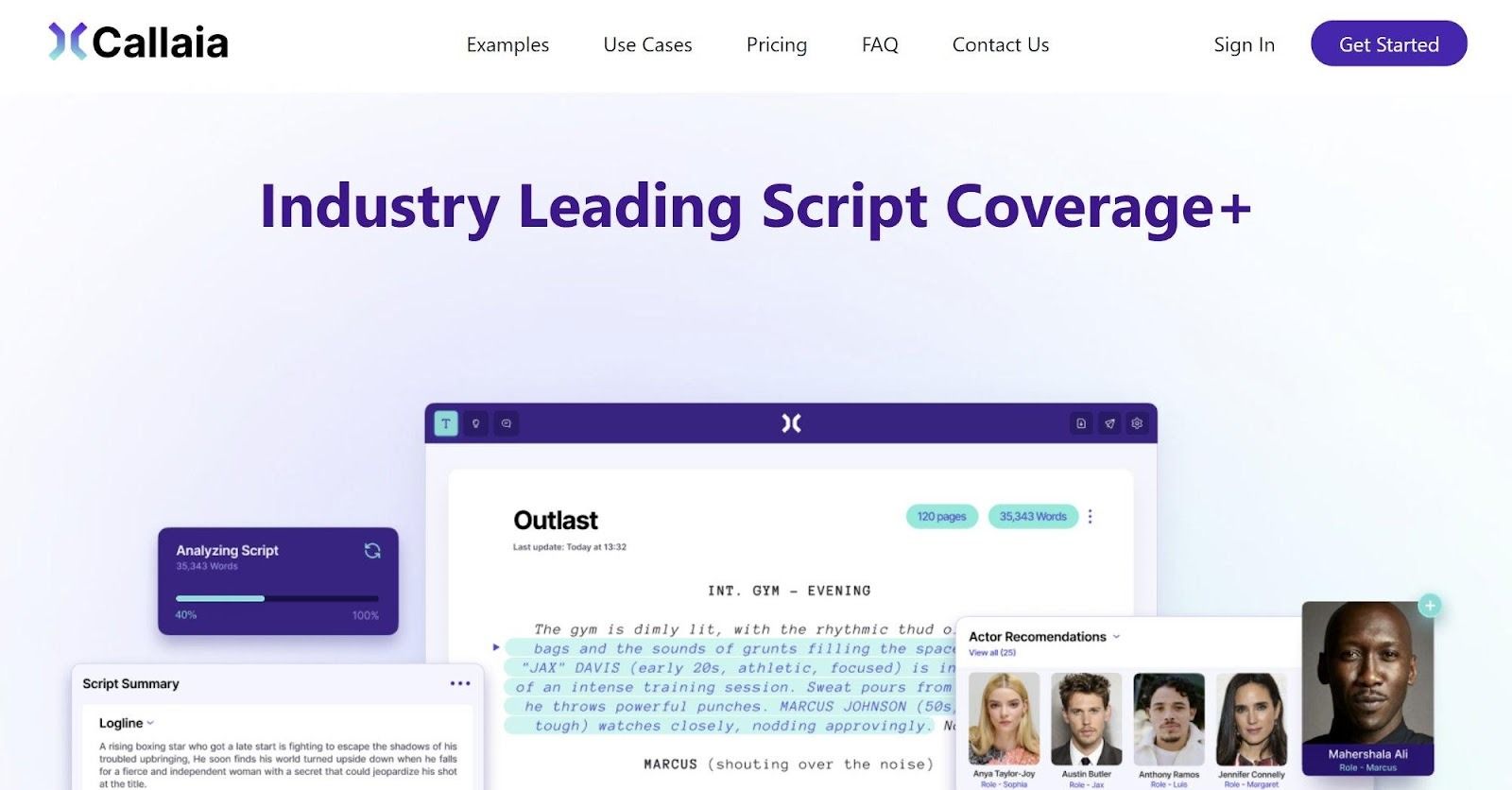
▲ Callaia (callaia.ai) platform interface. Developed by Cinelytic, the AI script coverage tool analyzes a 120-page screenplay in under 60 seconds, delivering loglines, synopsis, character summaries, comps, and Actor Recommendations. ⓒ Callaia / Cinelytic
Callaia (callaia.ai), launched by Cinelytic in September 2024, represents the formalized, enterprise end of the same trend. As the screenshot above shows, the platform analyzes a 120-page (35,000-word) screenplay in under 60 seconds, producing roughly 30 pages of output: logline, synopsis, character summaries, coverage, comparable films, actor recommendations, estimated budget, and release strategy. Pricing is $79 per script, $349 for five, $699 for ten. Cinelytic's client list includes Warner Bros. and Sony Pictures; WME uses the company's separate ScriptSense platform to sort submissions and track client work.
What distinguishes Callaia from shadow AI is security. The platform applies bank-grade encryption and explicitly states that it does not use submitted scripts to train its AI models — a critical differentiation from free public tools whose data handling policies are opaque. The platform's foundation on OpenAI's API means it adheres to OpenAI's data policies, which similarly prohibit using API inputs for model training.
But the creative quality verdict from industry veterans remains skeptical. Stephen Galloway — dean of Chapman University's Dodge College of Film and Media Arts, former Hollywood Reporter editor, and a five-year veteran of script reading — states the limitation plainly.
"AI can't summarize emotion. It can't define if a character is original." — Stephen Galloway, Dean, Chapman University Dodge College of Film and Media Arts
MIT Technology Review's test of Callaia found that the platform recommended expensive A-list actors like Paul Rudd for a film it simultaneously estimated would need a budget of just $5 to $10 million. The verdict from the field: fast but shallow. The qualities that determine whether a script is worth producing — originality, emotional resonance, cultural timing — are exactly the qualities AI renders most poorly.
<Film/TV Studio AI Partnership Overview>
Nearly all studio AI deals focus on incorporating AI into production pipelines, not licensing
* Primordial Soup — AI 프로덕션 스튜디오 (설립: Darren Aronofsky) / AI production studio founded by Darren Aronofsky
† Fabula — 칠레 기반 제작사 (설립: Pablo & Juan de Dios Larraín) / Chile-based production company founded by Pablo & Juan de Dios Larraín
‡ EDGLRD — 마이애미 기반 멀티미디어 크리에이티브 스튜디오 (설립: Harmony Korine) / Miami-based multimedia creative studio founded by Harmony Korine
출처 / Source: Luminate Intelligence, March 2026 | 정리: K-EnterTech Hub
■ The Apprenticeship Ladder Is Cracking
"Instead of hiring two assistants, you're gonna hire one, and I'm still swamped with admin work — and I'm not being pushed any closer to a promotion." — studio assistant, anonymous
Hollywood has always been an apprenticeship industry. Time as an assistant was the foundation of a career built through relationships, accumulated craft knowledge, and gradual advancement. As AI absorbs more entry-level work, the expectation is not that assistants gain time for skill-building — it is that they absorb more bosses.
Galloway frames the threat accurately: the primary damage is being done by industry consolidation, not AI. But the two forces compound each other. Today's assistants using AI to manage impossible workloads will become the executives of the next decade. Their habits will become industry norms. The WGA's AI training compensation provisions in the 2026 contract are, in part, an attempt to establish the rules of the road before those norms are set in stone.
■ SAG-AFTRA and DGA: WGA Sets the Template
SAG-AFTRA and DGA contracts both expire June 30. SAG-AFTRA, led by Sean Astin, is expected to resume negotiations in May or June. The DGA, now headed by newly elected President Christopher Nolan, will meet with the AMPTP next month. Crabtree-Ireland's demand for strong AI protections as a prerequisite for a longer contract puts WGA's clause directly in the spotlight. SAG-AFTRA's additional complexity — AI-generated performers alongside the training data question — means an even harder negotiating road ahead.
■ Implications for the Korean Content Industry
The WGA deal and the ground-level AI reality it responds to carry direct implications for Korea's content and media industry across three dimensions.
First, Korean IP may already be flowing through unauthorized AI pipelines. If Hollywood assistants are processing K-drama and K-film source materials through public AI tools as part of coverage workflows, Korean writers' unpublished work is already a potential training input. Korean writer and director guilds, the Korea Copyright Protection Agency, and the Ministry of Culture, Sports and Tourism should treat the WGA's 2026 AI compensation provisions as a direct reference point. Platforms like Callaia — which offer verified security and explicit no-training commitments — represent the safer alternative that industry guidelines should be steering professionals toward.
Second, the shadow AI problem exists in Korean production environments. The use of public generative AI tools by scripters, assistant writers, and development staff at Korean broadcasters and OTT platforms is growing rapidly, and company-level AI use policies are largely absent. Establishing enterprise-grade protocols and staff training frameworks is an urgent priority.
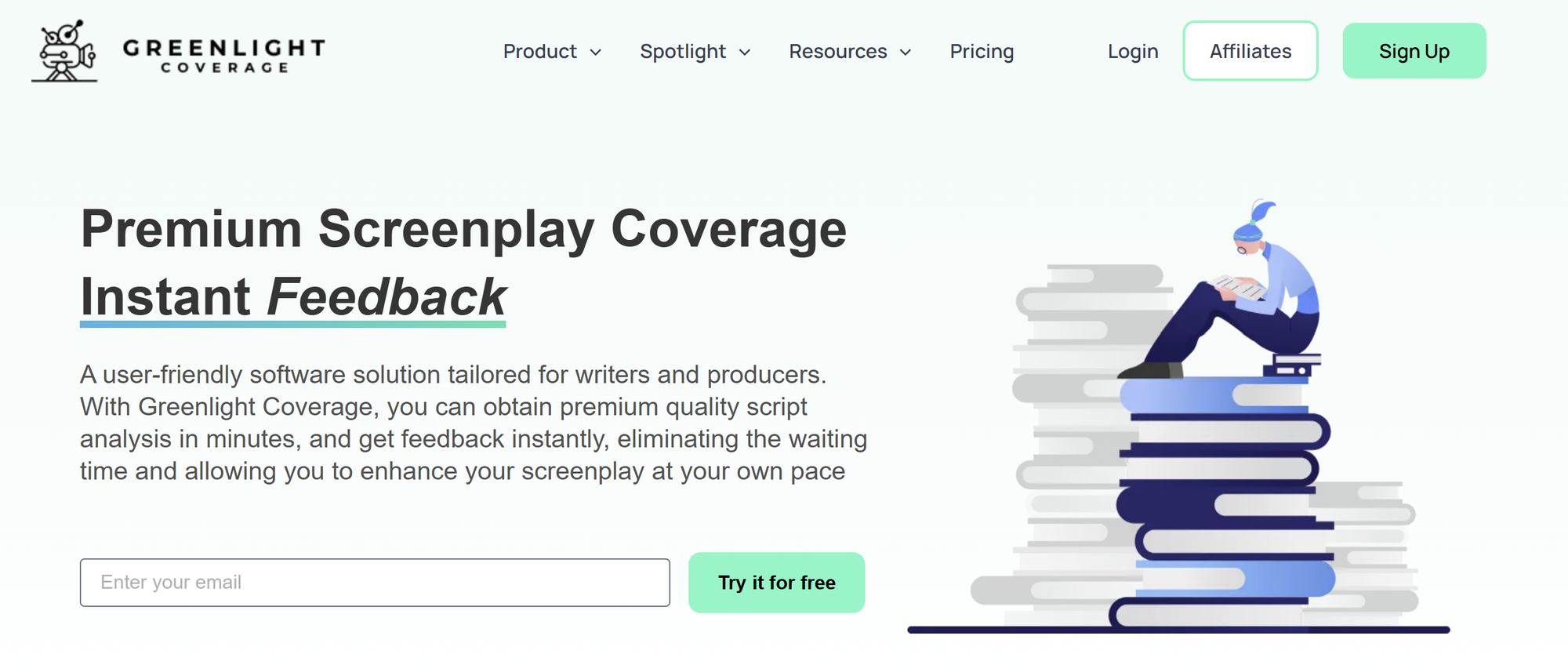
Third, AI script analysis platforms require proactive regulatory preparation. ScriptSense, Greenlight Coverage, and Cinelytic are already offering AI-based script evaluation, coverage, and commercial viability forecasting within minutes — and they are actively expanding globally. As these services extend into Asian and Korean markets, Korean-language screenplays and original IP are increasingly likely to be uploaded and analyzed by AI systems without clear consent or compensation frameworks in place. The Korea Copyright Protection Agency and the Ministry of Culture, Sports and Tourism should establish minimum standards for consent, compensation, data retention, deletion, security, and governing jurisdiction that apply when Korean IP is submitted to foreign AI analysis platforms — and should provide model contractual clause language that domestic studios, agencies, and platforms can incorporate directly into their agreements.
[ Minimum Standards for Korean IP Protection — Foreign AI Script Analysis Platforms (Proposed) ]
Note — Recommended recipients: Korea Copyright Protection Agency, Ministry of Culture Sports and Tourism, domestic studios, agencies, and OTT platforms | Reference precedents: WGA MBA 2023 & 2026 AI provisions, EU AI Act, GDPR Art. 17 (Right to Erasure)
[ Sources ]
① Deadline Hollywood (Apr 4, 2026) — WGA & Studios Agree To New, Longer Contract + Big Health Plan Funding
https://deadline.com/2026/04/wga-studios-deal-new-longer-contract-1236779728/
② Deadline Hollywood (Apr 4, 2026) — Inside WGA Deal: How The Writers Made Nice With The AMPTP
https://deadline.com/2026/04/inside-wga-deal-how-the-writers-amptp-agreed-1236779795/
③ Variety (Apr 4, 2026) — WGA Reaches Surprise Deal With Studios a Month Before Contract Expires
https://variety.com/2026/film/news/wga-reaches-deal-studios-1236708468/
④ The Hollywood Reporter (Apr 3, 2026) — Hollywood Assistants Are Using AI Despite Their Better Judgment — Including in Script Development
https://www.hollywoodreporter.com/movies/movie-features/hollywood-assistants-ai-development-1236553905/
⑤ Deadline Hollywood (Mar 2026) — WGA West Leaders On Healthcare, AI, More Ahead Of AMPTP Talks
https://deadline.com/2026/03/wga-west-leaders-talk-2026-bargaining-priorities-amptp-1236749232/
⑥ Callaia official site — https://www.callaia.ai/