
Beyond K-Content: Why Korea Must Now Compete on the Media-AI Stack

NAB Show 2025 revealed that Korea's global content leadership has not yet translated into media-AI platform leadership — and closing that gap before NAB 2026 requires treating content, AI, and broadcast infrastructure as a single co-evolving ecosystem, not three separate policy silos.

Beyond K-Content: Why Korea Must Now Compete on the Media-AI Stack

Reflections from NAB Show 2025, Las Vegas

By Samseok Ko (고삼석)  |columnist, Distinguished Chair Professor, Dongguk University  | Member, Presidential Committee on Artificial Intelligence, Republic of Korea

Global leadership in broadcasting and media is no longer decided by content alone. What NAB Show 2025 made unmistakably clear is that the new unit of competition is the AI-driven technology stack that spans the entire value chain — production, distribution, and monetization. In an industry now being reshaped by the convergence of FAST (Free Ad-supported Streaming TV), Connected TV (CTV) advertising, generative AI, and next-generation broadcast infrastructure (ATSC 3.0 / NextGen TV), any nation whose media strategy rests solely on exporting finished content will find itself structurally disadvantaged within five years. The structural cause is plain: artificial intelligence has collapsed the marginal cost of content production, fragmented audience attention across every conceivable screen, and dissolved the distribution monopoly once enjoyed by linear broadcasters. The winners of the next cycle will be those who own the tools, not merely the stories.

This is, in my view, the most important signal coming out of Las Vegas this April — and it carries particular weight for the Republic of Korea, a country whose global brand is built on K-pop, K-drama, K-food, and webtoons, but whose presence in the underlying media-technology stack remains under-weight relative to its content influence.

What NAB 2025 Actually Showed

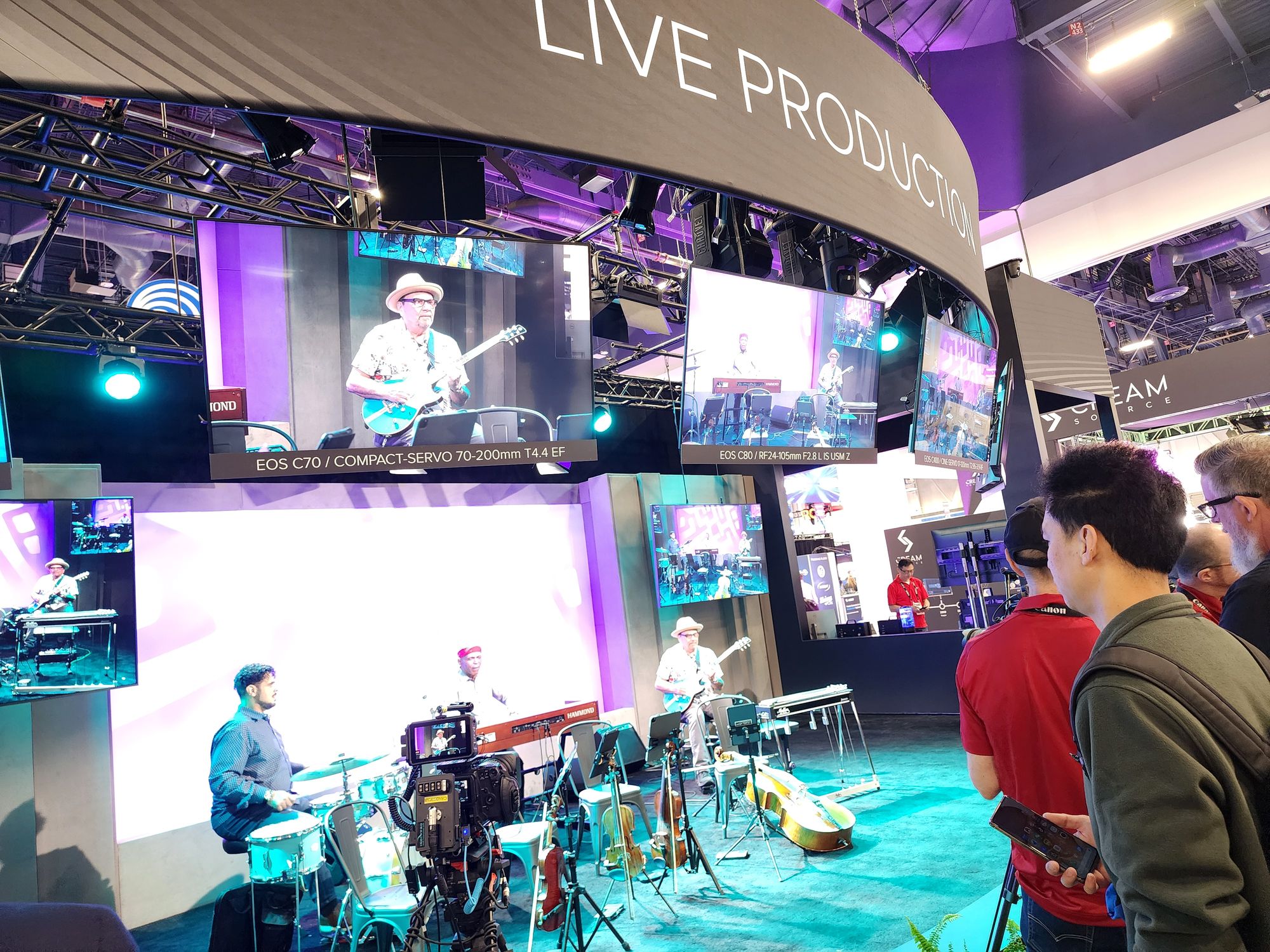
NAB Show 2025, the 102nd edition of the world’s largest broadcast, media, and entertainment trade show, was held April 5–9 at the Las Vegas Convention Center. It drew roughly 55,000 attendees and more than 1,100 exhibitors from approximately 160 countries, under the theme “Storytelling at Scale.” Two shifts dominated the show floor.

First, artificial intelligence has moved decisively from experimental pilots to operational execution. Nearly every major exhibitor — from Adobe, AWS, and NVIDIA to Blackmagic Design, Avid, and Sony — presented AI-integrated workflows across content creation, editing, upscaling, captioning, real-time translation, and monetization. IDC’s NAB 2025 review captured the transition with unusual clarity, noting that media companies must now “embrace advanced GenAI, AI agents, and agentic AI technologies throughout the business cycle” if they are to achieve the flywheel effect needed to hit financial targets. That is no longer a futurist statement. It is a description of 2025 operating reality.

Second, the traditional boundaries between broadcast, streaming, and the creator economy have effectively disappeared. NAB itself responded to this collapse by dedicating entire pavilions to AI Innovation, and by launching the Creator Lab, the Sports Summit, and an expanded Business of Media and Entertainment program. What used to be three adjacent industries is now a single, continuously converging ecosystem.

Two Korean Signals at NAB 2025

Against this backdrop, Korea’s presence at NAB 2025 sent two important signals — one about source technology, and one about industrial breadth.

The source-technology signal came from ETRI. The Electronics and Telecommunications Research Institute (ETRI), Korea’s leading government-funded ICT research body, used NAB 2025 to unveil five AI-powered next-generation media technologies developed with support from the Ministry of Science and ICT: (1) an Intelligent Multi-View OTT Player that uses AI to detect viewer interest in on-screen objects and generate rotated multi-view imagery for deeper interactivity and personalized recommendations; (2) a Metaverse Trust Layer that masks personal information and blocks adversarial tracking to protect privacy in immersive environments; (3) user-sovereign volumetric asset creation and trading technology; (4) photo-realistic stereoscopic spatial computing for hyper-realistic services; and (5) a user-selectable UHD stereoscopic media service designed for the ATSC 3.0 / OTT hybrid environment.

Curtis LeGeyt, President of the National Association of Broadcasters, described ETRI’s showcase as “a significant technological breakthrough for the future of the broadcasting and media industry.” The significance is structural, not ceremonial. For the first time, Korea appears on the short list of countries supplying original media-AI intellectual property to a global stack long dominated by U.S. and European vendors. Dr. Lee Tae-jin, Director of ETRI’s Media Research Division, framed the visit correctly: ETRI’s NAB presence is not only an R&D showcase but a deliberate platform for helping Korean media companies enter global markets.

The industrial-breadth signal came from the Korea Pavilion.Jointly organized by KOTRA and the Korea Information and Communications Technology Industry Association, the Korea Pavilion hosted 11 companies whose portfolios ranged from traditional broadcast hardware — professional cameras, monitors, intercom systems, signal converters, teleprompters — to AI-based upscaling, media asset management (MAM), cloud and streaming solutions, and AI-driven dubbing models. Additional Korean firms exhibited individually across the show floor. This breadth matters. It confirms that Korea has a real industrial base in broadcast-technology subcomponents, which is the prerequisite for moving up the value chain into AI-driven platform products.

The Gap We Must Name Honestly

And yet an honest assessment must acknowledge what was missing. Much of the show’s global attention on AI translation, for example, was captured by Australia’s AI-Media, whose LEXI Voice product delivered real-time AI interpretation into more than 100 languages with customizable voice and without additional hardware — drawing intense interest from broadcasters and streaming platforms worldwide. The uncomfortable question Korea must confront is this: given our global lead in K-pop, K-drama, and webtoons, why did no Korean firm yet own the breakout AI-native platform product at NAB 2025?

Content leadership has not, on its own, translated into media-technology platform leadership. That is the structural gap the next phase of Korean industrial policy and private capital must close. It will not close itself.

A Co-Evolutionary Strategy for Korea

The media industry, the AI industry, and the content industry are no longer three separate sectors. They form a single co-evolving ecosystem in which advances in one domain immediately reshape the others. Korea’s public and private resources, however, remain largely allocated along old silo lines — content subsidies for broadcasters, separate AI R&D budgets for ICT ministries, fragmented export-promotion programs for hardware exporters. The NAB 2025 evidence suggests that three strategic repositionings are now overdue.

First, reframe the AI broadcasting fund as a media-AI platform fund. The Ministry of Science and ICT’s AI- and digital-based broadcast content production support program is a good starting point, but its center of gravity should shift from “subsidizing AI-enabled Korean programs” to “subsidizing Korean-built AI tools that other countries’ programs depend on.” The leverage ratio of tool-layer investment over content-layer investment is dramatically higher in export terms, and it compounds.

Second, build a standing Korea–U.S. media-AI corridor anchored in NAB, CES, and SXSW. Korea’s largest single obstacle is not technology but global reference customers. A government-backed corridor — pairing ETRI-level intellectual property with Korean content producers and U.S. broadcast partners, including the ATSC 3.0 / NextGen TV deployments being driven by groups such as Sinclair Broadcast Group and the BAST Alliance — would generate the reference deployments that turn Las Vegas demonstrations into recurring export revenue.

Third, treat the creator economy and the FAST channel buildout as AI-infrastructure problems, not content-promotion problems. Global FAST inventory has been expanding at roughly one new channel per week, and CTV advertising is on track to surpass traditional television advertising in the United States within the next two years. The winners of this transition will be those who control the AI tools for channel packaging, dynamic ad insertion, multilingual localization, and superfan-economy monetization. Korea already has the demand signal — global K-content consumption — and a maturing AI research base. What it lacks is a policy architecture that treats these as one problem.

The Bottom Line

NAB Show 2025 is best read not as a technology exhibition but as a policy mirror. In it, Korea can see both its emerging strength — world-class original media-AI research at institutes such as ETRI, and a broadening industrial base of broadcast-technology small and mid-sized enterprises — and its structural weakness — the absence, so far, of a breakout Korean AI-native platform product at the center of the global media stack.

If we are honest about both, NAB Show 2026 becomes a deadline, not merely another destination. It is the moment to present Korea not as a content-exporting country, but as a co-architect of the global media-AI standard. The five-year window in which that repositioning is still affordable is already narrower than most of our policy calendars assume.

About the author:

Samseog Ko (고삼석) serves as Distinguished Chair Professor at Dongguk University and as a member of the Presidential Committee on Artificial Intelligence of the Republic of Korea. His research focuses on the co-evolution of media, artificial intelligence, and content industries, and on Korean strategy within the global market