
8,000 public comments flood FCC after formal notice DA 26-188 — sports rights dispute spreads to Olympics, NBA, and MLB, with major implications for Korea
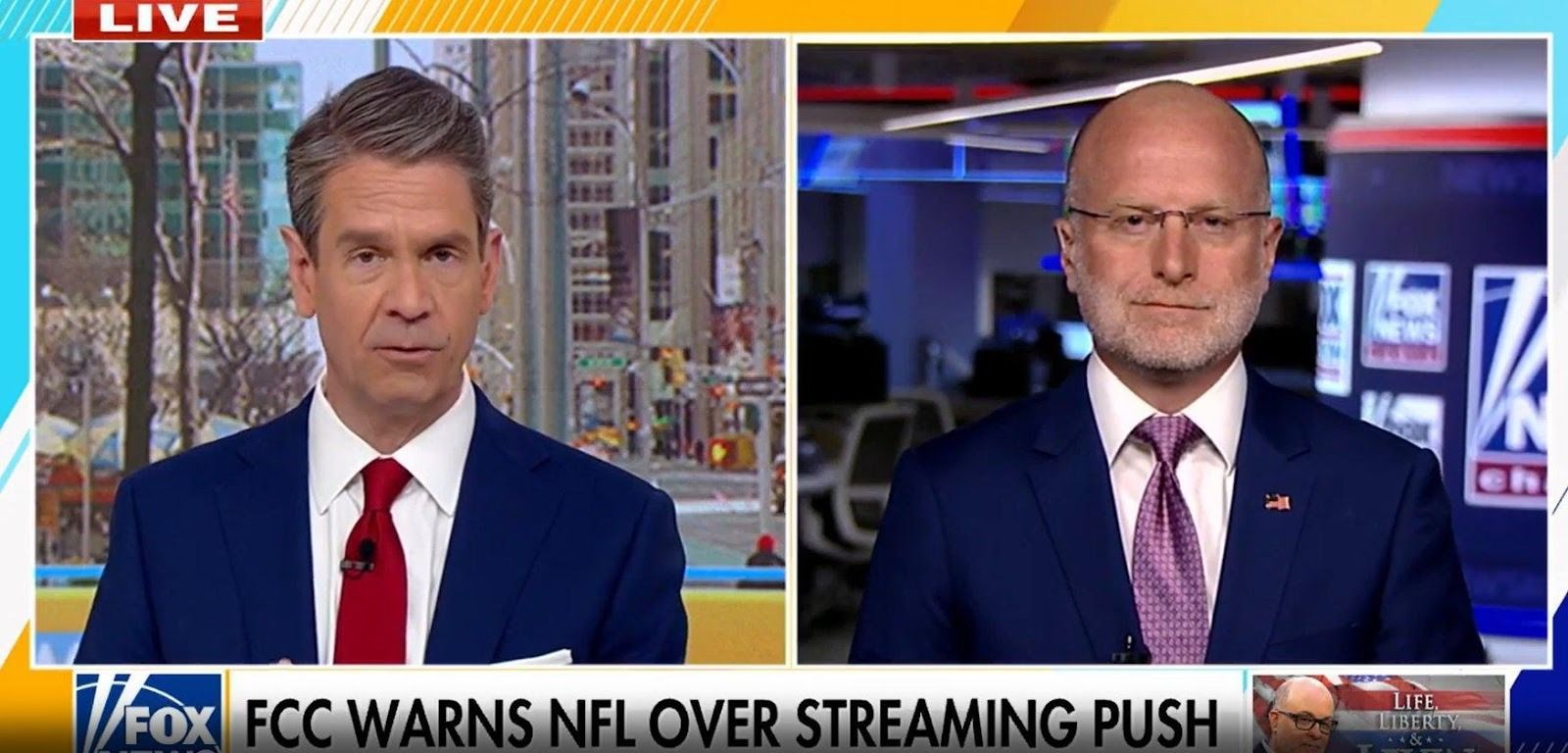
▲ Fox News 'Fox & Friends Weekend' live broadcast. Host Griff Jenkins (left) and FCC Chairman Brendan Carr (right). Caption: "FCC WARNS NFL OVER STREAMING PUSH"
As the global sports broadcasting rights market restructures around Big Tech streaming, the U.S. Federal Communications Commission (FCC) has drawn a line. Chairman Brendan Carr, speaking live on Fox News, issued a public warning to the NFL: if the league's tilt toward streaming continues unchecked, the antitrust exemption guaranteed under the Sports Broadcasting Act of 1961 (SBA) may no longer be tenable.
For the first time, the Sports Broadcasting Act — which has long granted pro leagues like the NFL an antitrust exception allowing them to pool and collectively sell broadcast rights — has been openly put under scrutiny in the midst of the streaming transition.
The SBA was originally designed to permit leagues to bundle team-level rights exclusively in the context of free over-the-air broadcasting. Now, with paid streaming as the dominant delivery model, Congress, the FCC, and the courts are simultaneously re-examining whether this special privilege remains justifiable.
The vast majority of the 8,000 public comments submitted to the FCC demanded that major games remain available on free over-the-air television. A Fox News poll (March 20–23, 2026) found that 72% of sports fans held the same view.
Fan outrage over the erosion of access to 'national sports' — once freely available on broadcast TV and now disappearing behind streaming paywalls — has pushed the FCC to launch a comprehensive review of the sports broadcasting rights framework.
The ripple effects extend beyond the NFL to the Olympics, NBA, and MLB — and the same structural pressures are reaching Korea's broadcasting and streaming market. With JTBC having secured exclusive Korean rights to the Olympics and the FIFA World Cup, the debate over 'universal viewing rights' — whether broad coverage is sufficient, or whether free over-the-air access must be guaranteed — makes this a highly relevant issue for Korea.
 Jung Han
BACKGROUND: How Streaming Growth Created the Crisis
This conflict did not emerge overnight. It is the direct result of explosive global streaming growth reshaping the sports broadcasting ecosystem. By 2024, the combined global subscriber base of major streaming platforms — Netflix, Amazon, Disney+, and others — had surpassed one billion. As advertising revenue models matured, platforms launched an aggressive race to secure premium content for subscriber retention, and live sports rights became their ultimate weapon.
Sports are 'real-time mandatory content' with virtually no DVR viewing — advertising rates run three to five times higher than standard dramas or variety programming. This drove Netflix to make its official entry into sports by exclusively broadcasting the 2025 NFL Christmas doubleheader. Amazon already holds exclusive streaming rights to NFL Thursday Night Football, generating hundreds of millions in annual ad revenue. NFL media rights, which amounted to just $8.5 million in the 1960 AFL-ABC deal, now exceed $10 billion per year. Broadcast networks simply cannot match the astronomical rights fees poured in by Big Tech, and the result is a hardening structural pattern in which marquee games gradually disappear behind paid streaming walls. Fans now face annual costs exceeding $1,500 to piece together access across ten or more services — and that is the direct pressure that has moved the FCC.
This collision is not uniquely American. Olympic rights disputes, the streaming exclusification of NBA and MLB — the same structure is spreading globally, and Korea's broadcasting and streaming industry is not immune. As the streaming market grows, rights disputes intensify. The FCC's move is the signal flare marking that inflection point.
FCC Public Notice (DA 26-188): A Full Review of the Sports Broadcasting Market
On February 25, 2026, the FCC's Media Bureau formally initiated a public comment proceeding on sports broadcasting practices and market trends through MB Docket No. 26-45. The initial comment deadline was March 27, with a reply comment deadline of April 13. The notice states explicitly: 'For decades, Americans could easily find their favorite games on free over-the-air television just by turning on their TV — today, that is no longer easy.'
The notice points to the historic symbiosis between sports and free broadcast television as its core argument. Sports leagues built their fan bases through the wide distribution networks of broadcast TV, while broadcasters sustained their operations and local news production capacity through sports advertising revenue. The FCC warns that if this symbiosis breaks down, local news and public safety communications — including emergency broadcast functions — will suffer direct harm.
From $8.5 Million to $110 Billion: 60 Years of NFL Broadcasting Rights
In 1960, the American Football League's five-year broadcasting deal with ABC was worth just $8.5 million. The following year, the NFL struck a two-year, $9.3 million contract with CBS for regular-season coverage — introducing, for the first time, a league-wide pooled sales and revenue-sharing structure. At the time, 'TV broadcasting rights' were little more than a supplemental revenue source for franchises, but the competitive bidding wars among CBS, NBC, and ABC in the 1960s and 70s — combined with the antitrust exemption codified in the Sports Broadcasting Act — turned the NFL into the defining example of a league built by television.
Over the following six decades, NFL media rights became the gold standard of the American sports market. According to research firms and industry estimates, the combined value of the NFL's latest long-term package agreements — covering Disney (ESPN/ABC), Paramount (CBS/Paramount+), Fox, NBCUniversal (NBC/Peacock), Amazon Prime Video, YouTube (YouTube TV/Sunday Ticket), and NFL Network — is estimated at approximately $110 billion through the mid-2030s, translating to more than $10 billion per year.
When single-event and partial rights — including Netflix's Christmas games and Peacock/ESPN+'s exclusive playoff and standalone broadcasts — are added, the total media money flowing into the 'NFL ecosystem' grows even larger.
This rights inflation is not unique to the NFL. In 2024, the NBA finalized an 11-year, approximately $77 billion media rights agreement with Disney (ESPN/ABC), Amazon, and NBCUniversal, locking in a structure worth roughly $7 billion annually beginning with the 2025-26 season. The NHL signed a seven-year deal with Disney (ESPN/ABC) and Turner (TNT Sports) in 2021, with the two companies paying a combined estimated $635 million per year — a total estimated at approximately $4.5 billion. MLB, through its national broadcasting contracts with Fox, ESPN, TBS, NBCUniversal, and Netflix, generates approximately $2 billion annually in media revenue through 2026-2028, according to Sports Business Journal.
Major U.S. Sports League Media Rights Deals
A market that stood at tens of millions of dollars in the early 1960s has grown into a structure where a single league commands over a hundred billion dollars — and to absorb those costs, broadcasters and streaming platforms are increasingly bundling more games behind paid subscriptions and exclusive packages. This sixty-year trajectory is the fundamental backdrop against which the FCC and the Sports Broadcasting Act are being revisited today.
10 Services, $1,500 a Year — The Fan's Reality
According to FCC Public Notice DA 26-188, during the 2025 season NFL games were distributed across as many as 10 separate services — combining free broadcast, cable, and streaming — and the estimated annual cost of legally accessing all games could exceed $1,500. In practice, combining YouTube's Sunday Ticket, Amazon Prime Video, ESPN/ESPN+, Peacock, NFL+, and local cable channels still runs a minimum of $500 to $800, with costs climbing above $1,000 depending on the packages selected.
In the 2025-26 season, 20 NFL regular-season games and one playoff game were exclusively streamed nationally across four streaming services: Amazon Prime Video, YouTube, Peacock, and Netflix. While the NFL requires streaming partners to provide same-day simulcast access to local broadcast or cable stations in the relevant team markets, the FCC flagged that this arrangement rests on private contractual terms between the league and its partners — not on any FCC regulation or statutory right. The league can modify or eliminate local simulcast obligations at any time simply by changing the contract structure.
College sports are no exception. In 2022, the Big Ten Conference signed a seven-year deal for football and basketball rights with Fox, CBS, and NBC, reported to be worth approximately $7-8 billion — the largest college sports media deal in history, exceeding $1 billion per season. Other power conferences — the ACC, SEC, and Big 12 — have also struck multi-billion-dollar media rights deals with ESPN, Fox, and others, shifting the financial structure of major conferences sharply toward broadcasting revenue over gate receipts.
With rights revenue displacing gate revenue as the primary income source across both professional and college sports, the entire American sports industry is effectively being restructured as a media business. In the FCC's view, fans are forced to open their wallets across an ever-growing number of platforms, the local news and emergency broadcast infrastructure built on free broadcasting is eroding, while leagues and Big Tech streaming companies emerge as the sole beneficiaries of a structurally regressive market.
"You Need a Computer Science Degree to Find the Game" — Chairman Carr's Warning
On March 29 (local time), FCC Chairman Brendan Carr appeared on Fox News' Fox & Friends Weekend and expressed sharp concern over an increasingly fragmented and complex sports viewing environment. When host Griff Jenkins noted that 'you now need more than half a dozen apps and $2,500 a year just to watch a single game,' Carr responded: 'The system is getting more complex and more expensive. You practically need a computer science degree to decode it.'
Chairman Carr specifically invoked the antitrust exemption under the Sports Broadcasting Act of 1961, noting that it was designed around 'sponsored telecasts' — i.e., free advertising-supported broadcasts. Rights deals with paid streaming platforms like Netflix, Amazon, and YouTube may not satisfy that requirement, which could mean the antitrust exemption the leagues have long relied upon no longer applies — potentially forcing each individual team to sell its own broadcast rights independently. He noted that 'this discussion is not limited to the FCC,' leaving open the possibility of additional action involving Congress and other executive branch agencies.
Fox News Poll: 72% of Fans, 60% of Non-Fans Support Keeping Games on Free TV
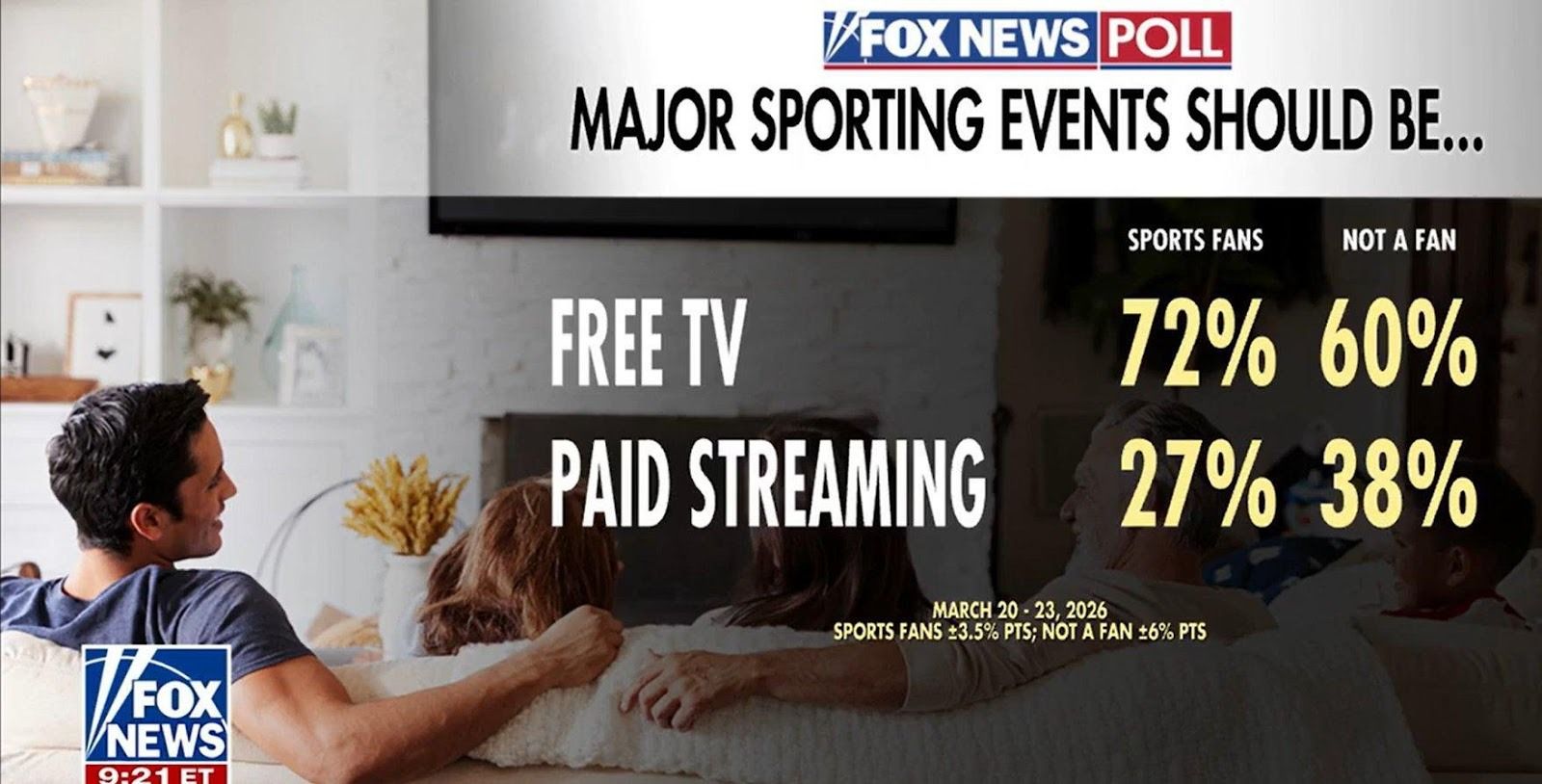
▲ Fox News poll (March 20–23, 2026): Major sports games should be broadcast on free TV — Sports fans: 72%, Non-fans: 60%. Support for paid streaming: fans 27%, non-fans 38%. (Margin of error: fans ±3.5pp, non-fans ±6pp)
In the Fox News poll, 72% of sports fans said major games should remain on free over-the-air television. Notably, 60% of non-sports viewers held the same view — a signal that access to sports broadcasting is increasingly perceived not merely as a fandom issue, but as a matter of universal public service. The FCC confirmed that the overwhelming majority of the more than 8,000 public comments it received pointed in the same direction.
Olympic Broadcasting Rights Disputes and Implications for Korea
The U.S. sports broadcasting rights conflict is one facet of a global phenomenon. The same structural tension is already at work in the Olympic and World Cup rights markets. Since the mid-2020s, the IOC has moved to expand digital and OTT rights, reshaping a structure that traditionally allocated rights to national broadcaster consortiums. As rights fees continue to climb, the ability of national public and free-to-air broadcasters to access Olympic and World Cup coverage is under threat worldwide.
Korea is absorbing the full impact of this structural shift. For years, a consortium of KBS, MBC, and SBS jointly secured Olympic and World Cup rights, preserving free universal access to 'national sporting events.' But in 2019, JTBC acquired Korean rights to the 2026 and 2030 World Cups and the 2026-2032 Olympics in a single package deal — abruptly changing the landscape. As JTBC and the three broadcast networks struggled through difficult resale negotiations ahead of the 2026 North America World Cup, fears that 'Korean viewers may not be able to watch the World Cup for free' became a live policy issue, escalating to the point where the government and the National Assembly moved to mediate. This illustrates how America's 'free broadcast vs. paid streaming' conflict is playing out in Korea as a clash between 'broadcast network consortiums vs. cable channel and streaming rights holders.'
NBA broadcasting rights also foreshadow structural change in the Korean market. The NBA's new 11-year, approximately $77 billion deal with Disney, Amazon, and NBCUniversal — beginning with the 2025-26 season — is viewed as a mega-package combining traditional media with Big Tech streaming. This contract structure effectively presupposes a reorganization of NBA broadcasting platforms in Korea, and depending on how Amazon deploys its global rights in the Korean market — through direct service, local partnerships, or otherwise — domestic sports and entertainment streaming strategies could shift materially over the medium term.
Key Implications for Korea's Broadcasting and Streaming Industry
- Proactive debate on broadcast protection norms: The FCC's attempt to reinterpret the SBA's antitrust exemption could catalyze discussion in Korea around institutionalizing a 'universal viewing rights framework' — guaranteeing minimum free access for key events such as the Olympics, World Cup, and national team matches, whether through public broadcasters or free over-the-air channels.
- FAST channel strategy: The emergence of FAST (Free Ad-Supported Streaming TV) in the U.S. as an alternative between free broadcast TV and paid streaming presents a strategic option for Korean content companies to develop sports-focused FAST channels in partnership with major rights holders (JTBC, global streamers, etc.), simultaneously targeting both overseas and domestic audiences.
- Strengthening negotiating leverage for Olympics and World Cup: As direct deals between the IOC/FIFA and global streaming services become standard, Korean broadcaster consortiums must reposition themselves — moving beyond being mere 'rights recipients' to becoming active negotiating parties that leverage domestic universal viewing rights, political will, and regulatory risk as bargaining tools.
- Monitoring Big Tech rights expansion: As Netflix, Amazon, and Google (YouTube) secure an expanding share of mega-event rights — NFL, NBA, Olympics, World Cup — the long-term risk of Korean sports broadcasting and advertising markets becoming increasingly dependent on Big Tech platforms grows significantly.
Domestic streaming services and broadcasters must prepare a medium-to-long-term roadmap premised on a multi-stakeholder cooperation structure involving free-to-air networks, cable, telecoms, and platforms. Simultaneously, the government must develop a parallel policy strategy that addresses mega-events like the World Cup and the Olympics as regulatory and policy agenda items.
Key Figures, Institutions, Laws & Terms
• FCC (Federal Communications Commission) — U.S. broadcasting and telecommunications regulatory authority
• Brendan Carr — FCC Chairman, appointed by the current Trump administration
• Griff Jenkins — Host of Fox News' Fox & Friends Weekend
• Roger Goodell — Commissioner, NFL (National Football League)
• Sports Broadcasting Act of 1961 (SBA) — Federal law granting antitrust exemptions to NFL, MLB, NBA, and NHL. Applicable only to advertising-supported free broadcasts
• Sponsored Telecasts — Advertising-based free broadcasts to which SBA exemptions apply; paid streaming services do not qualify
• MB Docket No. 26-45 — The FCC Media Bureau's formal review proceeding on the sports broadcasting market, initiated in February 2026
• Paywall — A content access barrier requiring a paid subscription
• Peacock — NBCUniversal's streaming service; holds NFL and NBA broadcasting rights
• FAST (Free Ad-Supported Streaming TV) — Free advertising-supported streaming TV; occupies the middle ground between free broadcast TV and paid streaming
• IOC (International Olympic Committee) — The principal counterparty in Olympic broadcasting rights negotiations
Sources: FCC DA 26-188 (Feb. 25, 2026) · Fox News Digital (Max Bacall, Mar. 29, 2026) · Policyband (Ted Hearn, Mar. 30, 2026) | Compiled by: K-EnterTech Hub