The D2C Lifestyle Pivot of Cable News, and What It Signals for Korea
▸ Ad-supported free → premium tier → bundle integration: a five-year experiment opened by Fox Weather
▸ Proven by hurricane traffic: 'engagement under crisis' is the real value of a weather channel
▸ FAST-first Fox vs. mobile-first CNN: two different paths walking the same revenue roadmap
CNN Weather: Why Weather, of All Things?
On May 12, CNN launched its standalone weather app, CNN Weather, in the U.S. iOS App Store. While framed as the first standalone lifestyle product from a cable news network, the significance CNN itself assigns to the app runs far deeper.

In its press release, the company described CNN Weather as "the next step in CNN's direct-to-consumer strategy, building on the recent launch of the All-Access subscription," and "the first in a planned suite of lifestyle products." This is not a single app. It is a declaration: CNN Weather is the second building block of a modular D2C portfolio.
Weather, alongside news, finance, and messaging, is one of the most frequently opened categories on a smartphone. Users check it multiple times a day, and it is tightly tied to location data, time-of-day patterns, and daily routines. For CNN, weather works as an ideal entry point on three fronts simultaneously:
- Advertising — an inventory that easily generates repeat exposure and long dwell time.
- Subscription — premium features, ad-free experience, and personalized alerts all create natural paths to paid conversion.
- Licensing — data and brand assets can be embedded into other services and devices.
This is why CNN chose weather as the first piece of a D2C subscription ecosystem where "news alone is not enough" in a post-cord-cutting world.
In the same week, The New York Times released Q1 2026 results — 13.1 million total subscribers and digital advertising revenue growing in the 30%-plus range — showing what the destination of this transition looks like. NYT has already layered Games, Cooking, Wirecutter (reviews), and sports on top of its news subscription to build a comprehensive D2C subscription pack. CNN is just starting on the path where NYT already stands at the end.
Korean broadcasting, by contrast, remains in disarray. Terrestrial advertising revenue has fallen by nearly half over the past five years, and even after rounds of OTT consolidation, ARPU stagnation and pressure for profitability persist simultaneously. The CNN Weather launch poses the same question directly to Korea: which lifestyle axis should a news channel choose to start designing D2C subscription from?
'One Context' Over '47 Data Points': CNN's Bet on Human Curation
The first impression of CNN Weather is not "there's a lot of information" but rather "the information is well organized." In its announcement, CNN pointed directly at existing weather apps, saying the product is "different from those that throw 47 data points at you before you've had your morning coffee." The judgment is that data-saturated UIs — short-term precipitation, wind, feels-like temperature, fine dust, allergy index, and endless graphs — actually intensify user fatigue.
The keywords CNN put forward are "clearer, calmer, more human" weather guidance. The core is not stacking numbers but providing contextual explanations that let the user understand at a glance:
- What they need to prepare for today
- Why a given weather pattern is occurring
- What to do right now in a dangerous situation
Ben French, Senior Vice President of New Business at CNN, framed the product this way:
"We are creating this portfolio of lifestyle products to help our audience navigate a complex world. CNN Weather will not only prepare people each morning for the day ahead and keep them safe and informed during severe weather events — it will also help our audience appreciate and understand the natural weather phenomena around them."
Angela Fritz, Senior Director of Weather & Climate at CNN, emphasized the editorial angle:
"Audiences have always come to CNN for trusted weather information because of our deep bench of meteorologists and climate experts. With CNN Weather, we can connect people directly with the science-backed insights and analysis that help them understand the weather and climate events happening around them."
The intent is to bind "numerical forecasts + expert commentary + climate journalism" inside a single frame.
Inside CNN Weather: How the App Is Built
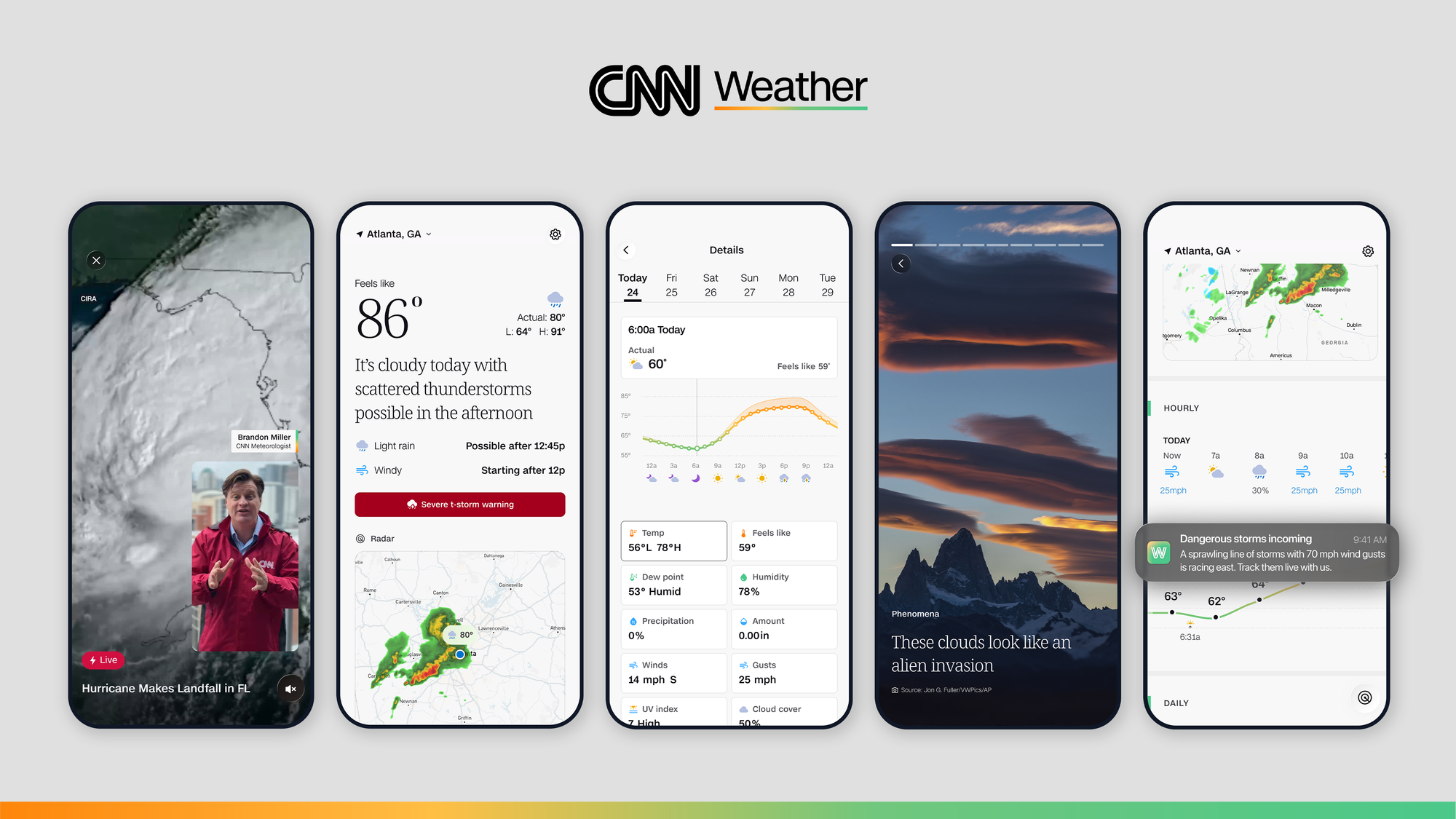
CNN Weather is currently available free to U.S. iOS users, with Android, international expansion, and a paywall left as medium-term agenda items. The feature design is closer to a "news + lifestyle" hybrid than to a simple forecast app.
Real-Time Weather Reporting + Climate Analysis
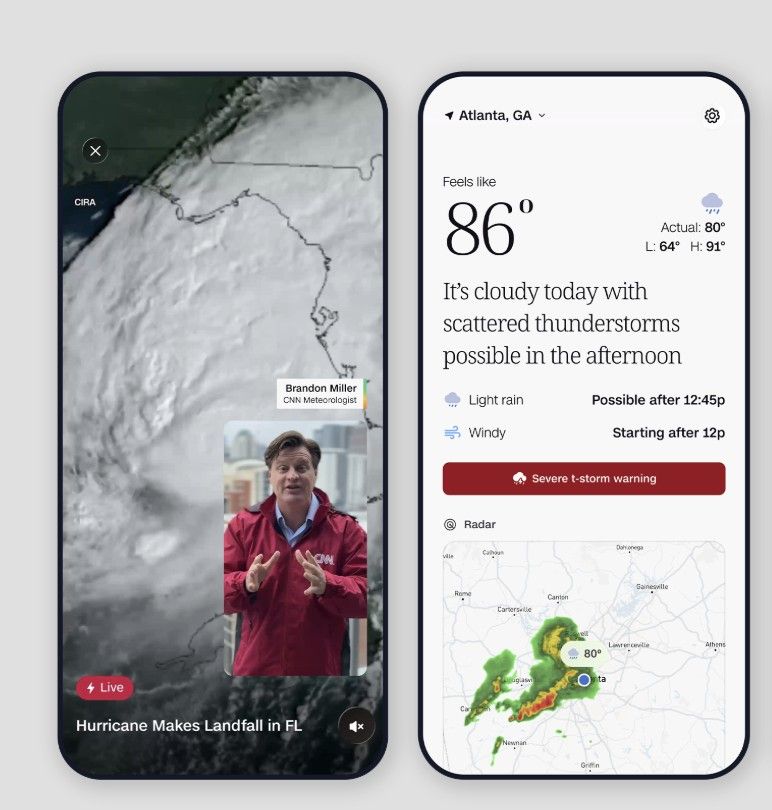
Real-time coverage linked to CNN live news during storms, hurricanes, wildfires, and other disasters
Not just "it will rain," but climate storytelling that explains why such patterns occur
Local Forecasts, Radar, and Minute-by-Minute Coverage
Location-based short- and medium-term forecasts
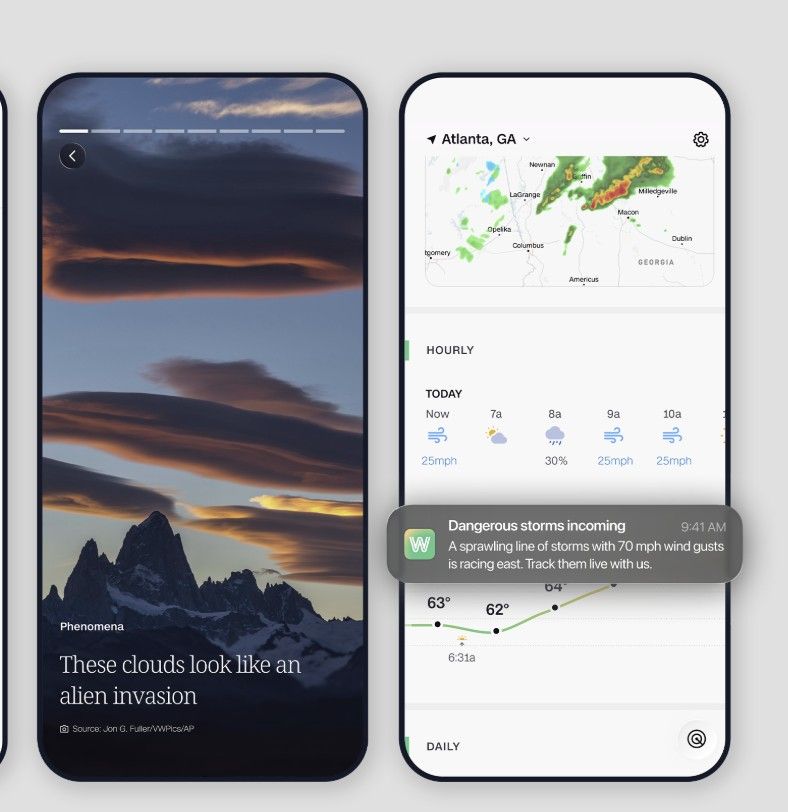
Interactive radar maps with visualization of precipitation, wind, and danger zones
Minute-by-minute alerts and live video integration during crises
'Experts on Video' Asset Reuse
Embedded commentary and explainer clips from CNN's meteorology and climate reporters
Repurposing the network's accumulated video production capability into the weather app
Mobile-First UX
Large typography, simple maps, minimized menu structures
Swipeable photos and video, graphics optimized for portrait orientation
Climate and Natural Phenomena Content
Explainer content covering heatwaves, droughts, and climate anomalies
Sections that extend "weather news" toward climate journalism
The point is that this entire structure is designed to interlock naturally with the All-Access subscription and future lifestyle apps. CNN Weather is not just one weather app — it is the first template for CNN's lifestyle portfolio.
AWS as 'Launch Sponsor': Reshaping the Media–Cloud Relationship
The technical infrastructure for CNN Weather is built in partnership with Amazon Web Services (AWS). The notable element is that CNN explicitly designated AWS not as a standard infrastructure vendor but as a "launch sponsor." The name change may look cosmetic, but it signals a shift in the standing of the media–cloud relationship.
In the traditional model, the relationship was a classic B2B transaction:
- Media — pays for infrastructure usage.
- Cloud — supplies compute, storage, and CDN.
The launch sponsor model elevates that relationship into a co-marketing partnership:
- Cloud — uses CNN Weather as a technology demonstration and reference case.
- CNN — reduces infrastructure cost burden while gaining brand exposure and credibility.
This matters most during peak-traffic events. Hurricanes, wildfires, and other major weather disasters trigger explosive traffic surges. At those moments, the launch sponsor's core responsibilities are:
- Stable handling of surging concurrent connections
- Sub-second and minute-by-minute data processing and scalability
- Integrated support for live video, push alerts, and location-based services
For CNN, this transforms a stretch where "traffic spike = cost spike" into a structure shared and co-managed with a cloud partner. When other news and media groups launch weather, sports, election, or event apps, they are now likely to reference not the "cloud customer" model but this "launch sponsor and technology partner" framework.
CNN's D2C Design: Layering Lifestyle on Top of All-Access
CNN Weather aligns with a third strategic axis inside CNN's D2C plan. The core concept is layering lifestyle products on top of the news subscription. The three platform capabilities CNN highlights are:
- Best-in-class video production and editing capability
- Global reach (brand and distribution network)
- Local access (regional news and weather networks)
These three assets will apply commonly across every lifestyle product to come. After weather, the next candidate categories — areas well suited to settle in as "daily-use apps" — include food, travel, wellness, and personal finance.
This strategy is also a direct response to the failure of CNN+, the short-lived streaming service launched in 2022. CNN+ tried to build a new subscription product by gathering original content separated from the cable channel and shut down one month after the Discovery merger.
The current Mark Thompson regime is moving in the opposite direction:
- Migrate and repackage existing cable news assets into the digital All-Access subscription
- Treat All-Access as the home base
- Stack vertical lifestyle apps like Weather on top, one at a time
- Expand daily user touchpoints
- Lift ARPU and dwell time simultaneously
In other words, the play is not "abandon news and move to lifestyle," but "layer lifestyle on top of news and expand the portfolio."

The Five-Year Precedent Set by Fox Weather
CNN Weather has one clearly established precedent in front of it: "Fox Weather," the dedicated weather channel that Fox News launched in October 2021. Fox introduced the service first as a free, ad-supported streaming (FAST) channel — making it the first major cable news network to spin weather out as an independent streaming brand. Tracing its five-year evolution reveals a relatively clear roadmap for how a weather vertical can expand into revenue and bundle strategies.
Stage 1 (2021): Ad-Supported Free — Securing Reach Through Full FAST Distribution
Fox Weather's starting point was a 100% ad-supported free channel. At launch in 2021, Fox distributed Fox Weather across the major FAST platforms — Pluto TV, Roku Channel, Samsung TV Plus, Sling Freestream, Xumo. Rather than offering it as a sub-program on a cable channel, Fox chose to launch an independent "weather streaming channel" as a free, ad-supported service.
The strategic goal at this stage was clear: before discussing revenue from paid subscriptions, secure as much reach and viewing time as possible. Weather is a genre consumed repeatedly not only during major disaster events but also in daily life — commuting, weekend travel, trip planning — making it a category where building viewing habits and brand awareness quickly was the first priority. Because the ad-supported model has no entry barrier, it also served as a testing ground for measuring how deeply a new service could embed itself in users' daily routines.
Stage 2 (February 2025): Premium Subscription — 'Tier-Up' Strategy on Top of Free
After accumulating sufficient reach and viewing time, Fox added a premium subscription model as its next move. In February 2025, an ad-free paid plan was introduced to Fox Weather, completing a "tier-up" structure where an optional paid layer sits on top of the existing free channel.
The core is that the existing free service remains intact, while:
- Removing ads
- Offering certain premium or convenience features only to users who want them — for an additional fee
This is a model that, while advertising still accounts for most revenue, naturally elevates a portion of users to a "higher tier." In high-frequency categories like weather, the need to "watch without ads, faster and easier" emerges easily, allowing the product to add a stable subscription revenue stream — even if at modest scale.
Stage 3 (August 2025): Bundle Integration — Folding Into FOX One
The third stage was bundle integration. In August 2025, Fox launched its unified streaming service "FOX One," bundling Fox News, Fox Sports, and Fox Weather into a single $19.99/month subscription.
From Fox Weather's perspective, from this point forward, it positions less as a standalone service and more as a "bundle component." A standalone weather channel might be stuck at a relatively low price point and niche demand, but combining categories with different usage motivations into a single product creates a bundle that lifts overall retention and dwell time:
- News — information, current affairs, politics
- Sports — live events and games
- Weather — disasters and daily routines
Weather handles usage frequency, news provides information trust, sports delivers real-time excitement — a clean role distribution emerges across the bundle.
The Catalyst: Hurricanes Helene and Milton Proved 'Engagement Under Crisis' (2024)
The catalyst that enabled this three-stage roadmap was the major weather disaster season of 2024. During the period of intense Hurricane Helene and Milton coverage, Fox Weather's daily streaming time reached the 900-million-minute range, increasing more than 600% year-over-year. It was a moment that crystallized a key truth about the weather genre — viewers tune in steadily during normal times, but viewing time explodes during crisis situations.
This data proved two things:
- From an advertising perspective — the weather channel during crisis windows offers premium inventory.
- From a subscription and bundle perspective — having a channel inside the bundle that viewers "absolutely must turn on" during disasters and emergencies elevates the necessity of the entire bundle.
Fox capitalized on this momentum to transition naturally into the premium plan and the FOX One bundle.
CNN's Reference Line, and Where the Paths Diverge
With reports that CNN is considering a paywall and paid options for CNN Weather, Fox Weather's path — "ads → paid tier → bundle integration" — becomes a highly natural reference line for CNN. The three-stage flow translates as:
- Stage 1 — maximize reach with a free, ad-supported model
- Stage 2 — introduce an ad-free premium tier to convert a portion of users to paid
- Stage 3 — fold the product into a bundle alongside news, sports, and lifestyle
However, there is an important difference at the starting point. Fox Weather was rooted in a FAST channel from the beginning, with the mobile app serving as a supporting asset to the TV and streaming channel. CNN Weather, by contrast, places the mobile app at the strategic center from day one, treating usage behavior, location, and notification response data — all first-party data — as core assets for CNN's overall D2C strategy.
If Fox chose a path of "TV/FAST-centered → bundle," CNN has chosen a path of "mobile/app-centered → All-Access subscription + lifestyle portfolio." Even so, the three-stage evolution Fox Weather has demonstrated over the past five years remains the most realistic reference case for gauging the speed and direction in which CNN Weather will expand its revenue model going forward.
Conclusion: "Go Beyond News — Ride on Top of Daily Life"
CNN Weather is not a project that can be summarized as "a news channel released one more weather app." The service contains layered blueprints for how CNN intends to make money and shape relationships with users over the medium and long term. It is an experiment that reorganizes the news core through digital subscription, expands a lifestyle portfolio starting with weather, and rewrites both the cloud-partner relationship and the underlying revenue model.
First: Migrating the News Core to All-Access Subscription
CNN is moving the news channel's "home base" into the All-Access subscription. The shift is away from a structure dependent on cable distribution and advertising, toward a model that directly gathers subscribers in digital. In this process, news remains core content — but it is no longer the entirety of revenue. News is the hardcore asset that constitutes the basic All-Access pass, and lifestyle and vertical services stack on top of it, layer by layer. CNN Weather is that first layer.
Second: A Lifestyle Portfolio Started by Weather
The lifestyle portfolio that begins with weather plays the role of widening CNN's D2C asset pool. Weather is a habit-forming category checked multiple times a day, and an area where location, time, and behavioral data accumulate naturally. As travel, food, wellness, and personal finance are added on top, CNN shifts from being "the network you visit only when you watch news" to "the network you encounter continuously throughout daily life." That frequency and density of touchpoints ultimately expands advertising inventory, paid features, and partnership/licensing opportunities all at once.
Third: Elevating AWS as 'Launch Sponsor' Redefines Media–Cloud Relations
Designating AWS as a "launch sponsor" goes beyond a question of technical infrastructure — it is an attempt to redefine the relationship between media and cloud. Rather than simply being a customer that buys servers and storage, the partner is positioned to share both upside and risk from the very start of the service.
This structure becomes most visible at moments when traffic explodes — major weather disasters being the prime case. Stability under traffic spikes, real-time scaling capability, and data processing speed are no longer invisible "back-office" concerns; they become front-line elements that determine the brand and trust of the news service itself. CNN is elevating this dimension into a co-marketing and co-responsibility structure with a technology partner.
Fourth: Fox Weather's Five Years as CNN's Pilot Experiment
The past five years of Fox Weather look like a leading experiment for the revenue model CNN intends to reference. Fox began with an ad-supported free channel, layered a premium paid tier on top, and then folded the product into a bundle alongside news and sports — a three-stage transformation. If CNN later introduces paid options and bundle strategy to CNN Weather, the trajectory is likely to overlap significantly with Fox's path of "ads → paid tier → bundle integration." The key distinction is that CNN starts from a mobile-first, data-first perspective from day one, giving its strategy a clearly different texture.
And the Question This Case Poses to Korea
Finally, the question this case poses to Korea is not an internal battle over content genres. It must move beyond the question of "news versus entertainment" and internal budget allocation. The real issue is: who will design news, lifestyle, cloud, and data as a single D2C portfolio, and how will Korea build the regulatory, investment, and technology environment that makes such a design possible? Ownership debates around the public-versus-commercial structure alone cannot answer this question.
In the end, the direction CNN Weather points to can be summed up this way:
The path to survival for a news channel is not about producing more news. It depends on how deeply the network can enter the moments people start their day, commute, consume, and choose to rest. Layering lifestyle touchpoints densely on top of those daily moments — and converting that into a structure where D2C subscription, data, and tech partnerships interlock — is where CNN is placing its bet for the next decade.
Korea's broadcasting and news industries now stand before a similar set of choices. The question — "Which daily life will we ride on top of, and through what structure will we monetize that daily life?" — will determine the winners and losers based on who offers a concrete answer first.
Sources
CNN Press Room (May 12, 2026); Axios (May 12-13, 2026); TV Technology, NewscastStudio, Cord Cutters News (May 12, 2026); CNN.com 'Why we're launching the CNN Weather app' (May 12, 2026); The New York Times Q1 2026 Earnings Release (May 6, 2026); Katie Robertson, 'New York Times Subscribers Top 13 Million as Profits Rise' (NYT, May 7, 2026); Adweek 'The Year in Weather' (Dec 2024); Fox One service page; Fox Weather public materials.