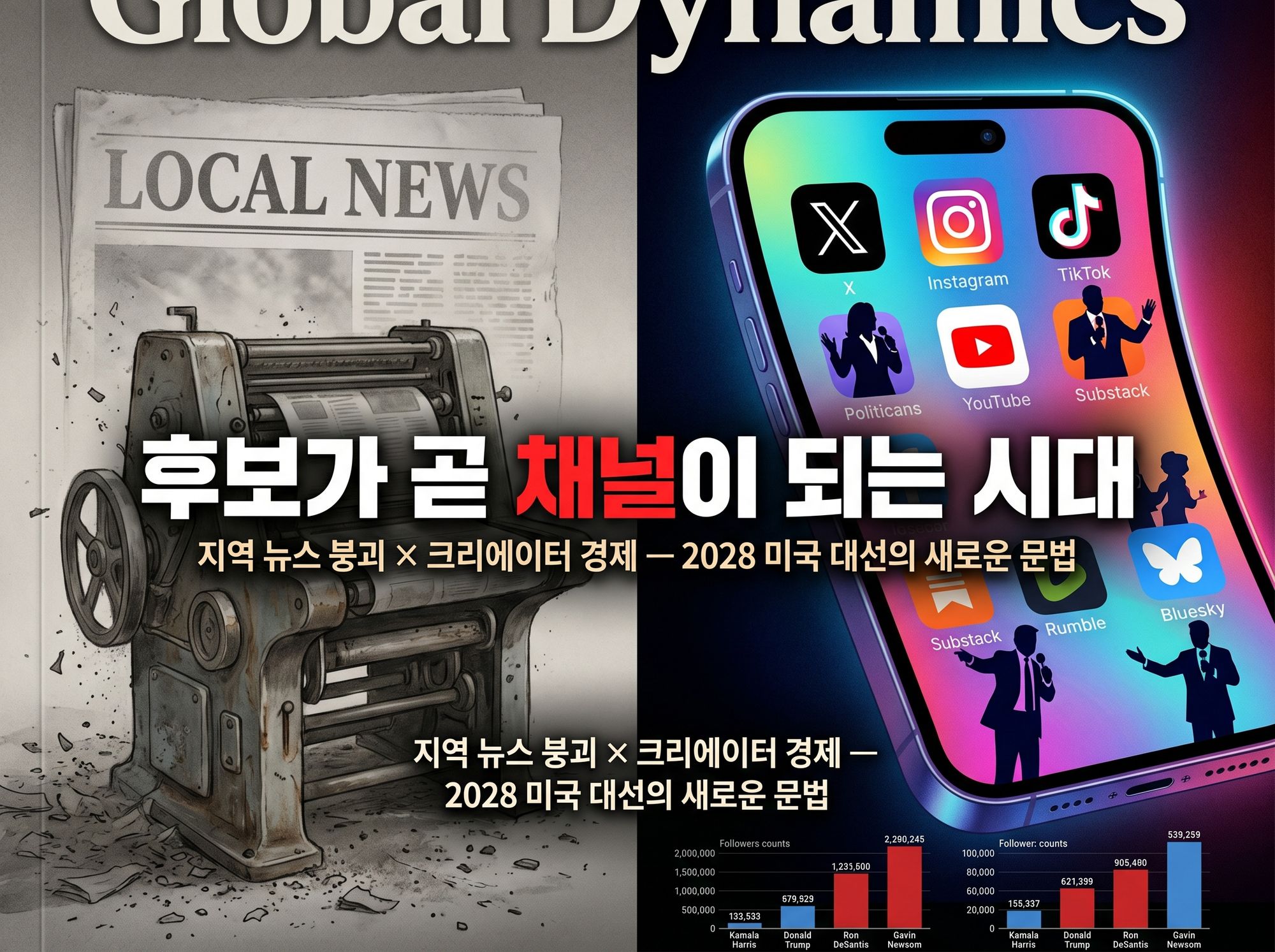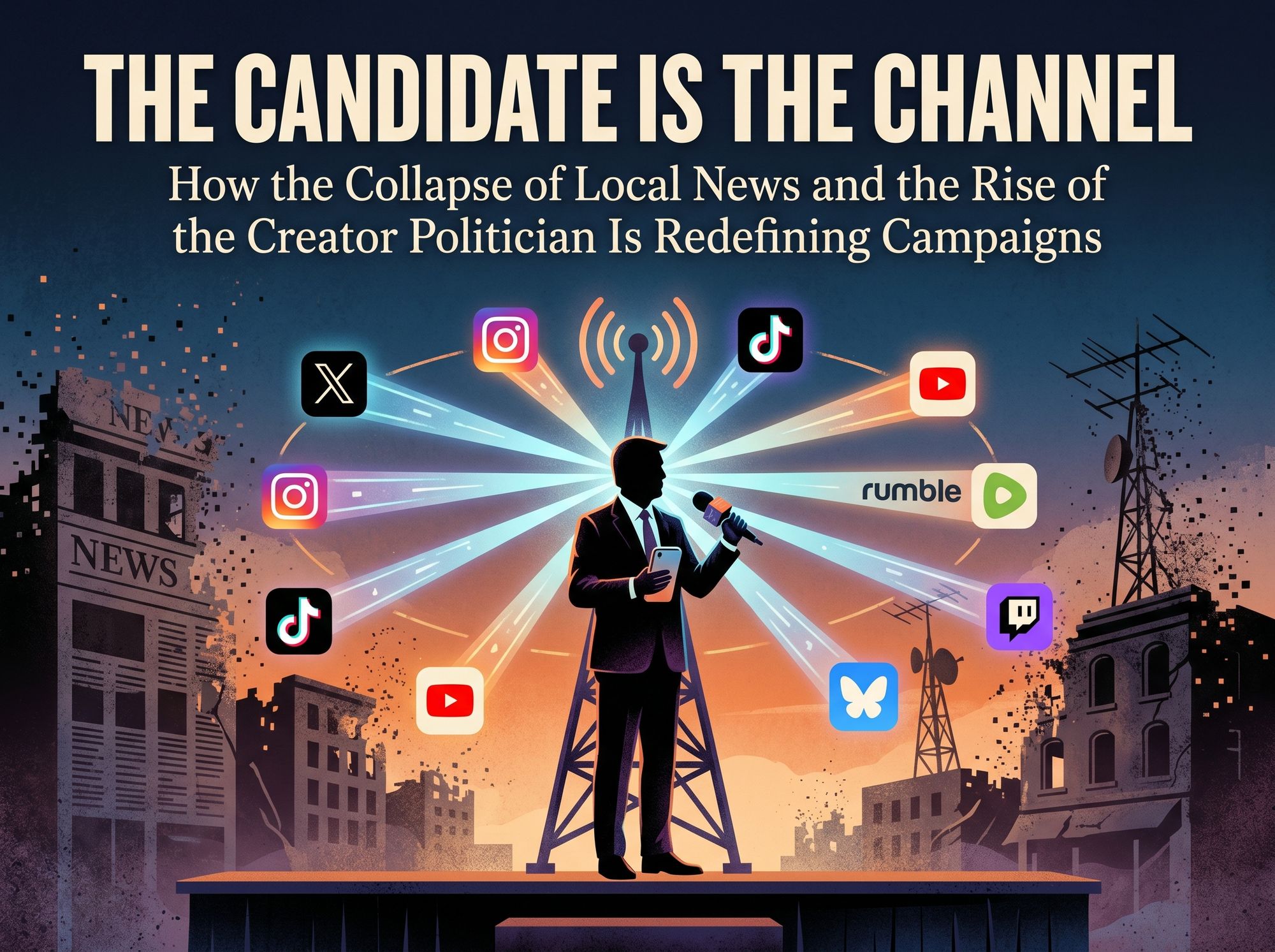
Local-news collapse and creator-economy diffusion have produced the era of candidate-owned channels
Potential 2028 U.S. presidential candidates are operating less like party-bound politicians and more like one-person media companies. The shift rests on two structural changes pulling in the same direction: the rapid collapse of America's local-news ecosystem, which has cut off the external coverage candidates once relied on, and the spread of creator-economy infrastructure that now lets anyone build a community on a platform. With both forces converging, candidates have begun running content production lines under their own names.

An Axios analysis of potential candidates' digital footprints published May 9 shows that former Vice President Kamala Harris (카멀라 해리스, 58.2 million followers), Rep. Alexandria Ocasio-Cortez (알렉산드리아 오카시오-코르테스, 29.0M), former Fox News anchor Tucker Carlson (터커 칼슨, 37.2M), and Donald Trump Jr. (도널드 트럼프 주니어, 35.2M) have established content footholds across X, Instagram, TikTok, YouTube, Substack, Rumble, and Bluesky. Politicians are migrating from being subjects of the news to operators of channels.
How local-news collapse made direct channels essential
Christian Tom (크리스천 톰), former director of digital strategy under the Biden administration, told Axios that creating one's own social and digital content is now table stakes for anyone seeking to influence people's lives. As local newspapers folded and regional broadcasters consolidated, candidates without owned channels lost the ability to reach beyond their home district. As candidates increasingly control their own distribution, governors, senators, and House members can now build national donor networks far beyond their home states — accelerating what was once a slow nationalization of American politics.
Republicans concentrate on X, Democrats diversify
Platform distribution splits along party lines. Republican contenders have roughly half their followers concentrated on X, while Democrats spread theirs across Facebook, Instagram, TikTok, and Bluesky. Pete Buttigieg (피트 부티지지), former Transportation Secretary, has built sizable Bluesky and Threads followings, and Ocasio-Cortez is testing Twitch (트위치) livestreams alongside her Bluesky (블루스카이) presence. Trump Jr. has skipped YouTube entirely, signing a multiyear deal with conservative-leaning Rumble (럼블) in 2023. LinkedIn has not yet emerged as a presidential channel, though Maryland Gov. Wes Moore (웨스 무어) and Trump Jr. have both built substantial audiences there.

Figure 1. Platform follower share of eight leading potential 2028 candidates. Ted Cruz shows the highest X concentration at 64%, while Tucker Carlson balances X dominance with a 15% YouTube share. The four Democrats display a more even spread across X, Instagram, TikTok, and Facebook.
Substack, podcasts, merch — the multi-stack as new standard
Content formats are diversifying. Democratic contenders dominate Substack (서브스택), with Buttigieg and California Gov. Gavin Newsom (개빈 뉴섬) building large subscriber bases. Podcasting attracts both parties: Newsom, Trump Jr., Kentucky Gov. Andy Beshear (앤디 베셔), and Sen. Ted Cruz (테드 크루즈) of Texas all run shows. Merch stores serve double duty as messaging tools and revenue streams — Newsom sells products that troll President Donald Trump, while Beshear runs a podcast-branded shop. Running video, newsletter, audio, and merchandise under one name has become the multi-stack template for top-tier contenders.

Figure 2. Media product holdings across 20 potential candidates. Books are nearly universal across parties; Substack skews Democratic; podcasts and merch stores appear selectively on both sides. Gavin Newsom is the only candidate operating all four formats.
Going viral isn't winning — the backlash against overproduction
Going viral does not always translate into votes. Grace Weinstein (그레이스 와인스타인), who tracks political content for the Substack "Who Broke It," argued that candidates imitating other politicians' online styles — citing Newsom's Trump-style posts — risk failing to build durable identities of their own. Heavily produced content can also backfire: when a lawmaker's video looks meticulously polished, it signals time the lawmaker is not supposed to have. Adam Mockler (애덤 모클러), a Gen Z political commentator, warned against over-indexing on the TikTok account; the real goal, he said, is to be "so omnipresent" that supporters and creators continuously clip and repost your content elsewhere.
Variables to watch — TikTok return and candidate video experiments
Two variables bear watching. The first: whether figures who once pushed to ban TikTok — Secretary of State Marco Rubio (마코 루비오), former Virginia Gov. Glenn Youngkin (글렌 영킨) — join the platform under its new ownership structure. Rubio posted a vertical video on X this week resembling a presidential-campaign teaser, while Ocasio-Cortez self-edited a vlog about a Girl Scout troop visit to her district. Weinstein read the AOC clip as a natural progression toward nationwide communication rather than a return to friendly-magazine profiles.
Three signals for Korea's media industry
Three implications follow for Korea's media sector.
First, as political advertising and political content migrate from terrestrial and cable networks to global platforms and candidate-owned channels, the election-cycle ad and ratings model that Korean broadcasters have leaned on will require redesign.
Second, Korean politicians' current dependency on YouTube and X is likely to diversify faster toward Substack, podcasts, Bluesky, and Twitch. Once candidate channels — not party structures — become the first-line message distribution path in the U.S., the same pressure will bear on Korean political communication.
Third, the free, personalized, data-rich video infrastructure being built by FAST and ATSC 3.0 can serve as a new distribution path for political content. The way U.S. contenders run Rumble, Bluesky, and Twitch in parallel with mainstream platforms maps closely onto the multi-stack strategy Korean broadcasters now need to reduce single-platform dependency.
When the candidate becomes the channel, the question for the media industry shifts from who covers the candidate to who competes with the candidate's channel.
Source: Axios Media Trends Executive (May 9, 2026, by Kerry Flynn and Sara Fischer) and Axios research