
At the 2026 K-Content Global Conference, Altamonte Springs Positions Itself as the U.S. Gateway for Korean Content and Culture Firms

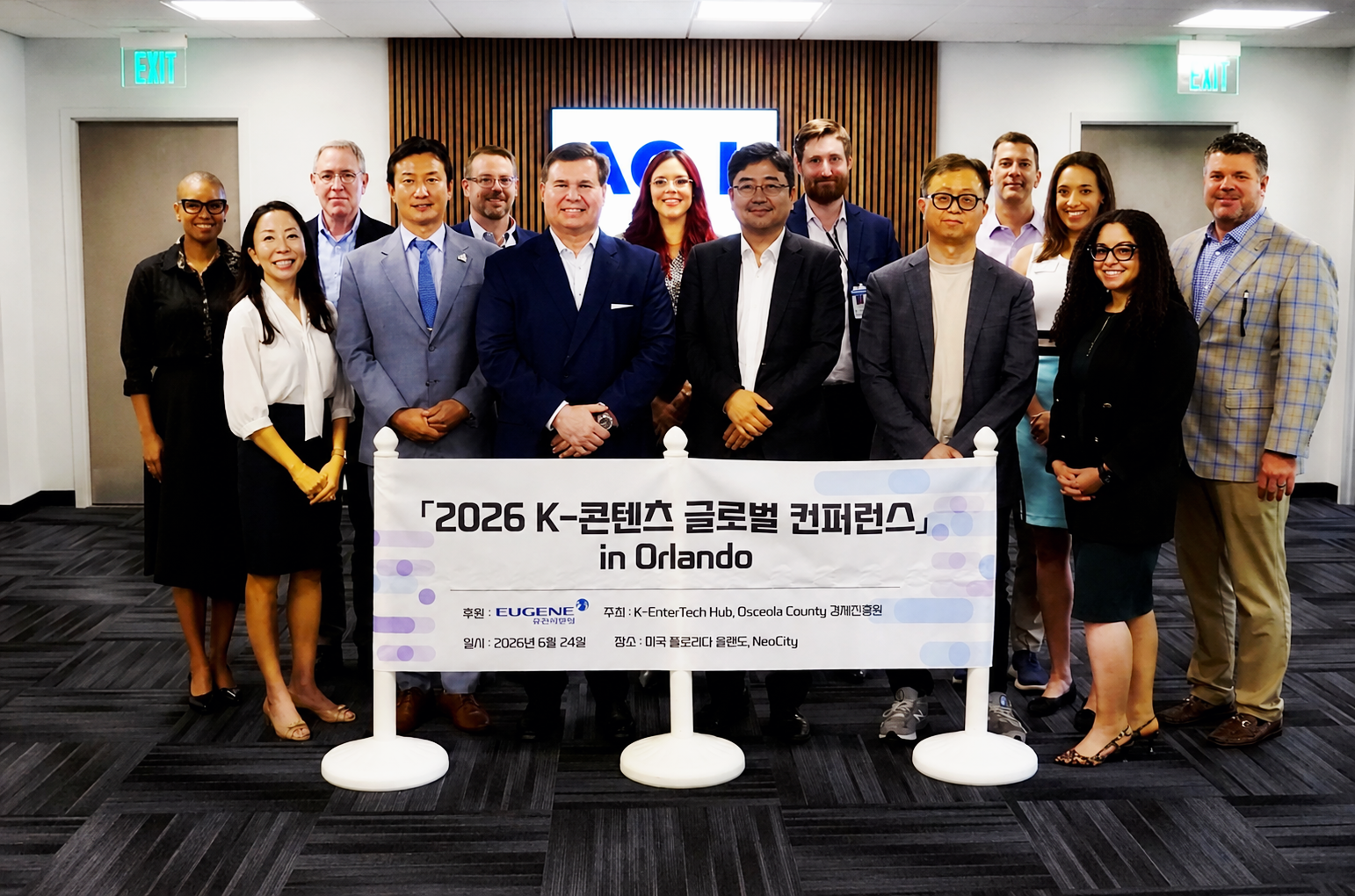
Sponsored by Eugene ENT and co-hosted by K-EnterTech Hub and the Florida Korean American Chamber of Commerce, the 2026 K-Content Global Conference (June 24, Altamonte Springs, FL) saw the city pitch itself—via a Korean-speaking AI avatar—as the U.S. "anchor-city" gateway for K-content firms

At the 2026 K-Content Global Conference, Altamonte Springs Positions Itself as the U.S. Gateway for Korean Content and Culture Firms

Co-hosted by K-EnterTech Hub and the Florida Korean American Chamber of Commerce, sponsored by Eugene ENT— pairing the AGīL AI living lab with Cranes Roost, a million-guest outdoor venue

The way U.S. local governments court Korean content and culture companies is changing. A contest once led by incentives and land has moved to unfamiliar ground: a stage on which to put content, and communication built with AI.

The 2026 K-Content Global Conference in Orlando, held on June 24 in Altamonte Springs, Florida with sponsorship from Eugene ENT, was a case in point. This city of about 45,000 greeted its Korean delegation not with a brochure but with a single film in which an AI “digital avatar” spoke Korean.

「2026 K-콘텐츠 글로벌 컨퍼런스」…美 알타몬테스프링스, K-콘텐츠·컬처 기업의 미국 관문 자처
플로리다 알타몬테스프링스, 유진 ENT후원 K콘텐츠 기업 미국 진출 세미나개최. AI 리빙랩과 대형 공연 베뉴를 앞세워 K-콘텐츠·컬처 기업의 미국 진출을 위한 실증·조달·공연이 결합된 새로운 거점 도시 모델 제시

Underneath the shift is a structural change in the U.S. market. Federal infrastructure and technology spending has climbed to record highs, while domestic-sourcing rules such as Build America, Buy America have raised the bar for foreign entrants.

The place that bundles compliance, procurement access and a real environment to test technology becomes the gateway. The conference — which set out to turn K-content’s global popularity into actual corporate expansion and local industry — stood on that terrain. It was co-hosted by K-EnterTech Hub and the Florida Korean American Chamber of Commerce (FLKACC).

The delegation from south Korea, The meeting was arranged by the Florida Korean American Chamber of Commerce (President Hunter Kim), with Kairos (CEO Jessica Kim) taking part. Hunter Kim had led economic-development work bringing semiconductor firms to Osceola County, which opened a pathway for further Korean investment.

A Korean-Speaking AI Avatar Instead of a Brochure

The roughly four-minute film handed to the delegation, “Edge at the Speed of Life — Korean Partners,” runs entirely in Korean. Its presenter is an AI digital avatar named “Catalyst,” captioned as the “Altamonte Springs Digital Avatar.”

After showing the city through a blue digital-twin display and an aerial of its downtown lake (Cranes Roost), the film explains the city’s support in three strands — Business Support, Market Awareness and U.S. Procurement Advisory. A Build America, Buy America seal appears beside the Altamonte Global Innovation Lab (AGīL) logo, and the closing frames name U.S. procurement advisory, Foreign Trade Zone access, a supportive local-government testbed and business-responsive workforce development as the city’s strengths.

City of Altamonte Springs

That a city handed its first greeting to foreign partners to an AI rather than a person signals that Altamonte Springs has moved AI from the back office of administration to the front of external communication. In a letter after the visit, City Manager Frank Martz called the film an example of “responsible and meaningful applications of artificial intelligence in communication,” and wrote that adopting new technology is a responsibility of government, provided it is used responsibly.

Why an ‘Anchor City’ Becomes the Gateway

Altamonte Springs’s bet is a one-stop structure that bundles regulation, procurement and testing. With TSG Advisors, the city built a Center of Excellence that handles Build America compliance, federal procurement, certification and workforce development in one place — an offer to clear, on a company’s behalf, the regulatory and procurement wall foreign firms hit first in the U.S.

The model gains force from the direction of federal budgets. As large infrastructure and technology funds flow and domestic-sourcing rules tighten, a region that has already laid a path through those rules grows more valuable. For K-content and K-tech firms, a mid-size city that pairs compliance with a testing ground is a practical alternative to the high costs of the coasts.

One City, Two Stages: An AI Living Lab and a Million-Guest Venue

Altamonte Springs was the first U.S. city to adopt AI-based site-plan review and has been debt-free since 2013. Martz said the city has long tested autonomous and connected vehicles and worked in water and energy, recently winning an international water-innovation award in Tokyo. It is now building nine digital twins and applies AI across its police department, human resources, GIS and asset management.

Its AGīL is a deployment platform of more than 40 public and private partners spanning Seminole County governments and the Orlando Sanford International Airport, which runs a Foreign Trade Zone; the city can approve new technology for use in public space so companies can test it and then deploy at scale. Real-time-translation AI body cameras, a staff chatbot that cites policy, an autonomous shuttle, a water program that reuses more than 500 million gallons a year, and AI pavement inspection all run inside one city.

At the same time, the city has a place to put content on a stage. Downtown Cranes Roost Park draws more than a million visitors a year as one of Central Florida’s leading outdoor venues, with a 900-seat Eddie Rose Amphitheater beside a 37-acre lake, a floating stage on the water and a choreographed fountain show; large events such as the Red Hot & Boom Independence Day celebration and the “Rhythms at the Roost” concert series are staged there. Holding both a living lab to test technology and a venue to stage content is an unusual combination for a K-content company.

The Roundtable: How Content Drives Urban Growth

The conference continued into a roundtable, “How Content Drives Urban Growth,” with Jung Han — more than two decades in broadcast journalism and the builder of Korea–U.S. media networks — moderating and putting questions to Martz and the others. K-content went global, he said, from “Gangnam Style” on YouTube in 2012 to the Academy Award–winning “Parasite” and Netflix’s “Squid Game”; about five years ago it moved beyond traditional production into a “local for global” phase of working with local communities.

Reaching beyond the West Coast and New York to partner locally, he argued, is what lets K-content earn revenue and grow in the U.S., and he called this a pivotal moment. The talk ranged over technology and innovation and — as the city noted — the Netflix animation “KPop Demon Hunters.” Dongguk University professor Samseog Ko, added the idea of “co-evolution,” in which content and communities advance by lifting each other.

Martz replied that Central Florida and his city are highly diverse and that he wants Altamonte Springs to be a place where international content is shared — the more people know about one another, the better they get along, he said, and content of many nationalities “makes this world smaller.” Jessica Kim, CEO of Kairos, who helped run and interpret the session, said K-EnterTech Hub’s media coverage had begun to make Altamonte Springs a search term on Korea’s Naver portal. The conversation ranged across technology, innovation and even the globally popular Netflix animated film “KPop Demon Hunters.”

The Companies the City Wants — and Yujin’s Calculation

Martz named the companies the city wants: transportation, lidar and functional radar; electric vehicles and autonomous-driving systems; energy firms that use bio-waste; and AI companies that lift productivity using data gathered in public spaces — transport, energy, mobility and utilities. As an end user that has run the technology in a real city, he said, Altamonte Springs would offer “third-party validation” to the U.S. market, and — as the first government to partner with the Florida Korean American Chamber of Commerce — he said Korea is “rich in intellectual opportunities” that can make U.S. communities better.

Martz stressed that the city does not move alone: an entry platform for foreign firms works only if the airport, a real-estate developer and the regional economic-development body move together. From the city, Deputy City Manager Rochelle Croskey, strategic-initiatives director Diana Lopez, Chief Mobility Officer Lenny Barden, strategic-program manager Daniel Halpin and human-resources director Kendall Gow took part, along with Scott Sturgill, founder of the Churchill Strategy Group.

The assets came with names attached. Stephen Fussell, the airport’s vice president and chief strategy officer, said the Orlando Sanford International Airport handles about 3 million passengers a year with room for 6 million, holds some 500 acres of greenfield and can land wide-body aircraft. Jessica Wilson, director of economic development at the Orlando Economic Partnership, challenged the “Disney town” assumption, noting that 80% of the region’s employment is in diverse industries rather than entertainment and hospitality. Kenneth Koch, Emerson International’s director of leasing, whose firm owns the building that hosted the meeting, said it could provide build-to-suit office space near the airport.

AGIL Lab

The meeting was facilitated by the Florida Korean American Chamber of Commerce (FLKACC), whose inaugural partner is the city; its president, Hunter Kim, framed the conference as a way to close a long-missing link between Korea and Central Florida, since visiting Korea in April he has worked to widen the prospects for Korean investment in Florida and pledged to help the delegation’s U.S. expansion with the region’s cities and counties.

Frank Martz, City Manager Altamonte Springs

Eugene ENT is part of the Eugene Group, a Korean building-materials conglomerate — a leader in ready-mix concrete — with dozens of affiliates that is expanding abroad. Eugene group's Kim Hyun-woo said the company is not trying to compete with Disney but to use the environment Disney created, and called the trip a possible first physical foothold for Eugene  global network in the U.S.

‘AI and Media,’ a Question of Co-evolution

A city’s Korean-speaking AI avatar raises, from the government side, the same question media companies face: how far and how responsibly to use generative AI. Sponsored by  Eugene ENT and co-hosted by K-EnterTech Hub and the Florida Korean American Chamber of Commerce, the conference offered an “anchor-city” model that bundles compliance, real-world testing and a stage for content itself. Both sides agreed to treat the meeting as a starting point for cooperation.