Substack, Patreon, Beehiiv and OnlyFans are converging on the same feature set — newsletters, video, live, subscriptions, commerce — even as their valuations are being repriced.
Substack’s launch of the Recording Studio on March 12, 2026 marks the moment the creator-platform market crossed decisively into a new phase: the competition is no longer about who owns a specific format, but about who runs the full content operating system. Recording, editing, auto-clipping, thumbnail generation, logo insertion and screen sharing now live inside a single platform — turning Substack, a tool that started life as a newsletter service, into an integrated infrastructure for video, podcasts, live and commerce. Patreon has pushed in the opposite direction, rebuilding its newsletter stack. Beehiiv has added podcast hosting and an ad network. OnlyFans already carries the full toolset. The result is that all four major creator platforms are converging on essentially the same feature map.

That convergence is being driven by three structural forces working in parallel. First, the “tool-fragmentation tax” on creators has hit its ceiling. Stitching together three to five external tools for recording, editing, clipping, thumbnails and distribution drains independent creators’ time, learning curve, and monthly SaaS bills. Whichever platform absorbs that chain raises its switching costs and locks creators in. Second, multi-format usage is now tied directly to revenue. Substack has disclosed that creators who used audio or video on the platform over the past 90 days grew revenue roughly 50% faster than those who did not. “Format expansion equals revenue lever” has become an operating rule. Third, in the post-pandemic repricing cycle, capital is rewarding “infrastructure platforms” over single-feature SaaS. Substack reached unicorn status at $1.1B after a $100M Series C in July 2025, and OnlyFans entered exclusive talks in January 2026 to sell a majority stake at a ~$5.5B valuation. Both pitches lean on the same narrative: format expansion, wider creator pool, higher revenue.
■ Why it matters: With differentiation gone, the rules of the war have changed
Until recently, positioning was clean: Substack owned newsletters, Patreon owned fan patronage, OnlyFans owned paid adult subscriptions, and Beehiiv owned newsletter growth tooling. As of April 2026, every one of those core capabilities — newsletters, websites, podcasts, live video, paid subscriptions, commerce — is effectively standard across all four. Once the feature list converges, the battle shifts to execution quality and switching-cost design. That is why each company is now positioning itself as “essential infrastructure” for the creator economy rather than as a category specialist.

▲ Creator platform features comparison (as of April 2026). / Source: Axios research; Axios Visuals
■ Deep Dive: Substack Recording Studio — The Missing Piece of the Full-Stack OS
The Recording Studio is not merely a new feature; it is the strategic move that reframes Substack from “newsletter tool” to “multi-format publishing OS.” Previously, making video on Substack meant going live or stitching together an external stack for recording, clipping and thumbnails. With the Studio, all of that happens inside Substack, and anything published is automatically distributed through the Substack network — mobile app, web, and connected TV via Substack TV.

▲ Substack Recording Studio preview (left) and published show view (right). Braun & Brains recording a snack-industry conversation with Express Checkout’s Nate Rosen. / Source: Substack official blog
① Recording Studio
A desktop-based environment for recording a solo show or a conversation with up to two guests. Hosts open a room from the “Create” menu; guests join the preview room from desktop or the Substack mobile apps. When the session ends, the platform generates the same auto-clips and thumbnails a live broadcast would produce. Rachel Braun of Braun & Brains used the Studio to record, publish and clip her conversation with Express Checkout’s Nate Rosen on snack-industry trends — the full workflow handled inside Substack.
② Publication branding
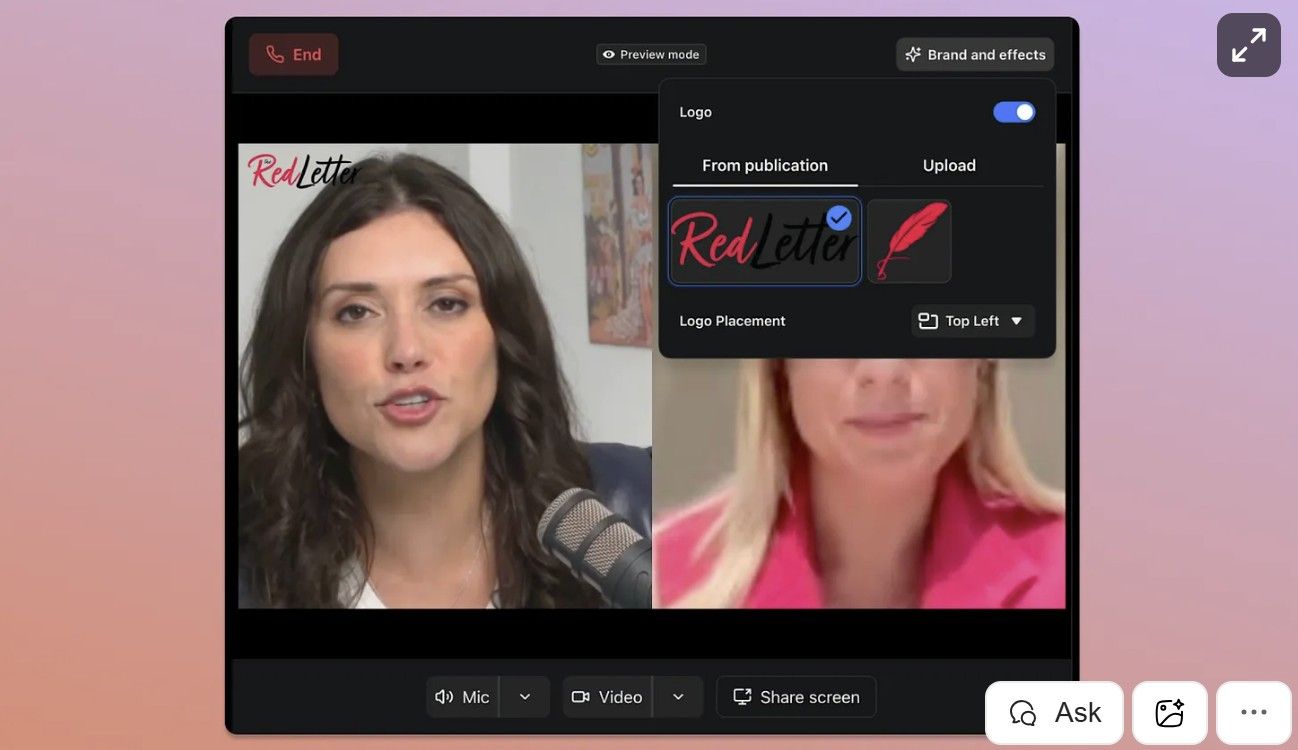
Hosts can now place a publication logo or wordmark in any live or recorded show, anchored at top-left, top-right or bottom-left, with the option to upload custom assets per show. Publisher Tara Palmeri added her Red Letter logo to an episode featuring congressional reporter Juliegrace Brufke. The feature is small in surface area but large in intent: it is the first step toward every Substack show having its own distinct brand identity, with the Substack network functioning as its distribution layer.
③ Screen sharing
Hosts and co-hosts can share their screens mid-conversation — a chart, a dataset, a news article, a draft — and the shared view is captured in the final recording, for both livestreams and Studio sessions on desktop. Audio from shared content is not yet captured but is on the roadmap. AI and exponential-technology analyst Azeem Azhar used the feature to demo how he runs his AI agent system on-camera.
④ Editable thumbnails
Building on the auto-thumbnail feature introduced in December 2025, creators can now select the frame and customize the thumbnail text across both live and recorded video. Catherine Price, publisher of How to Feel Alive, customized the thumbnail for her conversation with author Dan Coyle using the new editor.
■ The Counter-Move: Patreon Strikes Back With Newsletters
Convergence runs in both directions. As Substack has pushed down into video and live, Patreon has climbed up into newsletters. In October 2025 Patreon shipped a major newsletter upgrade: a code-free editor, the ability to embed multiple video and audio clips inside a single post, custom call-to-action buttons, open and click-rate analytics, and conversion insights that tie email performance to new memberships and revenue. “Flexible previews” let creators tease issues to free members while paywalling the full version — a low-pressure upgrade path.
Comedian and writer Chelsea Devantez migrated her Glamorous Trash newsletter to Patreon and started ending each issue with a discussion prompt, turning a one-way email format into an active comment community. Patreon’s own pitch — “cultureletters, sketchletters, beatletters, deadletters” — frames newsletters as one layer in a stack that already includes memberships, livestreams, merch and community chats. The positioning is clear: Patreon’s newsletters are not a standalone product but the connective tissue of a broader membership graph.
■ State of Play: Valuations Are Repricing, Even as Features Converge
Features are converging, but valuations are diverging sharply. What now separates the leaders is the maturity of the monetization stack, the depth of the creator pool, and the presence of secondary revenue layers such as advertising and commerce.
▶ OnlyFans — From $8B to $5.5B to $3.3B
• In 2025, founder and owner Leonid Radvinsky — a Ukrainian-American billionaire — began shopping the company at a reported $8 billion valuation.
• On January 30, 2026, Axios and the Wall Street Journal reported that OnlyFans had entered exclusive talks to sell a majority stake to San Francisco-based Architect Capital. The proposed structure: a 60% stake worth roughly $3.5B, implying an enterprise value of about $5.5 billion. That figure puts OnlyFans well ahead of peer creator-subscription platforms like Substack and Patreon — though still below public social-media companies such as Meta, Snap or Reddit.
• The financial profile is, by some measures, superior to those public peers. In fiscal 2024 OnlyFans generated $7.22 billion in gross revenue and $684 million in pre-tax profit. Over the same period Snap posted $5.46B in revenue and an operating loss; Reddit posted $1.3B in revenue and $298M in pre-tax profit. Architect Capital sees a potential IPO path for OnlyFans in 2028, according to the Wall Street Journal.
• The deal structure changed abruptly after Radvinsky’s death in March 2026. According to the Financial Times, talks are now centered on selling roughly 20% of the company at about $3.3 billion — a case study in how ownership uncertainty can compress enterprise value in the short run.
• Structural risk remains. In 2021 OnlyFans briefly announced a ban on “sexually explicit” material, then reversed course after a backlash from adult creators. The platform’s dependence on adult content continues to complicate its relationship with payment vendors and its standing in ESG-screened capital.
▶ Substack — 5M Paid Subscriptions, $1.1B Unicorn
• In July 2025 Substack closed a $100M Series C, bringing total capital raised to roughly $200M and the valuation above $1.1 billion. Against the 2021 benchmark of 1M paid subscribers at a $650M valuation, the paid base has grown roughly 5x while enterprise value has grown about 1.7x.
• The round was led by Andreessen Horowitz, with participation from The Chernin Group, BOND, Klutch Sports Group founder and CEO Rich Paul, and Skims co-founder and CEO Jens Grede. BOND’s Mood Rowghani joins the Substack board — an unusually tight alignment of media, sports and fashion capital around a single creator platform, and one directly linked to Substack’s creator-recruitment strategy.
• Substack takes a 10% cut of subscriptions sold on its platform — higher than rivals such as Ghost or Beehiiv — in exchange for a broader marketing funnel, advertising support, and, in some cases, health-care benefits for top creators.
• The journalism pipeline continues to favor Substack. Former CNN anchor Jim Acosta, former ABC journalist Terry Moran, and former MSNBC host Joy-Ann Reid have all moved independent, with Acosta surpassing 10,000 paid subscribers within weeks of leaving CNN. More than 50 creators on the platform now earn over $1M a year. Co-founders Chris Best, Hamish McKenzie and Jairaj Sethi said the new capital will go toward “better tools, broader reach, and deeper support for the writers and creators driving Substack’s ecosystem.”
▶ Patreon — $400M+ Raised, $4B+ Valuation Since 2021
Patreon, which launched four years before Substack, has raised more than $400M to date and was last valued at over $4B in 2021. Rather than raising a new round at a reset price, Patreon is betting on product expansion — newsletters, a personalized home feed — to generate the next repricing event on its own terms.
▶ Beehiiv — $225M Valuation in 2024
Founded in 2021, Beehiiv reached a $225M valuation in 2024. It is the only one of the four major platforms operating its own ad network, and differentiates primarily through growth tooling — subscriber referrals and creator referrals — aimed at compounding the network effect of email itself.
■ What to Watch: Substack’s Ad Experiment — The End of Subscription Purism
Substack has spent most of its life rejecting advertising in favor of a subscription-first, direct-to-reader model. That identity is now being revised. In December 2025 co-founder Hamish McKenzie outlined plans for a pilot sponsorship program. Emily Sundberg, who runs the Feed Me newsletter on Substack, framed the intent as filling a gap for independent creators who spend significant time coordinating sponsorships on their own. The signal is larger than the product: the industry’s operating question is shifting from “subscription vs. advertising” to “subscription plus advertising plus commerce plus live sponsorship, all in one stack.”
■ Implications: Three Axes for the Korean Creator Economy
The launch of Substack’s Recording Studio and the feature convergence across all four majors signal a decisive move from the “single-feature SaaS” era of creator tools into the “full-stack content OS” era. For the Korean creator economy, three response axes emerge.
• First, integrated infrastructure capacity. Korea needs platforms capable of unifying newsletters, podcasts, live, commerce and paid subscriptions into a single operating layer. A full-stack play that connects the B2B2C assets of Naver, Kakao, SK Broadband and KT-affiliated OTT and telecom platforms with domestic creator SaaS is now time-sensitive.
• Second, multi-layer monetization. Advertising, subscriptions, D2C commerce, fan patronage, and sponsorship matching must be provided to creators as defaults, not add-ons. Substack’s advertising pivot is a signal that subscription purism is over; Beehiiv’s ad network is evidence that even newsletters are now media vehicles.
• Third, creator-asset portability. As switching costs rise across platforms, the ability for creators to own and migrate their own email lists, fan data and content archives becomes the next competitive benchmark. That agenda connects directly to digital-content policy at the Ministry of Science and ICT (MSIT) and the Korea Communications Commission (KCC), and to the global K-content distribution agenda at the Korea Communications Agency (KCA) and the Korea Creative Content Agency (KOCCA).
In short, the 2026 creator-platform contest will be decided not by who ships a new feature first, but by who runs the full stack most seamlessly and builds the thickest revenue structure on top of it. The Substack Recording Studio is the opening shot of round two.