U.S. Lawmakers Take Aim at ‘AI Style Theft’: Bipartisan CREATOR Act Introduced, With Adobe Out Front

A bipartisan U.S. House bill (CREATOR Act), backed by Adobe, would create a new federal right letting visual artists sue when generative AI is used to commercially impersonate their signature style — while carving out parody, fan art, and AI research — with major implications for K-content

U.S. Lawmakers Take Aim at ‘AI Style Theft’: Bipartisan CREATOR Act Introduced, With Adobe Out Front

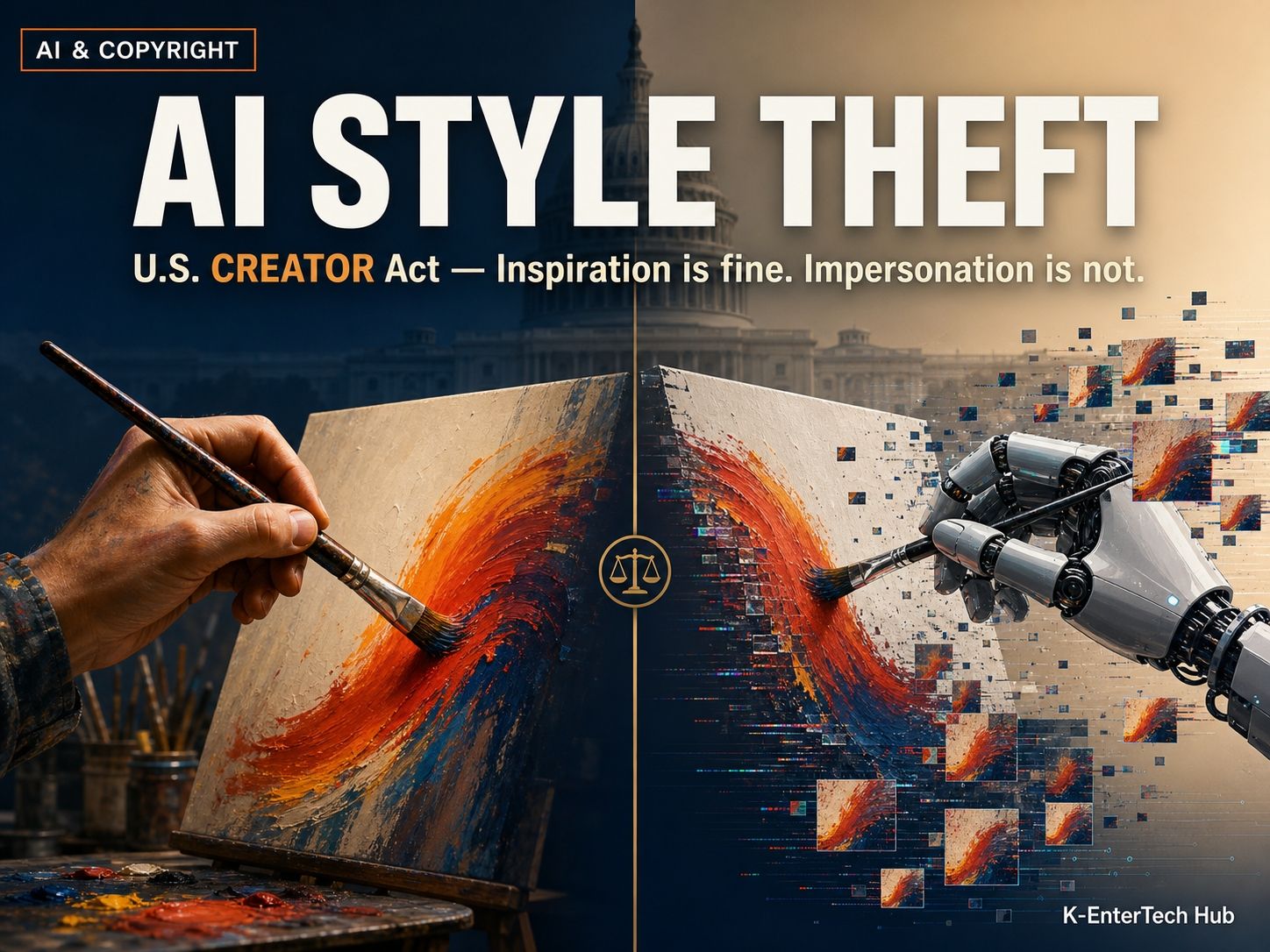
New federal right would protect an artist’s “style” beyond registered works — “inspiration is fine, impersonation is not.”

Parody, fan art and AI research carved out — Adobe: “the creative economy is worth $1.2 trillion, about 4.2% of U.S. GDP.”

U.S. lawmakers have introduced a bill to curb the use of generative artificial intelligence (AI) to copy an artist’s signature style and exploit it commercially without permission. The driving concern: with a single text prompt, anyone can now mass-produce images mimicking a specific artist’s signature style — at no cost, in seconds, and without consent or compensation — and flood the marketplace with them. While copyright protects individual registered works, the style an artist spends years refining has fallen through a legal gap that no statute addresses. This bill aims squarely at that gap.

美 의회, ‘AI 화풍 도용’ 정조준…초당적 ‘크리에이터법’ 발의, 어도비가 전면에
미국 의회 생성 AI가 화가의 고유한 작풍을 무단으로 베껴 상업적으로 활용하는 행위에 제동을 거는 법안 발의. 특히, 작가 ‘스타일(Style)’ 자체는 어떤 법의 보호도 받지 못하는 현실 정조준

The measure, known as the CREATOR Act (Creative Rights for Artists’ Technique and Originality Are Reserved Act), would give visual artists a way to fight back when their style is imitated without authorization. According to the media outlet Axios, the bill was introduced by a bipartisan group of House members: Beth Van Duyne (R-Texas), Yvette D. Clarke (D-N.Y.), Burgess Owens (R-Utah) and Valerie P. Foushee (D-N.C.). Imaging and design software maker Adobe has stepped to the front of the effort to back it.

The law protected “what you make,” not “how you make it”

A signature style is the product of years of practice and dedication. Artists hone their technique, their sense of color and tone, their capacity to express an emotion or an idea, and ultimately their creative decision-making. Over time those skills harden into something unmistakably their own — for many creators, their identity in the marketplace and the core of their livelihood.

Artists have always learned from and influenced one another. But Adobe argues that AI now automates imitation at a scale and speed fundamentally different from traditional artistic influence. Copyright protects what you make, the company notes, not your visual identity or style; existing and proposed laws address voice and likeness, but none was built to cover a visual artist’s distinctive aesthetic.

Case study: illustrator Fabiola Lara

Adobe pointed to Fabiola Lara, a Philadelphia-based illustrator. An AI platform, seeking to showcase its technology, approached her with AI-generated images imitating her work — without asking permission. The ease with which those images were produced, Adobe says, poses a direct threat to her artistic identity and her livelihood.

Inspiration is one thing. But this was impersonation.  — Louise Pentland, Chief Legal Officer, Adobe

The point, in other words, is that drawing inspiration from other artists is part of the craft — but copying a specific artist’s style almost wholesale, and trading on that person’s name, reputation and market position, crosses into impersonation and unfair conduct.

What the bill does — and doesn’t do

The bill establishes a federal right protecting a visual artist’s signature style from intentional, commercial AI-enabled impersonation. Creators would be able to seek damages and demand that the impersonation stop.

Adobe stressed how narrowly the bill is scoped. Its target is the bad actor who knowingly uses AI to fake an artist’s identity for commercial gain. Artistic influence, parody, fan work and broad AI research and development are all left out. By focusing only on deliberate, commercial impersonation of identifiable artists, the bill seeks to protect human creators without choking innovation.

A “safe harbor” for platforms — conditioned on notice-and-takedown

The bill pairs liability provisions for AI platforms with a safe-harbor clause. So long as a platform complies with the statute’s notice-and-takedown requirements, it is shielded from liability for infringement committed by its users. The structure goes after the bad actors driving the infringement while protecting compliant platforms. Van Duyne’s office said it has been in contact with tech platforms, which are largely supportive — a single federal standard is easier to follow than a patchwork of differing state rules.

No registration mandate — and a split over how to judge claims

The bill, however, only sets up the framework; it does not require creators to register their style or likeness in a database. That leaves no central registry to reference in a dispute. Clarke argued that, to avoid leaving enforcement to platforms, an independent arbiter is needed to assess the validity of creators’ claims — though the bill spells out no such mechanism.

Van Duyne, for her part, said creators should not have to register their likeness the way musicians register songs with the Copyright Office. She pointed instead to an “ordinary observer test” — the idea that an average person can tell when someone’s style has been copied.

Why Adobe is pushing it: the Content Authenticity Initiative

Adobe has advocated creator-first AI policies for years, including clear paths for creators who use AI in their process to secure copyright protection.

The company co-founded the Content Authenticity Initiative — now more than 6,000 members strong — to bring transparency, attribution and credit to digital content. It also emphasizes practical tools such as Content Credentials, which let creators signal how they want their work used in AI training.

The stakes are bigger than they look: $1.2 trillion

Adobe frames this as more than a creator issue. The U.S. creative economy generates about $1.2 trillion a year — roughly 4.2% of GDP. If AI impersonation erodes the ability of artists, designers, photographers and illustrators to sustain their careers, the logic goes, entire industries and the brands and platforms that depend on them lose too.

How it differs from earlier bills — and what comes next

Numerous bills on AI impersonation, deepfakes and data protection have been introduced, but visual artists have remained a blind spot. Even the NO FAKES Act, which protects a person’s voice, face, likeness and performance from unauthorized AI replicas, does not explicitly address visual style. Rep. Ro Khanna (D-Calif.) introduced a “Creator Bill of Rights” resolution earlier this year, but it is not a law. Van Duyne and Clarke launched the bipartisan Congressional Creators Caucus last year, and the CREATOR Act is regarded as one of the first major bills to emerge from that effort.

The open question is momentum. Congress is gridlocked, but Van Duyne expects the sheer reach of the creator economy across all 50 states to help build bipartisan support. Adobe, too, has urged Congress to move quickly.

ANALYSIS

Style Protection Is the Next Frontier for K-Content and EnterTech

Style is a core asset of K-content

In webtoons, illustration and character design — and in K-pop, dance, choreography and performance — an individual’s distinctive style is itself intellectual property and brand, translating directly into revenue models and global competitiveness. Now that generative AI can learn and reproduce the styles of specific artists and performers, style protection is no longer a matter of isolated disputes; it is a strategic issue that shapes the industrial structure of K-content as a whole.

The “inspiration vs. impersonation” line and provenance labeling set the baseline for domestic policy and platform design

As in the U.S. debate, Korea needs a standard that recognizes drawing inspiration from others’ work as legitimate artistic practice, while treating the act of foregrounding a specific artist’s, dancer’s or idol’s name and style to build what is effectively a substitute as impersonation and a source of consumer confusion. Layering in provenance-and-process disclosure technology such as Content Credentials would give Korea the infrastructure to distinguish whether a piece of content is a genuine human creation or an AI imitation of someone’s style.

Legislation should advance in stages through unfair-competition, publicity and attribution lenses — not by inventing a new “style copyright”

Recognizing style itself as a standalone object of copyright is difficult in terms of international harmonization and enforceability. A realistic first step is to capture, within unfair-competition law, the right of publicity and the right of attribution — or through equivalent special rules and guidelines — the act of using a particular artist’s or performer’s renown and recognizability to generate AI lookalikes for commercial use. Doing so allows fandom-based derivative works to be normatively separated from commercial substitution and impersonation.

Entertainment tech firms and platforms should build a proactive “private standard” through AI guidelines and contract structures

Companies building global businesses on K-pop, webtoon and game IP should establish their own rule-sets rather than wait for legislation. At the platform level, that means restricting prompts that directly invoke an artist’s style or name, offering officially licensed style presets, and applying AI/live-action labeling and metadata. At the contract level, agreements with creators should specify the permitted scope of AI training, the secondary use and revenue-sharing of style and performance data, and renegotiation clauses for future legal and regulatory change. This positions Korean operators as “prepared partners” with negotiating leverage as CREATOR Act-style frameworks take shape abroad.

K-content’s global strategy must expand from “exporting content” to “exporting governance for the age of style”

Ultimately, the message of K-content and EnterTech no longer ends at “we export good content.” The next-generation edge lies in exporting a full “IP governance package for the age of style” — AI-use principles, platform policies, contract structures and provenance-and-transparency standards that respect the styles and performances of artists and creators. K-pop, K-webtoons and the EnterTech solutions around them can become a model and reference for how to protect creator rights and fandom culture at the same time in the era of generative AI.

Sources: Axios, “Bipartisan members introduce new bill to protect creators from AI style theft” (Sara Fischer); Adobe Blog, “The CREATOR Act is the protection artists need in the age of AI” (Louise Pentland, June 2, 2026).