
U.S. Cable Industry Pushes Back Against Next-Gen Broadcast Standard Transition Policy
"1997 Supreme Court Ruling's Foundation Has Collapsed... Must Carry Is Anachronistic in the Online Era"
NCTA – The Internet & Television Association, representing the U.S. cable and internet industry, has strongly opposed the FCC's attempt to extend mandatory carriage (must carry) requirements to ATSC 3.0 (NexGen TV) signals, arguing it would violate the Constitution. NCTA contends that in today's video marketplace, must carry requirements can no longer be constitutionally justified, and extending them to ATSC 3.0 would clearly violate both the First Amendment (freedom of speech) and Fifth Amendment (property rights protection).
I. NCTA's Core Argument: The Constitutional Foundation for Must Carry Has Collapsed
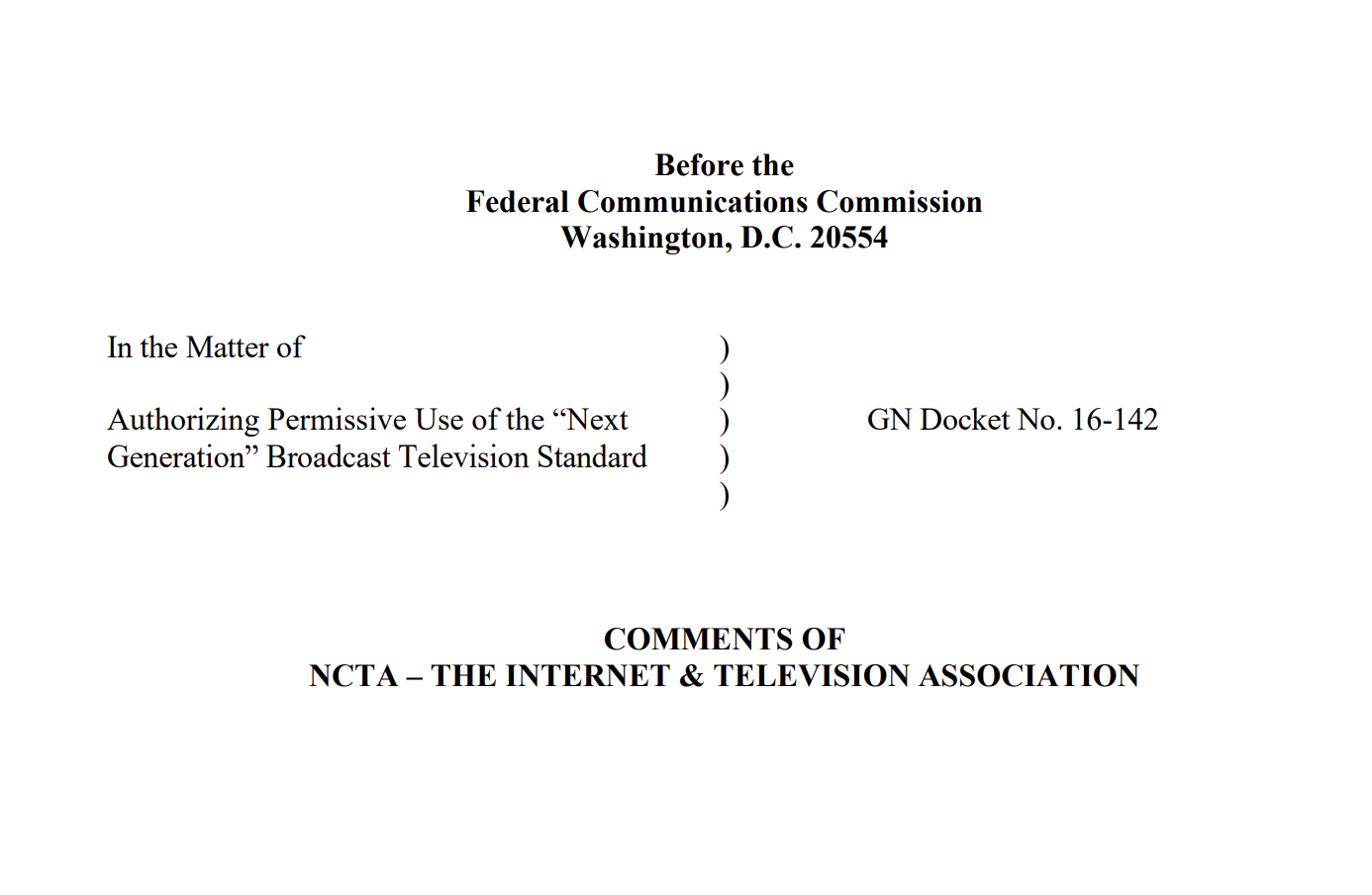
In its January 20 filing with the FCC (GN Docket No. 16-142), NCTA stated that "must carry requirements for 3.0 signals would impose substantial burdens on cable operators that would violate the First and Fifth Amendments."
This filing responds to the FCC's Fifth Further Notice of Proposed Rulemaking released on October 29, 2025, directly rebutting broadcasters' requests for mandatory carriage rights for their ATSC 3.0 signals.
First Amendment Violation Arguments
Under current law, cable operators must set aside up to one-third of their channel capacity for local TV stations that demand carriage without compensation. This must carry requirement was upheld as constitutional by the Supreme Court in Turner Broadcasting System, Inc. v. FCC (1997).
However, NCTA argues that the Supreme Court's decision was based on "a record of tens of thousands of pages of evidence" reflecting market conditions of that era, when cable operators possessed "bottleneck" control over video programming delivered to households.
NCTA's lawyers stated in their filing: "As the Commission itself has recognized, the video marketplace has changed dramatically since that 1997 decision. The government's interest in preserving local broadcast television can be achieved in a plethora of other, less burdensome ways, and no government intervention is necessary to ensure that each household has access to a broad diversity of video programming given the massive shift to online distribution."