
U.S. Regional Market Watch — Nevada
Growth is concentrating in healthcare, technology, advanced manufacturing and education; 150,000 job postings yielded only 22,000 lasting placements. A “Lithium Loop” construction-and-housing bottleneck and the nation's fastest-growing information sector — and how K-Nevada Gateway 2026 bridges in as a local partner.
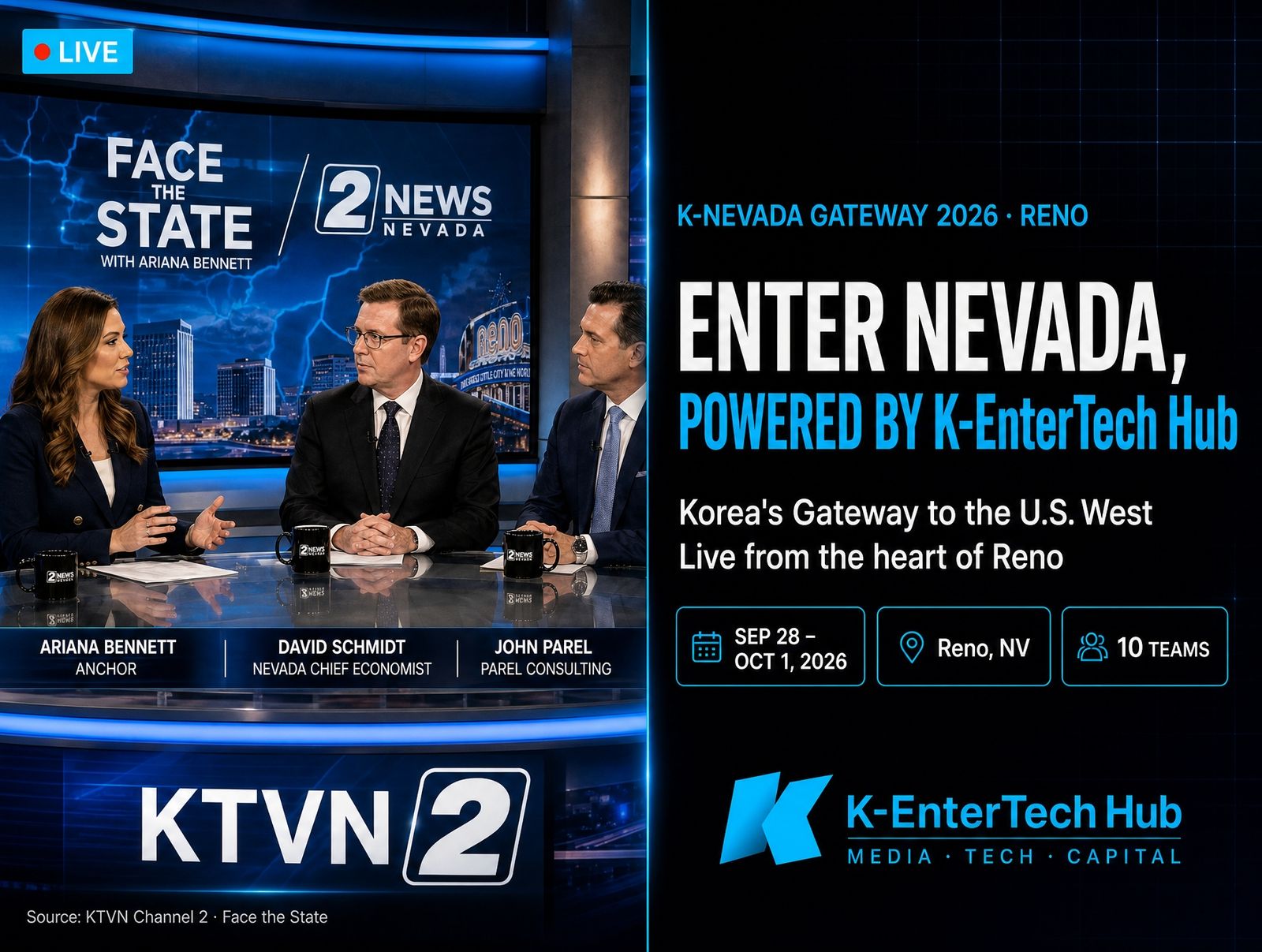
Source: KTVN Channel 2 (2 News Nevada) public-affairs program “Face the State” (host Ariana Bennett) · Watch the broadcast

Host Ariana Bennett (left) with DETR Chief Economist David Schmidt (center) and ESD Deputy Administrator for Workforce John Parel (right) on KTVN Channel 2's “Face the State.” Screen capture: KTVN Channel 2
The bottleneck in Nevada's labor market is not a shortage of jobs but the skills gap that separates jobs from people, officials said. According to the state, roughly 150,000 job postings went up in 2025, yet the state employment agency connected and retained only about 22,000 workers in jobs they held for a year or more.

Automation is erasing existing roles while creating new ones such as maintenance and cybersecurity, and a chronic shortage in healthcare and education together with a rural construction-and-housing bottleneck now operate at once — leaving labor shortage and job shortage coexisting within a single market. From an industry standpoint, that gap amounts to an entry space for outside technology and firms.
The assessment came from David Schmidt, Chief Economist at the Nevada Department of Employment, Training and Rehabilitation (DETR), and John Parel, the Employment Security Division (ESD) Deputy Administrator for Workforce, who recently appeared together on KTVN Channel 2 (2 News Nevada)'s public-affairs program “Face the State.” At the time of the interview the state had about 1.6 million employed and roughly 90,000 unemployed; state data put the March 2026 seasonally adjusted unemployment rate at 5.3% and the labor force near 1.7 million.
Growth Concentrates in Four Sectors
Healthcare tops Nevada's growth sectors. On the program, Parel said healthcare “has many doors to enter, so the opportunities open to newcomers are broad.” Technology is the second engine, seeping into nearly every other industry, followed by advanced manufacturing and education. Education in particular was singled out as a fast-growing field on strong demand for teachers and other professionals, and the state concentrates training programs and funding on these four sectors.

Nevada's four high-growth sectors — healthcare, technology, advanced manufacturing and education — anchored by state training and support.
Nevada's high-growth industries condense into healthcare, technology, advanced manufacturing and education. The state has designated them as future growth engines and is concentrating workforce development, vocational training and business incentives — its “state support” — to push the momentum further.
The labor-market mismatch is sharpest where automation is moving fast. Citing distribution centers, Parel noted that “automation replaces some jobs while creating new roles to maintain that equipment, along with added demand in areas like cybersecurity.” The overall labor force is growing, but the gap between the skills job seekers hold and the skills the jobs require is the heart of the problem.
Free Training and the EmployNV Hubs
Parel pointed to the EmployNV hubs as the main channel pulling new entrants and job-switchers into Nevada's labor market. There are 34 hubs statewide, with a center inside every community college, and each hub's career coaches help design individual career pathways. In northern Nevada, hubs in Reno, Sparks, Fernley and Fallon connect local demand and talent directly.

A guest explains Nevada's labor-market conditions on “Face the State.” Screen capture: KTVN Channel 2
Key Data
Training support is also close to fully free. Beyond traditional tuition pathways, EmployNV covers the cost when shorter-term certificates are needed, and runs reskilling and upskilling courses on a free-of-charge basis. The results show up in the numbers: last year EmployNV connected about 22,000 people to jobs they kept for a year or more, and worked with close to 8,000 employers over the same period.
By contrast, roughly 150,000 job postings went up across Nevada in that span — jobs themselves are abundant. The gap ultimately shows that the “connection infrastructure” linking people to roles and filling the needed skills is the key to closing the labor-market mismatch.
Doctors, Builders — and Housing as the Real Bottleneck
At the very top of training demand sit medical specialists. Both officials agreed that a shortage of specialists has become a structural, entrenched problem across Nevada, and that expanding medical residencies is urgent. Without raising residency slots in essential specialties and building out hospital-linked education and training infrastructure, they warned, the state will struggle to absorb its aging population and population inflow.
Construction is in much the same bind. In rural northern Nevada — Humboldt, Elko and Eureka counties — unemployment itself is low, yet it is hard to secure the construction workers needed to build housing and infrastructure there. Even in places like Winnemucca, where a new lithium mine is drawing population, a shortage of housing acts as a bottleneck that keeps construction labor from staying.
Workers ultimately drift toward cities like Reno that offer higher wages, and with them goes the capacity to train and pass skills to the next generation — a vicious cycle. Schmidt called housing the ultimate bottleneck variable blocking Nevada's migration and growth, stressing the need for a package approach that pairs a housing-supply strategy with labor and industrial policy.

How EmployNV links job seekers and employers to job listings, career coaching and skills training. Job information is available at EmployNV.gov.
DETR concentrates its budget on four sectors — advanced manufacturing, technology, healthcare and education. Working with regional hospitals, the nursing industry and manufacturers, it designs occupation-specific career pathways, and this year it introduced a career-guidance program for middle-schoolers to plant the “seeds” of career exploration in younger students. The aim is to realign the education-and-training system around industry demand and reduce on-the-ground mismatch over the long run.
On fears that AI will take jobs, the speakers recalled that the history of technological change has itself been a process of creating new occupations and demand. Parel cited how, when ATMs arrived, predictions poured in that bank tellers would vanish — yet new roles in financial services and wealth management actually grew — and projected that AI will likewise bring new jobs in cybersecurity, data operations and digital health. Schmidt emphasized that Nevada's information-sector employment is currently growing faster than in any other state, and that the medium-to-long-term growth potential of technology-based industries is, if anything, expanding.
Korea Connection — Filling the Gap with a Local Partner
Most of what Nevada cannot fill with its own workforce is a “market filled by technology”: maintenance of automated systems, digital health to offset the medical-staffing gap, productivity and robotics to relieve the construction-and-housing bottleneck, and AI-and-content infrastructure tied to surging data centers. The Winnemucca lithium mine and the Tesla-Panasonic “Lithium Loop” open supply-chain access for Korean battery and cleantech firms, while the nation-leading growth of the information sector aligns with the entry timing for Korean AI, media and XR startups.
The key is a local-partner network that can fill those gaps together. K-EnterTech Hub — with Pacemakers and The Way Company — will run “K-Nevada Gateway 2026” this September, serving as the EnterTech bridgehead that connects Korean companies to Nevada's four growth pillars, the Lithium Loop, the FAA drone test range, and the R&D capacity of UNR and DRI. Through simultaneous collaboration with local institutions and companies, the goal is to give Korean firms a multi-layered entry path that moves beyond simple buyer meetings to pilots, PoCs and investment.
Local Partners (Nevada)
UNR Ozmen Center
The main partner. It is the venue for the K-Startup Showcase, VC meetings, and seminars/workshops, with Director Dr. Mehmet Tosun co-planning and coordinating the program.
EDAWN · GOED
The Economic Development Authority of Western Nevada (EDAWN) and the state Governor's Office of Economic Development (GOED) are the gateway for the full landing process — investment attraction, incorporation, licensing and hiring. They serve as core partners on incentives, regulation and siting for Korean firms entering Nevada.
NCAR
An applied-research and biosciences incubator, and the hub connecting R&D and PoC in technology-intensive fields such as healthcare, bio, AI and semiconductors. It supports joint research and pilot-project design among hospitals, labs and companies.
Reno Startup Week 2026
A startup festival running September 29–October 2; as an official affiliate, K-Nevada Gateway enters the global startup-and-investor network at the same time, with one-stop access to conference sessions, networking and side events.
Site-visit companies
Participants visit nine innovation leaders representing Nevada — Tesla, Panasonic, Dragonfly, Renown Health, Nevada Autonomous, DRI, Switch, UNR — to see manufacturing, R&D, data centers and drone test ranges firsthand. It is strongly a “field research” track for uncovering sector-by-sector collaboration points across energy, healthcare, AI and mobility.

Nevada Growth Drivers ↔ K-Nevada Gateway Sectors
- Energy & battery (Lithium Loop, Winnemucca mine)
→ Energy / Battery track: supply-chain and co-development opportunities tied to the battery-energy ecosystem of Tesla, Panasonic and Dragonfly. - Healthcare shortage (specialists, residencies)
→ Medical / HealthTech track: PoC demand in digital health, telemedicine and medical AI linked with Renown Health and NCAR Biosciences. - Information sector, fastest U.S. growth
→ AI / Content / Media track: AI, data and content-infrastructure demand anchored by the Switch data center and UNR VARI; entry timing for media, XR and EnterTech firms. - Advanced mfg / automation maintenance
→ Semiconductor / AI track: demand for semiconductor processes, manufacturing automation and maintenance/monitoring solutions, linked with NCAR and the Nevada AI hub. - FAA UAS test range (1,000 sq mi)
→ Drone / Mobility track: BVLOS (beyond-visual-line-of-sight) drone testing centered on Nevada Autonomous, plus autonomous-driving and mobility projects. - Desert Research Institute, water & agriculture
→ AgTech / CleanTech track: climate, water, smart-farm and cleantech collaboration with DRI and UNR Agriculture, and chances to validate desert/arid-climate-specific solutions.
In this way, K-Nevada Gateway precisely matches Nevada's growth drivers with the technologies and solutions of Korean and Asian companies on a track-by-track basis — designing a practical entry path in which Korean and global partners help fill the “vacancies that workers alone could not.”
[ Summary ] Growth drivers ↔ program sectors
K-Nevada Gateway 2026 — Program Overview
A platform for Korean and Asian startups entering the U.S. market through Nevada. It packs a K-Startup Showcase, 1:1 VC meetings, Korea Night, and site visits to nine companies (Tesla, DRI and more) into four days, while linking to Reno Startup Week 2026 for simultaneous access to the global startup-and-investor network. After the program, the “K-Nevada Bridge” provides year-round support for PoC and pilot matching and CES 2027 linkage.
Four-Day Intensive Schedule
DAY 1 — Sep 28 (Mon) · Arrival & Welcome
Arrive Reno-Tahoe / orientation & team building / check-in at Whitney Peak Hotel · Reno Experience District / Welcome Dinner & early networking
DAY 2 — Sep 29 (Tue) · K-Startup Showcase
K-Startup Showcase @ Ozmen Center (Opening: Dr. Tosun, K-EnterTech Hub CEO) / EDAWN·GOED·NCAR·VCs / NV startup·IP·legal session / RSW 2026 events
DAY 3 — Sep 30 (Wed) · VC Meetings & Korea Night
1:1 VC/partner meetings (StartUpNV·FundNV·AngelNV) / afternoon deep-dives & Day 4 track assignment / Korea Night 2026 (17:00–19:30) “Business Meetup K-Night: Next K-Wave”
DAY 4 — Oct 1 (Thu) · Site Visits & Wrap-up
Track-based site visits (Tesla·Panasonic·Dragonfly·Renown·Nevada Autonomous·DRI·Switch·UNR) / second-round visits & meetings / Wrap-up Dinner & certificate “From Reno to CES 2027” / depart Oct 2
Day 4 — Nine Innovation Site Visits (by track)
Track A · Energy/Battery: Tesla Gigafactory (TRIC) · Panasonic Energy · Dragonfly Energy
Track B · Medical/HealthTech: Renown Health · NCAR Biosciences Incubator · UNR School of Medicine
Track C · Drone/Mobility/AI: Nevada Autonomous (FAA UAS Test Site, BVLOS) · NCAR Applied Research · DRI
Track D · AI/Data/Content: Switch Citadel Campus (Tier IV) · UNR VARI Core · UNR Innevation Center
Korea Night 2026 — “Business Meetup K-Night: Next K-Wave & EnterTech”
Sep 30 (Wed) 17:00–19:30 · downtown Reno (near the Reno Convention Center) · hosted by The Way Company × K-EnterTech Hub. It gathers NY/LA Korean networks and the Consulate General with EDAWN, GOED, the Ozmen Center, and VCs/angels — moving from a K-Pop/K-Culture icebreaker and a “Next K-Wave for Business” keynote through themed tables (deep-tech×energy, healthcare, AI/XR, drones) and open networking, before closing with CES 2027 follow-up.
Why Nevada
- 0% corporate and personal income tax — the U.S. West's most business-friendly environment
- No.1 in U.S. clean energy — 300+ sunny days a year; solar and geothermal
- Lithium Loop — integrated extraction–manufacturing–recycling (Tesla, Panasonic, Redwood Materials)
- Top-5 U.S. economic growth — Silicon Valley talent inflow; startup costs about half of SV's
- FAA UAS Test Site — 1,000 sq mi airspace for BVLOS drone testing
- UNR & DRI — world-class R&D partners
How to Apply
Ten teams; applications expected to close in August 2026. The fee covers the K-Startup Showcase, 1:1 VC/partner meetings, a Korea Night 2026 invitation, nine company site visits, Reno Startup Week linkage, three nights' lodging and meals, three months of K-Nevada Bridge follow-up, legal/IP/visa sessions, and CES 2027 linkage.
Program details and applications: https://knevada.com/
Source: KTVN Channel 2 (2 News Nevada) public-affairs program “Face the State” (host Ariana Bennett) — interview with David Schmidt, DETR Chief Economist, and John Parel, ESD Deputy Administrator for Workforce · youtube.com/watch?v=V1xDTKBhAEE. Nevada DETR labor-market data; K-Nevada Gateway 2026 Program Book (v20, May 7, 2026) and knevada.com. Photos / screen captures: KTVN Channel 2.