Nevada Has Opened Its Door — SelectNV 2026 in April and K-Nevada Gateway in Sep. Are Rewriting the U.S. Entry Route for Korean-Asian Companies
by
2026년 2월 23일

CES 2026 | Luminate Analyst: "Human Stars Will Never Be Displaced... An Era of Uneasy Coexistence with AI Is Coming"
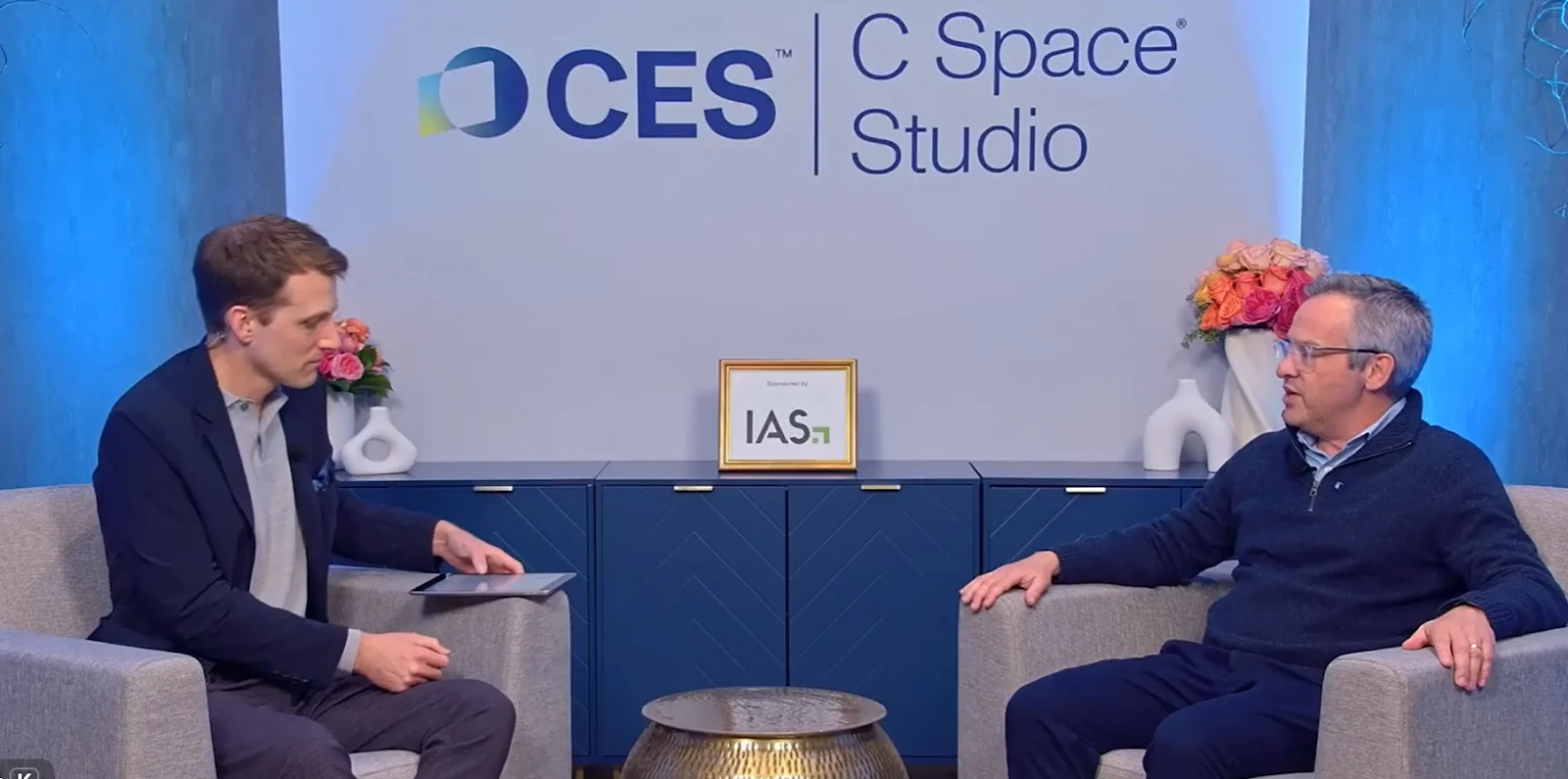
▲ Interview at CES 2026 C Space Studio. From left: host James Kotecki and Andrew Wallenstein, Chief Media Analyst at Luminate Intelligence. (Photo: CES/IAS)
The streaming landscape is shifting. The era of Netflix standing alone at the top is fading as competing platforms score successive hits with original content, creating a new "equilibrium" across the industry. With Netflix-Warner Bros. partnership discussions now surfacing, 2026 is increasingly seen as the watershed year for streaming consolidation.
Andrew Wallenstein, Chief Media Analyst and President of Luminate Intelligence — the media measurement firm behind Billboard chart data — delivered this assessment at CES 2026 in Las Vegas on January 10. Luminate, a sister company to Variety specializing in data and audience analytics, is best known for music industry measurement but has recently expanded into streaming film and TV coverage for Netflix, Disney+, and other platforms.
The interview took place at C Space Studio, CES's dedicated media and entertainment venue, under the theme "Decoding Media Signals, Culture Shifts, and What Comes Next." During CES, Wallenstein also moderated panel discussions at the Variety Entertainment Summit featuring CMOs from Samsung Electronics America, Snap, Blizzard Entertainment, and Fox Entertainment.
The Netflix vs. Everyone Else Dynamic Is Breaking Down
"Over 2025, we started to see a new form of parity emerge in the streaming marketplace," Wallenstein analyzed. Luminate is set to release its annual retrospective report containing comprehensive 2025 film and TV streaming data in the coming weeks.
"More streaming services are putting out hit original content, and those titles are resonating with audiences more than ever before. When you connect that trend with the recent Netflix-Warner Bros. collaboration moves, you can understand what the motivation is for HBO and Netflix to work together. It shows just how competitive things have become."
M&A Is Unavoidable
He maintained that further mergers and consolidation in the streaming industry are inevitable. "I've been saying this every year, but the number of players currently in the streaming market is not rational. Consolidation will happen."
Meanwhile, the Consumer Technology Association (CTA) projected that U.S. consumer technology industry revenue will reach $565 billion in 2026, up 3.7% year-over-year. Software and services revenue, driven primarily by streaming, is expected to grow 4.2% to nearly $194 billion.
AI dominated every conversation at CES 2026. "If you've been here at CES, you can't help but acknowledge that AI is dominating every conversation," Wallenstein said. "At Luminate, AI is helping us do what we do, and it's helping the companies we serve wrestle with these issues."
AI Agents: Democratizing Data Analytics
Luminate has introduced an AI interface called "Lumi" to its Subscription Viewership Measurement (SVM) platform. "It allows for a more seamless and easier way to access data than traditional search, and it can proactively suggest information based on users' past behavior patterns. Not every executive is comfortable with deep data analysis. AI agents will enable anyone to make data-driven decisions regardless of their technical capabilities."
AI-Generated Content: Already Charting in Music, Not Yet in Video
On AI-generated content, he noted diverging perspectives between industry and consumers. "From an industry standpoint, there's quite a split between those who embrace what AI can do for content creation and those who are cautious. On the consumer side, our surveys at Luminate show that most people are either indifferent or uncomfortable with AI-generated content."
However, change has already begun in music. "AI-generated music is already charting. I don't think we'll see a similar breakthrough in premium film or TV anytime soon." Host James Kotecki shared his own experience: "A few weeks ago, my brother-in-law recommended a song, and it turned out to be AI-generated. I didn't like it because it was a novelty — I just liked the song itself."
Human Stars "Will Never Be Displaced"
Yet Wallenstein pointed to fundamental limitations of AI content. "It's hard to have a relationship with an AI artist. There are AI artists with visual personas and avatars. I've seen AI projected as giant holograms doing concerts with real people dancing in front of them. But knowing it wasn't made by a real person, it's difficult to extend that into a deeper relationship."
"Human stars will never be displaced. But I do think there will be an uneasy coexistence between humans and AI in the long term. AI avatars have already been present on social media for quite some time, and they're only getting more sophisticated."
At the Variety Entertainment Summit, Joseph Gordon-Levitt also warned about the downsides of generative AI. "I was as optimistic as anybody during the rise of social media. But giant walled gardens came to dominate the internet, and their engagement optimization algorithms led to side effects like mental health issues and democratic backsliding. The same thing is going to happen with AI, but worse."
Gen AI Adoption: Gen Z and Gen Alpha Are Different
On targeting next-generation consumers, he emphasized the importance of recognizing generational differences. "You can't paint Gen Z and Gen Alpha with the same brush. Gen Alpha will be open to things that previous generations couldn't imagine. They might naturally embrace AI avatars, while Gen Z may be more guarded."
The Rise of Short-Form Drama from Asia
Wallenstein identified "micro dramas" as a key trend to watch in 2026. Originating in Asia and rapidly spreading to other continents, this short-form content format has attracted experimentation from Hollywood companies.
"I'm skeptical about this format that's produced at low cost — the quality is often poor. But there will be significant experimentation over the next year or two. If everything works out, AI combined with social media could create a new form of content with a viable business model. But I'll believe it when I see it."
Market Size: $1.3 Billion in the U.S. Alone in 2025
Despite Wallenstein's cautious outlook, the market is growing rapidly. Streaming consulting firm Owl & Co. estimated the U.S. micro drama market at $1.3 billion in 2025. According to Sensor Tower, DramaBox recorded $120 million in global in-app revenue in Q1 2025, while competitor ReelShort generated $130 million.
Disney-Backed DramaBox Seeking $100 Million Funding
According to Business Insider, Singapore-based StoryMatrix's DramaBox is pursuing $100 million in new funding at a $500 million valuation. DramaBox has already secured investment through Disney's selective accelerator program. Disney is reportedly in discussions to adapt young adult fantasy novels into micro dramas and to create vertical short-form videos from music albums.
Big Tech Joins In, But Questions Remain
Big Tech is also entering this space. Meta's Instagram is testing the micro drama format in India, and TikTok has added a "TikTok Minis" section for binge-watching short-form series. However, some investors have held back, questioning whether the format can succeed beyond its core of female-targeted romances. Whether micro dramas prove to be a passing trend or establish themselves as a new content paradigm, 2026 will be the defining year.
The media industry in 2026 faces two massive waves.
First, streaming platform consolidation. As Netflix's solo dominance ends and the market transitions to multi-player competition, M&A to achieve economies of scale will be unavoidable.
Second, an "uneasy coexistence" between AI and humans. AI has begun delivering commercial results in music first and is penetrating every sector from data analytics to content creation. Yet as Wallenstein noted, "human stars will never be displaced," and consumer wariness along with varying adoption rates across generations remain challenges for the industry.
The rise of micro dramas as a new format also merits attention. How this trend, which originated in Asia, will evolve through Hollywood and Big Tech experimentation remains to be seen — and 2026 will be the pivotal year to gauge that direction.
Sources: CES 2026 C Space Studio Interview (Sponsored by IAS), Business Insider, Variety | Compiled by: K-EnterTech Hub






![[보고서]전통 언론사의 크리에이터 전략 대전환](https://cdn.media.bluedot.so/bluedot.kentertechhub/2026/02/0nwc9z_202602100212.png)