From Object Removal to 'Interaction Replay' — A Dual-Pass Architecture Trained on VLM, Kubric and HUMOTO Opens the Next Era of Virtual Product Placement
① What's New — The Limits of Prior Methods and VOID's Leap
Prior video object removal models had well-defined limits. They handled "behind-the-object" inpainting and corrected appearance-level artifacts such as shadows and reflections reasonably well.

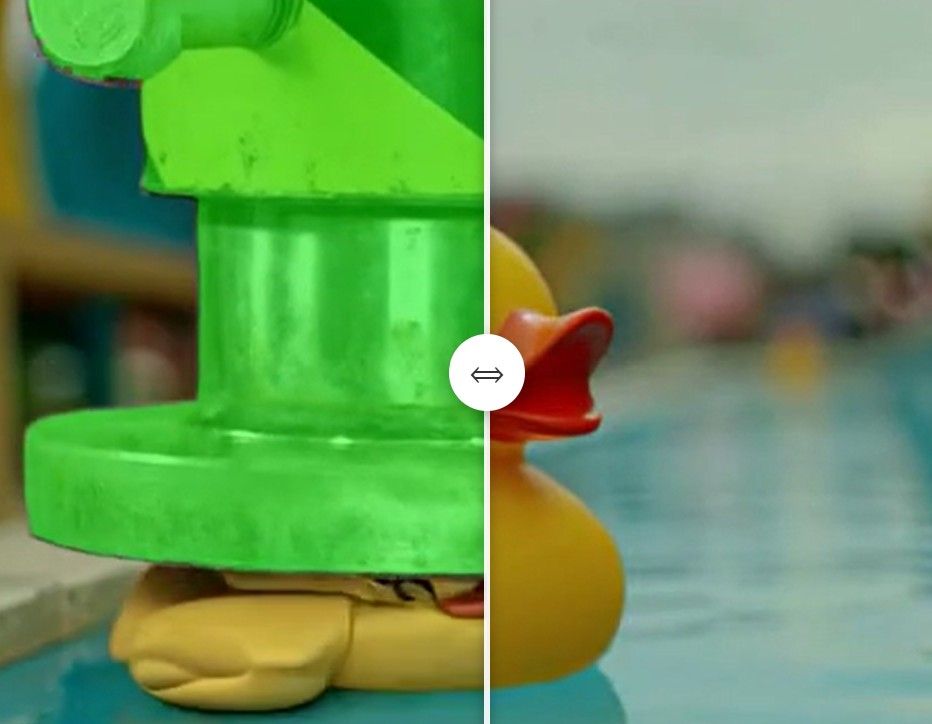
But when the removed object participated in meaningful physical interactions — collisions, momentum transfer, trajectory change — prior models failed. Erase the bowling ball and the knocked-down pins stayed flat on the floor. Erase a person and the cup they had tipped over remained frozen in its tilted state.

The Netflix × INSAIT team — Saman Motamed, William Harvey, Benjamin Klein, Luc Van Gool, Zhuoning Yuan, and Ta-Ying Cheng — reframed this gap as a "physically-plausible inpainting" problem and built a framework that reverses not just surface appearance but the physical consequences of the object's presence. The author list reflects a genuinely international collaboration between a commercial streaming platform and an academic AI institute.
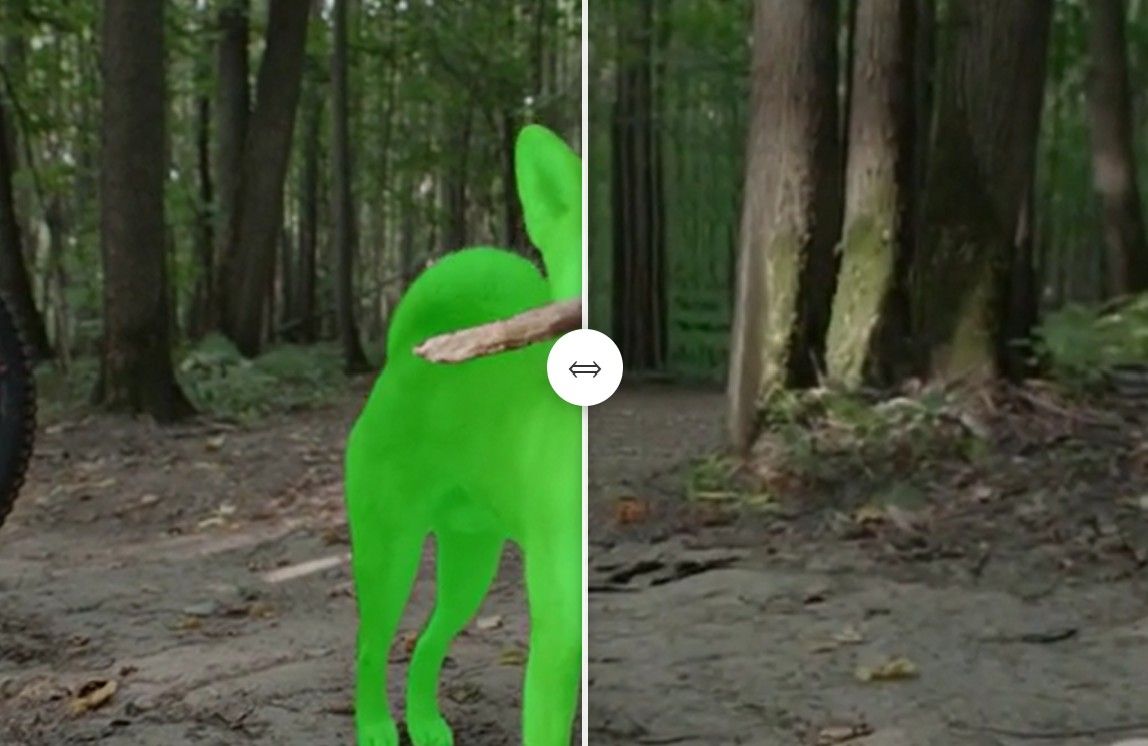
VOID's benchmarking posture is aggressive. The project page compares it against the current leading lineup of video object removal models: ProPainter, DiffuEraser, Runway, MiniMax-Remover, ROSE, and Gen-Omnimatte. The test scenes — bowling, car crash, block dominos, cat jenga, dog with stick, jump pool, dinosaur collision — are precisely the physics-heavy scenarios where prior models break. This is a frontal confrontation at the hardest points of the problem, not an easy-benchmark demonstration.

② The Pipeline — VLM Reasoning → Quadmask → Diffusion → (Optional) Pass 2 Stabilization
VOID operates in four stages.
Stage 1 · User selection. The user clicks on the object to be removed.
Stage 2 · VLM-based causal reasoning. A vision-language model analyzes the scene to identify which other regions will be causally affected by the object's absence — objects that will fall differently, not be struck, not change trajectory. This information is encoded into a four-channel quadmask that guides the diffusion model. Where prior methods received only "the mask of the object to remove," VOID explicitly labels both the object and the regions that must change as a consequence.
Stage 3 · First-pass generation. Guided by the quadmask, a video diffusion model generates a physically-plausible counterfactual video with the object and all its downstream interactions removed.
Stage 4 · Optional second-pass stabilization. When the first pass exhibits "object morphing" — a known failure mode of smaller video diffusion models, in which an object's shape drifts frame-to-frame — a second pass re-runs inference using flow-warped noise (noise recomputed from the first pass's optical flow) to stabilize object shape along the newly synthesized trajectories. The paper demonstrates particularly strong quality gains on ukulele and ball cases, where shape preservation is difficult.
The deeper meaning of this dual-pass design is that a self-correcting pipeline — AI auditing and repairing AI output — has now entered video editing in earnest.
③ Training Data — Counterfactual Pairs via Kubric and HUMOTO
VOID's hardest problem was data. It needed paired examples: "video with object present" and "physically correct video with object absent." Such pairs are essentially impossible to capture from real-world filming.
The team combined two synthetic sources. Kubric (from Google Research) is a physics-simulation-based synthetic video dataset that renders rigid- and soft-body collisions and falls with an accurate physics engine. HUMOTO provides human motion data — joint and body trajectories during human-object interaction. Combining the two, the team generated a large set of triplets: input video, quadmask, and counterfactual ground-truth video.
In an AI video market where proprietary data is the primary moat, VOID sets a methodological precedent: teach physical plausibility via synthetic data. The paper reports that, across both synthetic (Kubric) and real-world test data, VOID preserves scene-dynamics consistency better than prior video object removal methods.
④ The Reverse Engineering — If You Can Delete, You Can Insert
VOID is formally a removal tool in the paper. But as Tim Peterson of Digiday's Future of TV Briefing observed, the industrial payoff lies in reverse application. If the pipeline can remove an object and unwind its physical interactions with the rest of the scene, the same mechanism can insert a new object while simultaneously generating its interactions with what's already there. Three next-generation PPL scenarios the editorial desk foresees:
① Beverage can brand substitution. Replace a generic can in a character's hand with a Red Bull can — recomputing the grip geometry of the fingers and the shadow they cast to match the new silhouette.
② Full vehicle swap. Replace a nondescript sedan with a Rivian R2 — recomputing body reflections, road shadows, and even suspension behavior under the new vehicle's weight distribution.
③ Novel object insertion. Place a Blade Runner-style holographic billboard into a cityscape — simultaneously generating the reflected light it casts on the faces and clothing of nearby characters.
If Mirriad-class incumbent technology is the equivalent of "Photoshopping out a pimple," VOID's reverse application is closer to "rewriting the facial expression itself — and capturing the transformation as moving video."
⑤ The Twin Risk — Brand Integration and Deepfakes Ride the Same Curve
The paper frames VOID's applications as contributions to visual effects and the democratization of advanced video editing for non-experts. But the moment scene-regeneration capability is placed in non-experts' hands, the barrier to deliberate manipulation and disinformation collapses in parallel. Netflix's decision to open-source the model guarantees that diffusion speed will outpace anything a closed proprietary model could manage. Brand integration and deepfake misuse are twins on the same technology curve.
The industrial implication exists. The scale of the new advertising market VOID opens is mirrored by rising demand for provenance and authenticity layers — C2PA (Coalition for Content Provenance and Authenticity) standards, AI-generation watermarking, blockchain-based edit-history ledgers. These two markets will grow as a matched pair.

⑥ Implications for the Korean Industry — Preparation Time is Now
First, a "Localized PPL" opportunity for K-dramas and K-entertainment.
Multi-version international distribution — in which the Korean broadcast features domestic brands, while the U.S., Southeast Asian, and European releases each carry their own local brand integrations — becomes feasible without additional post-production cost. This is a structural opportunity for SBS, CJ ENM, Studio Dragon, and Netflix's Korean originals alike.
Second, revenue-model expansion for FAST and ATSC 3.0 next-generation terrestrial broadcasting.
In the K-Channel 82 initiative — the U.S.-based terrestrial K-content channel being built around Sinclair Broadcast Group and CAST.ERA — virtual PPL can serve as a core layer that lifts both advertising revenue and content value. The same K-drama, distributed across Korea, the U.S., and Southeast Asia, would carry distinct brand integrations tuned to each market.
Third, a layer-by-layer market opening for Korean AI and VFX startups.
Because VOID is open source, Korea's entry conditions are unusually favorable: the foundation model is already available; the business opportunity lies in the surrounding layers — broadcaster editing workflow integration, advertiser transaction platforms, provenance verification, brand rights management, targeting engines for dynamic insertion. This is precisely the whitespace where Korean AI-video firms such as NC AI, WestWorld VFX, and Studio Meta K, along with broadcaster technology subsidiaries, can enter first.
Conclusion
VOID remains a research-stage model. But the direction the technology points — streaming advertising's structural expansion, AI entering the stage of "causal scene understanding," the limits of incumbent virtual PPL, and Netflix's open-source release as a market-opening signal — has already become industrial gravity. The decisive variable was physical plausibility, and VOID solved it. That is why Korea's media, advertising, and content industries must prepare workflows, standards, and business models now. Chasing a technology after it crosses the threshold is always too late.