An FAA-designated test site + private airfield partnership forges a multi-state drone ecosystem
“The winner of the future aviation mobility market will be whoever accumulates the most reliable flight data”
Primary Source: University of Nevada, Reno – Nevada Today (2026.01.29) | Original Article
■ Executive Summary
The Nevada Center for Applied Research (NCAR) at the University of Nevada, Reno (UNR) and Eagle Field Airport LLC of California have signed a strategic partnership to advance UAS (Unmanned Aircraft Systems) and AAM (Advanced Air Mobility) R&D and flight testing. At its core, this collaboration links the FAA-designated Nevada UAS Test Site with a private airfield to build a multi-state test corridor spanning Nevada and California.
For Korea’s drone and AAM industry, this partnership is far more than a foreign news headline. With Korean companies advancing through the K-UAM Grand Challenge domestically but ultimately requiring FAA certification for global market entry, the Nevada–California test corridor could serve as a decisive gateway to the North American market—and a natural platform for deeper Korea-U.S. aerospace collaboration.
1. The Partnership: What Happened
On January 29, 2026, the Nevada Center for Applied Research (NCAR) and Eagle Field Airport LLC formally signed a strategic partnership to facilitate the research, development, and flight testing of UAS and AAM technologies.
The partnership’s central objective is to connect Eagle Field Airport’s private California airfield (FAA ID: CL01) with the FAA-designated Nevada UAS Test Site (NV UASTS), effectively creating a multi-state drone and AAM test ecosystem spanning two states. Both parties plan to work jointly with the FAA to explore the inclusion of Eagle Field Airport under NCAR’s existing public Certificate of Authorization (COA)—a structural innovation in how the U.S. organizes its UAS testing infrastructure.
Key Stakeholders & Roles
Entity
Role
Key Statement
NCAR(Nevada Center for Applied Research)
Operates FAA-designated UAS Test Site; holds public COA; manages applied research
"An innovation catalyst transforming complex data into high-quality, actionable research" – Carlos Cardillo, Director
Eagle Field Airport LLC
Provides private CA airfield; enables commercial-scale test environment
"The industry needs flexible, scalable test ranges where companies can move from prototype to operational demonstration at commercial speed" – Maki Kaplinsky
UNR(Univ. of Nevada, Reno)
Academic research infrastructure and institutional hub
"Strategic partnerships accelerate innovation and serve as a model" – Mridul Gautam, Sr. VP for Research
Nevada GOED(Economic Development)
Knowledge Fund investment; state innovation policy; multi-state corridor strategy
"Strategic investment through the Knowledge Fund creates new technologies and opportunities" – Karsten Heise, Sr. Director
2. Industry Background: U.S. UAS/AAM Test Infrastructure
The FAA UAS Test Site Program
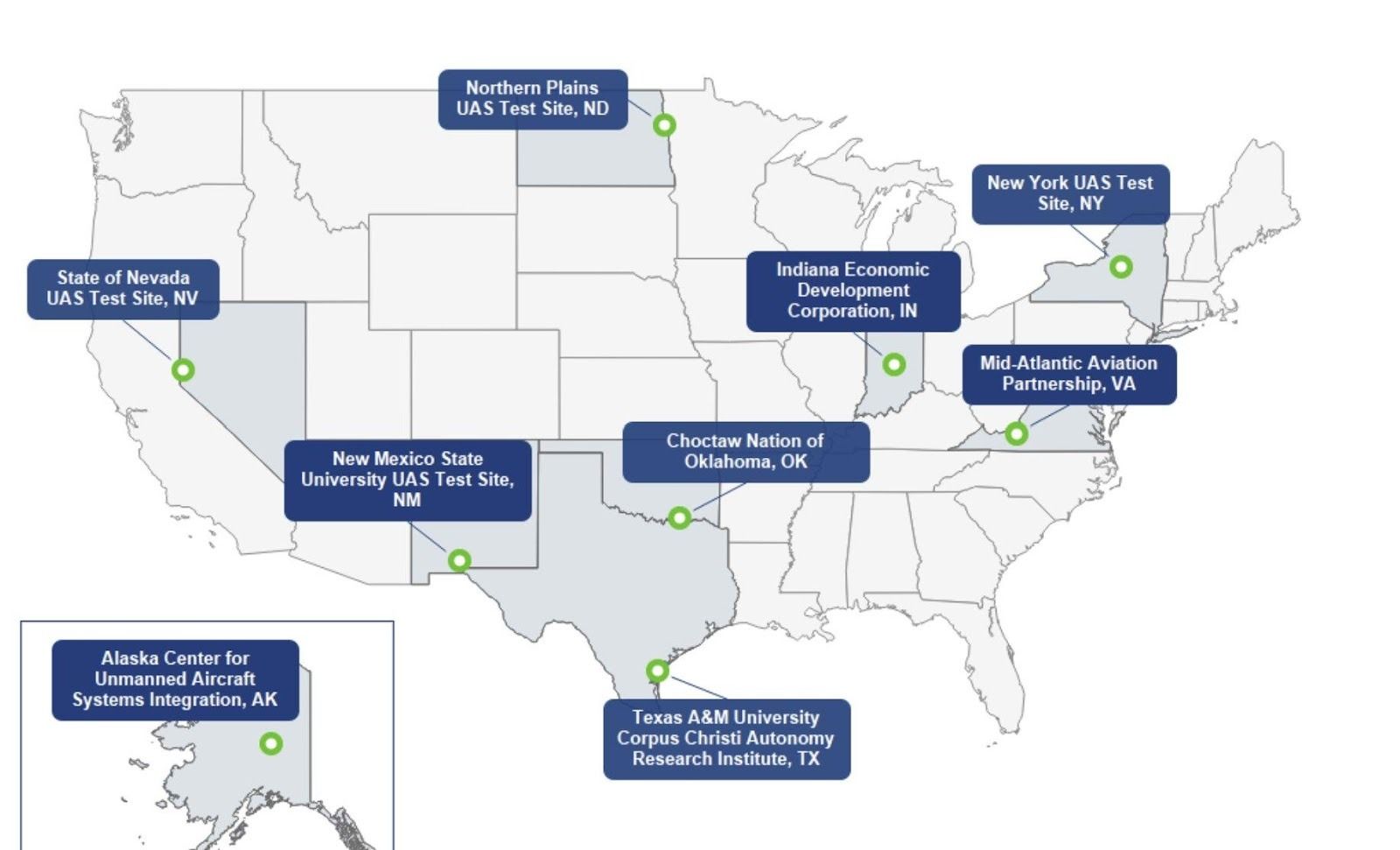
The FAA UAS Test Site Program, established under the FAA Modernization and Reform Act of 2012, originally designated six sites that became operational in 2014. A seventh was added in 2016 under FESSA, and the 2024 FAA Reauthorization continued the program. In 2026, the FAA added two additional sites, bringing the total to nine. These sites operate under public Certificates of Authorization (COA), providing a regulated environment for advanced drone operations not permitted in general airspace.
Figure: FAA-Designated UAS Test Sites across the United States (Source: FAA)
Alaska Center for Unmanned Aircraft Systems Integration
AK
2014
2
Northern Plains UAS Test Site
ND
2014
3
New Mexico State University UAS Test Site
NM
2014
4
State of Nevada UAS Test Site (NV UASTS)
NV
2014
5
New York UAS Test Site
NY
2014
6
Texas A&M Univ. Corpus Christi Autonomy Research Institute
TX
2014
7
Mid-Atlantic Aviation Partnership (Virginia Tech)
VA
2016
8
Choctaw Nation of Oklahoma
OK
2026
9
Indiana Economic Development Corporation
IN
2026
⚠ Key Insight: For Korean companies, obtaining independent flight test authorization in the U.S. requires enormous time and capital. By partnering with NV UASTS—which already holds FAA’s trust through its COA—Korean firms can accumulate technical verification data in FAA-recognized formats, effectively building their U.S. certification dossier from day one.
The core innovation of this partnership lies in extending NV UASTS’s COA coverage to Eagle Field Airport in California. This would transform a single-state test site into a multi-state corridor—a model that could reshape how the entire U.S. drone test infrastructure evolves.
Global UAS/AAM Market Context
The global UAS market is experiencing rapid growth across defense, public safety, logistics, and agriculture, while the AAM market—encompassing both Urban Air Mobility (UAM) and Regional Air Mobility (RAM)—is entering its first commercialization phase. The western United States, with its vast open airspace, varied climate zones, and concentrated defense-industrial demand, is emerging as the optimal testing ground for next-generation aerial technologies.
3. Strategic Analysis
3-1. The Value of a Multi-State Test Corridor
Until now, most UAS testing in the U.S. has been confined to single-state operations. The Nevada–California partnership creates cross-border testing infrastructure that unlocks several strategic advantages:
Diverse terrain and climate testing: Nevada’s hot, arid desert and California’s complex air-current environments and agricultural flatlands enable extreme-condition validation across radically different settings
Long-range flight scenarios: Cross-state operations provide the range needed for cargo delivery and logistics drone validation—a capability unavailable in Korea’s urban-focused test environments
Regulatory leadership: Multi-state operational experience positions the corridor to influence future FAA regulatory frameworks for interstate drone operations
Industry-academia-government hub: The three-way model combining university research (NCAR), private infrastructure (Eagle Field), and state funding (GOED Knowledge Fund) creates a replicable template for international partnerships
Korea’s K-UAM public service concepts could be cross-validated in Nevada’s open terrain; joint emergency-response drone protocols as a collaboration framework
Korea’s K-UAM Grand Challenge is driving rapid domestic progress in eVTOL and drone validation. However, global market entry—particularly into the North American market—ultimately requires FAA certification.
The Nevada–California partnership creates a concrete platform for Korean companies and institutions to build the bridge between domestic validation and FAA-compliant commercialization.
Independently securing FAA flight test authorization is prohibitively expensive and time-consuming for most international companies. By partnering with NV UASTS, Korean firms can leverage an existing, FAA-trusted COA framework to accumulate certification-grade flight data without building their own U.S. regulatory track record from scratch.
Practical pathways:
Establish direct test partnership with NCAR → Conduct flights under FAA COA → Accumulate U.S. flight-record data in FAA-recognized formats
Leverage Eagle Field Airport’s private infrastructure for IP-sensitive proprietary technology testing in a secure environment
Use test data toward FAA Part 107, Part 135, and Type Certificate applications—building a practical certification pathway step by step
⚠ Key Insight: This pathway is especially relevant for Korean eVTOL programs currently pursuing FAA Type Certificates. Partnership with NV UASTS creates a direct channel to accumulate the flight test data that FAA certification requires—accelerating what would otherwise be a multi-year, standalone process.
4-2. Extreme-Environment & Long-Range Flight Data
Korea’s K-UAM testing is inherently urban-focused. Nevada and California’s inland regions offer vast open terrain and extreme climate conditions that fill critical data gaps for Korean companies.
⚠ Key Insight: The data that Korea’s urban-centric K-UAM Grand Challenge cannot provide—extreme heat battery endurance, long-range BVLOS performance, desert GPS accuracy—is precisely what the Nevada–California corridor is optimized to deliver. These two programs are strategically complementary, not competitive.
4-3. Building a Korea–Nevada “Innovation Corridor”
The active involvement of Nevada’s Governor’s Office of Economic Development (GOED) in this project is significant. It provides a government-level entry point for Korean counterparts to build institutional collaboration channels that go beyond one-off technical partnerships.
Proposed collaboration framework:
Cross-Validation Program: Korean drone special zones (Incheon, Goheung, Sejong) establish bilateral agreements with Nevada for reciprocal testing access and incentives
Knowledge Fund Benchmarking: GOED’s Knowledge Fund—linking university research with private-sector commercialization—offers a directly replicable model for Korean technology commercialization programs
K-Nevada Gateway Expansion: The existing K-Nevada Gateway accelerator program can be expanded with a dedicated UAS/AAM track, giving Korean drone startups structured access to NV UASTS flight testing
Government-Level MOU: Korea’s MOLIT and MSIT can engage Nevada GOED on a UAS/AAM cooperation MOU, establishing a formal framework for regulatory harmonization and mutual certification recognition
4-4. Joint R&D and Technology Validation
NCAR is a dedicated applied research center, making it a natural counterpart for joint projects with Korean research institutions. The collaboration can focus on areas where Korea holds competitive technological advantages that need U.S.-environment validation.
Joint research programs: Korean institutions (KAIST, KARI) and UNR/NCAR partner on autonomous flight algorithms, AI-powered navigation, and 5G/6G aviation communications R&D
Global conference co-programming: Joint Korea-U.S. UAS/AAM sessions at CES, SXSW, and Airspace World to build industry networks and attract cross-border investment
Korea-U.S. Collaboration Roadmap
Phase
Action Items
Korean Side
U.S. Side
Phase 1(Near-term)
MOU signing; NV UASTS test partner registration; initial Korean company delegation visits
Drone special zone authorities; KARI; major AAM companies
NCAR, Nevada GOED
Phase 2(Mid-term)
Launch joint R&D programs; establish K-Nevada UAS accelerator track; first Korean company flight tests at NV UASTS
KAIST, KARI, KISED, MOTIE, startup ecosystem
UNR, NCAR, Eagle Field Airport LLC
Phase 3(Long-term)
Regulatory mutual recognition framework; permanent cross-validation program; joint CES / SXSW / Airspace World sessions
MOLIT, MSIT, Korea Airports Corp.
FAA, GOED, UNR, industry partners
5. Glossary
Term
Definition
UAS(Unmanned Aircraft Systems)
The complete system including drone airframe, ground control station (GCS), communication links, and operations software. Broader than the term “drone,” which typically refers to the aircraft alone.
AAM(Advanced Air Mobility)
Umbrella concept for next-generation aviation using eVTOL and other novel aircraft for urban (UAM) and regional (RAM) air transportation. Broader than Korea’s “UAM” terminology, which focuses on urban operations.
FAA(Federal Aviation Administration)
The U.S. federal agency responsible for regulating all civil aviation. Counterpart to Korea’s MOLIT Aviation Bureau. Holds authority to issue eVTOL Type Certificates.
COA(Certificate of Authorization)
Public flight authorization issued by the FAA to public entities, granting drone operation rights within specified areas and conditions. Comparable to Korea’s UAS flight approval system.
NCAR(Nevada Center for Applied Research)
Applied research center under UNR; operates NV UASTS and manages industry-sponsored research. Functional counterpart to Korea’s KARI.
GOED(Governor’s Office of Economic Dev.)
Nevada’s state economic development agency. Invests in innovation through the Knowledge Fund. Comparable to Korean regional economic development agencies.
eVTOL(electric Vertical Take-Off & Landing)
Electric-powered vertical takeoff and landing aircraft. The core vehicle platform for UAM/AAM services.
BVLOS(Beyond Visual Line of Sight)
Drone flight beyond the operator’s visual range. Essential for commercial delivery, long-range monitoring, and infrastructure inspection operations.
DAA(Detect And Avoid)
Technology enabling drones to autonomously detect and avoid other aircraft or obstacles. A critical safety requirement for BVLOS flight—and an area of Korean competitive strength.
6. Outlook: Data Is the New Asset
“Transforming complex data into high-quality, actionable research”
– Carlos Cardillo, NCAR Director
NCAR Director Carlos Cardillo’s framing of this partnership’s objective cuts to the heart of the future aviation mobility market. The winners will be determined by who accumulates the most reliable, FAA-recognized flight data fastest.
The convergence of California’s private infrastructure with Nevada’s public certification authority creates a model purpose-built for the commercialization phase—not just R&D. For global companies ready to move beyond prototypes, this combined corridor offers a commercially viable, regulatory-compliant test environment that no single-state site currently provides. The expansion from single-state to multi-state operations may mark the beginning of a national drone test network across the United States.
■ K-EnterTech Hub Analysis — Conclusion
Korea’s drone and AAM industry should view this partnership not as foreign news, but as a concrete U.S. market entry opportunity—and a platform for building the kind of Korea-U.S. aerospace collaboration that benefits both sides.
Direct partnership with an FAA-designated test site offers four decisive competitive advantages: (1) FAA-format certification data accumulation; (2) extreme-environment flight data unavailable domestically; (3) access to U.S. defense and public-safety markets; and (4) enhanced credibility for global investors.
Existing Korea-U.S. collaboration channels—including the K-Nevada Gateway accelerator program—provide a ready-made institutional pathway to systematically connect Korean startups with NV UASTS resources. The window is open. First movers will have a structural advantage that latecomers cannot easily replicate.
■ Sources & Disclaimer
Primary Source: University of Nevada, Reno – Nevada Today
"Nevada Unmanned Aircraft Systems Test Site and Eagle Field Airport form strategic partnership" (January 29, 2026)
Additional Source: FAA UAS Test Site Program Overview (faa.gov)
This article was prepared by the K-EnterTech Hub Industry Analysis Team as an English-language industry analysis based on the sources above. All strategic assessments and collaboration proposals represent K-EnterTech Hub’s independent analysis. Commercial use requires separate permission.


 Jung Han
 CHOSUNBIZ




![[투비]The Stream 2026: When Intention Becomes Attention](https://cdn.media.bluedot.so/bluedot.kentertechhub/2026/03/6h3xe4_202603220154.png)

![[SXSW2026]에이미 웹 트렌드 리포트(Convergence
Outlook 2026)](https://cdn.media.bluedot.so/bluedot.kentertechhub/2026/03/kty3s8_202603152312.png)





![[보고서]전통 언론사의 크리에이터 전략 대전환](https://cdn.media.bluedot.so/bluedot.kentertechhub/2026/02/0nwc9z_202602100212.png)