
From Competition to Co-evolution: Korea and Japan Sketch a Shared Path in EnterTech at ASTEEDA in Nozawa Onsen

At ASTEEDA Executive Salon 2026 in Nozawa Onsen, Lotte Holdings, Prof. Samseog Ko, and ESTsoft mapped a Korea–Japan 'co-evolution' blueprint — turning the asymmetry of chips/foundation models (Korea) and applications (Japan) into a plus-sum partnership

From Competition to Co-evolution: Korea and Japan Sketch a Shared Path in EnterTech at ASTEEDA in Nozawa Onsen

At the ASTEEDA Executive Salon 2026 session 'Media and Entertainment in the AI Era and Korea–Japan Co-evolution,' Lotte Holdings, Samseog Ko, and ESTsoft share one stage | Ko: 'Turn zero-sum into plus-sum — a world where everyone thrives together'; the asymmetry of strengths — chips and foundation models to Korea, applications to Japan — is where cooperation begins

JOYFUL Labs as the official Korean partner overseeing Korean company recruitment.
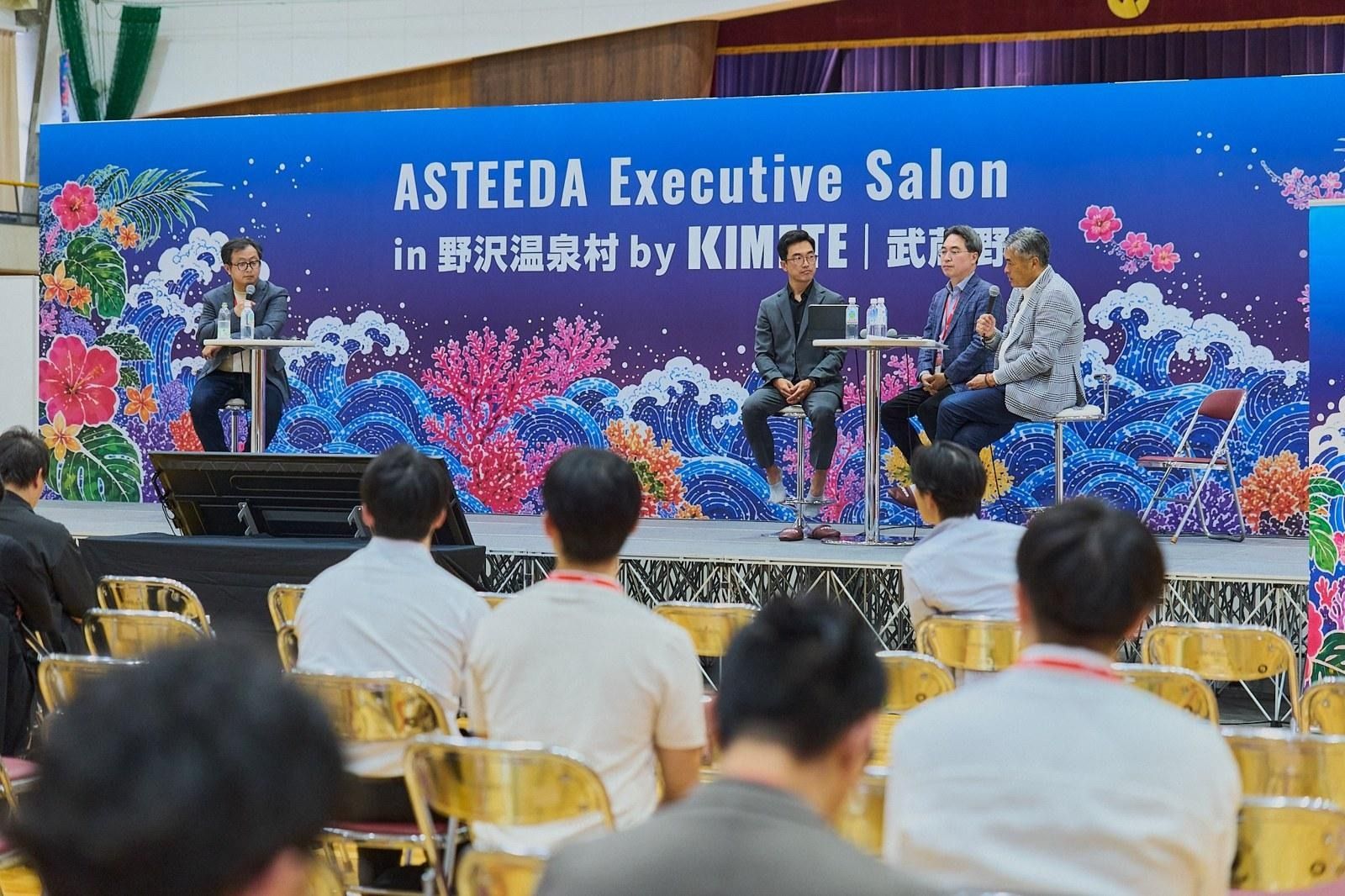
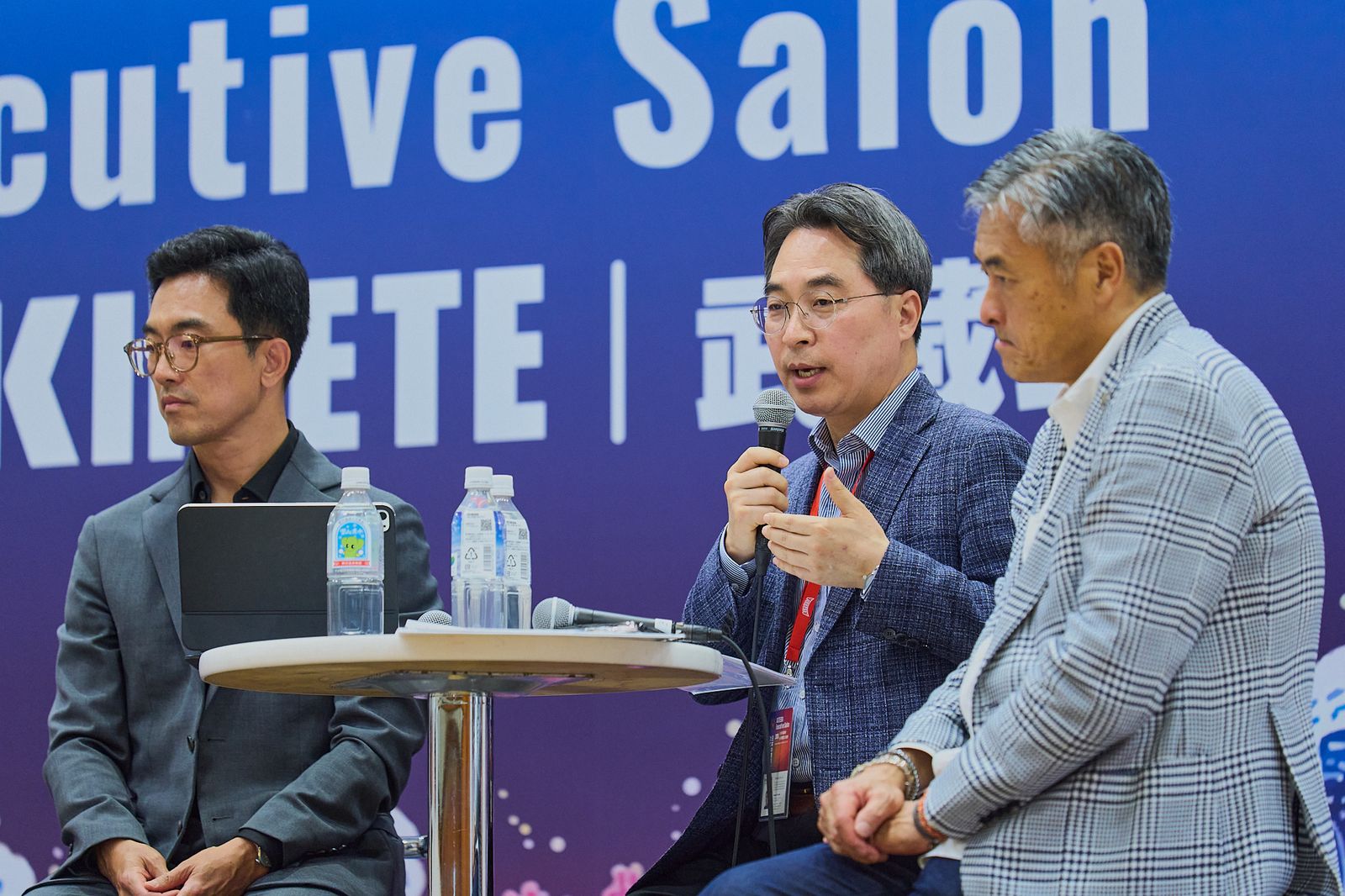
The June 12 session 'Media and Entertainment in the AI Era and Korea–Japan Co-evolution' at the Nozawa Onsen public hall stage. From left: moderator Han Jung, CEO of K-EnterTech Hub; Jung Sang-won, CEO of ESTsoft; Professor Sam-seog Ko of Dongguk University; and Lotte Holdings CEO Genichi Tamatsuka. (Photo: K-EnterTech Hub)

A blueprint for Korea and Japan to walk together through 'co-evolution (gongjinhwa)' — rather than competition — in the AI-era media and entertainment industry was laid out in a Japanese hot-spring village on June 12, at the ASTEEDA Executive Salon 2026 session 'Media and Entertainment in the AI Era and Korea–Japan Co-evolution' in Nozawa Onsen, Nagano Prefecture.

Genichi Tamatsuka, President and CEO of Lotte Holdings; Samseog Ko, Distinguished Chair Professor at Dongguk University, a member of Korea's Presidential National AI Strategy Committee and Jung Sang-won, CEO of ESTsoft, shared the panel stage.

Tracing the AI value chain, they noted that Korean and Japanese strengths diverge layer by layer — chips, foundation models, applications — and held that this very asymmetry is the joining point of co-evolution. Ko proposed creating a 'Korea–Japan EnterTech Open Innovation Track,' a standing matching channel between large corporations and startups backed by both governments.

There is a structural reason this debate convened in Nozawa Onsen. As AI reorganizes the production, distribution, and consumption of content all at once, the media and entertainment industry is passing through two opposing currents simultaneously: a 'democratization of creation' in which anyone can create, and a concentration of power in global big tech platforms. No single country can manage the shift alone — which is why Korea and Japan, both world-class IP powers that share the same weakness in global distribution platforms, sat down as cooperation partners.

Korea and Japan Along the AI Value Chain — “Chips Led by Samsung and SK; Applications by Japan”

The session's most concrete passage broke the AI industry into layers and located Korea and Japan within each. The discussion assessed that on the semiconductor chip layer, Korea — Samsung and SK included — clearly leads, and that on the underlying large language models, Korean conglomerates are moving to build their own foundation models while Japan is weighting the applications layer on top of them.

The applications layer, it was projected, will expand into physical AI and beyond. Even within AI, each country's strengths differ by layer — chips, foundation models, applications — and that very asymmetry becomes the joining point of co-evolution.

The session ran 50 minutes with simultaneous Korean–Japanese interpretation, following three questions: what is changing (Q1, the AI-era transformation); why and what to build together (Q2, the logic and possibilities of co-evolution); and what already exists and how it combines (Q3, working assets and next steps).

Three vantage points crossed — policy and industry (Ko), Korea–Japan group management (Tamatsuka), and the AI startup and platform front line (Jung). The session was programmed and run by K-EnterTechHub, with its CEO Jung Han moderating. A screen at stage left carried real-time Korean and Japanese interpretation subtitles so that participants unfamiliar with Japanese could follow the discussion.

Ko diagnosed the AI-era shift as one in which AI is applied across every stage — from the planning and distribution of content services to the point of user consumption.

Users now want newer experiences, he noted, and whether a company can deliver them has become the source of its competitiveness. In countries like Korea and Japan, where internet and mobile penetration reach 100 percent, he held, connectivity itself is the infrastructure of change — opening a 'democratization of creation' in which anyone makes content with AI, even as economic and cultural power concentrates further in big tech platforms like Google, Amazon, and Netflix.

“From Zero-Sum to Plus-Sum” — Sam-seog Ko's Theory of Co-evolution

The session's governing frame is the co-evolution concept Ko has advanced through his book Next Hallyu and his keynote at the K-EnterTech Forum at CES 2026 in January.

“Co-evolution emerged in evolutionary biology in the 1960s and developed through evolutionary economics and ecosystem research; it begins from the recognition that we are all connected and interdependent,” Ko said, compressing its direction as follows.

“Let us revise our relationships and strategies — turning zero-sum relationships into 'plus-sum' ones, and predatory co-evolution into 'altruistic co-evolution,' in which all stakeholders gain and grow together. Let us build a world where everyone thrives together.”  

— Prof. Samseog Ko, Dongguk University

Professor Sam-seog ko's co-evolution message. (Image: ASTEEDA Executive Salon)

Applied to Hallyu, Ko diagnosed that the wave had so far been built on one-way content exports from Korea and one-way consumption abroad, but that this relationship had reached its limits as Southeast Asian economies grew and their desire to build their own content industries strengthened.

The next stage — Next Hallyu — he defined as a paradigm shift toward planning, producing, and enjoying content together with partner countries, citing 'K-Pop Demon Hunters,' last year's global hit, as a defining example of co-evolution.

His diagnosis of the Korea–Japan structure was specific: Korea is strong in pop, drama, and games, and Japan in animation, characters, and games, but both are weak in global content distribution platforms — so cooperation in their areas of weakness as well as strength would let both content industries grow further.

On government's role, Ko held that with shuttle diplomacy restored and relations better than ever, governments should signal a future-oriented relationship to the market, but that, given the scale of both economies, exchange and cooperation should be strengthened around the private sector rather than led by government. He proposed that “with the backing of both governments, a standing Korea–Japan EnterTech Open Innovation Track is needed — a permanent matching channel between large corporations and startups — and private events like ASTEEDA should take root as its regular cooperation channel.”

ONE LOTTE's Stage, PERSO.ai's Infrastructure

The other two axes brought the assets of cooperation. Jung Sang-won — whom the moderator introduced as the head of “a software company so well known that hardly a Korean hasn't heard of it” — leads ESTsoft, a flagship EnterTech case that remade itself from a utility software maker (ALZip, ALYac, the portal ZUM) into an AI services company. Its AI human and AI dubbing platform PERSO.ai, built on 'AI Clone' technology that reproduces a real person's appearance and voice and 'AI Persona' technology that generates virtual humans, operates with 460,000 cumulative users, 90 percent overseas, across more than 75 languages and 110 countries — and is now extending into physical AI, transplanting virtual AI humans into real-world robots. Jung presented ESTsoft as an EnterTech and AI specialist that has successfully transformed itself from a utility company into an AI services company.

Tamatsuka, who led Uniqlo (Fast Retailing) and Lawson before taking the helm of Lotte Holdings in 2021, has integrated the Korean and Japanese Lotte groups' business resources since 2022 under the 'ONE LOTTE' strategy, around three pillars: food, life science and digital, and lifestyle and entertainment. He has presented ONE LOTTE as a strategy of integrating Korean and Japanese business resources to maintain global competitiveness while venturing into new domains.

The foundations are already in operation: BELLYGOM, the character IP developed by Korea's Lotte Homeshopping, is rolling out in Japan with Lotte Holdings as master licensee; LOTTE HOTELS JAPAN, a 2025 joint investment by Korea's Hotel Lotte and Japan's Lotte Holdings, targets 20 hotels and 4,500 rooms in Japan by 2034.

Add CALIVERSE, Lotte Innovate's metaverse platform, and the link between the Chiba Lotte Marines — where Tamatsuka serves as acting owner on the board — and Korea's Lotte Giants, and assets spanning IP, hotels, the metaverse, and sports are laid across both countries. He also chairs Japan Rugby League One.

The session's landing point was 'co-evolution cooperation models that Korea and Japan can launch together within 6 to 12 months' — combinations such as Japanese IP joined with Korea's AI multilingual and platform technology and fandom capabilities, staged on Lotte's offline assets.

Lotte Holdings CEO Genichi Tamatsuka (right) speaks. At center, Professor Samseog Ko; at left, ESTsoft CEO Jung Sang-won. (Photo: K-EnterTech Hub)

Seven Korean AI Companies' Booths, and the Next 60 Years

Outside the session hall, co-evolution is already in execution. Seven Korean AI and software companies joined the Global Track with booths — AI search company Liner, generative AI agent company Wrtn, AI media localization company XL8, ESTsoft, industrial AI company INEEJI, Polaris Office, and bluemoonsoft — holding pre-confirmed one-on-one meetings over three days, arranged under a double opt-in system, with executives from Fujitsu, IBM Japan, NTT West, Sekisui Chemical, Hikari Tsushin, and other major Japanese corporations and listed companies. Ko and Nina Kim, Founder and CEO of JOYFUL Labs, supported the Korean participants as mentors on Japanese market entry strategy and executive matching.

ESTsoft’s AI agent installed at OliveYoung

Host Ryukyu Asteeda Sports Club is the Japanese T.League table tennis franchise that listed on the Tokyo Stock Exchange's Tokyo Pro Market in 2021 (ticker 7364), becoming Japan's first publicly traded professional sports club.

“This salon is a private-sector retreat, not a government-hosted event — a place designed for dialogue on cooperation, mutual growth, and coexistence built on trust, beyond the exchange of business cards,” said Kim. “As the next step after the 60th anniversary of Korea–Japan diplomatic normalization in 2025, we want to ask, at the private-sector level, where the next 60 years of industrial cooperation begins.” In his closing remarks, Ko said: “Korea and Japan are neighbors that cannot be separated, interdependent across the economy, culture, politics, and diplomacy. I hope this relationship becomes one of co-evolution — not one side's unilateral gain or sacrifice, but the two countries cooperating and growing together.” The first agenda placed at that starting point is EnterTech.

Three Days Together, a Successful Close

The ASTEEDA Executive Salon 2026 Global Track closed successfully after its three-day run from June 11 to 13. On the final day, Korean participants rode the gondola together before wrapping up at a closing party that gathered all attendees. Across three days of booth meetings, sessions, an eve party, and side events, Korean and Japanese executives built relationships through time spent together rather than business cards exchanged. Meetings that could not be held because schedules clashed during the event were not lost but rescheduled as online sessions.

The on-the-ground response was concrete. Kunikazu Matsumoto, Fujitsu's senior evangelist, who held booth meetings with Korean AI companies, sent word after the event: “I so deeply shared the thinking and perspective on AI security that I'd want to make more time to talk it through.” He added that he had been stimulated by exchanges with many companies and had come to learn about AI activity in Korea — a sign that the double opt-in pre-matching is leading to follow-up discussion rather than one-off encounters. The organizers plan to compile the results of meetings that actually materialized and to separately organize the sessions converted to online, continuing the matching afterward.

Seven Korean Companies Meet Japan — Through Booths and Pitches

The Korean participants showcased their AI capabilities to the Japanese market directly through booth meetings and pitches. Liner, a source-grounded AI search engine used by more than 10 million people worldwide, presented its trusted research engine; generative AI agent company Wrtn introduced its AI agent platform for daily life and work. AI media localization company XL8 widened its contacts with Japanese content firms through automated subtitling and dubbing and its real-time AI interpretation solution EventCAT; ESTsoft led with its AI human and AI dubbing platform PERSO.ai and with AI security.

Industrial AI company INEEJI pitched AI optimization for manufacturing and energy sites; Polaris Office, its AI-infused document and office solutions; and bluemoonsoft, its own AI solutions — each before Japanese executives. Decision-makers from Fujitsu, IBM Japan, NTT West, Sekisui Chemical, Hikari Tsushin, and other major Japanese corporations and listed companies visited the booths on schedules pre-confirmed through double opt-in, with some meetings whose timing clashed rescheduled as online sessions. INEEJI said it was “leaving ASTEEDA with good energy,” promising follow-up meetings.

The booth of AI media localization company XL8, introducing its real-time AI interpretation solution EventCAT to a Japanese participant. (Photo: K-EnterTech Hub)

The booth exhibition hall at the Nozawa Onsen public hall, where Korean AI companies and Japanese corporate and consulting booths stood side by side for three days of one-on-one meetings. (Photo: K-EnterTech Hub)

The session program was not confined to EnterTech. Alongside the Korea–Japan co-evolution session, a range of tracks ran simultaneously over three days in Halls A and B of the Nozawa Onsen public hall — including a session featuring media and AI policy expert Professor Lee Won-tae, former president of the Korea Internet & Security Agency, as a speaker. Sessions with Japanese speakers on manufacturing AI, first- and real-data management, and large-corporation–startup collaboration were held in parallel, letting Korean and Japanese executives cross perspectives on shared themes.

In the manufacturing AI session, INEEJI CEO Choi Jae-shik delivered a presentation titled 'Inheriting and Extending the Tacit Knowledge of Skilled Workers in the Manufacturing AI Era.' Choi argued that the question 'Can AI learn skilled workers' tacit knowledge?' should be reframed as 'What kinds of tacit knowledge exist, and how should each be inherited?' — dissecting on-site tacit knowledge into four types (data-pattern, causal-model, situational-judgment, and accountability-judgment) and five hierarchical levels.

He pointed to an 'Ontology-to-Reality Gap' between the static knowledge models humans design and the dynamic reality of a factory, and proposed a new architecture in which a foundation model (learning reality), an ontology (structuring knowledge), and an agent (execution) divide roles and combine.

His conclusion was not an AI that replaces skilled workers, but the construction of a 'Knowledge Ecosystem' in which workers' insight, a company's ontology, and a foundation model that explores new knowledge on its own combine to continuously create new manufacturing knowledge. The shift to a 'human-AI two-way' stage — in which AI discovers tacit knowledge humans had not recognized — is, in effect, the manufacturing version of co-evolution.

INEEJI CEO Choi Jae-shik (second from right) presents in the manufacturing AI session. The screen shows commercial-operation references across more than 60 sites in five industries — steel heating furnaces (KG Steel, Dongkuk CM), cement kilns (Ssangyong C&E), and oil refining and chemicals (SK Energy). (Photo: K-EnterTech Hub)

The industrial track record INEEJI disclosed in the presentation is concrete: across more than 60 sites in five industries — steel, cement, refining, and chemicals — over 7,890 cumulative hours of autonomous operation with zero shutdowns, and closed-loop AI control rates of 66 to 87.9 percent. The company was presented as holding 11.67 million tons of cumulative industrial operation data, Korea's first national-strategic-technology designation in AI (explainable AI, XAI), and 62 patents across five countries.

The ASTEEDA Executive Salon is hosted and organized by Ryukyu Asteeda and co-organized by KIMETE and MUSASHINO, with JOYFUL Labs as the official Korean partner overseeing Korean company recruitment.

Seven Korean AI and software companies — Liner, Wrtn, XL8, ESTsoft, INEEJI, Polaris Office, and bluemoonsoft — joined the Global Track, supported by operational provisions for Korean participants including a profile book of the 93 executives on session stages and mobile simultaneous interpretation.

The salon presents itself as a 'Trust Protocol' platform built on three pillars: invitation- and approval-based membership, the reliability of a listed-company operation, and double opt-in matching. Korean companies can apply through the official site (global.ryukyuasteeda.jp).