

The AI Search Revolution: How Content Discovery Is Reshaping Hollywood's Future
From SEO to AIO: As consumers ask AI 'What should I watch?', the entertainment industry faces a paradigm shift in marketing, greenlighting, and star power metrics
Consumers no longer search for content titles—they ask AI, "What should I watch?" And AI provides all the answers. This fundamental shift in search behavior is forcing Hollywood to rethink everything from marketing strategies to greenlighting decisions and even how star power is measured.
According to analysis by Literate AI, a company specializing in AI search optimization, Marvel and Star Wars are showing signs of "franchise fatigue," while the Harry Potter series remains the only "evergreen asset." Video game IPs are emerging as the next growth engine, and actors under 40 are becoming increasingly invisible to AI algorithms.
AI Search: The New Gateway to Entertainment Discovery
AI technology is fundamentally transforming not content creation, but content "discovery." The key question in Hollywood has shifted from "Will AI replace writers?" to "How will AI define viewer choices?" As AI-based search and conversational answer engines become the primary entry point for entertainment consumers exploring content, traditional marketing and box office prediction systems are rapidly evolving.
According to Literate AI's analysis, over 1 billion people globally now use generative AI, with half of American consumers consulting AI before making product and content choices. Of these, 62% use AI search multiple times weekly, and two-thirds of corporate decision-makers utilize AI in board meetings. We've already moved from a "search-centric" era to an "AI consultation-centric" consumption structure.
The core of this transformation is that AI has emerged as a structural gatekeeper determining content visibility. Audiences no longer ask "What should I search for?" but rather "What should I watch?" Answer engines now provide conversational responses and context-based recommendations rather than simple link listings, reshaping content exposure priorities.
Mitch Stoller, co-founder of Literate AI, defines this as "digital search power redefined by AI." He emphasizes: "The central axis of content marketing is no longer SEO but AIO (Artificial Intelligence Optimization). Understanding and optimizing the narratives and exposure structures that AI platforms recognize will be the key to entertainment marketing going forward."
Understanding AIO: The New Marketing Frontier
Literate AI, founded as a subsidiary of digital marketing agency Red Krypton in 2019, analyzes how and in what context generative AI and chatbots mention specific teams and brands, proposing "AI optimization" strategies. While traditional SEO focused on getting links to appear at the top of search results, AIO focuses on managing presence within AI-generated sentences—which names and stories appear together in chatbot and AI summaries.
CEO Dan Weinberg compares the current AIO market to "the golden time of SEO 15 years ago," viewing the next 2-3 years as an opportunity for first-mover advantage. As internet search environments increasingly shift from "link clicks" to generative AI summaries, managing how brands, companies, and content firms appear in AI search results (AI visibility) has emerged as a new marketing challenge.
The 'Zero-Click' Phenomenon
With the rapid spread of generative AI search features like ChatGPT and Google AI Overview, users now receive core answers to their questions without leaving search result pages. In this environment, many users exhibit "zero-click" usage patterns, never visiting individual websites. According to some research (Bain & Company), approximately 80% of search users reference AI summaries in at least 40% of their searches, resulting in a 15-25% decrease in organic web traffic, with about 60% of all searches ending without external site clicks.
This structural change demands strategic pivots from entertainment companies and sports teams alike. Simply aiming to "drive users to our official site through search" is no longer sufficient. The more urgent questions have become: "How do we get our brand name included in AI's one-paragraph summary?" and "How do we climb to the top of AI's recommendation lists?"
Harry Potter Magic Outshines MCU
Analysis reveals that AI has chosen Harry Potter, not superheroes, as the "last blockbuster standing." According to Literate's report, major AI services are showing clear fatigue with superhero franchises while evaluating the Harry Potter series as the safest and most enduring box office bet.
When Literate queried major generative search engines including ChatGPT, Perplexity, and Google's AI Overview about "riskiest franchises" and "series with severe franchise fatigue," the Marvel Cinematic Universe (MCU) and Star Wars were repeatedly identified. ChatGPT characterized MCU as a "formulaic series," Perplexity warned that recent superhero films barely break even, and Google AI Overview assessed that these franchises are "no longer the absolutely safe bets they once were."
Interestingly, AI also shows some "peculiar fixations" on certain franchises. Some engines consistently place "The Mummy" in high-risk categories when asked about franchise risk, while relatively undermentioning series like "Fast & Furious" or "Transformers" that frequently appear in decline discussions. Literate interprets this as AI having "glanced over the past decade of Hollywood output and not being particularly impressed."
In contrast, when asked "What is the most reliable blockbuster machine on Earth?" the answer was nearly unanimous: Harry Potter. The franchise was evaluated as the safest investment target and the franchise leaving the most enduring cultural footprint across metrics including box office profitability, cross-generational and cross-national recognition, and positive online mentions. It was the only series AI repeatedly classified as "evergreen" across various question types.
The logic is compelling: each year brings a new cohort of school-age readers experiencing the Hogwarts world through books and films for the first time; merchandising and lifestyle products around characters, houses, and symbols form an entire ecosystem; adult fans actively rewatch and reread, generating "generational replacement" consumption rather than one-time hits. Most importantly, unlike Marvel-style universes requiring 40-minute explainer videos to catch up on dozens of films and series, the narrative is intuitive with low barriers to entry.
Video Game IP: The Next Frontier
If AI could directly invest in future IP, a significant portion of capital would flow to video game adaptations, according to the analysis. Major game IPs including Fallout, The Last of Us, Mass Effect, Minecraft, Pokémon, Mario, and Zelda are considered the industry's "last reliable fountain of youth," with the recent success streak of game-based films and series supporting this perception.
Perplexity designates video games as "the well from which the next generation of mega franchises will emerge," while Google AI points to the unexpected success of consecutive game adaptations as evidence that game IP is Hollywood's clearest growth sector. ChatGPT repeatedly mentions Brandon Sanderson's "Mistborn" as a fantasy series with major success potential if adapted—revealing tastes suggesting AI might be running a secret book club with development executives.
The Invisibility of Young Stars
When asked "Who are the biggest movie stars with ticket-selling power today?" the mood shifts dramatically. Major AI platforms still foreground familiar names from in-flight entertainment catalogs—Tom Cruise, Scarlett Johansson, Robert Downey Jr., Jason Statham—treating them as virtually the only "adult stars" capable of carrying box office today. This raises questions about whether AI exhibits conservative bias toward past box office data and filmographies, undervaluing recently emerging young stars.
According to Literate's analysis, young actors only enter the algorithm's field of vision when questions are very specifically constrained. Only when explicitly asking about "emerging talent" or "next-generation stars" do names like Timothée Chalamet, Zendaya, Glen Powell, and Sydney Sweeney reluctantly appear, seemingly with hesitation. Even Margot Robbie, who transformed Barbie into a billion-dollar cultural phenomenon, doesn't consistently rank as a top box office star across platforms.
Experts diagnose this as "both a tool AI brings to the greenlight meeting room and another bias overly dependent on past data." Even when using AI insights for actual investment and casting decisions, accepting the algorithm's habits of game IP concentration and older-generation star preference wholesale could further constrain investment in new faces and original stories.
AI's Peculiar Information Diet
Literate's analysis reveals that the "bias-minimized" AI personas used in this research rely on surprising information sources: obscure blogs, entertainment sites with minimal traffic, marketing copy focused solely on SEO optimization, Reddit threads from users distant from the industry, and wiki entries with questionable verification. These are referenced as if they were the ultimate repositories of knowledge. Meanwhile, industry trade publications and outlets that have accumulated professional insights are relatively underrepresented, creating what critics call an "information junk food diet" shaping global taste.
The report also emphasizes: "We shouldn't deify AI as an oracle." Different platforms and analysts assign different weights to metadata, engagement, and brand signals; AI models themselves update rapidly; and the datasets used for training often lack transparency. This means the same franchise can be read as a "risky bet" by one system and a "golden goose" by another.
AI search results continuously shift based on region, device, question phrasing, and update timing. Content classified today as a "sure-fire hit" could be relegated tomorrow to "not particularly recommended." Assuming these outputs are static can lead to significant judgment errors. However, refining queries across multiple platforms and cross-comparing results provides meaningful glimpses into the collective perspective millions of users will encounter when asking similar questions.
AI Search: The New Greenlight Meeting
Hollywood's most frequent question when looking at AI has been: "Can AI create content for us?" But Literate points to a more important question: "When AI starts telling people what they should care about, and studios use those signals as project approval criteria, what happens then?"
The problem is that these conclusions may originate from biased internet data, even sources of questionable reliability. Nevertheless, as studios and investors increasingly reference these signals to understand "what audiences want to see," the axis driving box office will shift once again. In the past, the tastes of specific directors, stars, critics, and fandoms moved markets; then platform algorithms seized recommendation power; going forward, AI outputs interpreting those algorithms may become the "new greenlight meeting notes."
The report emphasizes: "Whether Marvel wobbles, Harry Potter reignites, or Tom Cruise keeps running into his 70s, the industry has already received multiple warning signals." AI doesn't negotiate, schedule meetings, or embellish with rhetoric, but it quietly shapes where audience attention will gather through countless search queries—and that influence is far from small.
Implications for the Global Content Industry
The messages from this research carry direct implications for global content industries, including K-content.
First, auditing AI search visibility has become urgent. Systematic analysis is needed to understand how already-proven global hits like Squid Game, All of Us Are Dead, and The Glory, along with K-pop artists like BTS, BLACKPINK, and NewJeans, are being mentioned on major AI platforms and what keywords they're associated with.
Second, AI's optimistic outlook on video game IP suggests new opportunities for game companies. It's time to examine what potential value game-based film or drama adaptations might hold from an "AI search perspective."
Third, AI's conservative perception of young stars could paradoxically become an opportunity for K-content stars. Thanks to global fandoms generating secondary content through social media, fan cams, memes, and reviews, K-pop and K-drama stars can leave traces in AI training data through different mechanisms than traditional Hollywood star systems.
Ultimately, for content companies globally, the capability to design AIO (AI Optimization)—how to make brands and IP appear and contextualize in AI summaries and recommendation lists—has become an essential task beyond SEO.
Conclusion
As AI search solidifies its position as the "first discovery window" for global users, understanding what algorithms see and don't see is no longer a choice—it's approaching a survival issue.
The global content industry needs to actively interpret this new information landscape and proactively establish AI-era greenlight criteria that integrate data, brand, and fandom strategies. The industry that moves first to speak the language of algorithms while staying true to authentic storytelling may well define the next era of entertainment.
AI 검색 시대, 할리우드 콘텐츠 발견의 패러다임이 바뀐다
마블·스타워즈, '프랜차이즈 피로' 진입… 해리포터는 유일한 ‘상록 자산’으로 평가
비디오게임 IP가 차세대 성장축 부상, 젊은 스타는 AI 인덱스에서 비가시화
마블과 스타워즈는 ‘프랜차이즈 피로’ 징후로 하락세를 보이는 반면, 해리 포터 시리즈는 여전히 유일한 ‘상록 자산’으로 평가받고 있다. 비디오게임 IP가 새로운 성장 동력으로 부상하는 가운데, 40세 미만의 젊은 배우들은 AI 알고리즘 상에서 존재감이 점점 희미해지고 있다.
소비자들은 이제 콘텐츠 제목이 아니라 “무엇을 볼까?”라는 질문을 AI에 던진다. 그리고 AI는 그 질문에 모든 답을 제시한다. 이처럼 검색 행태가 바뀌면서, 콘텐츠 마케팅 전략부터 그린라이트(투자 결정), 스타 파워의 척도까지 할리우드의 산업 구조가 근본적으로 재편되고 있다.
AI 검색, 엔터테인먼트 발견의 새로운 관문으로 부상
AI 기술이 콘텐츠 제작보다 ‘발견(Discovery)’의 방식을 근본적으로 뒤바꾸고 있다. 최근 할리우드의 주요 화두는 “AI가 작가를 대체할 것인가”가 아니라, “AI가 시청자의 선택을 어떻게 규정할 것인가”로 이동했다. AI 기반 검색과 대화형 앤서 엔진(Answer Engine)이 엔터테인먼트 소비자들이 콘텐츠를 탐색하는 주요 진입점으로 부상하면서, 전통적인 마케팅과 흥행 예측 체계가 급속히 변화하고 있다.
AI 검색 최적화 전문 기업 Literate AI의 분석에 따르면, 글로벌 10억 명 이상이 생성형 AI를 활용 중이며, 미국 소비자의 절반이 제품 및 콘텐츠 선택 전에 AI에 자문한다. 이 중 62%는 매주 여러 차례 AI 검색을 이용하고 있으며, 기업 의사결정자 또한 3분의 2가 이사회에서 AI를 활용하고 있다. 이미 ‘검색(Search)’ 중심의 시대에서 ‘AI 자문(Consultation)’ 중심의 소비 구조로 이동이 진행 중인 셈이다.
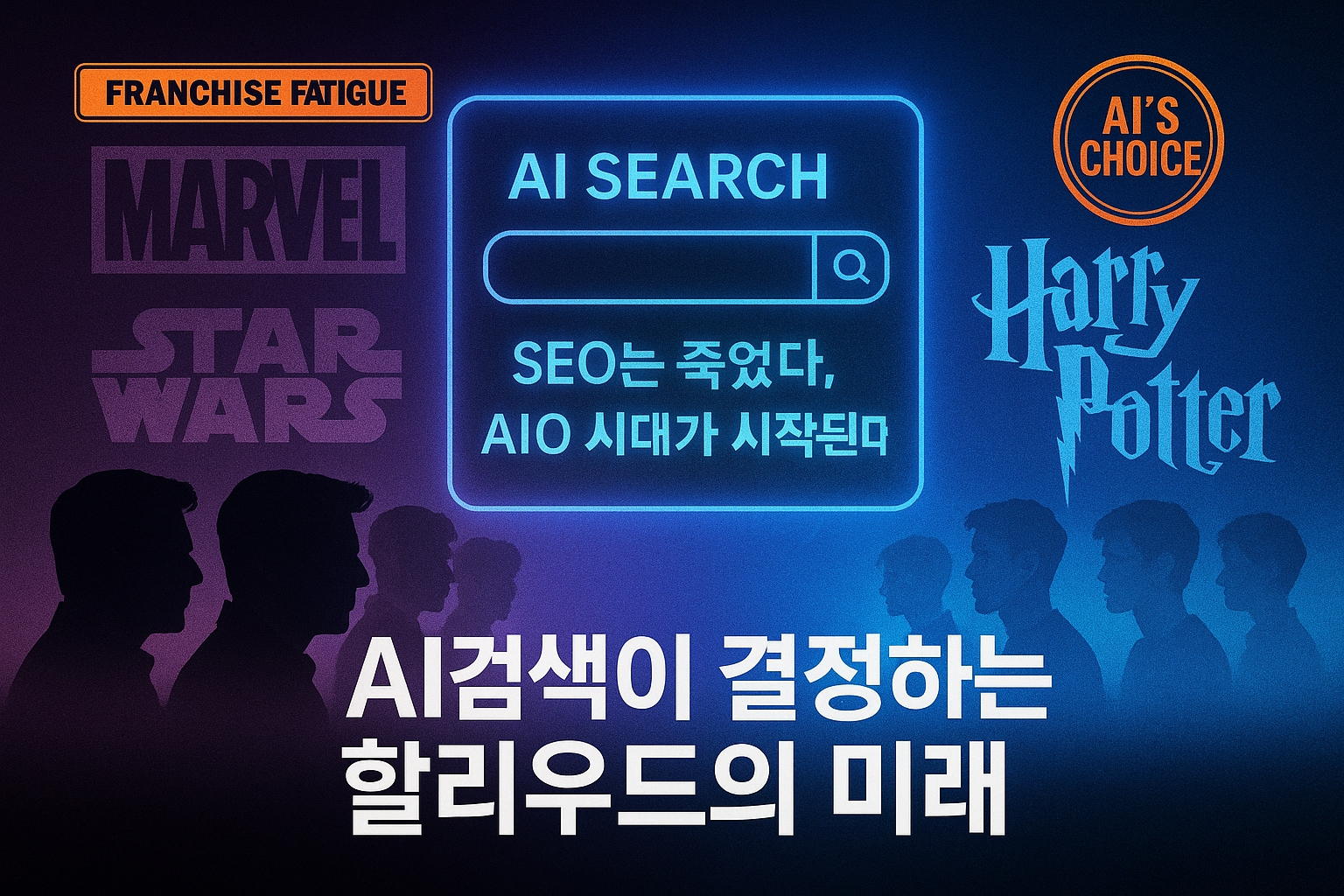
이 변화의 핵심은 AI가 콘텐츠 가시성을 결정하는 구조적 게이트키퍼로 부상했다는 점이다. 관객은 더 이상 “무엇을 검색할까”가 아니라 “무엇을 볼까”를 AI에 묻는다. 이에 따라 앤서 엔진은 단순한 링크 나열이 아니라, 대화형 응답과 맥락 기반 추천을 제공하며 콘텐츠 노출 우선순위를 재편한다.
Literate AI 공동창업자 미치 스톨러(Mitch Stoller)는 릴AI(Reel AI)와 이를 인터뷰에서 “AI가 재정의한 디지털 서치 파워”로 규정한다. 그는 “이제 콘텐츠 마케팅의 중심축은 SEO가 아니라 AIO(Artificial Intelligence Optimization)”라며, “AI 플랫폼이 인식하는 서사와 노출 구조를 이해하고 최적화하는 것이 향후 엔터테인먼트 마케팅의 핵심”이라고 강조했다.
이 같은 흐름은 제작 및 투자 의사결정, 즉 그린라이트 과정 전체에 변화를 예고한다. 기존에는 박스오피스, 평단, 소비자 조사 등이 주요 판단 근거였다면, 이제 AI 검색 노출 및 응답 패턴이 초기 관심도와 흥행 가능성을 가늠하는 주요 지표로 기능하기 시작했다.
결국 할리우드는 AI는 단순한 제작 도구가 아니라, 콘텐츠 소비 경로를 재설계하는 산업 인프라로 자리 잡고 있다. 향후 ‘AI 검색 발견율’이 흥행 예측 모델의 핵심 변수로 부상할 가능성이 높다.
리터레이트 AI와 AIO 개념
리터레이트 AI는 2019년 설립된 디지털 마케팅 에이전시 레드 크립톤(Red Krypton) 산하 자회사로, 생성 AI·챗봇이 어떤 팀·브랜드를 얼마나, 어떤 맥락에서 언급하는지를 분석해 ‘AI 최적화’ 전략을 제안하는 4년 차 회사다. 기존 SEO가 검색 결과 상단에 링크를 노출시키는 데 집중했다면, AIO는 챗봇·AI 요약에서 어떤 이름과 스토리가 묶여서 등장하는지, 즉 AI가 만드는 문장 안에서의 존재감을 관리하는 데 초점을 둔다.
리터레이트 AI는 특히 스포츠 산업 전용 AIO 서비스를 약 1년 전부터 본격적으로 시작했다. CEO 댄 와인버그은 인터뷰에서 “지금의 AIO 시장을 15년 전 SEO의 ‘골든 타임’에 비유할 수 있다”고 말하며 향후 2~3년을 선점 기회로 보고 있다.
인터넷 검색 환경이 점점 링크 클릭’에서 생성 AI 요약 위주로 이동하면서, 브랜드, 기업, 콘텐츠 회사들이 AI 검색 결과에서 어떻게 보일지(AI 가시성)를 관리하는 일이 새로운 마케팅 과제로 떠오르고 있다.
리터레이트 AI는 특히 스포츠 산업 전용 AIO 서비스를 약 1년 전(2024년)부터 본격적으로 시작했으며, CEO 댄 와인버그은 “지금의 AIO 시장을 15년 전 SEO의 ‘골든 타임’에 비유할 수 있다”고 말하며 향후 2~3년을 선점 기회로 보고 있다.
AI 검색 전환과 ‘제로 클릭’ 현상
챗GPT, 구글 AI 오버뷰 같은 생성 AI 검색 기능이 빠르게 확산되면서, 이용자는 이제 검색 결과 페이지를 벗어나지 않고도 질문에 대한 핵심 답변을 바로 얻고 있다. 이런 흐름 속에서 사용자 상당수가 개별 웹사이트를 방문하지 않는 ‘제로 클릭’ 이용 패턴을 보이고 있으며, 일부 조사(베인앤드컴퍼니)에서는 검색 이용자의 약 80%가 검색의 최소 40%에서 AI 요약을 참고하고, 그 결과 유기적 웹 트래픽이 15~25% 줄어들었으며 전체 검색의 약 60%는 외부 사이트 클릭 없이 끝난다는 분석도 나온다.
이 구조 변화는 엔터테인먼트 기업과 스포츠 구단·리그·스폰서에게도 전략 전환을 요구하고 있다. 과거처럼 “검색으로 우리 공식 사이트로 유입시키자”는 목표만으로는 부족해지고, “AI가 한 문단으로 정리하는 요약 안에 우리 브랜드 이름을 어떻게 포함시킬 것인가”, “AI가 뽑는 추천 리스트의 상위에 어떻게 올라설 것인가”가 더 시급한 과제가 된 것이다. 다시 말해, 전통적인 검색 엔진 최적화(SEO)를 넘어, 생성 AI가 참고하는 데이터와 서술 문맥 안에서 자사의 존재감을 극대화하는 ‘AI 요약 최적화’ 전략이 새 필수 과제로 떠오르고 있다.
리터레이트 AI의 서비스 구조와 가격
리터레이트 AI의 핵심은 두 단계다.


![[SXSW 2026]AI 파일럿 95%는 왜 실패하는가: '성공하는 AI 시스템의 7가지 패턴'](https://cdn.media.bluedot.so/bluedot.kentertechhub/2026/03/9wheq7_202603201341.png)
![[투비]The Stream 2026: When Intention Becomes Attention](https://cdn.media.bluedot.so/bluedot.kentertechhub/2026/03/6h3xe4_202603220154.png)
![[SXSW2026]에이미 웹 트렌드 리포트(Convergence
Outlook 2026)](https://cdn.media.bluedot.so/bluedot.kentertechhub/2026/03/kty3s8_202603152312.png)



![[보고서]전통 언론사의 크리에이터 전략 대전환](https://cdn.media.bluedot.so/bluedot.kentertechhub/2026/02/0nwc9z_202602100212.png)