
FAST Reinvents Itself: Free Streaming Reaches Past Film and TV to Absorb Video Podcasts

Tubi–SiriusXM’s non‑exclusive, ad‑revenue‑sharing deal shows how free streaming (FAST/AVOD) is turning into a multi‑format, creator‑ and podcast‑driven CTV platform, with Korea now facing both a new export route for K‑creators and fresh measurement and policy challenges.

FAST Reinvents Itself: Free Streaming Reaches Past Film and TV to Absorb Video Podcasts

Tubi signs a non-exclusive, ad-revenue-sharing deal with SiriusXM—a different path from Netflix’s exclusivity—as the lines between formats blur

Free, ad-supported streaming (FAST/AVOD) is rewriting its own content menu.

Once built on libraries of films, dramas and unscripted shows, the free-streaming camp is now rapidly embracing new formats such as creator video and video podcasts—shifting from its early days of imitating cable channels into a multi-format platform. The latest sign is Fox-owned Tubi's decision to bring SiriusXM's video podcasts onto its service.

FAST의 변신… 영화·드라마 넘어 ‘비디오 팟캐스트’까지 빨아들이는 무료 스트리밍
FAST의 변신. 투비. 영화, 드라마 아닌 팟캐스트 주요 콘텐츠포 편성. 시리우스XM과 광고 수익 배분형 비독점 계약. 팟캐스트의 인기와 FAST의 부상이 맞아 떨어진 결과

The forces driving the change are cost, advertising and viewing behavior. As original-content budgets soar, creator and podcast content that already commands fandom and buzz has become a comparatively low-cost way to fill programming gaps and differentiate a platform. At the same time, in a FAST/AVOD model that monetizes through advertising, every new format means new ad inventory. Audio has long grown by being distributed broadly across platforms—now video is following that same path onto the connected-TV (CTV) screen.

A non-exclusive, ad-revenue-sharing deal, launching in late June

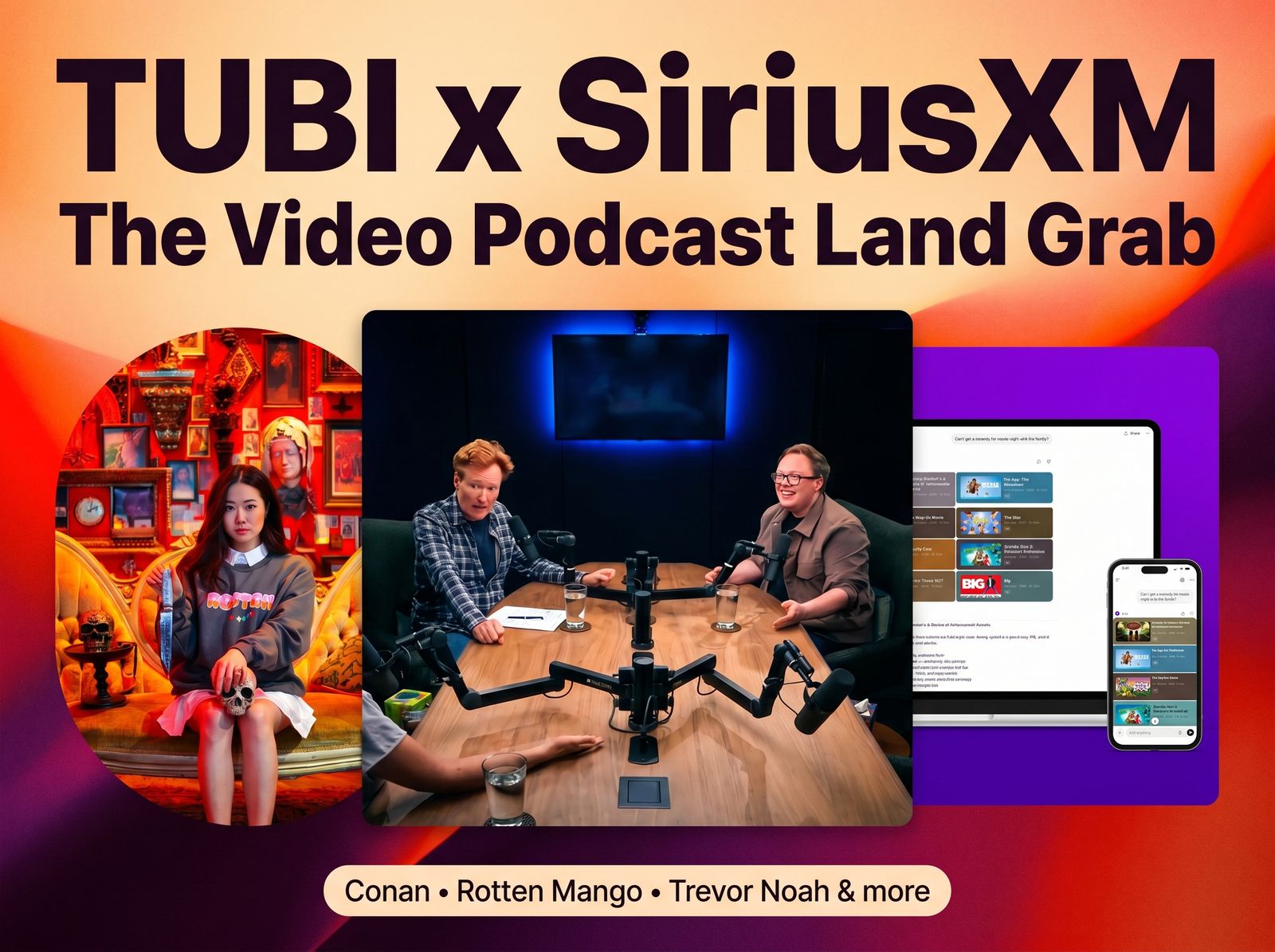
Tubi and SiriusXM announced a non-exclusive distribution and advertising agreement on June 2 (local time). SiriusXM's Podcast Network will supply its video podcasts to Tubi's platform of more than 100 million monthly active users (MAU), with the resulting ad revenue shared between Tubi and SiriusXM Media, the company's advertising division. The shows are expected to begin streaming on Tubi in late June.

The initial lineup includes “Conan O’Brien Needs a Friend,” “Rotten Mango,” “The School of Greatness,” “What Now? with Trevor Noah,” “Moral of the Story” and “The Deep 3 Podcast,” with more titles to be added over time. Among them, the true-crime podcast “Rotten Mango” and “Conan O’Brien Needs a Friend” both rank among the top 20 U.S. podcasts, according to Edison Research.

The deal's non-exclusive nature sets it apart from Netflix's approach. The podcasts carry no exclusive window on Tubi and will remain available on YouTube and other audio and video platforms. Whereas Netflix has been striking exclusivity-based deals with the likes of Spotify and iHeartMedia, SiriusXM—which is not partnered with Netflix at this time—has opted for a non-exclusive, reach-maximizing strategy. For Tubi, the trade-off is clear: rather than exclusivity, it gains proven content quickly and lifts discoverability on CTV.

From “channel” to a department store of formats

The agreement illustrates how FAST/AVOD's content mix is changing. Free streaming was long filled with scripted dramas, unscripted entertainment and film libraries, but Tubi has been building a podcasting foundation in short order. It acquired content studio Red Seat Ventures and signed a multi-year deal with Ashley Flowers—host of the hit true-crime podcast “Crime Junkie”—and her Audiochuck podcasting group. Over the past year it has also drawn in content from outside the traditional Hollywood pipeline, teaming with TikTok to scout creators for long-form originals. A library once centered on films and series now has personality-driven formats as another pillar.

Tubi framed the deal as a natural extension of its strategy as a CTV home for creators and fandom. “Tubi is a platform built to help creators grow their fanbases and revenue, and this partnership with SiriusXM is a natural extension of that,” said Rich Bloom, General Manager of Creator Programs and EVP of Business Development at Tubi. By bringing some of podcasting's most compelling voices to Tubi, he added, the company is giving creators a powerful new avenue to expand their reach.

SiriusXM stressed that it is porting to video the broad-distribution strategy that worked in audio. “In podcasting, audio has long thrived through broad distribution across platforms, helping shows grow and connect with new audiences,” said Andrew Moss, SVP of Content Strategy and Development at SiriusXM. “We’re applying that same philosophy to video—expanding our creators’ reach across phones, computers, and connected TVs.” According to SiriusXM, its Podcast Network holds more of the top-20 podcasts than any other network per Edison Research and reaches one in two U.S. podcast listeners each month.

The reinvention also shows in the fact that free streaming is no longer simply a free version of linear channels. Tubi is the second-largest free AVOD service for adults, with more than 300,000 movies and TV episodes, hundreds of its own originals and over 1 billion hours watched each month—and more than 95% of its viewing is on demand. With chosen, on-demand viewing so dominant, the company argues that new formats like video podcasts translate directly into premium ad inventory reaching engaged audiences.

Netflix joins in—but does anyone actually watch on TV?

The race to add formats extends well beyond Tubi. Last week Netflix signed a multi-year deal with Spotify to bring the video version of Jay Shetty's popular motivational podcast “On Purpose” exclusively to both platforms; the agreement is reported to be worth roughly $100 million. With Netflix buying up exclusive windows and Tubi and SiriusXM pursuing maximum reach through a non-exclusive approach, the spectrum of companies treating video podcasts as a new format keeps widening—from free AVOD players to subscription heavyweights.

Still, the question of whether people truly watch podcasts on the TV screen remains. In a recent column, TVREV analyst Alan Wolk noted that even though YouTube publishes podcast-consumption figures, it is hard to tell whether users are actually watching the video or simply leaving it on as background audio because the interface is easy to navigate. He advised streamers to make their mobile apps podcast-friendly and to art-direct the sets of top podcasts for the big screen, while keeping them from looking too slick.

Consumption data reinforces the caution. In a first-quarter Edison Research survey of U.S. weekly podcast users aged 13 and older, 14% had used Netflix to consume podcasts and 4% had used Tubi, versus 64% for YouTube and 42% for Spotify. That Netflix and Tubi are now tracked as separate line items is itself a signal of change, yet the gap with the big podcast platforms is wide. The survey also counted both “listening” and “watching,” so the real level of engagement with the video element remains to be verified.

What it means for Korea

The shift carries clear implications for free streaming in Korea. FAST platforms that have grown their influence at home and abroad—such as Samsung TV Plus and LG Channels—have largely programmed around linear channels and on-demand film and drama catalogs. Tubi's move shows Korean FAST operators that personality-driven, talk and video-podcast formats can serve as both a point of differentiation and a new source of ad inventory. A revenue model that splits ad sales with content suppliers is also instructive for domestic platforms looking to broaden their libraries without shouldering the full cost of original production.

The more direct opportunity lies in the global distribution of K-content and Korean creators. Because this deal shares ad revenue with no exclusive window, the barrier to entry is low—opening a possible route to push Korean talk, factual and true-crime creator content onto U.S. CTV. Tubi already programs a range of Korean content and creator-led stories, and its fandom-first positioning could give K-creators with deep fan bases a platform to extend their reach. Video podcasts also travel more easily as a format than drama, which carries heavier subtitling and dubbing demands, making them a practical testing ground for Korean MCNs and the digital arms of broadcasters eyeing global expansion.

That said, the “listen vs. watch” measurement gap and the need to verify attention on CTV apply just as much to Korean advertisers and platforms. Selling video podcasts as premium inventory will require evidence of visual engagement, which feeds into domestic debates over measurement standards and ad-effectiveness verification. The diversification of formats also intersects with media-policy questions in Korea around content classification, advertising rules and creator revenue-sharing.

Even so, FAST/AVOD's format experiments are likely to continue. The math still holds: lower content-acquisition costs, a draw for younger viewers and fandoms, and more ad inventory with each new format. The decisive question is whether the format can command, on the CTV screen, the kind of attention advertisers will pay for. Until that answer is clear, free streaming's reinvention and the verification of viewing behavior will move forward side by side.