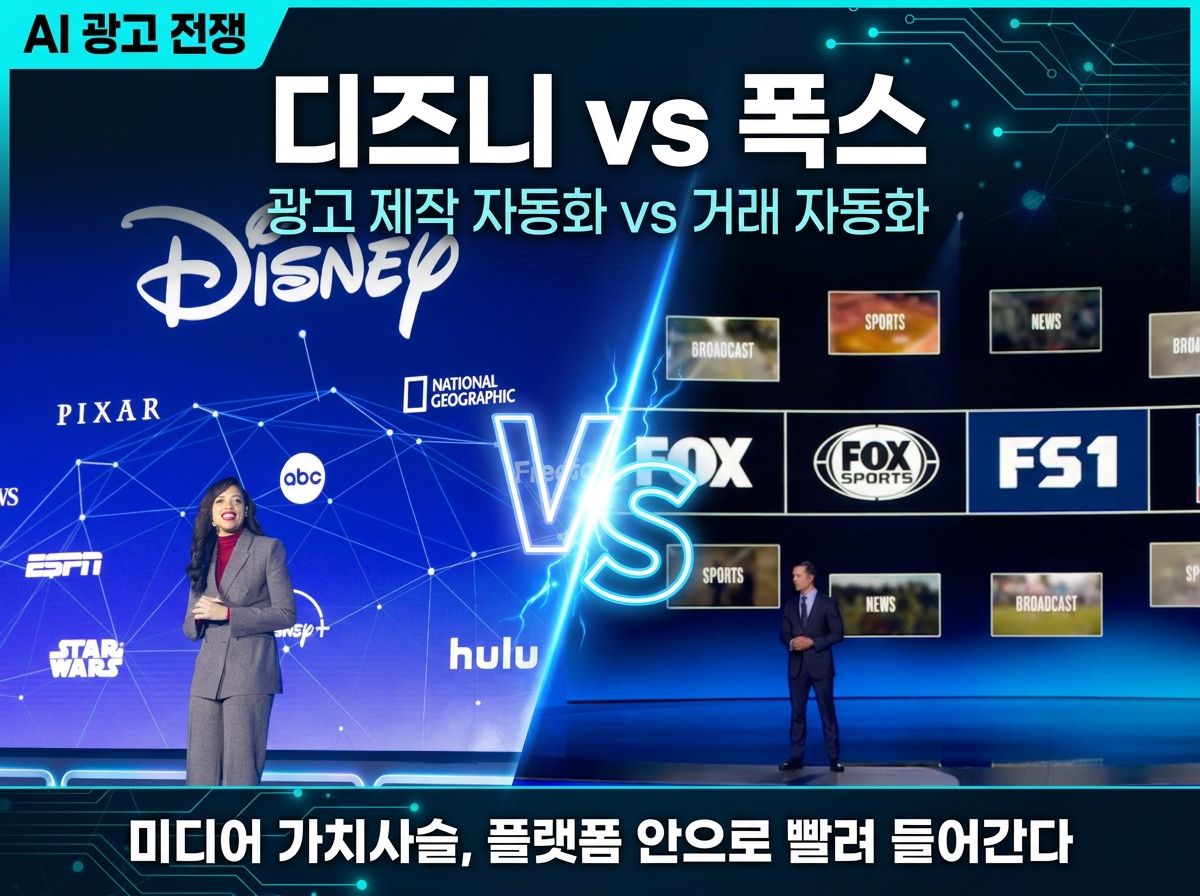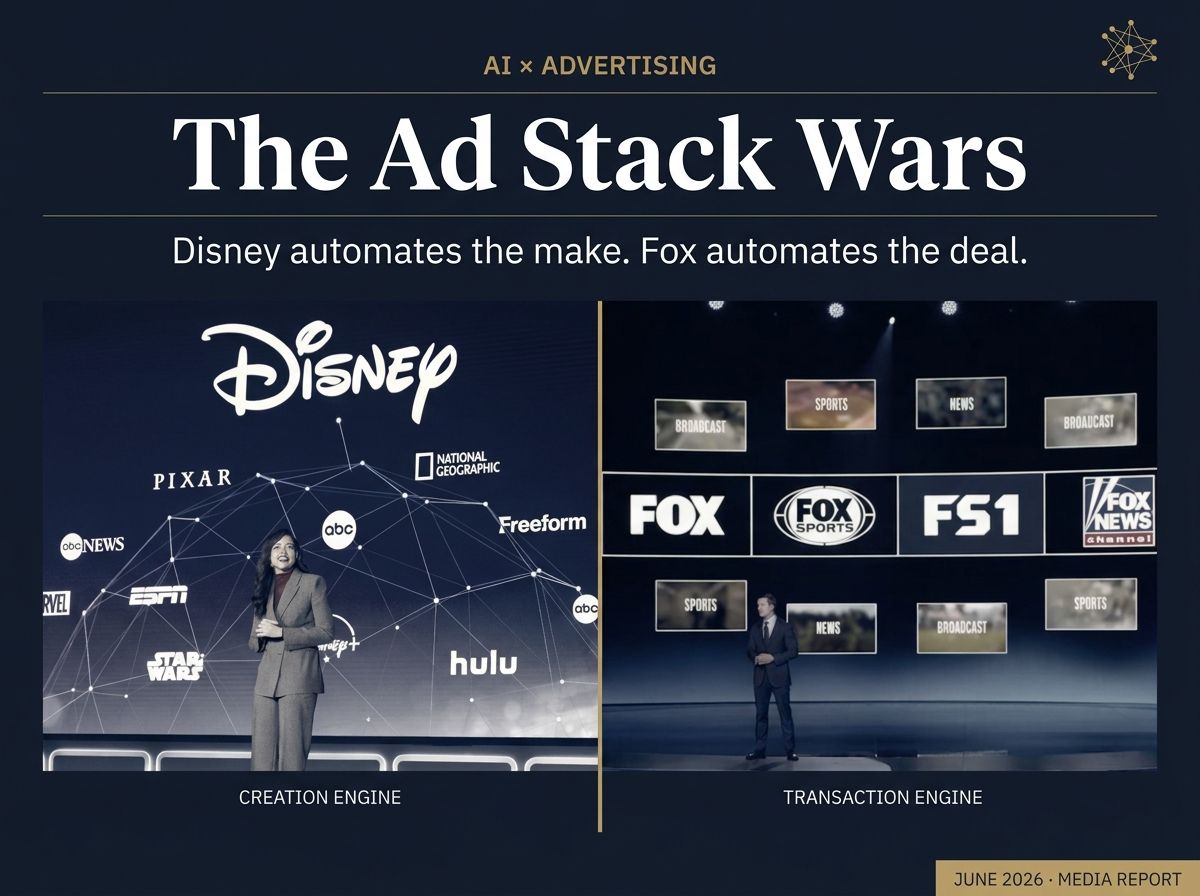
Disney readies a July beta for AI-made TV ads; Fox unveils what it calls the industry’s first end-to-end agentic ad platform
Media companies have begun a race to automate advertising end to end with AI — from how ads are made to how they are bought and sold. Disney is preparing a July beta of a tool that uses AI to generate TV commercials, while Fox has unveiled what it calls the industry’s first end-to-end agentic advertising platform, in which AI agents transact with one another. Both ends of the ad value chain — creative generation and automated trading — are being automated at once.

The push reflects a structural shift in the TV ad market. As connected TV (CTV) and self-service advertising lower the barrier to entry, a long tail of smaller advertisers — once priced out of producing even a single 30-second spot — has flooded in. Personalization that slices ads by audience and context now leaves campaigns needing dozens of variants, and media transactions have fractured into units too small to negotiate by hand. AI is moving to fill the production-and-trading gap that manual work can no longer serve at a workable cost.

Disney: a July beta to automate ad creation
Business Insider reported the timing exclusively. Adam Smith, chief product and technology officer for Disney Entertainment & ESPN, shared the July beta plan at an internal product meeting last week, the outlet said. Smith called the tool “one of the clearest areas where we’re really making traction.”
The tool generates scripts, video and music inside a single, orchestrated workflow. It is geared in particular to small and mid-sized businesses with no video assets, and is ultimately set to be offered through Disney’s self-service ad platform, a dashboard where advertisers run and manage campaigns on Disney properties.
It first appeared at Disney’s Sixth Annual Global Tech & Data Showcase, held live from CES in Las Vegas on Jan. 8. Framed around “better versions, not just more versions,” the tool builds CTV-ready commercials from a brand’s existing assets and guidelines and varies the creative by audience, context and placement. Disney has stressed that human oversight and safeguards run through the process; pet-food brands Known and Instinct Pet Food were among the first to develop proof-of-concept creative. The tool is one piece of a broader AI ad stack that also includes measurement products such as Disney Compass and a Brand Impact Metric.
Fox: the ‘first end-to-end agentic ad platform’
Fox Advertising told ADWEEK it has built what it calls the industry’s first end-to-end agentic advertising platform, spanning audience planning, media transactions and activation. Powered by its data-and-technology platform, Fox AdStudio, the system lets buy-side and sell-side AI agents act autonomously on tasks such as accessing audiences or making media buys across Fox’s portfolio. Where Disney automates the making of the ad, Fox automates the trading of it.

Agentic was the dominant buzzword of May’s upfront week, with Netflix and Amazon also touting agentic planning and buying tools. But Fox’s ad sales chief strategy and operations officer, Stephano Kim, said its platform — connecting the whole process through to automated execution — is the first of its kind, adding that he does not say so lightly.
Fox laid out a three-phase roadmap. Phase 1, ahead of the June 22 Cannes Lions kickoff, has buy-side agents connect securely to Fox’s sell-side agents via an authenticated token to test audience targeting. Fox ran tests with WPP and Horizon Media on audience discovery, forecasting and media recommendations; completed digital transactions with Comcast’s Universal Ads; and demonstrated linear deals with Simulmedia. Agent-to-agent transactions took seconds, with pricing validated by humans. Phase 2 (second half of 2026) widens the partner set and adds agent-assisted workflows in audience modeling, linear direct response and digital programmatic guarantees. Phase 3 (Cannes 2027) introduces real-time bidding, essentially “making linear programmatic.”
Governance is the central condition. Fox said it found error rates as high as 97% in agent-to-agent transactions without the right controls. To prevent that, it uses authenticated tokens for agent interactions, keeps an auditable log of every transaction, and inserts human approval at the pricing and planning stages. Ad sales chief Jeff Collins and Kim stressed that the business remains relationship-driven and that agents are there to assist and augment, not replace, the people doing the deals.
Fox AdStudio itself launched in April, ahead of the upfront. It analyzes audiences across Fox News, Tubi, sports and entertainment in real time and measures awareness, engagement and conversion, built on three layers: an audience graph, an LLM-based central intelligence layer, and always-on measurement automation. The move also ties into Fox’s recently announced $22 billion acquisition of Roku. Collins would not say how the agentic offering would integrate with Roku if the deal closes, but framed agentic trading as a more advanced way to execute upfront buys.
Disney vs. Fox: same destination, different ends
The two companies are heading to the same destination — a vertically integrated ad value chain — but starting from opposite ends. Disney automates the entrance, where ads are made; Fox automates the exit, where ads are bought and sold.
Disney’s generative approach takes direct aim at the long tail of small advertisers without video assets, while Fox’s agentic approach targets the transaction efficiency of agencies and large buyers. Where they meet is measurement and governance: both bind outcome measurement into their own stacks and keep humans in the loop to retain control.
An opening for advertisers with smaller budgets
Ashwin Navin, CEO of the measurement firm Samba TV, said a video-generation tool like Disney’s could open CTV to advertisers with smaller budgets — buyers who cannot afford a creative agency to produce a polished 30-second spot.
Alicia Weaver, VP of media activation at the agency Mediassociates, said she has begun talking to clients about Disney’s tool and sees it as a way to tailor CTV ads to different audiences. Producing multiple versions takes time, she said, and anything that makes that more turnkey is a benefit in itself.
The gating factor: quality control and governance
Advertisers have moved past the early excitement over AI’s promise to save time and money and now worry about consumer backlash against so-called slop. Weaver said she wants to understand how Disney will hold the ads to brands’ quality standards before recommending the tool, noting that clients have reached a point of scrutinizing whether their brand is represented correctly and that AI is no longer treated as a novelty. On the trading side, the 97% error rate Fox cited carries the same message: whether in creation or trading, where automation erases cost, review, authentication and auditing emerge as a new cost — and a new edge.
Industry structure: the value chain under one roof, going agentic
Generative AI built specifically for advertising is a market that Research and Markets pegs at about $4.2 billion in 2026, rising to $9.8 billion by 2030 at a 23.8% compound annual rate; the broader AI-in-marketing market is approaching $100 billion by 2028. The direction of travel is “agentic”: AI is moving from optimizing within a campaign to managing the whole lifecycle — audience selection, creative generation, media trading, budget allocation and measurement.
The larger implication lies not in any one tool but in the rewiring of the value chain. Creative production has belonged to ad agencies, media buying to media agencies, and measurement to separate ad-tech vendors. Disney is pulling creative into its stack; Fox is pulling trading and execution into its; and both bind in measurement. A media owner that makes the ad or automates the deal, sells it against its own inventory and measures it with its own data is a vertically integrated one — and the thicker that walled garden grows, the more ad spend, data and know-how accrue inside the platform.
The target is the long tail. When a 30-second spot cost tens of thousands of dollars, TV was closed to small businesses. As self-service and AI generation push the marginal cost of a usable spot toward zero, the many advertisers who stayed on search and social gain a path into premium video, and the SMB budgets Google and Meta absorbed are now in the sights of the premium-video camp. The agency’s role shifts with it — from making the video to safeguarding the brand and orchestrating and vetting both variants and agent-led transactions.
What it means for Korea
First, the automation pressure lands on Korea’s FAST and CTV operators from both sides at once. Growing ad inventory means winning over small merchants and SMB brands with no video assets — hard to do without AI tools that cut production cost. If Fox-style agent trading spreads, governance such as authenticated tokens, audit logs and human approval becomes a requirement too, bringing the build-or-partner decision forward.
Second, the opportunity sits on the “tool supplier” axis. Generating ad variants by audience and context shares a technology base with localizing content through dubbing, subtitling and re-editing. Korean EnterTech firms strong in AI video synthesis and voice/dubbing can supply the creative-variation and governance layers to domestic media owners and, potentially, global platforms. Seen through the frame that K-content’s next phase requires co-evolution with technology and platform infrastructure rather than content quality alone, ad automation is a space where Korean companies can move from content supplier to tool supplier.
Third, it ties into monetizing K-content on U.S. CTV and FAST. Korean broadcasters and content owners distributing FAST channels in the U.S. (K-Channel 82) can combine self-service advertising with AI creative to court local SMB advertisers directly. The $22 billion Fox–Roku combination, meanwhile, reshapes the U.S. CTV landscape — a variable for the partnership and deal structures of Korean players entering that market. The “AI slop” and brand-safety debates apply in Korea too; if Korean firms can offer variant generation and governance as a single package, that requirement itself becomes a differentiator.
Quality control and governance remain the key variables in how far AI advertising spreads. The balance media owners and agencies strike — between drawing in the long tail by cutting the cost of creation and trading, and shouldering the review burden that protects brand trust and transaction integrity — will determine how fast the tools are adopted, and how much of the advertising value chain ends up pulled inside the platforms.
Sources
• Business Insider exclusive, Disney’s AI-generated TV ads to launch in July (Jun 18, 2026) https://www.businessinsider.com/disneys-ai-generated-tv-ads-set-to-launch-in-july-2026-6
• ADWEEK, Fox announces ‘first end-to-end agentic ad platform’ (2026) https://www.adweek.com/convergent-tv/fox-announces-end-to-end-agentic-ad-platform/
• The Walt Disney Company news release, Sixth Annual Global Tech & Data Showcase (Jan 8, 2026) https://thewaltdisneycompany.com/news/tech-data-showcase-advertising-2026/