On the ground at the ASTEEDA Executive Salon 2026 — listed sports club Ryukyu Asteeda's 'Trust Protocol,' and Session 2 on a Korea–Japan 'Co-evolution EnterTech Hub'
June 11–13, 2026, Nozawa Onsen Village, Nagano, Japan | reporting from Nozawa Onsen
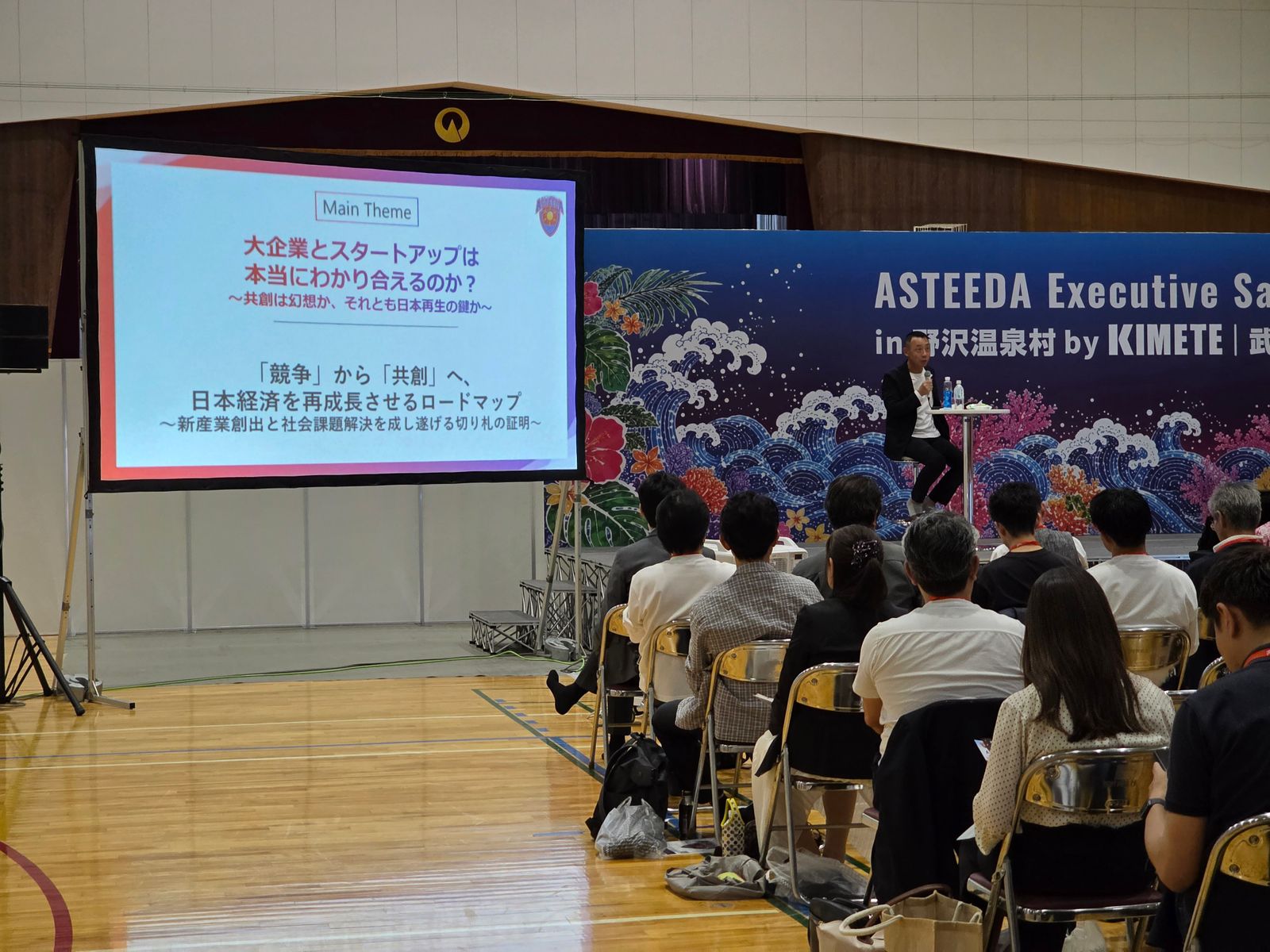
One o'clock in the afternoon, June 11, in the gymnasium of the public hall in Nozawa Onsen Village, Nagano Prefecture.
Beneath a steel-truss roof with the basketball hoops folded away, hundreds of Korean and Japanese executives sat on folding chairs facing a stage whose backdrop was painted with Okinawan coral reefs and hibiscus: 'ASTEEDA Executive Salon in Nozawa Onsen Village.'

A professional table tennis club from Okinawa had turned the gymnasium of a post-ski-season hot-spring village into a stage for Korea–Japan business. Food stalls stood at the first-floor entrance; red lanyards hung from every neck. From start to finish, nothing about the scene resembled a convention center.
The host is Ryukyu Asteeda Sports Club, the Japanese T.League table tennis franchise that became the first professional sports club in Japan to go public. The club's invitation-only executive community, the ASTEEDA Executive Salon, opened its first Global Track this year and officially invited Korean business leaders.
The design: spend three days and two nights in one village — eating together, lodging together, soaking in the same hot springs — building trust first and leaving transactions for later. The keyword running through the event is the 'Trust Protocol,' and its overall theme is 'AI cooperation and joint business creation through Korea–Japan private-sector open innovation (From AI Technology to AI Business).'
Structural change explains why an event like this has emerged between Korea and Japan. As global supply chains are reorganized and economic bloc-building deepens, corporate cooperation between the two countries has shifted from diplomatic ceremony to survival strategy.
Yet the first barrier to entering the Japanese market is not product competitiveness but trust. Japanese business runs not on cold calls or trade-show booths but on an 'economy of introductions (shokai)' — who introduced you, and which community you belong to, are preconditions for a deal. The three days in Nozawa Onsen are an experiment in passing directly through that cultural barrier.

Sake at the Eve Party, Lunch at the Food Stalls — Trust Begins at the Table
The event began the evening before the official opening, with an eve party at a small bar in the village — free entry for all booth participants. Korean CEOs and Japanese executives traded first greetings shoulder-to-shoulder in the cramped room, and staff who had been setting up the venue stage late into the evening ran over after finishing work. On the 11th, a participants' golf tournament and a table tennis tournament ran alongside the sessions — with a table tennis club as host, the ping-pong tournament is something of a rite of passage.


In the evening, four side events unfolded across the village. The organizers' message to participants amounted to an operating philosophy: if the daytime sessions are the insight, the evenings are when that insight becomes the raw material of conversation — and conversation becomes friendship.
The operational details are likewise tuned to the infrastructure of trust. Participants received a profile book covering the 93 executives appearing on session stages, with guidance attached: listening to a discussion when you know the speaker and their company is entirely different from listening cold, and if you hope to do business with someone afterward, take notes on what they say on stage.
A mobile simultaneous interpretation and translation solution was provided for Korean participants, and session guides were circulated in Korean translation. The second day began at 9:30 a.m. with a networking breakfast. The meal itself is the program.
A Fujitsu Evangelist on 15-Minute Rotations — Double Opt-in at Work
Booths for seven Korean AI and software companies lined the venue's two floors: AI search company Liner, generative AI agent company Wrtn, AI media localization company XL8, AI human platform operator ESTsoft, industrial AI company INEEJI, Polaris Office, and bluemoonsoft. The lineup itself announces that the salon's agenda is AI.
The booth meetings are not expo-style open booths. Under a double opt-in system — a meeting happens only when both sides agree — each Japanese executive's booth visits are confirmed in advance down to the time slot and duration.
Around midday on the 12th, the itinerary of Kunikazu Matsumoto, Fujitsu's senior evangelist, compressed the system into a single route: 60 minutes at Polaris Office from 11:45, then a relay of 15-minute consultations through Liner, bluemoonsoft, ESTsoft, and Wrtn — the open windows between his own session appearances allocated to Korean companies by the minute.
Over three days, executives from IBM Japan, NTT West, Sekisui Chemical, Hikari Tsushin, and other major Japanese corporations and listed companies rotated through the booths the same way. Meetings that fell through did not vanish; they were converted to Zoom calls and survived. The design target is not the quantity of encounters but the conversion rate to actual deals.

Lotte Holdings CEO Genichi Tamatsuka also scheduled meetings with Korean AI companies separately from his session appearance. Professor Samseog Ko and Nina Kim, Founder and CEO of Korean partner JOYFUL Labs, served as mentors to the Korean participants throughout the event, advising on Japanese market entry strategy and matching with Japanese executives.

Pre-introductions operated everywhere — briefing the president of Japanese advertising company OPT on Liner the evening before his scheduled meeting, then connecting the two the next day.
Session 2 — Extending 'Co-evolution' to Korea and Japan
Session 2 on the afternoon of the 12th — 'Platforms, Media, and Industrial Policy in the AI Era: Korea–Japan Co-evolution and the EnterTech Hub' — is the centerpiece of this Global Track. The panel: Tamatsuka of Lotte Holdings; Distinguished Professor Samseog Ko, a committee member of Korea's Presidential National AI Strategy Committee; and Jung Sang-won, CEO of ESTsoft.
A group executive rooted in both countries, a media and content policy architect, and an AI platform operator share one stage to debate what Korea and Japan can build together. This writer, CEO of K-EnterTech Hub, moderates.

The session's governing frame is 'co-evolution (gongjinhwa),' the concept Professor Ko has advanced. In his keynote at the Next K-Wave EnterTech Forum at CES 2026, Ko argued that the era of one-way K-content exports has reached its limits, and that the next stage is a 'cultural partnership' in which partner countries plan and produce together and share the results. The frame has already been applied to Korea–U.S., Korea–Malaysia, and Korea–Singapore cooperation; this session is its first extension to Korea and Japan.

“Korea and Japan stand before the same questions — ours is not a relationship in which one side teaches the other, but a co-evolutionary relationship in which we build the answers together,” Ko said. “When Japan's IP and Korea's AI, platform, and fandom capabilities co-evolve rather than compete, the two countries can open new markets together.”
The session stages co-evolution as a three-layer value chain. The policy layer — designing the ecosystem — is represented by Ko, a former standing commissioner of the Korea Communications Commission. The language and AI infrastructure layer is represented by Jung, whose company operates the AI human and AI dubbing platform PERSO.ai, with 460,000 cumulative users, 90 percent overseas, and support for more than 75 languages. The offline 'stage' layer — connecting IP, hotels, sports, and customer experience — is represented by Tamatsuka, who led Uniqlo (Fast Retailing) and Lawson before becoming Lotte Holdings CEO in 2021 and has driven the 'ONE LOTTE' strategy linking the Korean and Japanese Lotte groups since 2022.
The foundations are already in operation: BELLYGOM, the character IP developed by Korea's Lotte Homeshopping, is rolling out in Japan with Lotte Holdings as master licensee; LOTTE HOTELS JAPAN, a 2025 joint investment by Korea's Hotel Lotte and Japan's Lotte Holdings, targets 20 hotels and 4,500 rooms in Japan by 2034; add CALIVERSE, Lotte Innovate's metaverse platform, and the link between the Chiba Lotte Marines and Korea's Lotte Giants, and assets spanning IP, hotels, the metaverse, and sports are laid across both countries.
The discussion is built to land not on an abstract declaration but on 'co-evolution PoCs that Korea and Japan can actually launch together within 6 to 12 months' — combinations that cut across the three layers, such as Japanese IP joined with K-fandom and AI multilingual technology, staged on Lotte's offline assets.

How to Say Goodbye by Gondola
On the final day, the 13th, participants ride the gondola up the mountain together, come back down, and close the three days with a 3 p.m. farewell party. The organizers describe the architecture as a three-stage trust conversion process — from Contact to Bonding to Business. Time spent together, not business cards exchanged; the dinner table and the hot spring, not the booth, become the infrastructure of sales.

The three days in Nozawa Onsen raise two points worth watching. The first is the direction of sports club IP expansion.
Ryukyu Asteeda, listed on the Tokyo Stock Exchange's Tokyo Pro Market in 2021 (ticker 7364), is monetizing not athletic performance or fandom but the club's community-operating capability and its credibility as a listed company. With the traditional club business model centered on media rights and sponsorship under pressure, this is an attempt to redefine the club as a hub for the regional economy and corporate networks — a model worth studying for Korean professional clubs and sports tech companies.
The second is the institutionalization of a private channel decoupled from government-to-government relations. “This salon is a private-sector retreat, not a government-hosted event — a place designed for dialogue on cooperation, mutual growth, and coexistence built on trust, beyond the exchange of business cards,” said Nina Kim of JOYFUL Labs.
“As the next step after the 60th anniversary of Korea–Japan diplomatic normalization in 2025, we want to move past commemoration and ask, at the private-sector level, where the next 60 years of industrial cooperation begins.” As Session 2 shows, the first agenda placed at that starting point is EnterTech.
Korean content companies entering Japan must pass through the same barrier — the structure of introductions and trust — and co-evolution becomes the language of cooperation that works within it.