
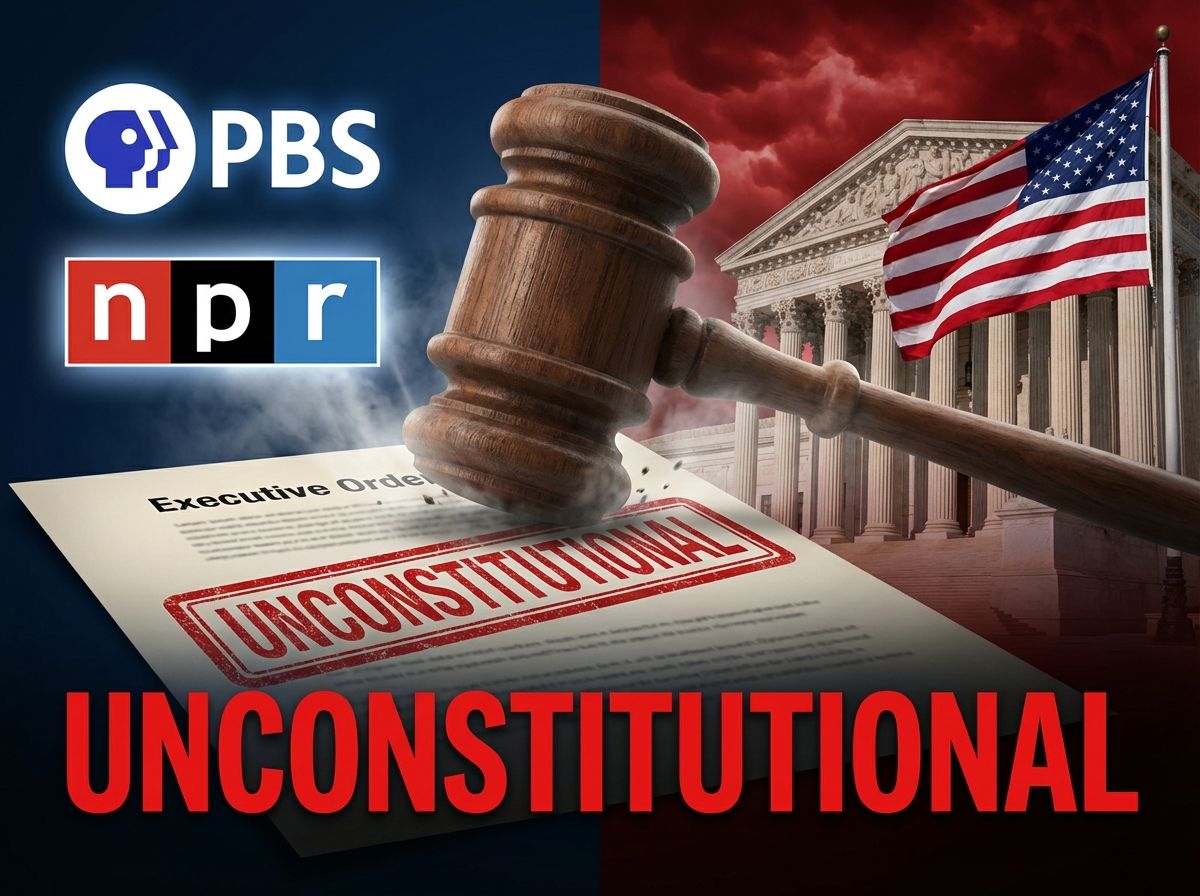
Court Voids Executive Order 14290 as Unconstitutional Viewpoint Discrimination, But CPB's Dissolution and Congressional Rescission Leave Public Media's Financial Recovery in Deep Uncertainty
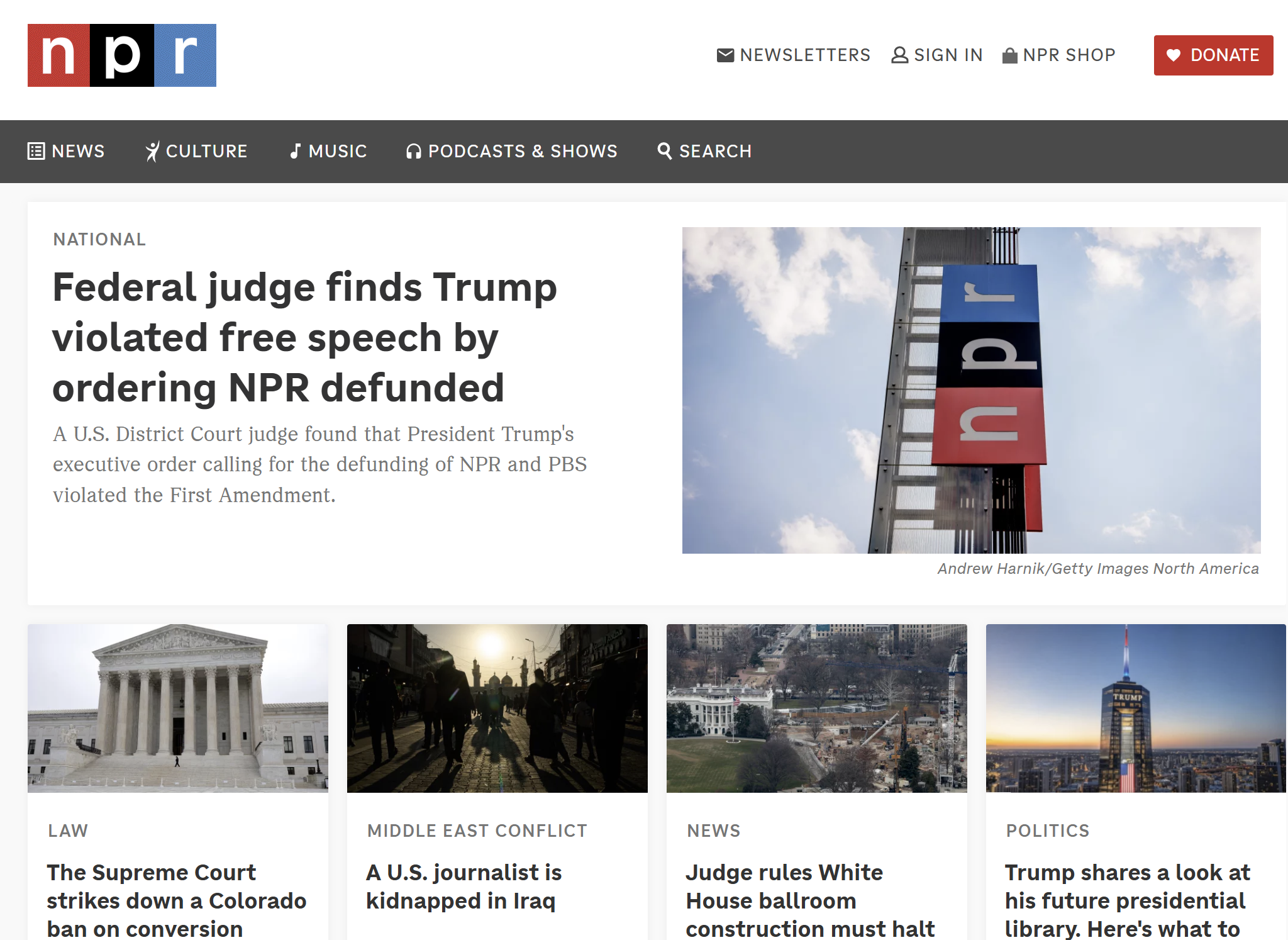
A federal judge has permanently blocked the Trump administration's sweeping directive to strip NPR and PBS of all federal funding, ruling it an unconstitutional act of viewpoint discrimination — but with the Corporation for Public Broadcasting already dissolved and $1.1 billion in congressional appropriations already rescinded, the ruling's practical impact on public media's financial future remains deeply constrained.
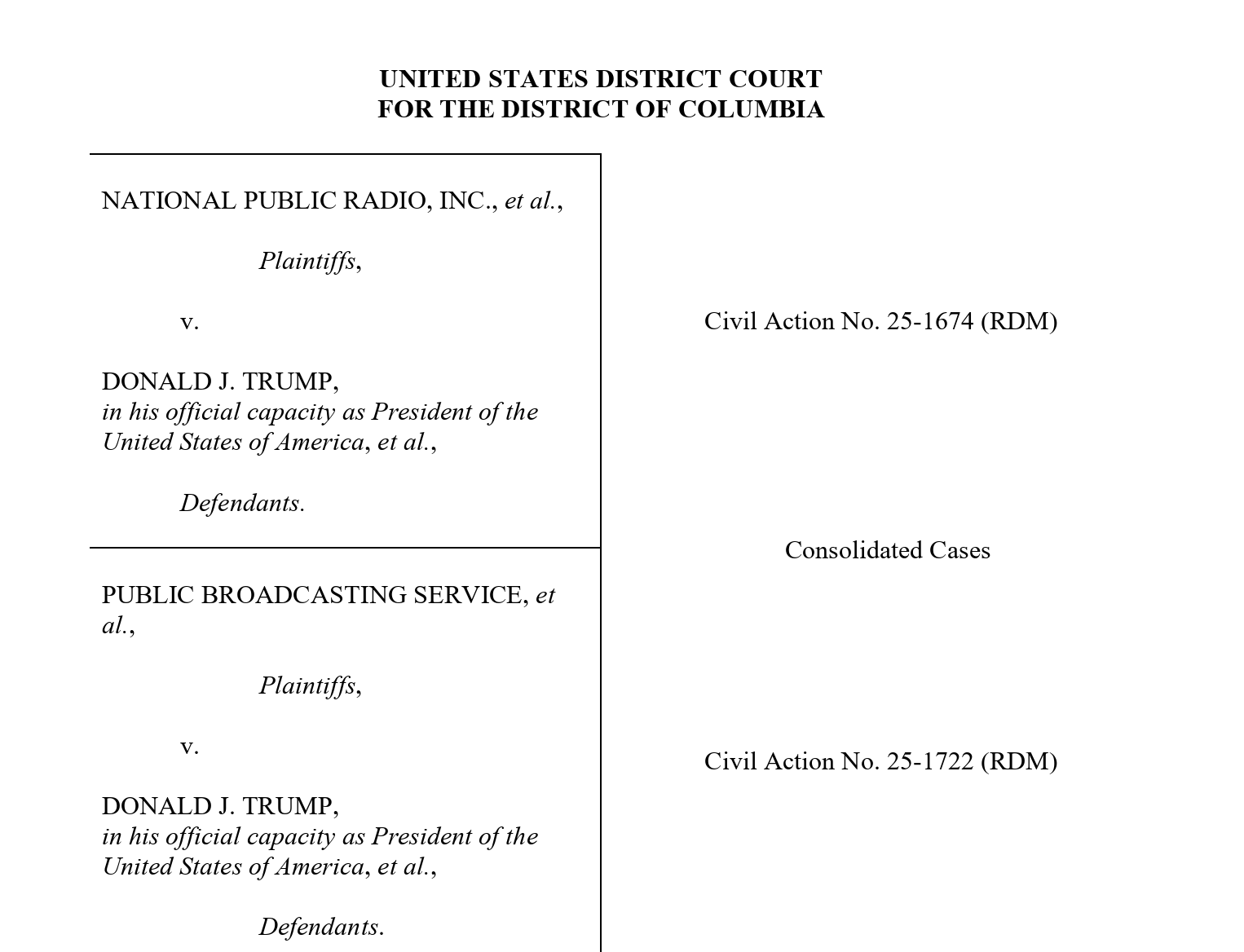
U.S. District Judge Randolph D. Moss of the District Court for the District of Columbia issued a 62-page opinion Tuesday in the consolidated cases of NPR v. Trump (Civil Action No. 25-1674) and PBS v. Trump (Civil Action No. 25-1722), permanently enjoining the administration from implementing Section 3(a) of Executive Order 14290. The order, Moss wrote, is "simply another lever in the President's arsenal to punish or extinguish speech he dislikes."

The Scope of the Order and Its Immediate Damage
Signed May 1, 2025, Executive Order 14290 went far beyond instructing the CPB to cut off direct funding. Section 3(a) directed all federal departments and agencies — including the Department of Education, FEMA, and the National Endowment for the Arts — to identify and terminate, to the maximum extent consistent with applicable law, any direct or indirect funding of NPR and PBS, regardless of the nature of the program or the merits of any application.
 Jung Han
The consequences were immediate. The day after the executive order was signed, the NEA canceled two NPR grants — one supporting literary content and one supporting music programming production and distribution. The same day, the Department of Education terminated the "Ready to Learn" grant, a $78 million joint award to CPB and PBS for children's educational content production, resulting in the termination of 22 PBS Kids staff.
FEMA also suspended a Next Generation Warning System grant program — which funds the public broadcasting emergency alert infrastructure — for approximately three weeks.
The ruling's 62-page opinion lays out the financial stakes in granular detail. In 2025, PBS operated on a total budget of $373.4 million: 61% from member station dues ($227 million), 16% from CPB grants ($59.8 million), and 6% from other federal grants ($20.7 million). PBS content reaches nearly 97% of the U.S. population and is free to the public. NPR received approximately $11.1 million in CPB grants and has received NEA grants in each of the past 27 consecutive years. For many local public radio stations, CPB grants historically made up between 30% and 50% of total operating budgets.
The Court's Central Holding
Judge Moss — an Obama appointee — was unequivocal on the constitutional question. The Federal Defendants themselves conceded that the executive order is viewpoint-based. As Moss wrote, the order "does not define or regulate the content of government speech or ensure compliance with a federal program. Nor does it set neutral and germane criteria that apply to all applicants for a federal grant program. Instead, it singles out two speakers and, on the basis of their speech, bars them from all federally funded programs."
Critically, the court also found that the order had a measurable chilling effect on local stations. The Federal Defendants admitted that NPR understood the executive order "put it on notice that it must adapt its journalistic and editorial choices to suit the government's preferences if it is ever to receive federal funding again," and that at least one local radio station questioned whether it should continue to acquire and air NPR programming.
What Comes Next
① DOJ Silent on Appeal — White House Signals Legal Fight Ahead
The U.S. Justice Department offered no immediate comment on whether it would appeal the ruling. The White House called it "a ridiculous ruling by an activist judge," strongly implying a challenge through the D.C. Circuit Court of Appeals — and potentially the Supreme Court.
② CPB Cannot Be Revived Without New Legislation
The court's opinion is explicit: while Congress has not repealed the Public Broadcasting Act, the prospect of CPB reconstituting itself is "entirely speculative." Re-incorporation would require new board members appointed by the president and confirmed by the Senate — a prospect deemed "highly unlikely" while the executive order remains in effect — and no congressional funding to justify reconstitution. The CPB filed Articles of Dissolution with the D.C. government on February 27, 2026, effective February 28 — ending nearly 58 years of operation.
③ Limited Funding Restoration Possible via Federal Agency Grants
The ruling could open a narrow path to some future funding. Public broadcasters have historically received grants from individual federal agencies beyond the CPB — including the Department of Education's now-rescinded $23 million for educational programming. Those grant channels are now constitutionally protected going forward under the injunction. The CPB itself, notably, agreed during the litigation that Executive Order 14290 is "unconstitutional" and stipulated it would not implement or enforce it.
④ Over 100 Local Stations at Risk of Permanent Closure
While few local NPR and PBS affiliates have shut down entirely — sustained by emergency fundraising — more than 100 stations are expected to eventually be forced to close. NPR currently has 246 member stations operating more than 1,000 radio signals nationwide; PBS has 336 member television stations. Both networks' satellite distribution systems — which also carry FEMA presidential emergency alerts — are among the infrastructure elements the court noted were swept into the order's blanket funding ban.
⑤ Part of a Broader Judicial Pattern on Press Freedom
Tuesday's ruling follows a March 20 decision by a separate federal judge finding that the Trump administration's restrictive press access policy at the Pentagon was unconstitutional — part of a pattern of judicial pushback against the administration's pressure on media institutions.
Industry Takeaway
The ruling firmly establishes — in 62 pages of constitutional analysis — that the government cannot use its funding power as a political weapon against news organizations based on their editorial viewpoints. The injunction covers all federal agencies, not just the now-defunct CPB, providing a constitutional shield for future grant applications from NPR, PBS, and their affiliates. Yet the structural damage to American public media — the CPB's dissolution, the $1.1 billion congressional rescission, the layoffs and station cutbacks already underway — will not be undone by a court order alone. With a likely administration appeal and no clear path to restoring congressional funding, the battle over the future of public broadcasting in the United States is far from over.
Sources: Court Opinion, Civil Action No. 25-1674 & 25-1722 (D.D.C. March 31, 2026); Variety; NPR; CNN; The Hill; OPB; Colorado Public RadioCompiled by K-EnterTech Hub Editorial Desk