
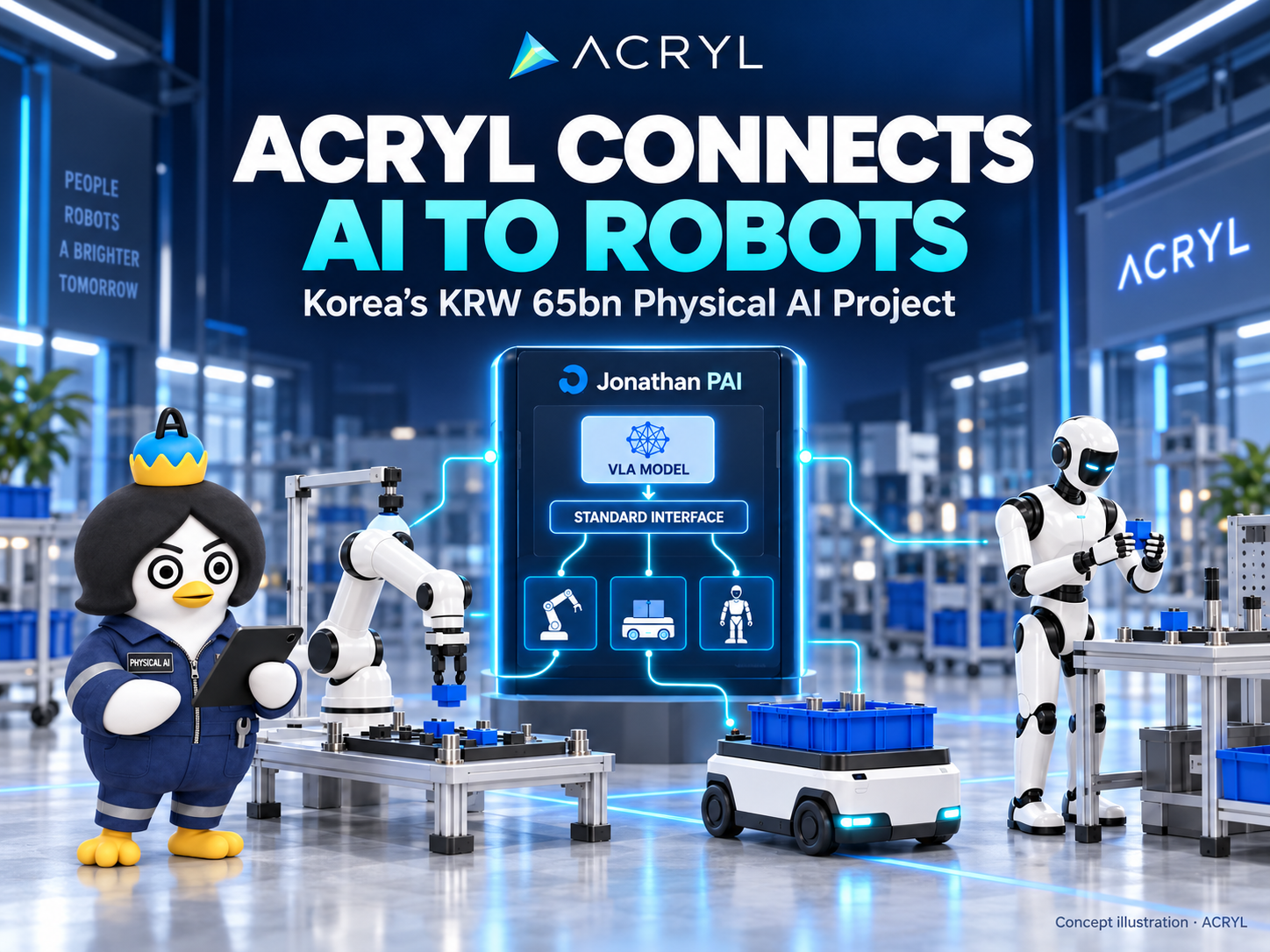
Acryl to validate robots in Korea’s 65 billion won physical AI project, with its Jonathan PAI platform as the yardstick
Sungkyunkwan University leads an 18-member consortium; the target is seven or more robot types connected through Jonathan PAI by 2030, inside the Jeonbuk arm of a 1.41 trillion won government program
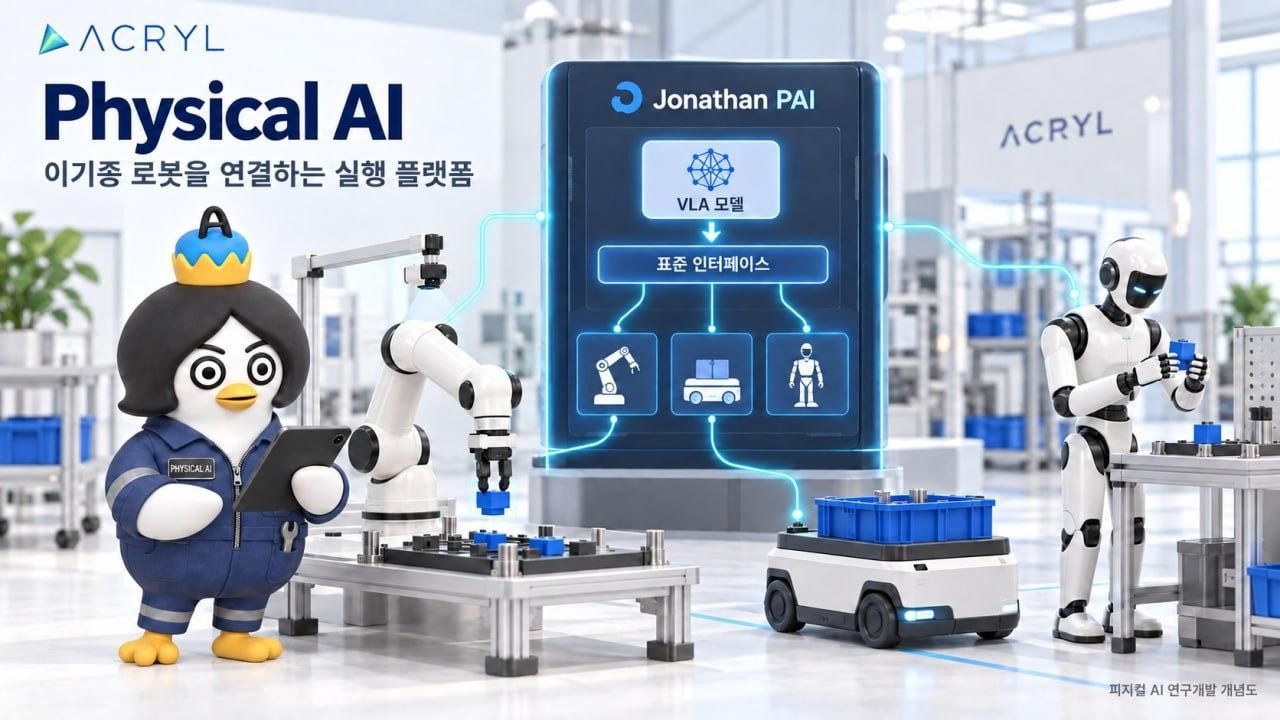
Acryl (아크릴), a Seoul-based AI infrastructure company, said on Sept. 22 that it has joined a government-funded physical AI research project worth about 65 billion won ($47.5 million) as a co-developing institution. The project develops foundation models for collaborative physical AI in software-defined factories (SDF). It belongs to a program run by the Ministry of Science and ICT (과학기술정보통신부) and the National IT Industry Promotion Agency (NIPA, 정보통신산업진흥원) to build a software platform ecosystem for collaborative-intelligence physical AI.
Acryl’s role is written into the project’s metrics. The R&D plan sets the number of robots that can be connected to and controlled through Jonathan PAI, Acryl’s integrated physical AI platform, as one of its key performance indicators. The goal is at least seven robot types that differ in form, degrees of freedom and sensor configuration by 2030. Whether the consortium’s foundation models actually run on different machines will be checked on that platform.
Sungkyunkwan University’s industry-academic cooperation foundation (성균관대학교 산학협력단) leads the project, which runs from August 2026 to December 2030. Of the roughly 65 billion won budget, 45 billion won ($32.9 million) comes from the government. The 18 participants include KAIST, Seoul National University (서울대학교), Rainbow Robotics (레인보우로보틱스) and Hyundai WIA (현대위아).
The parent program is the Jeonbuk half of a 1.4131 trillion won ($1.03 billion) physical AI push the ministry unveiled on Sept. 16: 736.8 billion won for a collaborative software platform in North Jeolla (전북) and 676.3 billion won for large action models in South Gyeongsang (경남). “Acryl doesn’t build robots, and it doesn’t build robot brains,” Jin Park, Acryl’s chief executive, said in the company’s release. “Our role is to build the path by which every brain reaches every robot.”
A company platform in the metric; Acryl also sits on the steering committee
The plan measures output as the number of robots brought onto and controlled through Jonathan PAI, putting a participating company’s platform name directly into the indicator. The foundation models the consortium builds are validated on robots connected to that platform.
Acryl is also a member of the steering committee that adjusts the project’s budget, schedule and performance targets. Its principal investigator is Lee Su-gi (이수기), who heads a division at Acryl’s research institute. The company plans to hire five researchers in robotics middleware, multimodal data platforms and field testing for the work.
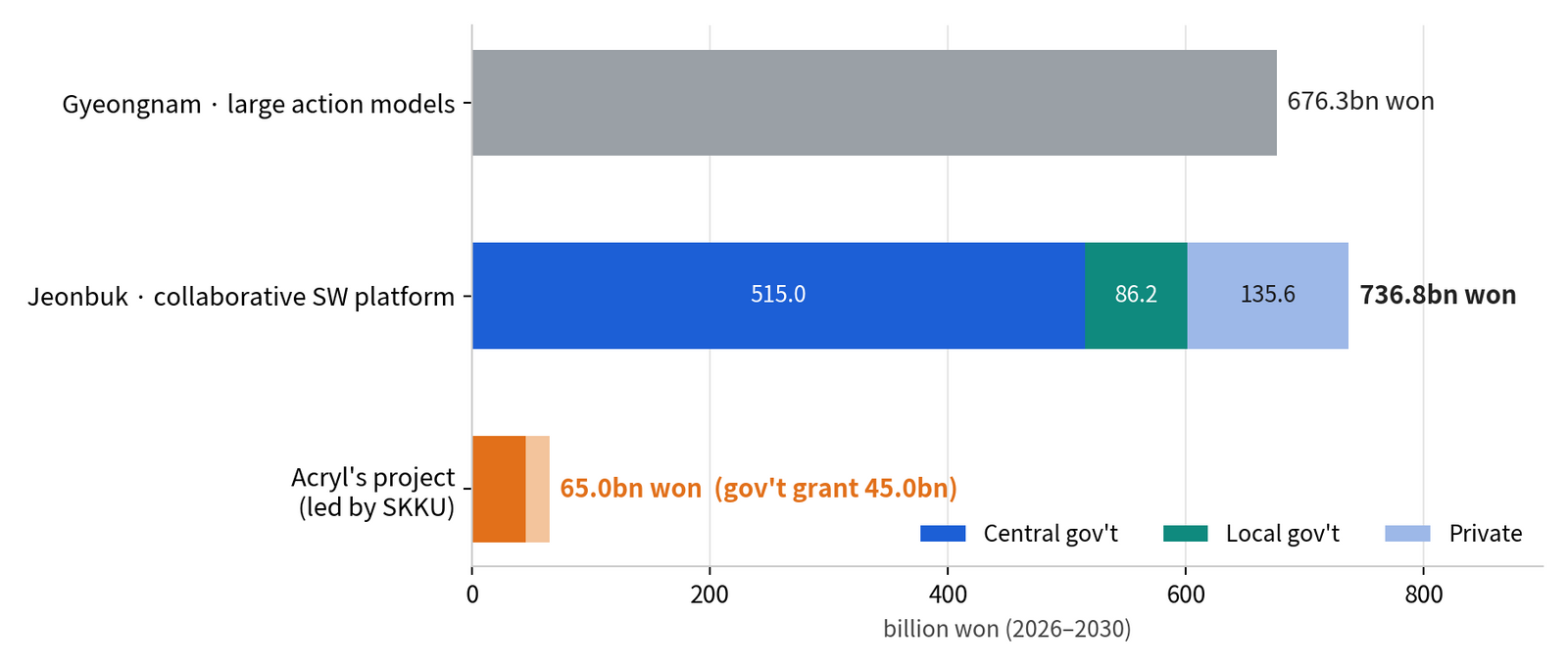
Budgets for the two regional physical AI programs and for Acryl’s project. Only a total is available for Gyeongnam. Source: Ministry of Science and ICT, Acryl
An execution layer between VLA models and robots: gateway, standard interface, data pipeline
Acryl’s share is what it calls the execution layer, which carries a foundation model’s output to physical robots. It will build Jonathan PAI to support training, inference and serving of vision-language-action (VLA) models, along with a real-time robot communications gateway and a standard interface for different robot types. It is also responsible for a pipeline that collects and manages robot manipulation data automatically, and for a benchmark that evaluates performance across robot types.
Translating a model’s decisions into each robot’s control system is work that has to be redone whenever the hardware changes. A standard interface is meant to reduce that to a single connection specification. With two robot makers, Rainbow Robotics and Hyundai WIA, in the same consortium, the interface can be fitted to real machines.
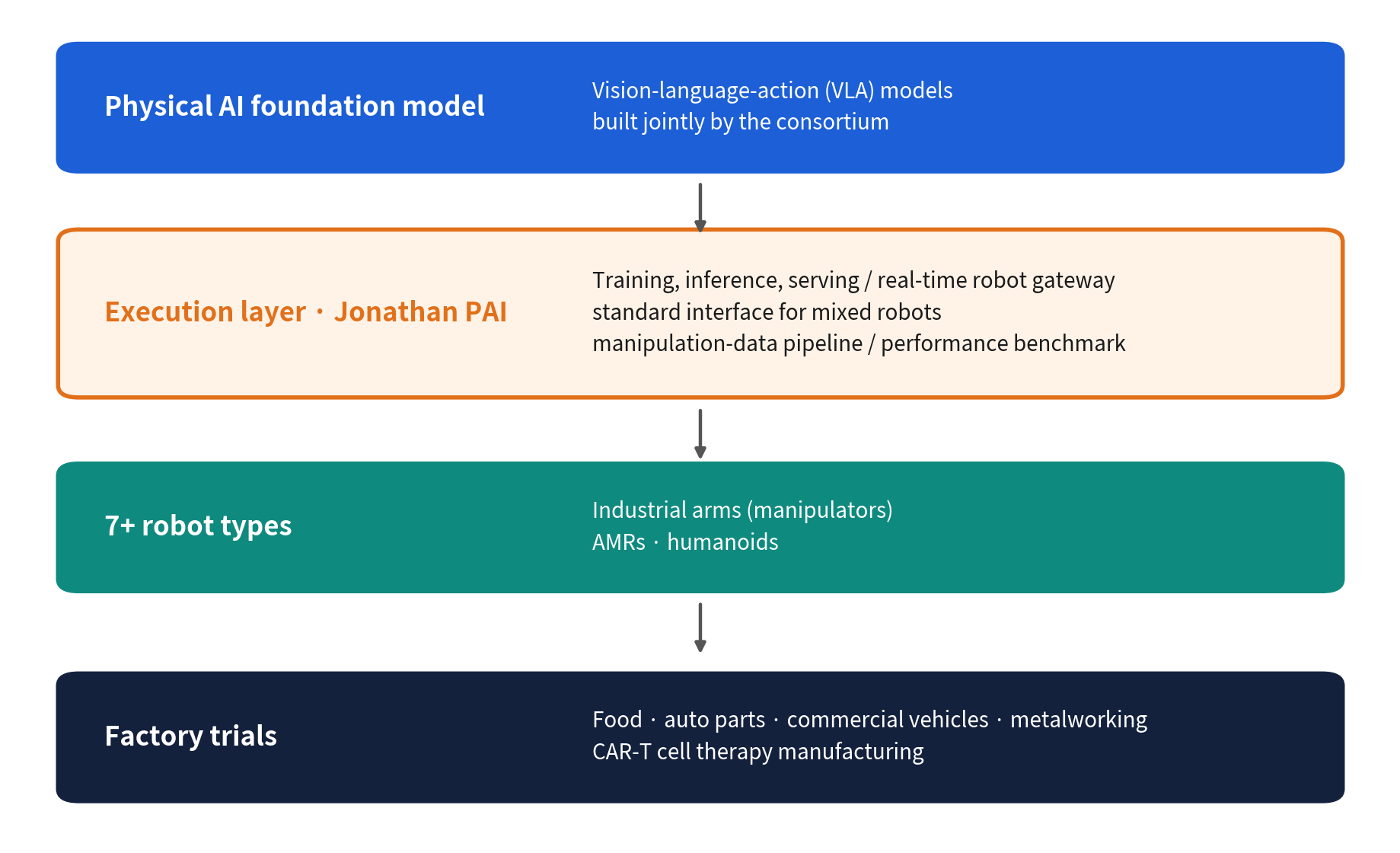
Seven-plus robot types, tested in food and auto-parts plants and a CAR-T process
The robots to be brought onto the platform span industrial arms (manipulators), autonomous mobile robots (AMRs) and humanoids. Acryl plans to build up a library of robot connectors, the per-model modules that link each machine to the platform.
The technology will be tested on real production lines in food, auto parts, commercial vehicles and metalworking. Sample handling in CAR-T cell therapy manufacturing and coordinated operation of mixed robots there are also on the list, extending the trials from factory work to a biomanufacturing setting with sterile and precision requirements.
A 1.41 trillion won program: 736.8 billion won for Jeonbuk, 676.3 billion won for Gyeongnam
At a launch briefing in Seoul on Sept. 16, the ministry said it would put 1.4131 trillion won into North Jeolla and South Gyeongsang over five years through 2030. The Jeonbuk program’s 736.8 billion won is made up of 515 billion won ($376 million) in central government money, 86.2 billion won from local government and 135.6 billion won from the private sector. A joint R&D center, a technology testing station and a “meta-factory” will be built in Iseo-myeon, Wanju County (완주군 이서면), with Jeonbuk National University (전북대학교) and CAMTIC (캠틱종합기술원) as anchors.
According to Dailian (데일리안) on Sept. 16, about 150 universities, research institutes and companies and 3,500 researchers take part in the two programs, 107 of them small and mid-sized companies. The government’s targets include integrated trials across at least 13 manufacturing processes and a closed-loop automation rate of 90% or more by 2030. KT, KAIST and Daim Research (다임리서치) said on Sept. 8 that they had joined the same program with a project on “dark factory” platforms for unmanned plants.
From GPU software to robots: a first integration test with Sungkyunkwan in January
Acryl listed on the KOSDAQ in December 2025. Its main products are GPUBASE, software that allocates and schedules GPU resources, and Jonathan, a platform for building and running AI. In June the company was chosen to lead an Institute of Information & Communications Technology Planning & Evaluation (IITP, 정보통신기획평가원) project on Ethernet-based network fabric for GPU clusters, worth 6.7 billion won ($4.9 million).
Its robotics work began earlier this year. Edaily (이데일리) reported on Jan. 28 that Acryl had connected the Jonathan platform to robot systems with the research team of Professor Honguk Woo (우홍욱) at Sungkyunkwan University, linking multimodal data preprocessing, VLA model fine-tuning and low-latency infrastructure that keeps inference within set deadlines. Sungkyunkwan also leads the new project.
Acryl plans to turn the results into a Jonathan PAI Robotics Edition, a robot connector library, a third-party benchmark certification service and subscription licenses priced by the number of robots deployed. “We will extend the heterogeneous resource management capabilities we built in GPU infrastructure software into physical AI and develop Jonathan PAI into a core platform linking a wide range of AI models and robots,” Park said.
Outlook: more models and more robot types, with seven types by 2030 as the first test
The number of robot foundation models is growing. NVIDIA released Isaac GR00T N1, an open humanoid foundation model, in March 2025. Google DeepMind introduced Gemini Robotics 2 on July 30 this year, with a capability for “different types of robots to communicate and work together.” As models and machines multiply, so do the model-robot pairings a single factory has to support. Park’s comment that “the value of this execution layer will grow as robot foundation models and robot types increase” rests on that count.
Acryl’s business plan ties revenue to the same number. If licenses scale with deployed robots, sales rise with every robot added to the platform. If robot makers and model developers keep their own control specifications and SDKs, the room for an intermediate layer shrinks. The four years and five months of fitting a standard interface to two robot makers’ machines inside the project are where that is tested.
Korea’s program has split physical AI into two hubs, models in Gyeongnam and a collaboration platform in Jeonbuk, and the layer that moves a model onto hardware is being measured as a metric of its own. The next checkpoints are how many robot types are on Jonathan PAI when the project closes in December 2030, and whether its connectors are used in factories outside the consortium.
Sources
· Acryl press release, “Acryl to handle robot validation in 65 billion won physical AI national project… Jonathan PAI platform used as performance metric” (distributed Sept. 22, 2026; in Korean)
· Newspim (뉴스핌), Sept. 22, 2026. https://www.newspim.com/news/view/20260922000403
· Newsprime (뉴스프라임), Sept. 2026. https://www.newsprime.co.kr/news/article/?no=748664
· Dailian (데일리안), “1.4131 trillion won for physical AI… manufacturing trials in Jeonbuk and Gyeongnam” (Sept. 16, 2026). https://www.dailian.co.kr/news/view/1690909/
· Asia Economy (아시아경제), Sept. 16, 2026. https://view.asiae.co.kr/article/2026091614412871631
· Jeonbuk Ilbo (전북일보), Sept. 16, 2026. https://www.jjan.kr/article/20260916500060
· HuffPost Korea (허프포스트코리아), on the KT–KAIST–Daim Research dark factory agreement (Sept. 8, 2026). https://www.huffingtonpost.kr/article/260258
· Edaily (이데일리), on Acryl’s robot integration (Jan. 28, 2026). https://www.edaily.co.kr/News/Read?newsId=03201286645322312&mediaCodeNo=257
· Edaily (이데일리), on Acryl’s IITP GPU network fabric project (June 2026). https://edaily.co.kr/News/Read?mediaCodeNo=257&newsId=03424326645480408
· Google DeepMind, “Gemini Robotics 2 brings whole body intelligence to robots” (July 30, 2026). https://deepmind.google/blog/gemini-robotics-2-brings-whole-body-intelligence-to-robots/
· NVIDIA Newsroom, “NVIDIA Announces Isaac GR00T N1 — the World’s First Open Humanoid Robot Foundation Model” (March 18, 2025). https://nvidianews.nvidia.com/news/nvidia-isaac-gr00t-n1-open-humanoid-robot-foundation-model-simulation-frameworks