

Media & Journalism
The smaller the outlet, the bigger the search loss; AI citation payments are both a new revenue source and the start of a fight over allocation
Reasons to return matter more than apps or newsletters; expertise and direct audiences will separate winners from losers
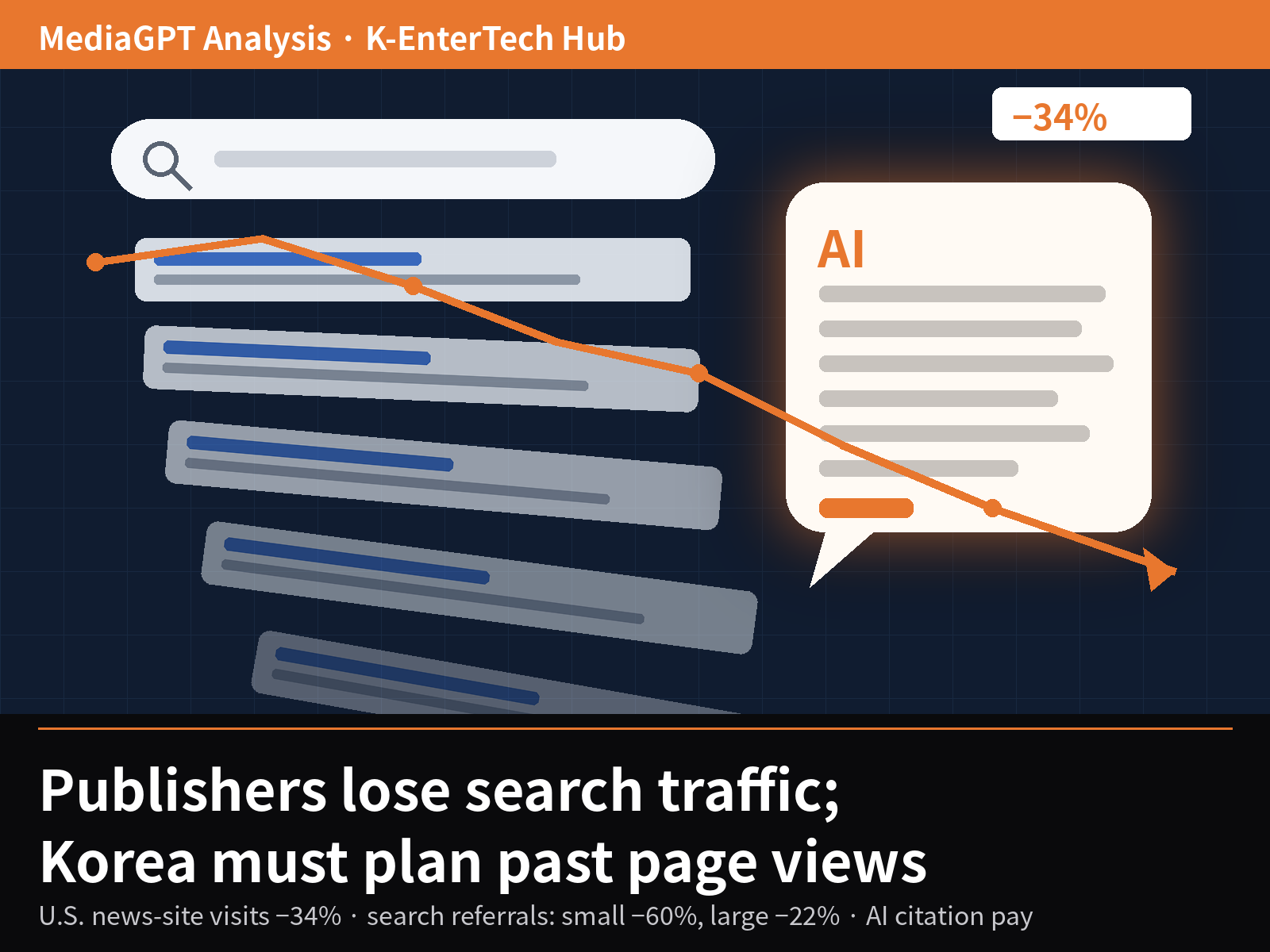
AI chatbot referrals are growing but equal 1.5% of search. In South Korea, weekly news use via AI chatbots doubled to 14%, while only 8% go directly to publisher sites or apps. Daum's AI citation payments could become a new revenue source, but measurement and allocation rules will decide their value. Korean publishers need revenue built on returning readers and hard-to-replace expertise.
The business formula of drawing readers from search and monetizing them with advertising is breaking down. A headline and link in search results no longer means a reader will reach the publisher's site. As AI answers questions on the search page and condenses several stories into one reply, the use of news and the visits publishers receive are coming apart. News may be used more widely than ever while less of its value returns to publishers as visits and revenue.
Smaller publishers are taking the heaviest hit. Chartbeat data reported by Axios show traditional search referrals fell 60% at small publishers, 47% at mid-sized ones and 22% at large ones over the past two years. ChatGPT referrals grew quickly over the same period, but chatbots as a whole still account for less than 1% of publisher page-view referrals. A new channel does not by itself fill the gap search has left.
This is not a distant problem for Korean media. In the Korea Press Foundation (한국언론진흥재단) analysis of the Reuters Institute Digital News Report 2026, the share of Koreans using AI chatbots for news doubled in a year from 7% to 14%, while 61% still rely mainly on search engines and news aggregators. Because AI news use is expanding before portal dependence has meaningfully declined, Korean publishers must respond to changes in the existing distribution system and to new consumption habits at the same time. Winning back on another platform the visits lost on portals risks repeating the same dependence.
Against this backdrop, portal Daum (다음) has announced it will split ₩2 billion (about $1.47 million) a year among publishers according to how often its AI cites their news, and has proposed a business that processes and sells news data.
It is a test of whether AI's use of articles can carry its own price. Whether it becomes a real revenue stream depends not only on the size of the budget but on what counts as a citation, who verifies usage and how payments are divided. If measurement and allocation are left entirely to the platform, the portal-centered relationship of the past could carry over into the AI era.
Competition in Korea's news industry is likely to split into two tasks: recovering lost clicks, and capturing the value of news that is used without a click. In the short term publishers need revenue that can absorb falling search traffic; over the longer term they need reasons for readers to come directly and information AI companies will pay for.
Apps, newsletters and memberships should be judged as tools for sustaining reader relationships rather than as solutions in themselves. What Korean media need is not a business that abandons audience numbers, but a revenue structure that can keep funding reporting even as outside traffic shrinks.
U.S. news-site visits fall from their peak, and the weaker rebounds are the bigger concern
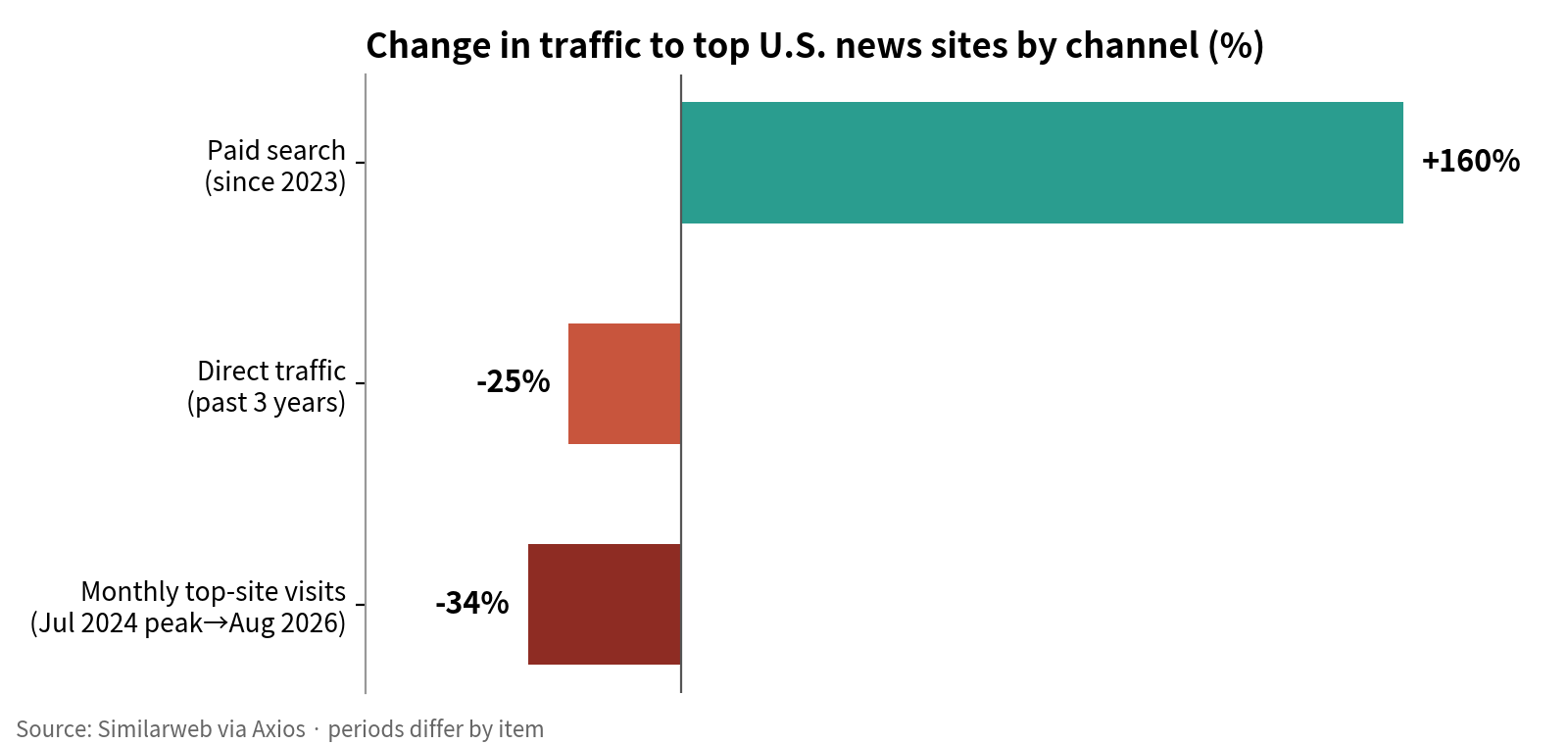
In an Axios chart based on Similarweb data, monthly visits to top U.S. news sites fell from about 72.6 million in July 2024 to about 47.6 million in August 2026, roughly 34% below the peak. Traffic rebounded to about 68 million around the November 2024 presidential election but could not sustain the gain, and from 2025 both highs and lows have moved lower amid monthly swings.
The pattern after the rebound matters more than any single month's decline. Big news events such as an election can lift visits temporarily, but if publishers cannot keep the readers who arrive, the spike does not become a lasting revenue base. Publishers need to track not only how many people visit when demand for news surges, but how many return and stay on as registered users or subscribers.
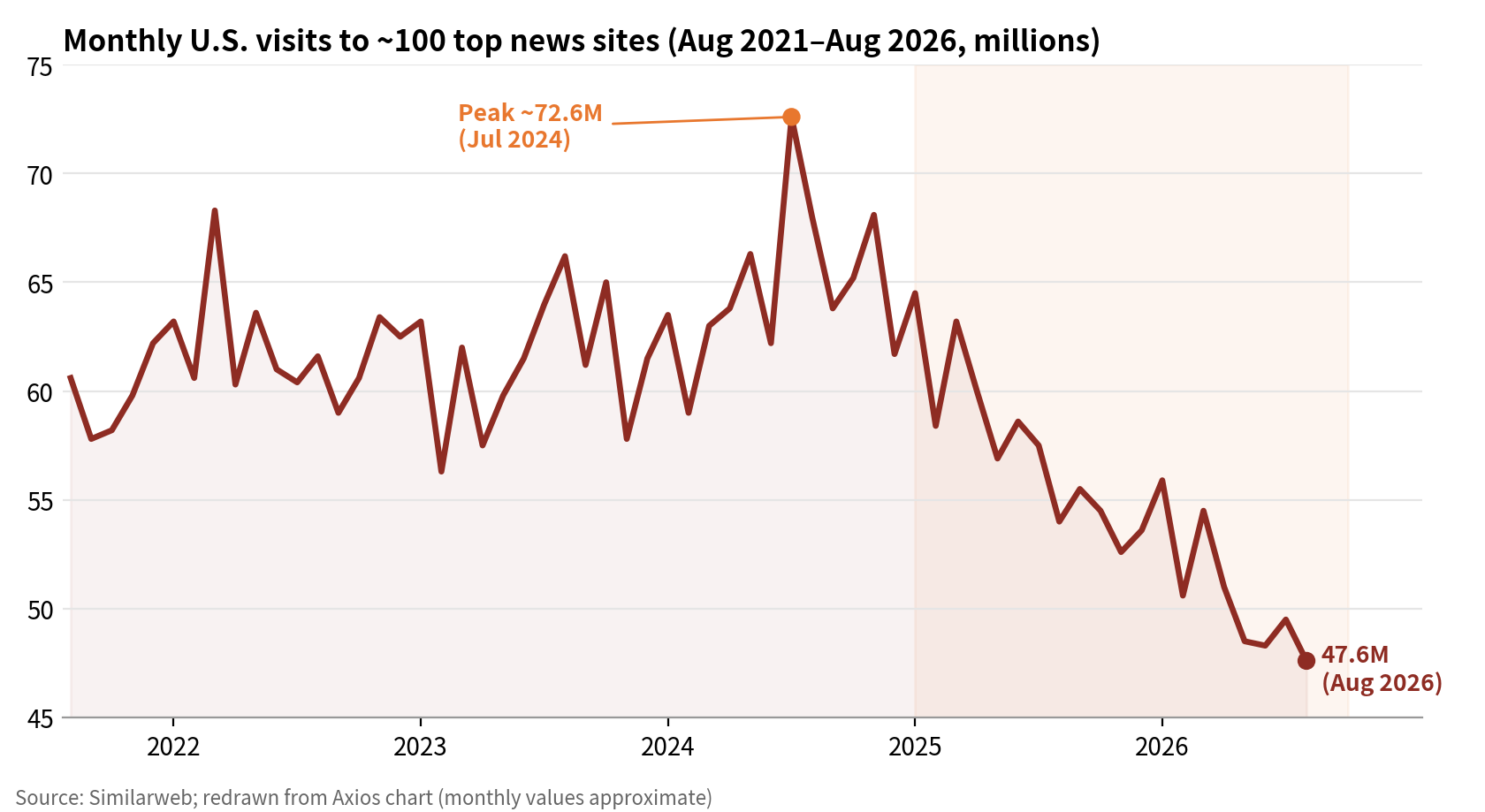
Axios tied the decline to tech giants moving users from search and social platforms to AI-centered interfaces, putting digital publishers under pressure to change their businesses faster than expected. Still, the entire drop should not be attributed to AI; it reflects shifts in news demand and platform policies as well. Korean publishers, too, should prepare structures that sustain readers and revenue as outside traffic falls, rather than waiting for big stories or better search placement to bring visits back.
AI chatbots have not filled the space search left behind
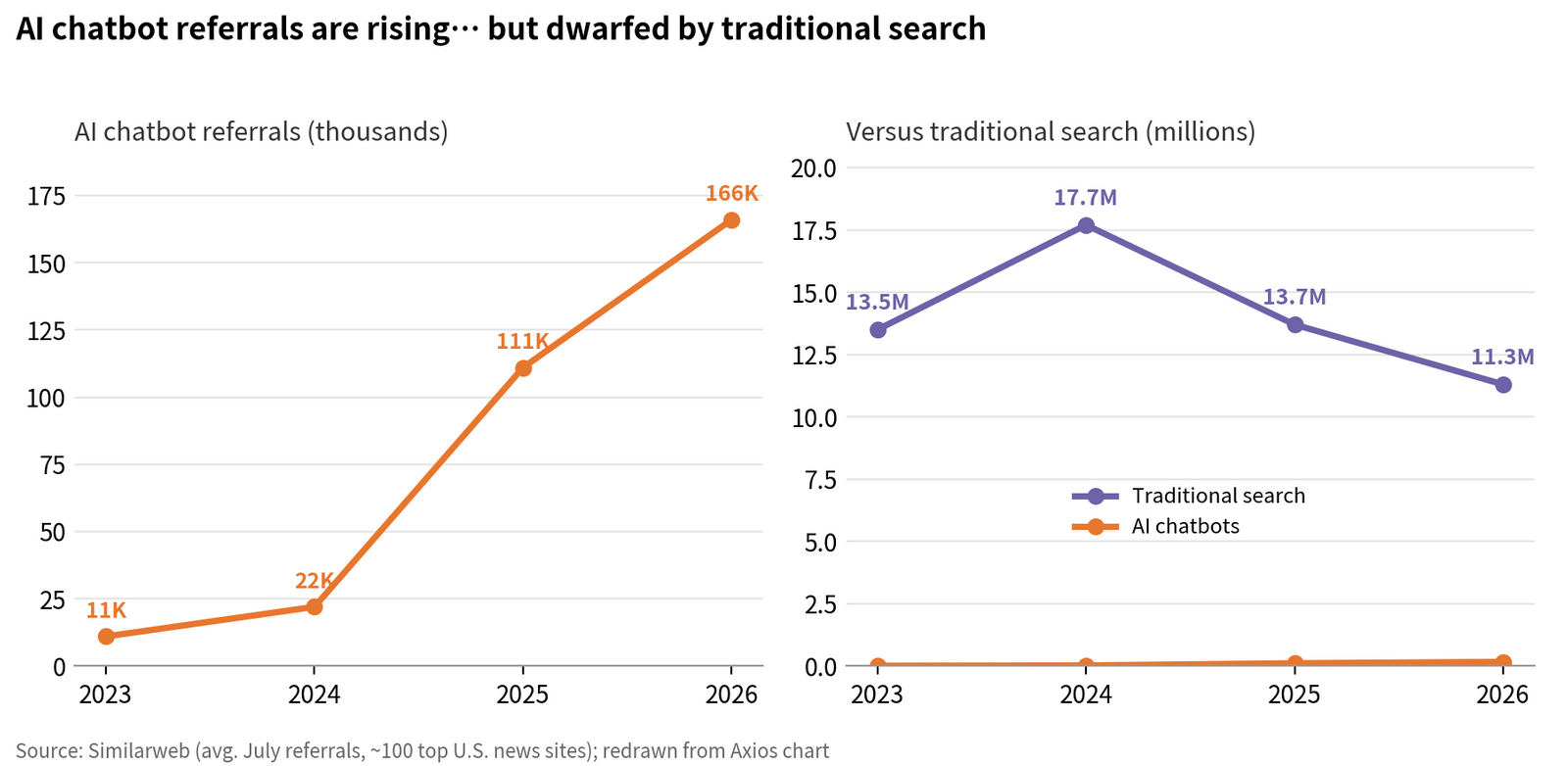
Referrals from AI chatbots are rising fast but remain too small to replace lost search traffic. Readings of the Similarweb chart cited by Axios show average July search referrals to top U.S. news sites fell about 36%, from about 17.7 million in 2024 to about 11.3 million in 2026. AI chatbot referrals rose from about 22,000 to 166,000 over the same period, yet this year still equal only about 1.5% of search referrals.
A longer view sharpens the contrast. Search referrals rose from about 13.5 million in 2023 to a high in election-year 2024, fell to about 13.7 million in 2025 and have now dropped below 2023 levels. AI chatbot referrals, by contrast, grew about fifteenfold in three years from about 11,000 in 2023. Despite the high growth rate, the small starting base means they are nowhere near large enough to change publishers' overall traffic mix.
Users who get what they need on the search page and never click through add to the pressure. An analysis cited in the Korea Press Foundation's overseas media briefing No. 1 of 2026 found the zero-click rate rose from 56% in May 2024 to 69% a year later, while clicks to news publishers fell from 2.3 billion to 1.7 billion. The gap between appearing in search results and actually bringing readers to a publisher's site is widening.
Pew Research Center's analysis of search behavior found a similar gap. On Google searches that displayed an AI summary, users clicked a traditional result 8% of the time, versus 15% without a summary, and clicked a source link inside the summary 1% of the time. Because the study compared different search visits, the whole difference should not be read as a decline caused by AI summaries.
Publishers need to separate being cited by AI from gaining new readers. Frequent appearances in AI answers will not offset falling ad revenue unless they lead to visits or subscriptions. For now, rather than expecting AI referrals to replace search, publishers should track which stories bring readers in and how often those readers return.
Search referrals down 60% at small publishers, 22% at large ones
The impact of falling search traffic varied by publisher size. In the Chartbeat analysis Axios reported on March 17, traditional search referrals over two years fell 60% at small publishers, 47% at mid-sized ones and 22% at large ones. Small publishers' decline was about 2.7 times that of large ones, meaning smaller outlets have been shaken hardest by the change in search.
Chartbeat, drawing on data from thousands of client sites worldwide, classifies publishers averaging 1,000–10,000 daily page views as small, 10,000–100,000 as medium and more than 100,000 as large. Because the classification is based on web usage rather than revenue or newsroom size, the results should be read as differences by the size of a publisher's online audience.
Axios said large publishers, with stronger brand recognition and subscription products sold directly to readers, have more room to withstand the search decline. The same analysis found direct visits and internal traffic — readers moving from one story to another on the same site — partly filled the gap, and the share of traffic from email, apps and messaging grew.
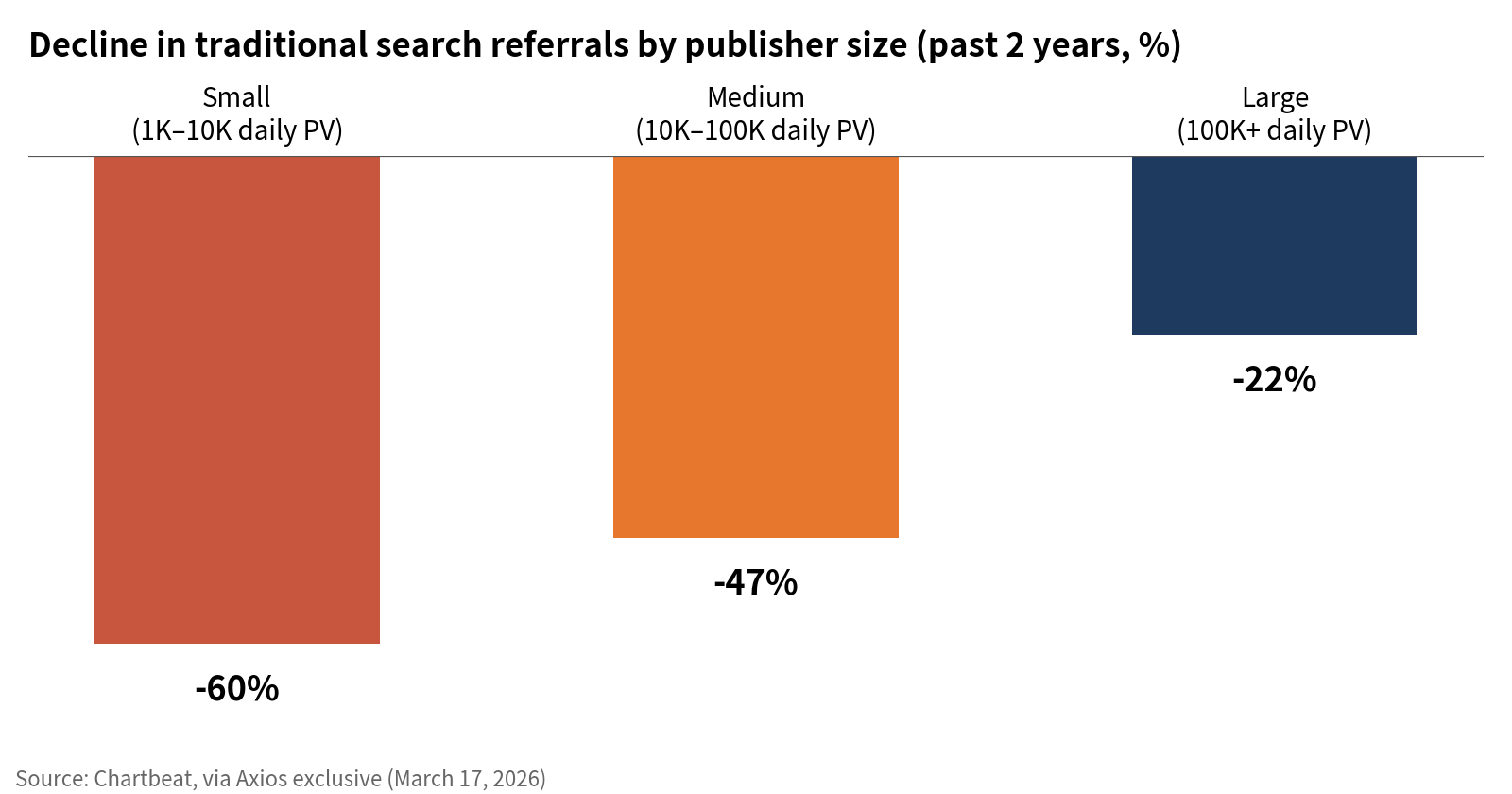
The smaller the publisher, the steeper the search decline. Source: Chartbeat via Axios (March 17, 2026)
The difference lies not only in the ability to draw readers from search but in the base for meeting those readers again and getting them to read more. Even as search referrals fall, readers who already know a site and read several stories can cushion the overall drop. Outlets that must win new visitors through search every time are more likely to see falling outside traffic turn into shrinking use of the whole site.
Google Search referrals down 34%, but total page views down only 6%
By referral source, the shift away from search is even clearer. Across Chartbeat's network, page views from Google Search fell 34% and from Google Discover 15% between December 2024 and December 2025. Page views from ChatGPT referrals rose more than 200%, but chatbots as a whole remained under 1% of publisher page-view referrals.
Yet the search decline did not translate into an equal drop in overall site use. Average weekly page views across Chartbeat's global publisher network fell 6% between 2024 and 2025. Axios said direct visits and internal traffic partly compensated for lost search. The size-based gap shown earlier needs to be read in terms of both how much publishers lost from search and how much use they kept from other channels.
It also means total site usage alone is a poor gauge of the change in search. Even when overall page views hold relatively steady, the share coming from outside search may shrink while dependence on existing readers and on-site navigation grows. The ability to win new readers through search and the ability to keep existing readers engaged show up as different metrics.
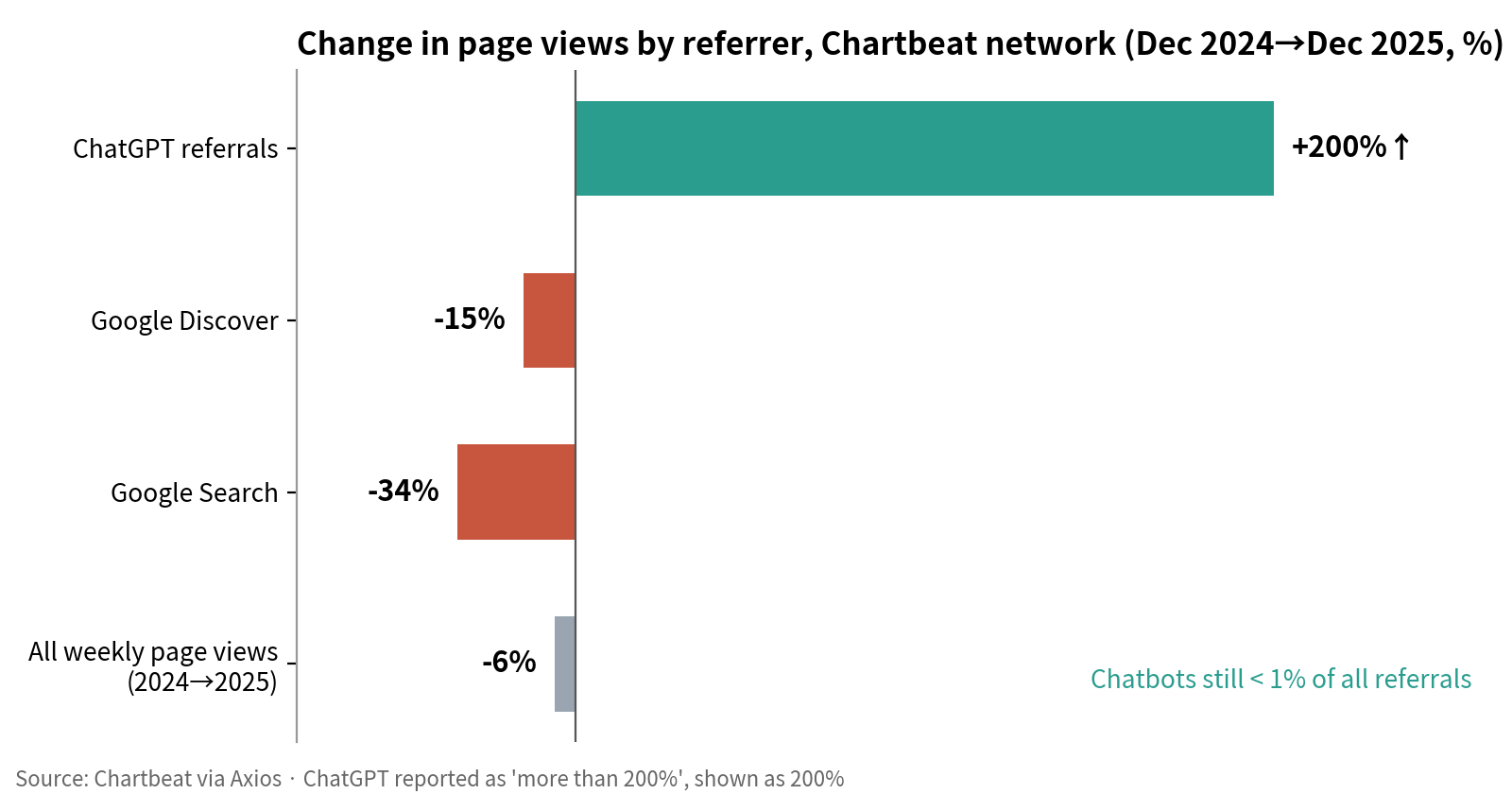
ChatGPT's gains did not make up for losses at Google's two referral channels; total weekly page views fell 6%. Source: Chartbeat via Axios
Comparing the Similarweb and Chartbeat figures calls for care. Similarweb covers top U.S. news sites; Chartbeat covers thousands of client sites worldwide, and the two measure different things — visits versus page views. Because one visit can generate several page views, the declines in the two datasets should not be compared directly, nor should their different findings on direct traffic be explained by sample differences alone.
News sites get the most AI traffic, but practical information wins on per-article use
As referrals shift from search to AI, differences in what readers look for are emerging. In Chartbeat's data, news and media sites received the most page views from AI platforms of any category compared, but per-article performance was low. Sites that help solve specific problems, such as health advice or gardening tips, saw relatively high page views per article from chatbots.
Axios suggested that AI users visiting news sites may be looking to check facts or context from an answer. If the original story offers little beyond what the AI answer already said, readers have little reason to read further. If it provides the reporting, detailed explanation and practical information the answer left out, there is a reason to visit the original.
On that basis, Axios argued news outlets must go beyond breaking news and incremental updates to help readers solve problems — for example, explaining who a policy change applies to and how, or adding material that helps companies make decisions about industry trends. Changing content and building reader habits takes time, however, and in the meantime some publishers are trying to fill the traffic gap with advertising spending.
Paid search traffic up 160% as publishers buy back lost visits with ads
In the Similarweb data cited by Axios, the only channels that grew for top U.S. news sites over the past three years were paid search, email and affiliate referrals. Paid search traffic rose 160% since 2023. As organic visits from search fell, the share of readers acquired by paying for them grew.
Ad spending tells the same story. According to Media Today (미디어오늘), citing Adweek's Sept. 9 report, the 100 largest U.S. media companies spent $113 million (about ₩153.5 billion) on paid search ads in July, up 41% from a year earlier and 274% from three years earlier. Forbes spent about $72.2 million (about ₩98.1 billion) that month, up 34%, and The New York Times doubled its spending to $11.3 million (about ₩15.3 billion).
The keywords publishers bought included purchase-intent terms such as insurance, prescription drugs and bank accounts, so not all of this spending should be seen as a cost of winning back general news readers. Some of it may aim at revenue from product comparisons or affiliate sales; the key test is whether it generates revenue above its cost, not simply whether visits rose.
The problem is that this response once again pays the platforms. Media Today noted that publishers' growing search ad spending pushes up ad prices and adds to revenue at Google and other platforms, and Axios called such stopgaps costly and hard to sustain. If visits bought with ads do not turn into return visits or subscriptions, publishers must keep spending to hold their traffic. The smaller a publisher's resources, the narrower its room to compete in this race.
Wired bets on an app, Business Insider on niche brands: loyal readers over anonymous visitors
Alongside buying short-term visits, publishers are expanding direct points of contact with readers. Wired and Business Insider (BI) are using an app and specialist brands, respectively, to prioritize readers who come back repeatedly over readers who stumble in from search.
Condé Nast's Wired launched a global app in September with a personalized daily digest, the option to follow writers, custom alerts and live AMA question-and-answer forums with Wired journalists and experts. It did not include an AI chatbot, and global editorial director Katie Drummond said the brand would focus on loyal, more engaged readers even if the audience becomes smaller. Wired chose features that connect journalists with readers, and readers with each other, over conversations with AI.
Wired has strengthened original reporting and investigations and says it has beaten its subscription targets every year since Drummond took editorial charge in 2023. The app packages that work while letting readers follow specific journalists and receive follow-up coverage — an attempt to turn one-time visits into ongoing use.
Axel Springer's Business Insider chose to segment its readers' interests further. After naming Christian Baesler permanent CEO in August, it announced plans to reorganize coverage around four specialist brands aimed at markets, AI, small businesses and chief marketing officers. On top of more than 10 million YouTube subscribers, it launched a stand-alone streaming app and a free ad-supported streaming (FAST) channel in July.
What the two share is not just more distribution channels but a clearer sense of who the content is for. Wired builds repeat use on trust in its journalists and reporting; BI on demand for information in specific fields. Strategies that widen reach on outside platforms, such as video and FAST, should still be distinguished from strategies that win readers directly through owned apps and subscriptions. More people encountering a brand is not the same result as a publisher building a direct relationship with those readers.
Registration walls and newsletters to know readers: from visitor counts to repeat use
What underpins this shift is information publishers collect directly with readers' consent. So-called first-party data — email addresses, subscription status, interests and usage history — is the basis for turning anonymous visitors into readers a publisher can keep in touch with. The point is not to collect as much personal data as possible but to understand which readers need what and why they return.
One tool publishers use is the registration wall, which asks readers to register an email or account to continue reading. Unlike a paywall, it aims to identify readers and create a channel for newsletters and follow-up stories on their interests. Push notifications can also give consenting readers a reason to return, but consent to receive alerts should not be treated as consent to personal identification or broad behavioral tracking.
Chartbeat's finding that email, apps and messaging account for a growing share of traffic fits this trend. But a rising share does not necessarily mean more users; it can also reflect search falling faster, so actual referral volumes and return frequency need to be tracked together.
Challenges remain after sign-up. A member who registers and never returns is worth far less than a reader who comes back every week, and frequent alerts can lead to opt-outs. The success of apps, newsletters and registration walls shows up not in the number of accounts but in how consistently readers use them and whether those relationships lead to subscriptions or other revenue. The center of gravity is shifting from a business that waits for visitors from search to one that must keep giving known readers reasons to come back.
14% of Koreans use AI chatbots for news as portal dependence stays high
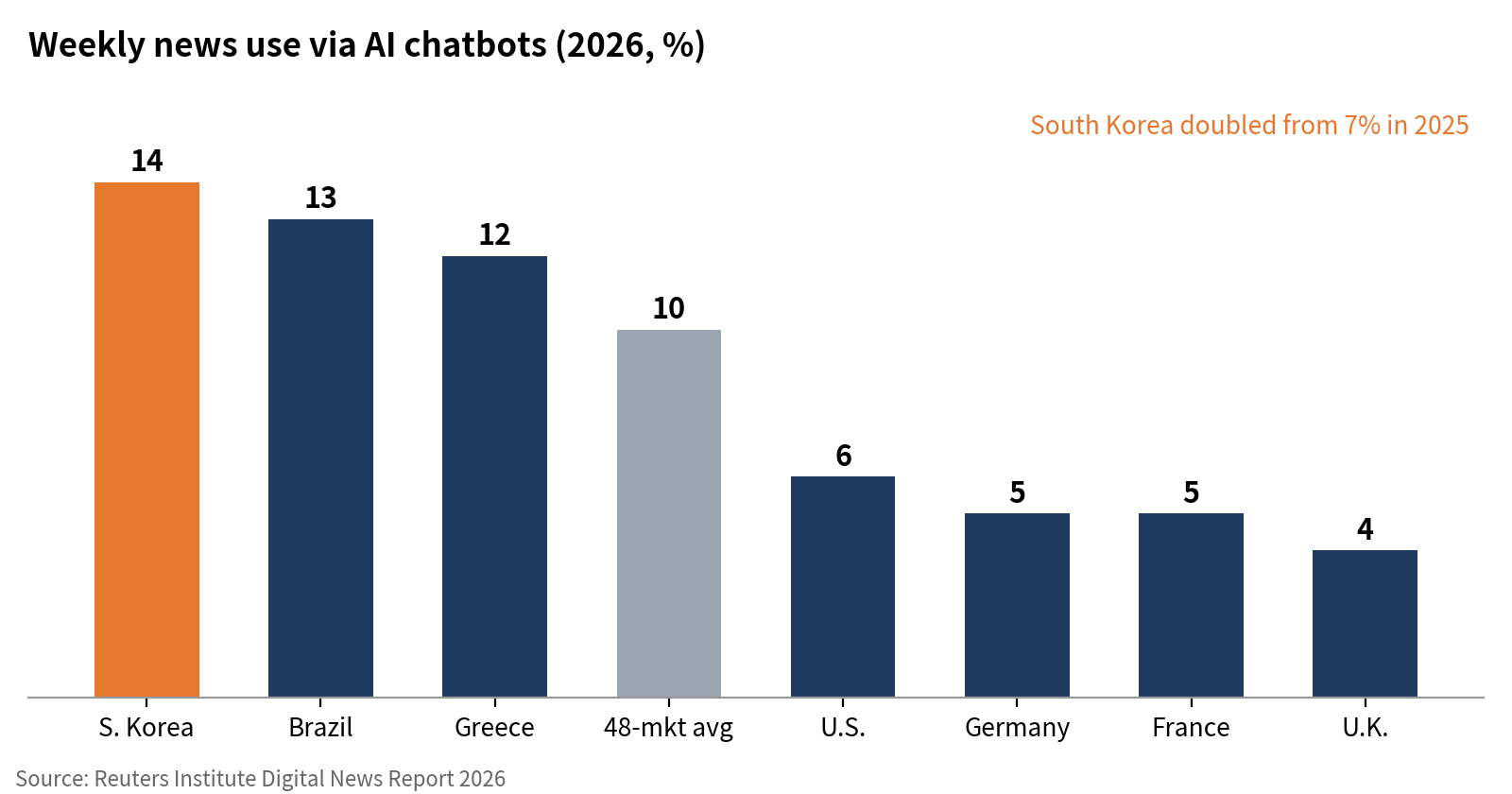
While publishers abroad strengthen their direct audiences, in Korea AI is being added as a new route on top of portal-centered news consumption. According to the Korea Press Foundation's analysis of the Reuters Institute Digital News Report 2026, 14% of Korean respondents said they use AI chatbots for news, double the previous year's 7% and above the 48-market average of 10%. Getting news through AI answers is spreading quickly in Korea too.
Portals remain powerful. Sixty-one percent of Korean respondents named search engines and news aggregators as a main route to news — down from 76% in 2019 but still second-highest among the markets surveyed. Only 8% said they go directly to publishers' websites or apps, the second-lowest after Thailand. Readers' starting point for news is concentrated on outside platforms rather than publishers' own services.
These figures are survey responses about how people access news, not measurements of the traffic sources of Korean publishers. But they do reveal the structural burden of having to respond to changes in search and recommendation screens with a weak base for meeting readers directly. If AI summaries of articles take up more space within portals, appearing on the same screen may no longer lead to visits to the original story in the same way.
High AI usage does not automatically mean a bigger drop in clicks. Coverage of the same report found that 56% of Korean AI news users said they 'always or often' click through to the original articles linked in answers — the highest of any market. It is a survey response rather than click data, but it suggests demand to check the original after reading an AI answer. The opportunity and risk for Korean publishers depend less on AI usage itself than on how far that use leads to visits and repeat use.
The vulnerability of small outlets identified by Chartbeat should be viewed in this light. U.S. and global sample declines cannot be applied directly to Korea, but outlets with weak audiences of their own that depend on search exposure may have limited capacity to adapt. If AI uses their articles without sending back enough visits, the debate in Korea will inevitably widen from securing traffic to how to price the use of news.
Daum to split ₩2 billion a year by AI citation volume and block outside AI crawlers
Daum, acquired in May by AI startup Upstage (업스테이지), held Daum Media Day 2026 at the Korea Press Center in Seoul on Sept. 21. According to the Journalists Association of Korea's weekly (기자협회보) on Sept. 22, Daum will replace a mix of flat content fees and revenue sharing with fixed fees for all partners and extend annual partnership contracts to two years. Lim Kwang-wook (임광욱), head of Daum's media division, said it would keep a fixed-fee model because declining traffic and revenue from the existing news service were unavoidable.
Daum also created a new payment for AI citations. It will measure how often the AI summaries in its search results cite each outlet's articles and split a ₩2 billion (about $1.47 million) annual budget quarterly, by contribution, among publishers that agree to participate or allow data use. Lim said the company debated at length whether to launch a system that even larger overseas tech platforms have not. Daum will also fully block outside search-index crawlers, AI search and training crawlers, and AI answer agents.
Daum also proposed an AI data API business that would, with publishers' consent, process article data into search, full-text and training packages for outside buyers, citing a 70:30 split of net revenue after processing costs as an example. CEO Lee Kun-soo (이건수) acknowledged that news consumption on Daum keeps falling and said an AI-personalized 'MY Feed' and an AI button on article pages launching in October are meant to revive it.
While U.S. publishers pay Google to buy back search traffic, a Korean portal has for the first time put a price on AI citations and pays publishers for them. The budget of ₩2 billion a year is about 2% of what Forbes spent on search ads in July alone (about ₩98.1 billion).
Generative AI search favors organic mentions over ads; the race moves inside AI answers
Axios flagged that generative AI search engines prioritize organic mentions over paid promotions, so buying the top line does not work in an AI answer. Gaming large language models to appear in their answers, Axios said, is becoming the internet's new race to the bottom.
The pages AI cites are also not where readers land. Similarweb found that 65% of URLs cited by ChatGPT sit two or three folders deep in a site, while 58.8% of the resulting referral traffic lands on homepages. Because AI uses in-depth stories as evidence while readers arrive by brand name, the brand recognition Chartbeat identified as large publishers' advantage also helps with AI referrals.
What it means for Korean publishers and portals
In Chartbeat's data, large U.S. publishers weathered the search decline through direct traffic and internal traffic within their sites. Those are the channels Korean publishers lack most. With 61% of Koreans relying mainly on portals and search, and only 8% going directly to publisher sites or apps — second-lowest after Thailand — many Korean outlets will face conditions like those of small U.S. publishers as portal search pages turn into AI summaries. The first metric Korean publishers should manage is not portal-referred page views but the number of readers identified through log-ins, newsletters and app alerts.
The $113 million (about ₩153.5 billion) the top 100 U.S. media companies spent on paid search in July was up 41% in a year, and the added spending went to Google, while Forbes's organic traffic fell 26.7% over the same period. The U.S. experience shows that buying back traffic gets more expensive each year and deepens platform dependence. Before Korean publishers take the same path with portal search or social ads, they need to weigh the cost per visit against how many of those visits turn into members or subscribers.
Chartbeat found search referrals fell 60% at small publishers and 22% at large ones. Korea had 27,063 registered periodicals in 2025, and because Daum splits its AI citation budget in proportion to citation volume, payments may favor outlets with more articles and stronger brands. Individual small outlets have little room to negotiate with portals or AI companies on their own. Just as the Korean Association of Newspapers (한국신문협회) formed a generative AI task force of ten member-company digital strategy chiefs to address AI companies' use of news, internet newspapers and trade outlets need an association-level framework to negotiate how citations are measured and on what terms data is provided.
Daum's AI citation budget is ₩2 billion (about $1.47 million) a year. At the same event, describing its data API plan, Daum cited overseas AI startups where plain content sells for $1 per 1,000 calls but processed data fetches up to $2,000 — a 2,000-fold spread for the same articles depending on processing. For publishers, how citations are counted, the quarterly allocation formula and whether data sale prices are disclosed matter more in negotiations than the ₩2 billion total.
Daum fully blocked outside crawlers and AI answer agents, saying surging bot traffic brings publishers server costs and data-leak risk but no revenue. Lim said he expects more Google referrals to reach publishers after the block. Whether publishers allow or block AI crawlers on their own sites is likewise a business decision that shapes their bargaining position with AI companies. Publishers need to measure which AI bots come in and how often, and set rules for blocking, allowing or charging.
South Korea's 14% weekly AI-chatbot news use is more than double the U.S. figure of 6%. Similarweb found AI cites deep pages while readers land on homepages. A metric tracking how often Korean stories are cited in answers from ChatGPT, Gemini and Naver's AI Briefing, and how many readers click through afterward, would give publishers a basis for citation negotiations and brand strategy. Today only the portals and AI companies hold those numbers.
In Chartbeat's data, news sites had the lowest per-article engagement from AI referrals, while practical information sites such as health or gardening had higher numbers. Breaking news and incremental updates are what AI summaries replace most easily. Wired stopped aggregating competitors and chasing search, and Business Insider raised exclusives and original reporting from 40% to 80% of output. Korean publishers need to cut back on short breaking items aimed at portal exposure and shift toward scoops, explainers and practical expertise that solves readers' problems if they want AI referrals to turn into time spent.
Reorganizing around practical expertise: large outlets offer breadth, small ones hard-to-replace information
In Chartbeat's data, news and media sites drew a large total of page views from AI platforms but low per-article performance, while practical information sites such as health and gardening had relatively high page views per article. The comparison cannot be turned directly into a ranking of time spent on articles, but it is grounds for asking what use news outlets can offer readers beyond breaking news and simple updates.
In Korea, businesses that narrow their coverage but deepen and sustain their information may matter more. For industry trade outlets, candidates include analysis of the impact of policy changes, deal and supply-chain information, and explanation that supports corporate decisions. For local media, steadily building up information on local government, education, housing and transportation, and answering readers' real questions, is a possible approach.
Choosing a specialty does not automatically make it payable, however. The questions are how often the information is needed, whether it is easily available elsewhere, and whether it saves individuals or companies enough time or improves their decisions enough to be worth paying for. Starting from articles, publishers can test several forms: newsletters, data services, briefings and corporate subscriptions.
Competition between large and small outlets may change along the way. Large outlets can use their brand and reach to run broad services, while small outlets build hard-to-replace information and relationships in specific fields. Conversely, small and midsize outlets that cover broad topics and rely on outside search for most of their readers may struggle to earn enough to justify the cost of adapting.
Outlook: the value of news splits into clicks, reader relationships and AI usage contracts
Korea's news industry is likely to keep its page-view business while adding direct reader revenue and fees for AI use. Rather than one revenue source quickly replacing another, the three are likely to run side by side, with the mix differing by outlet.
The biggest short-term risk is that falling search traffic arrives before new revenue does. Apps, newsletters and memberships need time to build habits, and AI citation payments cannot be counted as real revenue until contract and allocation terms are concrete. Publishers need to manage the costs and cash flow of their existing businesses as carefully as they announce new ones.
The gap between large and small outlets may therefore widen for a while. Outlets with established brands and audiences have room to ride out the transition, but those whose revenue falls as soon as search traffic declines may lack the money to invest in new products. Discussions of support for small outlets and joint negotiation should focus on lowering the costs of reader management, data measurement and rights contracts rather than preserving article output.
In the medium term, contracts between portals and publishers are likely to change. More contracts may separate fees for carrying articles, payments for use in AI answers and sales of data to companies. Publishers' bargaining power will then depend not only on the number of articles but on hard-to-replace information, clear usage rights and data that can prove actual use.
Daum's citation payment plan tests that possibility. Whether the announced budget becomes a stable new revenue source can only be judged once eligibility, measurement criteria, allocation results and how the budget will be adjusted are made public. Whether Naver (네이버) and other companies introduce separate payments, or handle AI use within existing partnership contracts, remains an open question.
On the positive path, readers' desire to check original stories and the value of specialist information turn into membership, subscription and data revenue. AI citations raise brand awareness, and some readers form direct relationships with publishers to reach originals and follow-up information. That requires publishers' services to offer something extra that cannot be had by reading the AI answer alone.
The opposite path is also possible. If search traffic keeps falling while AI fees stay fixed and direct reader growth stalls, publishers could end up supplying articles to more places while earning less. If counting usage and setting prices are left entirely to platforms, the old dependence on portals could repeat itself in AI distribution.
What to watch, then, is not just how often AI cites articles. It is how citations relate to visits, whether visitors return, how much of reporting costs direct reader revenue covers, and whether publishers can verify usage under AI contracts. If these metrics do not improve, wider exposure cannot be counted as business success.
The next competition for Korean media is not about giving up on audience numbers. It is about producing information that readers return for, and that companies and platforms will pay fairly to use, even as outside traffic shrinks. Recovering every click lost from search may not be possible, but a structure that confirms and captures the value of reporting wherever it is used can be designed now.
Sources
Axios (Kerry Flynn, Sara Fischer), “Link economy breaks as AI reshapes web traffic,” Sept. 19, 2026 — axios.com/2026/09/19/ai-search-traffic-referrals-news-sites (two charts; Data: Similarweb; Chart: Erin Davis/Axios Visuals)
Axios (Sara Fischer), “Exclusive: Small publishers hit hardest by search traffic declines,” March 17, 2026 — axios.com/2026/03/17/chartbeat-search-traffic-ai-chatbots (Data: Chartbeat)
Axios, “Wired launches new global app,” Sept. 15, 2026 — axios.com/2026/09/15/wired-launches-new-global-app
Axios, Business Insider names Christian Baesler permanent CEO, Aug. 4, 2026
Press Gazette (Charlotte Tobitt), Non-website audience is focus of revenue growth for new Business Insider CEO
Press Gazette, “News publishing trends for 2026: AI, avoidance, subscriptions,” June 19, 2026 (South Korea 56%)
Media Today (미디어오늘), Sept. 17, 2026, citing Adweek (Sept. 9) — mediatoday.co.kr/news/articleView.html?idxno=337162
Journalists Association of Korea weekly (기자협회보), Sept. 22, 2026 — journalist.or.kr/news/article.html?no=61718
Reuters Institute Digital News Report 2026, via Korea Press Foundation report ‘The era of multiple news pathways’ (News1/Newsis, June 16; Kuki News, June 26, 2026)
Newspim, citing Korea Press Foundation overseas media briefing No. 1 (2026), April 8, 2026
e-Narajipyo (e-나라지표), registered periodicals, Ministry of Culture, Sports and Tourism (updated March 10, 2026)
VentureBeat, “AI cites the deep pages but sends humans to the homepage,” July 27, 2026 (Similarweb data)
MediaCopilot, “Axios says AI is breaking the link economy” (citing Pew Research Center), Sept. 2026
Codeit blog on Naver's 2026 search changes (citing Naver's April figures for AI Briefing), Sept. 2026
Asia Economy, Korean Association of Newspapers generative AI task force, Feb. 18, 2025
Exchange rate: $1 = ₩1,358.4 (Seoul close, Sept. 23). Korean amounts in won with dollar equivalents; foreign amounts in dollars with won equivalents.
Quotation: text in quotation marks is reported speech; unquoted attributions summarize reporting. Secondhand citations name both outlets.
Data note: the monthly peak (about 72.6 million, July 2024) and the July referral figures by year (search 13.5M/17.7M/13.7M/11.3M; AI chatbots 11K/22K/111K/166K) are approximate readings of the Axios charts. Axios's text gives search referrals as roughly 18 million to 11 million and chatbot referrals as roughly 10,000 to more than 160,000. The chart's alt text cites a November 2024 peak of about 68 million, but the chart's highest point is July 2024; November is the second-highest. Similarweb covers about 100 top U.S. sites; Chartbeat covers thousands of client sites worldwide.