
Six NHL clubs' local games move to Prime Video — US$3.8bn of 2026 streaming sports-rights spend, the most of any streamer
Amazon has taken the local rights to six National Hockey League clubs. Prime Video said on 2 September it would exclusively stream in-market games for the Columbus Blue Jackets, St. Louis Blues, Carolina Hurricanes, Minnesota Wild, Anaheim Ducks and Dallas Stars in 2026-27. Counting the Seattle Kraken, Prime Video is now the exclusive local streaming home for seven NHL clubs.
Pricing splits two ways. The Blue Jackets, Blues, Hurricanes and Wild are sold as standalone packages at US$19.99 a month (about 26,900 won) or US$99.99 for the season (about 134,600 won), with no Prime membership required. Ducks and Stars games carry no extra charge for Prime members, and the two clubs will put 65 and 17 games respectively on local over-the-air stations.
The split follows the route each club took to get here. The first four were carried by Main Street Sports' FanDuel Sports Network, which ceased operations in April. Victory+, which carried the Ducks and Stars, was dissolved this summer. The four clubs that had been paid out of pay-TV subscriber fees kept a paid product; the two whose fans had grown used to free streaming moved inside Prime.
Amazon's reason for buying local rights on top of national packages is not the profitability of the broadcasts. Jay Marine, who runs Prime Video in the US and Amazon's global sports business, described the return on sports spending in terms of Prime membership acquisition and renewal in an interview published in Bloomberg's Screentime newsletter on 13 September. Amazon will spend US$3.8bn (about 5.11tn won) on streaming sports rights in 2026, 27% of the US$14.2bn (about 19.11tn won) streamers will spend in total, according to Ampere Analysis on 2 February. The company's 2025 content spend was US$22.4bn (about 30.15tn won) and its advertising revenue in the second quarter of 2026 alone was US$19.8bn (about 26.65tn won).
Four clubs at US$19.99 a month, two inside Prime — the clubs sell the advertising
The four standalone clubs will still be carried on pay TV. They are negotiating direct-to-distributor agreements with the NHL's support, and some also plan to put selected games on local broadcast stations. The Ducks and Stars have no pay-TV carriage, so Prime Video is the only platform carrying every locally distributed game for those two clubs.
David Proper, the NHL's chief media officer, said the league negotiated with several streaming partners before putting options to the clubs. "We talked to a whole bunch of different people, and everybody had good proposals and a lot of good partners," he told Sports Business Journal on 2 September. "At the end of the day, we negotiated all of them as far as we could and then took them to the clubs, and the clubs opted for the Amazon opportunity." He declined to discuss financial terms, including whether Amazon is paying traditional rights fees.
The two models earn their money differently. Proper said the economics of the Prime-included arrangement for the Ducks and Stars are driven by advertising, sponsorship and audience growth, while the subscription clubs rely on direct consumer revenue supplemented by ad sales. All six clubs sell their own local inventory across linear and digital. The Blue Jackets have appointed Mosaic Sports Media Group for local sales and Playfly Sports for national sales.
Production sits with the league. A centralised operation led by Proper and Steve Mayer, NHL president of events and content, supplies studio programming, game production, graphics and replay, and engineering support to the six clubs. Charlie Neiman, head of sports partnerships at Prime Video, said in the 2 September release that the deal would "provide fans with more ways to connect with the local teams they love".
Local distribution models for the six NHL clubs in 2026-27. Source: Sports Business Journal; Prime Video release, 2 September 2026
Main Street's April closure cut loose 13 NBA and six NHL clubs
Main Street Sports Group emerged from the bankruptcy of Diamond Sports Group. It began missing rights payments in December 2025, and when a further payment was missed in January 2026 nine clubs terminated their agreements (SportsPro, 11 February). An emergency sale to London-based DAZN failed, and the company wound down after the first round of the Stanley Cup Playoffs in April.
The closure left 13 NBA clubs and six NHL clubs without a local outlet at once. On the NBA side those were the Hawks, Hornets, Cavaliers, Pistons, Pacers, Clippers, Grizzlies, Heat, Bucks, Timberwolves, Thunder, Magic and Spurs. Teams were expected to recover as much as 60% of their lost television money from Main Street's creditors (Awful Announcing, April). The Los Angeles Kings stayed on FanDuel Sports Network after the Los Angeles Angels bought that channel.
With local rights reaching the market together, the pricing mechanism changed with them. The RSN model, built on carriage fees indexed to pay-TV subscriber counts, gave way to two options: the club charges viewers directly, or the games move inside a streaming platform's membership.
MLB produces 15 clubs' local games in house — each league answered differently
Three leagues met the same collapse with three different structures. Major League Baseball's league office produces the local broadcasts of 15 clubs in 2026: the Arizona Diamondbacks, Cleveland Guardians, Colorado Rockies, Minnesota Twins, San Diego Padres, Seattle Mariners, Washington Nationals, Milwaukee Brewers, Miami Marlins, Kansas City Royals, St. Louis Cardinals, Cincinnati Reds, Tampa Bay Rays, Los Angeles Angels and Detroit Tigers (SportsPro, 11 February).
Distribution went to ESPN. MLB announced three-year agreements with ESPN, NBCUniversal and Netflix together on 19 November 2025. ESPN pays US$550m a year (about 740bn won) for 30 national games, more than 150 out-of-market games, exclusive distribution of MLB.TV from 2026, and exclusive in-market streaming for the Padres, Guardians, Mariners, Twins, Diamondbacks and Rockies. NBCUniversal pays about US$200m a year (about 269bn won) for 25 Sunday night games and the entire Wild Card round; Netflix pays about US$50m a year (about 67bn won) for the Opening Night game, the Home Run Derby and the World Baseball Classic in Japan.
The NBA took a third route. With 13 clubs losing their outlet at once, the league pulled forward its plan for a single aggregated local streaming hub by a year and is negotiating with YouTube for a 2027-28 launch. Only the NHL kept club-by-club deals while centralising production.
How three leagues handled local rights after the RSN collapse. Source: Sports Business Journal, SportsPro and MLB announcements
US$3.8bn on sports rights in 2026 — 27% of all streaming spend
Ampere Analysis put 2026 streaming sports-rights spending at US$14.2bn, up 7% from US$13.2bn (about 17.77tn won) in 2025. Prime Video accounts for US$3.8bn of that, displacing DAZN, which had led every year since 2018 and is expected to spend more than US$500m less than Amazon this year. Generalist streamers rather than sports-first services account for 44% of the total, and Paramount+ entered the top five on the strength of US$1.1bn a year (about 1.48tn won) for UFC rights in the US.
"These rights give Amazon a year-round live sports portfolio in the US," said Danni Moore, senior analyst at Ampere Sports, in the 2 February report. Asked to confirm the figure, Marine said only: "I don't think we really disclosed that. You could probably piece it together though."
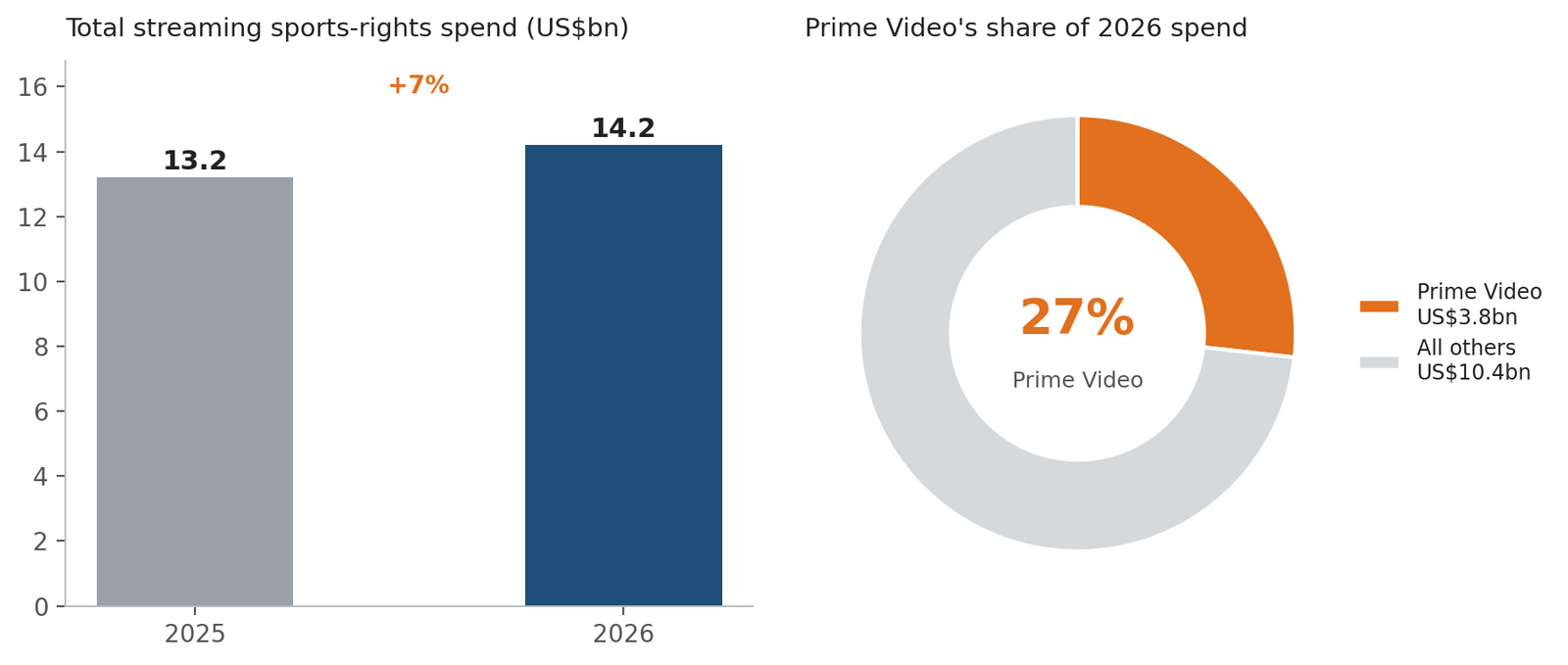
Streaming sports-rights spending rose to US$14.2bn in 2026, with Prime Video accounting for US$3.8bn. Source: Ampere Analysis
On how he prices against rivals, Marine said: "When someone outbids us, I don't say, 'Oh, they overpaid.' Because I don't know. They have a different business model. They're trying to achieve different things. I can only value what I think it's worth to Amazon. That's not an exact science." On the 11-year NBA agreement he added: "No one can predict 11 years. But we bet on that league, bet on Adam Silver and that younger audience."
US$1bn a year for Thursday nights, US$1.8bn for the NBA — YouTube pays US$2bn for Sunday Ticket
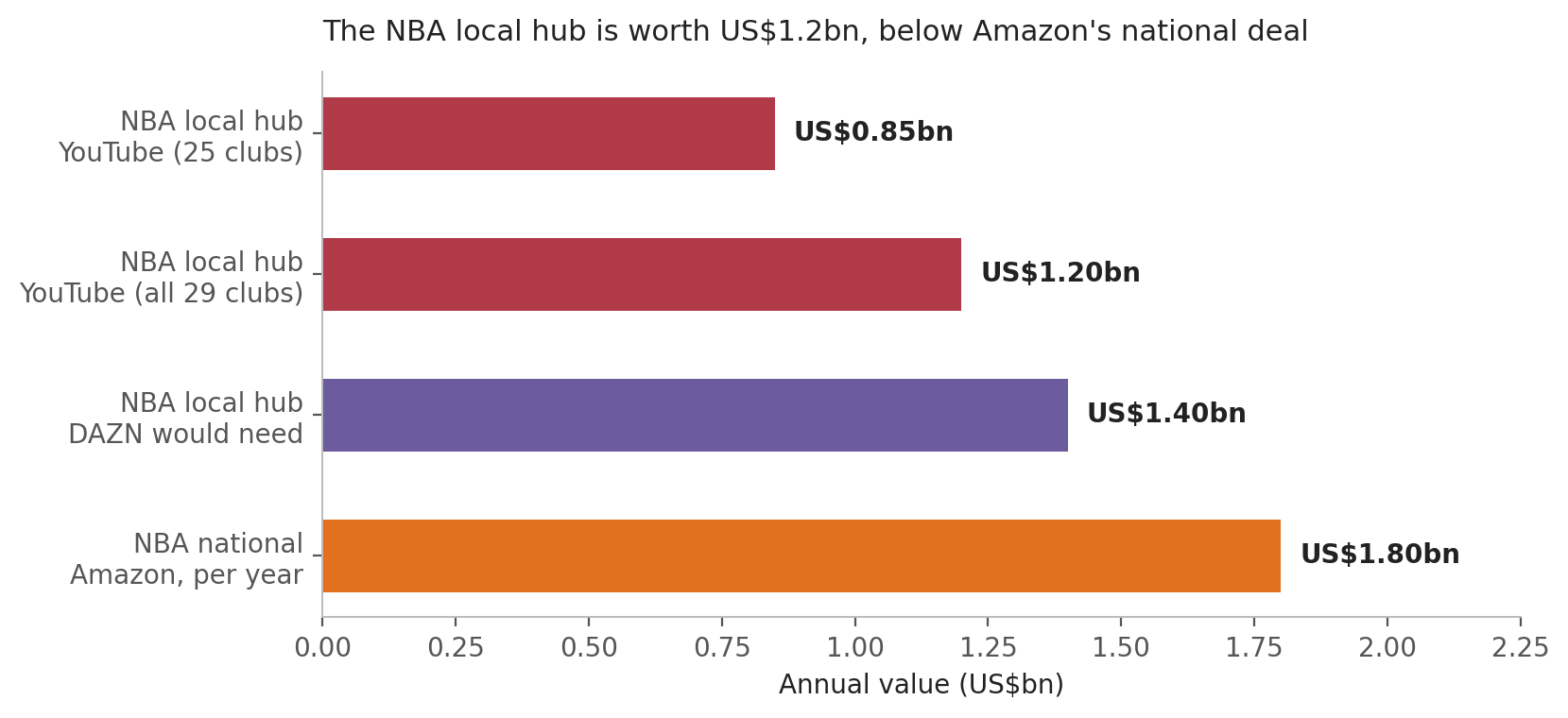
Amazon holds two US national contracts. Thursday Night Football runs from 2023 to 2033 on an 11-year exclusive estimated at about US$1bn a year (about 1.35tn won), and Ampere puts Amazon's NBA obligation at US$1.8bn a season (about 2.42tn won). The two together come to US$2.8bn a year (about 3.77tn won).
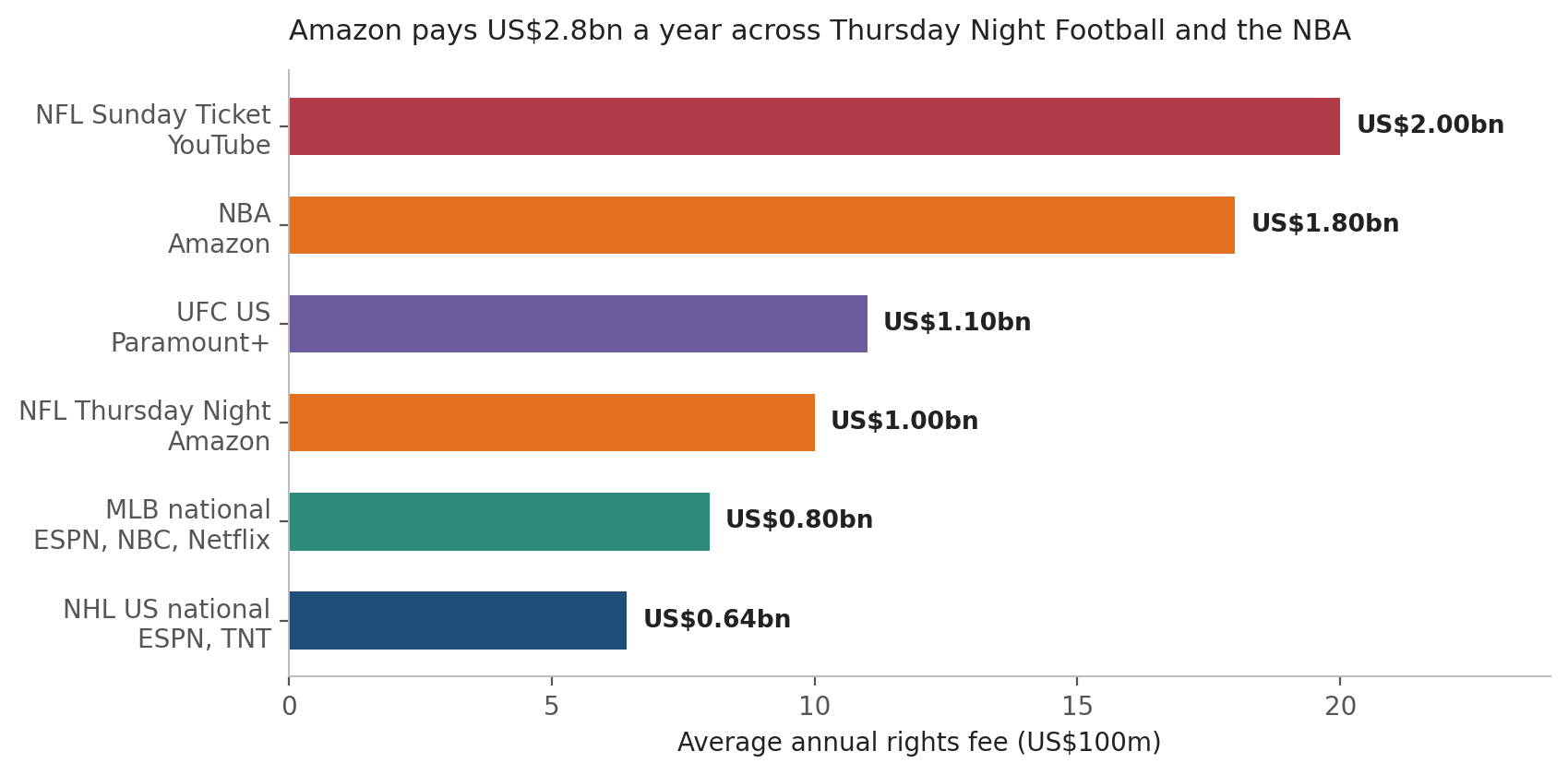
YouTube's NFL Sunday Ticket, at about US$2bn a year (about 2.69tn won), is the largest line on that list. For 2026-27 YouTube priced it at US$240 a year for new subscribers (about 323,000 won), US$378 as an add-on for YouTube TV subscribers (about 509,000 won) and US$480 standalone through Primetime Channels (about 646,000 won). The 50% discount attached to new subscribers in the product's fourth season points to acquisition cost that has not yet come down (9to5Google, 10 September).
The NHL's US national package is the smallest on the list. The seven-year deals ESPN and TNT Sports signed in 2021 are worth about US$4.5bn combined, or US$643m a year (about 865bn won), and expire after the 2027-28 season. NHL commissioner Gary Bettman said on 2 June that viewership had grown by double digits in every playoff round and that "I am excited about those prospects, based on how well we're performing." The benchmark the league cites is the 12-year, US$7.7bn English-language deal with Rogers Communications in Canada.
More than 200m Prime members, 315m monthly Prime Video viewers — payback in sign-ups and renewals
Marine framed the sports budget as a membership expense. "Everything comes back to Prime. We want that to be the best membership program in the world," he said. "It started off as a retail program and free shipping. But entertainment's become a big pillar." Sports were chosen, he said, because "they come with built-in fan bases. So it's almost like a guaranteed hit."
Amazon last disclosed Prime membership at more than 200m several years ago. Prime Video reaches more than 315m monthly viewers worldwide and 130m monthly in the US. At that scale, Marine said, only tier-one properties move the needle, and they do so in two ways: sports bring new members into Prime, and members who watch live sports renew at a higher rate. He cited the same pattern for Champions League coverage in Europe and the NFL and NBA in the US.
The clearest number on that payback came with the first Thursday Night Football broadcast. When Amazon took over the package in September 2022, Marine said the three-hour window produced more Prime sign-ups than any other day, Prime Day, Black Friday and Cyber Monday included (Front Office Sports). It was the first time membership additions, rather than broadcast revenue, were offered as the performance measure.
Asked about Netflix's position that renting big sports packages cannot be made profitable, and about traditional media companies treating sports as a loss leader, Marine said: "I don't want to speak on their business model, my guess is it makes sense for them... We all have different business models." He added: "Sports are uniquely valuable. Unfortunately, I'm not the only one who knows that, so they're also uniquely expensive."
US$22.4bn of content spend, US$19.8bn of Q2 advertising — TNF, NBA, WNBA and NASCAR sold out
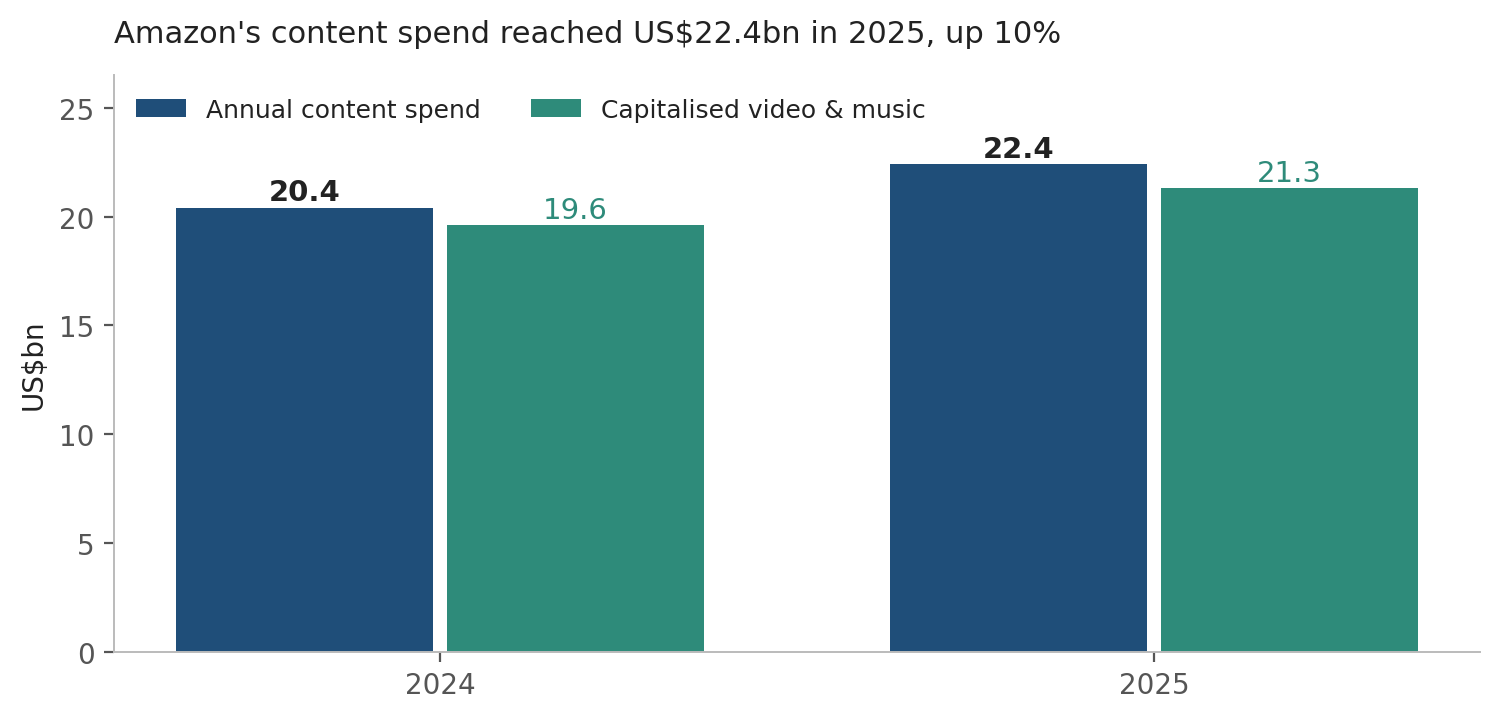
Amazon's total content outlay for 2025, covering video and music, was US$22.4bn, up 10% year on year, disclosed in its 10-K annual filing on 6 February (Variety, Todd Spangler, 6 February). Capitalised video and music content stood at US$21.3bn (about 28.67tn won) at the end of 2025, up 9% from US$19.6bn, and the weighted average remaining life of capitalised video content was 3.2 years.
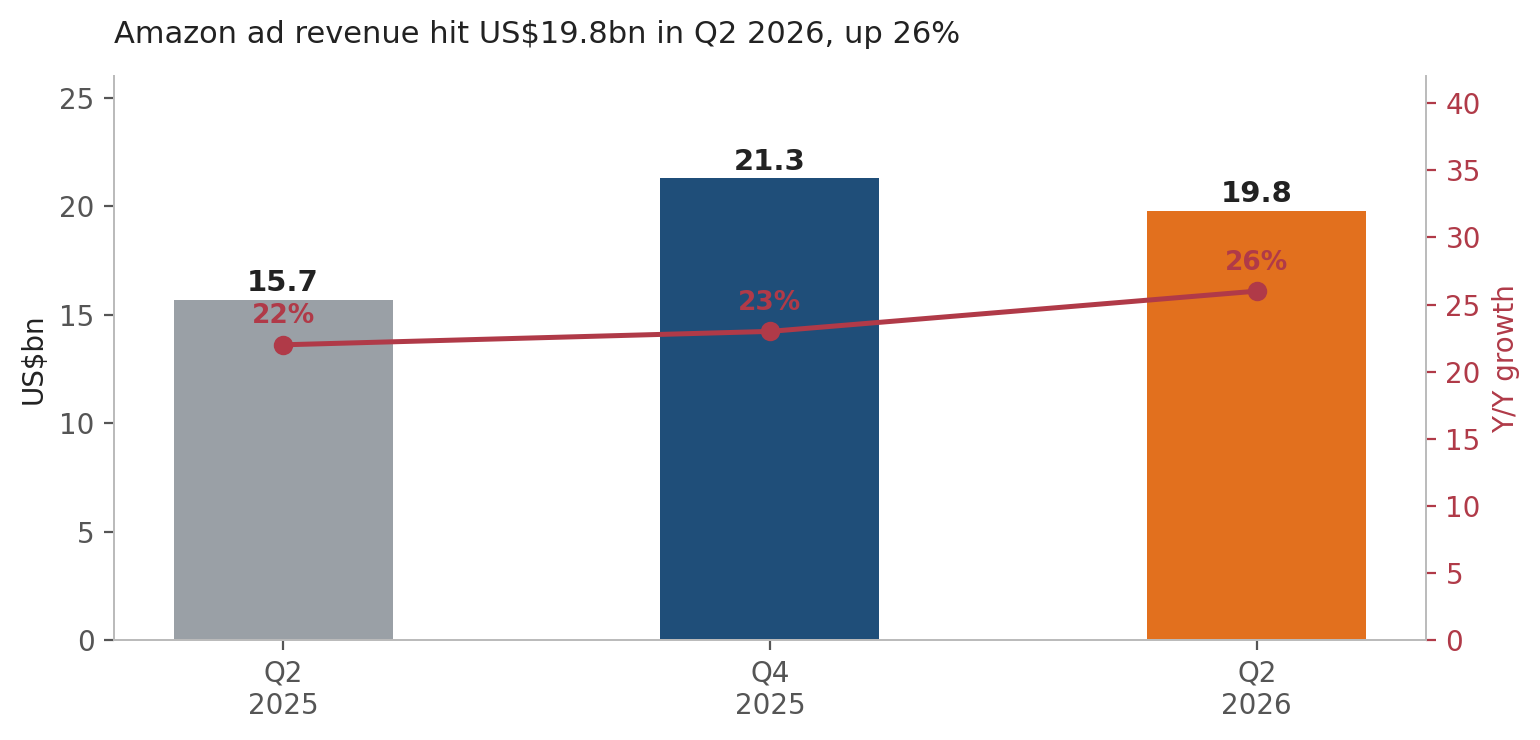
Content is not Amazon's largest expense line. Chief executive Andy Jassy said 2026 capital expenditure would rise 50% to US$200bn (about 269.18tn won), driven by AI investment. Fourth-quarter 2025 advertising revenue was US$21.32bn (about 28.69tn won), up 23%, and subscription services revenue, which includes Prime, was US$13.12bn (about 17.66tn won), up 14%.
Advertising growth accelerated into 2026. Second-quarter ad revenue was US$19.8bn, up 26%, against US$15.7bn (about 21.13tn won) and 22% growth a year earlier. Jassy said on 30 July that inventory on Thursday Night Football, NBA, WNBA and NASCAR had all sold out. Thirty new advertisers came in during the first NBA season, and brands buying across multiple sports achieved 2.3 times the unduplicated reach of single-sport buyers.
TNF averaged 15m, the NBA 1m — median age 46.9 and household income US$96,800
Thursday Night Football averaged more than 15m viewers a game in the 2025 season, the most since Amazon took the package and 16% above the previous year. Marine put the gain at 60% against year one. "When I used to talk to leagues back before we launched Thursday Night Football, they all wanted to talk to us and wanted us to bid, but they weren't ready for us to win," he said. "They just wanted to scare the shit out of the other networks, which was very effective... We ended up going from the risky choice to the safer choice." This is the fifth season.
The first NBA season landed differently. Prime Video averaged 1.00m US viewers across 67 regular-season games; across the 53 games scheduled against traditional television windows the average was 1.09m, down 2% year on year. Younger demographics rose: up 11% among adults 18-34, 20% among 18-49 and 16% among 25-54. Median viewer age was 46.9 against 56.0 on linear, and median household income was US$96,800 (about 130m won), 16% above the US$83,600 (about 112m won) of traditional networks (Barrett Media, 15 April).
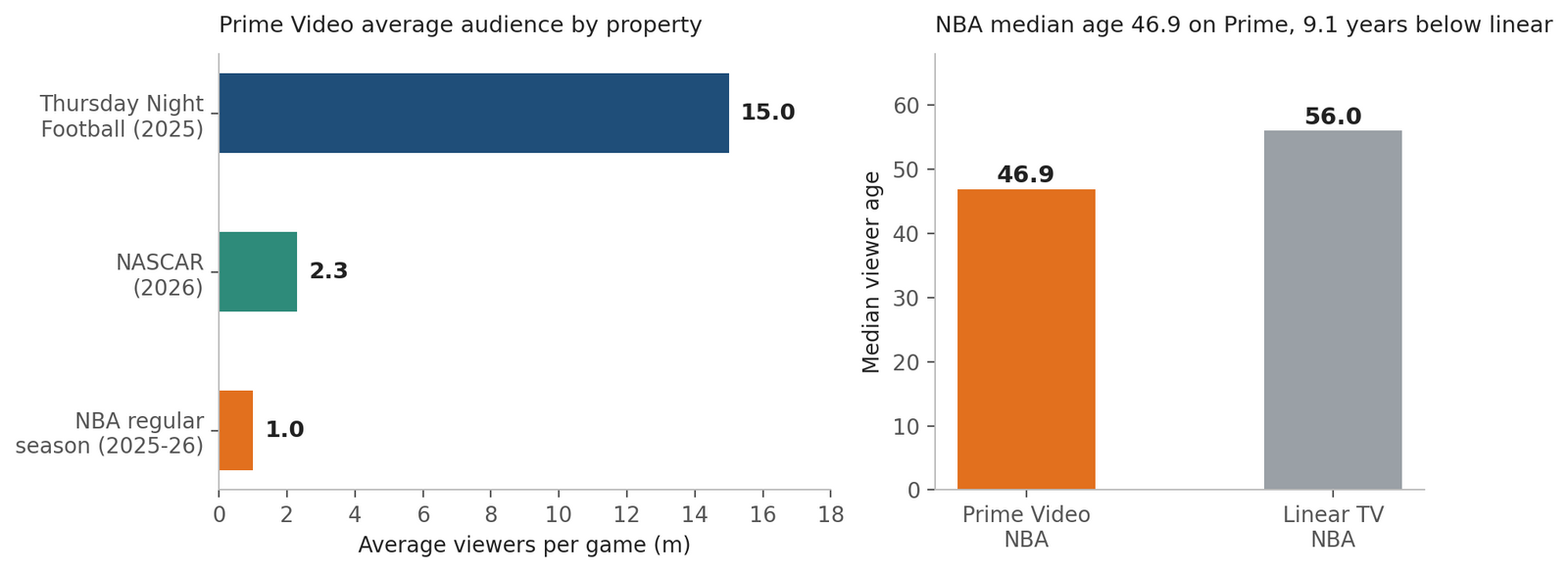
The single largest game was the Emirates NBA Cup final between the San Antonio Spurs and New York Knicks on 16 December, at 3.07m viewers. Games streamed on 227m devices across more than 200 countries for 13.1bn watch minutes. The NBA Nightcap postgame show averaged 491,000 viewers at a median age of 46.7. In the second quarter of 2026, Game 7 of the Eastern Conference Semifinals drew 6.5m US viewers and European NBA viewership more than doubled. NASCAR averaged 2.3m viewers in its second season. Marine said WNBA audiences were up 60%.
FOX One, Peacock and Paramount+ sit inside Prime Video — reselling offered as the answer to fragmentation
Marine answered criticism from the government and the Federal Communications Commission that sports rights have become too fragmented by pointing to resale inside Prime Video. "On Prime Video, we have other streaming partners who sell their subscriptions or channels all within the Prime Video app. You don't have to leave, so it's one login, one password," he said. "Fox One came on with their new launch. Peacock came on. Paramount Plus, which is CBS. So essentially, you can find every NFL game with the exception of Monday night within Prime Video."
Prime Video sells more than 100 streaming subscriptions and more than 900 FAST channels in the US. Source: Amazon
He drew the comparison with Amazon's retail marketplace. "One of the best decisions we ever made was the decision to invite other merchants to let them sell on Amazon because we decided that's the best thing for consumers. It adds selection. It makes sure you have the best pricing," he said. "We're doing the same thing in video because if you work backwards from customers, they want the most selection. Do they really want to download three apps and have to call their spouse to remember the password for X app? No."
On whether Amazon prefers its own productions, Marine said he has "a slight preference because I like what we do on the production and innovation side", but that "no one company can afford all sports rights. It's just impossible." Told that ESPN had tried, he said: "It's just not going to happen. And, by the way, that's true in movies and TV. No one gets to corner the market on making a great show or movie." On the comparison with cable, he said the aggregation worked from a usability standpoint while the price increases and cancellation process did not.
Netflix has committed about US$7bn, event by event — a different payback buys a different product
Netflix buys one-off events rather than season-long packages. Its committed rights fees across WWE, the NFL, MLB, the FIFA Women's World Cup and boxing total about US$7bn (about 9.42tn won). It paid US$60m (about 81bn won) for Concacaf rights in Mexico and US$120m (about 162bn won) for Japanese rights to the World Baseball Classic. Co-chief executive Ted Sarandos said on 16 April that investment would concentrate on regional live sport outside the US (SportBusiness Media, April).
That choice follows from where Netflix collects. Mike Darcey, former chief operating officer of Sky, and Nicolas Buchon of the agency Two Circles set out the logic: short commitments cap the financial risk, churn of roughly 2% stays intact, advertising rates stay premium, and the event supplies instant brand equity without development cost. The failure case they named is the reverse — season-long properties push the cost onto subscribers who do not watch sport and pull the service back towards a pay-TV model.
In the same market Amazon buys a year-round portfolio, YouTube buys advertising exposure and YouTube TV subscriptions, and Netflix buys single events. The three price the same rights differently not because they value the games differently but because the money returns in different places.
A 12-year NHL deal in Canada, 26 Wednesday games a season — entry differs by market
Prime Video signed a 12-year sublicensing agreement with Rogers Communications for NHL rights in Canada on 28 July. From 2026-27 it carries at least 26 national regular-season games on Wednesday nights plus three Stanley Cup Playoff series a year — two in the first round and one in the second. The first game is on 30 September. Terms were not disclosed. Rogers' own agreement with the NHL is worth US$7.7bn over 12 years for English-language rights.
Marine described that deal in the same membership terms. "When combined with our hit original series, blockbuster movies, and fast, free shipping on millions of items, the Prime membership is more valuable than ever for Canadian customers," he said. Buying club-level local rights in the US and sublicensing a national package in Canada are justified by the same metric.
YouTube leads for the NBA local hub — up to US$1.2bn if all 29 clubs join
Tom Friend of Sports Business Journal reported on 17 August that YouTube is in advanced talks to host the NBA's aggregated local streaming hub. The term would start in 2027-28 and run nine years to the end of 2036-37, with an exit option after five. If all 29 clubs join — the Toronto Raptors are excluded because of their Rogers arrangement — the deal is worth up to US$1.2bn (about 1.62tn won); at 25 clubs it is around US$850m (about 1.14tn won). DAZN would reportedly have to pay up to US$1.4bn (about 1.88tn won) to outbid YouTube.
Amazon and ESPN have shown interest but are considered less likely given their existing national packages. The Los Angeles Lakers, on a Charter Communications deal paying more than US$200m (about 269bn won) a year through 2031-32, are an open question, and the New York Knicks could start with 15 games digitally. The league is seeking at least 25 of the 29 clubs in year one (Awful Announcing, 18 August, citing SBJ).
Asked whether Amazon could become the single home of local sports, Marine expected a mix. "It could be, but it could be that those 30 teams we have now are a mix of models. Sometimes it's directly us, sometimes it's an RSN, but we're the digital home for that," he said. "We'd love to be the home of local sports, whether that means it's all Amazon only or through partners." Proper said the NHL is not moving toward centralised local streaming as aggressively as the NBA, and that Amazon would likely be part of any conversation if it did, though the league is "not there yet by any stretch".
Coupang Play hit 10.07m monthly users in August — a retail membership buying rights in Korea
Coupang Play (쿠팡플레이) recorded 10.07m monthly active users in August, up 15.97% from 8.69m in July and the first Korean streaming service to pass 10m, according to Mobile Index (모바일인덱스). Netflix had 16.21m, Tving (티빙) 8.15m, Wavve (웨이브) 4.05m and Disney+ 4.01m in the same month (Edaily(이데일리), 3 September).
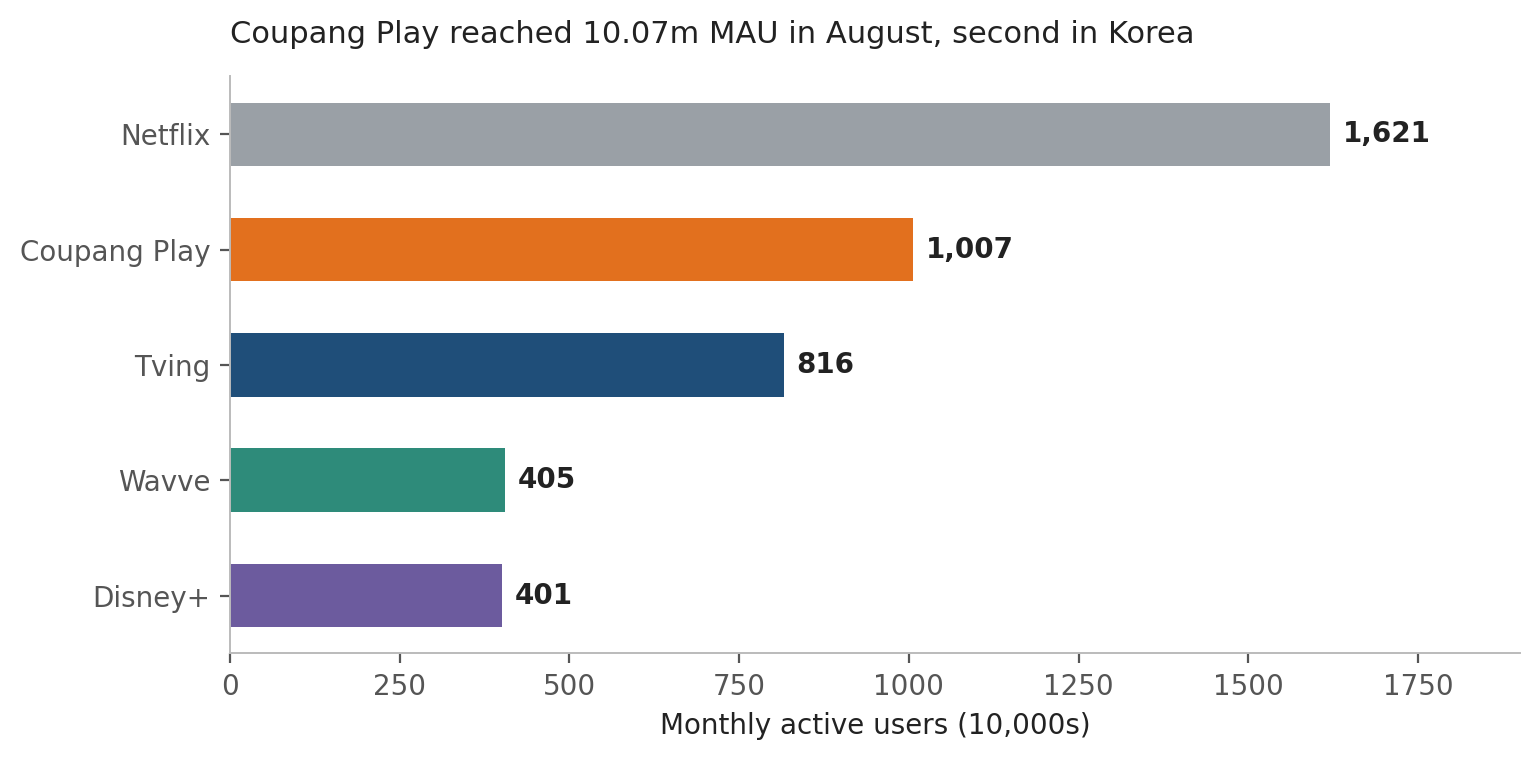
Coupang Play reached 10.07m monthly active users in August, second in Korea. Source: Mobile Index
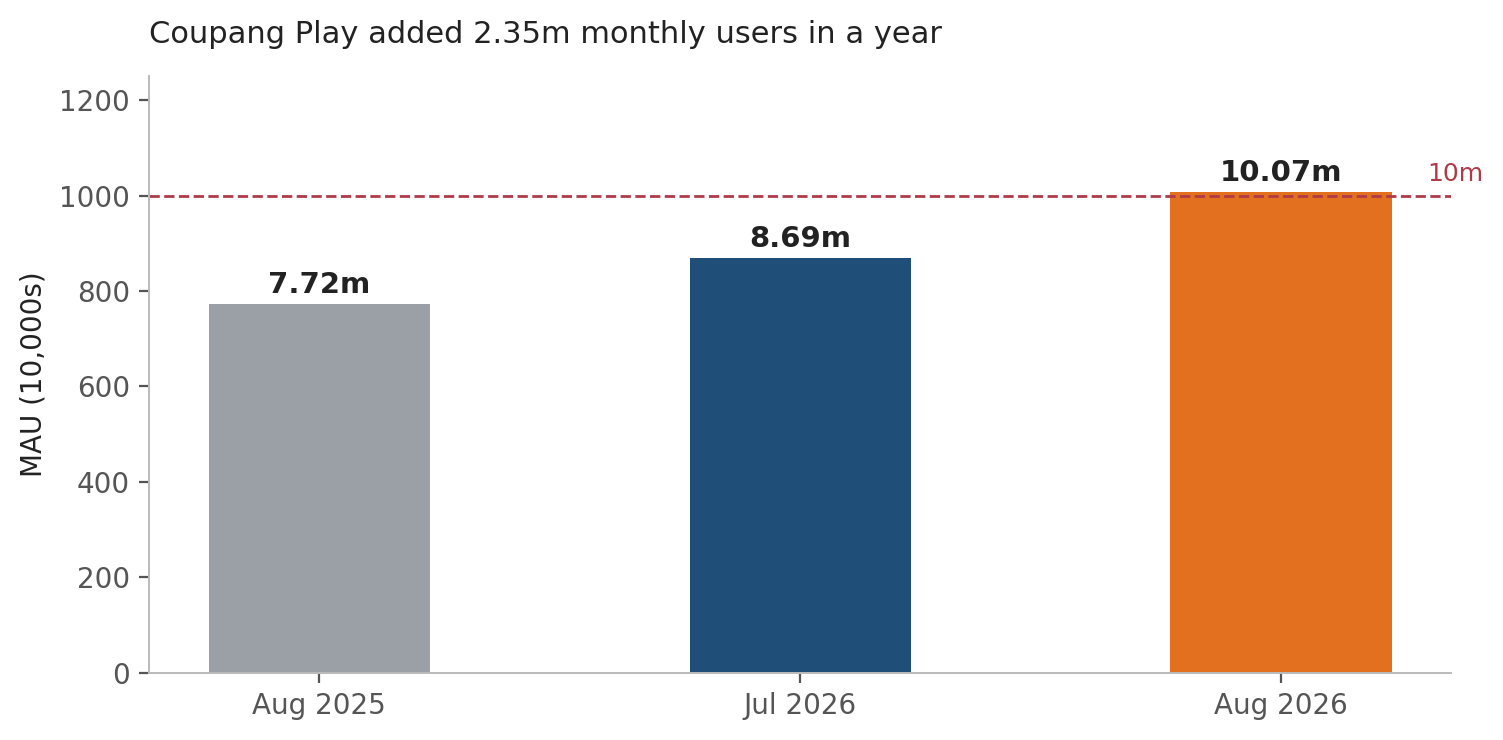
Coupang Play collects in the same place Prime Video does. It is attached to the Wow (와우) membership at 7,890 won a month (about US$5.90) alongside delivery and shopping benefits, and sport earns its keep by holding that membership rather than by selling video. Coupang last disclosed paid Wow membership at 14m at the end of 2023 and the industry estimates 14m to 15m now. Coupang Inc. reported second-quarter 2026 revenue of US$8.9bn (about 11.98tn won), up 4%, and 24.7m Product Commerce active customers, up 3%, on 4 August. Coupang Play appeared in that release only as a component of Developing Offerings, with no discussion of sports rights.
The rights portfolio has kept growing. Coupang Play holds exclusive Korean rights to the English Premier League for six seasons from 2025-26, reported at 420bn won in total (about US$312m) and 70bn won a year (about US$52m) (Financial News(파이낸셜뉴스), 8 October 2025). Its sports pass also carries LaLiga, the Bundesliga, Ligue 1, K League 1 (K리그1), AFC competitions, the NBA, the NFL, Formula 1, NASCAR and LIV Golf. On 2 August it was reported to have taken UEFA men's club competitions for 2027-2031 from SPOTV (스포티비) at more than double the previous fee (KPI News).
Viewing moved most visibly around one player. On 14 September 2025, the day Son Heung-min (손흥민) played for LAFC against San Jose, Coupang Play's daily active users reached 1,133,899, up 13.6% on the previous day's 998,340. Financial News estimated that a Son match added roughly 100,000 users against a day carrying only EPL fixtures (8 October 2025). August's move past 10m was attributed less to sport alone than to original drama plus the 9 August Coupang Play Series match between Manchester City and Atletico Madrid, carried in 4K (Seoul Economic Daily(서울경제), 5 September).
Prices have already moved. From 1 June new subscribers pay 12,400 won (about US$9.20) with a Wow membership and 19,300 won (about US$14.30) without, against 9,900 won and 16,600 won for existing subscribers (Newsis(뉴시스), 11 May). Sport was added to the membership to gather members, and the sports charge was raised afterwards.
Chzzk's exclusive World Cup stream peaked at 4.95m concurrent viewers — membership decides the picture
Naver (네이버) said on 28 May that it had taken exclusive online rights to all 104 matches of the 2026 World Cup. The stream ran on Chzzk (치지직), where free viewers could watch only Korea's matches at 480p. Full HD and replays of all 104 matches were reserved for subscribers to the Naver Plus (네이버플러스) membership at 4,900 won a month (about US$3.60) or Chzzk+ at 14,300 won (about US$10.60). The value was not disclosed; reported estimates range from more than 30bn won to about 40bn won (Digital Today(디지털투데이), 9 June; Star News(스타뉴스), 27 April).
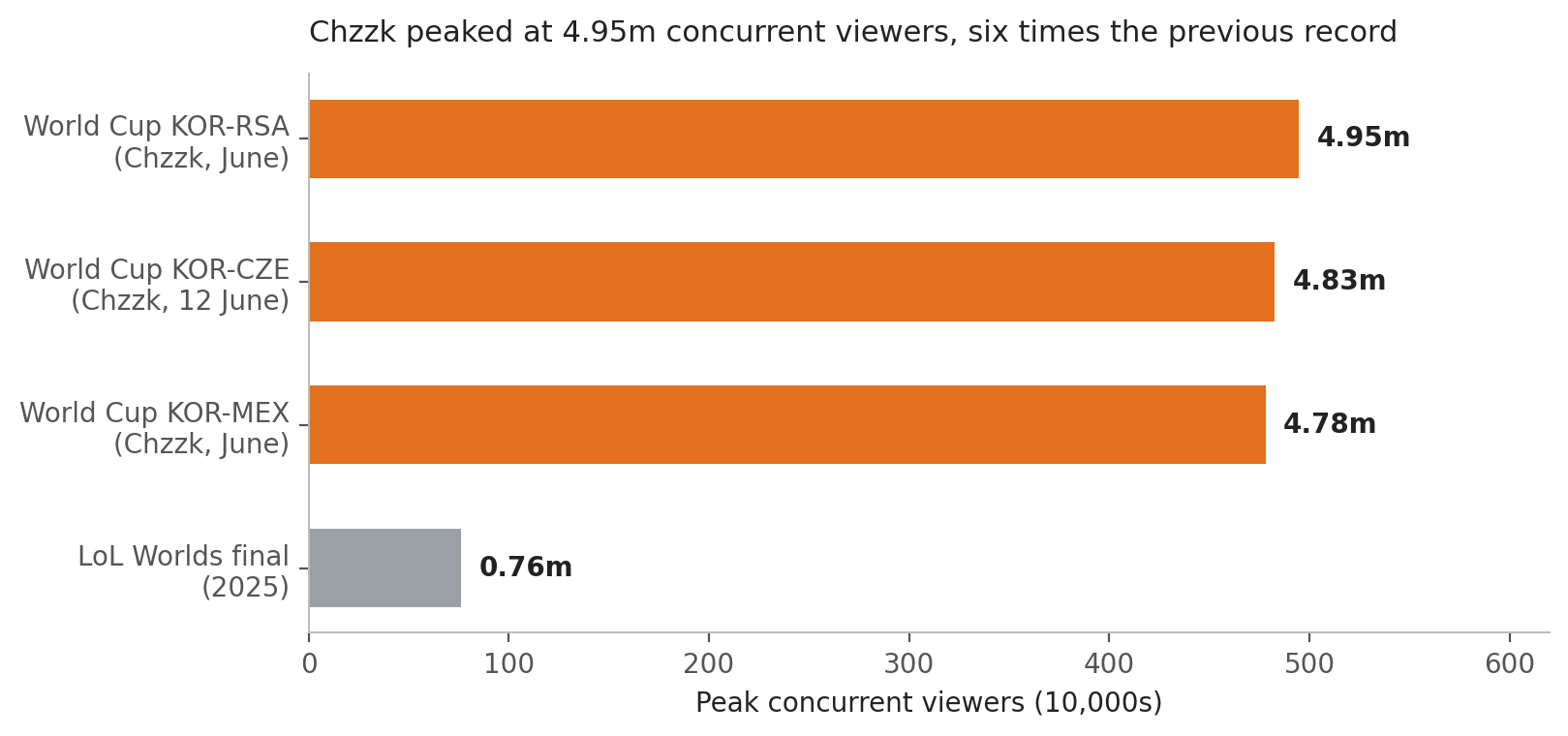
The record changed twice in a month. Korea's 12 June match against the Czech Republic peaked at 4,825,000 concurrent viewers across the official channel and creator co-streams, more than six times the previous Korean high of 760,000 set by the 2025 League of Legends Worlds final (ZDNet Korea, 12 June). The Mexico match reached 4.78m and the South Africa match 4,948,000. Chzzk's June monthly active users were 5.33m, up about 90% from 2.76m in May, with the largest gains among people in their 40s (780,000), 30s (480,000) and 50s (250,000) (News Who Plus(뉴스후플러스), 31 July).
Naver also collects through a commerce membership. Naver Plus bundles shopping rewards with a choice of Netflix's ad-supported standard tier or Tving's broadcast tier. Membership has not been disclosed since the company reported 8m in 2022; the industry puts it around 10m. Naver and Netflix said in April 2025 that the tie-up had lifted daily new sign-ups by about 1.5 times and that new members choosing Netflix increased their shopping spend by more than 30%. Putting World Cup picture quality and replays behind the same membership is an extension of that structure.
In a survey of 1,000 adults conducted from 23 to 29 June by the research arm of the Korea Broadcast Advertising Corporation (코바코), 16.6% said they had watched the World Cup on Chzzk, up 8 percentage points from the 8.6% recorded for the Winter Olympics in February. Watching on a television at home was 47.1% (Media Today(미디어오늘), July).
KBO online rights reach 90bn won a year — Tving posts a first quarterly profit of 6bn won
CJ ENM disclosed on 6 August that it had secured exclusive online rights and video business rights to the KBO League (한국야구위원회 리그) for five years from 2027 to 2031. IPTV carriage was excluded from exclusivity and the value was not disclosed. SBS Biz reported it at about 450bn won (about US$334m), or 90bn won (about US$66.9m) a year, on 25 November 2025. The previous three-year deal totalled 135bn won, or 45bn won a year, and the cycle before that ran at 22bn won a year. Adding the 54bn won a year (about US$40.1m) the three terrestrial broadcasters pay for television rights takes the KBO's annual rights income to about 144bn won (Monthly JoongAng(월간중앙), 21 January).
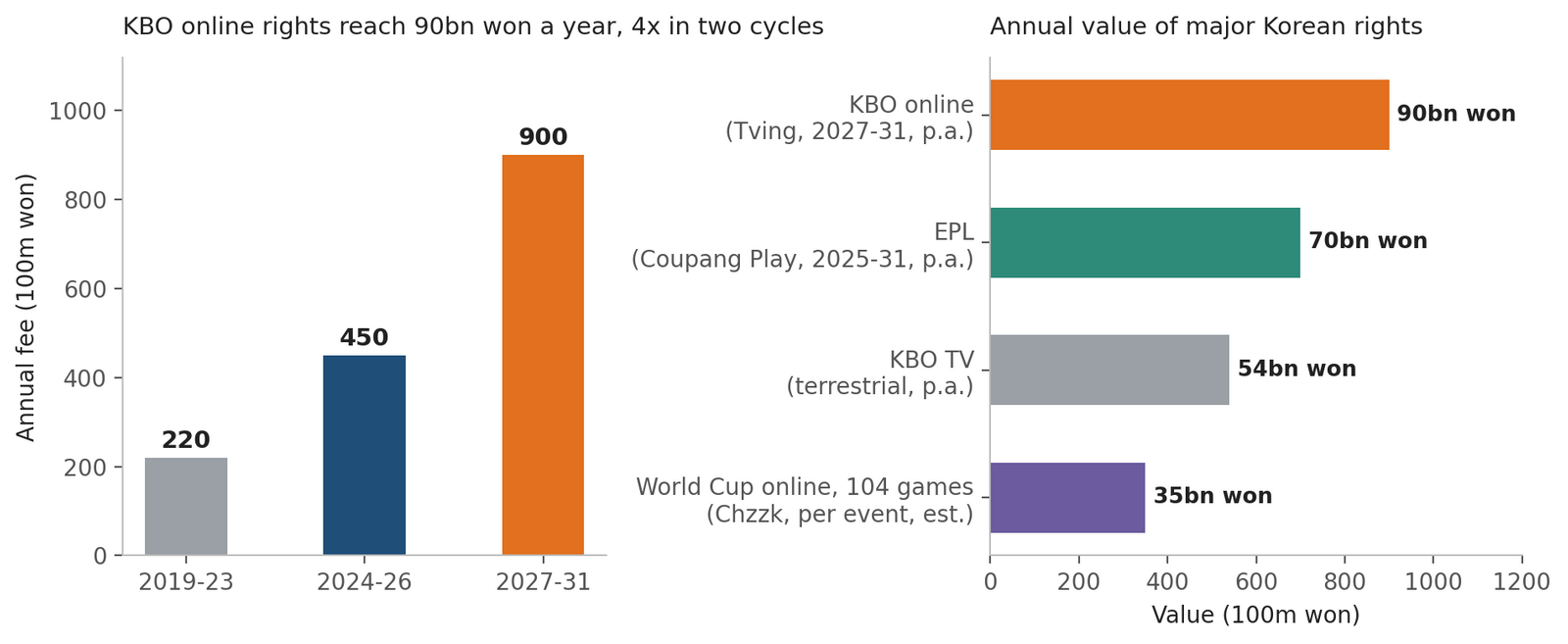
Tving got its numbers from the investment. At the start of the 2026 season KBO viewers on the service were up about 30% year on year, women rose to about 43% of the audience, 5 percentage points higher, and peak concurrent viewers of its 'fandom broadcast' feed doubled (Tving, via Ilgan Sports(일간스포츠), 22 April). Second-quarter revenue was 140.7bn won (about US$104.6m), up 41%, with operating profit of 6bn won (about US$4.5m) — its first quarterly profit. The company also reported 9.7m monthly users, ad revenue up 52.2% and paying subscribers up 24.7% (CJ ENM, 6 August).
The league's own figures moved with it. KBO drew a record 7,633,775 spectators in 2026, first-half average ratings rose to 1.30% from 1.17%, and average viewers per game rose 9.4% to 301,089 from 275,205 (KBO, 15 July). Tving collects through subscriptions and advertising, Coupang Play through a commerce membership and Naver through a platform membership. Three buyers in the same rights market are pricing against three different returns.
JTBC paid US$125m for the World Cup and only KBS joined at 14bn won — the limit of collecting on advertising
JTBC acquired Korean rights to the 2026 World Cup for about US$125m (reported at about 186.1bn won), more than 200bn won including production. Its resale price to the terrestrial broadcasters fell from 30bn won in March to 14bn won in April, against a 12bn won ceiling from the three networks. Only KBS joined, at about 14bn won (about US$10.4m); negotiations with MBC and SBS collapsed (Star News, 27 April; Digital Today, 14 April).
KBS collected on advertising. About 6bn won of terrestrial inventory sold out for the 12 June Korea-Czech Republic match and 3.4bn won of virtual advertising sold out early. The Korea Broadcast Advertising Corporation said it had set a sales target above the 14bn won KBS paid for the rights and had passed it about seven weeks after the schedule was confirmed (Media Today, June; Digital Today, 17 June). JTBC, even counting an estimated 40bn won from the online rights sold to Naver, fell short of its acquisition cost, and losses in the tens of billions of won were reported as possible.
The terrestrial broadcasters were weaker going in. The three posted a 99.6bn won loss at KBS, a 27.6bn won loss at MBC and a 13.2bn won profit at SBS in the previous year. Terrestrial advertising revenue fell 51.1% from 1.89tn won in 2014 to 927.3bn won (about US$689m) (Hankyung(한국경제), 11 April). The three declined to buy the 2026 Milan-Cortina Winter Olympics on cost grounds, leaving JTBC to carry it alone at ratings of about 1%.
Regulation has moved as well. A broadcasting act amendment requiring events of major national interest, including the Olympics and the World Cup, to be carried live at no additional cost by at least one national terrestrial broadcaster and its streaming service passed the National Assembly's Legislation and Judiciary Committee (법제사법위원회) on 9 September. A plenary vote remains, and the rule would apply to contracts signed after it takes effect. KBS said the provision would weaken Korean broadcasters' negotiating position against the International Olympic Committee and FIFA, and the opposition People Power Party (국민의힘) objected on rights-cost and broadcaster-finance grounds (Kukmin Ilbo(국민일보) and Business Post(비즈니스포스트), 9 September).
The losing side reads the same way. SPOTV gave up the EPL, LaLiga, the Bundesliga and Ligue 1 to Coupang Play, and hands over UEFA club competitions from 2027. What remains includes official coverage of the Aichi-Nagoya Asian Games opening on 19 September, Serie A, and exclusive television coverage of Son Heung-min's LAFC. When a buyer that recovers its money only from the broadcast bids against one that treats the fee as the running cost of another business, the two cannot meet on price.
Prime Video does not offer won-based billing or a localised service in Korea, and the Amazon Prime membership has never formally launched there. The structure Amazon built reaches Korea through Coupang and Naver.
Where each rights buyer collects its return. International operators are listed first. Source: company statements and reporting
What separates buyers in the local rights market is not who spends most but where the money comes back. Prime Video collects on membership sign-ups and renewals, YouTube on advertising and subscription bundles, Netflix on low churn and premium ad rates, Tving on subscription fees, KBS on advertising. Where the payback differs, the same game carries a different price. That difference is why Amazon took six NHL clubs while the 29-club NBA package moved towards YouTube, and why Korea's World Cup online rights went to Naver while the terrestrial broadcasters stopped at 12bn won. For any operator entering the next rights auction, the question to settle first is not the amount to bid but where that money is recovered.
· Won figures are converted at 1,345.9 won to the dollar, the closing daily-session rate in the Seoul foreign exchange market on 11 September 2026 (Financial News(파이낸셜뉴스), 11 September). Dollar amounts are given with a won conversion, Korean amounts with a dollar conversion.
· Quotation marks indicate remarks as reported by the outlet named. Unquoted text summarises reported content. Remarks first carried by another outlet are marked as such.
· Amazon's 2024 content spend of US$20.4bn is derived from the 2025 figure and the disclosed 10% growth rate. The US$1bn a year for Thursday Night Football, US$1.8bn a season for the NBA and DAZN's 2026 spend are industry estimates. Coupang Play's EPL total, CJ ENM's KBO value and Naver's World Cup fee are estimates carried in the cited reports and have not been confirmed by the parties. Coupang Play and Tving monthly-user figures are Mobile Index counts; the 9.7m Tving reported in its earnings uses a different basis.
Sources
· Alex Silverman, "Amazon's Prime Video to serve as local streaming home for six NHL teams", Sports Business Journal, 2 Sept 2026 — https://www.sportsbusinessjournal.com/Articles/2026/09/02/amazons-prime-video-to-serve-as-local-streaming-home-for-six-nhl-teams/
· "Prime Video Reaches Exclusive Agreement with National Hockey League to Provide Local Streaming Coverage for Six Teams", Amazon MGM Studios release, 2 Sept 2026 — https://press.amazonmgmstudios.com/us/en/press-release/prime-video-reaches-exclusive-agreement-with-natio
· "Prime Video Lands Exclusive In-Market Streaming Rights for Six NHL Teams Beginning This Season", Sports Video Group, 2 Sept 2026 — https://www.sportsvideo.org/2026/09/02/prime-video-lands-exclusive-in-market-streaming-rights-for-six-nhl-teams-beginning-this-season/
· Lucas Shaw, "How Amazon became streaming's sports leader" (interview with Jay Marine), Bloomberg Screentime newsletter, 13 Sept 2026
· Todd Spangler, "Amazon Spent $22.4 Billion on Content in 2025, Up 10%", Variety, 6 Feb 2026 — https://variety.com/2026/tv/news/amazon-content-spending-2025-video-music-1236654302/
· Josh Sim, "Streamers to spend 'US$14.2bn' on sports rights in 2026", SportsPro, 2 Feb 2026 — https://www.sportspro.com/news/broadcast-ott/sports-rights-streaming-spend-2026-amazon-prime-video-dazn-peacock-february-2026/
· "Streamers Will Spend $14.2 Billion on Sports Rights in 2026, New Projections Show", TheWrap, Feb 2026 — https://www.thewrap.com/culture-lifestyle/sports/streaming-service-sports-rights-spend-ampere-analysis-forecast/
· "Prime Video Set To Replace DAZN As Biggest Sports Rights Spender In Streaming – Ampere", Deadline, Feb 2026 — https://deadline.com/2026/02/prime-video-top-streaming-sports-rights-spender-1236705839/
· "Amazon advertising gains 26% to $19.8 billion as sports inventory sells out", PPC Land, July 2026 — https://ppc.land/amazon-advertising-gains-26-to-19-8-billion-as-sports-inventory-sells-out/
· "Q2 earnings: CEO Andy Jassy on what's driving Amazon Ads growth", About Amazon, 30 July 2026 — https://www.aboutamazon.com/news/company-news/amazon-ceo-andy-jassy-amazon-ads-growth-q2-2026-earnings
· "Prime Video Wraps First Year of NBA Coverage Averaging a Million Viewers", Barrett Media, 15 Apr 2026 — https://barrettmedia.com/2026/04/15/prime-video-nba-viewership-2025-2025/
· "'TNF' Draws Record Prime Subscriptions for Amazon", Front Office Sports — https://frontofficesports.com/tnf-draws-record-prime-subscriptions-for-amazon/
· "NFL finalizes new 11-year media rights deal, Amazon gets exclusive Thursday Night rights", CNBC, 18 Mar 2021 — https://www.cnbc.com/2021/03/18/nfl-media-rights-deal-2023-2033-amazon-gets-exclusive-thursday-night.html
· "Main Street Sports Group officially shuttering this month, 13 NBA teams become local TV free agents", Awful Announcing, Apr 2026 — https://awfulannouncing.com/local-networks/main-street-sports-group-shuttering-13-nba-teams-local-tv.html
· "NBA, NHL teams told Main Street sports network will end operations", ESPN, Apr 2026 — https://www.espn.com/espn/story/_/id/48388773/nba-nhl-teams-told-main-street-sports-network-end-operations
· Steve McCaskill, "MLB handles local broadcasts for 15 teams in 2026 as ESPN MLB.TV deal goes live", SportsPro, 11 Feb 2026 — https://www.sportspro.com/news/broadcast-ott/espn-mlb-tv-angels-tigers-local-rights-rsn-february-2026/
· "MLB Media-Rights Shakeup Overview: ESPN, NBCU, Netflix Ink Three-Year Deals", Sports Video Group, 19 Nov 2025 — https://www.sportsvideo.org/2025/11/19/mlb-media-rights-shakeup-overview-espn-nbcu-and-netflix-inks-three-year-deals/
· "Major League Baseball announces new media rights deals for NBC, ESPN and Netflix", CNBC, 19 Nov 2025 — https://www.cnbc.com/2025/11/19/mlb-media-rights-deals-nbc-espn-netflix.html
· Drew Lerner, "YouTube remains frontrunner for local NBA streaming hub, per report", Awful Announcing, 18 Aug 2026 (citing Tom Friend, Sports Business Journal, 17 Aug 2026) — https://awfulannouncing.com/youtube/frontrunner-local-nba-streaming-hub.html
· Josh Sim, "NBA 'preps' local game streaming hub amid RSN uncertainty", SportsPro, 6 Mar 2026 — https://www.sportspro.com/news/broadcast-ott/nba-national-streaming-hub-local-rights-plans-march-2026/
· "YouTube details NFL Sunday Ticket pricing & availability for 2026 season, including a 50% discount", 9to5Google, 10 Sept 2026 — https://9to5google.com/2026/09/10/youtube-nfl-sunday-ticket-2026-details/
· "NHL Set to Enter Rights Talks With ESPN, TNT As Ratings Climb", Front Office Sports, June 2026 — https://frontofficesports.com/nhl-set-to-enter-rights-talks-with-espn-tnt-as-ratings-climb/
· "Why Netflix's unique sports approach works. And why it might fail.", SportBusiness Media, Apr 2026 — https://media.sportbusiness.com/2026/04/why-netflixs-unique-sports-approach-works-and-why-it-might-fail/
· "Rogers and Prime Video Announce 12-Year Sublicensing Agreement for NHL Rights in Canada", Rogers Communications release, 28 July 2026 — https://about.rogers.com/news-ideas/rogers-and-prime-video-announce-12-year-sublicensing-agreement-for-nhl-rights-in-canada/
· "How to add subscriptions on Prime Video like HBO Max, Apple TV, FOX One, and more", About Amazon — https://www.aboutamazon.com/news/entertainment/what-are-prime-video-channels
· "Prime Video to exclusively stream NHL games in 6 local markets this season", NHL.com, 2 Sept 2026 — https://www.nhl.com/news/prime-video-to-stream-nhl-games-in-6-local-markets
· Edaily (이데일리), "Coupang Play first to pass 10 million", 3 Sept 2026 — https://www.edaily.co.kr/News/Read?newsId=03794966645576512
· Seoul Economic Daily (서울경제), on Coupang Play passing 10m, 5 Sept 2026 — https://www.sedaily.com/article/20087253
· Financial News (파이낸셜뉴스), on Coupang Play DAU and the EPL rights value, 8 Oct 2025 — https://www.fnnews.com/news/202510052147200793
· Financial News (파이낸셜뉴스), "Coupang Play DAU 1.13m on LAFC match day", 17 Sept 2025 — https://www.fnnews.com/news/202509170550139296
· Newsis (뉴시스), "Coupang Play raises Sports Pass price", 11 May 2026 — https://www.newsis.com/view/NISX20260511_0003624998
· Coupang Play Sports Pass page — https://www.coupangplay.com/promotion/sportspass
· KPI News, "Coupang Play takes UEFA club competition rights", 2 Aug 2026 — https://www.kpinews.kr/newsView/1065562888296227
· Coupang Inc., "Coupang Announces Results for Second Quarter 2026", 4 Aug 2026 — https://ir.aboutcoupang.com/news-events/news/news-details/2026/Coupang-Announces-Results-for-Second-Quarter-2026/default.aspx
· Coupang Newsroom, "Wow membership at 7,890 won a month", 12 Apr 2024 — https://news.coupang.com/archives/38866/
· Newsis (뉴시스), "Naver takes exclusive online rights to the 2026 World Cup", 28 May 2026 — https://v.daum.net/v/20260528104716176
· ZDNet Korea, "Chzzk peaks at 4.82m concurrent viewers for Korea-Czech Republic", 12 June 2026 — https://zdnet.co.kr/view/?no=20260612151837
· News Who Plus (뉴스후플러스), "Chzzk June MAU 5.33m on World Cup effect", 31 July 2026 — https://www.newswhoplus.com/news/articleView.html?idxno=65679
· Digital Today (디지털투데이), on Naver's World Cup rights value and paywall structure, 9 June 2026 — https://www.digitaltoday.co.kr/news/articleView.html?idxno=672821
· Media Today (미디어오늘), KOBACO survey on World Cup viewing routes, July 2026 — https://www.mediatoday.co.kr/news/articleView.html?idxno=335738
· TheElec (디일렉), "Naver Plus cuts the Netflix upgrade price", 25 June 2026 — https://www.thelec.kr/news/articleView.html?idxno=58614
· Xportsnews (엑스포츠뉴스), "CJ ENM renews KBO online rights for five years", 6 Aug 2026 — https://www.xportsnews.com/article/2180881
· SBS Biz, "Tving's 450bn won bet on KBO rights", 25 Nov 2025 — https://biz.sbs.co.kr/article/20000274295
· Ilgan Sports (일간스포츠), "Tving KBO viewers up 30%", 22 Apr 2026 — https://isplus.com/article/view/isp202604220032
· Digital Daily (디지털데일리), "Tving posts 140.7bn won revenue and 6bn won operating profit in Q2", 6 Aug 2026 — https://m.ddaily.co.kr/page/view/2026080615090115732
· Ilgan Sports (일간스포츠), "KBO draws record 7.63m spectators in 2026", 15 July 2026 — https://isplus.com/article/view/isp202607150159
· Ryu Sun-gyu (류선규), on KBO rights-fee history, Monthly JoongAng (월간중앙), 21 Jan 2026 — https://www.m-joongang.com/news/articleView.html?idxno=402075
· Star News (스타뉴스), "JTBC paid US$125m for World Cup rights; losses feared", 27 Apr 2026 — https://www.starnewskorea.com/sports/2026/04/27/2026042708513719760
· Digital Daily (디지털데일리), "JTBC resale price falls to 14bn won", 14 Apr 2026 — https://m.ddaily.co.kr/page/view/2026041410591783232
· Media Today (미디어오늘), "KBS World Cup advertising sells out", June 2026 — https://www.mediatoday.co.kr/news/articleView.html?idxno=335131
· Digital Daily (디지털데일리), "KBS scores with 2026 World Cup coverage", 17 June 2026 — https://m.ddaily.co.kr/page/view/2026061715101234000
· Hankyung (한국경제), "KBS loses 99.6bn won, MBC 27.6bn won; terrestrial ad revenue halves in a decade", 11 Apr 2026 — https://www.hankyung.com/article/2026041026437
· Kukmin Ilbo (국민일보), "Terrestrial carriage of Olympics and World Cup to be mandated", 9 Sept 2026 — https://www.kmib.co.kr/article/view.asp?arcid=9000010518
· Business Post (비즈니스포스트), "Carriage mandate bill clears Legislation and Judiciary Committee", 9 Sept 2026 — https://www.businesspost.co.kr/BP?command=article_view&num=446831
· K News (K뉴스통신), "Bill clears committee; plenary vote remains", 10 Sept 2026 — https://www.knewstv.kr/news/articleView.html?idxno=13918
· Kim Se-hoon (김세훈), "Sports IN: the broadcasting act and Olympic and World Cup rights", Sports Khan (스포츠경향), 10 Sept 2026 — https://sports.khan.co.kr/article/202609101116003/
· Sports Khan (스포츠경향), "SPOTV to carry the 2026 Aichi-Nagoya Asian Games", 28 Aug 2026 — https://sports.khan.co.kr/article/202608280258003
· Seoul Economic Daily (서울경제), "KBS agrees joint 2026 World Cup coverage with JTBC" — https://www.sedaily.com/article/20034849
· ZDNet Korea, "LCK signs five-year partnership with Naver and SOOP", 16 Dec 2025 — https://zdnet.co.kr/view/?no=20251216095903
· Financial News (파이낸셜뉴스), "Won closes at 1,345.9 to the dollar", 11 Sept 2026 — https://www.fnnews.com/news/202609111533222331