
Cable News’ ‘Big Three’ Are Racing Ahead of the Bundle’s Collapse

Pay TV is collapsing but news viewing holds: Fox News, MS NOW and CNN are spending linear cash to build beyond the bundle — and Korea’s JTBC (out of runway) and YTN (mid-transition) are the same fork at home. For Korea’s news channels, the question is no longer whether to move, but how fast.

Cable News’ ‘Big Three’ Are Racing Ahead of the Bundle’s Collapse

MEDIA & PLATFORMS  |  CABLE NEWS

As pay-TV penetration breaks below 50% and M&A prunes the dial, Fox News, MS NOW and CNN spend linear cash on streaming, memberships and podcasts — with the same force now bearing on Korea’s JTBC and YTN

Cable news’ “big three” — Fox News, MS NOW and CNN — are not waiting for cord-cutting to burn the industry down. They are using the cash and audience loyalty their linear channels still generate to build businesses beyond the traditional bundle: streaming, memberships, podcasts, digital publishing and live events. The move is less a choice than a response to the upheaval facing linear TV.

케이블 뉴스 ‘빅3’, 번들 붕괴를 앞질러 달린다 — 폭스뉴스(Fox News)·MS NOW·CNN의 ‘포스트 케이블’ 설계
″유료방송은 무너지지만 뉴스 시청은 버틴다”폭스뉴스·MS NOW·CNN은 리니어가 버는 현금으로 번들 밖 사업을 짓고, 완충을 먼저 소진한 JTBC. 전환을 시도하는 YTN이 그 갈림길의 국내판 한국 뉴스채널에 남은 질문은 전환 여부가 아니라 속도

Pay-TV penetration will slip below half of U.S. households this year, and MoffettNathanson estimates the industry shed more than two million subscribers in the first quarter, to roughly 62.2 million. Yet cable news engagement holds firm: in Nielsen’s April Gauge, news accounted for 29% of cable viewing, far ahead of sports at 9%. That paradox — a shrinking distribution platform paired with durable engagement — is why the three are investing hard while linear still throws off meaningful cash.

Why now — a collapsing bundle, resilient news

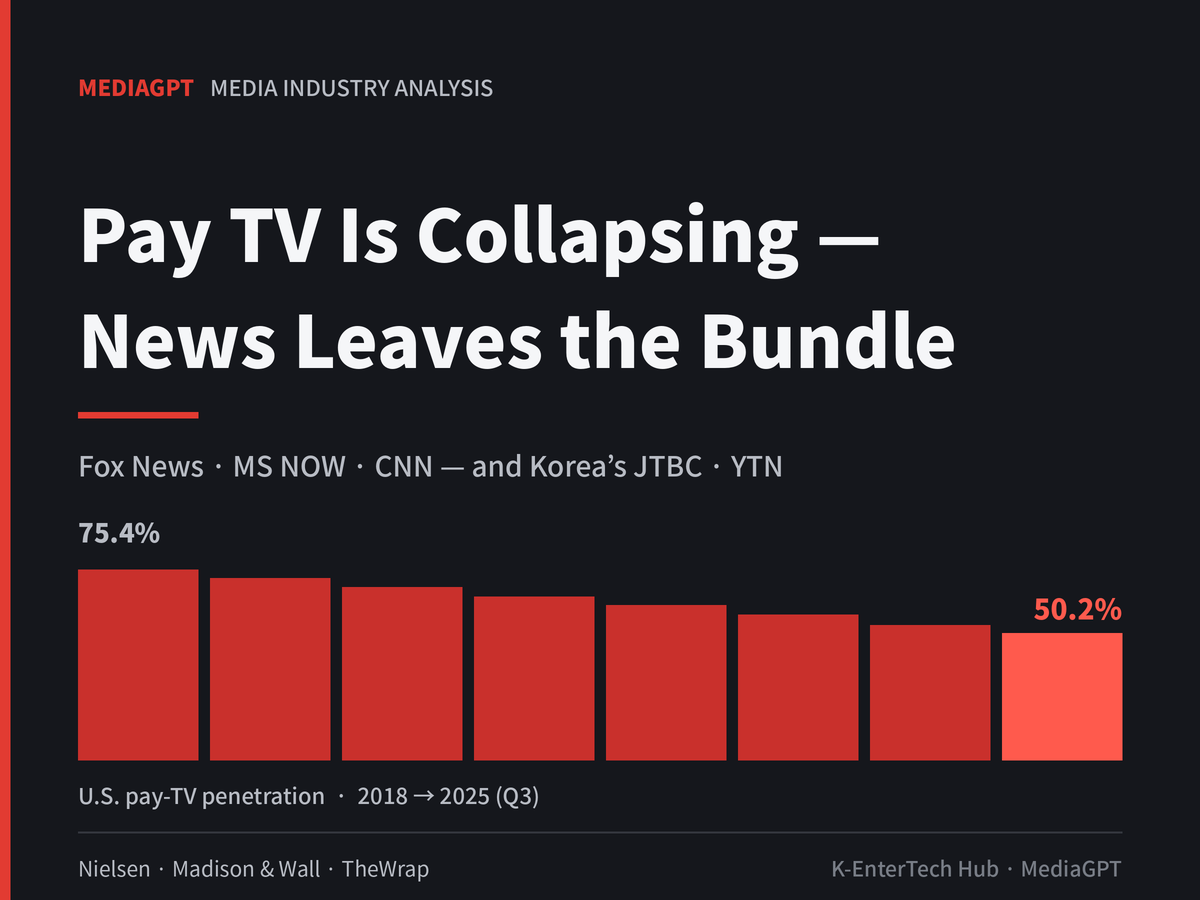
The answer lies in how fast pay TV is eroding. Per Madison & Wall, U.S. pay-TV penetration fell from 75.4% in Q3 2018 to 50.2% in Q3 2025 — 25 points gone in seven years, with the halfway line set to break this year.

[Chart 1] U.S. pay-TV household penetration (Q3 2018–Q3 2025) · Source: Madison & Wall / company reports / U.S. Census Bureau

In share of viewing, streaming and linear have already traded places. Nielsen’s April Gauge put streaming at 47.6%, cable at 21.6% and broadcast at 19.9%. Cable news, though, reads differently: cable was the only category to gain share in April, riding the March Madness tail, and within it news drew 29% of viewing versus 9% for sports.

[Chart 2] Nielsen The Gauge, April 2026 · Total Day / Persons 2+ · Source: Nielsen

The pressure shows up first — and unevenly — in distribution revenue, the affiliate and retransmission fees distributors pay to carry a channel. The three news brands’ parents split precisely here. In Q1 2026, Fox’s distribution revenue rose 5%, while Versant (MS NOW’s parent) fell 7.3% and WBD (CNN’s parent) fell 8%. Fox’s pricing power on a must-carry news channel offset subscriber losses; the two cable-heavy portfolios could not.

[Chart 3] Year-over-year change in distribution revenue (Q1 2026) · Source: company results / Datawrapper

Three paths — ecosystem, membership, portfolio

The approaches diverge. Fox News treats the cable channel as a marketing engine for a wider ecosystem; MS NOW is converting loyalty into paid membership; and CNN anchors its parent’s streaming portfolio as a premium brand. Three answers to the same problem.

Brand (parent)

Approach

Q1 2026 metrics

DTC / digital

Fox News (Fox)

Uses the cable channel as a marketing engine for a subscription/digital/events ecosystem

Cable segment revenue $1.74B (+6%), distribution +5%, ad +5%, EBITDA $884M

Fox Nation, Fox One (Aug.), podcasts, books, live events; ~$500M non-linear revenue in 2025, 30–50% younger audience

MS NOW (Versant)

Converts viewer loyalty into a paid “membership community”

Versant distribution −7.3%, ad −5.2%; Platforms +9.5%, content licensing more than doubled

First DTC membership later this year; No. 1 news brand on YouTube in June; 2.9B YouTube+TikTok views YTD

CNN (WBD)

Anchors WBD’s streaming portfolio as a premium brand rather than a standalone service

CNN TV & digital platforms +30%, linear viewership +35%

CNN All Access (late 2025): live + on-demand, Originals, newsletters, events in one subscription


Fox News has turned its off-linear operations into real scale. Fox Nation has grown from a streaming companion into a subscription business spanning documentaries, opinion, true crime and live events, while Fox News Digital (articles, newsletters, podcasts, social video), Fox News Books and branded events tie audiences to the brand across many touchpoints.

The cable channel is the primary marketing engine, funneling millions toward Fox Nation, podcasts and books and, ultimately, its direct-to-consumer offerings. Fox News Media CEO Suzanne Scott shaped this into a consumer-media strategy, and CEO Lachlan Murdoch casts Fox News not as a mere news service but as “one of the top five broadcast networks” in the U.S. In Q1 2026 the cable-network segment that includes Fox News posted $1.74 billion in revenue, up 6%, with distribution and advertising each rising 5% and EBITDA of $884 million. Its off-linear businesses were projected at roughly $500 million in 2025, have grown at double digits annually since 2020, and skew 30% to 50% younger than traditional TV. In Q1, Fox News Digital logged 6.5 billion social-video views, a quarterly record.

MS NOW is betting on membership. Rebranded from MSNBC in November 2025, the channel was folded into Versant, Comcast’s cable spinoff. At December’s investor day, President Rebecca Kutler said it posted its best revenue in five years despite cord-cutting, arguing loyalty and financial performance matter more than Nielsen ratings alone. In November it averaged about 600,000 daily viewers — second in cable news behind Fox News (about 1.38 million) — but the strategy is not a ratings race; it is converting the most loyal viewers into paying members. Its first DTC product arrives later this year, and Kutler frames it as “a membership community,” distinct from a typical streaming tier or news subscription. The base is already digital: it was the top news brand on YouTube in June, with 2.9 billion combined YouTube and TikTok views this year. In Q1, Versant’s distribution revenue fell 7.3% and ad revenue 5.2%, but Platforms revenue rose 9.5% and content licensing more than doubled. Versant is recycling cable cash into sports tech, AI finance tools and FAST to cut its reliance on pay TV; chief revenue officer David Pietrycha says the aim is to go deeper in the verticals and win a bigger share of fans’ time and wallets.

CNN sits differently. Warner Bros. Discovery casts it not as a standalone service but as a premium brand underpinning a broader streaming portfolio. CNN All Access, launched in late 2025, bundles live and on-demand news, CNN Originals, premium digital journalism, newsletters and live events into one subscription. Unlike CNN+, which folded weeks after its 2022 debut, and CNN Max, it complements WBD’s streaming rather than recreating cable. CEO Mark Thompson is pushing subscriptions directly and says the effort is pacing ahead of plan, while the digital newsroom has been reinforced. In Q1, CNN’s TV and digital platforms grew 30% and linear viewership 35%. The path remains fluid: Paramount’s proposed acquisition of WBD could reshape where CNN fits, and Barry Diller has said he would buy CNN “tonight” given the chance.

All three are chasing the same problem: how to build a durable news business beyond the bundle. Bank of America’s senior media analyst Jessica Reif Ehrlich calls them “brands that can create more products over time.” Wall Street’s question has shifted from how long affiliate fees can sustain cable news to whether today’s cash flow is funding tomorrow’s businesses, and MoffettNathanson notes executives now emphasize a broader distribution revenue that includes DTC rather than traditional affiliate fees alone. The hard part remains: launching a streaming or membership product is one thing; getting consumers to pay year after year is another. Even a globally known news brand cannot assume audiences will follow — CNN+ proved as much when it closed within weeks in 2022.

The rest of cable faces the cull — M&A pulls the trigger

While the news big three engineer their transitions from relative strength, the rest of cable is in a different phase. Aaron Meyerson, managing director at Qualia Legacy Advisors, told TheWrap the debate is now about slowing the decline, harvesting cash and protecting crown-jewel brands — and deciding which channels to carry into a streaming-first future and which to wind down. He expects M&A to trigger “the biggest pruning of cable networks in TV history,” leaving roughly 30 to 40 “meaningful” linear networks anchored by sports, news and a handful of lifestyle, documentary and entertainment brands.

Channels with scale, strong IP and clearly defined identities should survive in digital; those propped up by artificial bundle economics fade. The force actually driving the cull is the live M&A drama — the contest for all or part of WBD and Comcast’s year-end Versant spinoff will shape where cable lands.

A strategy map of the operators — prune, transform, survive

The majors are passing through the same decline in different ways. Above a shared pattern of double-digit linear-profit erosion, their responses split into pruning-and-splitting, transforming-in-place, and relative survival.

Company

Linear (cable) results

Streaming / FAST / digital strategy

M&A stance

Comcast / Versant

Versant net income $749M (9 mo., −24%)

CNBC, MS NOW, Oxygen, Syfy, E!, USA, Golf Channel (65M households). Xumo, FAST, Peacock, OTA, live; digital (GolfNow, Fandango, Rotten Tomatoes, SportsEngine). Comcast keeps Bravo

“Opportunistic, disciplined”; Comcast bid on WBD studio/streaming

Warner Bros. Discovery (WBD)

Linear profit $1.7B (Q3, −20%)

April split into Warner Bros. and Discovery Global (cable); CNN’s third streaming try, 24/7 HBO channels, TNT Sports app, Roku/Tubi FAST

In play; Discovery Global “free and clear” to pursue M&A post-split

Paramount

TV/media profit $822M (Q3, vs $936M)

“More curated” slate (SpongeBob, South Park, The Daily Show). Paramount+, BET+, Pluto and Roku/Prime/Plex/Samsung/LG/Vizio FAST; Shell: “transform in a digital way”

Four bids for all of WBD; divesting Telefe/Chilevisión; $3B cost cuts

Disney

Entertainment linear profit $391M (−21%), ESPN $898M (flat)

ABC News Live, ESPN Unlimited, Disney+ “Streams”; 80% of ESPN Unlimited via trio bundle

“No need for major M&A”; Iger shelved the linear spinoff

Fox

Cable profit $3.03B (FY25), $800M (FY26 Q1, up)

Fox One, Fox Nation, Tubi (100M+ MAU, profitable, 2.2% of streaming in April); LiveNow, Fox Local; Red Seat (podcasts)

M&A “important” but rules out assets heavily tied to cable (Murdoch)

AMC Networks

Q3 overall profit up; revenue pressured by linear (buyout <5%)

AMC+, Acorn, Shudder, ALLBLK, HIDIVE driving BBC America, IFC, Sundance, We TV; 33+ FAST channels on 22 platforms, 250+ feeds

Focused on the streaming pivot over big deals

Starz

Loss widened to $52.6M (cord-cutting)

70% of revenue digital; Starz app, Roku FAST, bundles with HBO Max/BET+/AMC+/MGM+; licenses to Canada’s Bell Media

Eyes “marooned” channels for women/underserved; explored A&E (Lifetime, History)

One camp is slimming down through spinoffs and splits. Comcast is carving CNBC, MS NOW, Oxygen, Syfy, E!, USA and the Golf Channel into Versant while keeping Bravo as a Peacock feeder; Versant plans to extend those channels across Xumo, FAST, Peacock, OTA and live events and to grow digital assets such as GolfNow, Fandango, Rotten Tomatoes and SportsEngine. WBD splits in April into Warner Bros. (studio/streaming) and Discovery Global (cable) — a move set against a 20% drop in Q3 linear profit to $1.7 billion.

Another camp is transforming in place. Under David Ellison, Paramount is narrowing cable to a “more curated,” franchise-led slate (SpongeBob, South Park, The Daily Show) while, as President Jeff Shell put it, aiming to transform the business digitally rather than sell it. Disney shelved the linear spinoff Bob Iger once weighed, keeping cable tied to streaming; entertainment linear profit fell 21% but ESPN held flat, and 80% of ESPN Unlimited sign-ups came through its trio bundle.

The relative winner is Fox. On the pricing power of cable news and sports, FY25 cable profit topped $3 billion, and Tubi crossed 100 million monthly users and reached profitability. Murdoch calls M&A important but won’t buy assets heavily tied to cable. Smaller players compete on the speed of their pivot: Kristin Dolan’s AMC Networks has laid 33-plus FAST channels across 22 platforms via AMC+, Acorn and Shudder, while Jeff Hirsch’s Starz — now 70% digital — is exploring tie-ups with “marooned” channels serving women and underserved audiences, and an A&E (Lifetime, History) acquisition.

Two axes run through it all: FAST and sports/news. From Versant to Starz, operators are pushing soon-to-be-pruned libraries onto the Roku Channel, Tubi, Pluto TV and the FAST tiers of Samsung TV Plus, LG Channels and Vizio. What preserves cable’s residual value is sports (Disney’s ESPN, Fox’s rising cable profit) and news (Versant’s MS NOW and CNBC, WBD’s CNN).

Who survives — sports, news, and ‘content-first’

The survivor view is broadly shared. S&P Global’s Scott Robson sees news and sports networks best positioned, and warns children’s and music-video channels may struggle to win future license-fee increases. eMarketer’s senior analyst Ross Benes agrees non-sports cable brands are most at risk.

Veteran TV producer Evan Shapiro judges that very few cable channels have the brand, scale and loyalty to make it. His likely digital survivors: HGTV, Hallmark, Fox News, MS NOW, HBO, CNN and ESPN — with Meyerson adding FX, National Geographic, Bravo, Discovery, Food Network, Nickelodeon and Paramount Network. They have the right to win, Shapiro says, but must go “content-first, not platform,” or be swept into consumption, consolidation or elimination. The news big three’s early move into streaming, memberships and podcasts is one answer to that test.

The same force at home — JTBC and YTN

The force that shook the U.S. runs the same way in Korea, where the ad market is contracting at least as fast. Per KOBACO figures, Korea’s broadcast ad market fell from 4.05 trillion won in 2021 to 3.22 trillion in 2024 — down more than 20% — and is projected to drop another 20%-plus to 2.56 trillion in 2026. The ad-and-fee revenue base is thinning no less quickly than U.S. pay TV.

The difference is the cushion. The U.S. big three build beyond the bundle on linear that still generates cash; one Korean broadcaster ran that cushion down first. JTBC, a general-programming channel in chronic deficit since 2019, defaulted on 20.6 billion won of asset-backed borrowings on June 12, 2026. Within days, JTBC and its JoongAng Group affiliates filed for court rehabilitation, and the JoongAng Ilbo newspaper itself defaulted on notes on June 19.

On June 30 the court opened rehabilitation for four affiliates but deferred a decision on JTBC by a month, citing a broadcaster’s special status. When linear decline outruns the transition, the American harvest-and-build path simply closes — JTBC crossed that threshold first.

On the other side is an attempted transition. YTN, an all-news channel, was privatized in 2023 when a 30.95% stake held by public enterprises was sold to the Eugene Group, approved by the Korea Communications Commission in February 2024.

In July 2026 Eugene Group unveiled a plan to invest more than 2 trillion won in media and reach 500 billion won in media revenue within five years — expanding beyond broadcasting into data, commerce, events and property, and turning Namsan Tower, which it takes over in January 2027, into a K-brand marketing venue.  Eugene Group is a South Korean conglomerate headquartered in Seoul, with diversified operations spanning construction materials, financial services, and media.

The intent to build trust, platforms and events beyond the channel rhymes with the U.S. playbook, though at YTN it runs alongside an unresolved dispute over the privatization’s legitimacy and editorial independence — the journalists’ union opposes the ownership change while the company pledges to respect newsroom autonomy.

The two cases are opposite ends of the same structural shift. The big three’s lesson — build beyond the bundle while linear still pays — applies more urgently in Korea, where the cushion is thinner. Securing new revenue (FAST carriage, licensing, live rights) and reframing metrics from fees and ads to subscriptions, licensing and platform revenue, before linear runs dry, is the whole game.

What it means for Korean media

As U.S. cable is pruned to 30–40 networks, the libraries of the losers flow onto the Roku Channel, Tubi, Pluto TV and, notably, Samsung TV Plus, LG Channels and Vizio. Samsung and LG are Korean companies running their own U.S. FAST platforms.

As American cable channels go dark, FAST slots on the same CTV screen take their place — and both the stage where K-drama and K-variety channels compete and the platforms selling those slots are tied to Korea. Korean players hold two positions at once: content supplier and platform operator.

The shift in programming budgets is a second opening. As non-sports channels struggle to win fee increases, spending tilts toward lower-cost-per-hour content. Just as Starz has said it will partner with “marooned” linear channels serving women and underserved audiences, channels caught in the cull are hunting for low-cost partners to fill schedules. For Korean producers with deep genre catalogs, that widens the licensing door — and broadens the toolkit from finished content to formats and co-productions.

Because sports and news are cable’s last anchors, live rights gain value. If what cable and streaming both fight for is “must-watch-now” content, then rights to K-pop concerts, awards shows and fan events become part of that scarce supply — and, as global platforms move into sports and live, Korea’s live IP becomes leverage at the scheduling table.

How results are measured is changing too. As MoffettNathanson notes, U.S. executives now describe performance in terms of a broader distribution revenue that includes DTC rather than legacy affiliate fees. Korean media companies moving from linear to digital and FAST will likewise need to reframe their performance narrative — from fee-and-ad metrics to one spanning subscriptions, licensing and platform revenue — to hold their ground in negotiations and fundraising.

Korea’s news channels must move, too

The signal from the U.S. big three points straight at Korea’s news channels: go beyond the bundle while linear still generates cash, because the window does not stay open long. JTBC has already shown at home that when the cushion dries up first, there is no capital left even to begin the transition — and a broadcast ad market shrinking more than 20% again in two years pulls that timetable forward.

Moving is concrete. It means terrestrial, general-programming and all-news channels shifting linear programming assets onto FAST channels, attaching DTC products that bundle depth, originals and live — as Fox Nation and CNN All Access do — and converting the reach built on YouTube and podcasts into paid membership, as MS NOW is doing. The trust and immediacy of news were, alongside sports, the last assets cable held onto; the same assets are what FAST and streaming want to capture in Korea.

The cost of not moving is real: wait until linear advertising dries up and you lose both the capital to transition and your negotiating leverage. Korea, though, holds a lever U.S. news channels lack — Samsung TV Plus and LG Channels, global FAST platforms owned by domestic companies. If Korean news channels pair those platforms with K-live IP, they can walk the American path faster, and on their own distribution rails.

The timetable is already set. WBD’s split and Versant’s spinoff concentrate U.S. channel pruning and library reshuffling in 2026, and at home JTBC’s rehabilitation and YTN’s transition fall in the same year.

The window to negotiate FAST carriage, licensing and membership design is this year. For Korea’s news channels, the remaining question is not whether to transition, but whether they can finish before linear runs dry.


Sources

· TheWrap, “How Fox News, MS NOW and CNN Are Building Beyond the Cable Bundle”, A.J. Katz, 2026.7.20

· TheWrap, “How Hollywood Is Managing Cable TV’s Rapid Decline”, Lucas Manfredi, 2025.12.1

· Nielsen, The Gauge — Total TV and Streaming Snapshot, April 2026 (released 2026.6.25)

· Madison & Wall, U.S. pay-TV household penetration (company reports / U.S. Census Bureau)

· Company Q1 2026 results: Fox Corporation · Versant · Warner Bros. Discovery · MoffettNathanson · Bank of America Securities

· Versant, Q1 2026 results (investors.versantmedia.com/node/7396/pdf)

· 국내 방송광고 시장·유진그룹 미디어 비전: 헤럴드경제·이투데이·뉴스1 (2026.7)

· JTBC·중앙그룹 회생절차: MBC뉴스·이데일리·인베스트조선 (2026.6~7)

· YTN 민영화·지배구조: IB토마토·한국기자협회 (2026)

ⓒ K-EnterTech Hub · MediaGPT Industry Analysis