Engineering disciplines speed and cost; creative accelerates storytelling — bound by a human-centric principle and a distributed org
Disney’s AI strategy has turned from a marquee external deal toward in-house capability. After its $1 billion OpenAI deal collapsed in March, Disney disciplines engineering — raising development velocity while curbing output-agnostic “tokenmaxxing” — and, in creative, has brought a “commercially safe” Adobe Firefly Foundry, trained on its own IP, into theme-park design.

Two structural shifts underpin the turn: tokens are now cost just as streaming reaches its first double-digit margins, making discipline urgent; and as AI copyright fights intensify, IP defense — build on your own IP, litigate against scraping — has become a strategic axis. One principle binds both fronts: technology is a means in service of storytelling.
FRONT 1 Engineering — raising velocity, disciplining cost
The engineering front turns on one idea: faster, but without waste. Disney is pushing its streaming tech staff to use AI to speed up development while drawing a clear line against so-called “tokenmaxxing” — burning tokens regardless of output.
Streaming leaders have recently pressed employees to boost velocity — the pace of output — and productivity with AI, two senior tech staffers told Business Insider. A senior AI-focused employee said the first thing leadership stressed was raising velocity. But Andre Rohe, Disney’s EVP of product engineering, told a Wednesday meeting that employees shouldn’t be tokenmaxxing — maximizing AI token use regardless of any contribution to productivity.
One software engineer distilled the message into three parts: usage tracking is meant to surface inefficient use; teams should ship features and deliver code faster; and code quality and product resiliency must hold, to minimize AI-written code that fails after release.
Over the past year Disney has warmed quickly to AI, giving staff Claude and Cursor and building an “AI Adoption Dashboard” to track token usage. Some managers even messaged engineers who weren’t using AI. Still, the company says use should be intentional: a person familiar with the strategy said the dashboard isn’t meant to drive high usage but to help staff use AI efficiently and effectively.
Behind Rohe’s caution sits a simple fact — tokens are cost. The dashboard shows active users and ranks the heaviest by requests and tokens; one staffer called it a “leaderboard,” and in mid-April one employee invoked Claude about 460,000 times over nine workdays (≈51,000/day), much of it likely from autonomous agents. Displayed as a ranking, the metric can become the target and push toward the very tokenmaxxing Rohe warns against. The countercurrent is industry-wide: Microsoft’s Satya Nadella called tokenmaxxing “addictive,” and Paramount Skydance told tech staff it would set per-user monthly spend limits, though it said the cap would be high.
Out with OpenAI, in with agent armies
The biggest swing in Disney’s AI path was the collapse of the OpenAI deal. In December the company struck a $1 billion arrangement to license its characters to Sora and open Disney+ to AI-generated video. But OpenAI canceled it in March and shut Sora down — less than a week into Josh D’Amaro’s tenure as CEO. No major AI deal has followed, though The Wall Street Journal reported in March that Disney had spoken with more than a dozen partners. Top engineers now run “armies” of AI agents to handle coding loads too large to tackle alone. Jason Cox, Disney’s executive director of AI R&D and engineering, wrote in blog posts that an AI assistant he built has captured his “affection,” calling it his “son.”
Cost discipline and streaming margins
That discipline meets streaming profitability. Disney’s DTC unit crossed into double-digit operating margins for the first time in fiscal Q2 2026 and targets at least 10% for the year. With tokens as cost, uncontrolled AI use is a live variable for a unit that has only just proven a margin. On scale, Disney’s combined streaming viewership share hit its highest monthly level in nearly three years in March 2026 and its best against Netflix in nearly a year (Nielsen, US). As the “super app” consolidation folds Hulu into Disney+, Nielsen stopped reporting the two services’ individual shares in December 2024.

Disney streaming viewership share (%). Data: Nielsen · Chart: James Faris/BI. Nielsen stopped reporting Disney+ and Hulu’s individual shares in December 2024.
The profits rest on a large, loyal, engaged subscriber base. Disney made $582 million in streaming profit last quarter and, though it no longer discloses a subscriber count, had 196 million subscriptions as of late September 2025. Despite repeated price hikes, Disney+ and Hulu have the lowest cancellation rates in the business besides Netflix — under 4% of customers quit in May, per Antenna. Still, on US TV viewing share, Netflix has stayed ahead of Disney Streaming since mid-2025. D’Amaro is merging Disney+ and Hulu into a “super app” to lift engagement and use resources more efficiently, and — like Netflix, Peacock and Paramount+ — is betting on short-form video.
In-house tools and a human-centric line
Disney has also expanded internal tools. Its DisneyGPT chatbot helps with IT tickets, the company roster, and project financials, and a December update let employees upload Excel and PowerPoint files. An agentic chatbot codenamed “Jarvis,” after Iron Man’s assistant, is in development; Claude, outside the approved list late last year, has since been folded into the provided toolset.

The DisneyGPT beta interface. Source: Business Insider
On its policy page Disney describes a “responsible, human-centric” approach, holding that human creativity will remain the company’s engine. Three of eight staffers who spoke with Business Insider worried AI could threaten jobs — a concern sharpened by Hollywood’s 2023 writer and actor strikes. As for how long the encouragement lasts, one put it plainly: “They’re celebrating it now, but we’ll see how long that lasts.”
FRONT 2 Creative — accelerating storytelling with Imagineering

Disney’s creative and experiential work extends into the parks — Mickey and Minnie topiaries before Cinderella Castle at Walt Disney World. Photo: WDW Magazine.
If AI is something to discipline inside engineering, it wears a different face in creative. Adobe, NVIDIA and Meta are turning to Disney to help shape the future of storytelling, with Walt Disney Imagineering — which builds immersive experiences across parks and cruise ships — at the center. “Our product is emotion,” said Kyle Laughlin, SVP of Imagineering R&D, adding that these tools help make that emotional connection faster.
Accelerating design — Adobe Firefly Foundry
The marquee example brings Adobe Firefly Foundry into theme-park design. Imagineering R&D will use it to generate 2D concept art, 2D renderings and 3D prototype models for future parks, hotels, cruises and attractions. Firefly Foundry is a version of Adobe’s generative models trainable on a company’s own content and marketed as “commercially safe” — built on data the user owns or that is public domain — so Disney can produce images of its characters and settings without risking copyright infringement. It runs on Adobe’s Sensei platform, sold to enterprises by subscription, with AI copilots that plug into Creative Cloud.
The first projects involve classic films such as Frozen, Cars and Lilo & Stitch: Imagineers turn hand-drawn sketches into detailed prototypes and renderings for the design and construction of new attractions, iterating on visual concepts before moving to physical models to shorten the path from idea to attraction and cut manual-drafting and mock-up costs. Laughlin said the partnership “lets us bring Disney stories and characters to life in our Parks faster, and with the emotional quality our guests expect.” Adobe’s Hannah Elsakr, VP of GenAI New Business Ventures, added that the tools would provide a creative foundation to explore bolder ideas and make the best ones real.

The Firefly Foundry theme-park design workflow (trained on Disney IP). Reconstructed from Adobe/Disney announcements.
Choosing a “commercially safe” model is itself strategic. Disney is simultaneously a plaintiff against AI firms over training data: in June 2025 Disney and Universal sued the image generator Midjourney for scraping their IP, and in May 2026 Disney sued the Chinese AI firm MiniMax for using its characters without permission. The posture pairs “build models on IP we own or that is public domain” with “litigate against unauthorized scraping” — a choice of IP-protective platform that could set a precedent for other entertainment companies. For Adobe, landing Imagineering R&D is a marquee reference as investors question the durability of its AI business.
Robots fill the parks — aquatic bots and hovering droids
The creative front’s other axis is physical experience — robots. Disney has a 10-year plan to invest $60 billion in its parks and resorts, and its Imagineering R&D lab in Glendale, California builds much of the technology. The push aligns with new CEO Josh D’Amaro, the former parks chief who oversaw the Imagineers and robotics — and who has been known to travel with BDX droids to fan conventions.
The headline project is aquatic robots. In the lab sits a six-foot, car-sized wooden manta ray prototype that, when finished, will transform into the Gramma Tala character from Moana and appear in a park lagoon; using hydrofoil technology, it aims to be a lifelike aquatic character performing alongside human actors (and could be repurposed for franchises like Star Wars). A fleet of dolphin-like robots follows — jet-pump propulsion, biomimetic articulation and GPS navigation let them move like jet skis, interact and even run synchronized shows. Onboard sensors make them nearly autonomous, like self-driving cars or drones, though a human operator is still required. Laughlin sees the parks’ waters — lit for night shows but idle by day — as a “canvas,” pairing “water IP” such as Moana and Avatar with autonomous aquatic performers.
The form factors are multiplying — bipedal and quadruped, plus flying and swimming. Free-roaming characters already roam the parks: bipedal BDX droids, the Fantastic Four’s H.E.R.B.I.E., and Frozen’s Olaf (built in four months on the BDX framework stood up with NVIDIA’s Newton simulator, and briefly viral this year for a malfunction). Last year the first animatronic of founder Walt Disney debuted on Disneyland’s Main Street, with a version coming to Florida next year. Next-generation projection adds expression: as when a Pirates of the Caribbean buccaneer transforms from flesh to skeleton, real-time front-projection mapping and optical tracking yield far more lifelike faces than static silicone. That technology — with free-roaming robots and integrated XR (Meta Ray-Bans among them) — is aimed at Disneyland Abu Dhabi, which Disney calls its most technologically ambitious park.

Commerce meets storytelling, too. Autonomous droids inspired by The Mandalorian and Grogu hover over a stationary food-truck counter as if it were a stage; guests order sodas via a mobile app, and characters behave differently depending on the order — buy just one drink and a robot might act lonely. Built with filmmaker Jon Favreau’s production team, it will be shown at the D23 fan conference in August and may debut at Disneyland in Anaheim by year-end. Earlier, Disney ran a day-and-date debut, adding a Din Djarin and Grogu mission to Millennium Falcon: Smugglers Run on the day “Star Wars: The Mandalorian and Grogu” opened.
Laughlin summed up the aim: not innovation “for technology’s sake, but always in service of the story.” Robots are now everywhere — Morgan Stanley projected last year that the humanoid market alone could top $5 trillion by 2050 — and for a company that has sold a “peek at the future” since Disneyland’s 1955 Rocket to the Moon, ignoring the trend was not an option.
Projected animatronics — the cursed pirate at Pirates of the Caribbean
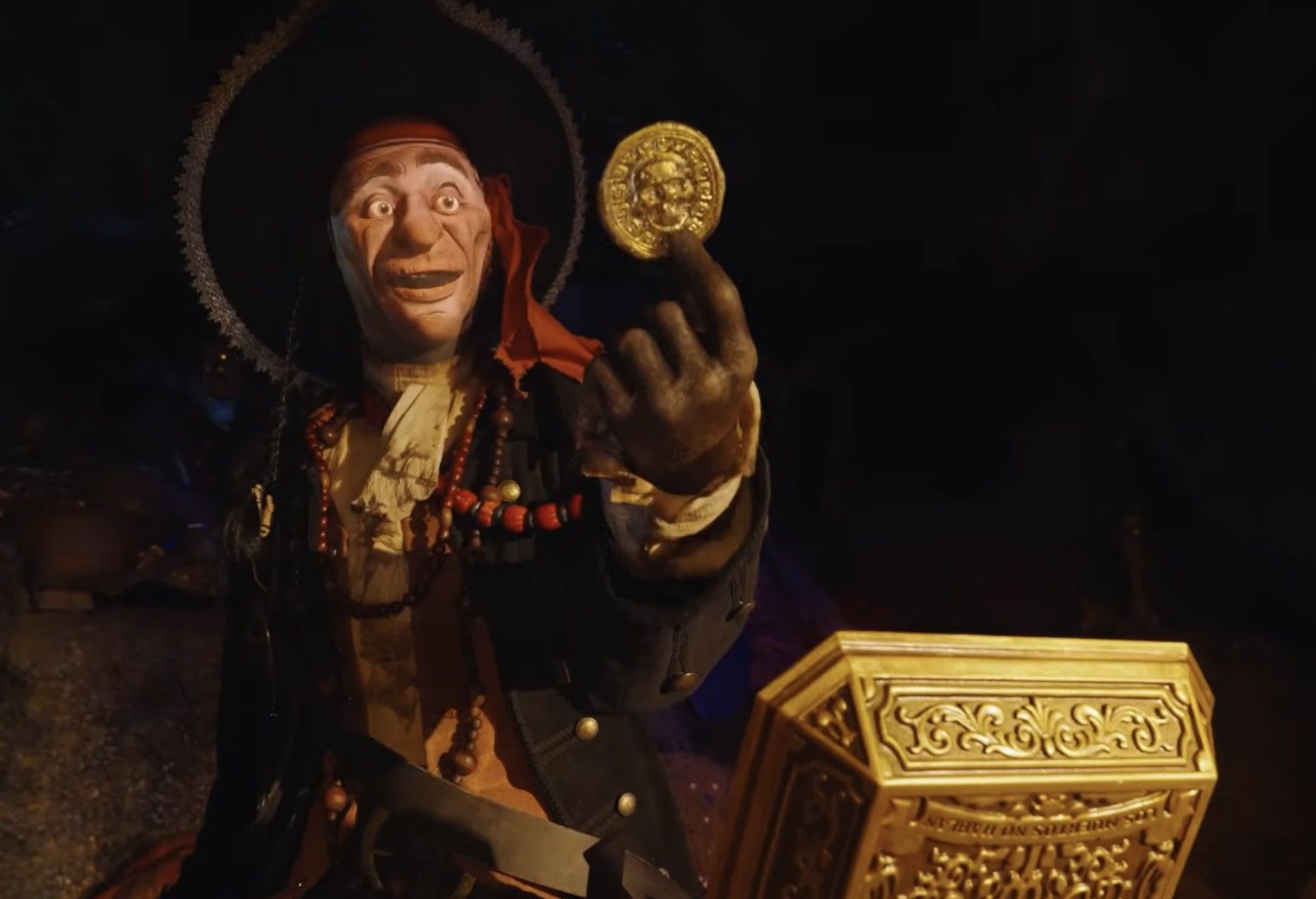
Where robots meet projection, Disney took another step. On June 26, 2026, after an roughly eight-week refurbishment, Disneyland (Anaheim) reopened Pirates of the Caribbean with the parks’ first projection-mapped animatronic face, in the grotto’s scene 11. The skeleton pirate who sat atop the gold for 59 years now transforms from flesh to skeleton in real time and acts out his own story: he grabs a cursed coin and freezes into a skeleton; as his arm drops the coin the curse lifts; greed makes him grab it again, restarting the loop. He cycles through three moods — “Hehehe,” “Ooh” and “Ah.”
The core is “hybrid front projection.” The face is a 3D-printed shell with no visible moving parts, onto which high-fidelity video is projected in real time to form expressions, while the body uses conventional animatronic mechanics. The animatronic’s animation system both drives the figure’s movement and feeds real-time data into Unreal Engine — part of an ongoing partnership with Epic Games — and the projected image moves in lockstep with that data. It is the first time projection mapping has been applied to a moving figure.

Projected animatronics in three steps: mechanical base → real-time projection overlay → living character. Reconstructed.
Alignment required a newly patented calibration method. Because of the heavy costuming, cameras couldn’t see conventional targets, so markers were built into the pirate’s bandanna; they respond to UV light, glowing yellow during nightly calibration and invisible to daytime guests with the UV off. Two projectors are installed — one active, one backup — and the system constantly tracks the figure so the image stays locked to the face even if the figure moves or a motor fails. Sensors run calibration daily, with redundancy across compute and projection.

Hybrid front-projection setup: two projectors (one backup), an IR camera and calibration track the bandanna’s UV markers to lock the image to the face. Reconstructed.
Disney first revealed the technology as a concept in a November 2025 “We Call It Imagineering” episode, and put it in a park seven months later. Leslie Evans, Executive R&D Imagineer at Walt Disney Imagineering R&D, said the aim is “more tools to just tell stories in an incredible way.” Reception was not uniformly warm: some fans criticized replacing a beloved 59-year scene, and on July 4 the figure was down, its projection temporarily swapped for a physical skull mask — a sign that stabilizing the system still takes trial and error.
Both faces converge on one principle: technology exists to support storytelling. Laughlin said Disney sought collaborators that respect its identity as a creator- and talent-driven company, with a human at the heart of the process — systems that enhance rather than replace human creativity. The logic that disciplines cost in engineering and the principle that keeps humans central in creative resolve into the same sentence: technology is the means, not the end.
What it means for Korea
The first message for Korea’s media industry is simple: use AI, but design its cost. Even Disney — whose streaming has only just reached double-digit margins — manages token use by ranking it. For domestic broadcasters and streamers with thinner margins than Disney, controlling inference cost is not optional but a precondition. Treating AI as an operating discipline — encouraging use while governing it with dashboards, budgets and caps — is a template Korean content and platform firms can borrow as they embed AI in workflows. But as the tokenmaxxing “leaderboard paradox” shows, the moment usage is mistaken for a performance metric, waste can become institutionalized.
The second is how to use assets. Disney built a custom generative model on its own creative material to accelerate production while preserving brand consistency. For Korean content owners with strong IP libraries, this approach — a bespoke model customized on one’s own IP and archives rather than an off-the-shelf general model — is a realistic way to hold creative identity and copyright control at once. Notably, Disney’s dual posture — training models only on owned or licensed IP while suing AI firms such as Midjourney for unauthorized scraping — is instructive for Korean content holders adopting AI while defending IP value. As K-content’s global distribution widens, converting vast broadcast and film archives into training assets to compress production pipelines only grows in value.
The third is the direction of partnerships. After its marquee OpenAI deal collapsed, Disney shifted weight to in-house tools and usage discipline. The balance between dependence on a single external platform and building one’s own capability is a question Korean media and platform firms face just as squarely. For players competing in FAST and global distribution, managing reliance on external AI while standing up internal tools and data governance is a matter not only of cost but of strategic autonomy.
The fourth is creative labor and experience. Disney’s stated human-centric, creator-driven principle and its staff’s job-displacement worries echo a tension Korea’s creative sector has known since Hollywood’s 2023 strikes. And as generative tools, robotics and wearables extend into parks and experiences, the trajectory speaks to Korea’s own experience economy — theme parks, immersive content, live shows and exhibitions. In the end the question is the same: is technology the means of storytelling, or its end?
The fifth is the fusion of robots and experience. The way Disney turns parks into living story spaces with aquatic robots, free-roaming characters and projection is a concrete reference for Korean players seeking to extend IP into physical experiences. Korea holds both a robotics manufacturing base (Hyundai’s ownership of Boston Dynamics, among others) and powerful IP in webtoons, K-pop and drama. Marrying content IP with robotics and immersive tech opens a new export form — experiential K-content across theme parks, permanent exhibitions, pop-ups and festivals. Here too the crux is story, not technology: as Disney keeps stressing, a robot earns its value only as a means of storytelling.

Disney’s AI Organization (as of 2026)
Disney’s AI is executed on three tracks under CEO Josh D’Amaro. Prioritizing streaming, D’Amaro named TV head Dana Walden the company’s first-ever chief creative officer and made Adam Smith and Joe Earley co-presidents of the direct-to-consumer (DTC) business. Company-wide policy and coordination sit with the Office of Technology Enablement (OTE) — led by Jamie Voris (stood up in late 2024, ~100 people) and reporting to Disney Entertainment co-chairman Alan Bergman.
Engineering execution — the in-house tools, the dashboard, and the tokenmaxxing guidance — lives in Smith’s product and technology group. Smith has eight direct reports; beneath him Andre Rohe leads a consolidated engineering unit spanning product, media, QA, commerce, growth and identity, along with the AI Adoption Dashboard, and Rohe himself has twelve direct reports. Jason Cox, who leads AI R&D, also sits in the engineering org. Creative and experiential AI sits with Walt Disney Imagineering R&D (SVP Kyle Laughlin) under Disney Experiences. Rather than naming a single chief AI officer, Disney runs a distributed setup — policy in OTE, execution in the segments.

Disney’s AI-related org chart (2026). Policy = OTE; engineering execution = streaming product & tech; creative = Imagineering R&D. Compiled/reconstructed from Business Insider, Variety and others.
Adam Smith (CPTO) — 8 direct reports (alphabetical)
Andre Rohe (EVP) — 12 direct reports (alphabetical)
Sources
▸ AI strategy & engineering (Business Insider, James Faris)
“Disney is pushing tech employees to move faster with AI — but avoid ‘tokenmaxxing’” June 13, 2026.
“Disney staffers have an ‘AI Adoption Dashboard’ — one Claude user invoked it 460,000 times in 9 days” Apr. 23, 2026.
“Disney’s internal AI strategy: ‘DisneyGPT’ and a new ‘Jarvis’ tool” Dec. 13, 2025.
https://www.businessinsider.com/disney-ai-strategy-employees-disneygpt-openai-deal-chatgpt-2025-12
“Disney org chart: streaming tech leaders as Hulu converges into Disney+” July 2026.
▸ Creative & Imagineering (design)
The Walt Disney Company, “Why the World’s Leading Tech Companies Collaborate with Disney” Disney Newsroom, June 18, 2026.
https://thewaltdisneycompany.com/news/tech-companies-collaborate-storytelling-innovation/
Rahim Amir, “Adobe and Disney… next generation of theme park rides with Foundry AI” TechRadar Pro, June 30, 2026.
▸ Parks · robots · animatronics
Samantha Kelly, “Disney’s Parks Revamp Includes Aquatic Robots and Hovering Star Wars Droids” Bloomberg, June 26, 2026.
Blog Mickey, “Disney Debuts First Projection-Mapped Face on an Audio-Animatronic” June 26, 2026.
https://blogmickey.com/2026/06/disney-debuts-first-projection-mapped-face-on-an-audio-animatronic/
Jacob Krol, “I watched Disney’s next-gen audio-animatronic transform from a pirate to a skeleton…” TechRadar, June 26, 2026.
Walt Disney Imagineering / Disney Parks, projection-mapped animatronic video, YouTube.
https://www.youtube.com/watch?v=331z0nOZJw0
See ‘The Future of Animatronics — Great Moments in Imagineering’ (supplied material).
▸ Business & market data
Streaming results/subscriptions/churn: Disney FY2026 Q2 earnings coverage (TheWrap and others), Antenna. Viewing share: Nielsen. Peer cases: The Information. OTE (2024): Variety.
https://www.thewrap.com/industry-news/business/disney-earnings-q2-2026/