
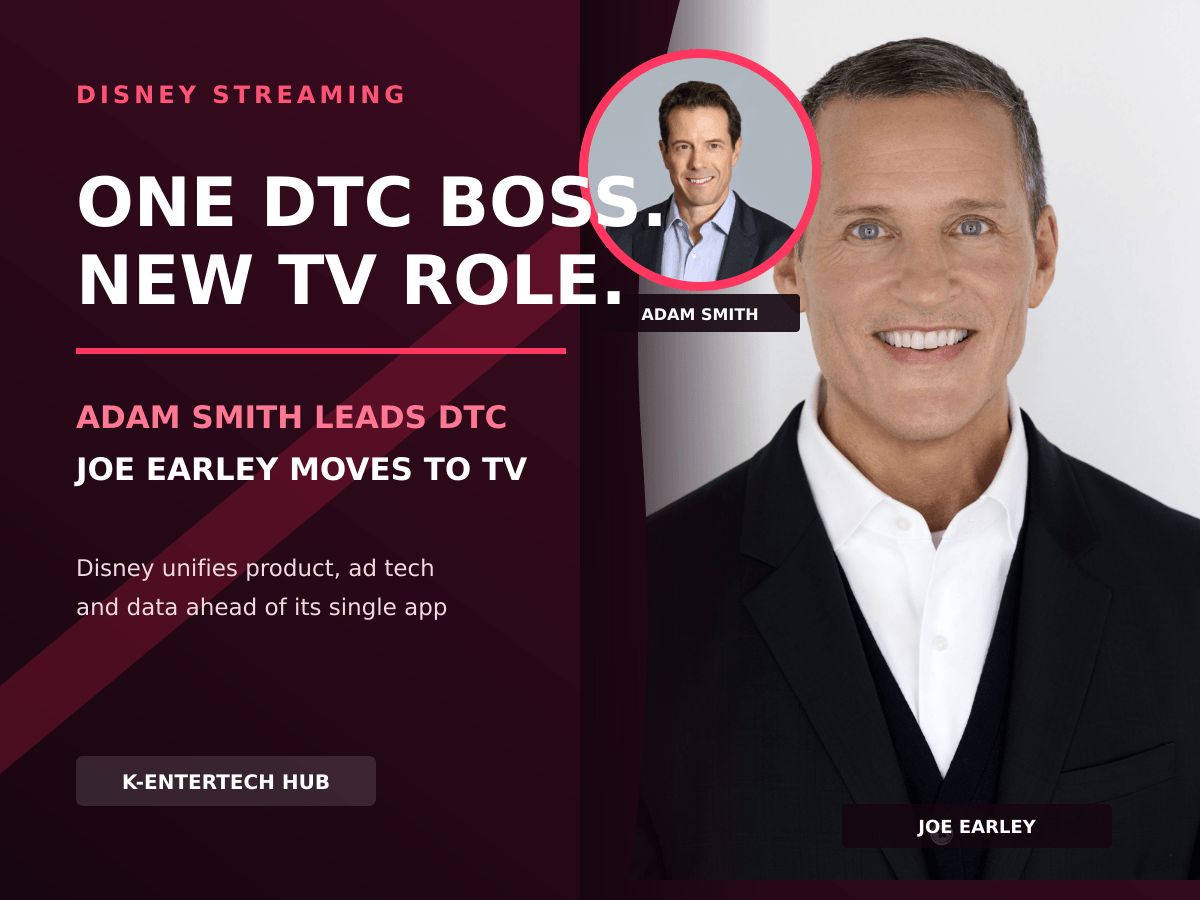
Adam Smith becomes chairman of direct-to-consumer, Joe Earley moves to television franchises; streaming operating income was $712 million in the June quarter, and July viewing share ran 14.2% for YouTube against 4.7% for Disney

Disney named Adam Smith, co-president of direct-to-consumer at Disney Entertainment, as chairman of direct-to-consumer. The announcement came on Sept. 17. Smith takes product, engineering, advertising technology, programming strategy, viewer experience, partnerships and data and analytics for Disney+ and Hulu. Joe Earley, the other co-president, moves to Disney Entertainment Television (DET) as president of franchise and content strategy, reporting to DET chairman Debra OConnell.
The reason for putting one executive in charge is that the March structure split responsibility for the elements a viewer sees on screen. Dana Walden, Disney’s president and chief creative officer, gave Smith product and technology and Earley content strategy in March. Walden and film chief Alan Bergman continue to share oversight of direct-to-consumer. Day-to-day decisions now run through a single line to Smith.
Revenue at Disney Entertainment’s streaming business was $5.532 billion in the April–June quarter of 2026, up 11% year over year. Operating income was $712 million, more than double the $329 million a year earlier. The operating margin was 12.9%. Subscription growth broke down as nine percentage points from more subscribers, three from higher rates and one from currency.
In Nielsen’s July Gauge, streaming accounted for 49.0% of all television viewing time. YouTube alone hit a record 14.2%. Disney’s streaming services together held 4.7% that month. The gap sits inside the screen layout, ad tech and data Smith now runs.
Chief executive Josh D’Amaro calls Disney+ the company’s “digital centerpiece.” Disney+ and Hulu merge into a single app by the end of the year, and an ad-supported free tier is under study. The executive in charge of that work came from product and technology at Google and YouTube rather than from content.
Product, ad tech and data for Disney+ and Hulu in one group
Disney describes Smith’s remit as the global entertainment SVOD business: product and engineering, advertising technology, programming strategy, viewer experience, partnerships, and data and analytics for Disney+ and Hulu. Sports is excluded; ESPN’s direct-to-consumer service sits in a separate organization.
The company’s release says Smith will drive strategy, development and innovation across its streaming platforms, its proprietary advertising technology and emerging technologies. Bundle subscribers already watch Hulu and ESPN content inside the Disney+ app, and the Disney+ Perks loyalty program sits in the same app. The Walt Disney Company reported revenue of $94.4 billion in fiscal 2025 and runs three segments: Entertainment, Sports and Experiences.
Walden said Smith “has done an exceptional job building a world-class team of product and technology leaders and has significantly enhanced the Disney+ user experience globally,” adding that she and Bergman “are confident that he is the right leader to meet the critical moment we’re in.” Smith said the aim is to “make Disney+ the connection point for fans everywhere to engage with the full breadth and depth of the broader Disney ecosystem.”

Joe Earley, president of franchise and content strategy at Disney Entertainment Television. He joined Disney in 2019 ahead of the Disney+ launch and became president of Hulu in 2022. Photo: Disney
At DET, Earley leads strategic development of television franchises and oversees content and production for international originals, production, labor relations and creative talent development. Walden called him “an exceptional leader for our direct-to-consumer business over the past four years.” Earley joined Disney in 2019 to run global Disney+ marketing and operations, became president of Hulu in 2022, and spent years at Fox across content, communications, marketing and operations.
Source: Disney release and reporting by Deadline and The Hollywood Reporter, Sept. 17, 2026
Two decades at Google and YouTube, then Disney in 2024
Smith joined Disney in August 2024 as chief product and technology officer for Disney Entertainment and ESPN. He had spent more than 20 years at Google and YouTube, where he led YouTube Premium and YouTube Music. He was hired from outside as Bob Iger, then chief executive, pushed the long integration of Hulu and ESPN content into Disney+.
The launch of ESPN’s direct-to-consumer service is counted among his results. ESPN Unlimited arrived on Aug. 21, 2025 at $29.99 a month and is seen as established a year in. On the other side, Hulu’s first live stream of the Academy Awards in 2025 crashed; Disney fixed the problem for the 2026 telecast.
Co-presidents lasted six months as Bowen left for Fubo and Schrier stepped down
People have moved through the DTC organization all year. Alisa Bowen, president of Disney+, left in the summer to become chief executive of Fubo. Eric Schrier, president of DTC international originals, stepped down on the same day as this reorganization and signed a producing deal with Disney Entertainment Television.
D’Amaro and chief financial officer Hugh Johnston began an efficiency program months ago and the company is running a voluntary early retirement offer. Disney cut several hundred jobs in July, with Pixar and National Geographic among the most affected, and moved consumer products under the studio umbrella in August.
Streaming operating income of $712 million and a single app by year-end
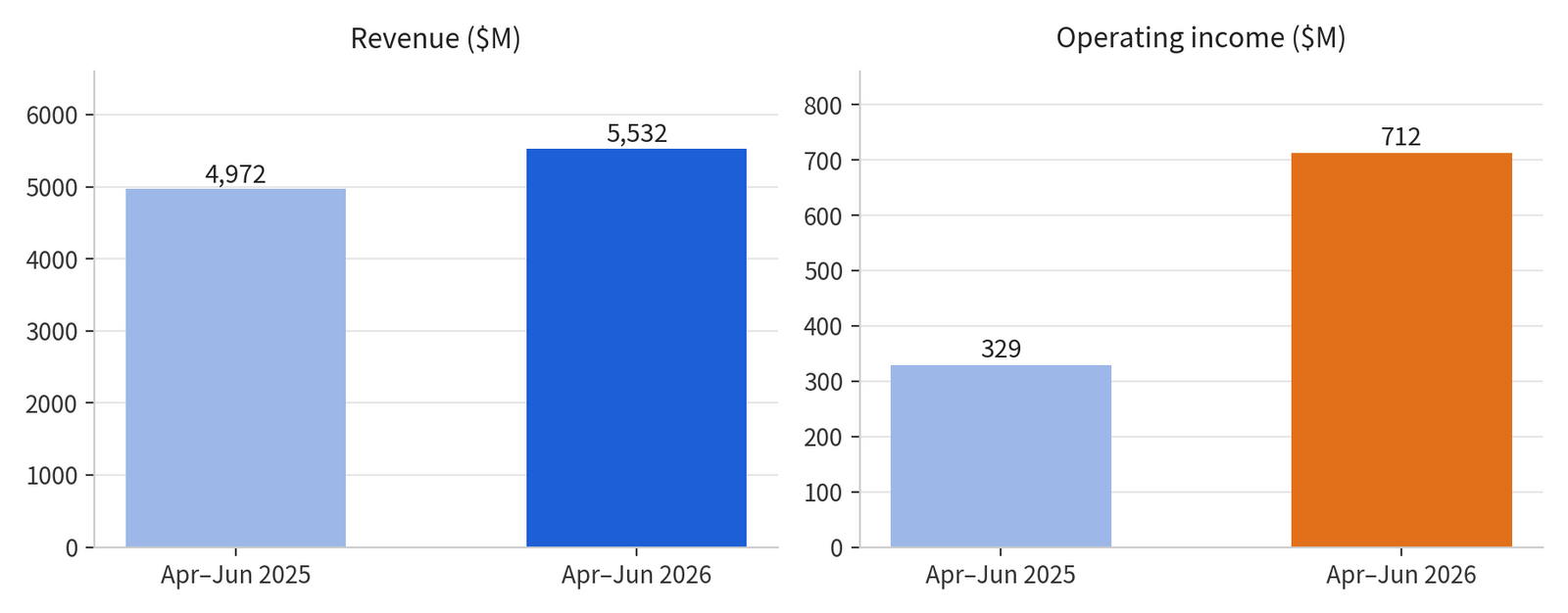
Disney Entertainment streaming (SVOD) revenue and operating income, April–June 2026. Source: The Walt Disney Company fiscal 2026 third-quarter results
Disney showed an intermediate step toward app unification in its June-quarter results. Hulu standalone and bundle subscribers can now link profiles and viewing history and manage subscriptions inside Disney+. The merged app arrives at the end of the year. Autoplay on the home page and the short-form feed Disney+ Verts sit with the same group, and a U.S. pilot with TikTok will put fan-made clips into that feed.
An ad-supported free tier is the next lever under study for adding subscribers. D’Amaro has said a shift to a purely licensing model would sacrifice the strategic value of the direct relationship. Disney lists that value as a direct line to users worldwide, first-party data for product work and personalization, and a base for new revenue.
On the content side, the company plans to triple local original series over three years and describes the spending as a tool for subscriber growth and churn.
Streaming at 49.0% of July viewing, YouTube at 14.2%, Disney at 4.7%
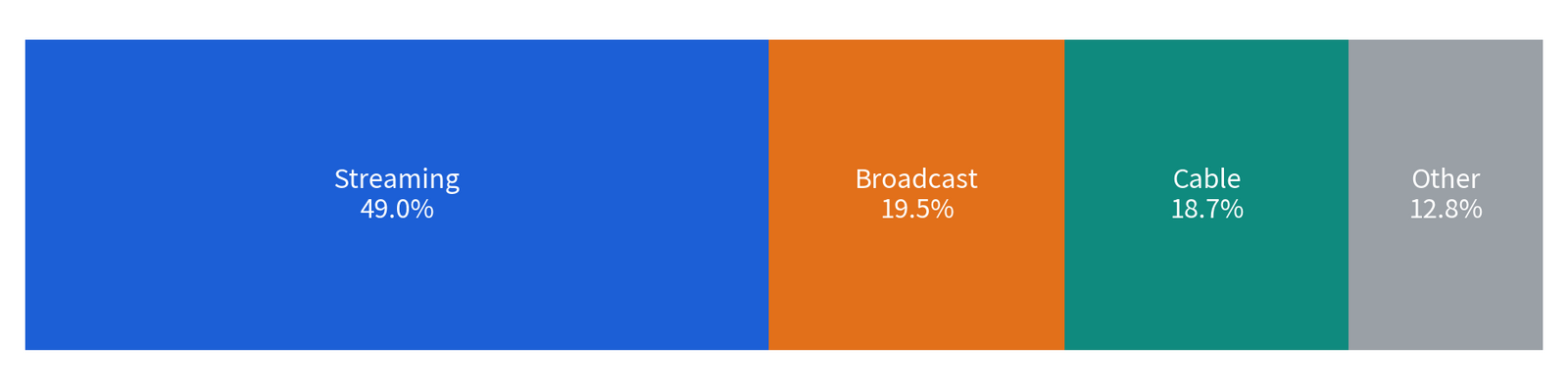
Shares of total U.S. television viewing time, July 2026. Source: Nielsen’s The Gauge, released Sept. 10, 2026
Total television usage in July rose 2.2% from June, against the usual summer decline, as the final weeks of the FIFA World Cup 2026 ran into the month; the increase is close to the 2.3% recorded in July 2024 during the Olympics. Streaming took 49.0% (+0.5 points), broadcast 19.5% (-0.3 points) and cable 18.7%. Cable sports viewing fell 27% as World Cup telecasts dropped from 31 in June to two in July.
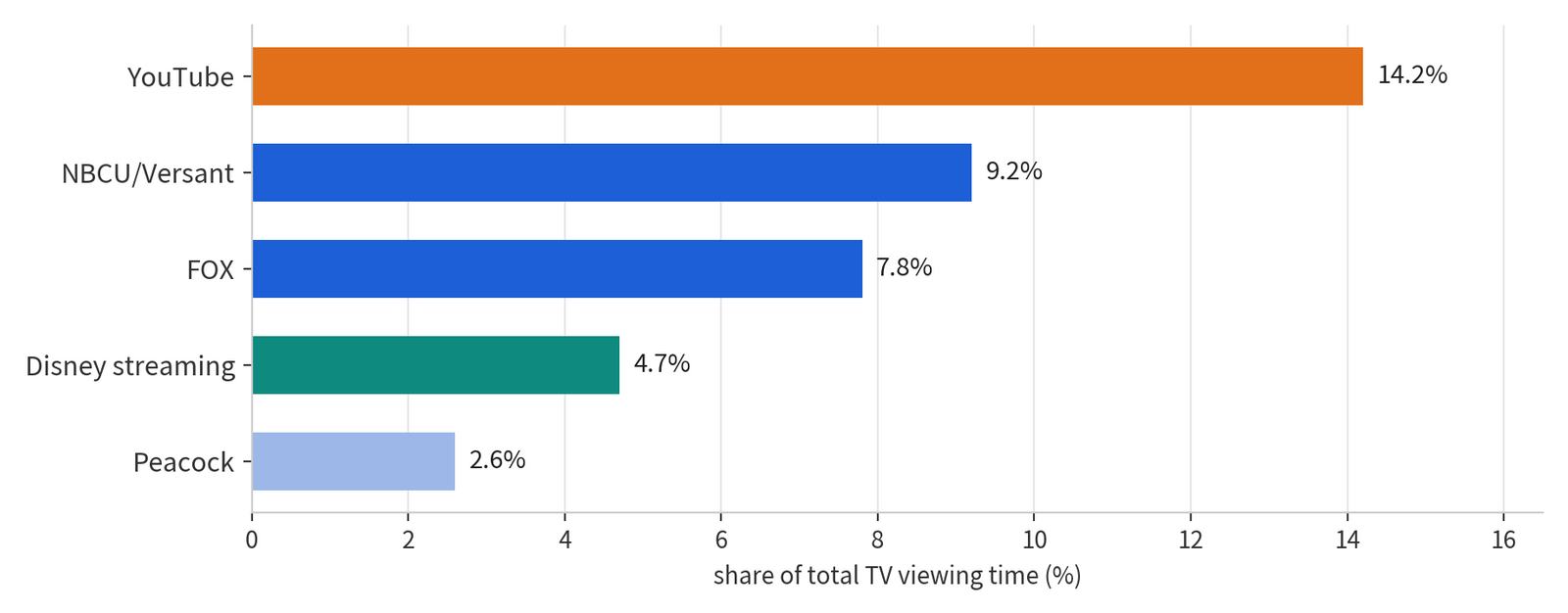
Shares of U.S. television viewing time by platform and distributor, July 2026. YouTube, Disney streaming and Peacock are Gauge figures; NBCU/Versant and FOX are Media Distributor Gauge figures. Source: Nielsen
YouTube viewing rose 6% from June to a record 14.2%, extending its lead in the Media Distributor Gauge to 5.0 share points. NBCUniversal and Versant together were second at 9.2%. Peacock, carrying Telemundo’s World Cup simulcasts, grew 15% month over month to 2.6%, and “Love Island USA” drew 4.9 billion viewing minutes in July alone. FOX rose 7% on World Cup coverage to 7.8% and held 25 of the month’s top 26 telecasts.
Disney’s streaming services together reached 4.7%, up 0.1 point from June, with viewing up 4% and a 7% gain among 6- to 17-year-olds. “The Bear” and “King of the Hill” contributed nearly 3 billion viewing minutes between them. In months without a marquee live event, what moves Disney’s share is the release calendar and placement inside the app — the home screen, recommendations, the short-form feed and ad tech that Smith now controls.
In Korea, Disney+ had 4.07 million monthly users and 540,000 daily users
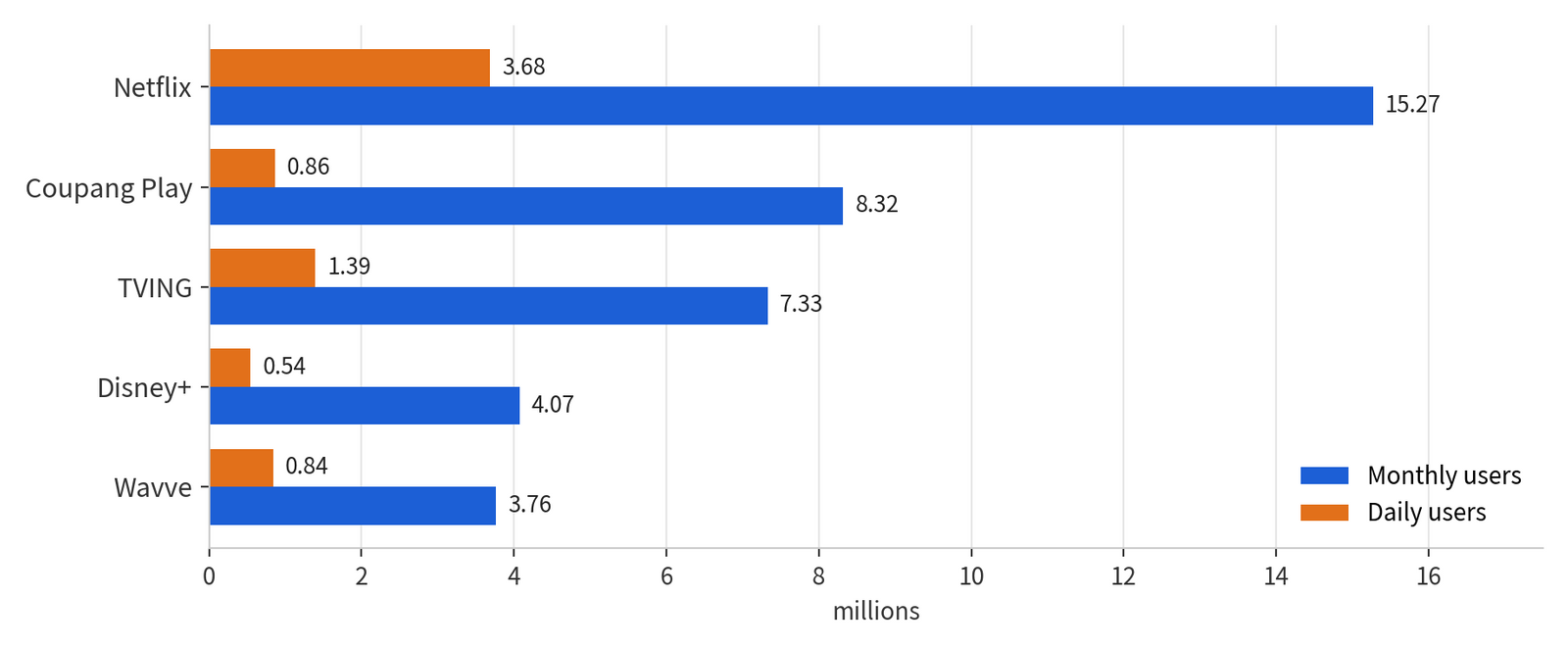
Monthly and daily users of streaming services in Korea, February 2026. Source: Mobile Index (모바일인덱스), as reported by Electronic Times (전자신문) on March 9, 2026
Disney+ sits in a different place on scale than on frequency in Korea. Mobile Index counted 4.07 million monthly users in February 2026, fourth behind Netflix (15.27 million), Coupang Play (쿠팡플레이, 8.32 million) and TVING (티빙, 7.33 million). Daily users were 540,000, the lowest of the five services. Subscriptions exist; the daily habit does not. That gap is the problem the product and data group now owns.

The Disney+ service page in Korea, with the original series “Made in Korea” (메이드 인 코리아) and the pricing panel on the same screen. Photo: screenshot of Disney+
Standard costs 9,900 won a month (about $7.2) in Korea and Premium 13,900 won (about $10.2), with up to 16% off for an annual membership against 12 months at the monthly rate. At the top of the page sits “Made in Korea,” the Korean original that began in 2025 and has run two seasons, with the sign-up buttons and price notes directly beneath the synopsis. Deciding which title holds that slot, and which plan appears next to it, falls inside the programming strategy and viewer experience Smith now runs.
The merged app reaches Korean viewers as the same screen. Without the Hulu brand in Korea, the Star (스타) hub carries adult-oriented content, and once the apps combine, Korean programming and plan structures follow decisions made by the same product group. Bundles with telecom operators and pay-TV providers, ad-tier inventory and the scope of usage data all move to that counterpart.
Tripling local originals means more volume for Korean producers. As the basis for those orders shifts toward subscriber and churn data, usage curves in the first days after release come before the pitch document. How a Korean original on Disney+ performs in that window sets the terms of the next order.
Korean operators face the same sequence. TVING and Wavve (웨이브) received conditional approval from the Fair Trade Commission (공정거래위원회) in June 2025, but the merged company has yet to launch and the two services still run separate apps and price plans. Coupang Play built 8.32 million monthly users on the back of its membership program while daily users stopped at 860,000. How far to consolidate product and data under one executive is the same open question here.
Conclusion: the decision rights move from the content line to the product line
Disney has moved the decision rights in streaming from the content line to the product line. Screen layout, ad tech and data are settled in one organization, and content follows those decisions. July viewing share was 14.2% for YouTube against 4.7% for Disney. The merged app and the free ad-supported tier under study are the tools aimed at that gap.
The point of contact with Disney+ in Korea moves to the same group. Plan structures, bundle partnerships, ad inventory and the scope of usage data are decisions for the product and data organization. Korean producers get volume from the local original plan, while the basis for each order shifts from the pitch to post-release usage. What holds the first slot on the Korean Disney+ screen is where that judgment shows up.
Note: Won figures converted at 1,368.6 won to the dollar, the Sept. 16, 2026 close. Quotation marks indicate statements as announced or reported; unquoted passages summarize releases and reporting. Disney’s fiscal third quarter covers April–June 2026.
Sources
· The Walt Disney Company release, “Adam Smith Named Chairman, Direct-to-Consumer, Disney Entertainment” (Sept. 17, 2026, Burbank). https://thewaltdisneycompany.com/
· Deadline, “Adam Smith To Lead Disney’s Direct-to-Consumer As Chairman, Joe Earley Becomes President Of Television Franchise & Content Strategy” (Sept. 17, 2026). https://deadline.com/2026/09/adam-smith-head-disney-direct-to-consumer-joe-earley-tv-1237106753/
· The Hollywood Reporter, “Disney Names New Streaming Boss In Major Shake Up of Direct-to-Consumer Division” (Sept. 17, 2026). https://www.hollywoodreporter.com/business/business-news/disney-streaming-chairman-adam-smith-joe-earley-tv-1236704657/
· Deadline, “Eric Schrier Stepping Down As President Of DTC International Originals” (Sept. 2026). https://deadline.com/2026/09/eric-schrier-leaving-disney-entertainment-producing-deal-1237106825/
· The Walt Disney Company, fiscal 2026 third-quarter results (Aug. 5, 2026). https://s206.q4cdn.com/979796730/files/doc_financials/2026/q3/q3-fy26-earnings.pdf
· Nielsen, “TV Usage Kicks Usual Summer Slowdown, Fueled by World Cup and Streaming in Nielsen’s July Gauge Reports” (Sept. 10, 2026). https://www.nielsen.com/news-center/2026/tv-usage-july-2026-gauge/
· TheWrap, “Disney+, Hulu Combined Profit Hits $712 Million in Q3” (Aug. 2026). https://www.thewrap.com/industry-news/business/disney-earnings-q3-2026/
· Variety, “Disney Names YouTube’s Adam Smith Chief Product and Technology Officer” (Aug. 2024). https://variety.com/2024/tv/news/disney-entertainment-espn-adam-smith-chief-product-technology-officer-1236107959/
· Variety, “Disney+ Will Become ‘Immersive, Interactive Digital Centerpiece’ of the Company” (May 2026). https://variety.com/2026/tv/news/disney-plus-immersive-interactive-digital-centerpiece-josh-damaro-1236739211/
· The Hollywood Reporter, “Fubo Names Alisa Bowen CEO” (2026). https://www.hollywoodreporter.com/business/business-news/fubo-alisa-bowen-new-ceo-1236643463/
· Electronic Times (전자신문), on Korean streaming usage patterns (March 9, 2026). https://www.etnews.com/20260309000306
· Money Today (머니투데이), on the TVING–Wavve conditional approval (June 11, 2025). https://www.mt.co.kr/economy/2025/06/11/2025061023212179571
· Disney+ Korea service page, pricing and “Made in Korea” listing (accessed Sept. 18, 2026). https://www.disneyplus.com/ko-kr/