FAST Platforms Turn O&O Channels Into Their Most Strategic Asset — A Digital Replay of the Cable TV Vertical-Integration Playbook

Platforms that can run both O&O IP channels and curated branded O&O channels in parallel — while sitting at the OS layer that controls distribution, data, and ad-tech — will own the next decade of FAST economics

FAST Platforms Turn O&O Channels Into Their Most Strategic Asset — A Digital Replay of the Cable TV Vertical-Integration Playbook

Samsung TV Plus posts the sharpest expansion of any platform (13 → 34 in two years); the same MSO–PP integration logic that built NBCUniversal and CJ ENM is now reshaping FAST.

As the FAST (Free Ad-Supported Streaming TV) market enters a phase of mounting financial pressure, owned-and-operated (O&O) channels have emerged as the industry's most strategically valuable asset. Unlike licensed third-party channels, O&Os are fully owned by the platforms that run them — generating advertising revenue with no profit-sharing obligation. Every ad dollar earned on an O&O channel stays inside the platform.

90년 대 케이블TV 전략을 벤치마킹하는 FAST 플랫폼..이용자를 가둬라
FAST O&O 채널은 2020년 이후 빠르게 늘어 2024년에 피크를 찍은 뒤 2026년에 약간 줄었지만, 그 안을 들여다보면 파라마운트(Pluto TV)는 비효율 채널을 정리하는 대신 핵심 IP 중심으로 효율화하고, 삼성 TV Plus·LG Channels·Vizio WatchFree+ 같은 디바이스 OS 진영 자체 브랜드 채널을 공격적으로 늘려. ‘유통+편성+데이터+광고기술’을 한 번에 쥐는 방향으로 수직통합 가속하는 국면

This is not a new model. It is the digital-era replay of the vertical-integration strategy that defined the cable TV industry in the 1990s and 2000s — when MSOs (cable operators) merged with PPs (programming networks) to capture margin and inventory under one roof.

The shift is structural. FAST is being squeezed simultaneously by three forces: slowing growth in ad rates, rising content licensing costs, and deteriorating economics for third-party channel aggregators. In that environment, the O&O model has effectively become the only durable margin-defense lever available to platforms.

According to FASTMaster Intelligence, the eight largest U.S. FAST platforms collectively operated 135 O&O channels in 2020, peaked at 311 in 2024, and settled at 303 in 2026. The headline number understates a deeper shift: the industry's center of gravity is moving from licensed-channel aggregation toward proprietary IP and proprietary brands — exactly the trajectory cable took a generation earlier.

[Figure 1] O&O Channel Counts by Major FAST Platform (2020 → 2026)

1. Why O&O Has Become a Strategic Asset

An O&O channel is one the platform owns outright. Unlike a licensed channel, the platform controls the content rights, programming, and ad inventory, and therefore owes no revenue share to a third party. In the early phase of FAST, growth was a channel-count race — whoever lined up the most carriage deals won shelf space. As the market matures, the key metrics have shifted to revenue per user (ARPU) and gross margin. O&O channels are essentially the only lever that moves both at the same time.

That structural shift has split the industry into two distinct strategic camps: traditional media companies with deep libraries that can channelize their own IP directly, and device manufacturers without deep libraries that must build differentiated channels through brand curation.

2. The Paramount Model: Channelize What You Already Own

Broadcasters and studios with large back catalogs have taken the most direct path: repackaging their existing content into channel form. The clearest example is Paramount on Pluto TV. As of 2026, Paramount operates 166 O&O channels on Pluto TV — by far the largest single-owner footprint on any FAST platform.

Pluto TV's total O&O count climbed from 121 in 2020 to a peak of 187 in 2024 before easing to 166 in 2026. The decline is not a retreat. Industry observers read it as an efficiency phase — pruning underperforming channels while reinforcing flagship IP-driven channels. Pluto TV is moving past the channel-count race and into a stage focused on viewing time and ad revenue per channel.

Freevee / Prime Video shows a similar pattern, edging from 35 channels in 2024 to 32 in 2026. With Amazon now leaning into its ad-supported Prime Video tier, the company's O&O FAST strategy is consolidating around fewer, higher-value channels rather than maximum breadth.

3. The Samsung Model: If You Don't Own a Library, Build a Brand

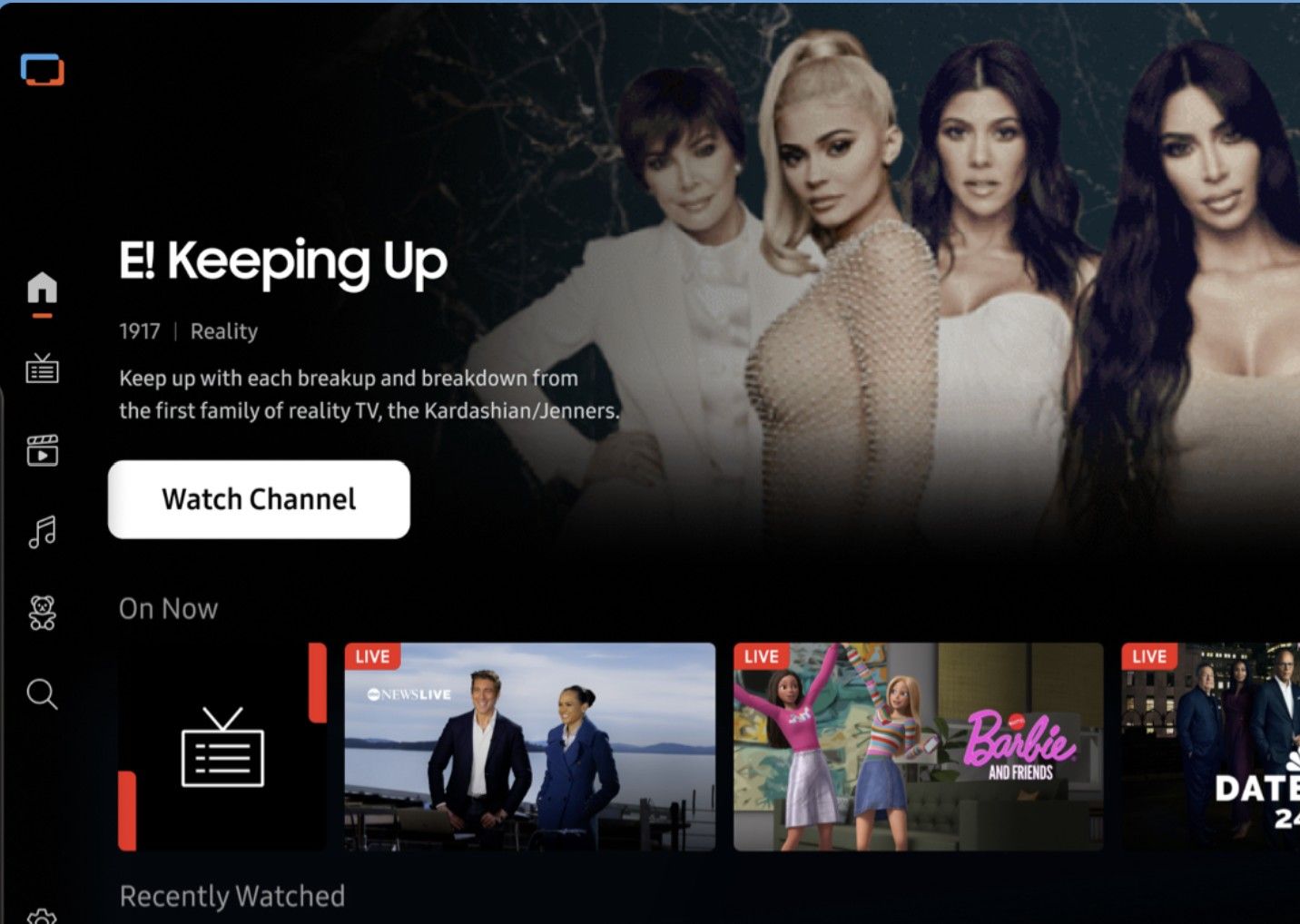
Device manufacturers, with relatively shallow proprietary libraries, have taken a different route: blending content from multiple licensed libraries under a proprietary platform brand — a curation-driven O&O model. The former Samsung Television Network was the prototype, packaging films, documentaries, and entertainment titles into platform-branded genre channels.

This model still involves revenue sharing with rights holders, but it produces differentiated viewing experiences that pure licensed-channel relays cannot replicate. Crucially, programming control and ad inventory remain on the platform side, so even with revenue sharing, the platform retains strategic control of the channel.

The numbers tell the story. Samsung TV Plus expanded from 13 O&O channels in 2024 to 34 in 2026 — a 161% increase in just two years, the sharpest expansion of any platform observed in that period. Vizio WatchFree+ moved from 0 in 2020 to 15 in 2026, and LG Channels tripled from 3 to 9 between 2024 and 2026. Across the board, the device-manufacturer camp is now treating branded channel inventory as a core platform asset, not a marketing afterthought.

4. The Numbers at a Glance

The platform-level data, presented year-over-year and by 2024→2026 delta, shows where the market is heading. The two-year change column is the clearest indicator of strategic direction.

Platform

2020

2022

2024

2026

'24→'26

Pluto TV

121

172

187

166

▼ 21

Samsung TV Plus

2

6

13

34

▲ 21

Freevee / Prime Video

0

1

35

32

▼ 3

Xumo

11

19

21

20

▼ 1

Peacock

18

19

17

▼ 2

Vizio WatchFree+

0

6

11

15

▲ 4

Roku Channel

1

4

22

10

▼ 12

LG Channels

0

0

3

9

▲ 6

TOTAL

135

226

311

303

▼ 8

Source: FASTMaster Intelligence (unit: number of channels)

5. The Cable TV Parallel: A Familiar Vertical-Integration Playbook

Step back, and the FAST O&O strategy looks less like an invention than a digital-era replay of cable television's vertical-integration era. In the United States, Comcast's 2011 acquisition of NBCUniversal was the high-water mark — combining MSO and programming operations under one roof. In Korea, CJ ENM built the same logic through an MPP (Multiple Program Provider) structure spanning tvN, OCN, Tooniverse, and other channels. The math has always been the same: owning a channel effectively waives the carriage fee you would otherwise owe yourself, while giving you 100% control of the ad inventory. That margin formula is identical 30 years later.

The reasoning behind FAST platforms' push to expand O&O counts is the same. Every licensed channel filling the catalog requires a revenue share, and the higher the share, the lower the platform margin. Owning the channel is the most direct way to convert content cost into a balance-sheet asset. Paramount running 166 O&O channels on Pluto TV, and Samsung and LG aggressively expanding their own branded channels despite being device manufacturers, traces the same arc that NBCUniversal and CJ ENM walked a generation earlier.

But while the strategy is familiar, the precision of control in the digital environment is a different category altogether. The key contrasts are summarized below.

Dimension

Cable TV Era (1990s–2010s)

FAST Era (2020s–Present)

Industry Structure

MSOs (cable operators) + PPs (channel providers)Vertical integration produced NBCU, CJ ENM

FAST platforms + O&O channelsParamount, Samsung, LG follow same pattern

Revenue Model

Carriage fees + ad revenueOwning a channel = paying yourself $0 in carriage

Revenue share + ad revenueO&O = 0% revenue share to outside parties

Channel Slots

EPG capped at ~200–500 channelsNew launches require carriage negotiation

Effectively unlimitedInfinite genre/library segmentation possible

Ad Sales

Direct sales-ledMediated through ad agencies

Programmatic + Dynamic Ad Insertion (DAI)Different ads for different viewers

Audience Data

Reliant on external measurement (Nielsen panels)

Platform owns first-party dataOS-level viewing logs captured directly

Gatekeeper

MSOs (Comcast, Charter, etc.)

Device OS(Tizen, webOS, Roku OS, Fire TV)

Source: K-EnterTech Hub Analysis

The decisive difference is in the bottom two rows. In the cable era, audience data was estimated by an external measurement firm (Nielsen) from sample panels — and even integrated MSO–PPs could not directly access first-party 'who watched what, when' logs. In the FAST era, the device OS itself owns the viewing log and uses that data to insert different ads for different viewers in real time. Where cable's vertical integration combined distribution and programming, FAST's vertical integration combines distribution, programming, data, and ad-tech — a four-layer stack. Same strategy, an order of magnitude deeper level of control.

Seen through this lens, the rapid O&O expansion among device manufacturers (Samsung +21, LG +6, Vizio +4 between 2024 and 2026) is not simply a content-business move. It signals that the gatekeeper power once held by cable MSOs is being absorbed by device operating systems — and on top of that gatekeeper layer, OEMs are stacking owned brand channels to consolidate distribution rights, programming rights, data rights, and ad rights in a single hand.

6. The Takeaway: Platforms That Can Run Both Models Will Win

The most important pattern in the data is not that platforms are choosing between the two models — it is that they are converging on the ability to run both. Where they own deep libraries, they channelize their own IP directly. Where they do not, they bundle licensed content under proprietary brands. The result is a hybrid O&O model in which the platform controls programming and inventory across the full lineup, regardless of who originally owned the content.

As FAST competes for advertiser confidence and audience retention, the best-positioned platforms will be those that can scale both approaches in parallel — owned IP where they have it, blended branded channels where they don't. The same logic now confronts Korean broadcasters and content owners.

Just as CJ ENM seized leadership of the Korean content industry through its MPP strategy in the cable era, the next round of competition in FAST will be defined by how Korean rights holders build, operate, and monetize their own O&O channels on top of global platforms. The shift from channel supplier to channel operator is the next strategic frontier for K-content in the global FAST ecosystem.