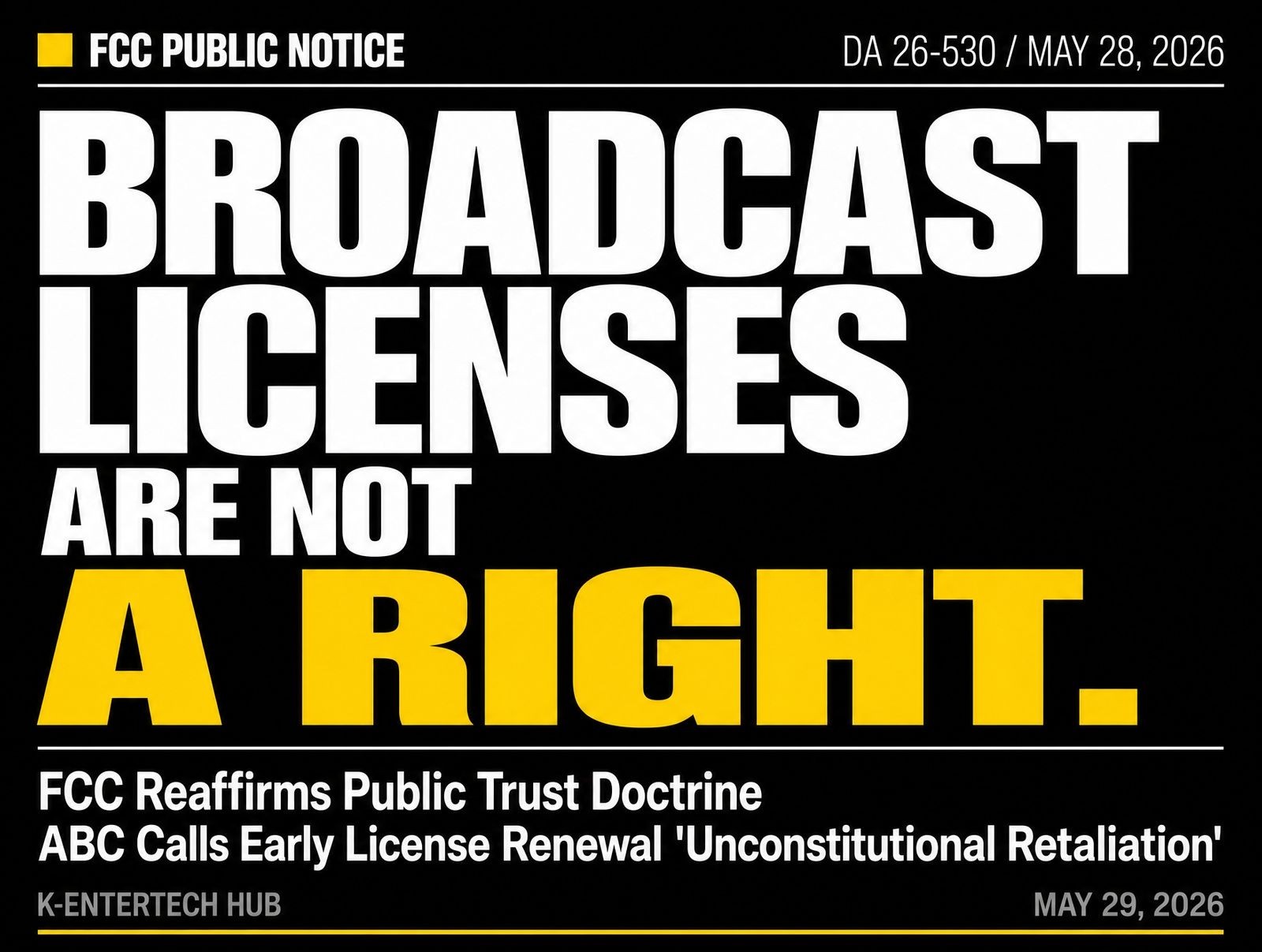
FCC Declares Broadcast Licenses a “Public Trust, Not a Right,” Tightening Pressure on Networks

FCC has reasserted that broadcast licenses are a public trust, not private property, using that principle to justify early review and potential sanctions on Disney-owned ABC’s stations in a politically charged environment.

FCC Declares Broadcast Licenses a “Public Trust, Not a Right,” Tightening Pressure on Networks

Public Notice DA 26-530 revives public-interest duties as ABC blasts an early license-renewal order as “unconstitutional retaliation”

The U.S. Federal Communications Commission has once again pushed to the center of its regulatory posture an old principle: a broadcast license is not property a company owns, but a public trust it is entrusted to operate for a limited term.

美 FCC “방송 면허는 권리 아닌 공적 신탁”…공익성 의무 앞세워 지상파 압박
미 FCC가 지상파 면허를 ‘공적 신탁’으로 재확인하며 공익 의무 미이행 시 회수 가능성을 경고. ABC는 조기 면허갱신 명령을 정치적·위헌적 압박이라 반발하며 규제 권한·공익성·정치화 리스크를 둘러싼 충돌이 격화

In a Public Notice issued May 28 (DA 26-530), the agency stated that “no broadcaster has a ‘right’ to use the public spectrum.” It warned that the licenses of operators who fail to adequately meet their public-interest obligations may be revoked, and that the spectrum could be reassigned to others who will faithfully carry out those duties.

The same day, Disney-owned ABC pushed back hard. After the FCC designated the licenses of its owned-and-operated (O&O) stations for early renewal, ABC publicly countered that the move was “unconstitutional retaliation and improper coercion.” The episode has once again surfaced the tension between the regulator and major broadcasters.

The reason a public-interest doctrine sustained for roughly a century is again being foregrounded as a regulatory instrument lies in the structural nature of broadcast spectrum. Spectrum is a physically scarce resource: only a limited number of channels can operate within the same market. That forces the government to grant one operator the right to use a frequency while excluding others.

Brendan Carr FCC Chairman

The institutional premise has long been that a broadcast license is not private property but something closer to a delegated authority to manage and operate a public resource for a defined period. In reaffirming this principle, the FCC signaled that a station’s very retention of its license can be at risk if it fails to provide content and service consistent with the public interest.

The move also intersects with a broader debate over how to redefine the public responsibility of traditional broadcasting in a media environment reshaped around digital platforms and streaming. How the contest between large media companies and the regulator over the boundaries of authority and accountability plays out is likely to shape both policy and industry structure.

A ‘Free-of-Charge’ Structure — the Basis for Public-Interest Duties

The FCC takes this asymmetry as the starting point of its regulatory logic. The notice points out that the same spectrum band can generate billions of dollars in value at auction, while broadcasters use it essentially for free. In exchange, the agency explained, broadcasters bear an obligation to operate in the public interest of the communities they serve. That sets broadcasting apart from other distribution technologies such as the internet and cable, which carry no direct FCC duty to meet the needs of a specific community.

The notice further stressed that Congress has imposed on licensees a duty to air programming responsive to local needs—programming that must serve the residents of the license area “not the private interests of national networks.” While the FCC has eased some formal burdens over the years, eliminating measures such as ascertainment and the main studio rule, it made clear that broadcasters’ status as public trustees has not been weakened.

Existing duties remain in force. Broadcasters must prepare and retain issues/programs lists in the online public inspection file, refrain from news distortion, and provide equal opportunity to political candidates. Prohibitions on obscene, indecent and profane content, as well as broadcast hoaxes, also continue to apply.

Where a broadcaster is found not to serve the public interest, the FCC said, it may impose a range of measures—enforcement actions, conditional or short-term renewals, orders to file early renewal applications, and designation for a hearing. The notice warned that the Commission “will not hesitate” to ensure broadcasters either meet their public-interest obligations or hand the privilege of a license to another operator who will.

This restatement of principle arose amid the collision with ABC. In April, the FCC ordered ABC to file early renewal applications years before its licenses expire. ABC argues that no such demand has been made in more than 50 years, and that the agency has never targeted an entire group of network-owned stations at once.

Filing its applications on May 28, ABC nonetheless stated it was submitting them “under duress” and argued that the timing “makes the retaliatory purpose unmistakable.” The order came just after President Donald Trump and First Lady Melania Trump called for the firing of ABC late-night host Jimmy Kimmel over remarks in his monologue—fueling a wider dispute over the political neutrality of the regulator.

FCC Chairman Brendan Carr drew a line under the Kimmel connection, denying any link. He pointed to ABC’s insufficient cooperation with an investigation into its diversity, equity and inclusion (DEI) policies, saying the agency ordered the early renewal after telling the company its submissions had been “disingenuous, deficient and improper.” “The FCC will follow the facts and law wherever they may lead,” Carr said. ABC countered that it had supplied all requested documents—numbering in the thousands—and had received no notice of inadequate cooperation before the order.

‘DEI Investigation’ vs. ‘Retaliatory Action’

The two sides’ positions have hardened into a clash over the legitimacy of regulatory enforcement. The FCC frames the matter as inadequate cooperation with a legitimate administrative process, while ABC casts it as retaliation justified by after-the-fact reasoning. The use of early renewal—an unusual instrument—has widened the debate over the proper scope of the agency’s authority.

The matter centers on the eight O&O stations ABC holds in major markets including New York, Los Angeles and Philadelphia. Separately, ABC supplies content to roughly 240 affiliate stations.

ABC said it had insufficient time to prepare the renewal applications and requested a 60-day extension, which the FCC denied without explanation. Industry observers widely expect that actually revoking a license faces high legal and procedural barriers and could take years—potentially outlasting the current administration’s term.

A hearing, by contrast, is seen as a variable that could open relatively early. In that case, a hearing led by Carr could become the venue for a full-fledged fight over alleged bias in programming. ABC retains its existing right to broadcast while the process unfolds.

A Three-Member FCC, With Ideological Fault Lines Exposed

The FCC currently operates with three members: Republicans Carr and Olivia Trusty, and Democrat Anna Gomez. By law the Commission may have up to five members, and to preserve partisan balance no more than three may belong to the same party. At present, however, two seats remain vacant amid delayed Senate confirmations and political gridlock. With major decisions thus shaped by a small number of members, ideological differences among them have become more pronounced.

Daniel Suhr, president of the conservative Center for American Rights, read the notice as “a signal that the FCC will no longer tolerate overt bias,” adding that broadcasters unwilling to comply with the law “can return their licenses.” His group has repeatedly filed FCC complaints against stations owned by CBS, NBC and ABC, and against Jimmy Kimmel.

Gomez, by contrast, argued that “the public interest does not mean a particular administration’s interests” and that broadcasters should not yield to threats but push back. The divergence in interpretation within the Commission was thus laid bare.

The episode is also read as entwined with the existing friction between Disney and President Trump. Earlier, Disney settled a 2024 lawsuit brought by Trump for $15 million before his second inauguration.

The case is seen as one that weaves together the principle of broadcast licenses as public property, the scope of regulatory authority, and questions of political neutrality. Analysts describe it as a test of how the traditional broadcast-regulation framework will be applied and extended within a shifting media environment.

■ Implications for Korea’s Media Industry

Beyond the U.S. regulatory fight, the FCC notice carries layered implications for the institutional design and business strategy of Korea’s media industry. With debate over the regulatory asymmetry between broadcasting and streaming resurfacing at a global level, its connection to Korea’s own policy environment merits attention.

First, the question of recalibrating the regulatory framework between broadcasting and streaming. The FCC reaffirmed the legitimacy of regulation premised on public-interest duties for broadcasters that use scarce spectrum, while making clear that streaming and cable do not bear the same level of community-service obligation.

This connects directly to Korea’s ongoing debate over an Audiovisual Media Services Act. The legislation seeks to consolidate a regulatory regime currently split between the Broadcasting Act and the Telecommunications Business Act, governing broadcasting and streaming within a single framework. As the influence of global OTT operators grows, the policy aim is to secure regulatory parity with domestic players and impose at least a minimum of public accountability.

The core issue, however, lies not in “identical regulation” across media but in the design of “differentiated regulation.” Traditional broadcasters such as terrestrial and general-programming channels are licensed on the basis of scarce public resources like spectrum or authorization, and have long borne strong duties of localism, fairness and public interest. Streaming services, by contrast, are open internet-based platforms with low entry barriers and markets shaped by user choice—supporting the competing logic that the same level of ex-ante regulation cannot easily be applied. Opinion is therefore split in Korea over whether to impose a degree of public accountability on streaming (content responsibility, user protection, incentives for domestic production investment) while stopping short of extending the same programming and local-service obligations as broadcasting.

The U.S. FCC case offers a reference point. It maintains the traditional “public resource use–public interest duty” logic for spectrum-based operators, while keeping a dual structure that does not impose the same community-service obligation on unlicensed platforms such as streaming. This suggests that even where regulatory consolidation is pursued, absent a different rationale, a differentiated design reflecting each medium’s technical and economic attributes and its dependence on public resources remains unavoidable.

Korea’s debate over the Audiovisual Media Services Act can likewise be seen as a search for balance between “fair competition among platforms” and “the imposition of public accountability.” Excessive consolidation may hinder industry innovation, while a regulatory vacuum may deepen reverse-discrimination against incumbent broadcasters. The U.S. case underscores, within this dilemma, the importance of policy choices about how far to maintain public-resource-based regulation and what minimum norms to apply to digital platforms.

Second, K-content’s entry strategy for U.S. terrestrial broadcasting needs to be redesigned on the premise of a structural understanding of the ‘license-based regulatory environment,’ not mere distribution. When Korean content is carried over U.S. terrestrial airwaves, it differs fundamentally from OTT or FAST in that it operates atop a local licensee’s public-accountability framework. The same content is subject to different regulation and operating practices depending on which platform distributes it.

For terrestrial broadcasting, the licensee is required, under the principle of localism, to program in a way that reflects the viewer demand and public-interest issues of its market. In this process, preparing and disclosing issues/programs lists, the prohibition on news distortion, and election-related fairness duties go beyond formal requirements to influence actual programming judgment and content composition. Stations must be able to explain how a program scheduled in a given slot relates to the local community and how it treats public issues—and the same applies when bringing in outside content.

Streaming services and FAST platforms, by contrast, are relatively free of these locality-based public-interest duties. Content is consumed nationally or globally, with limited responsibility for local programming or public-interest review. As a result, the same K-content may enjoy rapid scalability and flexible scheduling on streaming, while on terrestrial broadcast, local relevance and regulatory compliance become the decisive criteria.

These differences demand a clear distinction in business strategy. Terrestrial entry requires more than selling rights or securing slots: content must be reconfigured or packaged to fit the licensee’s structure for fulfilling public-interest duties. Without designing a compliance framework in advance—records of programming rationale, issue-response standards, internal review processes—unexpected regulatory risk can follow.

Channel launches or block-programming models aimed at a specific market are directly bound up with these requirements. A strategy targeting a particular DMA (Designated Market Area) such as Washington, D.C. or Los Angeles must reflect that area’s public issues, audience composition and political-social sensitivities—demanding a complex design that includes regulatory fit, not just content competitiveness. K-content’s entry into U.S. terrestrial broadcasting is a strategic domain distinct from streaming-centered expansion, carrying a dual structure that must satisfy both “content competitiveness” and “regulatory fit.” The FCC case reaffirms this distinctive environment and signals the need for Korean operators to differentiate their platform-specific entry strategies more precisely.

Third, the risk of politicized regulatory power. As the FCC case shows, when judgments about content bias are fused with license renewals or hearings, regulation can function beyond mere oversight as a real instrument of pressure on operators. Procedural tools such as early-renewal orders and hearing designations impose a substantial burden on corporate management through the process itself, even if they never reach the ultimate outcome of revocation. Where regulatory uncertainty drags on, it can ripple across advertising, investment and partnership negotiations—forming a structure in which procedural risk transfers into financial risk.

Further, when such regulatory power is combined with the political environment, it is hard to rule out that judgments about the fairness or balance of content could be used as a pretext for policy enforcement. This amplifies the tension between regulatory independence and freedom of expression, leaving operators to navigate a complex risk environment in which not only legal standards but political and social context must be weighed.

The deeper problem is the structural risk that an operator who invested in reliance on a regulator’s formal approval can suffer unforeseeable losses from later procedural defects or shifts in the political environment. If a business pursued through lawful procedures is voided by the regulator’s internal decision-making or a court’s subsequent judgment, the legal basis for recovering hundreds of billions of won in investment and for exercising management control can be shaken. This lays bare the nature of the institutional risk that private investors must bear in areas highly dependent on regulation, such as broadcast licensing.

A structure in which the gap between the standards at the time of approval and a later legal judgment falls entirely on the operator reaffirms the importance of regulatory consistency and predictability. If a company that trusted the regulator and committed to long-term investment suffers irrecoverable harm from a later reversal of administrative or judicial process, it can undermine investment confidence across the market as a whole.

Korea may face similar issues in its debate over the Audiovisual Media Services Act. If an integrated regulatory regime is introduced, key questions will emerge over which body judges and sanctions content accountability by what standards, and how independently that authority can be exercised free of political influence. Beyond that, how to guarantee the legal stability of regulatory decisions—and how to design remedies where an operator invests in reliance on a regulator’s formal approval only to see it reversed—remains an important institutional task.

Ultimately, the case shows that the “public resource–public interest duty” principle at the core of traditional broadcast regulation still functions as a viable policy tool, while also revealing how its enforcement must be reinterpreted amid a changing media environment. In a platform-centered market, the objects and methods of regulation will inevitably expand and diversify, and balancing regulatory equity, industrial competitiveness and content autonomy will demand ever more refined policy design.

Korea, too, is entering a phase in which these complex variables must be weighed together in both legislative debate and industry strategy. Absent regulatory consistency and predictability, operators cannot trust lawful procedures—potentially chilling investment and eroding competitiveness—making the precision of institutional design and procedural transparency more important than ever.

Sources: FCC Public Notice DA 26-530 (May 28, 2026); The New York Times; Policyband D.C. Memo