
MediaGPT (미디어GPT) | Global Media Analysis
Kennedy’s ‘The Real Food Show’ averages 175,000 views per episode and Duffy’s ‘The Great American Road Trip’ about 7,500; sponsorship tiers ran from $100,000 to $1 million and drew an inspector general complaint, while broadcast’s share of Korean government advertising fell 34% per buy
Health and Human Services Secretary Robert F. Kennedy Jr. and Transportation Secretary Sean Duffy have each launched a YouTube show. Kennedy released the cooking series “The Real Food Show” on July 30. Duffy posted all six episodes of the family travel reality series “The Great American Road Trip” to the Transportation Department’s YouTube channel on August 19.
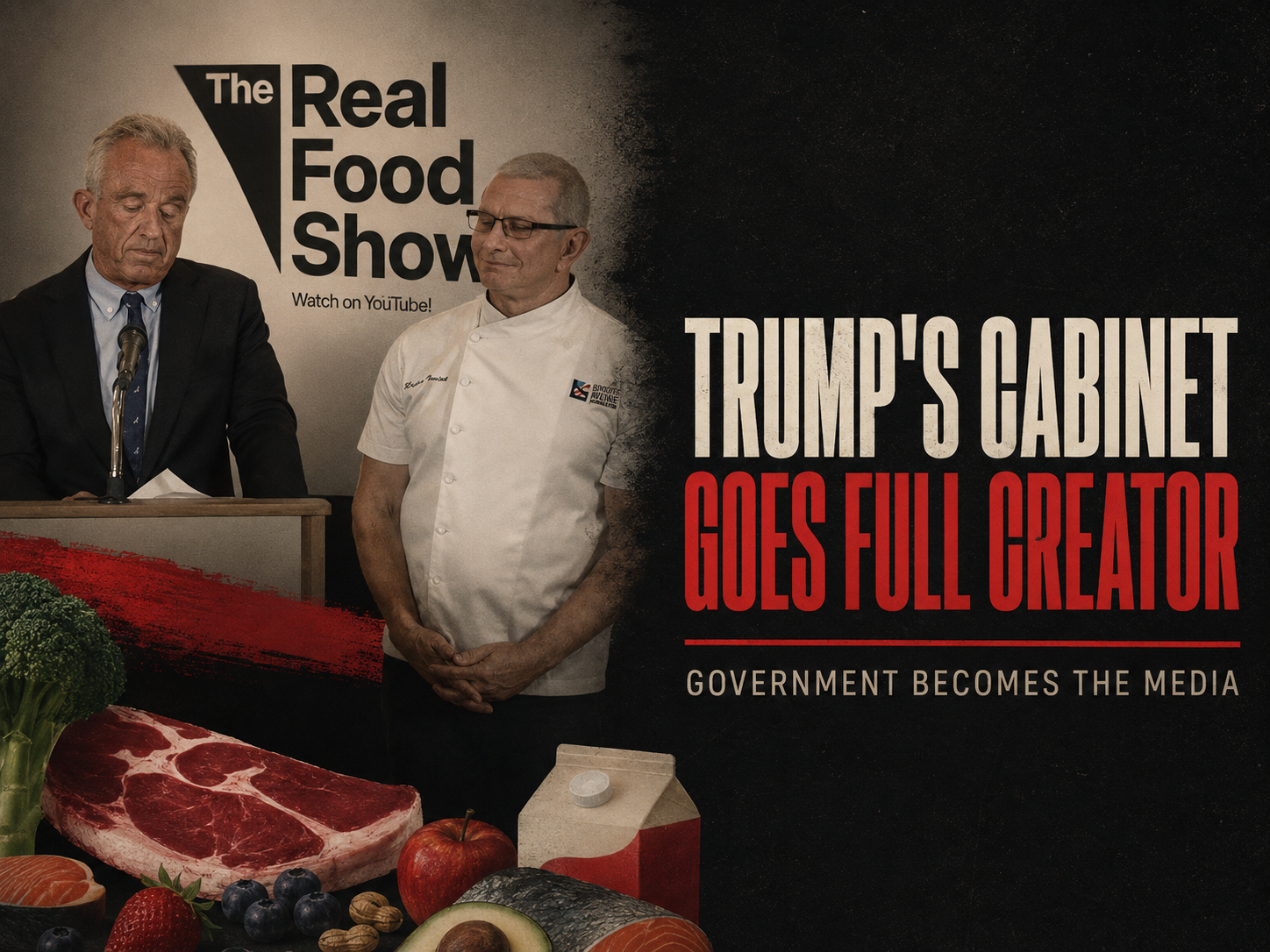
Axios framed the shift in its August 25 piece, “Trump’s Cabinet goes full creator,” as the White House bypassing traditional press relations and placing itself in the role of content creator. Reporters Sara Fischer and Neal Rothschild wrote that by putting themselves at the center of their own messaging, officials sidestep traditional media gatekeepers while matching the president’s communication style.
The starting point was the January 2025 briefing-room overhaul. At her first briefing, White House Press Secretary Karoline Leavitt converted a seat previously used by press office staff into a “new media” seat and said the administration welcomes independent journalists, podcasters and social media influencers (as reported by The Hill, January 2025). More than 10,000 applications followed, and the White House later opened “Podcast Row,” where podcasters record and stream from inside the complex. The White House accounts themselves have leaned into creator-style content, using memes and internet humor to promote mass immigration arrests and the Iran war.
In Nielsen’s Media Distributor Gauge, YouTube took 13.8% of TV watch time in May 2026, leading all distributors for a third straight month. Streaming overall accounted for 48.6% that month.
“Watch on YouTube!” on the podium: Kennedy’s show averages 175,000 views
HHS announced “The Real Food Show” at a July 30 press conference at its headquarters. The podium carried the show logo along with “Watch on YouTube!,” the YouTube icon and the channel handle; the backdrop read “Eat Real Food” over illustrations of produce. Standing beside Kennedy was television chef Robert Irvine, who has volunteered on U.S. Army dining hall reform since the Biden administration and who has called President Trump a great boss (as reported by Tubefilter). Irvine was announced as a guest in an early episode.
The series translates the Dietary Guidelines for Americans, released by HHS in January, and the Make America Healthy Again agenda into video. Each episode has a chef teaching Kennedy a dish, with recipes coming in under $5 per serving where practical. Kennedy told the press conference that fast food is not cheaper, putting such a meal at $12 to $14, and said part of the department’s job is reintroducing Americans to cooking (as reported by USA Today-affiliated outlets). He also cited a figure that “real food” outsold highly processed food by 7% between June 2025 and June 2026.

The July 30 HHS press conference, with “Watch on YouTube!” on the podium. At right, chef Robert Irvine. Image: HHS ‘The Real Food Show’ announcement video
The first episode featured chef Andrew Gruel making salmon cakes with an apple, white bean and greens salad. Gruel is a frequent Fox News guest who was appointed to the Huntington Beach, California city council last year. By Axios’ count the three episodes average more than 175,000 views — not MrBeast territory, but a solid number for an agency channel.
A Bloomberg column on August 6 allowed that celebrity chefs work as messengers on food, but argued the show diverges from what nutrition specialists actually recommend. Columns in The Hill and MS NOW said Kennedy spends little time cooking on camera and that the series sits far from food assistance for low-income households. Tubefilter noted that YouTube’s leading food creators have been reluctant to work with the administration, leaving Fox News regulars to fill the guest slots.
Road Trip’s six episodes landed August 19: seven states, 30 minutes each, 7,500 views apiece
“The Great American Road Trip” follows Duffy, his wife Rachel Campos-Duffy and their nine children through seven states across six episodes of about 30 minutes each. All six went up at once on the Transportation Department’s YouTube channel (@usdotgov) on August 19. The premiere had been planned for June, ahead of the July 4 holiday, and slipped; a department spokesperson told CNN that the country’s 250th anniversary is a year-long observance. The family said filming took place one or two days at a time over seven months.
Episode one, “Where America Began,” stops briefly at the Oval Office before heading to Philadelphia, taking in the Liberty Bell and Independence Hall and ending with a run up the Philadelphia Museum of Art steps. Per Breitbart, Interior Secretary Doug Burgum joins the family in that episode, and interpreters portraying Betsy Ross and Benjamin Franklin appear.

A Benjamin Franklin interpreter in the Philadelphia episode. At lower right, the Transportation Department’s America 250 mark. Image: DOT ‘The Great American Road Trip’
Episode two, “College Dreams and a Homecoming,” is set in Boston, where the family tours Boston College and Harvard for daughter Paloma and the parents voice reservations about Harvard on the basis of their Catholic faith. They also visit the house where Duffy lived during his MTV reality run; Campos-Duffy met him on that show. Episode three, “Winter in the Wild,” covers Wyoming and Montana, with snowmobiles and bison at Yellowstone, a hospital check for a possible appendicitis in the youngest son, and a gender reveal for the eldest daughter and her husband.
Episode four, “By Land, Sea and Sky,” is set in Charleston, where the family visits an aquarium and a coffee shop that employs people with intellectual and developmental disabilities; Duffy’s youngest daughter has Down syndrome. Episode five goes to Texas for the Fort Worth Stockyards and line dancing at Billy Bob’s Texas. The finale, “Family, memories and the road ahead,” covers Arizona, from Route 66 and the Grand Canyon to a Waymo self-driving ride in Phoenix. Axios put per-episode viewership at roughly 7,500.

Average views per episode for the two agency series. Source: Axios, August 25, 2026
A Toyota logo in close-up on the trailer, sponsor sites through the episodes
In the trailer released May 14, per The Wall Street Journal, the family travels in a Toyota and the logo appears in close-up. The trailer also shows skiing, snowmobiling and water slides alongside the Gateway Arch in St. Louis, Fenway Park in Boston and the Golden Gate Bridge. Reporters Andrew Tangel and Sharon Terlep wrote that the series was expected to include a stop at Boeing’s 787 Dreamliner factory in South Carolina; it appears in episode four.
In the finished series the destinations keep lining up with the sponsor list. Per CNN on August 19, Yellowstone Vacations sponsored the third episode. In the fifth Duffy visits a site run by building materials supplier CRH, also a sponsor. The finale was sponsored by the Arizona office of tourism, with a Grand Canyon resort operator among its backers. The Waymo vehicle the family rides in Phoenix falls under the National Highway Traffic Safety Administration, an agency in Duffy’s department.
Each episode opens with a statement that filming, crew, food, fuel, lodging and activity costs were paid by The Great American Road Trip, Inc. and accepted by the department as a gift, and that no taxpayer money went to the participation of Duffy’s family. An on-screen disclosure identifies the entity as an independent nonprofit funded by sponsors, operating under an agreement with the department. The underlying DOT initiative launched in May 2025 with a website featuring 250 destinations, and the 2026 version adds passports travelers can stamp at more than 250 locations.
Sponsorship tiers from $100,000 to $1 million, sold by a Delaware nonprofit
The entity that funded production is a nonprofit registered in Delaware, led by executive director Tori Barnes, a former auto and travel industry lobbyist. Per the Journal, Barnes has been approaching airlines, carmakers and other prospective sponsors since last year. Politico first published the deck laying out partnership levels from $100,000 to $1 million — bronze at $100,000, silver at $250,000, gold at $500,000 and platinum at $1 million.
Citing people with knowledge of the agreements, the Journal reported that Boeing and Toyota each gave $1 million. The nonprofit’s site lists United Airlines, Shell and Comcast alongside them. U.S. Travel Association CEO Geoff Freeman said his group gave a six-figure donation. Per Forbes on July 7, the American Bus Association confirmed a bronze-tier sponsorship and some organizations at that tier said they contributed logistical support in kind. Barnes declined to disclose the show’s budget.
The sponsors are companies the department regulates and has acted against. The Federal Aviation Administration, a DOT unit, has been scrutinizing Boeing after earlier safety and quality lapses and is weighing approval of its new aircraft designs. The department fined United in 2019 over inaccurate information to passengers about compensation for delayed, lost or damaged baggage. Toyota has paid millions in penalties to the National Highway Traffic Safety Administration over emissions violations and its handling of recalls.
CREW asked the inspector general to investigate; senators called it pay for play
Citizens for Responsibility and Ethics in Washington (CREW) requested an investigation on May 11 by the department’s inspector general into possible violations of federal rules on gifts, travel and product promotion, and posted the filing under legal complaints on its site. CREW chief executive Donald Sherman told the Journal that with sponsors paying for the project, the public is left wondering whose interests come first. A spokesman for the inspector general’s office said the complaint was under review.

CREW’s posted complaint against Transportation Secretary Sean Duffy, dated May 11, 2026. Image: CREW website
A department spokeswoman said government ethics officials signed off on the nonprofit arrangement, that the secretary had no role in soliciting sponsorships, and that the department gives no preferential treatment. Barnes likewise said Duffy took no part in fundraising conversations.
The pushback spilled into an exchange with the predecessor’s family. Chasten Glezman Buttigieg, husband of former Transportation Secretary Pete Buttigieg, wrote on X on May 8 that with gas and grocery prices rising the Duffys were boasting about a months-long “taxpayer-funded family road trip.” Rachel Campos-Duffy replied with a post beginning “Stand down, Chas.”
In that reply Campos-Duffy wrote that the nonprofit paid all production costs and that no one in the family, her husband included, was paid — that they did it for free to mark the country’s 250th anniversary and to get Americans off couches and screens to see the country together, filmed in one- and two-day stops over seven months. She added that her husband had done more in a year to change the department and air traffic control than his predecessor did in four, and said she hoped the Buttigiegs would take a trip of their own.

Rachel Campos-Duffy’s reply to Chasten Glezman Buttigieg’s May 8 post. Image: X
The two sides describe the taxpayer question differently. Chasten Buttigieg called it taxpayer-funded; the department said no taxpayer money went into production. What the department did acknowledge covering were Duffy’s flights on legs that overlapped with official visits to air traffic control facilities or port infrastructure assessments. Duffy himself wrote on social media that the “radical, miserable left” had seized on the trailer, defending road trips as a civic and patriotic activity. Pete Buttigieg called the project badly out of step at a time when high gas prices put travel out of reach for many families.
At a Senate budget hearing in May, Sen. Patty Murray said the show was out of step with where Americans are and raised questions about whom the secretary answers to; Sen. Kirsten Gillibrand, pointing to the fact that companies under the department’s oversight paid for it, said it would be “pay for play, it would be 100% illegal” in their own jobs (CNN, August 19).
Corporate money behind administration projects is not confined to this series. The White House solicited company donations for a planned $400 million ballroom, and many companies gave to last year’s inauguration events. The Road Trip nonprofit also explored a car show for the 250th anniversary, with sponsorships letting automakers display vehicles on backdrops and raised platforms, though Barnes said it may not go ahead.
NIH and FDA went with podcasts, where the host acts less as messenger than as interviewer
Agencies that stopped short of video turned to podcasts. NIH Director Jay Bhattacharya hosts “The Director’s Desk,” mostly conversations with researchers about medical progress. Former FDA Commissioner Marty Makary ran “FDA Direct” for roughly a year before resigning on May 12, 2026. Kennedy also hosts an interview show, “The Secretary Kennedy Podcast,” separately from the cooking series. Axios observed that Kennedy and Makary embraced the role of conversationalist, more often drawing out guests than delivering a message of their own.
Earlier administrations ran one-off influencer collaborations and Reddit AMAs. Few sitting officials had ventured into highly produced video series starring themselves, and Axios attributed that to the time and expense involved. Axios also reported on May 9 that potential 2028 candidates are building creator-style media brands.
U.S. digital video ad spend tops $80 billion, passing 60% of all TV and video budgets
The Interactive Advertising Bureau (IAB) projected on May 5 that U.S. digital video ad spending would surpass $80 billion in 2026, up 11% year over year and growing nearly 20% faster than the total ad market. 2026 is the first year digital video exceeds 60% of combined TV and video ad spending. In the same report, social video growth (13%) outpaced connected TV for the first time.
Creator-side numbers point the same way. EMARKETER’s February forecast put U.S. social media creator revenue at $21.10 billion in 2026, more than double the 2022 level. In IAB’s survey, 57% of ad buyers named influencer ads and partnerships their top investment priority for 2026, up from 48% in 2025. EMARKETER also expects 2026 CTV upfront spending ($17.73 billion) to exceed primetime linear upfront spending ($16.98 billion) for the first time.
The Road Trip’s sponsorship structure sits inside that shift. Boeing, Toyota, Comcast and United Airlines put money into the production entity rather than buying time from a media company, and the exposure happens inside the program — from the logo close-up in the trailer to the sponsor sites visited episode by episode. Instead of a broadcaster making the program and advertisers buying around it, advertisers funded production and YouTube handled distribution. That directness is what drew the hearing and the complaint.
Korean broadcast ad spend estimated at KRW 2.77 trillion, a third of online
In the 2025 Broadcasting and Telecommunications Advertising Expenditure Survey released on January 8 by the Korea Communications and Media Commission (방송미디어통신위원회) and KOBACO (한국방송광고진흥공사), Korea’s combined broadcast and telecommunications ad spending for 2024 came to KRW 17.13 trillion (about $12.2 billion), up 3.5%. Online took KRW 10.10 trillion (about $7.2 billion), or 59.0%, while broadcast fell 5.0% to KRW 3.22 trillion (about $2.3 billion), an 18.8% share. Terrestrial broadcasters (TV, radio and DMB) dropped 7.2% to KRW 1.23 trillion (about $880 million).

Korean broadcast ad spending, 2022–2025. The 2025 figure is an estimate. Source: Korea Communications and Media Commission and KOBACO, 2025 survey
The 2025 estimate is KRW 2.77 trillion (about $2.0 billion), a 13.8% decline — the first year broadcast falls below KRW 3 trillion, taking a 16.1% share. Terrestrial is estimated at KRW 1.05 trillion (about $750 million). In the same survey, advertisers named targeting accuracy as their main reason for buying OTT ads, at 53.4%.
A Korean ministry or public agency attempting the same project would have to go through budget appropriation or an open tender rather than selling sponsorship tiers. The Act on Collection and Use of Donations (기부금품의 모집 및 사용에 관한 법률) bars state agencies and their officials from soliciting donations as a general rule, and the Improper Solicitation and Graft Act (청탁금지법) and the Code of Conduct for Public Officials (공무원 행동강령) restrict accepting sponsorship from companies with business before the agency. That is where the U.S. hearing and complaint arose as well. Public-sector commissioning opens a new category for production companies and agencies, but a proposal built on U.S.-style sponsor financing will not clear review in Korea as written.
Broadcast’s share of government advertising: KRW 322.5 billion, with unit prices down 34%
Mediaus (미디어스) tallied the Korea Press Foundation (한국언론진흥재단) government advertising records and found broadcast placements falling from KRW 338.8 billion across 10,671 buys in 2023 to KRW 322.55 billion across 15,506 buys in 2024.
Spending dropped 4.8% while the number of buys rose 45.3%, taking the average buy from KRW 31.75 million to KRW 20.8 million, a 34% decline. Against 2024 broadcast ad spending of KRW 3.22 trillion, government advertising accounts for roughly 10%.
Total government advertising grew 34.9%, from KRW 971.2 billion in 2019 to KRW 1.31 trillion in 2023, or 7.7% of the whole ad market (Media Today (미디어오늘), February 2025, citing figures obtained from the foundation by Rep. Kang Yu-jung (강유정)). Over the same period online took close to 60% of the general ad market but only 26.9% of government advertising. Korean public budgets still sit with newspapers and broadcasters.
A U.S.-style shift would change what that KRW 322.5 billion is. Today it is media spending a broadcaster collects repeatedly at rate-card prices; under a commissioning model it becomes a one-time production fee at cost plus margin. When distribution ends at YouTube, as with the Road Trip, no media revenue reaches a broadcaster at all.
Whole episodes built around sponsor sites would hit Korea’s product placement rules
Article 59-3 of the Enforcement Decree of the Broadcasting Act limits product placement to entertainment and cultural programming and bars it from programs aimed at children and from news, current affairs, commentary and debate. The same provision states that placement must not affect a program’s content or composition or compromise editorial independence, and that the program must not mention the product or urge viewers to buy or use it.
Episode four of the Road Trip is built in part around a visit to sponsor Boeing’s 787 plant, with the secretary speaking on camera about U.S. manufacturing. Episode three is set in a sponsor’s territory, episode five visits a site run by sponsor CRH, and the finale tours the region covered by sponsor Arizona’s tourism office. As a Korean broadcast program, that is placement affecting content and composition. Distributed only on YouTube, it falls outside the rule.
That is the dividing line for a broadcaster taking agency production work. Made for YouTube only, it sits outside both the sponsorship disclosure rules and the placement provisions; put the same content on the schedule and both apply. The contract needs to name the distribution channel, state whether each rule set applies, define how far a re-edited version may be scheduled, and settle rights allocation and performer reuse terms.
Citing the material raises a separate problem. The U.S. series discloses who paid for production and that the department accepted it as a gift, in the opening frames of every episode. Video distributed by Korean ministries carries no such notice. Whether to caption the source, whether to state the funding and sponsorship alongside it, and how much footage to run are decisions that sit with the desk.
View-count targets written into a commissioning contract carry the same risk. Per-episode viewership between the two series differs more than twentyfold. Kennedy came in with an online following from his 2024 presidential run and an existing podcast audience; the Road Trip put all six episodes up on one day. Without host recognition and an existing subscriber base, a view-count target produces results like 7,500.
Sources
· The Wall Street Journal (May 14, 2026), “Boeing, Toyota Donated $1 Million Each to Transportation Secretary’s Road-Trip Show” — Andrew Tangel, Sharon Terlep https://www.wsj.com/business/boeing-toyota-donated-1-million-each-to-transportation-secretarys-road-trip-show-bccbe412
· Axios (Aug. 25, 2026), “Trump’s Cabinet goes full creator” — Sara Fischer, Neal Rothschild https://www.axios.com/2026/08/25/rfk-jr-sean-duffy-youtube-podcast-creator
· CNN (Aug. 19, 2026), premiere, episode breakdown and Senate hearing — Alexandra Skores https://www.cnn.com/2026/08/19/us/duffy-reality-show-premiers
· Breitbart (Aug. 19, 2026), Philadelphia episode and the DOT America 250 initiative https://www.breitbart.com/america250/2026/08/19/dot-sec-sean-duffy-hits-road-family-great-american-road-trip-series/
· IAB (May 5, 2026), “U.S. Digital Video Ad Spend to Surpass $80B in 2026” https://www.iab.com/news/u-s-digital-video-ad-spend-to-surpass-80b-in-2026/
· EMARKETER, U.S. creator revenue and CTV upfront forecasts (Feb.–May 2026) https://www.emarketer.com/content/digital-video-forecast-trends-q2-2026
· Korea Communications and Media Commission and KOBACO (Jan. 8, 2026), 2025 ad expenditure survey https://www.kobaco.co.kr/site/adstat/content/broadcastprice_stat
· Journalists Association of Korea (Jan. 8, 2026), coverage of the survey https://www.journalist.or.kr/news/article.html?no=60072
· PD Journal (Jan. 12, 2026), coverage of the broadcast ad share falling below 20% https://www.pdjournal.com/news/articleView.html?idxno=81096
· CREW (May 11, 2026), complaint against Transportation Secretary Sean Duffy — inspector general referral https://www.citizensforethics.org/legal-action/legal-complaints/crew-files-complaint-against-transportation-secretary-sean-duffy/
· HHS, “The Real Food Show” official page https://www.hhs.gov/real-food-show/index.html
· Bloomberg (Aug. 6, 2026), “RFK Jr. Cooking Show Misses Mark With Actual Food Experts” https://www.bloomberg.com/news/articles/2026-08-06/rfk-jr-cooking-show-misses-mark-with-actual-food-experts
· Tubefilter (July 31, 2026), analysis of food-creator partnerships https://www.tubefilter.com/2026/07/31/robert-f-kennedy-jr-health-human-services-real-food-show/
· The Hill, launch coverage and opinion columns https://thehill.com/policy/healthcare/5999541-kennedy-hhs-real-food-show-dietary-guidelines/
· NPR (May 12, 2026), sponsor conflict-of-interest reporting https://www.npr.org/2026/05/12/nx-s1-5818190/sean-duffy-road-trip-reality-show-sponsors
· Forbes (July 7, 2026), sponsorship tiers and in-kind contributions https://www.forbes.com/sites/suzannerowankelleher/2026/07/07/sean-duffys-controversial-road-trip-series-has-yet-to-launch-heres-why-sponsors-may-not-care/
· Mediaus (July 7, 2025), analysis of 2024 government advertising placements https://www.mediaus.co.kr/news/articleView.html?idxno=313714
· Media Today (Feb. 13, 2025), government advertising passing KRW 1 trillion and media mix https://www.mediatoday.co.kr/news/articleView.html?idxno=324252
· Enforcement Decree of the Broadcasting Act, Article 59-3 (product placement) https://www.law.go.kr/
· Rachel Campos-Duffy, post on X (May 2026), response on production costs and unpaid participation https://x.com/RCamposDuffy/status/2052848788402782423
· Nielsen (July 28, 2026), The Gauge and Media Distributor Gauge for May 2026 https://www.nielsen.com/news-center/2026/streaming-embarks-on-annual-summer-ascent-in-nielsens-may-2026-gauge-reports/
Quotation policy: quotation marks indicate remarks as reported by the named outlet; unquoted passages summarize reporting. Material confirmed through a second outlet is identified as such.
This is the English edition of a Korean-language article. Currency conversions use an approximate rate of USD 1 = KRW 1,400.