

K-ENTERTECH HUB ANALYSIS
Streaming renewals fell to 75 titles as K-drama suppliers faced a market with fewer openings for first seasons
The U.S. television business is ordering fewer new shows and keeping a larger share of proven titles. The September report by Luminate Intelligence media analyst Tyler Aquilina put the 2025 scripted renewal rate at 75% for broadcast networks, 68% for cable and 49% across the eight largest subscription streaming services. Broadcast and cable lifted their renewal rates after cutting new scripted launches. Streaming stayed near 50%, but fewer titles entered the pool and the number renewed declined.[1, p. 5][2]
The shift matters to Korean producers. South Korea remained the largest overseas supplier to U.S. subscription streamers in 2025, delivering more than 40 titles, while Korea's own drama output continued to fall. U.S. renewal rates and Korea's season-based commissions are not directly comparable. Both markets, however, are placing more weight on completion, cost and the economics of another season than on the volume of new titles alone.[6][10]
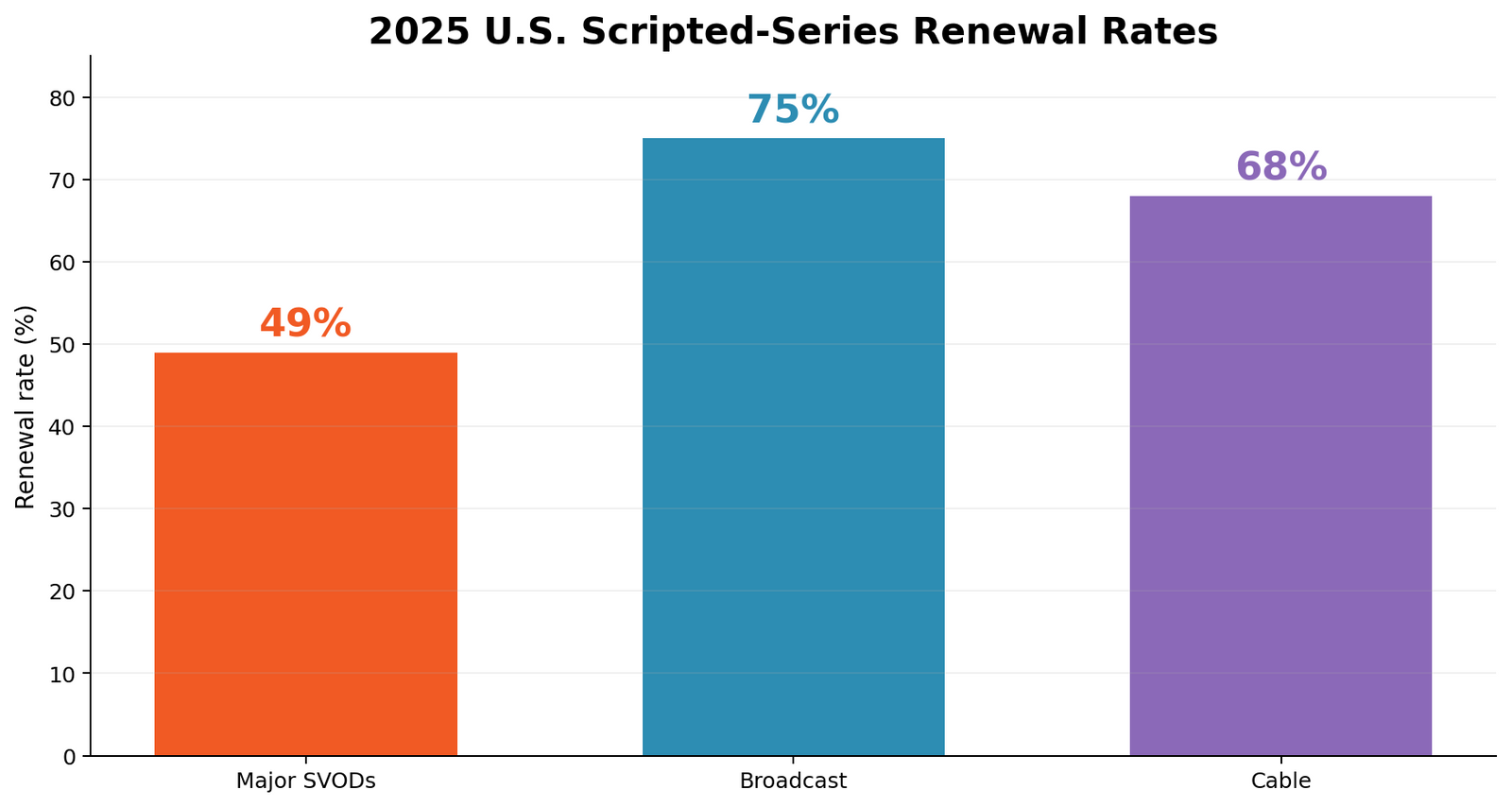
2025 U.S. scripted-series renewal rates. Streaming covers the eight largest SVOD services and excludes children’s programming. Source: Luminate. Graphic: K-EnterTech Hub.
A stable streaming rate concealed fewer renewals
Scripted renewal rates for the major streamers were 48% in 2022, 50% in 2023, 47% in 2024 and 49% in 2025. The narrow range suggests stability, but gross renewals fell from 98 titles to 75. Dividing renewals by the reported rate implies that the measured slate contracted from roughly 204 titles to 153. The rate barely moved while the number of shows reaching another season fell about 24%.[1, p. 5]
The reset accelerated after the 2023 Writers Guild of America and SAG-AFTRA strikes. Luminate found that cancellations surged for shows released in 2023 as studios and platforms used the production shutdown to review their slates. HBO Max was the exception because Warner Bros. Discovery had begun cutting originals in 2022.[7]
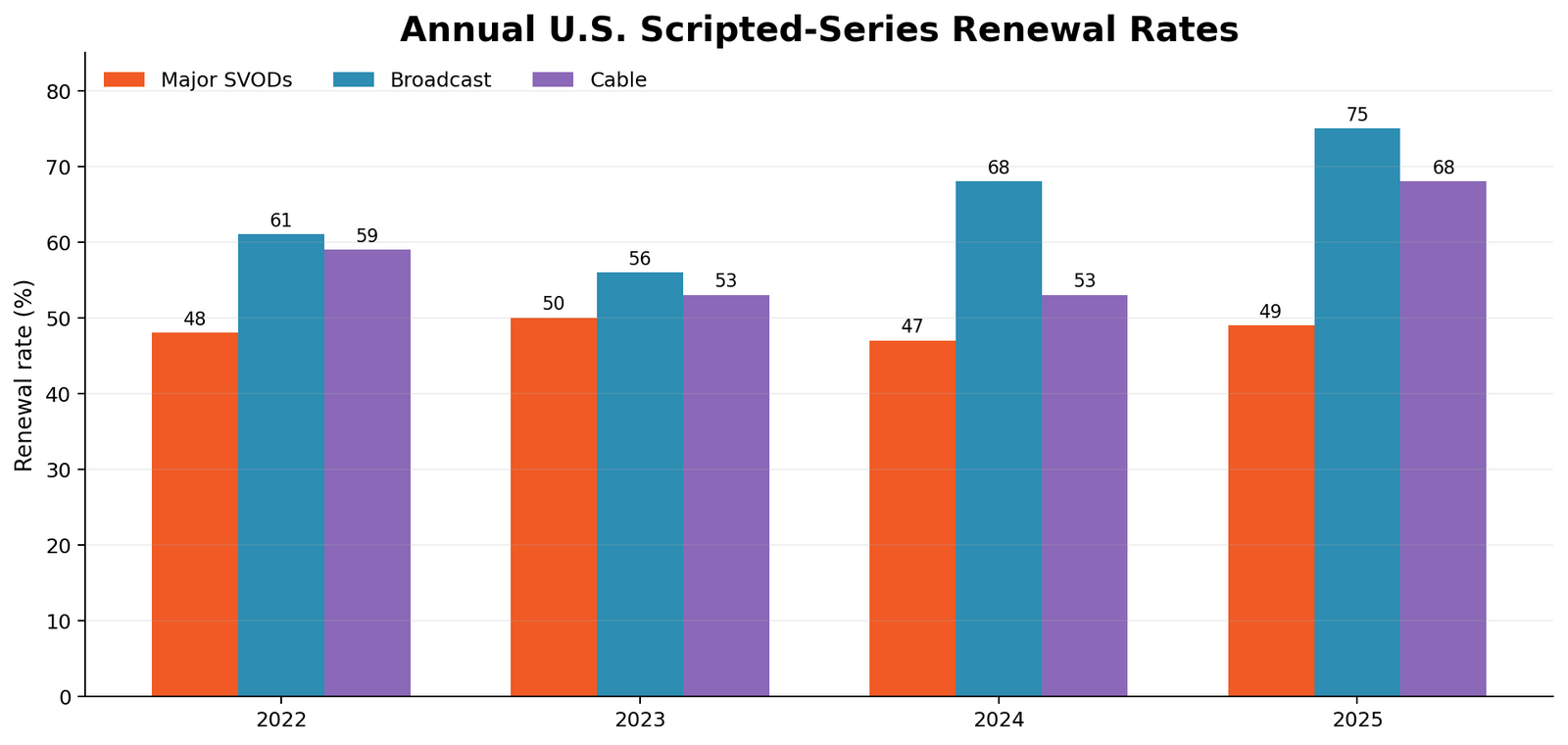
Annual U.S. scripted-series renewal rates by platform. Source: Luminate.
Overall supply moved in the same direction. The number of TV series released in the United States fell from 1,695 in 2022 to 1,122 in 2025, a decline of about 34%. Netflix released 133 series in 2025, Prime Video 59, Peacock 31, Paramount+ 26, HBO Max 16 and Disney+ 14. Prime Video and Disney+ increased output from 2024; Netflix, HBO Max, Paramount+ and Peacock reduced it. These totals combine scripted and unscripted series and therefore use a broader scope than the renewal-rate chart.[5]
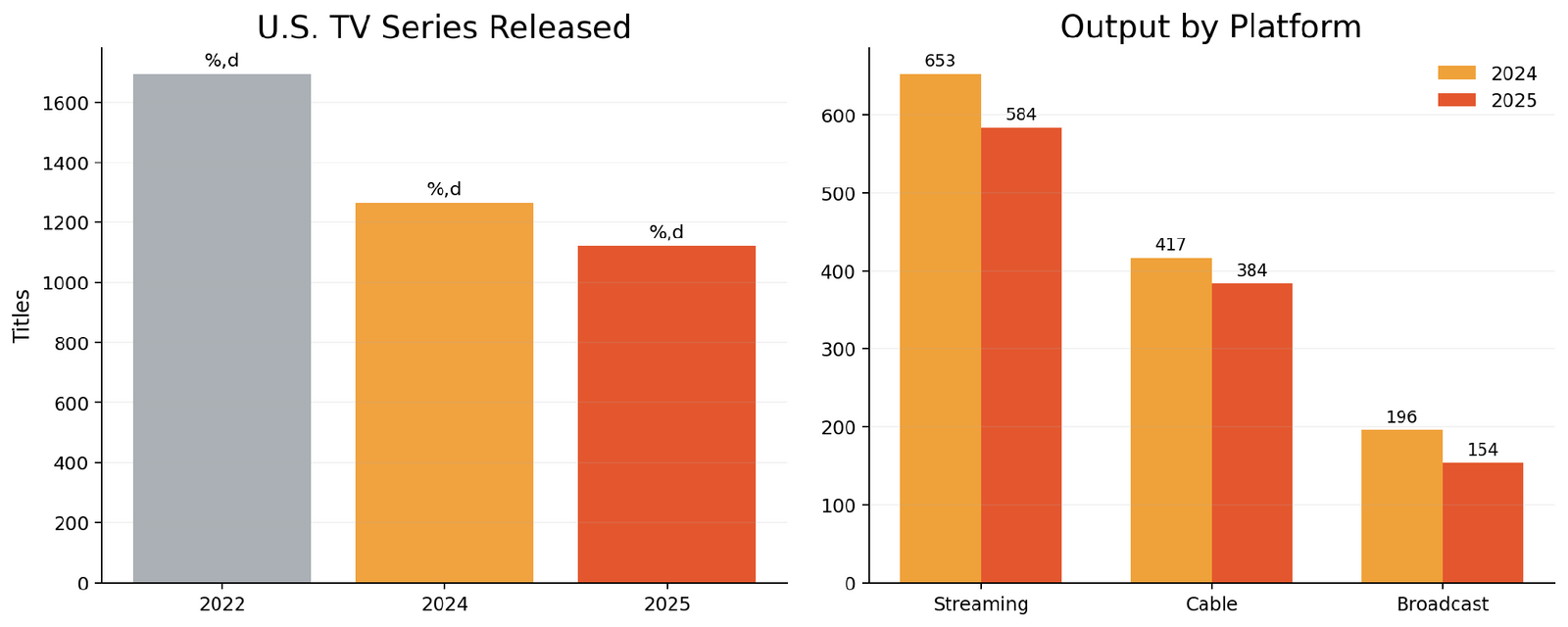
U.S. TV series released annually and 2025 output by platform. Live sports and news are excluded. Source: Luminate year-end data, as reported by The Hollywood Reporter.
Broadcast schedules force earlier decisions
Broadcast's scripted renewal rate fell from 61% in 2022 to 56% in 2023, then rose to 68% in 2024 and 75% in 2025. Cable held at 53% in 2023 and 2024 before reaching 68% in 2025. Compared with 2022, new scripted launches were down 30% on broadcast, 37% on cable and 25% on streaming. The higher broadcast and cable renewal rates are therefore better read as the consequence of fewer new orders than as a broad production recovery.[1][2]
The calendar also matters. Broadcast networks must settle their fall schedules before the May upfront presentations to advertisers. They work with fixed time slots, defined budget ranges and comparatively straightforward ratings. Streaming services have no equivalent deadline. Netflix titles such as The Politician and No Good Deed have remained in limbo without a formal renewal or cancellation.[2][3]
When unscripted programs are included, 2025 renewal rates fall to 65% on broadcast, 45% on cable and 44% on streaming. Those figures are 10, 23 and 5 percentage points below the corresponding scripted rates. The widely cited comparison of 65% for broadcast and 44% for streaming covers all series; for scripted titles alone, the comparison is 75% versus 49%.[1][2]
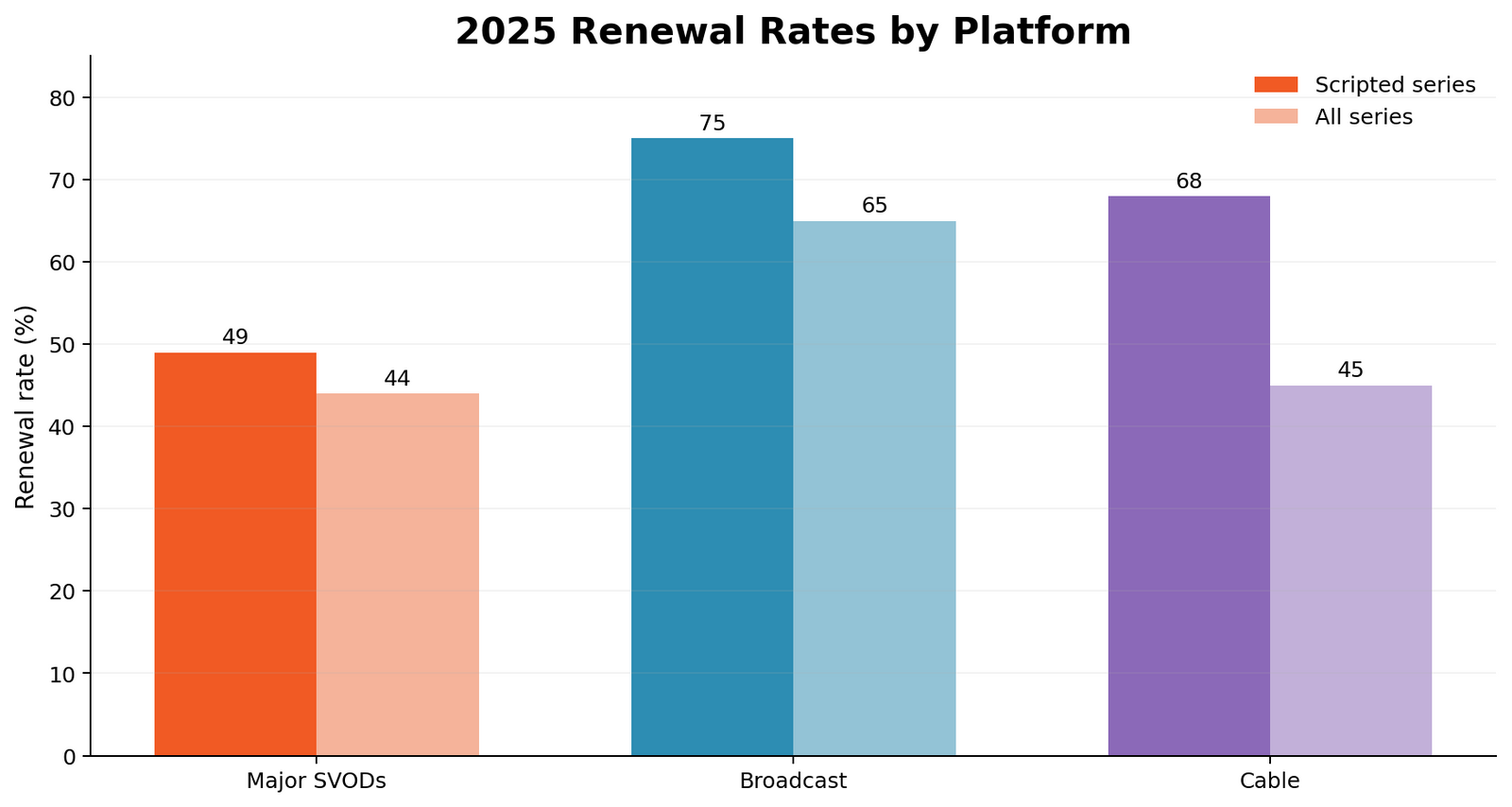
2025 renewal rates by platform. Dark bars show scripted series; light bars show all series. Source: Luminate.
Retention alone does not secure another season
Streamers closely watch retention, the share of premiere viewers who reach the finale. Luminate described 50% or more over the first 12 weeks as ideal. In its sample of freshman shows released from 2024 through the first half of 2026, only 25% of canceled series cleared that line. Marvel's Wonder Man on Disney+ posted 52%, and Netflix's The Waterfront reached 62%, yet both were canceled. The Waterfront creator Kevin Williamson later said the series did not reach the required threshold quickly enough.[1, pp. 17-18][2][3]
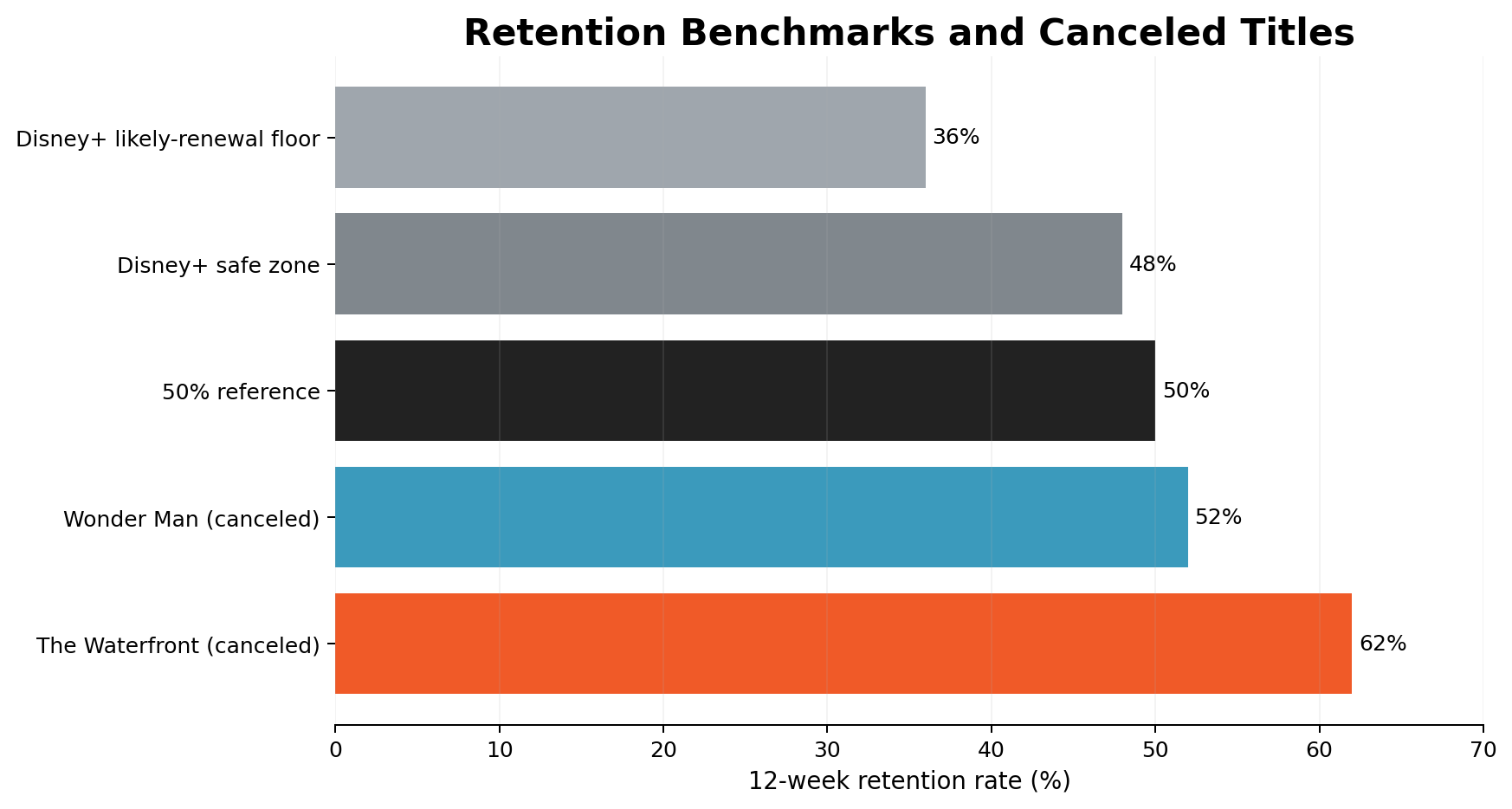
Twelve-week audience retention for two canceled series, alongside Luminate benchmarks. Sources: Luminate and The A.V. Club.
Luminate media analyst Tyler Aquilina estimated Wonder Man at $7 million to $10 million per episode (about KRW 9.68 billion to KRW 13.83 billion), or $56 million to $80 million for the season (about KRW 77.46 billion to KRW 110.66 billion). Assuming a $70 million budget (about KRW 96.83 billion), its cost-per-minute-streamed ratio over 12 weeks was 0.041. The Mandalorian Season 3, estimated at $140 million (about KRW 193.66 billion), posted 0.018. Aquilina's analysis pointed to soft viewing relative to cost, rather than an unusually high budget by itself.[4]
The threshold is not fixed. Luminate's report estimated Disney+'s likely-renewal floor at 36%, its safe zone at 48% and its danger zone at 42%. Netflix's corresponding figures were 40%, 52% and 46%; Paramount+'s were 44%, 55% and 45%. The report explicitly cautioned that these were not absolutes. Aquilina's separate August analysis said a new Disney+ series generally needed at least 53% to be considered safe from cancellation. Release timing, genre, viewing velocity and cost all affect the decision. Luminate also estimates that the share of series costing more than $10 million per episode (about KRW 13.83 billion) rose 7% over five years, while sub-$5 million shows (about KRW 6.92 billion) fell below two-thirds of U.S. scripted releases in 2025.[1, p. 19][3][8]
Korea led foreign supply as first-season space narrowed
South Korea supplied more than 40 titles to U.S. subscription streamers in 2025, leading a group that also included Germany, Argentina, Mexico, Japan, Spain, France, India and the United Kingdom. Korean supply nevertheless declined from 2024. Argentina was the only country in the group to increase its total.[6]
About 42% of scripted titles released by the major U.S. streamers in 2025 were first seasons; returning seasons accounted for 58%. Korean dramas have traditionally been sold as complete, single-season packages, leaving many suppliers to compete repeatedly for first-season slots. As those slots tighten, global buyers have more reason to examine 12-week retention, completion velocity, per-episode cost and sequel rights alongside initial demand.[1][2]
Rights structure can decide whether a show continues. Luminate noted that ownership removes license fees and profit-sharing obligations for distributors. In 2025, the share of releases owned by the platform was 89% at Prime Video, 83% at Disney+, 65% at Hulu and 57% at Paramount+, but only 15% at Netflix. Third-party licensing can spread production risk, yet renewal talks may fail over fees and rights after a title succeeds. For Korean suppliers, IP ownership and sequel options therefore matter alongside audience performance.[1, p. 29]
Korean drama output fell about 43% in three years
The Korea Drama Production Association counted 141 dramas released by broadcasters and streaming services in 2022, 123 in 2023 and roughly 100 in 2024. It projected only about 80 for 2025, a three-year decline of roughly 43%. In a 2025 statement, the association said fees for some lead actors had reached $723,000 per episode (KRW 1 billion).[10]
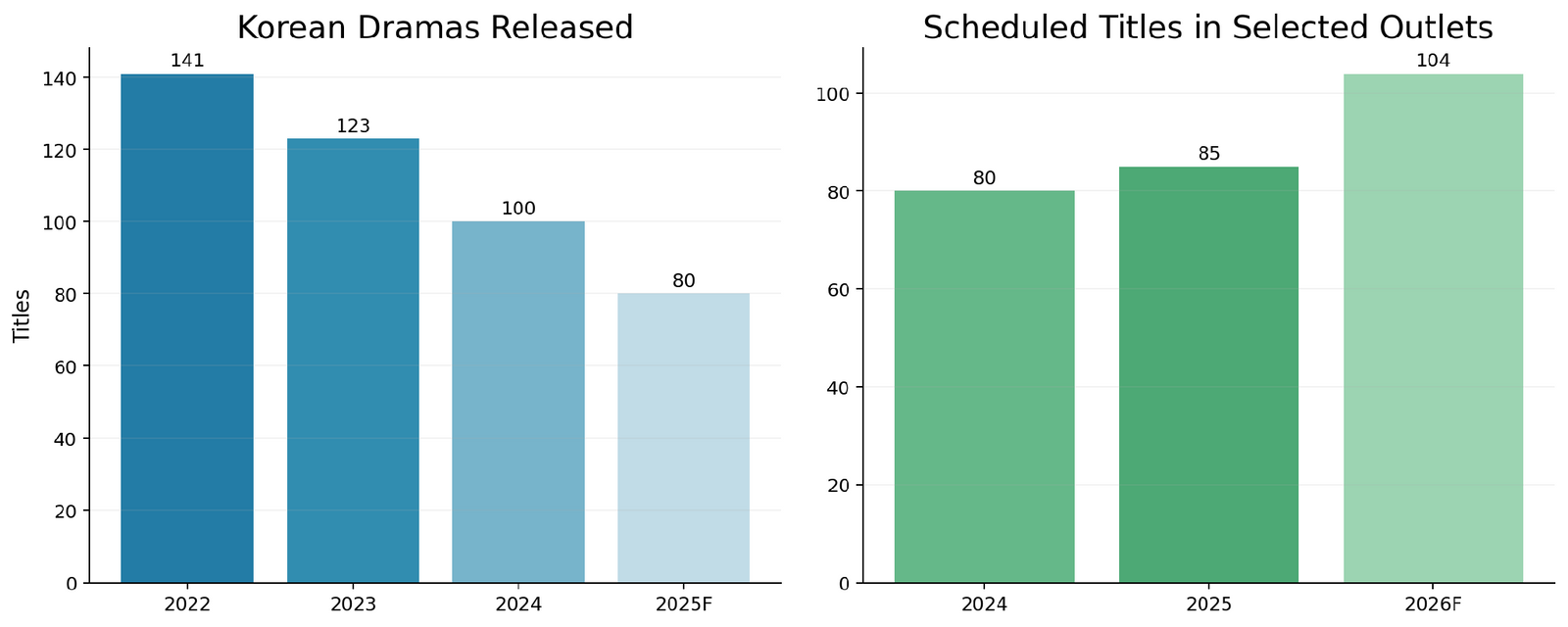
Korean drama releases and scheduled titles. The association and Daishin Securities use different coverage and should not be read as one continuous series. Sources: Korea Drama Production Association and Daishin Securities, via secondary reporting.
Broadcaster funding moved in the opposite direction from costs. Combined July advertising sales at Korea's terrestrial networks fell from $90.58 million (KRW 125.3 billion) in 2016 to $39.04 million (KRW 54 billion) in 2026. First-half 2026 terrestrial advertising totaled $224.40 million (KRW 310.4 billion). Over the same decade, average production cost for a miniseries episode rose from $434,000-$578,000 (KRW 600 million-KRW 800 million) to $1.084 million (KRW 1.5 billion). An MBC official told Star News that July ad sales were down 10% from a year earlier.[9]
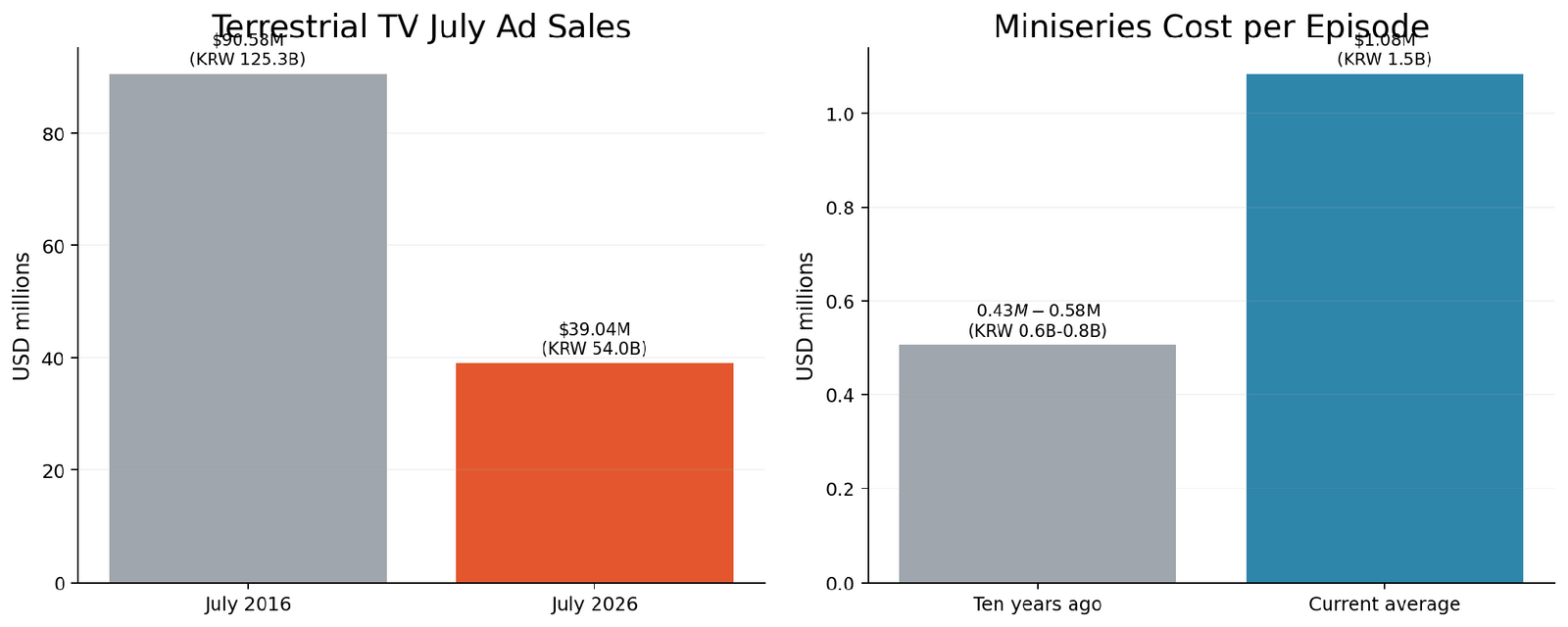
July terrestrial-TV advertising sales and average miniseries cost per episode. Source: Star News, including an MBC official’s comment.
Large streaming originals have pushed the upper end higher. Disney+'s Tempest was reported at about $50.60 million (KRW 70 billion), while Netflix's When Life Gives You Tangerines was estimated at $36.15 million (KRW 50 billion). Broadcast producers say compensation levels established by streaming productions also influence negotiations for network dramas. When advertising declines but talent and production costs rise, commissioning a proven property becomes easier to defend than starting from zero.[11]
Returning properties account for much of the 2026 rebound
Daishin Securities counted 80 Korean titles and 1,007 episodes in 2024 across CJ ENM, JTBC, the three terrestrial networks, ENA, Netflix and Disney+ originals. It put 2025 at 85 titles and 1,059 episodes and projected 104 titles and 1,358 episodes for 2026. Its coverage differs from the production association's data, so the two series should not be joined directly.[12]
Returning shows account for a meaningful share of the increase. SBS's Taxi Driver 3 exceeded a 14% rating, while Good Partner and Flex X Cop secured second seasons. TVING scheduled a third season of Yumi's Cells. Reusing audience-tested intellectual property lowers some of the uncertainty created by rising costs and shrinking broadcast advertising.[13]
Netflix's announced 2026 Korean slate contained 29 originals, including eight returning seasons or sequels. Six were unscripted programs. Bloodhounds Season 2 was the only returning scripted series, and Mission: Cross 2 was a film sequel. Korea's season-based commissioning is expanding, but Netflix's slate shows that much of the repeat business remains concentrated in unscripted formats with shorter cycles and lower cost exposure.[14]
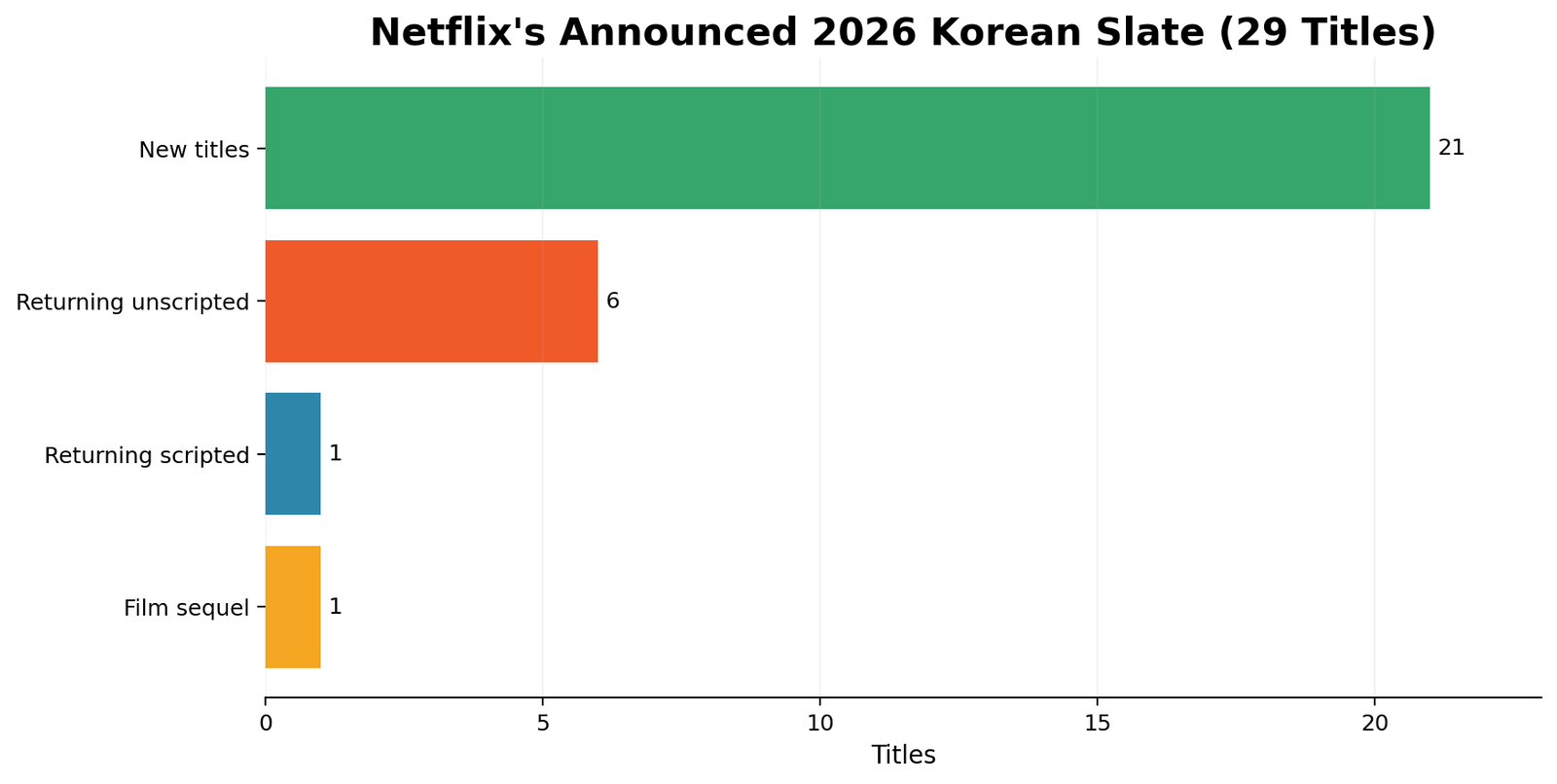
Composition of Netflix’s 29 announced Korean originals for 2026. K-EnterTech Hub classified the published slate. Source: Netflix Newsroom.
K drama needs comparable performance data
The U.S. streaming renewal rate of 49% cannot be set against Korea's returning-season count as if they measured the same thing. Luminate measures the share of released titles approved for another season. Korea's public figures cover releases or commissions under varying definitions. The commercial questions are nonetheless converging: how quickly viewers complete a season, how much viewing the budget produces, and who controls the rights to continue it.
Korea has no public, platform-level renewal series or comparable 12-week retention data by title. Streamers do not disclose completion rates or cost-adjusted performance, and broadcasters rarely explain the metrics behind a second-season decision. As repeat seasons become more common, producers will need to negotiate access to retention data, season-by-season cost terms, IP ownership and license duration together. Reduced U.S. commissioning does not close the market to Korean titles, but shipment volume alone is no longer an adequate measure of success.
Sources and editorial notes
Currency conversions use the Sept. 18, 2026 Seoul daytime-market close of KRW 1,383.3 per U.S. dollar. Every monetary figure is shown as U.S. dollars followed by Korean won. Quotation marks are reserved for directly reported remarks; other source material is paraphrased. K-EnterTech Hub calculated the estimated streaming title counts and percentage declines from the published renewal totals and rates.
1. Luminate Intelligence. Tyler Aquilina, The Show Must Go Off: The Data Behind Renewals and Cancellations in a Post-Peak TV Landscape, September 2026. https://docsend.com/view/durjkgdwmm46x3i7
2. Deadline. Wonder Man Had 52% Audience Retention Yet Was Canceled As Broadcast TV Sees Higher Renewal Rates Than Streaming — Report, Sept. 18, 2026. https://deadline.com/2026/09/wonder-man-most-watched-canceled-series-streaming-broadcast-1237107820/
3. The A.V. Club. Matt Schimkowitz, Wonder Man's strong retention rates weren't enough to save it, Sept. 18, 2026. https://www.avclub.com/wonder-man-retention-rates-luminate-study
4. Luminate. Tyler Aquilina, Why Did Disney 'Un-Renew' Wonder Man? Data Offers Clues, Aug. 21, 2026. https://luminatedata.com/blog/why-did-disney-un-renew-wonder-man-data-offers-clues/
5. The Hollywood Reporter. Past the Peak: TV Series Count Declines for Third Straight Year in 2025, Jan. 21, 2026. https://www.hollywoodreporter.com/tv/tv-news/no-more-peak-tv-series-total-falls-2025-1236479596/
6. Indian Television. Luminate research reveals TV show production in 2025 shrank by a third since 2022 peak, Jan. 26, 2026. https://indiantelevision.com/news-headline/luminate-research-reveals-tv-show-production-in-2025-shrank-by-a-third-since-2022-peak/
7. Luminate. How Streaming Series Cancellations Have Changed Post-Peak TV, Oct. 10, 2025. https://luminatedata.com/blog/how-streaming-series-cancellations-have-changed-post-peak-tv/
8. Luminate. The Data Behind L.A.'s Lagging TV Production, May 22, 2026. https://luminatedata.com/blog/the-data-behind-l-a-s-lagging-tv-production/
9. Star News. 한해선, 방송국 적자 시대 천정부지 제작비 AI가 해결할 수 있을까, Sept. 1, 2026. https://www.starnewskorea.com/broadcast-drama/2026/09/01/2026082811564764325
10. Korea Credit News. 배우 출연료 회당 10억 시대 제작비 부담에 드라마 141편에서 80편 급감, July 9, 2025. https://www.creditnews.kr/news/articleView.html?idxno=1222
11. Invest Chosun. 북극성 700억 폭싹 500억 제작비 치솟지만 흔들리는 K드라마 경쟁력, Sept. 16, 2025. https://www.investchosun.com/site/data/html_dir/2025/09/16/2025091680205.html
12. Daishin Securities. 2026 Media Industry Outlook, Dec. 26, 2025, cited via secondary source. http://umi.re.kr/board/board_view?code=review&no=67534
13. Newsen. 황지민, 엔딩 대신 다음을 택한 K드라마 시즌제가 점령한 안방극장, Apr. 1, 2026. https://v.daum.net/v/9uG84IRfdq
14. Netflix Newsroom. 2026 Netflix Korea and global slate, Jan. 21, 2026. https://about.netflix.com/ko/news/next-on-netflix-korea-2026
15. Money Today. 원달러 환율 1.1원 오른 1383.3원, Sept. 18, 2026. https://www.mt.co.kr/economy/2026/09/18/2026091815365178159