
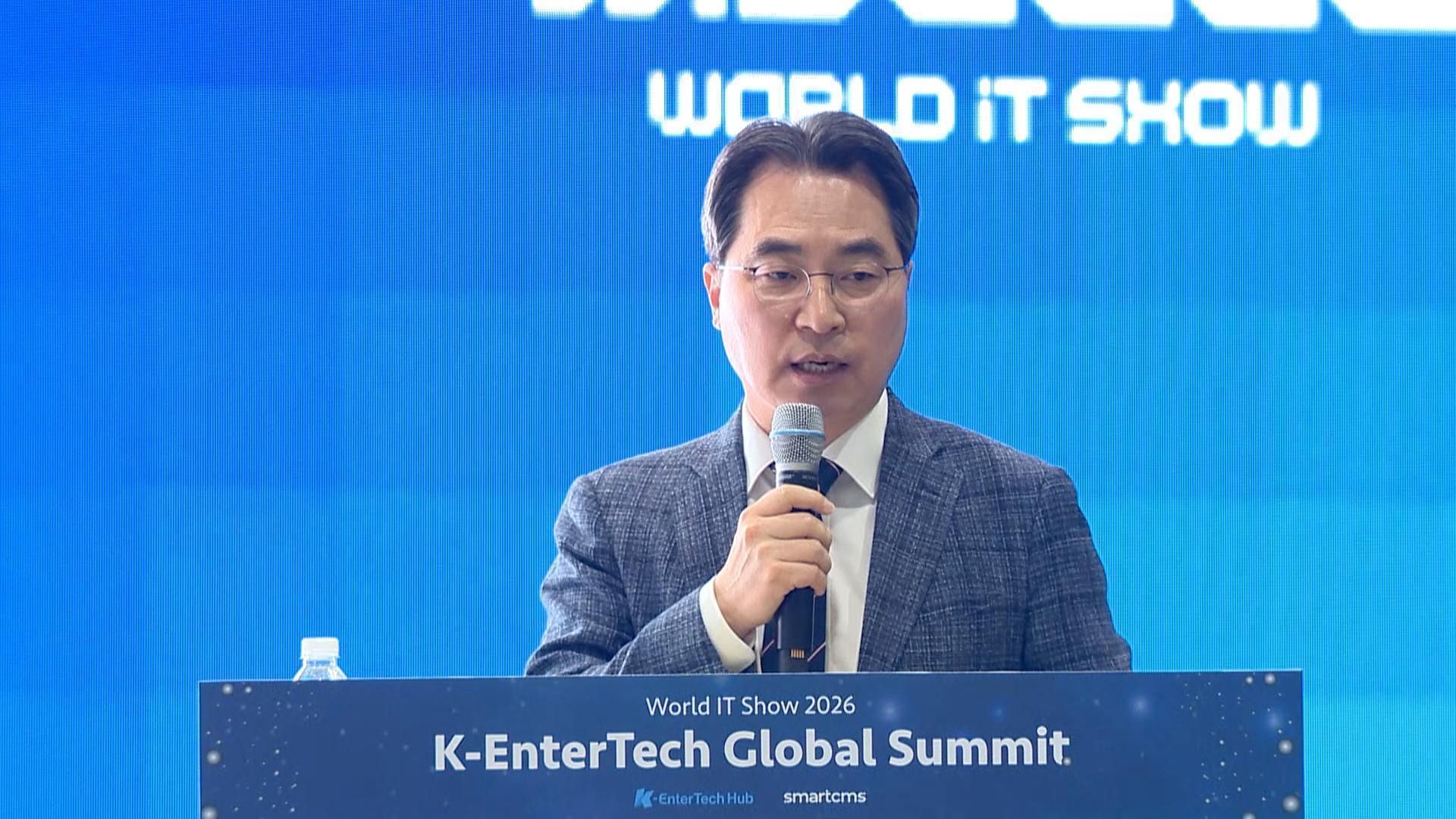
FEATURE | K-EnterTech Global Summit 2026 · Keynote by Prof. Ko Sam-seog (Dongguk University)
Korea Completes the EGOT, but Hallyu's Next 30 Years Hinge on "Co-Evolution" with AI
Prof. Ko Sam-seog: K-content revenue hits 157 trillion won and USD 14.18 billion in exports; Korea ranks #1 worldwide for SVOD local originals — yet negative perception agreement rises from 30.7% to 37.5% in five years and "#SEAbling" boycotts emerge across Southeast Asia. The first real-world test of the co-evolution model launches in September with K-Channel 82 on Sinclair's ATSC 3.0 network.
The next thirty years of K-Culture will be decided by "co-evolution" with AI, not by another round of quantitative expansion. With the 2025 Tony Award for the musical Maybe Happy Ending (Eojjeomyeon Haepiending), Korea joined the very short list of nations holding all four major U.S. entertainment honors — Emmy (Squid Game, 2022), Grammy (soprano Sumi Jo, 1993), Oscar (Parasite, 2020) and Tony (2025).
 Jung Han
According to Korea's Ministry of Culture, Sports and Tourism, content industry revenue reached 157.4 trillion won in 2025, and exports hit USD 14.18 billion, after a decade in which exports compounded at 10.2% a year in dollar terms. Yet the era of pure volume growth is closing. Generative AI now operates across the full content value chain — planning, production, post-production, marketing and consumption — and competition is moving from "how much we export" to "which technology we combine with, and how."
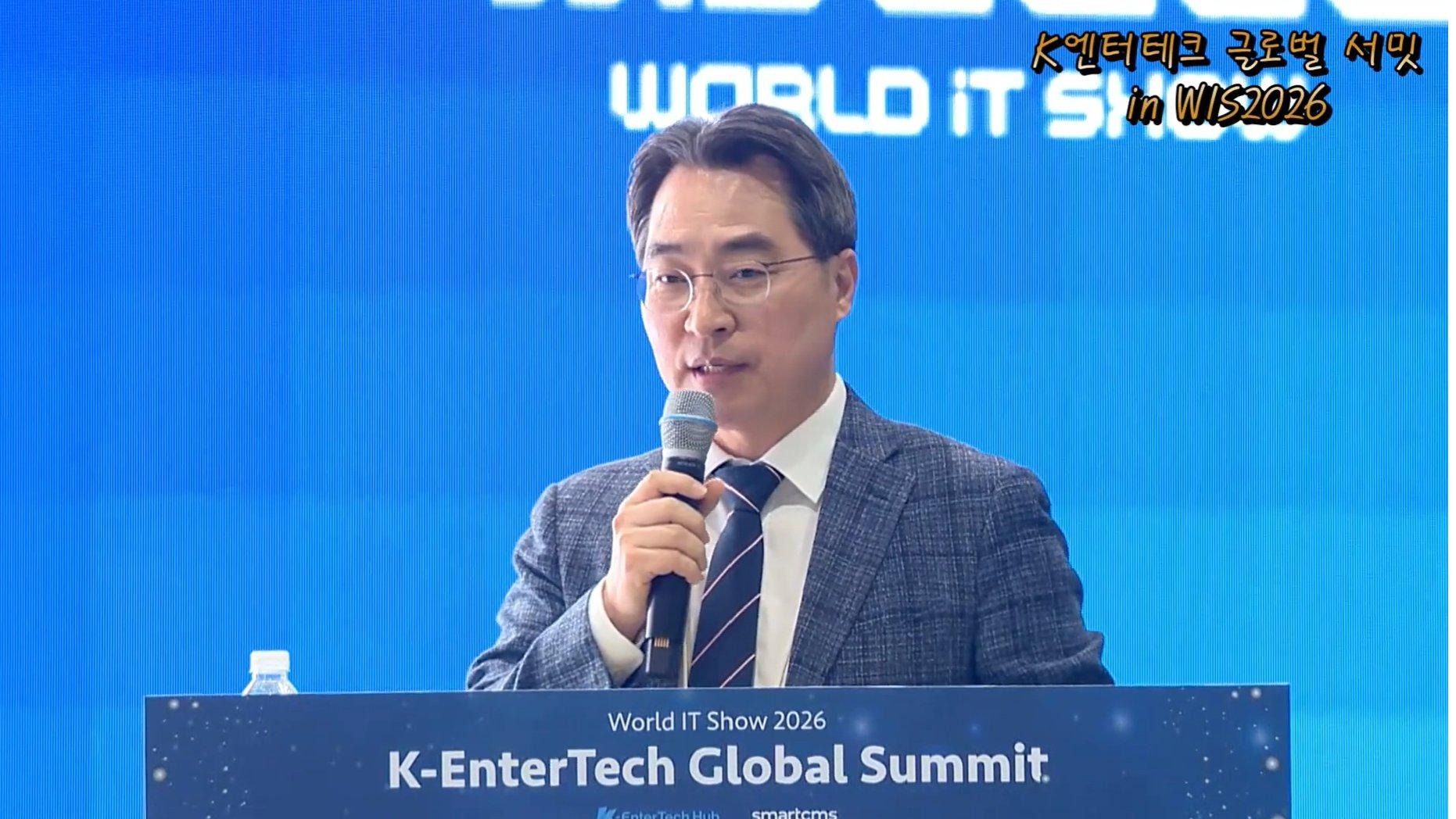
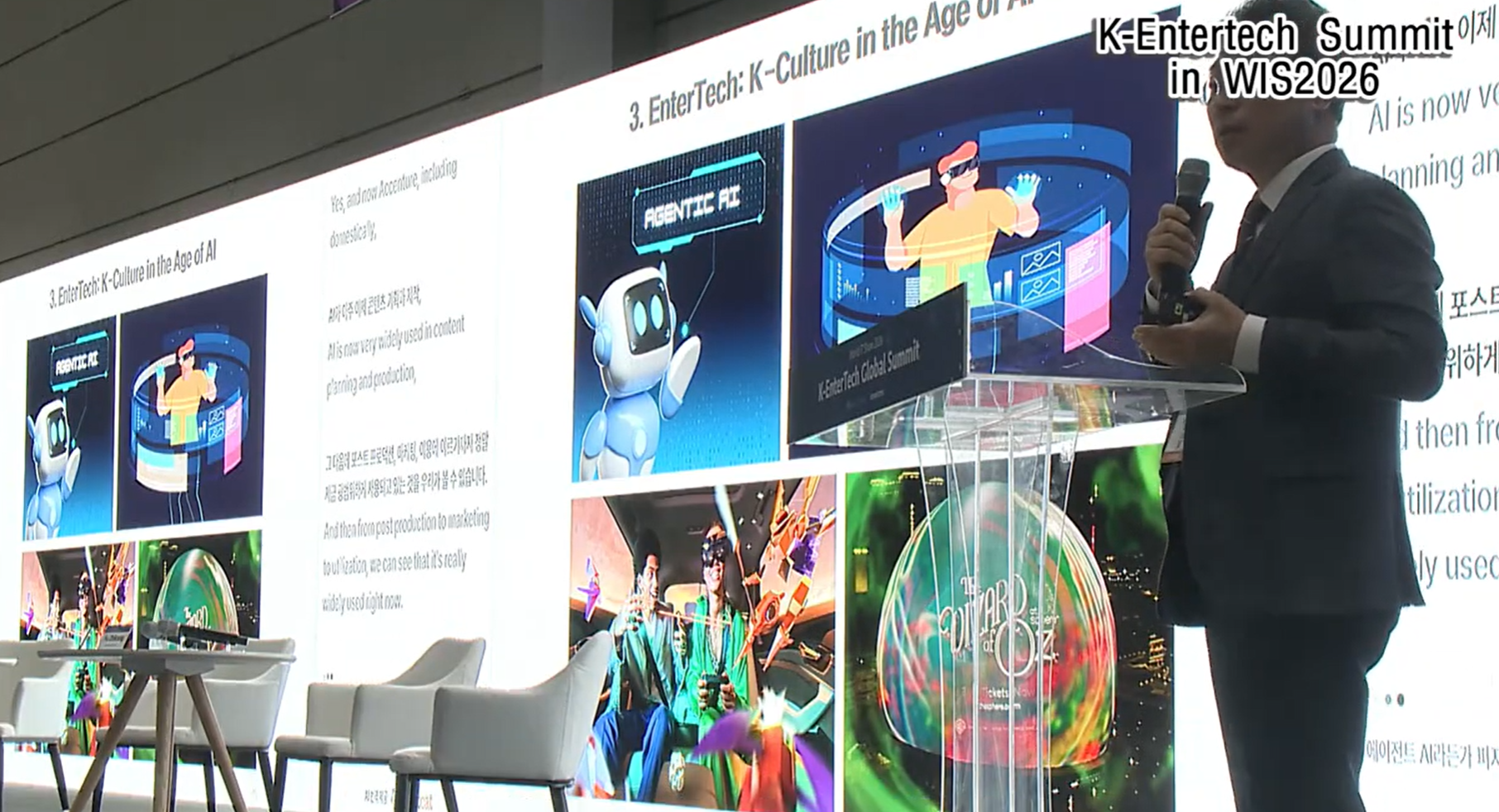
Speaking at the K-EnterTech Global Summit @ WIS 2026 in Seoul on April 24, Prof. Ko Sam-seog of Dongguk University — a member of the Presidential Council on National AI Strategy and standing chair of the K-EnterTech Forum — argued that the Korean content industry "must move from quantitative expansion to qualitative maturity," and that the route forward is co-evolution (공진화): Korean content and Korean AI advancing onto the global stage as a single proposition. The keynote was titled "The Future of K-Culture: Coevolution & EnterTech."
1. From "What is Love" to EGOT: A Thirty-Year Arc
Ko opened with a single lyric from BTS's "Aliens": Pardon Mr. Kim Gu, tell me how you feel. The reunion concert in Seoul's Gwanghwamun district on March 21 — the group's first full-lineup show in roughly three years after mandatory military service — was, for Ko, more than a music event. It was a stand-in for an industry that has grown up.
"Just as BTS grew from boys into men, K-Culture and the content industry must move beyond quantitative expansion into qualitative growth and qualitative maturity."
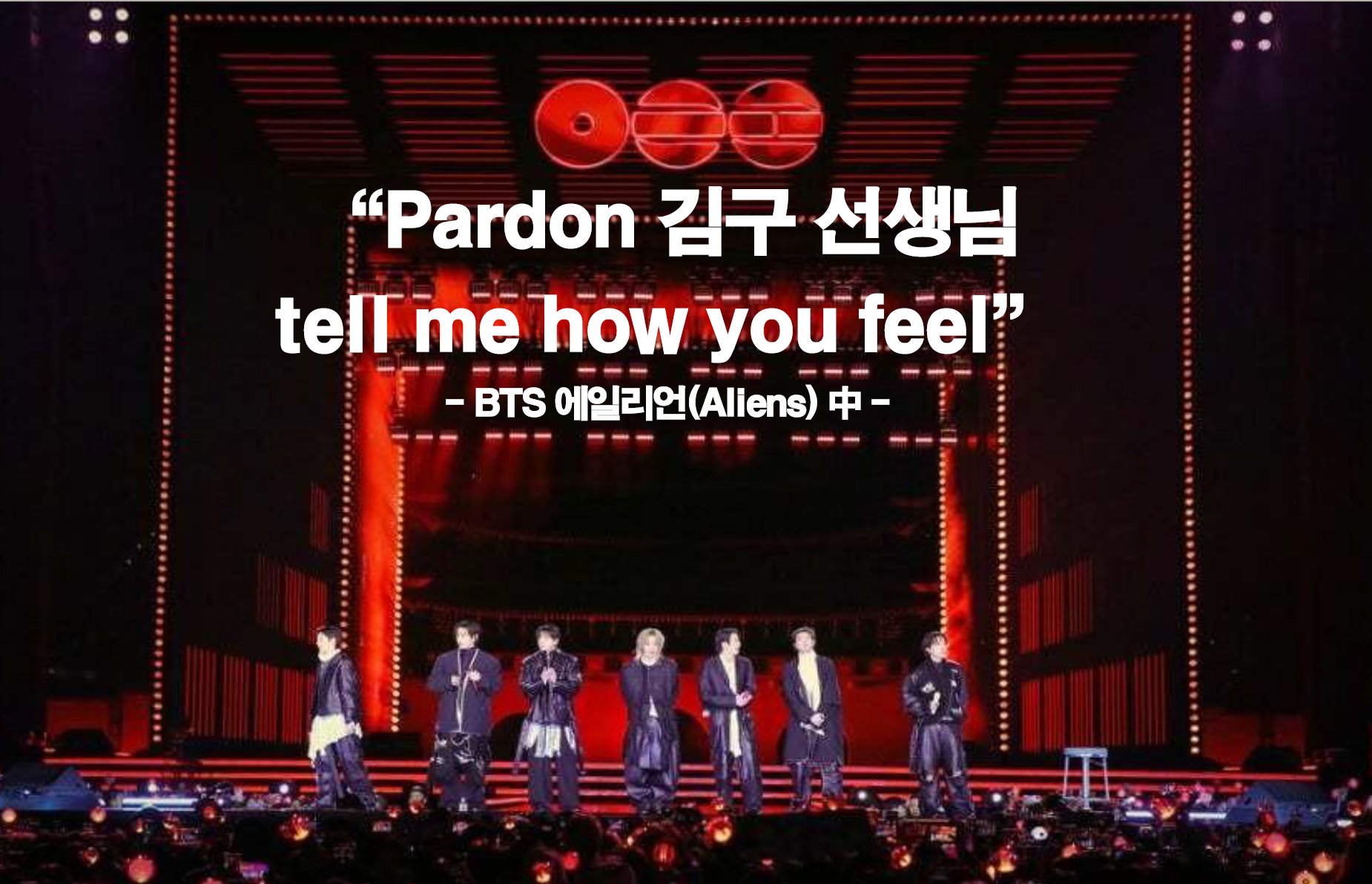
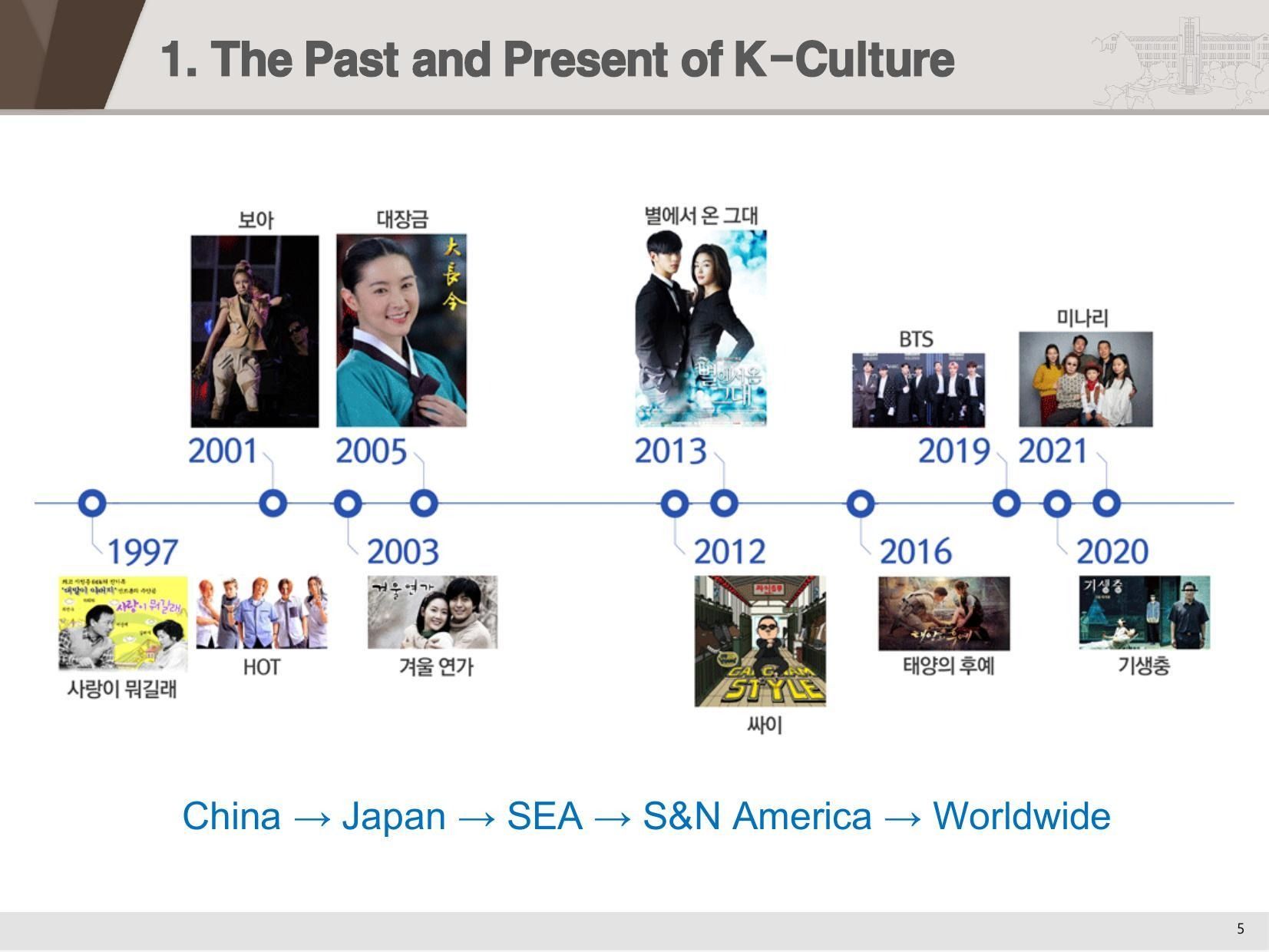
The Korean Wave that began in 1997 with the broadcast of the drama What is Love on Chinese television has, in thirty years, reached EGOT status. The Tony Award for Maybe Happy Ending in 2025 closed the loop on Korea's collection of the four major U.S. entertainment honors. The BBC reported that "Korea has attained EGOT status." Korea is no longer simply an exporter of content; Korean culture itself has become the content. Returning from meetings in Washington D.C. and Las Vegas, Ko said the global breakout of KPop Demon Hunters made the cultural shift visible inside the American mainstream.
2. 157 Trillion Won, USD 14.18 Billion — and #1 on Local Originals
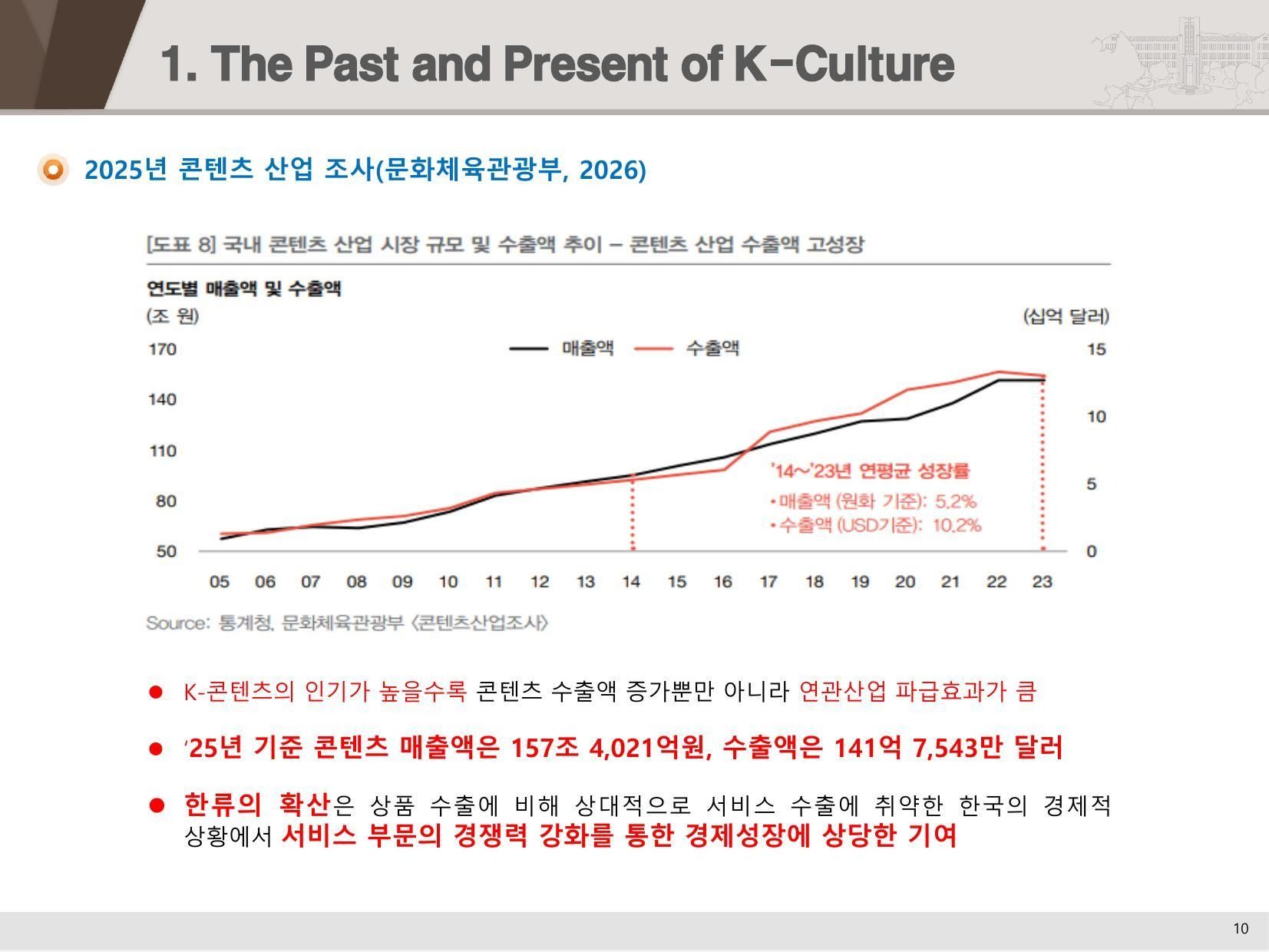
Ministry of Culture 2025 Content Industry Survey — 2025 revenue of 157.4 trillion won and exports of USD 14.18 billion, with 2014–2023 CAGR of 5.2% in won revenue and 10.2% in USD exports. Exports have grown nearly twice as fast as domestic revenue. (Source: Statistics Korea, MCST)
The Ministry of Culture, Sports and Tourism's 2025 Content Industry Survey put content revenue at 157.4 trillion won and exports at USD 14.18 billion. Between 2014 and 2023, revenue compounded at 5.2% a year in won terms while exports compounded at 10.2% in U.S. dollars — meaning the export curve has been climbing nearly twice as fast as the domestic one. For a Korean economy historically weaker in services exports than in goods, K-content has become a meaningful structural offset.
On global streaming, Korea's position is even sharper. According to Luminate, Korea ranked #1 worldwide in 2024 for local originals commissioned by major U.S.-based SVODs, with roughly 60 titles — well ahead of Japan (around 35) and Brazil (around 22). The data signals that Korea has moved beyond being a content exporter into being a base of local-original production for global platforms.
KOFICE's 2026 Overseas Hallyu Survey, covering 26,400 K-content consumers across 30 regions, found K-Pop holding its top position for the ninth consecutive year as the first thing global audiences associate with Korea (17.5%), followed by Korean food (12.1%), drama (9.5%), beauty products and cosmetics (6.2%), film (5.9%) and IT products and brands (4.8%). A separate analysis cited by Samil PwC put the share of respondents saying K-content influences their purchase of Korean products at an average of 57.9% across 26 countries — rising into the 70s in Indonesia (81.4%), Vietnam (78.6%), Saudi Arabia (74.5%), Egypt (74.0%), India (73.3%), Thailand (72.8%) and the UAE (72.3%).
3. The 37.5% Shadow — Negative Perception Rises, #SEAbling Emerges
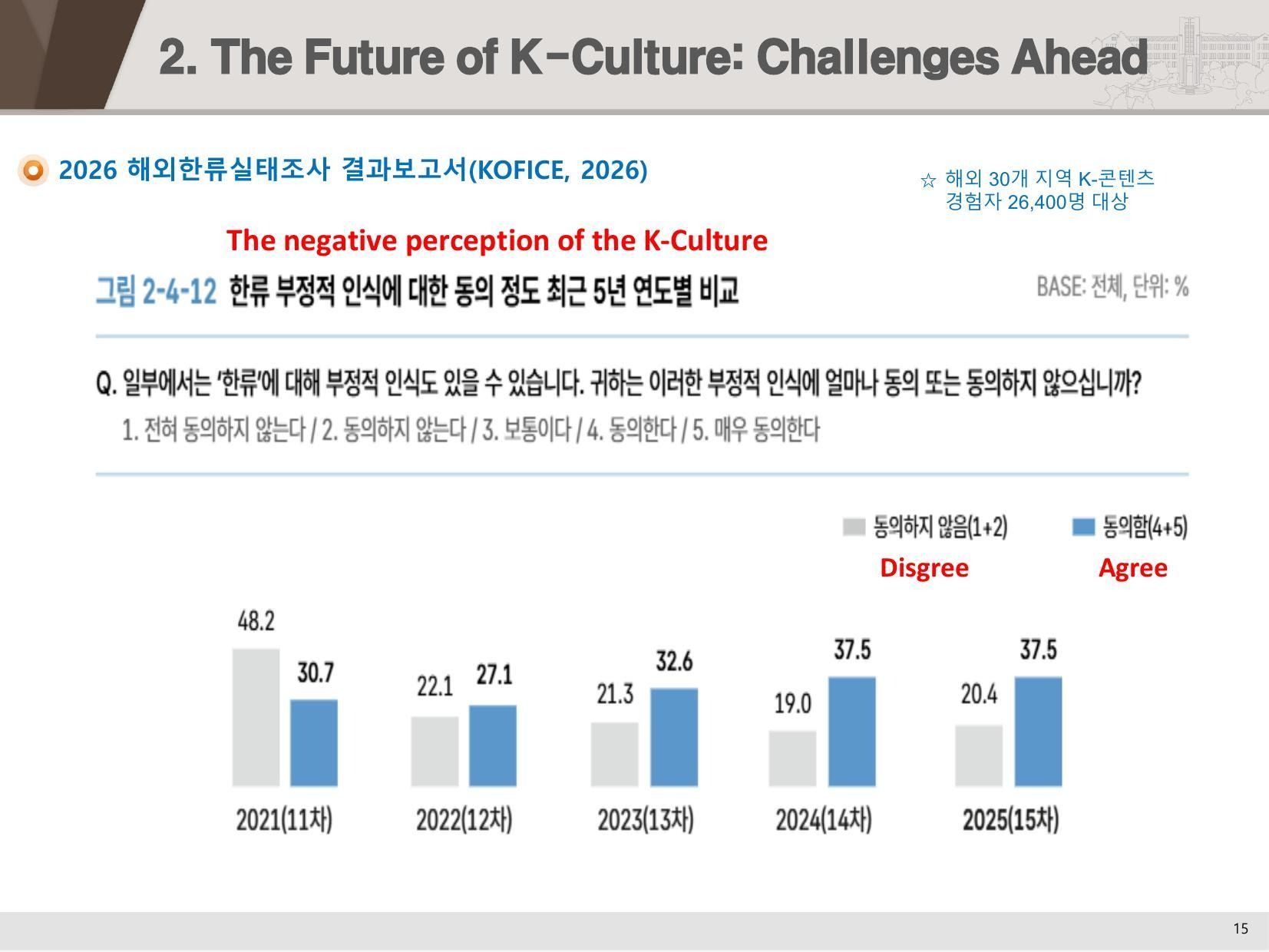
KOFICE 2026 Overseas Hallyu Survey — Agreement with negative perceptions of Hallyu rose from 30.7% in 2021 to 37.5% in 2025, while disagreement collapsed from 48.2% to 20.4% over the same period. (Source: Korea Foundation for International Cultural Exchange)
Ko spent meaningful time on the other side of the story. In KOFICE's tracking survey, agreement with negative perceptions of Hallyu has risen for five consecutive years: 30.7% in 2021, 27.1% in 2022, 32.6% in 2023, 37.5% in 2024 and 37.5% again in 2025. Over the same period, the share of respondents disagreeing with negative views fell from 48.2% to 20.4% — less than half. The picture is not a fading of K-Culture but a polarization around it.
The February clash between Korean and Malaysian netizens after a Korean idol group's Kuala Lumpur concert was one signal. A more structural one is the "#SEAbling" (Southeast Asia + Sibling) solidarity movement that has spread across Indonesia, Vietnam, Malaysia, the Philippines and Thailand, framing a "do not buy Korean products" campaign on social platforms. The friction has not yet translated into meaningful offline damage, but the data, Ko argued, says the cultural side effects of global expansion can no longer be treated as background noise.
"We cannot only look at the enthusiasm for K-content and K-Culture. We have to ask why a non-trivial share of audiences abroad hold negative perceptions. That is the question the next stage of K-content has to answer."
The pressure also comes from inside the production floor. A January survey by PD Journal of 2,842 members of the Korea PD Association found that producers do not feel the on-the-ground reality of the "AI transition" their broadcasters publicly champion — AI workflows, training and guidelines, and subscription budgets for production-grade AI tools remain insufficient. Closing that gap, Ko said, is a condition for competing on the global stage at all.
4. Slot #9 of the AI Action Plan: "Our Culture, Enjoyed by the World"
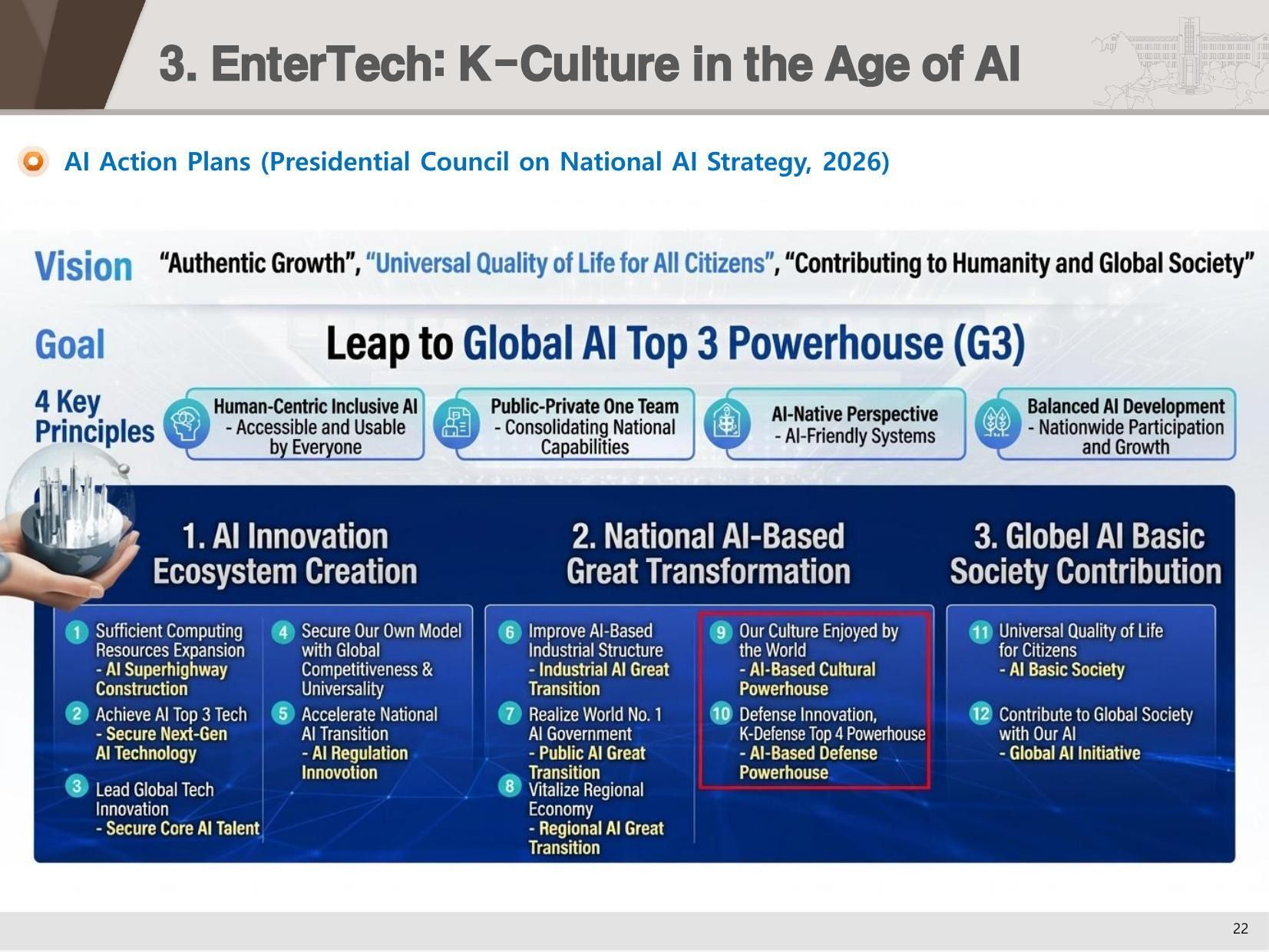
Presidential Council on National AI Strategy, AI Action Plan (2026) — A push to become a "Global AI Top 3 Powerhouse (G3)," with item 9 of the 12-point agenda dedicated to "Our Culture Enjoyed by the World — AI-Based Cultural Powerhouse." (Source: Presidential Council on National AI Strategy)
The Lee Jae-myung government's National AI Action Plan, finalized this year, sets out three vision statements — "Authentic Growth," "Universal Quality of Life for All Citizens," and "Contributing to Humanity and Global Society" — and a target of becoming a Global AI Top 3 Powerhouse (G3). Of the plan's twelve agenda items, item 9, "Our Culture Enjoyed by the World — AI-Based Cultural Powerhouse," is dedicated to the cultural industry. Culture, in other words, was not folded into general industrial transition; it sits as an independent pillar of the national AI strategy.
Three operational priorities anchor that pillar: activating an AI-based creative ecosystem; sustaining K-content industry growth through pioneering AI transformation; and promoting the simultaneous global expansion and exchange of K-content and K-AI. "Korean policy alone cannot make this sustainable," Ko said. "We need policies and corporate strategies that allow us to create together, enjoy together and share the outcomes."
5. K-Channel 82 Launches in September — SBS, KBS, and Sinclair Sign On
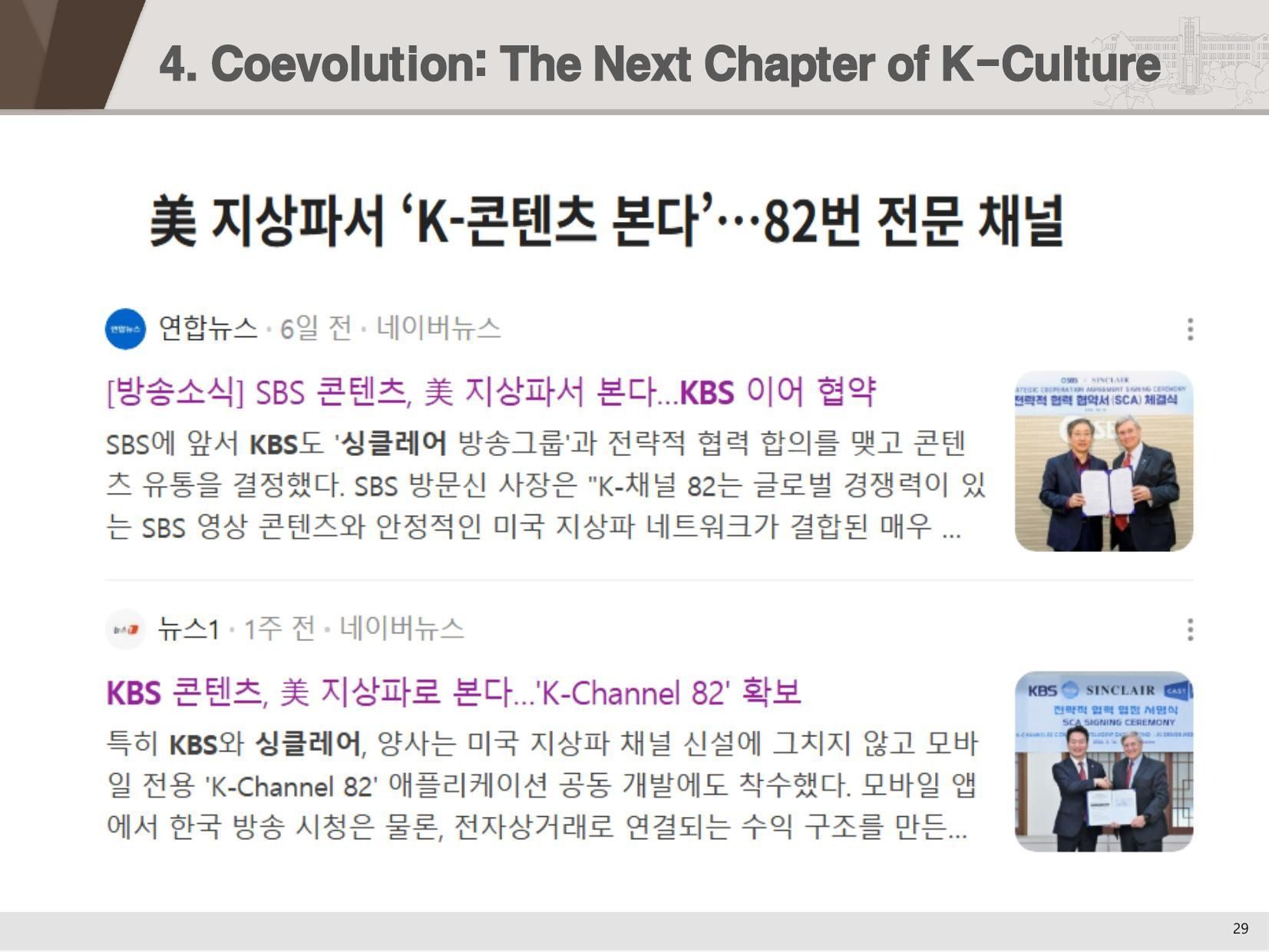
K-Channel 82 — SBS and KBS have each signed agreements (an MOU and a Strategic Cooperation Agreement, respectively) with Sinclair Broadcast Group, the largest local broadcast network in the U.S., to launch a Korean-content channel on broadcast slot 82. A dedicated K-Channel 82 mobile app, jointly developed, will combine viewing with e-commerce. (Source: Yonhap, News1)
The first real-world test of the co-evolution model arrives in September, in the United States. K-Channel 82, built on the infrastructure of Sinclair Broadcast Group, the largest local broadcast network in the country, will launch in the Washington D.C. and Baltimore markets on the next-generation ATSC 3.0 broadcast standard. SBS signed an MOU with Sinclair at CES 2026 in January; KBS followed with a Strategic Cooperation Agreement (SCA). KBS and Sinclair have moved beyond linear distribution: the two are jointly developing a K-Channel 82 mobile app that connects broadcast viewing to an e-commerce revenue layer.
SBS President Bang Moon-shin described K-Channel 82 as a model that combines "globally competitive SBS video content with a stable U.S. terrestrial broadcast network." Beyond a content channel, it is the first deliverable of what Ko calls the BAST (Broadcast Alliance with Sinclair and Telecommunications) framework — Korean content and Korean AI stacked on top of U.S. broadcast infrastructure rather than treated as separate businesses.
"K-Channel 82 will combine not only K-content but also K-AI, developing new content and services together."
6. A Korea–U.S. EnterTech Alliance: Four Concrete Items
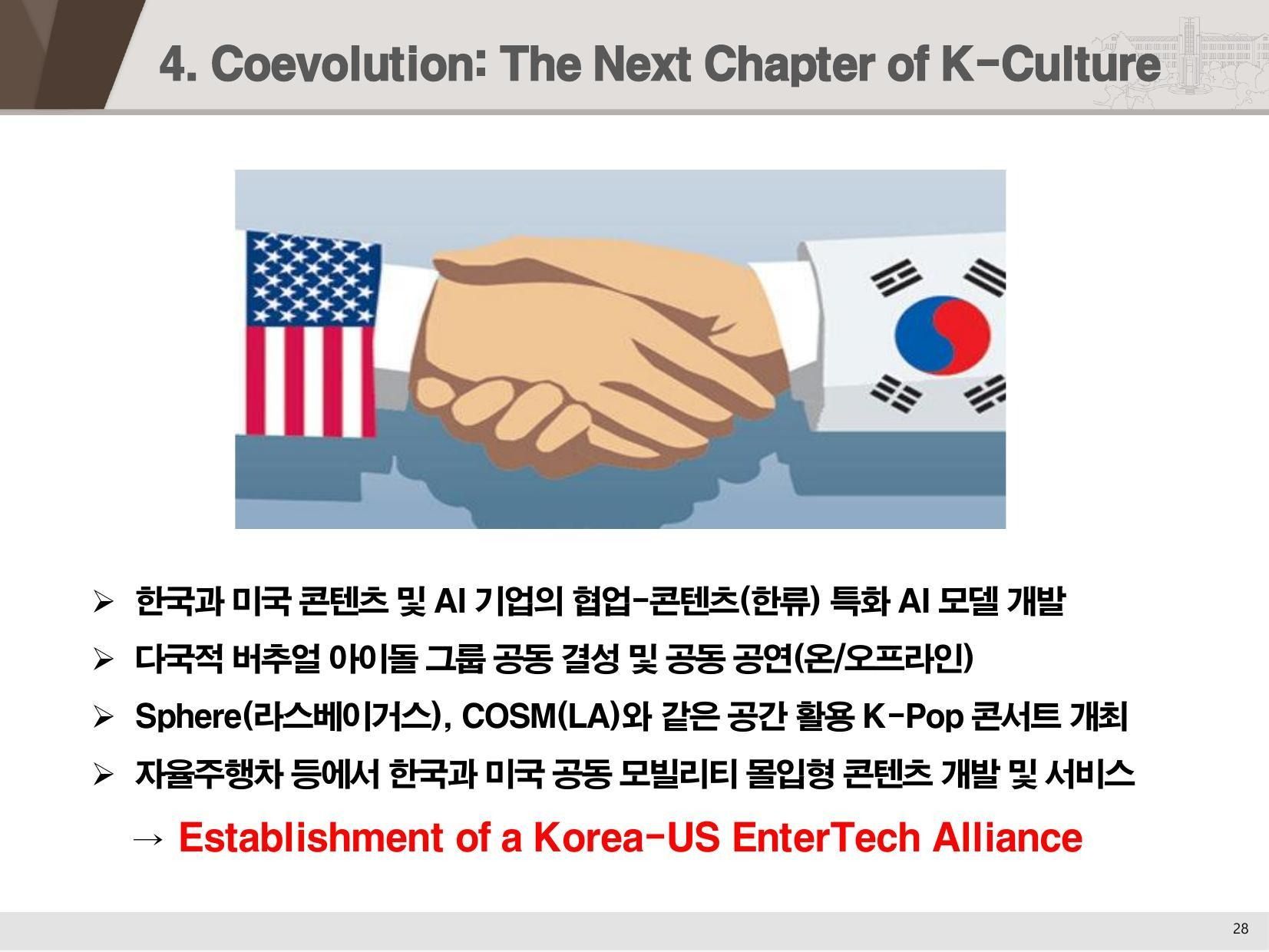
The four-point agenda Ko Sam-seog presented at CES 2026 for a Korea–U.S. EnterTech Alliance: a Hallyu-specialized AI model, a multinational virtual idol group, K-Pop concerts in immersive venues such as Sphere and COSM, and co-produced immersive mobility content for autonomous vehicles. (Source: Ko Sam-seog keynote)
Ko's four-point agenda — first proposed at AICON in Singapore last year, then carried into the "Next K-Wave EnterTech Forum" at Caesars Palace during CES 2026 (where he shared the stage with Del Parks, President of Technology at Sinclair, and Jung Han, CEO of K-EnterTech Hub), into a February meeting with Malaysia's Deputy Minister of Investment, Trade and Industry, and into NAB Show 2026 in April — converges on one frame: a Korea–U.S. EnterTech Alliance.
First, Korean, U.S. and Southeast Asian content and AI companies co-develop a Hallyu-specialized AI model. Second, a multinational virtual idol group is formed and brought to online and offline stages — the 2025 PLAVE Asia Tour "Quantum Leap" in Seoul demonstrated the format. Third, immersive venues such as the Las Vegas Sphere and COSM in Los Angeles host co-produced global K-Pop concerts. Fourth, autonomous vehicles become the next site of immersive content experience through co-developed Korea–U.S. mobility entertainment services.
"To put it simply: let us establish an Entertainment-Technology Alliance with the United States, Singapore and other Southeast Asian countries."
7. The EnterTech City: CES, SXSW, BIFF, Edinburgh
Ko closed on the geography of the next stage. The cities that combine entertainment, technology and an urban platform into a single development engine are the ones positioning for the next decade — Las Vegas through CES, Austin through SXSW, Busan through BIFF, and Edinburgh through its festival. In Korea, Seoul, Incheon, Busan and Seongnam Techno Valley (often described as the country's Silicon Valley) are the most credible candidates.
The keynote closed on a single line on the final slide: "A Nation Powered by AI & Culture."
"This cannot be done by any single country. The next era of K-Culture has to be built through exchange and cooperation with experts in every country."
■ AT A GLANCE — Seven Data Points from Prof. Ko's Keynote
① EGOT Completed The 2025 Tony Award for Maybe Happy Ending closed Korea's set of Emmy, Grammy, Oscar and Tony wins.
② KRW 157T / USD 14.18B 2025 content industry revenue 157.4 trillion won, exports USD 14.18 billion. 2014–2023 export CAGR (USD): 10.2%.
③ #1 in SVOD Locals Luminate: Korea ranked #1 worldwide in 2024 for local originals from major U.S.-based SVODs, with roughly 60 titles.
④ Negative Perception 30.7%→37.5% Agreement with negative perceptions of Hallyu rose for five consecutive years; #SEAbling boycotts surface across Southeast Asia.
⑤ AI Action Plan, Item #9 The Lee government's "Global AI Top 3 (G3)" agenda places culture as an independent pillar: "AI-Based Cultural Powerhouse."
⑥ K-Channel 82 in September SBS MOU and KBS SCA with Sinclair; launch on ATSC 3.0 in Washington D.C./Baltimore; jointly developed mobile app links broadcast and e-commerce.
⑦ Korea–U.S. EnterTech Alliance Four-point agenda: Hallyu-specialized AI model, multinational virtual idol group, Sphere/COSM K-Pop, autonomous-vehicle immersive content.