

K-EnterTech Hub | Hollywood · Policy · In depth
MPA/Olsberg study: a 20% credit lifts 2032 US spend to $34.7bn, twice the $16.9bn without it — $125.3bn and 143,500 jobs added by 2035; bill due this month
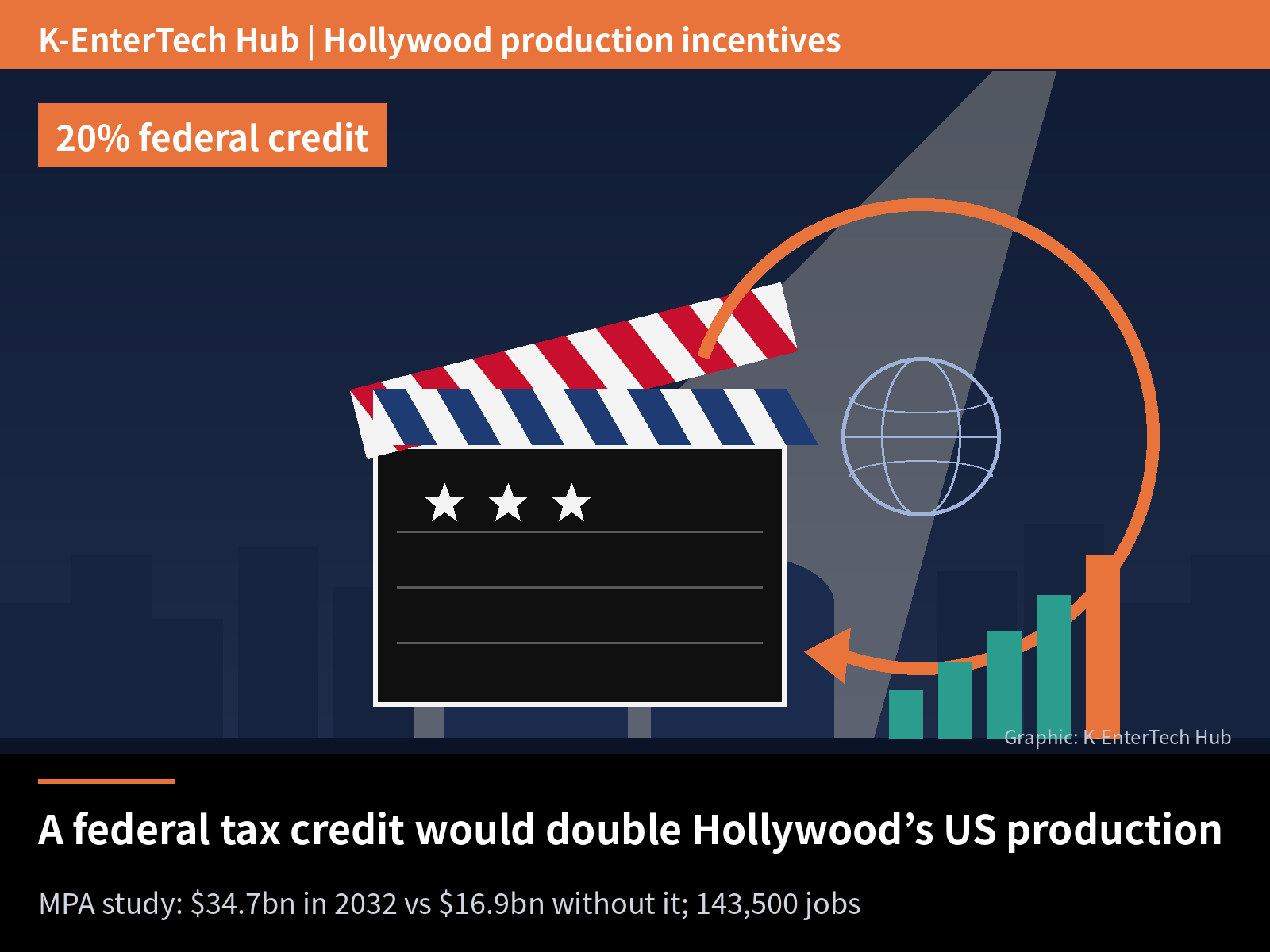
Graphic: K-EnterTech Hub
The Motion Picture Association (MPA) on Tuesday (15 September, local time) published an estimate of the economic effect of a federal film and television production incentive. The credit rate is 20%, starting in January 2027. The report projects $125.3bn (about KRW 170.3tn) in additional US production spending over 2027-2035, $249.1bn (about KRW 338.6tn) in additional gross value added (GVA, 부가가치) and an average of 143,500 full-time-equivalent (FTE, 정규직 환산) jobs a year. It was prepared by the UK screen consultancy Olsberg•SPI.
The MPA commissioned the report because production has been leaving the country, a trend the industry calls runaway production. It began when Canada introduced tax credits in the mid-1990s and later spread to Australia and the UK (NPR, 13 Sept). Some 45% of US films and scripted series were shot abroad last year, up from 33% in 2022. According to production tracker ProdPro, high-budget US production spending fell 20% in 2025 to $12.15bn (about KRW 16.5tn), while the UK’s rose 15% to $6.97bn (about KRW 9.5tn).
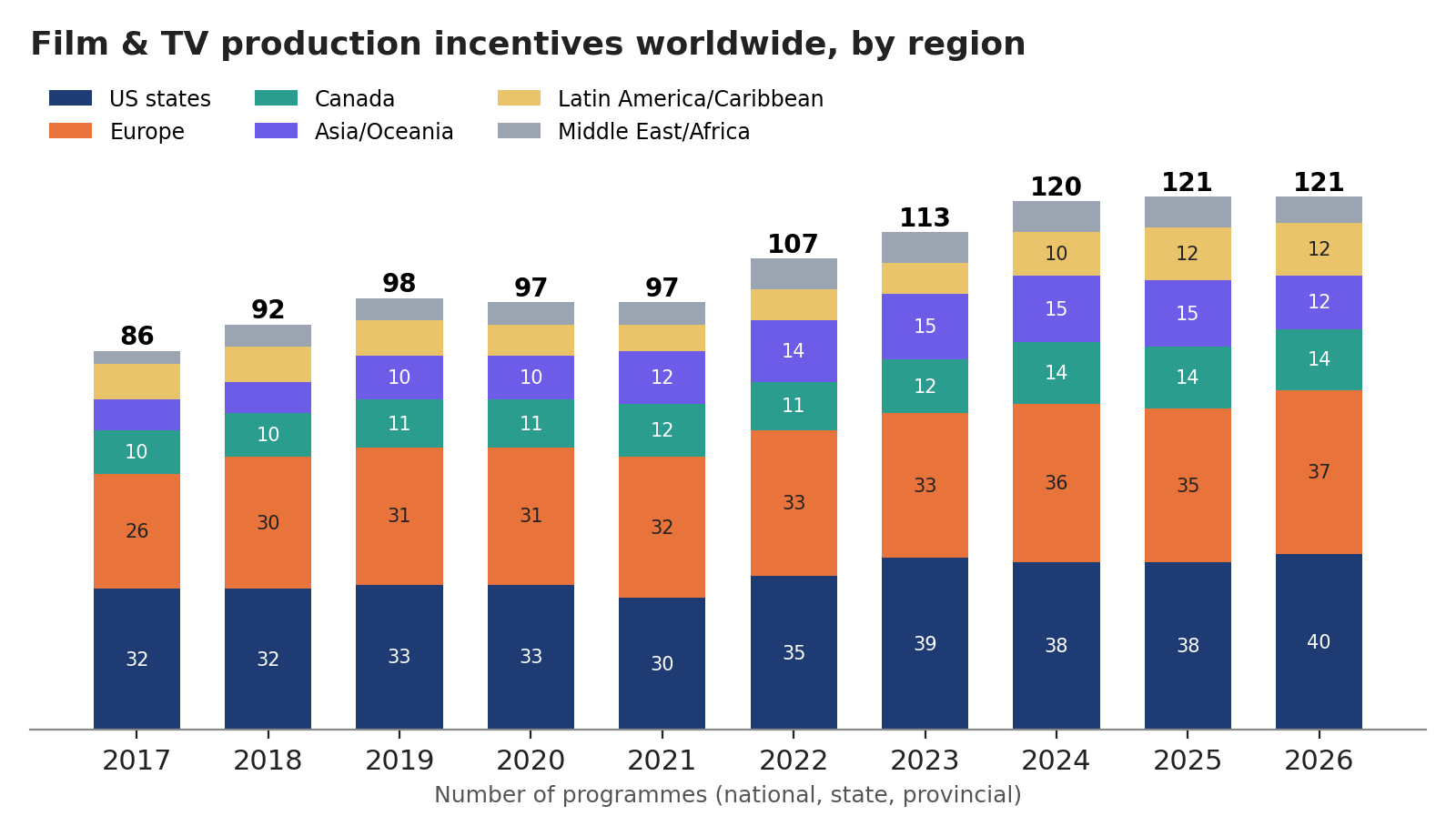
The US has no federal production credit. As of August, 39 states run their own programmes. Canada and Australia layer national and sub-national credits. The number of national, state and provincial production incentives worldwide rose from 86 in 2017 to 121 this year, and 65 countries run a national scheme, the report says. California runs a $750m-a-year (about KRW 1.02tn) credit, yet Los Angeles shoot days fell 12.7% year on year in the second quarter.
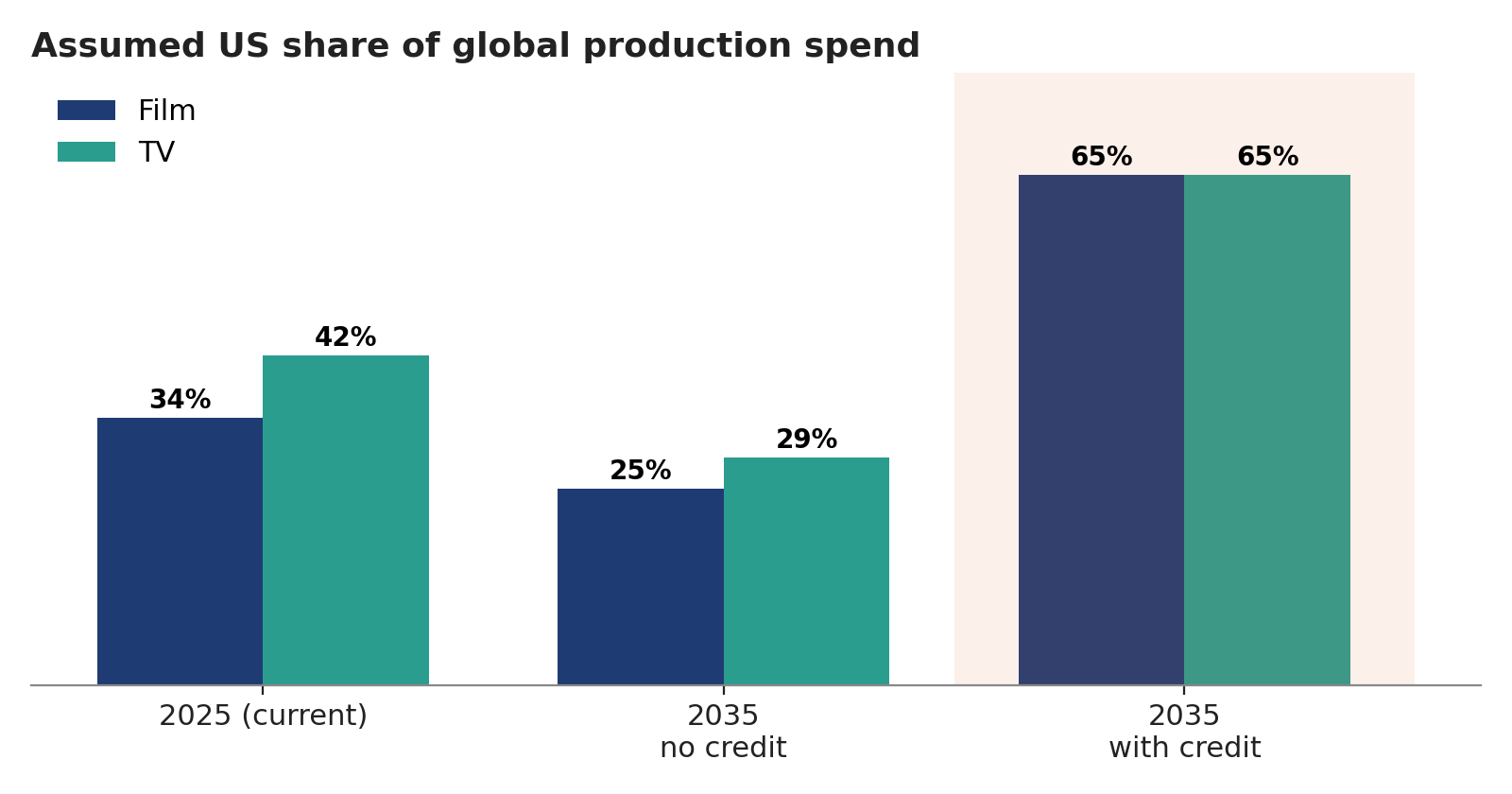
The additional spend comes from assuming that the share of US platforms’ global slate shot in the US rises to 65%, from 34% for film and 42% for TV today. On that assumption, spend outside the US in 2035 falls to $20.8bn (about KRW 28.3tn), against $42.9bn (about KRW 58.3tn) without a credit. The 65% figure rests on a single 2015 FilmLA survey, and the report leaves out other countries’ responses and the fiscal cost. President Donald Trump called for legislation on 31 August, and Variety reported on 15 September that a bill is due by the end of the month.
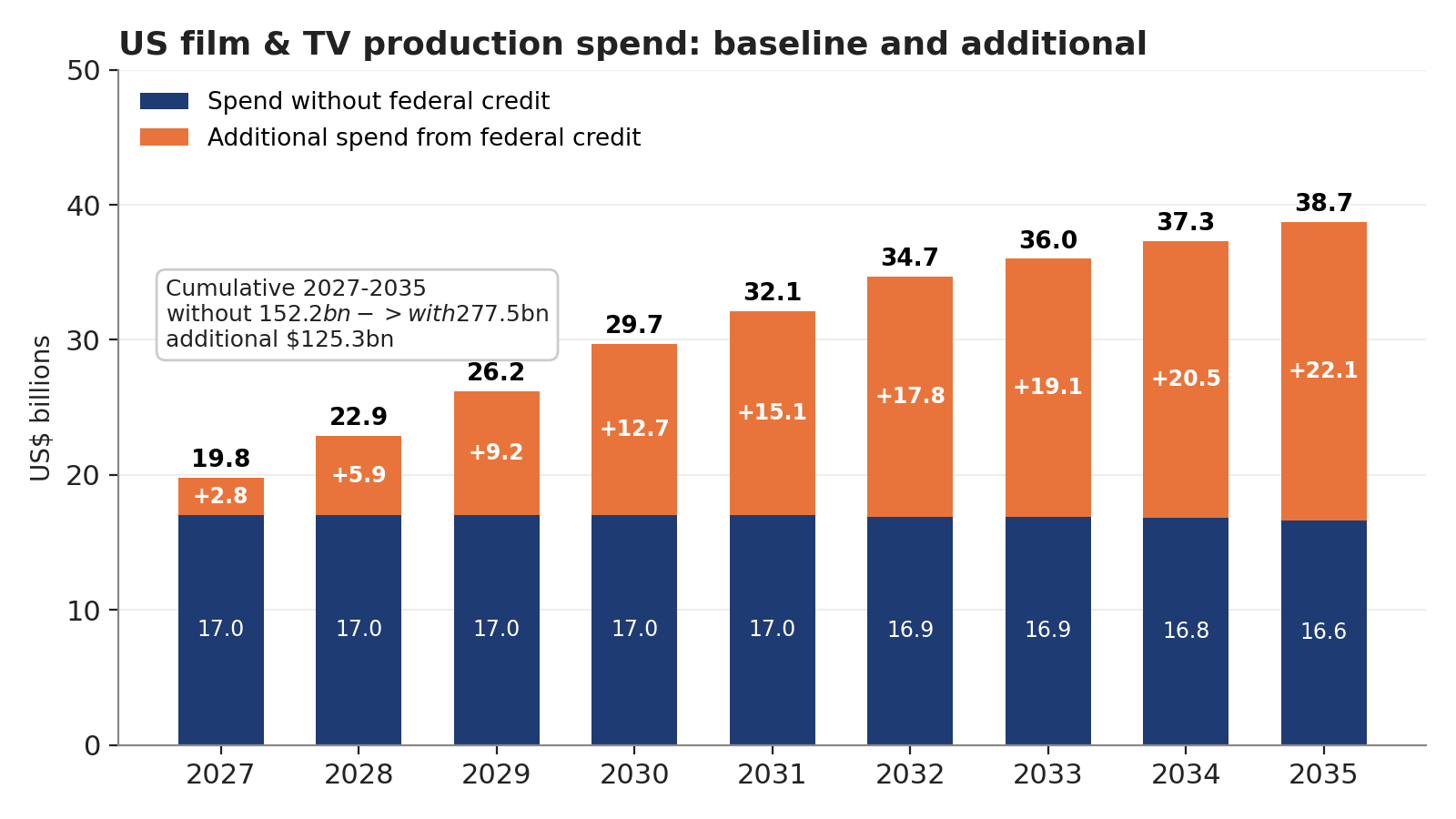
A 20% credit means $38.7bn of US production in 2035… additional spend grows from $2.8bn to $22.1bn
The report notes there is no formal government proposal yet, so it bases its design on an industry-supported proposal reported by Variety on 19 August. The credit is a transferable tax credit (양도형 세액공제), meaning producers with little tax liability can sell it for cash. Qualifying production expenditure (QPE) is limited to US resident labour. The base rate is 20%, with 5-point uplifts for labour in areas declared disasters by the Federal Emergency Management Agency (FEMA) and for independent production companies. The minimum spend is $1m (about KRW 1.36bn).
With the credit, US production spend reaches $19.8bn (about KRW 26.9tn) in 2027, $29.7bn (about KRW 40.4tn) in 2030 and $38.7bn (about KRW 52.6tn) in 2035. Without it, spend holds at $17.0bn (about KRW 23.1tn) a year through 2031 and slips to $16.6bn (about KRW 22.6tn) in 2035. The gap between the two paths grows from $2.8bn (about KRW 3.81tn) in the first year to $15.1bn (about KRW 20.5tn) in 2031 and $22.1bn (about KRW 30.0tn) in 2035. Over nine years the totals are $277.5bn (about KRW 377.2tn) and $152.2bn (about KRW 206.9tn), a difference of $125.3bn. Because ProdPro tracks only productions above $1m, the report treats all additional spend as clearing the minimum threshold.
$249.1bn in value added, $133.1bn in labour income… multipliers of 2.05 and 2.33
The estimate has two stages. The report first forecasts US production spend with and without the credit, then feeds the $125.3bn difference into IMPLAN, an input-output (I-O, 산업연관) model. IMPLAN adds direct effects on productions, indirect effects on suppliers such as equipment, lodging and catering, and induced effects as wages are re-spent. Coefficients for 2024 are held fixed, giving a value-added multiplier of 2.05 and an employment multiplier of 2.33 throughout. Spending on imported inputs is treated as leakage from the US economy.
Summary of estimated economic impact. Source: Olsberg•SPI report, Tables 2 and 7
IMPLAN counts jobs regardless of hours. To convert to FTEs, the report applies 0.919 to direct motion-picture jobs and 0.946 to indirect and induced jobs; one person on a three-month full-time contract counts as 0.25 FTE. Citing MPA analysis of Bureau of Labor Statistics (BLS) data, the report says direct US production jobs paid 52% more in 2024 than the national average for direct jobs, and typically carry employer-sponsored health insurance and retirement benefits.
“A federal incentive would be a gamechanger for our industry,” MPA chairman and CEO Charles Rivkin said in a statement, adding that it could bring opportunities to “people in all 50 states” (Variety, 15 Sept). At the virtual news conference he said: “Film and television production doesn’t come with a red or blue label” (Los Angeles Times, 15 Sept).
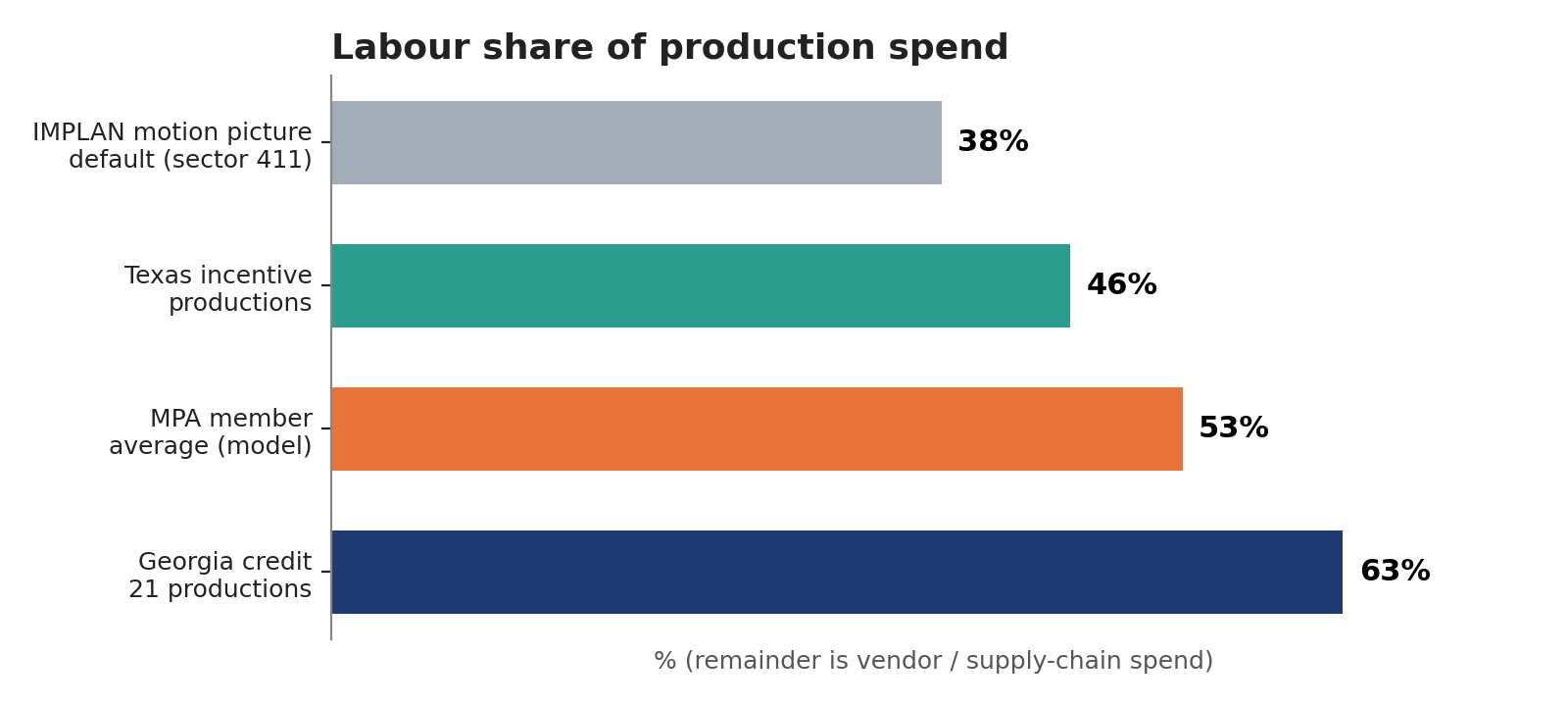
Labour share assumed at 53%… IMPLAN default is 38%, Georgia productions 63%
Because the credit applies only to labour, the labour share of a budget drives the result. The report uses an MPA average from members’ films and series: 53% labour, 47% vendor spend. IMPLAN’s default for sector 411 (Motion picture and video industries) is 38% labour and 62% vendors; the report replaced it because that sector also covers distribution and exhibition, which are less labour-intensive than production.
It cites state studies in support. SPI’s analysis of 21 productions under Georgia’s Entertainment Industry Tax Credit found about 63% payroll and 37% vendor spend. Productions under the Texas Moving Image Industry Incentive Program showed about 46% payroll and 54% vendor spend. At a 53% labour share, the 20% base rate equals roughly 10.6% of the total budget.
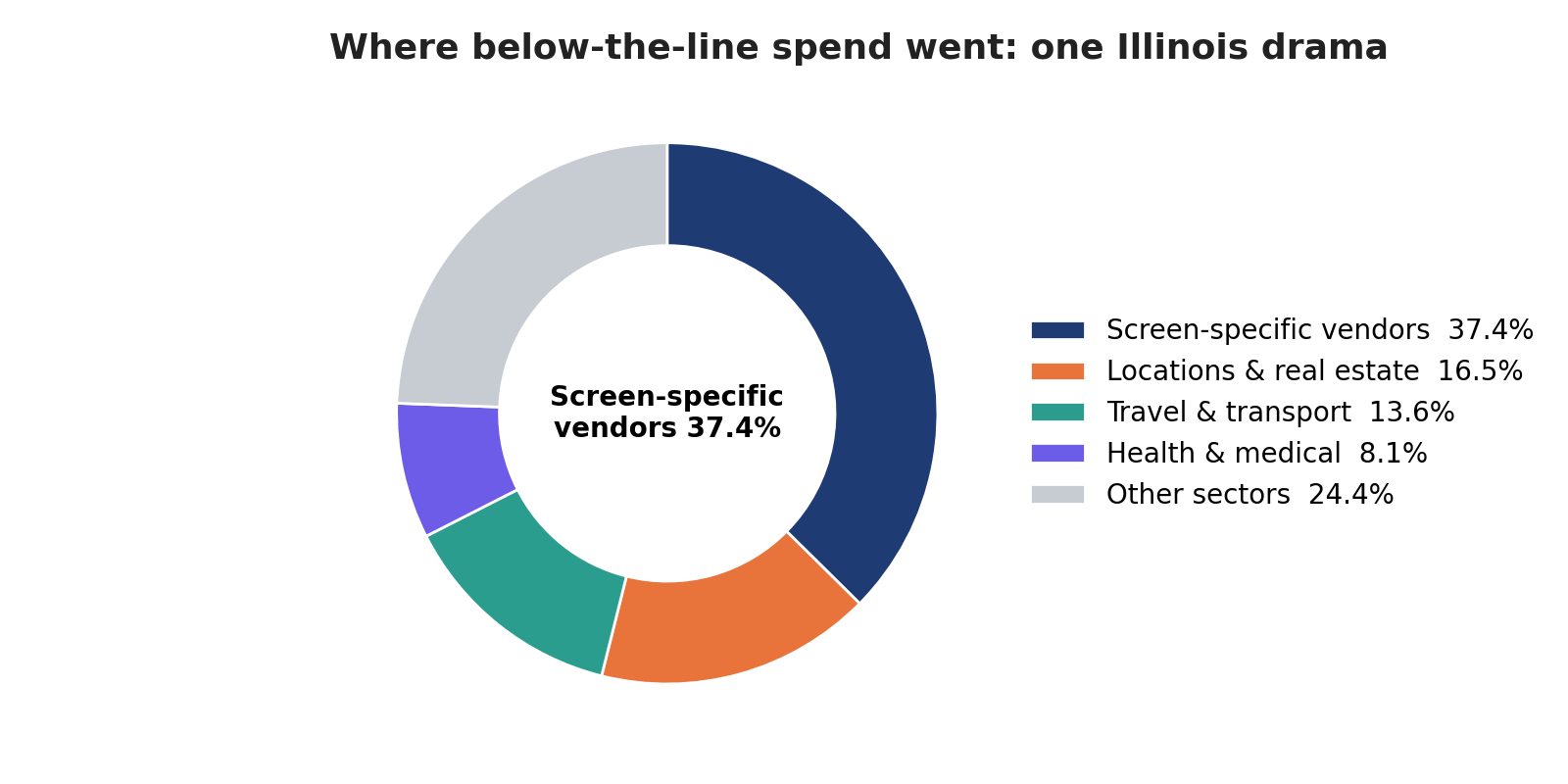
55-75% of below-the-line spend goes outside the screen sector… one Illinois drama
The report draws on earlier SPI work to show how spend flows into other industries. For a mid-budget drama series shot in Illinois, 37.4% of below-the-line (BTL) spend — crew and technical costs, excluding key talent such as directors, writers and lead actors — went to screen-specific vendors. The remaining 62.6% went to other sectors, including location fees and real estate (16.5%), travel and transport (13.6%) and health and medical (8.1%). Across SPI’s ripple analyses, 55-75% of BTL spend typically lands outside screen-specific sectors.
The reach extends beyond the shooting location. One production filmed around North Texas used vendors in El Paso, more than 550 miles (about 885km) from Dallas. Georgia’s credit supported $5.5bn (about KRW 7.48tn) in GVA through production and studio construction in fiscal 2022. A 2017 SPI study found that 38% of film and 47% of TV drama spend reached other creative industries such as theatre, design, fashion, music and publishing.
Incentives are paid only after the money is spent. A production applies, shoots, and then goes through an independent audit and government verification before payment, after it has hired and paid its workforce. The report also cites screen tourism: in a January 2026 study by 2CV, viewers of ‘Made in US’ content were 1.8 times more interested than non-viewers in travelling to the US.
US share of 34% (film) and 42% (TV) assumed to reach 65%… offshore spend in 2035 falls from $42.9bn to $20.8bn
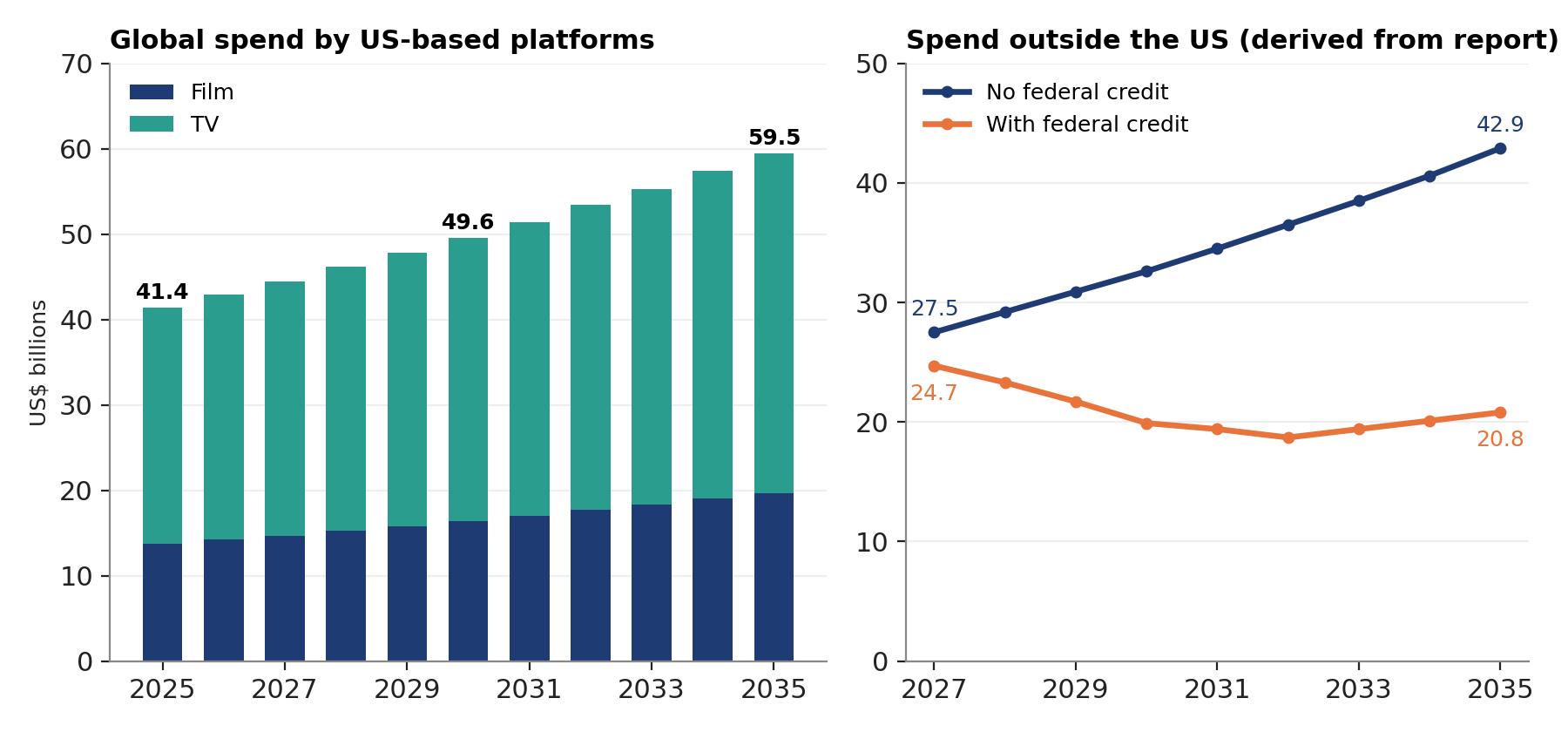
The starting point is global production spend by major US-based distributors, platforms and channels. ProdPro’s 2026 TV & Film Industry Outlook Report puts it at $41.4bn (about KRW 56.3tn) in 2025: $13.7bn (about KRW 18.6tn) film and $27.7bn (about KRW 37.7tn) series. The data cover scripted live-action titles budgeted above $1m and commissioned by US platforms such as Netflix, HBO and Amazon, in English and other languages. The report grows the total 3.7% a year to $49.6bn (about KRW 67.4tn) in 2030 and $59.5bn (about KRW 80.9tn) in 2035.
It then applies a US location share, using ProdPro data supplied privately for the study: 34% for film and 42% for TV in 2025. Without a credit, recent declines continue to 25% for film and 29% for TV by 2035. With a credit, the share reaches 65% for film by 2030 and for TV by 2032, and stays there.
Subtracting US spend from the global forecast gives spend outside the US. Without a credit it rises from $27.5bn (about KRW 37.4tn) in 2027 to $42.9bn (about KRW 58.3tn) in 2035. With a credit it falls from $24.7bn (about KRW 33.6tn) to $20.8bn (about KRW 28.3tn).
The nine-year totals are $313.2bn (about KRW 425.8tn) and $188.0bn (about KRW 255.6tn); apart from rounding, the difference equals the report’s $125.3bn of additional US spend. The report adds that the share shift is how the model accounts for additional activity, and that real growth could also include net new domestic and foreign production.
The only basis offered for 65% is FilmLA’s 2015 study, which found that 65% of 109 feature films that year were made in the US, Variety’s Gene Maddaus noted. The report also cites an analysis of 20 MPA member productions: a 20% labour credit would make 16 of them (80%) competitive to shoot in the US rather than abroad.
Key modelling assumptions in the Olsberg•SPI report. Source: report Table 4 and Appendix
No supply constraints, no foreign response, no opportunity cost… the limits the report states
The report calls its results an illustrative scenario and says SPI did not independently verify third-party data such as ProdPro’s. The model is not dynamic: it does not reflect other policy changes, macroeconomic shifts or other countries strengthening their incentives, and it assumes existing state credits stay unchanged.
It also lists the standard limits of input-output analysis. The model assumes no constraints on labour or materials, no price effects or offsetting changes in other sectors, and a fixed input structure with constant returns to scale. The opportunity cost of spending the money elsewhere was outside its scope. A different rate or design would change the results. The fiscal cost will be estimated by Congress’s Joint Committee on Taxation (JCT).
Incentives up from 86 in 2017 to 121… 40 in US states, 37 in Europe
By region, incentives in US states rose from 32 in 2017 to 40 this year, and in Europe from 26 to 37. Canada went from 10 to 14, Asia/Oceania from 7 to 12, Latin America and the Caribbean from 8 to 12, and the Middle East and Africa from 3 to 6. The report says Asia-Pacific, Latin America, the Middle East and Africa are adding competitive incentives.
Major production markets layer national and sub-national incentives. Canada’s Production Services Tax Credit (PSTC) pays 16% of qualified Canadian labour, with a higher Canadian Film or Video Production Tax Credit (CPTC) for Canadian content; larger provincial credits stack on top. Australia offers a 30% Location Offset for international productions and a 30% or 40% Producer Offset for Australian productions and official co-productions, with smaller top-ups from states such as New South Wales and Victoria. In the US, Savannah, Georgia adds a city rebate. The report expects a US federal credit to stack with state programmes.
In 2025, high-budget spending in Canada fell 13% to $4.61bn (about KRW 6.27tn), while central and eastern Europe, including Germany, the Czech Republic and Hungary, rose 78% to $1.53bn (about KRW 2.08tn). Ireland climbed 42% to $320m (about KRW 435bn). In the first quarter of 2026, global production spending fell 6% to $8.7bn (about KRW 11.8tn), and productions starting to shoot slipped 7% to 332. US spending was flat at $3.8bn (about KRW 5.17tn).
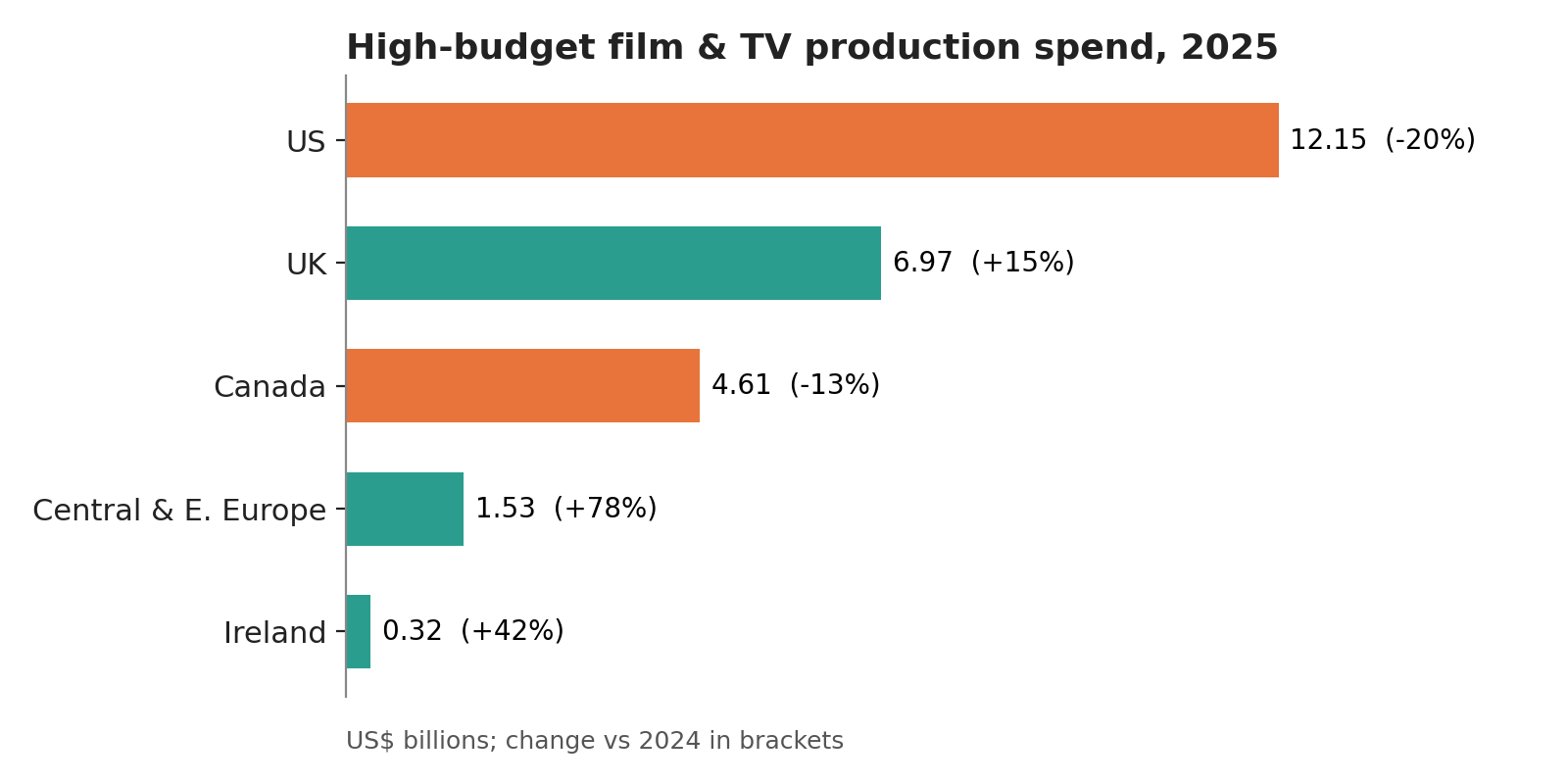
High-budget ($40m+, about KRW 54.4bn+) film and TV production spend by country and region, 2025. Source: ProdPro, as reported by Entertainment Partners / TheWrap
The UK offers a 25.5% refundable credit on film and TV, about 30% for animation and children’s programming and about 40% for independent film, with no overall cap. Germany raised its cash rebate from 20-25% to 30% and its annual cap from about $156m (about KRW 212bn) to about $293m (about KRW 398.3bn). Mexico has introduced a new 30% incentive.
Selected film and TV production incentives. Sources: Olsberg•SPI; Entertainment Partners / TheWrap; Los Angeles Times; 기획재정부 (Ministry of Economy and Finance) via Digital Daily
Trump backs the idea on 31 August… bipartisan bill due this month, target is year-end
“I am going to suggest that Republicans and Democrats get together and immediately craft Legislation to save the Movie, Television, and Entertainment Business in America,” Trump wrote on Truth Social on 31 August (IndieWire, 31 Aug). He said the post followed a conversation with actor Jon Voight, one of his Hollywood ambassadors alongside Sylvester Stallone and Mel Gibson. Trump had earlier floated tariffs on films made abroad, which did not turn into concrete measures.
“Thousands upon thousands of our people are out of work — out of the work they love — and are struggling to find ways to put food on the table for their families,” Voight said at the 15 September news conference. “The ball is rolling right now because we have seen so much production leave the U.S., and we see what that leaves behind,” said Rep. Friedman. “We know how to bring these jobs back. It’s not rocket science” (Los Angeles Times, 15 Sept). Friedman is a former independent film producer who worked at Paramount and HBO (NPR, 13 Sept).
In the House, Republicans Nathaniel Moran (Texas), Nicole Malliotakis (New York) and Mike Carey (Ohio) and Democrats including Judy Chu and Ted Lieu are involved in drafting (TheWrap, 2 Sept). NPR reported the bill’s name as the Motion Picture, Television, and Entertainment Revitalization Act. A spokesperson for Sen. Adam Schiff (D-Calif.), who has pushed for a federal incentive for about two years, said: “There is bill language, and currently, leaders in the Senate, House, and Trump administration are engaging in conversations to finalize text. Negotiations are ongoing” (Deadline, 9 Sept).
Deadline reported that the model draws heavily on California’s $750m-a-year programme, with a 20% base that could rise by 5 to 10 points for rural areas or multi-state productions. Democrats emphasise Hollywood and New York jobs; Republicans point to production growth in Texas and Georgia. The bill will go through the House Ways and Means Committee. With Congress expected to recess from October to mid-November for the midterms, TheWrap reported that mid-November is the earliest realistic passage date and that the goal is the president’s signature by year-end. “We want to get it right … but we want to get it done. We want to get it done quickly,” Rivkin said (Los Angeles Times, 15 Sept).
Chu and Malliotakis have separately put forward the CREATE Act, which would renew Section 181, the provision letting producers expense production costs in the year they are incurred (TheWrap, 2 Sept). White House spokesman Kush Desai said: “President Trump has made clear his intention to protect the dominance of the American film industry.”
California’s $750m credit in place… LA shoot days still down 12.7% in Q2
California raised its annual film and TV credit cap in 2025 from $330m (about KRW 448.6bn) to $750m (about KRW 1.02tn), running to 30 June 2030. Actor salaries are excluded. The current Program 4.0 has awarded credits to 170 projects, 41 of them announced in July. FilmLA counted 4,711 on-location shoot days in the Los Angeles area in the second quarter, down 12.7% year on year. TV shoot days rose 34.4% from the previous quarter but were 27.7% lower than a year earlier, and incentivised productions accounted for 38.3% of TV shoot days. First-quarter shoot days were 5,121, down 3.3%.
“While there is still much work to do, FilmLA’s quarterly report is proof that incentives are working: local incentivized productions are on the rise, creating good-paying union jobs,” said Los Angeles Mayor Karen Bass (Beverly Press, Aug). FilmLA CEO Denise Gutches pointed to credit recipient ‘The Pitt’.
Post-production (후반제작) is being handled separately. AB 2319, passed by the California legislature and awaiting Gov. Gavin Newsom’s signature, would give a 35-50% credit on post-production spending in the state. Funding was cut from a proposed $100m (about KRW 135.9bn) to $10m (about KRW 13.6bn). The existing credit requires 75% of filming or of the overall budget to be spent in California, which leaves editors, sound mixers, composers and VFX artists largely outside it. “Post-production and the jobs it creates is at the core of the entertainment industry, but it doesn’t qualify for our expanded Film and TV Tax Credit — that must change,” Bass said (MyNewsLA, 10 Sept).
The federal credit is being discussed as a layer on top of state programmes, as in Canada. According to the report, 39 US states run production incentives this year. “If we have a level playing field upon which to shoot, where we are not much more expensive than other locations, productions will come back to Los Angeles,” Friedman said. “There is a ticking clock. If something isn’t done by the end of the year or in sight, there will be a further solidification of offshoring,” said Peter Marshall of Epic Insurance (Los Angeles Times, 3 Sept).
Korea’s credit reaches 30%; the US plan equals about 10.6% of budget… Netflix’s Korean originals sit in the base
Under its Restriction of Special Taxation Act (조세특례제한법), South Korea raised the base rate of its video content production cost credit (영상콘텐츠 제작비 세액공제) from 2024 to 5% for large companies, 10% for mid-sized firms and 15% for SMEs. Productions meeting domestic-spend conditions get a further 10 points (large and mid-sized) or 15 points (SMEs), for maximum rates of 15%, 20% and 30% (기획재정부, Ministry of Economy and Finance, 2023 tax revision). The Korean credit covers production spending in Korea broadly. The US plan covers only US resident labour; at the report’s 53% labour share, that is an effective rate of about 10.6% of the total budget, before uplifts and state credits.
The ProdPro base used by the report includes non-English titles commissioned by US platforms, which means Korean-language originals commissioned by Netflix and others are part of the $41.4bn global total. The report does not split its 65% US-share assumption between English and non-English titles. Productions such as Korean-language originals, tied to a language and cast, are hard to relocate to the US; the calculation that spend outside the US falls to $20.8bn in 2035 does not separate them out.
Korean productions set in the US, and co-productions with US producers, are directly exposed to the design. Local cast and crew wages would earn the credit, but under the report’s assumptions wages of staff brought from Korea would not. If multi-state or rural uplifts go ahead, as Deadline reported, the combined federal and state rate in places such as Georgia (조지아) and Texas would weigh on the choice of a US base. The Georgia productions cited in the report had a 63% labour share; the higher a production’s labour share, the larger its credit at the same 20% rate.
Olsberg names South Korea among production hubs that have grown since 2015 (Variety, 15 Sept). The finding that 16 of 20 member titles become competitive in the US compares the US against foreign locations generally. Korea’s credit is designed mainly for domestic producers, so foreign shoots in Korea rely on budget programmes such as the Korean Film Council’s (영화진흥위원회, KOFIC) foreign production location incentive (외국영상물 로케이션 인센티브). Just as the report counts the tourism benefit of on-screen exposure (1.8 times the interest in visiting the US), attracting foreign shoots ties into screen tourism (스크린 투어리즘).
Post-production and visual effects (VFX, 시각효과) houses are also exposed. Both the federal plan and California’s AB 2319 are based on labour spent in the US. If confirmed on those terms, US studios weighing offshore post-production would compare it with credit-adjusted US rates, and Korean VFX and post houses bidding for US work would compete against those rates.
The remaining steps are publication of bill text, the JCT cost estimate and review by Ways and Means. Rates, uplift conditions and the start date may change, and the report itself notes that a different design would change its results. It assumes a start date of 1 January 2027.
Sources
1. Los Angeles Times, Samantha Masunaga, “A federal tax credit could add 143,000 film and TV jobs, industry-commissioned study says”, 15 Sept 2026 (full text supplied by the author)
2. Variety, Gene Maddaus, “MPA Projects Federal Film Incentive Would Double U.S. Production and Create 143,500 Jobs”, 15 Sept 2026 — https://variety.com/2026/film/news/mpa-federal-film-incentive-jobs-production-report-1236861764/
3. Motion Picture Association / Olsberg•SPI, “Economic Impact of a Proposed US Federal Production Incentive”, Sept 2026 (22 pp., PDF supplied by the author) — https://www.motionpictures.org/wp-content/uploads/2026/09/Economic-Impact-of-a-US-Federal-Incentive-2026-09-07-1.pdf
4. Los Angeles Times, “Trump backs a federal film tax credit. What that could mean for Hollywood”, 3 Sept 2026 — https://www.latimes.com/entertainment-arts/business/story/2026-09-03/trump-backs-federal-film-tax-credit-what-that-could-mean-for-hollywood (republished: https://www.ep.com/news/trump-backs-federal-film-tax-credit-what-that-could-mean-for-hollywood/)
5. Los Angeles Times, “Trump calls for federal tax incentives to revive U.S. film industry”, 31 Aug 2026 — https://www.latimes.com/politics/story/2026-08-31/trump-calls-for-federal-tax-incentives-to-revive-u-s-film-industry
6. IndieWire, “Trump Endorses Federal Film Tax Credit”, 31 Aug 2026 — https://ca.news.yahoo.com/trump-endorses-federal-film-tax-232049258.html
7. Deadline, “Federal Film & TV Tax Credits Not A Done Deal, Adam Schiff Says”, 9 Sept 2026 — https://deadline.com/2026/09/federal-film-tv-tax-credits-latest-1237071772/
8. TheWrap, “With Trump’s Go-Ahead, Inside the Next Steps to Pass a Federal Film Tax Incentive”, 2 Sept 2026 — https://www.thewrap.com/creative-content/movies/federal-film-tax-incentive-next-steps-pass-congress/
9. NPR, “A new tax incentive could lead to more films being made in the U.S. rather than abroad”, 13 Sept 2026 — https://www.npr.org/2026/09/13/nx-s1-5962169/a-new-tax-incentive-could-lead-to-more-films-being-made-in-the-u-s-rather-than-abroad
10. Washington Examiner, “What to know about the bipartisan push for a federal film tax credit”, 2 Sept 2026 — https://www.washingtonexaminer.com/news/entertainment/4707997/what-to-know-bipartisan-film-tax-credit/
11. Entertainment Partners / TheWrap, “Hollywood offshoring: A look at who’s winning the global production race”, 2026 — https://www.ep.com/news/2026-hollywood-offshoring-look-at-whos-winning-global-production-race/
12. Entertainment Partners / TheWrap, “US Finally Stems the Bleeding in Film Production — but Will It Last?”, 2026 — https://www.ep.com/news/us-film-production-2026/
13. Beverly Press, “Data shows film production picking up in Los Angeles”, Aug 2026 — https://beverlypress.com/2026/08/data-shows-film-production-picking-up-in-los-angeles/
14. Deadline, “Los Angeles Production: Total Q2 Shoot Days Dip, Says FilmLA Research”, July 2026 — https://deadline.com/2026/07/los-angeles-film-television-production-q2-shoot-days-filmla-1237001626/
15. Los Angeles Times, “Post-production workers and Mayor Bass press Gov. Newsom to sign first-of-its-kind tax credit”, 10 Sept 2026 — https://www.latimes.com/entertainment-arts/business/story/2026-09-10/post-production-workers-urge-newsom-sign-tax-credit-ab-2319
16. MyNewsLA, “Film Post-Production Workers and Bass Urge Newsom to Sign New Tax Credit Bill”, 10 Sept 2026 — https://mynewsla.com/business/2026/09/10/film-post-production-workers-and-bass-urge-newsom-to-sign-new-tax-credit-bill/
17. FilmLA, 2015 Feature Film Study — https://filmla.com/wp-content/uploads/2015_film_study_v5_WEB.pdf
18. 디지털데일리(Digital Daily), “영상콘텐츠 제작비, 최대 30% 세액공제” (Video content production cost credit of up to 30%), 27 July 2023 — https://m.ddaily.co.kr/page/view/2023072716210908061
19. 머니투데이(Money Today), KRW/USD closing rate 1,359.4, 15 Sept 2026 — https://www.mt.co.kr/economy/2026/09/15/2026091515343525913
20. Variety, “Hollywood’s Push for Federal Film Tax Credit Could Help Boost Production in All States”, 19 Aug 2026 (cited by the report as the basis for its credit design) — https://variety.com/2026/film/focus/federal-film-tax-credit-production-1236837623/
21. ProdPro, 2026 TV & Film Industry Outlook Report — https://prodpro.com/blog/2026-tv-film-industry-outlook-report/
22. SPI, Economic Impact Study of Georgia’s Entertainment Industry Tax Credit, 6 Nov 2023 (cited in report) — https://62be1ab4-fdab-4e67-a4ac-c55fd6f1acba.filesusr.com/ugd/18ed45_c5ca9791ffde4f36a4ac705491f56538.pdf
23. SPI, Economic Impact of the Illinois Film Production Services Tax Credit, 19 Dec 2023 (cited in report)
24. SPI, Reel Returns: The Economic Impact of the Texas Moving Image Industry Incentive Program (cited in report)
25. 2CV, Impact of Filming on Cultural Affinity & Tourism, Jan 2026 (cited in report) — https://www.motionpictures.org/wp-content/uploads/2026/08/Impact-of-Filming-Report-Made-in-US-content-Jan-14-Final-v2.pdf
26. SPI, Film and the Creative Economy, 31 July 2017 (cited in report)
Exchange rate: US$1 = KRW 1,359.4 (Seoul close, 15 Sept 2026).
Quotation policy: text in quotation marks is speech as reported by the named outlet; unquoted passages summarise reporting or the report. Outlet and date are given with each.
‘Spend outside the US’ is calculated by K-EnterTech Hub (케이엔터테크허브) by subtracting the report’s US spend forecast (Table 6) from its global spend forecast (Table 5). The report does not publish this figure.
The ‘effective rate on total budget’ multiplies the 20% base rate by the report’s 53% labour-share assumption. Actual credits depend on each production’s labour mix, uplifts and state stacking.
The 34% (film) and 42% (TV) US shares are spend-based ProdPro figures supplied privately to the MPA; the 38% Q1 figure is ProdPro’s quarterly count and is not directly comparable.
Regional incentive counts were read from Figure 2 of the report and redrawn.