

Disney hires Character.AI’s chief as its first CTO as studios and unions negotiate the terms of AI adoption. Audience surveys reveal a similar divide, but payment for training data remains unresolved.

Karandeep Anand, Disney’s incoming chief technology officer, will join from Character.AI on October 2. Photo: Disney.
Disney’s CTO hire, studio investments and four-year union deals show how Hollywood is adopting AI while restricting performer replacement. Audiences draw a similar distinction. Compensation for training data remains unresolved, with implications for Korean producers.
Disney has hired the chief executive of an AI company it threatened with legal action a year ago. On September 18, The Walt Disney Company named Character.AI CEO Karandeep Anand its first chief technology officer. He starts on October 2 and will report directly to CEO Josh D’Amaro. A number of Character.AI engineers will also join Disney. In September 2025, Disney sent the company a cease-and-desist letter over the use of its characters in chatbots it said posed risks to children.
The appointment follows a year of agreements between Hollywood and AI companies. The Motion Picture Association (MPA) signed a memorandum of understanding with ByteDance on August 17. A24 entered a research partnership with Google DeepMind and received an investment in June. Lionsgate acquired an equity stake in Runway that month. Netflix bought AI post-production company InterPositive in March for $587 million, approximately KRW 812 billion. Between April and June, the Writers Guild of America (WGA), SAG-AFTRA and the Directors Guild of America (DGA) ratified four-year collective bargaining agreements, each with new AI provisions.
Those agreements place restrictions on the replacement of performers and writers. Under the SAG-AFTRA deal, producers must establish that a synthetic performer offers “significant additional value” over a human performer. The DGA renewed its 2023 principle that directing work must be performed by humans and secured directors’ control over AI-generated imagery. Studios, meanwhile, are bringing AI into visual effects, lighting corrections and establishing shots through partnerships and acquisitions. Audience research shows a comparable distinction. In Luminate Intelligence’s July report, net comfort among film and television viewers was minus 20 percentage points for digital replicas of living actors and minus 19 points for fully synthetic actors, against plus 12 points for sound effects and plus 9 for visual effects.
The agreements examined here do not establish a public price for using films and television programs to train AI. The WGA and DGA contracts provide notification and bargaining procedures if training licenses are granted. The MPA–ByteDance memorandum addresses safeguards on generated output, but the details have not been disclosed. Among the studio deals covered here, Lionsgate’s 2024 agreement with Runway is the example of a library being used to train a dedicated model; its terms remain private. SAG-AFTRA’s four-year contract also prevents a strike over the covered issues until 2030.
South Korea is addressing related questions through legislation and government-backed standard contracts. Disclosure requirements under the AI Basic Act took effect on January 22. On September 10, the Korea Broadcasting Actors Union signed an agreement to manage performers’ facial and voice data with their consent. These measures do not establish compensation for training data either.
Disney brings technology and AI under its first CTO
According to Disney’s September 18 announcement, Anand will oversee enterprise technology, infrastructure, data and AI platforms, product and engineering. Working with technology teams across the company’s businesses, he is tasked with changing how Disney develops and delivers technology at the corporate level. D’Amaro cited Anand’s experience across infrastructure, consumer technology and AI. He identified storytelling, technology that supports creativity, and operating as “One Disney” as the company’s three priorities. He described Anand as a builder and strategist with product judgment who shares Disney’s view that technology delivers its greatest value when it helps people do their best work.
Disney framed the appointment around growth. Its announcement said D’Amaro is focused on making technology a company-wide growth driver. Since becoming CEO, he has emphasized Disney+ as the digital center of the business and a means of building direct relationships with fans. Anand said he had spent his life watching Disney combine storytelling with emerging technology and would build on its existing capabilities to connect audiences with stories and characters in new ways.
Before Character.AI, Anand was president and chief product officer at fintech company Brex and vice president of advertising and business products at Meta. He spent 15 years leading product and engineering teams at Microsoft and was part of the team that built Azure. He studied computer science at the International Institute of Information Technology, Hyderabad. He initially joined Character.AI as an adviser to its board before becoming CEO. Disney credited him with leading the company through rapid growth, developing a highly engaged consumer AI user base and prioritizing user trust and safety as the business expanded.
A day before Anand’s appointment, Disney elevated Adam Smith to chairman of Disney Entertainment’s direct-to-consumer business. Smith joined Disney in 2024 after two decades at Google and YouTube. D’Amaro, who became CEO in March, has placed Disney+ at the center of a One Disney strategy connecting films, parks and games. In two days, he put executives from technology companies in charge of both the streaming product organization and enterprise technology.
A year earlier Disney demanded the removal of character chatbots
Axios reported on September 30, 2025, that Disney’s letter described Character.AI as being filled with chatbots imitating characters from its classic films, Pixar, Star Wars and the Marvel Cinematic Universe. It cited a report by ParentsTogether Action and the Heat Initiative that documented conduct described as grooming, sexual exploitation and emotional manipulation in chatbot conversations with accounts registered as children. Disney emphasized the lasting damage to its brand and consumer trust from the use of its characters in such conversations, rather than simply financial losses.
The letter accused Character.AI of reproducing and monetizing copyright- and trademark-protected characters without authorization. It said the company’s conduct had crossed a line and must stop immediately. Disney demanded written assurances and warned that it would take the necessary action under copyright law and the Lanham Act if those assurances were not provided.
Character.AI told Axios that users created the platform’s characters and that it promptly removed content reported by rights holders. The Disney characters were removed. Its spokesperson also expressed interest in partnerships that would bring licensed characters onto the service, offering rights holders tools to develop controlled, revenue-generating interactive experiences around their fandoms. A year later, Disney hired the company’s CEO and technical staff rather than announcing a license for that service.
The letter was part of a broader series of legal actions. Disney and NBCUniversal sued image generator Midjourney in June 2025, the first such suit by major studios against a generative AI company. Warner Bros. Discovery filed a separate suit against Midjourney in early September. That month, the three companies jointly sued Chinese video generator MiniMax over alleged large-scale unauthorized use of their works. Axios interpreted Disney’s position as requiring platforms to identify and remove infringing user-generated material proactively. By contrast, The Wall Street Journal reported on September 29, 2025, that OpenAI’s new video service would require rights holders to opt out.
Disney’s proposed billion dollar OpenAI investment never closed
OpenAI released Sora 2 on September 30, 2025, using an opt-out approach. In an October 6 statement, MPA chairman Charles Rivkin said videos infringing members’ films, programs and characters were spreading on Sora 2 and social media, and that preventing infringement was OpenAI’s responsibility, not the rights holders’. OpenAI CEO Sam Altman subsequently wrote that rights holders would receive more granular controls over whether and how their characters could be generated. Variety’s August 17, 2026, account said OpenAI introduced safeguards following the MPA’s criticism. In December 2025, Disney announced a three-year agreement under which Sora users could generate videos featuring more than 200 Disney, Marvel, Pixar and Star Wars characters.
Disney also proposed a $1 billion equity investment in OpenAI, approximately KRW 1.3833 trillion. It was Disney’s first announced AI licensing agreement, but it did not take effect. On March 24, 2026, OpenAI announced the closure of Sora, and Disney withdrew the same day. Deadline reported that the agreement had not been finalized and no money had changed hands.
Disney said it respected OpenAI’s decision and would continue discussions with AI platforms. Its lawsuits against Midjourney and MiniMax continued. The company was pursuing legal action against unauthorized uses while negotiating licenses with businesses willing to accept its conditions.
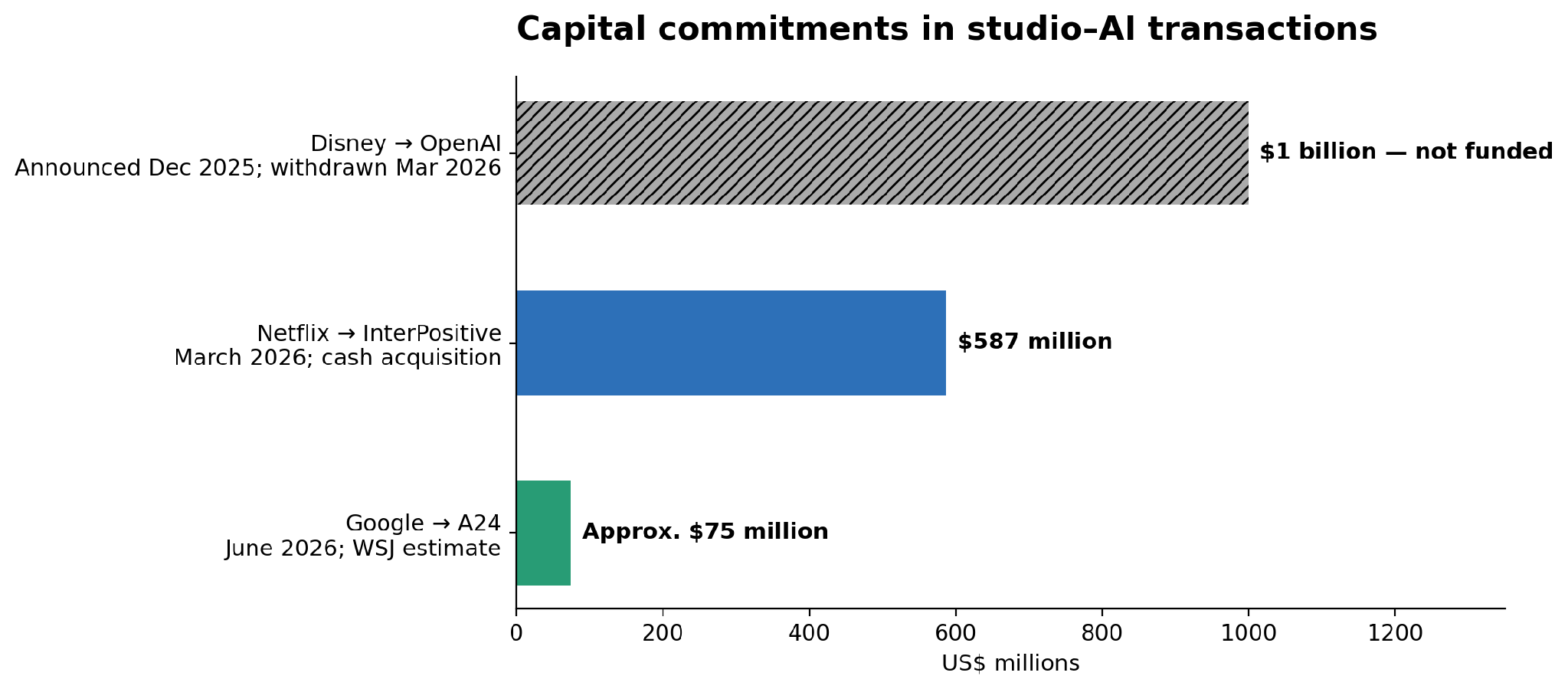
Announced AI-related capital transactions between studios and technology companies. Disney’s proposed OpenAI investment was withdrawn three months after announcement. Sources: company announcements, Netflix’s quarterly filing and The Wall Street Journal.
The MPA and ByteDance reach an agreement on output safeguards
The August 17 memorandum establishes a joint framework to protect film and television intellectual property across ByteDance’s generative AI products, including its Seedance video models and Seedream image models. It covers generative features in TikTok, the TikTok USDS Joint Venture, CapCut and Dreamina.
According to Corbin Bolies’s August 17 report in Variety, the negotiations began after Seedance 2.0 was released in February. Users circulated videos imitating actors including Brad Pitt and Tom Cruise, prompting a cease-and-desist letter and public criticism from the MPA. The parties then discussed incorporating intellectual property safeguards into the models. They said the resulting measures appeared in Seedance 2.5 and Seedream 5.0 Pro, released in July. The sequence echoed the MPA’s October 2025 criticism of Sora 2 and OpenAI’s subsequent introduction of safeguards. ByteDance is a Chinese company that can be difficult to reach through U.S. litigation. The Next Web argued on August 17 that studios had chosen to negotiate protection available immediately rather than rely on uncertain litigation.
Rivkin’s announcement described copyright as foundational to the film and television industry. He said the parties had spent months working on effective protections for Seedance and Seedream and that the memorandum would support further improvements. ByteDance general counsel John Rogovin said responsible AI innovation must go hand in hand with protecting rights holders, describing the memorandum as a framework for continued cooperation as the technology spreads across products and platforms. Reuters reported on August 17 that Disney and other studios had objected in February to the tools generating protected characters and celebrity likenesses without permission.
The memorandum is not a license. Its stated focus is preventing infringing output, rather than settling how the underlying model acquired its knowledge. Refusing a request to generate Iron Man, for example, would not answer which material taught a model what the character looks like. Variety noted that Hollywood’s interest in generative AI coexists with concern about unauthorized collection of performers’ likenesses for training. The Next Web pointed out that neither side had explained the safeguards in detail.
Audience behavior helps explain the pressure for such controls. In Luminate’s research, 74% of respondents aware of generative AI had used it to create content in the style of a particular writer or artist. The figures were 38% for images, 34% for writing, 27% for video and 24% for music. Among 13- to 17-year-olds, 43% had generated video and 49% images this way. The report noted that style itself is not protected by copyright, while identifying imitation as a major concern for creators and rights holders. The output users seek is often precisely what rights holders want platforms to control.
A24 keeps its library out while Lionsgate puts its catalog to work
In a June 22 Google blog post, DeepMind vice president of product Eli Collins described the A24 partnership as its first research-focused collaboration of this kind. The long-term arrangement spans multiple projects. DeepMind’s technology will be used within production workflows as A24 and its filmmakers develop techniques and working methods, with creators providing feedback and direction. Google confirmed an investment but did not disclose the amount. The Wall Street Journal put it at approximately $75 million, or KRW 104 billion.
Google said the partnership’s specific goals, technical outputs and creative schedules would evolve over time, rather than committing to fixed deliverables and deadlines. Variety reported on June 23 that the deal does not give Google access to A24’s film library or data. Google supplies funding and research resources; A24 contributes filmmakers’ working environments and feedback. Library access for training is excluded.
Scott Belsky, the partner leading A24 Labs, told The Wall Street Journal that AI developers had made a mistake by positioning their products chiefly as cheaper, faster production tools. IndieWire’s June 23 account quoted him describing the planned tools as very different from the prompt-based generation that makes people uncomfortable. AI storyboarding is among A24 Labs’ initial projects.
Lionsgate took a different approach. Runway’s September 18, 2024, announcement described a custom model trained on Lionsgate’s own catalog for use by the studio’s filmmakers and production teams. Vice chairman Michael Burns said it would support pre-production and post-production. The Wall Street Journal reported that storyboarding would come first, followed by effects such as backgrounds and explosions. Runway also said it was exploring ways to offer such custom models as templates to other creators. Where A24 excluded its library, Lionsgate supplied its catalog for a model designed for its own productions. On June 11, 2026, Lionsgate announced that it had acquired a Runway equity stake and planned AI-generated short-form series based on existing intellectual property. The stake did not involve a cash investment, and its value was not disclosed. The studio did not identify the franchises involved; its portfolio includes John Wick, The Hunger Games, Twilight and Saw. Runway raised funding earlier this year at a $5.3 billion valuation, approximately KRW 7.33 trillion.
Lionsgate appointed Kathleen Grace its first chief AI officer in February. In Variety’s September 18 feature, she said the company would use generative AI to find new audiences and distribution routes for its catalog, rather than focus on efficiency alone. Runway also partnered with AMC Networks in 2025.
Netflix bought a toolmaker outright. It announced the InterPositive acquisition on March 5 and disclosed approximately $587 million in cash consideration in its July Form 10-Q. Sixteen engineers, researchers and creative staff joined Netflix, while Ben Affleck became a senior adviser. InterPositive builds production-specific AI models from a project’s dailies to assist post-production tasks including mixing, lighting adjustments and visual effects. Its tools do not generate an entire film from scratch.
Major agreements between Hollywood studios or industry bodies and AI companies. Sources: company announcements; Variety, Deadline and The Wall Street Journal.
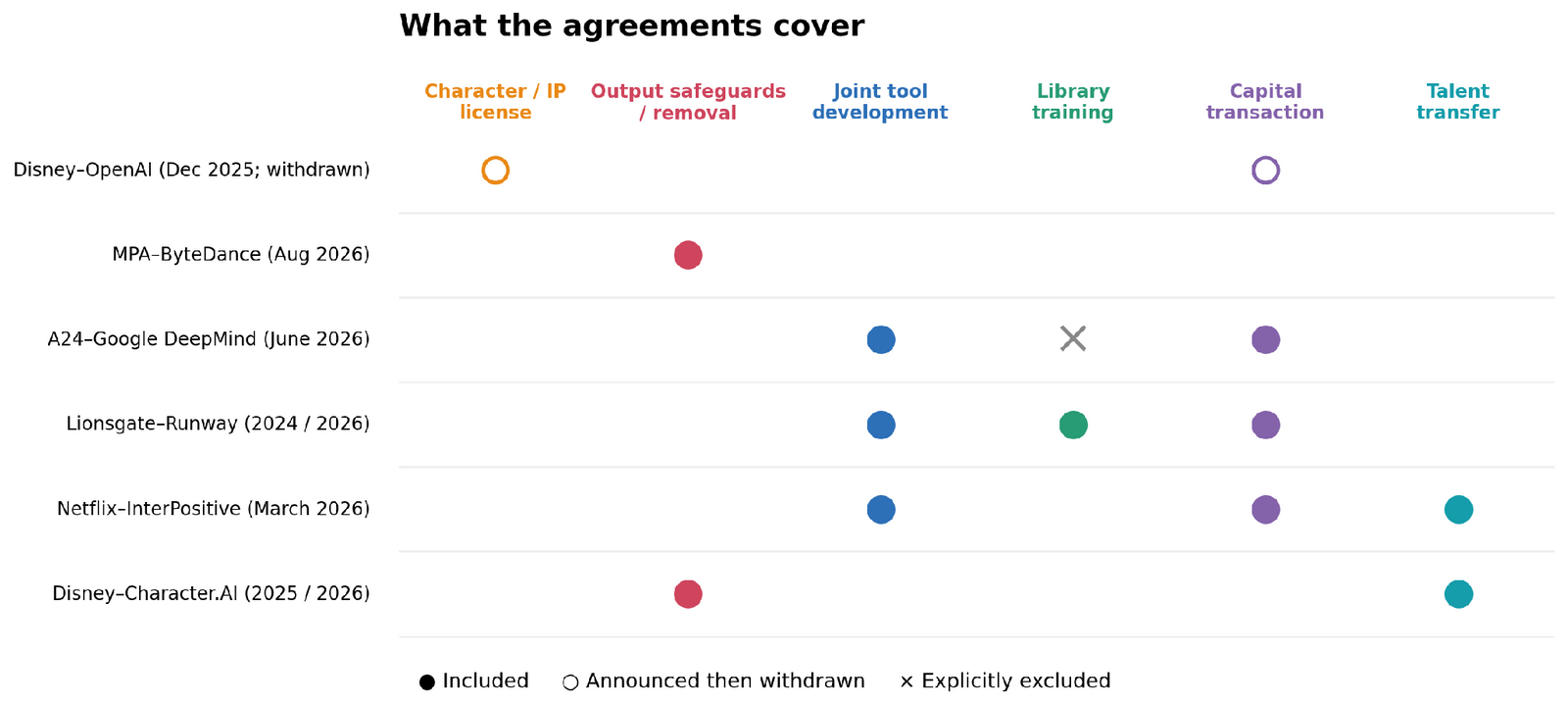
What each deal covers. Of the transactions shown, the Lionsgate–Runway partnership includes library-based model training. Sources: company announcements and reporting.
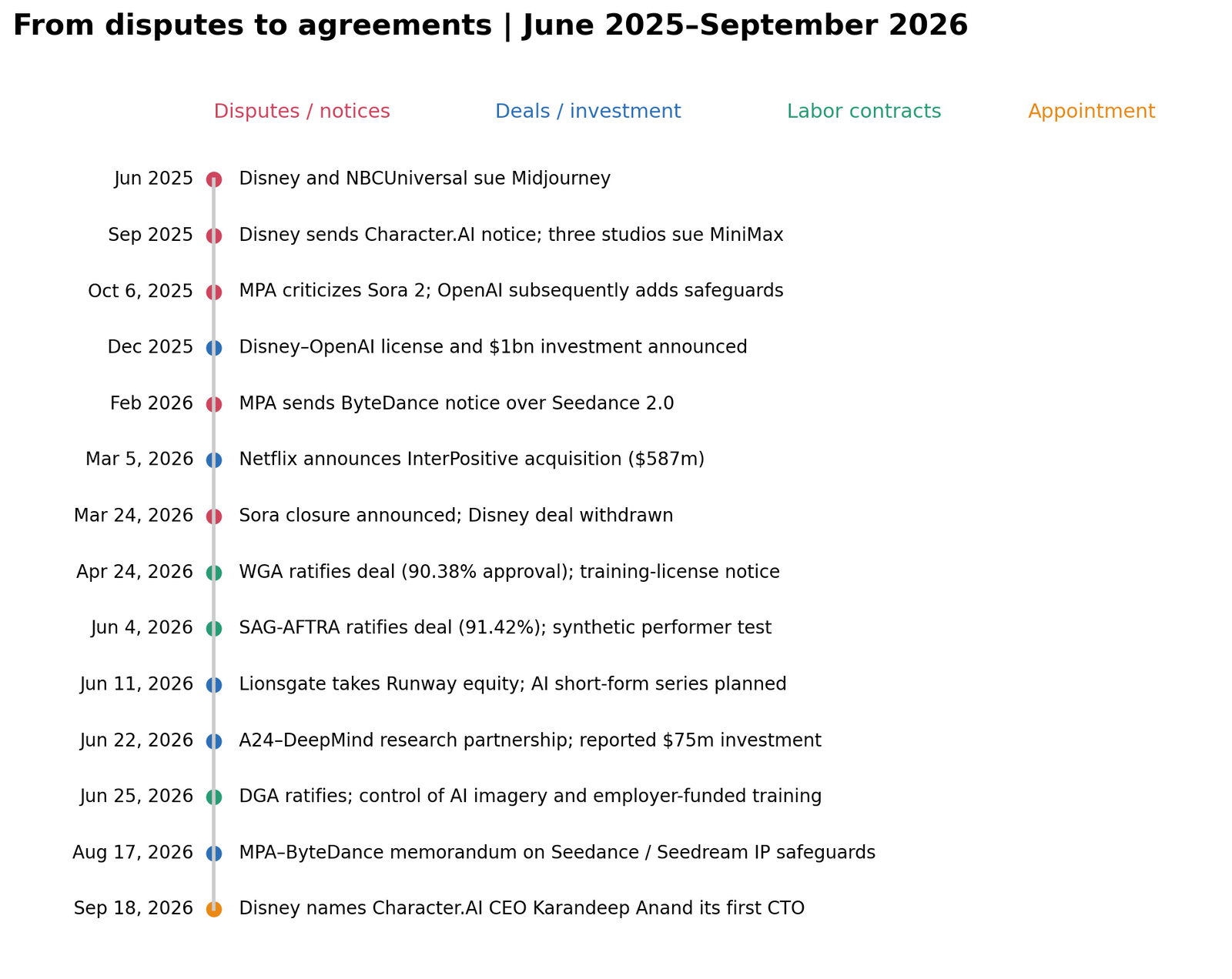
Disputes, corporate agreements, labor contracts and executive appointments from June 2025 to September 2026. Sources: company and guild announcements; Variety, Deadline and Reuters.
The WGA wins notification and bargaining rights on training licenses
WGA members ratified the new Minimum Basic Agreement on April 24, with 90.38% approval, or 4,282 votes. It runs from May 2, 2026, through May 1, 2030. According to the guild’s summary, a company licensing a writer’s script, or a production based on that script, for commercial generative AI training must notify the union in writing. The guild can then request discussions about the license, including compensation for writers. All protections secured in the 2023 strike remain in place. Deadline reported on April 9 that the new agreement does not itself set compensation for training use.
SAG-AFTRA limits synthetic performers but members question the terms
SAG-AFTRA members ratified the television and theatrical agreement on June 4. Of those voting, 91.42% supported it and 8.58% opposed it; turnout was 19.25%. The contract runs from July 1, 2026, through June 30, 2030. The union valued the improvements at more than $700 million, approximately KRW 968 billion. Gene Maddaus reported in Variety that the national board had previously approved the proposed deal with 89% support.
A producer seeking to use a synthetic performer for a role that could be played by a human must demonstrate “significant additional value” compared with a live performer or that performer’s digital replica. The process moves from notice to bargaining and, if necessary, arbitration. The union can seek damages in arbitration if bargaining fails, and those damages are not limited to the fee a human actor would have earned. On ratification day, national executive director Duncan Crabtree-Ireland said the agreement built on the 2023 strike settlement, which required consent and compensation for the use of performers’ AI replicas. He said the new terms would keep synthetic performers exceptional rather than routine. President Sean Astin described the agreement in a May interview as ahead of comparable protections in other industries.
Critics within the union focused on the standard itself and the four-year term. TheWrap reported on May 22 that the contract does not define “significant additional value.” Variety reported that some members wanted tighter restrictions, arguing that studios would face few meaningful barriers to using synthetic performers. The union gains notice and an opportunity to bargain when studios begin using them, but cannot strike over the covered issue before 2030. Some members also questioned extending the usual three-year term to four years when AI is changing so quickly. The Alliance of Motion Picture and Television Producers (AMPTP), seeking to avoid a repeat of the 2023 strikes, made a longer period of labor stability a central bargaining objective.
Members did not vote on AI provisions separately. The package also includes a merger of the SAG-Producers Pension Plan and the AFTRA Retirement Fund, which have remained separate in the 14 years since the unions merged. Studios will contribute an additional 1% to the combined pension plan. Some national board members opposed the merger, and former secretary-treasurer candidate Peter Antico led a campaign against it. Critics cited benefit cuts that followed the 2017 combination of the SAG and AFTRA health plans. Union leaders countered that actuarial projections supported the combined pension fund’s long-term stability. Other contributing employers must still approve the merger. Members therefore voted on synthetic performer protections, pensions, wages and streaming residuals as one package.
After ratification, the AMPTP said the deal improved wages, pension and health contributions, streaming residuals and performer protections. Together with the WGA agreement, it described the package as a practical basis for long-term industry stability. Variety reported that the AMPTP was then negotiating with the DGA ahead of its June 30 expiration, with jobs, AI and health coverage among the key issues.
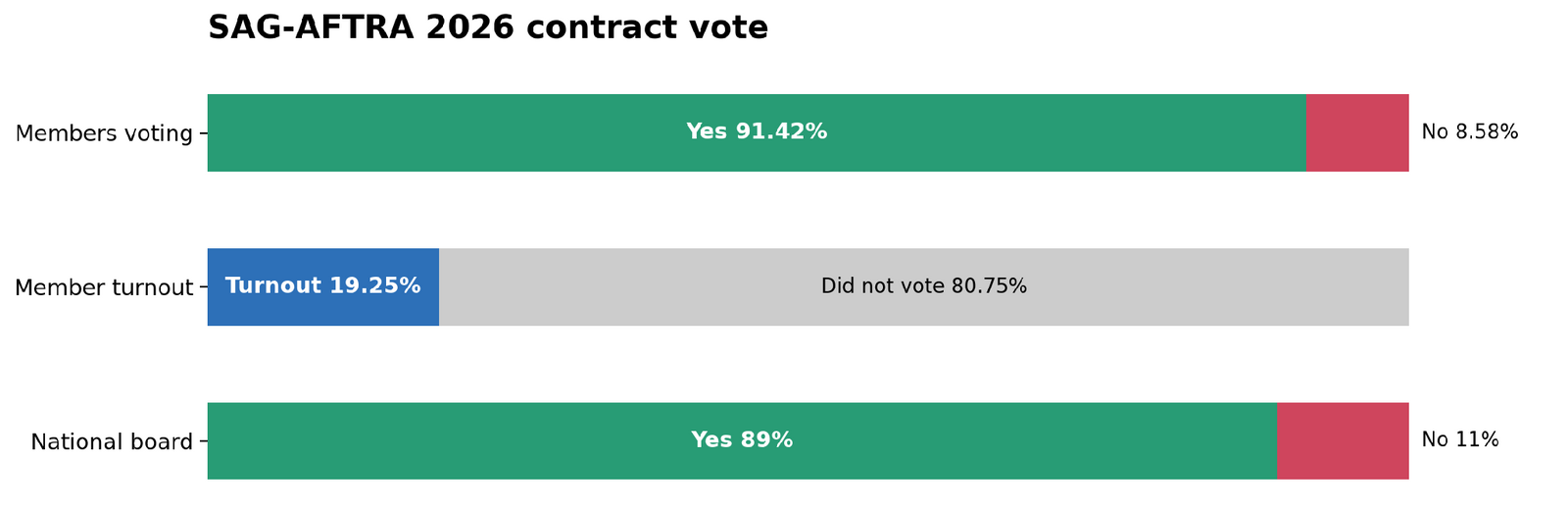
Voting on SAG-AFTRA’s 2026 television and theatrical agreement. Sources: SAG-AFTRA and Variety, June 4.
The DGA secures directors’ control over AI imagery
The DGA and AMPTP reached a tentative four-year agreement on June 9. At a special meeting on June 12, the national board unanimously recommended ratification. Voting closed at 5 p.m. Pacific time on June 25, and the agreement passed. In the June 12 announcement, DGA president Christopher Nolan identified funding health coverage, protecting jobs and safeguarding members’ position as AI changes the industry as the three negotiating priorities, saying the agreement delivered on all three. National executive director Russell Hollander, negotiations chair Jon Avnet, co-chair Karen Gaviola and a 70-member committee representing all guild categories led the talks after more than 18 months of preparation and research. The agreement renews the 2023 protections requiring humans to perform directing and directorial-team work. New generative AI provisions give directors control over AI-generated imagery and establish an employer-funded skills program. Variety reported on June 26 that the program was intended to launch before year-end. The guild also highlighted record employer contributions to health coverage, increases in wages and residuals across categories, and a commitment by company leaders to pursue federal film and television tax incentives. Companies licensing productions for AI training agreed to meet with the DGA to bargain over compensation, following the same broad notification-and-bargaining approach described for the other guilds.
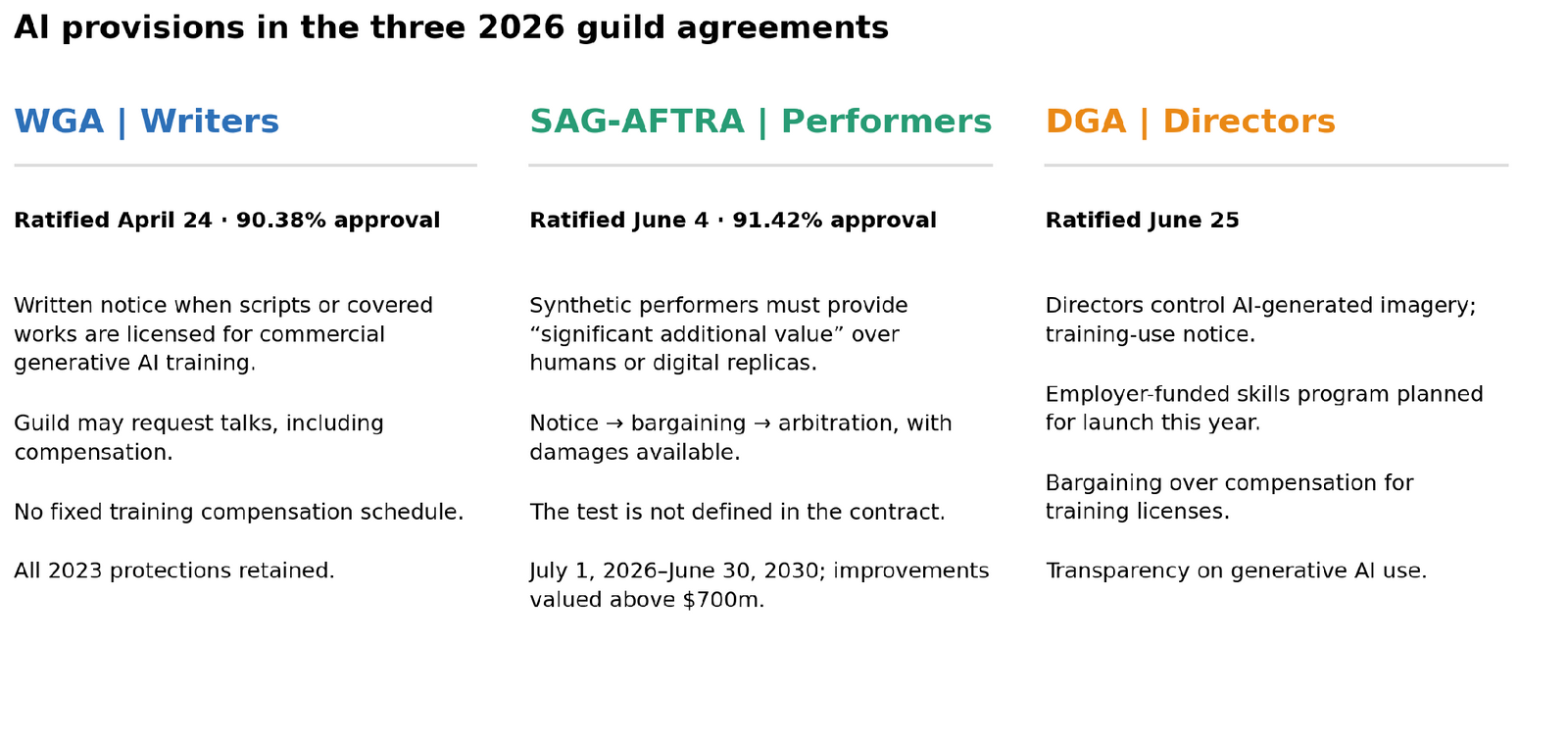
AI provisions in the 2026 writers’, performers’ and directors’ agreements. All three contracts run for four years. Sources: WGA, SAG-AFTRA and DGA announcements; Variety and TheWrap.
All three agreements were reached before expiration and without a strike. Following DGA ratification, the AMPTP thanked the guilds for their cooperative approach. A July 22 analysis by law firm Jackson Lewis concluded that generative AI had become a bargaining issue across the production workforce, rather than for a single occupational group.
Production teams are changing river levels and rebuilding stadium crowds
Executives from Netflix, Lionsgate, Google, Hasbro, Adobe and Teads appeared at the “Entertainment and Media in the AI Age” session at Variety’s Entertainment & Technology Summit in Los Angeles on September 17. Variety business editor Todd Spangler moderated.
Axios’s September 19 report described several practical examples. Lionsgate’s Grace discussed a screenwriter who used “vibe coding”—building an application through AI without conventional coding knowledge—to create a tool for organizing network and studio notes and tracking characters and script changes. Google vice president of technology and society Mira Lane described a director who needed a river to look a particular way. Rather than wait months for conditions to change, the team built a tool to alter water levels, flow direction and weather. Netflix senior director of creative innovation Girish Balakrishnan cited AI-generated establishing shots that could not be filmed by drone and a recreation of the packed Estadio Azteca during the 1970 World Cup, when Pelé played there.
Variety reported on September 18 that Balakrishnan said Netflix had published its standards for production use of AI and that roughly 300 programs had used generative AI. Lane argued that discussions should distinguish between specific applications because the term AI now covers so much. She contributed to Human Generative Workflows, a report led by Kathleen Kennedy and the American Film Institute and released in August. It examines how creators should divide and document their workflows when seeking copyright protection for AI-assisted works.
Audience attitudes vary sharply by medium and age
Luminate Intelligence’s July 2026 special report, AI & Media: Audience Attitudes, combines Wave 17 of its U.S. Entertainment 365 survey, conducted May 5–26 among 2,000 people aged 13 and older, with six external studies. More than half of the U.S. general population used generative AI at least occasionally. Usage reached 66% among 13- to 17-year-olds, compared with 37% among those aged 65 and older. Among 18- to 24-year-olds, 19% had tried generative AI but no longer used it, the highest drop-off rate of any age group.
Knowing that AI had been used generally reduced the willingness to consume content. Net preference was minus 13 percentage points for AI-scripted films and television, minus 18 for AI-produced music and minus 9 for AI-generated social video and images. Games were the only positive category, at plus 10 points. The report linked that relative acceptance to a larger neutral group: 40% said AI made no difference to their gaming preference, compared with roughly one-third in the other media categories.
Age differences were substantial, including within Generation Z. Respondents aged 13–17 were positive across media, with net preference of plus 32 points for AI-scripted film and television and plus 19 for AI music. Among 18–24-year-olds, the corresponding figures were minus 26 and minus 29. The gap for film and television was 58 points. Respondents aged 55 and over were negative across media, and AI music scored minus 47 among those aged 65 and over. Luminate cautioned against treating Gen Z as a single attitudinal group.
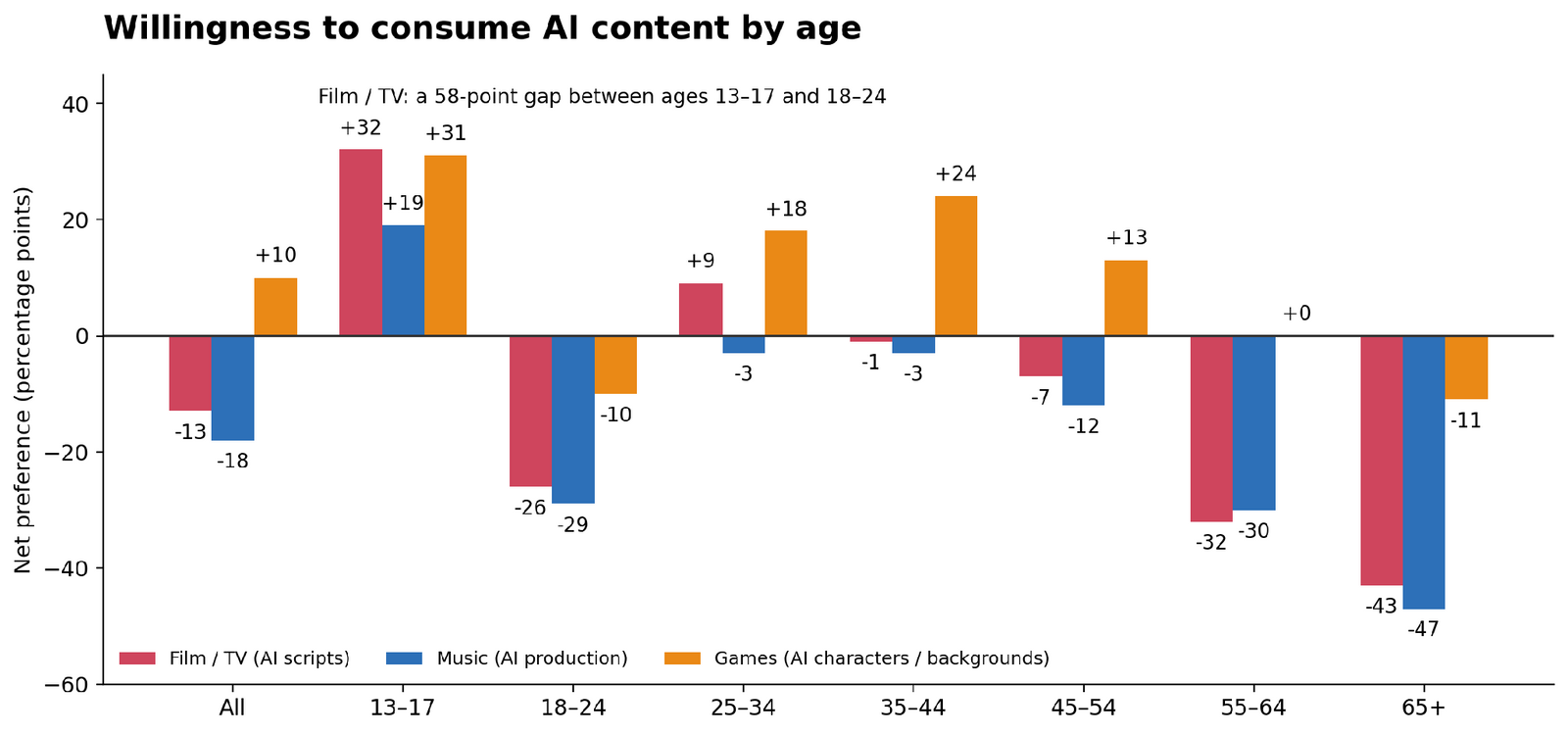
Net preference after learning that AI was used, by age. The film and television gap between ages 13–17 and 18–24 is 58 percentage points. Source: Luminate, U.S. Entertainment 365, Wave 17.
Intended consumption after learning that content was made wholly or partly with AI. “Consume more” combines “more” and “much more.” Source: Bain Media Consumption Survey, May 2025, 5,089 U.S. respondents, as cited by Luminate.
Written content drew the strongest rejection in Bain’s survey: 44% said they would not read an AI-written book at all. For music, video and social media, the combined shares who would stop or reduce consumption were similar, at 59–62%. Games had the largest unchanged group, at 44%. Luminate noted that Bain’s results were more negative toward AI content than its own survey findings.
Viewers distinguish digital actors from sound and visual effects
Luminate asked 1,341 film and television viewers about their comfort with AI at different production stages. Uses replacing actors drew the weakest response. For fully synthetic performers who do not exist in real life, 46% were uncomfortable and 27% comfortable, producing net comfort of minus 19 percentage points. Digital replicas of deceased actors also scored minus 19, while replicas of living actors scored minus 20. Scripts and screenplays scored minus 10. Only about one-quarter were indifferent across the three actor-related categories, compared with roughly one-third for other uses, indicating more polarized responses.
Technical work behind the image received a more favorable response. Sound effects synchronized to on-screen action scored plus 12 points, special and visual effects such as aging an actor scored plus 9, and animation illustration scored plus 8. Foreign-language dubbing using AI voices was close to neutral at plus 2. Luminate said audience attitudes had become more differentiated since the 2023 writers’ and actors’ strikes, while noting substantial discomfort with digital actors and AI-written scripts.
These preferences overlap with the distinctions in the guild agreements. SAG-AFTRA’s “significant additional value” requirement applies to fully synthetic performers; its 2023 consent and compensation rules cover digital replicas of existing actors. The WGA addresses writing, and the DGA controls the use of generated imagery. Lighting correction and visual effects supported by InterPositive, along with the establishing shots and reconstructed crowds discussed at the Variety summit, are closer to the categories receiving positive audience scores.
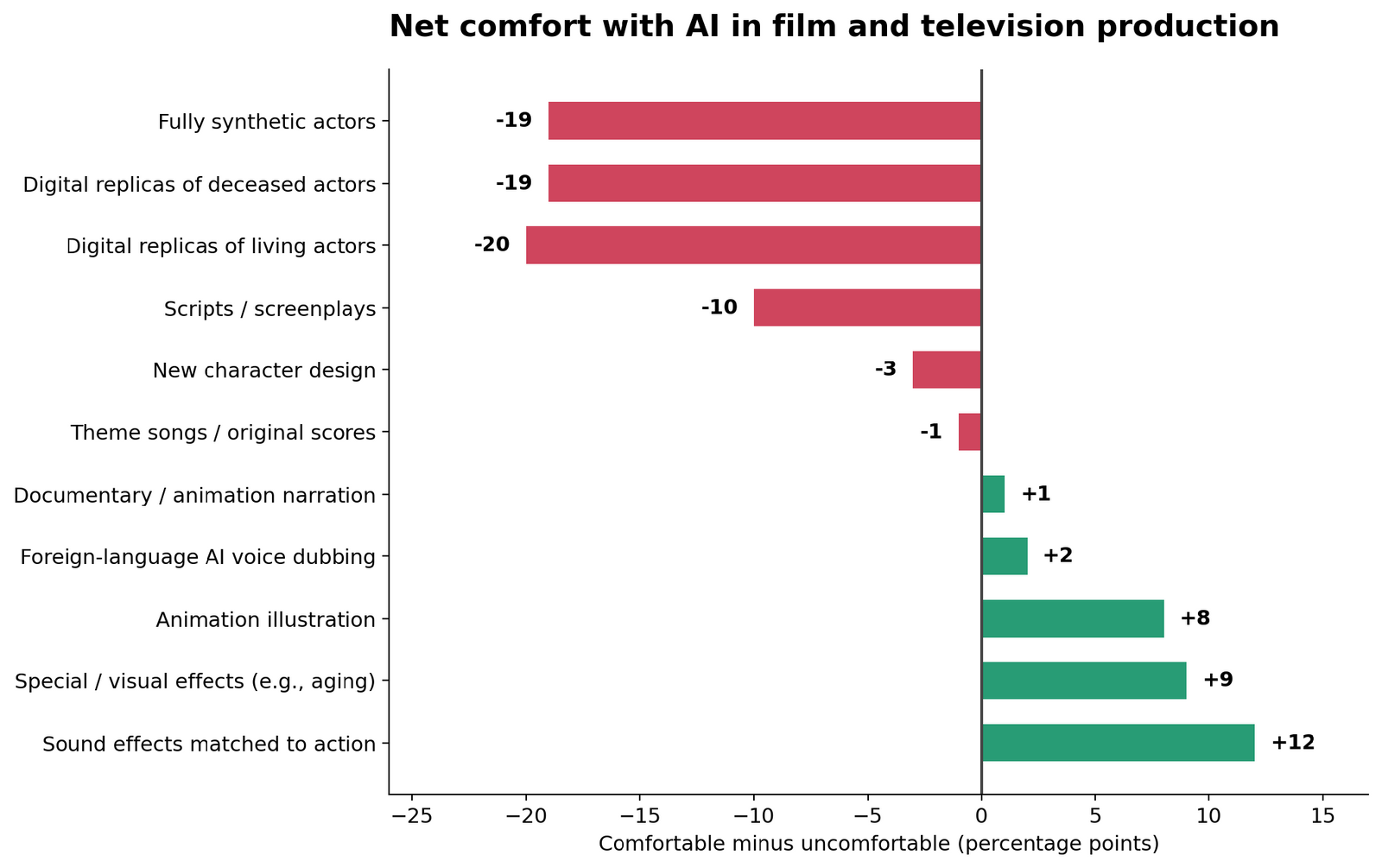
Net comfort with AI uses in film and television production: comfortable minus uncomfortable, in percentage points. Source: Luminate, U.S. Entertainment 365, Wave 17; 1,341 film and television viewers aware of AI.
Three quarters reject replacing an entire cast with AI
A YouGov survey cited in the report, conducted October 2–5, 2025, among 1,106 U.S. adults, found clear differences between filmmaking applications. Replacing all actors with AI characters was considered inappropriate by 75%. The figure was 65% for casting AI characters in roles that humans could perform, 63% for making an entire film without actors, 59% for recreating deceased actors and 57% for writing scripts. By contrast, 64% considered subtitle translation appropriate, 61% approved of visual effects generation and 52% approved of dubbing into a language not used during filming. Generating dialogue in a language an actor cannot speak and editing or assembling filmed scenes each received 45% approval.
Bain’s May 2025 survey of 5,089 respondents showed a similar pattern. Fifty-five percent said they would watch less video generated entirely by AI, and 54% said the same of a production whose entire script was AI-written. The figure fell to 28% when AI revised scripts or improved dialogue, and to 26% when it created scenes that the budget would otherwise have made impossible. The distinction appears to depend less on the medium alone than on whether AI supports or substitutes for human creative decisions.
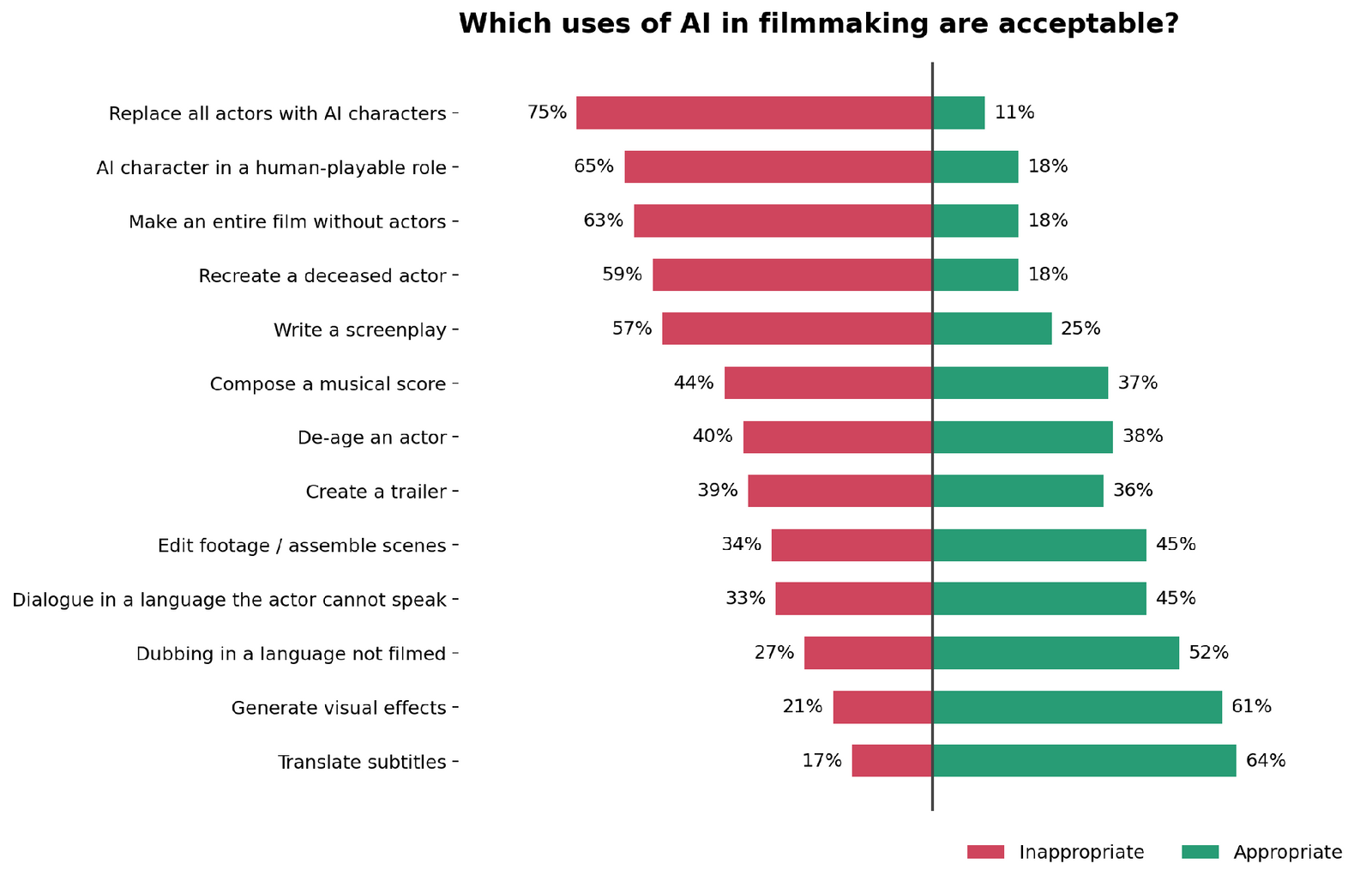
Acceptance of AI applications in filmmaking. Source: YouGov, AI and Filmmaking, October 2–5, 2025, 1,106 U.S. adults, as cited by Luminate.
Audiences want to know when AI has been used
In HUB Entertainment Research’s November 2025 survey of 2,500 people aged 16–74, 72% said AI use in film and television should always be disclosed, and 21% required disclosure when AI played a major role. Only 7% saw no need for disclosure. An Ipsos Digital–Deezer survey of 6,791 music-streaming users worldwide, conducted October 6–10, 2025, found that 73% wanted to know when a recommended track had been generated entirely by AI. In gaming, a March 2026 National Research Group survey of 1,000 adults aged 18–44 found that 49% wanted all uses of AI characters, dialogue and art disclosed, 31% accepted a general statement that AI tools were used, and 17% wanted disclosure of major features only.
Disclosure is also addressed by U.S. labor agreements and Korean law. The DGA contract contains generative AI transparency provisions. Article 31 of Korea’s AI Basic Act imposes labeling obligations on businesses providing generative AI services. Luminate argued that music services would likely bear some responsibility for labeling as large volumes of AI tracks are uploaded and played without listeners knowing how they were made.
Survey overview. Source: Luminate Intelligence, AI & Media: Audience Attitudes, July 2026.
The summit examples—establishing shots, altered river conditions and reconstructed crowds—concern technical production work. SAG-AFTRA’s restrictions concern synthetic performers replacing people. Studio adoption, union protections and audience preferences thus converge around particular uses. The 93% seeking some form of film and television disclosure adds another issue already reflected in the DGA’s transparency provisions and Korea’s labeling rules.
Korea relies on legislation and standard contracts
The U.S. agreements address three connected questions: training data, performers’ faces and voices, and control over production workflows. Hollywood has placed these issues in corporate deals and industry-wide collective bargaining agreements between the AMPTP and unions. In Korea, the discussion centers on legislation and government-backed standard contracts.
Korea’s Basic Act on the Development of Artificial Intelligence and the Establishment of a Foundation for Trust took effect on January 22, 2026. Article 31 requires businesses offering generative AI products or services to give advance notice and label outputs. According to Safety Journal’s January 22 account, webtoon and video creators and production companies using AI as a tool are classified as users rather than the providers subject to that obligation. The responsibility lies with the AI service provider; platforms engaged only in distribution are also excluded from that category. The government has provided a guidance period of at least one year, deferring fact-finding investigations and administrative fines during that time. These provisions concern disclosure, not training compensation.
For unauthorized character chatbots, Korean rights holders can seek suspension of reproduction or transmission under Article 103 of the Copyright Act. The rights holder identifies the material and requests action from the online service provider. Disney’s letter instead demanded proactive identification and removal by the platform. The MPA similarly said in October 2025 that OpenAI bore responsibility for preventing infringement. Character.AI’s response described a notice-and-removal approach closer to Korea’s procedure. For broadcasters and animation or webtoon IP owners negotiating with conversational AI services, allocating that responsibility is an early contractual question.
AI production is already under way in Korea. On April 30, CJ ENM presented the 60-minute hybrid live-action and AI film The House at CGV Yongsan I’Park Mall in Seoul. Performers were filmed for four days in an indoor studio, while backgrounds and visual effects were created using Google’s Imagen, Nano Banana and Veo. The production cost KRW 500 million, approximately $360,000. Kookmin Ilbo reported that production efficiency was five to seven times that of a conventional film. At the presentation, CJ ENM content innovation executive Baek Hyun-jung described the project as a test of workflows that could be applied to film and television drama. Digital Today identified inconsistent backgrounds and resolution differences between live-action and generated imagery as limitations.
Performers seek consent rules for digital likenesses and voices
The Korea Broadcasting Actors Union signed a memorandum with the Korea Digital DNA Center (KDDC) on September 10. Sports Kyunghyang reported the following day that the parties would build a system to record performers’ faces, bodies, expressions and movements as high-resolution 3D data with prior consent, while controlling who may use the data, for what purpose and to what extent. Union chairman Kim Young-jin said a protection framework should be established before technological development infringes performers’ rights.
The Ministry of Culture, Sports and Tourism is developing a standard voice-acting recording contract. A draft obtained by Media Today on February 14 set out how parties should agree to the copying, processing and storage of voice performances for AI training and use. The ministry is also considering an AI copyright standard contract separate from genre-specific agreements. A bill on the protection and use of publicity rights, sponsored by Democratic Party lawmaker Park Soo-hyun, is pending in the National Assembly.
The principle secured by SAG-AFTRA in the 2023 strike was that a performer’s digital replica requires consent and compensation. The Korean actors’ union’s agreement with KDDC likewise begins with prior consent. In the United States, collective bargaining arbitration can enforce the principle; the Korean initiative remains at the memorandum stage. SAG-AFTRA’s notice, bargaining and arbitration procedures operate within negotiations with a single employer-side body, the AMPTP. Korea has no equivalent bargaining counterpart representing broadcasters and production companies together. Standard contracts are recommendations, and their use depends on individual agreements. AI terms therefore enter project-specific performance and writing contracts, with ministry templates and proposed publicity-rights legislation providing reference points.
Korean producers supplying global streaming services also encounter the commissioning company’s requirements. Netflix has published generative AI guidelines for production partners, while Disney has established a new enterprise technology leadership role. Production agreements can bring the client’s rules on permitted AI use and disclosure into Korean projects. A24’s exclusion of its library and Lionsgate’s receipt of equity without a cash investment offer two different precedents for Korean broadcasters and studios negotiating with AI developers.
U.S. and Korean approaches to AI-related issues. Sources: WGA, SAG-AFTRA and DGA announcements; Korean science and culture ministry materials; reporting cited below.
Training compensation remains unsettled as the next bargaining cycle approaches
Between Disney’s September 2025 letter to Character.AI and its September 2026 recruitment of the company’s CEO, the cases examined here produced an MPA memorandum, a research partnership, an equity transaction, an acquisition and three collective bargaining agreements. One announced deal was withdrawn. Together they cover output restrictions, joint tool development, synthetic performer conditions and directors’ control, without establishing a public price for training data. The structures vary: the MPA secured a framework for output safeguards; A24 obtained investment and joined tool development while excluding its library; Lionsgate supplied its catalog for a dedicated model and later acquired Runway equity; Netflix and Disney brought tools or technical talent in-house. Character.AI, OpenAI and ByteDance each faced demands or public criticism before removing characters or introducing safeguards, followed by a hire, a proposed license or a memorandum. These responses address output; they do not publicly settle training rights and compensation. Character.AI’s 2025 proposal for revenue-generating licensed character tools did not become a Disney platform agreement. Disney instead recruited its leadership and engineers. The WGA and DGA contracts leave the payment question to notification and bargaining when a license arises.
Several developments will show how the agreements work in practice. Anand takes office on October 2. Disney, which has identified Disney+ as its main digital connection with fans, is preparing a unified Disney+ and Hulu app before year-end. The DGA’s AI skills program is also intended to begin this year. Lionsgate and Runway have said their first joint work will be AI-generated short-form series using existing IP, but have not announced a release date. The three guild agreements expire in May and June 2030. Until then, arbitration cases may define the practical meaning of SAG-AFTRA’s “significant additional value” test. That test was approved in a vote with 19.25% turnout, within a contract that prevents a strike over the covered issue before 2030.
In Korea, the next milestones are the end of the AI Basic Act’s guidance period, no earlier than January 2027, and the completion of the ministry’s standard contracts. Whether the actors’ union’s data-management system becomes part of actual performance agreements, and whether voice-acting provisions on AI training spread to actors’ and writers’ contracts, will determine how far these protections reach.
Currency conversions use KRW 1,383.3 per U.S. dollar, the September 18, 2026, Seoul foreign-exchange market daytime closing rate.
Quotation and sourcing note: Statements are attributed to the publications or announcements cited. Paraphrases are not presented as verbatim quotations. Production examples from the Variety summit follow Axios’s September 19 report. The A24 investment estimate originated in The Wall Street Journal and was cited by Variety and Deadline.
Charts were prepared by K-EnterTech Hub from figures in the cited announcements and reports.
Sources
1. Axios, Sara Fischer, “Scoop: Disney sends cease and desist letter to Character.AI”, 2025.9.30 — https://www.axios.com/2025/09/30/disney-characterai-cease-desist
2. Axios, Kerry Flynn, “Hollywood studios strike new AI deals as adoption grows”, 2026.9.19 — axios.com
3. The Walt Disney Company press release, “The Walt Disney Company Names Karandeep Anand to Newly Created Role of Chief Technology Officer”, 2026.9.18 — https://thewaltdisneycompany.com/news/karandeep-anand-chief-technology-officer/
4. Variety, “Disney Hires First CTO: Karandeep Anand, Former CEO of Character.AI”, 2026.9.18 — https://variety.com/2026/biz/news/disney-cto-karandeep-anand-character-ai-1236866528/
5. Deadline, “Disney Names Former Character.AI CEO Karandeep Anand As Its First Chief Technology Officer”, 2026.9.18 — https://deadline.com/2026/09/disney-chief-technology-officer-character-ai-1237107626/
6. Variety, “OpenAI Will Shut Down Sora Video App; Disney Drops Plans for $1 Billion Investment”, 2026.3.24 — https://variety.com/2026/digital/news/openai-shutting-down-sora-video-disney-1236698277/
7. Deadline, “Sora Shutting Down, Meaning Disney's OpenAI Investment Is Dead”, 2026.3.24 — https://deadline.com/2026/03/sora-shut-down-disney-investment-1236764689/
8. TikTok Newsroom, “MPA and ByteDance Announce Global Agreement to Protect Intellectual Property on AI Video and Image Generation Models”, 2026.8.17 — https://newsroom.tiktok.com/mpa-and-bytedance-announce-global-agreement-to-protect-intellectual-property-on-ai-video-and-image-generation-models?lang=en
9. MPA press release, “MPA Issues Statement on OpenAI’s Recent Release of Sora 2”, 2025.10.6 — https://www.motionpictures.org/press/mpa-issues-statement-on-openais-recent-release-of-sora-2/
10. IBC, “MPA calls on OpenAI to take immediate action on Sora 2 copyright concerns”, 2025.10 — https://www.ibc.org/monetisation/news/mpa-calls-on-openai-to-take-immediate-action-on-sora2-copyright-concerns/22737
11. Variety, Corbin Bolies, “Motion Picture Association Strikes Deal with ByteDance for IP Protections in AI Video, Image Models”, 2026.8.17 — https://variety.com/2026/biz/news/motion-picture-association-deal-bytedance-ip-ai-seedance-1236836240/
12. Reuters (republished by NBC News), “ByteDance signs AI copyright pact with Hollywood trade group”, 2026.8.17 — https://www.nbcnews.com/business/media/bytedance-signs-ai-copyright-pact-hollywood-motion-picture-association-rcna592977
13. The Next Web, “ByteDance signs a copyright pact with Hollywood’s MPA to rein in its Seedance AI video tool”, 2026.8.17 — https://thenextweb.com/news/bytedance-mpa-ai-copyright-pact-seedance
14. Google, Eli Collins, “Google DeepMind and A24 announce first-of-its-kind research partnership”, 2026.6.22 — https://blog.google/innovation-and-ai/models-and-research/google-deepmind/deepmind-a24-research-partnership/
15. Variety, “Google Invests $75 Million in A24 to Develop AI-Powered Filmmaking Tools”, 2026.6.23 — https://variety.com/2026/film/news/google-a24-ai-filmmaking-tools-1236787297/
16. Deadline, “Google, A24 Partner On AI-Powered Filmmaking Tools”, 2026.6.22 — https://deadline.com/2026/06/google-a24-partnership-ai-filmmaking-tools-1236963944/
17. IndieWire, “A24 Opens Filmmaking Workflow to Google DeepMind in AI Partnership”, 2026.6.23 — https://www.indiewire.com/news/analysis/a24-google-deepmind-workflow-ai-1235201651/
18. Runway, “Runway Partners with Lionsgate”, 2024.9.18 — https://runway.com/news/runway-partners-with-lionsgate
19. SiliconANGLE, “Lionsgate partners with Runway AI to develop custom video generation model” (citing The Wall Street Journal), 2024.9.18 — https://siliconangle.com/2024/09/18/lionsgate-partners-runway-ai-develop-custom-video-generation-model/
20. Bain & Company, Media Consumption Survey, May 2025 (5,089 U.S. respondents), as cited by Luminate.
21. Luminate Intelligence, AI & Media: Audience Attitudes, July 2026. U.S. Entertainment 365, Wave 17 (May 5–26, 2026; 2,000 respondents aged 13+) and studies by YouGov, Bain, HUB, Ipsos–Deezer, NRG and Morgan Stanley.
22. Variety, “Lionsgate Takes Equity Stake in Runway AI, Plans to Draw on Existing Properties for AI-Generated Short-Form Series”, 2026.6.11 — https://variety.com/2026/film/news/lionsgate-equity-stake-runway-ai-franchises-for-ai-show-1236775590/
23. TheWrap, “Lionsgate Takes Equity Stake in Runway, Will Mine IP for AI-Generated Shorts”, 2026.6.11 — https://www.thewrap.com/creative-content/movies/lionsgate-runway-ai-short-films-franchises-ip/
24. Variety, “Netflix Paid $587 Million for Ben Affleck’s AI Startup InterPositive”, 2026.7 — https://au.variety.com/2026/film/news/netflix-paid-587-million-ben-affleck-ai-interpositive-38668/
25. WGA press release, “WGA Ratifies 2026 Minimum Basic Agreement With AMPTP”, 2026.4.24 — https://www.wga.org/news-events/news/press / Summary of the 2026 WGA MBA — https://www.wga.org/contracts/contracts/mba/summary-of-the-2026-wga-mba
26. Deadline, “WGA Reveals Details Of Its Studio Deal”, 2026.4.9 — https://deadline.com/2026/04/wga-2026-contract-details-studios-1236784944/
27. SAG-AFTRA, 2026 TV/Theatrical Contracts — https://www.sagaftra.org/contracts-industry-resources/contracts/2026-tvtheatrical-contracts
28. Variety, Gene Maddaus, “SAG-AFTRA Members Approve Four-Year Deal With AI Terms and Pension Merger”, 2026.6.4 — https://variety.com/2026/film/news/sag-aftra-ratification-ai-pension-merger-1236767288/
29. TheWrap, “SAG-AFTRA's New AI Protections: What They Mean for Real and Synthetic Actors”, 2026.5.22 — https://www.thewrap.com/industry-news/tech/sag-aftra-ai-protections-in-new-contract-synthetic/
30. RedShark News, “SAG-AFTRA AI deal: what the new contract means”, 2026.6.8 — https://www.redsharknews.com/sag-aftra-ai-deal-synthetic-actors-2026
31. DGA press release, “DGA National Board Unanimously Approves Tentative New Agreement”, 2026.6.12 — https://www.dga.org/news/pressreleases/2026/260612_dga_board_recommends_ratification_of_new_contract
32. DGA press release, “DGA National Board Unanimously Approves Tentative New Agreement”, 2026.6.12 — https://www.dga.org/News/PressReleases/2026/260612_DGA_Board_Recommends_Ratification_of_New_Contract
33. Variety, “DGA Members Ratify Four-Year Contract”, 2026.6.26 — https://variety.com/2026/film/news/dga-ratify-contract-four-year-1236789691/
34. Jackson Lewis, “AI Stays at Center Stage at Entertainment Industry Collective Bargaining Talks”, 2026.7.22 — https://www.jacksonlewis.com/insights/ai-stays-center-stage-entertainment-industry-collective-bargaining-talks
35. Variety, “Battling Misconceptions and Figuring Out Use Cases: Entertainment Leaders Navigate AI’s Place in the Industry”, 2026.9.18 — https://variety.com/2026/biz/news/battling-misconceptions-and-figuring-out-ai-entertainment-1236866336/
36. Variety, “The Old and New Hollywood Guard Wielding AI's Might”, 2026.9.18 — https://variety.com/2026/film/features/ai-hollywood-particle-6-higgsfield-innovative-runway-1236865085/
37. Safety Journal, “AI Basic Act takes effect with AI-generated content disclosure requirements”, 2026.1.22 — https://www.anjunj.com/news/articleView.html?idxno=41515
38. Shin & Kim newsletter, “The AI Basic Act and the content industry: transparency obligations”, 2026.2.26 — https://www.shinkim.com/kor/media/newsletter/3142
39. Financial News, “CJ ENM unveils AI film The House”, 2026.4.30 — https://www.fnnews.com/news/202604301710278660
40. Kookmin Ilbo, “Only the actors are live action: an AI film made for KRW 500 million”, 2026.4.30 — https://www.kmib.co.kr/article/view.asp?arcid=1777536593
41. Digital Today, “CJ ENM unveils AI feature The House”, 2026.4.30 — https://www.digitaltoday.co.kr/news/articleView.html?idxno=661855
42. Sports Kyunghyang, “Actors’ faces and voices as digital assets: actors’ union and KDDC seek rights protection”, 2026.9.11 — https://sports.khan.co.kr/article/202609111531003/
43. Media Today, “Who owns a voice in the AI era? Culture ministry develops standard voice-acting contract”, 2026.2.14 — https://v.daum.net/v/pSyZsEd8lI
44. Money Today, “Won closes at 1,383.3 per dollar, down 1.1 won”, 2026.9.18 — https://www.mt.co.kr/economy/2026/09/18/2026091815365178159