
K82 Sets U.S. On-Air Debut for September 14 in D.C. and Baltimore — First K-Exclusive Channel on American Terrestrial TV
Korea–U.S. EnterTech alliance built as a joint testbed combining ATSC 3.0, AI dubbing, datacasting and shoppable TV; Sinclair plans national rollout by 2028 based on Washington-area performance.
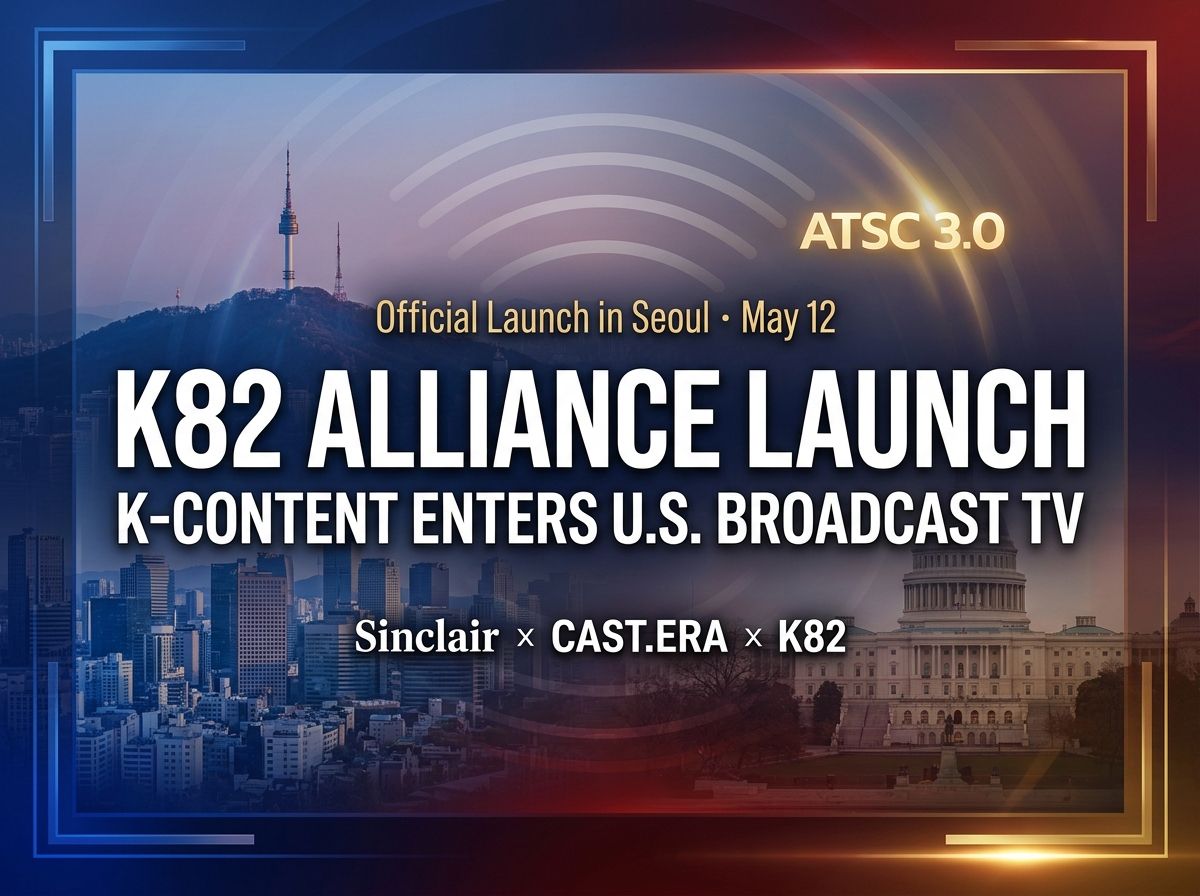
K-content takes its first direct step onto U.S. terrestrial TV television this September. K82 Alliance — the partnership between Sinclair Broadcast Group, CAST.ERA Networks will hold its public launch ceremony in Seoul on May 12, then go on-air officially on September 14 in Washington, D.C. and Baltimore on Sinclair's ATSC 3.0 (NextGen TV) network.

It will be the first time a Korean broadcaster places a K-exclusive channel on American over-the-air television, and Sinclair plans to expand the model nationally by 2028 based on the D.C./Baltimore reference performance.
The launch is more than a single channel. It marks the point where four distinct waves of Korea–U.S. cultural and commercial expansion converge into one demand stream.
K-content hits — Parasite, Squid Game, BTS, BLACKPINK — built the audience. Korean government promotion (KTO's Visit Korea, KOCCA's content campaigns) converted that audience into intent. K-brands (CJ Bibigo, H Mart, Olive Young) followed with retail and food-service expansion that needs U.S. media spend to defend share.
And U.S. ad demand is now pulling all three back upstream into terrestrial broadcast, local TV, FAST and retail media — precisely the inventory K82 will operate. At the same time, ATSC 3.0's transition is opening multi-channel slots that bypass cable and MVPDs entirely. K82 sits at the intersection of both shifts.
■ Milestones at a Glance
May 12 sets the alliance's public profile. September 14 makes it real on U.S. air. 2028 is the scale-up.
THE EXPANSION · Beyond K-Content to K-Culture in the U.S.
The strategic case for K82 rests on a four-stage progression that has been visible in U.S. data for nearly a decade — and is now compounding. Each stage created the conditions for the next, and the fourth stage is what makes a Korean-content terrestrial channel commercially viable for the first time.
Stage one — Korean creative output broke into the U.S. mainstream: Parasite at the Oscars, Squid Game on Netflix's all-time top chart, BTS and BLACKPINK selling out U.S. stadiums. Stage two — Korean public agencies, led by the Korea Tourism Organization (KTO) and the Korea Creative Content Agency (KOCCA), poured budget into U.S.-targeted promotion that converted cultural awareness into purchase and travel intent. Stage three — Korean consumer brands followed the audience: CJ's Bibigo line in U.S. retail, H Mart's grocery footprint, Olive Young's K-beauty distribution.
Stage four — those brands now need U.S. media inventory to defend and grow share, increasingly with global creative that features non-Korean talent and locally-tuned music. Their natural buying destinations are U.S. terrestrial broadcast, local TV, FAST, and retail media networks — which is the inventory K82 will operate.

The Expansion — Beyond K-Content to K-Culture's expansion into the U.S. market (K82 Alliance internal strategic framework)
Read this way, K82 is not a channel launch in isolation — it is the supply-side answer to a demand curve that K-content, Korean public diplomacy and K-brand expansion have spent a decade building.
SEPTEMBER 14 · D.C. + Baltimore as the Reference Channel
K82's official on-air date is Monday, September 14, 2026, beginning in the Washington, D.C. and Baltimore markets on Sinclair's ATSC 3.0 infrastructure. The launch makes K82 the first instance of a Korean broadcaster placing a K-exclusive channel on U.S. over-the-air television — a structural first that no cable carriage, FAST channel or OTT placement has previously achieved.
It is also a reference channel in the technical sense. U.S. terrestrial broadcasters have spent the past several years searching for ways to bring Generation Z and global fandom audiences back to over-the-air viewing — audiences that have largely abandoned linear cable but still consume long-form video at scale through streaming and short-form platforms. K82 is the first channel built specifically to test that thesis at the intersection of three NextGen TV capabilities at once: ATSC 3.0 broadcast delivery, datacasting (non-video data services delivered alongside the broadcast signal), and personalized advertising tied to the household. Both sides' distribution and advertising models are being redesigned simultaneously on this single channel.
Sinclair's commercial plan is staged accordingly. The D.C./Baltimore launch period is treated as a 6–12 month reference window with KPIs tracked across reach, engagement, ad performance and content velocity. Based on results from that window, the company plans to extend K82 to its national footprint of approximately 185 stations by 2028, taking K-content terrestrial coverage from a two-market test to a U.S.-wide platform.

INDUSTRY PERSPECTIVE · “First Real Version of a Korea–U.S. Entertainment tech and TV Alliance”
Prof. Ko Sam-seog — Distinguished Professor at Dongguk University, former Standing Commissioner of the Korea Communications Commission (KCC) and a member of Korea's Presidential AI Committee — characterized the K82 project as “not merely an overseas channel rollout, but the first real-world version of a Korea–U.S. Entertainment tech alliance.”
Prof. Ko's framing positions K82 in a different category from prior Korean media export efforts. Where past initiatives focused primarily on licensing or carriage — moving finished content into foreign distribution windows — K82 is being designed from the start as a multi-stack platform.
The same channel that carries K-drama and K-pop programming will also serve as the live testing ground for AI-generated dubbing pipelines, datacasting service applications, and TV commerce formats that Korean and U.S. partners will operate jointly. That is the shift Prof. Ko characterizes as moving “from content export to ecosystem creation.”
LAUNCH CEREMONY · Seoul, Tuesday, May 12
■ Event Overview
Paid parking is available at Oakwood COEX (KRW 6,000/hour, advance purchase recommended).
■ A First: Korean Broadcast Goes Direct to U.S. Terrestrial
The May 12 ceremony formally launches K82 Alliance and presents — for the first time publicly — the business structure and channel lineup of a Korea-content terrestrial offering on U.S. ATSC 3.0 infrastructure. Built on a strategic partnership with Sinclair Broadcast Group (SBG), the project is the first time a Korean broadcasting initiative is entering U.S. over-the-air television directly, without going through cable or MVPD intermediaries.
Hosts will use the session to formalize the partnership architecture between content, advertising and technology participants, and to share the channel-launch plan in detail — lineup, scheduling logic, and the promotion and marketing direction running into the September on-air date.
■ Key Topics
The May 12 session will cover (i) the formal launch and partnership architecture of K82 Alliance, (ii) member-company introductions and division of roles, (iii) the channel-launch roadmap and timeline, (iv) channel lineup, ad scheduling and content-supply plan, and (v) original content concepts including the channel's Korean News Desk anchor program plus K-Tour, K-Food and K-Beauty influencer collaborations.
The Korean News Desk is being positioned as the channel's signature original — a guide format that introduces U.S. audiences to Korean news, culture and industry in English, and that anchors the rest of the lineup.

■ Detailed Run-of-Show (Draft)
Times and session order are subject to adjustment. The final run-of-show will be communicated in advance.
■ Registration & Inquiries
Sinclair Broadcast Group · CAST.ERA Networks · K82 Alliance PMO