

Venture Money Returns to Media, on One Condition: Direct Revenue From Subscriptions and Events

U.S. venture capital has resumed investing in media startups, restricted to outlets that earn revenue from paid subscriptions and events

Venture Money Returns to Media, on One Condition: Direct Revenue From Subscriptions and Events

Puck at $250M, Semafor at $330M and The Free Press at $150M vs. BuzzFeed sold 86% below peak… Semafor priced its first round in its first profitable year, with half of revenue from events
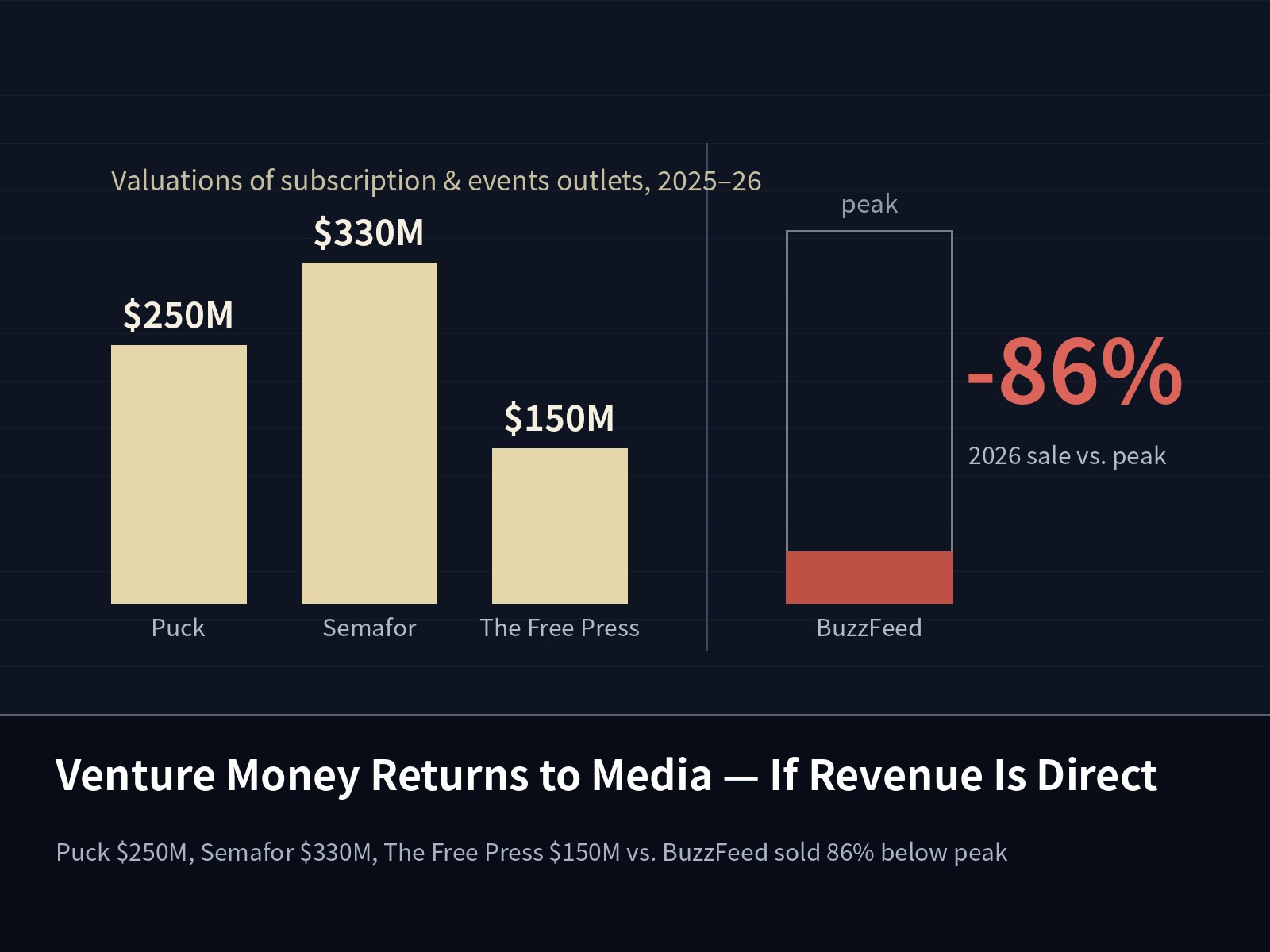
Puck, the paid-newsletter publisher, is in advanced talks with RedBird Capital Partners on an investment valuing it at about $250 million. Reuters reported the talks on August 26 and Puck confirmed them the same day.

Semafor raised $30 million in January at a $330 million post-money valuation, weeks after closing its first profitable year on $40 million of revenue.

The Free Press was acquired by Paramount Skydance last October for $150 million. In its September 4 media newsletter, Axios reported that venture capital is returning to media startups, with interest confined to outlets built on premium subscriptions and events.
Axios's media and journalism industry section, home to the Media Trends newsletter and the deal reporting this article draws on. Photo: Axios screenshot

In the 2010s digital publishers layered advertising revenue on traffic supplied by Facebook and Google. Investors, Axios wrote on May 19, took social distribution, search traffic and scale-based audience growth as evidence that these companies were the next generation of media giants.

When platform traffic fell and advertising budgets tightened, buyers re-priced them on profitability, cash flow and durability, and sale prices came in 86–94% below peak. Venture funding stopped at that point.

The outlets funded this year sell directly to readers. Subscription fees, conference tickets and advertising in member newsletters make up the bulk of revenue, and valuations rest on paying readers and subscription and event income rather than traffic. Fire sales of the first generation and high-multiple investments in the second are proceeding in the same year.

BuzzFeed sells 52% stake for $120 million… 86% below its peak

Year of sale in parentheses. CNET compares its 2024 sale to Ziff Davis with the 2008 CBS acquisition price (fewer brands included). Source: Axios

BuzzFeed's homepage: quizzes, shopping, celebrity and games in the menu, with a 'trending' ranking filling the screen. Photo: BuzzFeed homepage screenshot

BuzzFeed sold a 52% stake to Byron Allen for $120 million in May, roughly 86% below its peak valuation, according to Axios.

Vice went to a creditor group led by Fortress in 2023, Mic to Bustle Digital Group in 2018 and Food52 through a bankruptcy auction in 2025, each at more than 90% below their highs.

CNET's 2024 sale to Ziff Davis was 94% below its 2008 acquisition by CBS, even allowing for the smaller number of brands included. Quartz was bought by Uzabase for $86 million in 2018, sold back to its co-founder for far less in 2020, and has since passed to G/O Media and, in 2025, Redbrick.

Axios asked whether these companies were ever worth their peak valuations. Ad-dependent publishers were priced at the multiples of high-growth technology startups; once platform-driven growth slowed, buyers reassessed them on profitability, cash flow and durability. Family offices and wealthy individuals are partly filling the gap left by venture money.

Puck at $250 million… 3.3 times its $75 million valuation three years ago

A Puck article page. Writer Matthew Belloni's face and name sit directly under the headline; the top menu divides beats such as Washington, Wall Street, Silicon Valley and Hollywood into icons. Photo: Puck screenshot

Since launching in 2021, Puck has raised money from TPG, Standard Investments, the investment arm of Standard Industries, and J. Rothschild Capital Management, among others. Axios puts total funding at more than $17 million; Reuters at about $20 million. According to the August 26 Axios report by Sara Fischer and Dan Primack, RedBird would buy out those shareholders and become the company's largest private investor. Shares held by employees, including founders and journalists, are not part of the transaction. Axios described the deal as a strategic recapitalization and said it would set a benchmark for other media startups seeking an exit. A Media Operator, a media-business newsletter, put Puck's valuation three years ago at $75 million.

Puck has about 50,000 paying subscribers. Axios reports it is on track for more than $20 million in revenue this year, the majority from advertising and sponsorship rather than subscriptions. A $250 million price for the combined Puck and Air Mail business, Axios noted, implies a relatively high multiple of combined revenue, above 10x on a simple calculation. A Media Operator raised the possibility that RedBird negotiated a preferred return, separating the headline valuation from its actual return expectation.

Last year Puck acquired Air Mail, the digital magazine founded by Graydon Carter, in a cash-and-stock deal worth $16 million. Air Mail had raised more than $30 million over two rounds. Neither company was profitable at the time, Axios reported. RedBird was an early investor in Air Mail alongside Standard Investments and TPG and became a Puck shareholder through that acquisition.

A Puck spokesperson told Reuters and Axios that the company is "in advanced discussions about a strategic recapitalization to accelerate growth that would make RedBird our leading investor," adding that its "journalist-centric model, commitment to premium I.P., direct audience relationships, and journalistic independence are at the core of its business model and that will not change." Puck gives journalists equity and a share of subscription revenue. Reuters noted that writers such as Hollywood correspondent Matthew Belloni each have thousands of paying readers, concentrating the company's value in individual authors.

Semafor prices its first round at $330 million in its first profitable year… half of $40 million revenue from events

Puck: valuation under negotiation and revenue excluding Air Mail. Punchbowl: 2023 figures. Sources: Axios, Reuters, Bloomberg, WSJ

Semafor raised $30 million on January 7 at a $330 million post-money valuation, its first priced round since launching in 2022. The Wall Street Journal reported the deal that morning and Axios confirmed it the same day. Semafor generated about $40 million of revenue in 2025 and $2 million of EBITDA, its first profitable year, according to the Journal. Half of revenue came from advertising and half from sponsorship of live-journalism events. Its newsletters are free and ad-supported; subscriptions remain a longer-term option. The valuation is about 8x revenue.

Semafor's homepage on September 5: events and email briefings in the top bar, clocks for six hubs from D.C. to Singapore, and a CEO Signal interview as the lead. Photo: Semafor homepage screenshot

Semafor was co-founded in 2022 by Justin Smith, formerly chief executive of Bloomberg Media, and Ben Smith, formerly editor of BuzzFeed News. Its articles are split into the news, the reporter's view and alternative perspectives, and it employs journalists in the U.S., Africa, Saudi Arabia, the UAE and the U.K. Justin Smith told the Journal that its audience is a "global leadership class" of chief executives, government leaders and policymakers, and that journalism for decision makers is "relatively healthy." Events, he said, sit at the center of the company and of the newsroom.

Semafor launched with about $25 million raised through a SAFE, including $10 million from FTX founder Sam Bankman-Fried. It bought out that stake in 2023 and raised a further $19 million, taking total funding to about $34 million. More than half of the new $30 million came from existing investors including KKR co-founder Henry Kravis, Carlyle's David Rubenstein, 3G Capital co-founder Jorge Paulo Lemann, Gallup and Stand Together.

New investors include Penny Pritzker's PSP Partners, Belgian businessman Thomas Leysen, Douglas Emslie of Cuil Bay Capital and K Group, led by Antenna Group chairman Theodore Kyriakou. There is no lead investor and no board seats were granted. The syndicate consists of wealthy individuals and family offices rather than venture firms.

Proceeds will fund the expansion of the Semafor World Economy Summit, its annual chief-executive gathering in Washington, D.C., new event markets and journalist hires. The company plans to expand its D.C., Gulf and business newsletters and launch a China newsletter for chief executives. The Journal contrasted Semafor with The Messenger, which closed in early 2024 after less than a year, and with BuzzFeed, whose shares have fallen more than 90% since its 2021 listing.

The Free Press sold to Paramount for $150 million… founder also becomes CBS News editor-in-chief

The Free Press homepage on September 5: Forum, Newsletters and Subscribe in the top bar, with sections organized by theme, from 'Today in America' and 'The New Economy' to 'Israel and the Jewish World'. Photo: The Free Press screenshot

Paramount Skydance acquired The Free Press, founded by former New York Times writer and editor Bari Weiss, on October 6, 2025. The stock-and-cash deal valued the outlet at about $150 million, according to Axios. The Financial Times reported annual revenue of more than $15 million at the time, putting the price at about 10x. The Free Press publishes a newsletter and the "Honestly" podcast hosted by Weiss, and held its first live debate event in Los Angeles in September, weeks before the deal.

Under the terms of the deal Weiss became editor-in-chief of CBS News while remaining chief executive and editor-in-chief of The Free Press. She reports to Paramount Skydance chairman and chief executive David Ellison rather than to CBS News president Tom Cibrowski.

In a note to staff, Ellison wrote that most of the country wants balanced, fact-based news and that he wants CBS to be their home. Axios grouped the acquisition with a series of Ellison decisions moving CBS News coverage to the right. Weiss describes herself as a centrist.

With advertising and venture investment slowing and buyers scarce, Axios wrote, media executives seeking to raise money or sell would cite The Free Press price as evidence of a recovering market. Semafor followed three months later and Puck ten months later.

Punchbowl at $100 million on $20 million revenue… FOS grows revenue 85% and triples it in two years

Punchbowl News homepage on September 4: a free morning newsletter sign-up, 'Premium'-tagged stories and a 'Become a Member' button occupy the top of the page. Photo: Punchbowl News homepage screenshot

Punchbowl News was valued at $100 million in 2023 on an estimated $20 million of annual revenue, per a December 14, 2023 report in The New York Times. It runs on premium subscriptions and sponsorship for its Washington politics newsletters, and Axios reports the business has grown substantially since.

Front Office Sports, which covers the business of sports, took its first investment from RedBird IMI in November 2023 and sold a majority stake in 2024. RedBird IMI bought out SC Holdings, the company's first investor, which exited after five years, according to the announcement. Jeff Zucker, chief executive of RedBird IMI and chairman of the FOS board, said revenue had grown 85% year on year. No valuation was disclosed. Founder and chief executive Adam White told Axios this year that revenue should exceed $20 million in 2026, up from $6 million two years earlier.

By the company's figures, FOS records more than 175 million social impressions, 35 million newsletter opens, 10 million video views and 2 million page views a month, and its content runs on screens in more than 50,000 buildings and venues across North America through 15-plus distribution partners. Web page views are the smallest of the four metrics. White said the RedBird IMI investment funded senior hires and an expanded events program.

Front Office Sports monthly reach (company figures)

Metric

Monthly

Note

Social impressions

175 million+


Newsletter opens

35 million

Direct channel

Video views

10 million


Web page views

2 million

Smallest of the four

Out-of-home screens

50,000+ buildings and venues

15+ distribution partners, North America

Source: Front Office Sports announcement (2024)

Major U.S. media startup transactions, 2023–2026

Company

Deal

Valuation

Revenue

x Rev.

Investor / buyer

Revenue mix

Puck

Aug 2026 recapitalization talks (buyout of existing holders)

~$250M

>$20M (2025, excl. Air Mail)

12x

RedBird Capital (to become largest investor)

Majority ads & sponsorship; 50,000 paid subs

Semafor

Jan 2026 first priced round, $30M

$330M post-money

~$40M (2025), $2M EBITDA

8x

Kravis, Rubenstein, Lemann et al. + PSP, Antenna; no lead

50% ads, 50% event sponsorship; free newsletters

The Free Press

Oct 2025 stock-and-cash acquisition

~$150M

>$15M (FT)

10x

Paramount Skydance

Paid subscriptions, podcast; live events launched

Punchbowl

Dec 2023 investment

$100M

~$20M (est.)

5x

Undisclosed

Premium subscriptions, sponsorship

Front Office Sports

Nov 2023 first investment → 2024 majority (SC Holdings buyout)

Undisclosed

>$20M (2026 est.), $6M two years ago, +85% YoY

RedBird IMI (CEO Jeff Zucker)

Ads, events; newsletter, social, venue-screen distribution

Workweek

Aug 2026 Series B, $17M ($36.5M total)

Undisclosed

>$20M, unprofitable

Next Coast Ventures (lead), Aperiam

B2B newsletter ads; 150,000 verified subs

Multiples are simple calculations dividing disclosed valuation by the nearest reported annual revenue. Sources: Axios, Reuters, WSJ, FT, NYT, Adweek

Puck: valuation under negotiation divided by 2025 revenue excluding Air Mail. Sources: Axios, Reuters, WSJ, FT, NYT

All six companies sell primarily to their own audiences: events at Semafor and Front Office Sports; subscriptions and sponsorship on a paid-reader base at Puck, The Free Press and Punchbowl; B2B advertising against verified subscribers at Workweek. A Media Operator expects that if RedBird takes control of Puck, expanding events along the Semafor model would be the first option considered.

RedBird, the common investor across Puck, Air Mail and The Free Press

RedBird Capital Partners features in several of these transactions, according to Axios. It was an investor in Paramount Skydance when that company bought The Free Press, invested early in Air Mail and became a Puck shareholder through the Air Mail acquisition; if the current talks close it becomes Puck's largest investor. RedBird IMI first invested in Front Office Sports in November 2023 and took majority control in 2024. RedBird IMI is a joint venture between RedBird Capital and Abu Dhabi-based International Media Investments, run by former CNN president Jeff Zucker. RedBird Capital, founded in 2014 by Gerry Cardinale, manages about $10 billion across sports, media and entertainment, and financial services.

RedBird's media and entertainment holdings include Artists Equity, the studio founded with Ben Affleck and Matt Damon, and EverPass Media, a commercial sports distribution company that DAZN agreed to acquire on August 26, according to TheWrap. RedBird is also a principal backer of Paramount Skydance's acquisition of Warner Bros. Discovery, which a dozen states are contesting in court over theatrical and television distribution, Reuters reports.

Workweek raises $17 million… venture money reaches B2B creator newsletters

Workweek, a B2B newsletter company, raised a $17 million Series B on August 27 led by Next Coast Ventures with participation from Aperiam Ventures. Total funding stands at $36.5 million, including a $12.5 million Series A in June 2024, according to Adweek. Founder and chief executive Adam Ryan told Adweek that revenue exceeds $20 million and the company is not yet profitable. No valuation was disclosed.

Workweek's newsletters page: each title, in marketing, DTC marketing or fintech, is fronted by the face and name of the practitioner who writes it. Photo: Workweek screenshot

Workweek operates as a network of practitioner creators rather than a newsroom: industry professionals who keep their day jobs and front a branded newsletter in their field. It runs five verticals, in finance, HR, marketing, commerce and healthcare, with eight creators and about 150,000 subscribers.

Subscribers are verified at the individual and company level, allowing the company to sell account-based targeting to advertisers. Alongside the round, Workweek opened a platform that lets outside creators publish ad-supported newsletters on its ad network. Thirty-five newsletters are in the pipeline, and the network is due to open fully to outside creators in early 2027.

Beehiiv, the newsletter infrastructure company, raised $33 million in 2024 in a round led by NEA. Axios reported that creator platforms focused on industry coverage are drawing venture capital.

50,000 paying readers underpin a $250 million price… traffic scale drops out of the valuation

In May Axios wrote that buyers now prioritize profitability, niche audiences and intellectual property over scale; in September it reported that venture capital is returning to outlets that meet that test. The figures investors examine in these deals are paying subscribers, subscription revenue and event revenue, not monthly visitors.

Puck's 50,000 subscribers, Semafor's $40 million of revenue and Front Office Sports' tripling of revenue in two years formed the case for each transaction. Adam White told Axios that "the best media brands today are ones that matter to their audiences and not to algorithms," adding that "just like other types of asset classes, high-quality media brands with diversified revenue bases that matter to their audiences are hard to come by."

Korea: 63% of news users go through portals, the highest of 48 markets… direct visits the lowest

In the Reuters Institute Digital News Report 2025, conducted in Korea with the Korea Press Foundation (한국언론진흥재단), 63% of Korean respondents named search engines and news aggregators, chiefly portals, as their main route to online news, the highest share of the 48 markets surveyed. Direct visits to publishers' sites and apps were the lowest. Trust in news stands at 31%. Gallup Korea's (한국갤럽) 2025 survey found paid text content lagging paid video and music.

Under this structure, Korean publishers' digital revenue consists of portal licensing fees and traffic-based advertising on and around the portals. The figures U.S. buyers price on, paying subscribers, revenue per reader and the share of revenue from events, do not exist at most Korean outlets. The reason BuzzFeed sold at 86% below its peak and the reason Korean outlets cannot begin a valuation negotiation are the same: the asset a buyer wants is the reader relationship, not the traffic, and in Korea the reader relationship belongs to the portal.

Paying readers outside the portal come first… the U.S. models read as a sequence

The implication for Korea is not a menu of four models to choose from but a single sequence. The direction is direct sales: an outlet sells to readers, then sells advertising and events on the strength of that reader data. The order is paying readers, advertising against verified readers, events, then capital, and each stage depends on numbers produced by the one before it.

The starting point is a single field, not general news. Punchbowl covers Congress; Front Office Sports the money in sports; Puck insider information on Hollywood, Washington and Wall Street. In Korea, willingness to pay has been demonstrated in business and startup coverage (Longblack 롱블랙, Outstanding 아웃스탠딩, NEWNEEK 뉴닉) and knowledge content (JoongAng Ilbo's fol:in 폴인); fields where corporate readers can subscribe on company expense, such as semiconductors, biotech, games, entertainment technology and the sports business, still lack a specialist outlet. For a general newspaper the workable form is not a paywall across the newsroom but spinning out a beat and its reporters as an independent brand, with equity and a share of subscription revenue for the journalists, as at Puck. Reuters' observation that individual journalists' paying readers underpin Puck's value is a risk, and also a description of an asset Korean publishers do not yet hold.

Once paying readers exist, the nature of advertising changes. Workweek verifies its 150,000 subscribers by individual and employer and sells account-based targeting.

What a Korean B2B advertiser buys from a portal is reach; what it buys in this model is a list of decision makers. Verifying subscribers by company e-mail domain and capturing role and employer data can begin at 10,000 subscribers regardless of traffic. Semafor keeps its newsletters free while earning half of $40 million from advertising because a free newsletter with reader data commands higher rates than portal traffic.

Events are a product that sells only with reader data behind it. Semafor earns half its revenue from live-event sponsorship; Front Office Sports expanded its events program after RedBird IMI's investment.

Korean newspapers have run forums for decades, but most are business-side events separated from the newsroom, and attendee data is not linked to subscriptions or advertising. The Semafor method puts the newsletter audience on stage and sells it to sponsors, with journalists moderating and the newsroom setting the program.

Capital is the last step. Semafor raised from a syndicate of wealthy individuals and family offices with no lead investor and no board seats; The Free Press was bought by a media group that gave its founder a broadcast newsroom; Puck's deal is a private-equity buyout of institutional holders. In Korea the realistic exit is acquisition rather than venture funding: a broadcaster, telecom or platform buying a specialist digital outlet to secure editorial leadership and paying readers together, on the Paramount–Free Press pattern, or strategic capital from wealthy investors or industry associations on the Semafor pattern. What an outlet must have ready are the numbers: paying subscribers, revenue per reader, the share of revenue from events, and each journalist's contribution to subscriptions.

Applying the U.S. models in Korea

Stage

U.S. case

Korea today

Precondition

Paying readers

Punchbowl, Puck: one beat, journalist brands, 50,000 paid subs

Limited to business verticals (Longblack, Outstanding, fol:in); newspapers at login/membership stage

Pick a beat, spin out beat and reporters, journalist equity and revenue share

Verified-reader ads

Workweek: 150,000 verified subs, account-based B2B targeting. Semafor: ads on free newsletters

Portal traffic ads; advertisers buy reach

Company-domain verification, role and employer data; viable from 10,000 subs

Events

Semafor: 50% of revenue. FOS: program expanded after investment

Business-side forums; attendee data not linked to subs or ads

Newsroom sets program; reader data packaged for sponsors

Capital / exit

Semafor: wealthy syndicate. Free Press: media-group acquisition. Puck: PE recap

Media a minor venture sector; few acquisitions

Quantify paid subs, revenue per reader, event share, per-journalist contribution

Sources: Axios, WSJ, Reuters, Adweek, company announcements; Korean data from Digital News Report 2025 and public materials

Paramount paid $150 million for an editor-in-chief and paying readers together… what the broadcaster bought was a reader relationship, not a channel

These deals are not only a newsletter story. The buyer in the largest of them, The Free Press, is a broadcast group. Paramount Skydance paid $150 million for The Free Press's paying readers and its founder in one transaction, and installed the founder as editor-in-chief of CBS News. The company's statement gave the reason: a CBS News that spans television, streaming, digital, audio, social media and events requires unified editorial leadership. A broadcast news division run on ratings and advertising bought a digital outlet run on subscriptions and placed its editorial method and reader relationship on top of the broadcast organization.

The line between video and newsletters is also disappearing inside the deals. Front Office Sports records 10 million video views a month, distributes to screens in 50,000 buildings and venues, and carries a 'Shows' item in its top menu; Punchbowl and Workweek have the same menu item in the same place. The Free Press's 'Honestly' podcast was a core product before the acquisition. The buyers straddle video too: RedBird IMI is run by former CNN president Jeff Zucker, and RedBird Capital built EverPass, the commercial sports distribution company, before selling it to DAZN, while financing Paramount's purchase of Warner Bros. Discovery. Justin Smith's remark to the Journal that journalism for decision makers is "relatively healthy" is a comparison with ad-funded mass media.

Two roles are open to Korean broadcasters. The first is buyer. Broadcasters have reach and brand but no paying relationship and no viewer data, the two things Paramount bought from The Free Press. Acquiring a Korean paid digital outlet or newsletter brand in politics, business or an industry field and putting its editor in charge of the digital news organization is faster than building paying readers in-house.

The second is spin-out. Broadcast reporters and anchors are the most recognized journalist brands in Korea, and Puck's valuation rests on the paying readers of individual brands of that kind. Spinning out paid newsletters and memberships by beat under anchors' and reporters' names, with equity and revenue share, creates the paying-reader data broadcasters currently lack.

Sports is a field where broadcasters already hold the assets. A broadcaster with media rights, production staff and venue access needs, to build a sports-business outlet covering clubs, leagues, rights and sponsorship rather than results, what Front Office Sports built: readers held outside the portal through newsletters and venue-screen distribution.

Events are likewise a field where broadcasters have stages, production crews and booking power; the difference from a business-side forum, on the Semafor model, is that the newsroom sets the program and viewer data becomes the product sold to sponsors.

If, as The Free Press acquisition showed, the exit for a digital outlet that has completed this sequence is a broadcaster, the broadcaster can also choose to occupy that position first.

Media outlets mentioned in this article

Outlet

URL

What it is

Puck

puck.news

Founded 2021. Paid newsletters written under individual journalists' names covering Hollywood, Washington, Wall Street, Silicon Valley and media. Journalists hold equity and share in subscription revenue

Semafor

semafor.com

Founded 2022 by former Bloomberg Media CEO Justin Smith and former BuzzFeed News editor Ben Smith. Free newsletters plus live events for executives and policymakers (World Economy Summit)

The Free Press

thefp.com

Founded 2021 by former New York Times columnist Bari Weiss. Subscription newsletter and the 'Honestly' podcast. Acquired by Paramount Skydance in 2025

Punchbowl News

punchbowl.news

Founded 2021 by former Politico reporters. Congress and Washington politics newsletters on premium subscriptions and sponsorship

Front Office Sports

frontofficesports.com

Founded 2014. Covers the business of sports: teams, leagues, media rights, sponsorship. Distributed via newsletters, social and venue screens; runs conferences

Air Mail

airmail.news

Weekend digital magazine founded 2019 by former Vanity Fair editor Graydon Carter. Acquired by Puck in 2025

Workweek

workweek.com

Founded 2021. B2B newsletter company whose newsletters are run by working practitioners in finance, HR, marketing, commerce and healthcare; the company sells B2B advertising

beehiiv

beehiiv.com

Founded 2021. Newsletter publishing and monetization platform used by creators and publishers

BuzzFeed

buzzfeed.com

Founded 2006. The emblematic social-traffic digital publisher. Listed via SPAC in 2021; sold a 52% stake to Byron Allen in 2026

Vice

vice.com

Began as a magazine in 1994; youth-focused digital media once valued at $5.7 billion. Sold to creditors after 2023 bankruptcy

Mic

mic.com

Millennial news site founded 2011. Sold to Bustle Digital Group in 2018

Food52

food52.com

Cooking and home media and commerce company founded 2009. Sold at a bankruptcy auction in 2025

Quartz

qz.com

Global business news site founded by Atlantic Media in 2012. Owners since: Uzabase, its co-founder, G/O Media, Redbrick

CNET

cnet.com

Tech news and reviews site founded 1994. Sold to CBS in 2008, Red Ventures in 2020, Ziff Davis in 2024

Descriptions based on each outlet's own materials and public reporting

Notes

Text in double quotation marks is a statement as reported by the cited outlet; unquoted statements summarize reporting.

Sources

· Axios, "Frothy media market" (Media Trends newsletter), September 4, 2026

· Axios, "The great digital media valuation collapse" (Kerry Flynn, Sara Fischer), May 19, 2026

· Axios, "Byron Allen buys 52% of BuzzFeed", May 12, 2026

· WSJ, "Media Startup Semafor Raises $30 Million in New Funding Round" (Isabella Simonetti), January 7, 2026 / Axios, "Semafor raises $30M at a $330M valuation" (Sara Fischer), January 7, 2026

· Axios, "Paramount Skydance acquires The Free Press for $150M" (Sara Fischer), October 6, 2025 / FT report on The Free Press revenue

· Front Office Sports, "RedBird IMI Takes Majority Stake in Front Office Sports", company announcement, 2024

· NYT, "Punchbowl News valued at $100 million", December 14, 2023

· Axios, "Puck in advanced talks with RedBird for a deal valuing it around $250M" (Sara Fischer, Dan Primack), August 26, 2026 / Axios, Puck–Air Mail stock deal, October 30, 2025 / Mediaite on the $16 million Air Mail sale

· Reuters, "Exclusive-Puck in advanced talks for investment by RedBird Capital Partners at $250 million valuation", August 26, 2026

· Bloomberg, "RedBird Seeks Lead Stake in Puck at $250 Million Valuation", August 26, 2026

· TheWrap, "Puck in Talks for $250 Million Investment From RedBird Capital Partners", August 26, 2026

· A Media Operator, "What the Puck?", late August 2026

· Adweek, "Workweek Raises $17 Million, Debuts B2B Newsletter Platform", August 27, 2026

· Korea Press Foundation, Media Survey Vol. 11 No. 3, "Korea's digital news landscape as seen in the Digital News Report 2025", June 17, 2025 / Journalists Association of Korea, June 19, 2025

· Gallup Korea, Usage of 18 media, content and social network services (2025)

· citybiz, "Workweek Raises $17M to Expand B2B Creator Platform", September 1, 2026