
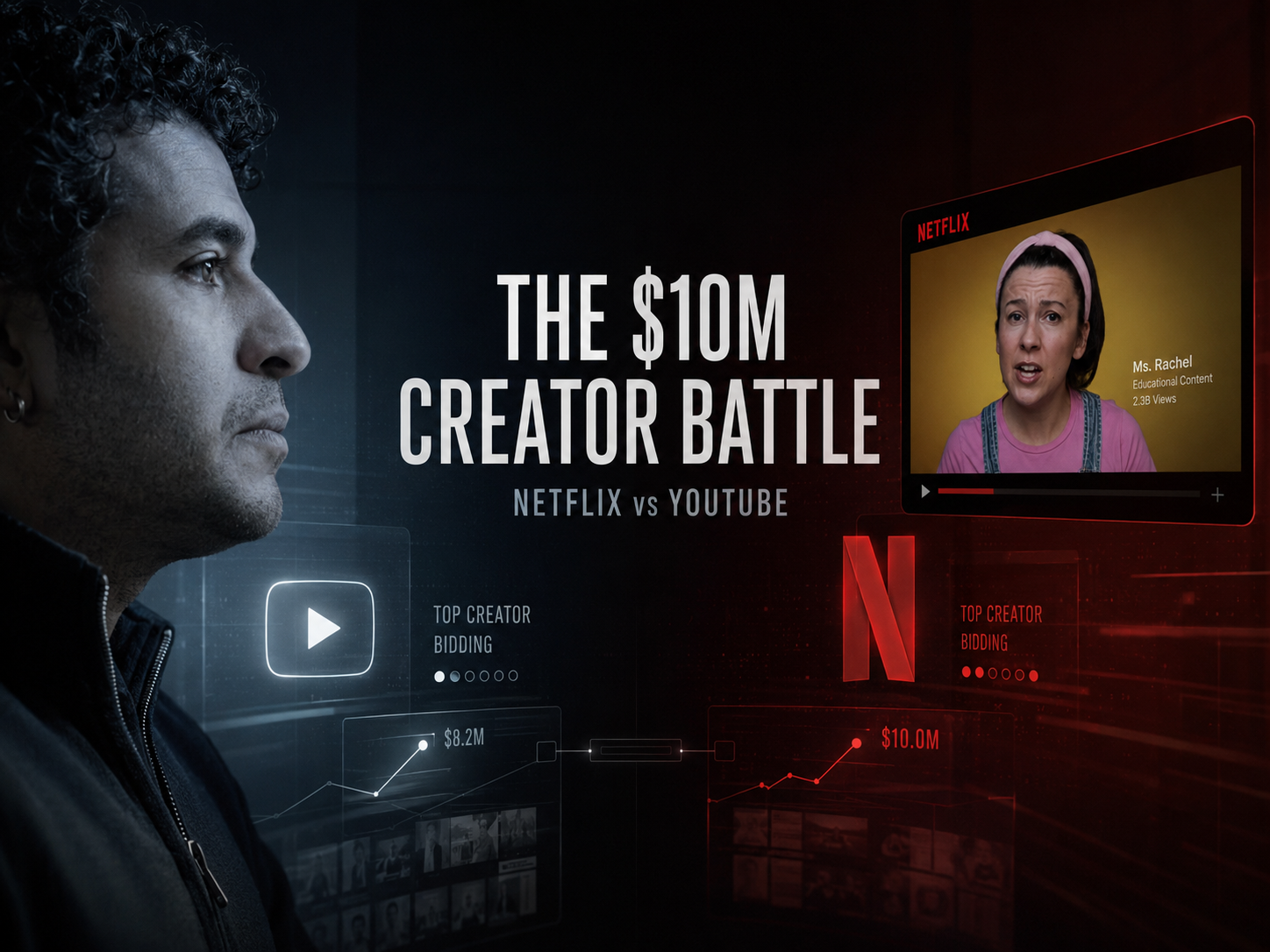
Netflix signs 20-plus YouTubers and bars podcast video from YouTube; YouTube counters with up to $10 million 'stay' packages for its top 15
YouTube has offered roughly 15 of its top creators up to $10 million each. The condition is exclusive uploading to YouTube for a set period. The Ankler, the U.S. entertainment-industry outlet, reported the figures on August 26 and the same day on its Ankler Agenda podcast.
It is the first time in years YouTube has paid creators to stay. Bloomberg reported on August 19 that the payments take two forms, direct financing of programs and a share of major brand deals, and that creators who release simultaneously on Netflix will be left out of marketing campaigns, events and certain brand-campaign proceeds. Netflix has signed more than 20 YouTube creators over the past two years.
Behind YouTube's exclusivity terms is Netflix's offensive. In July, Netflix signed Rhett & Link, the Stokes Twins, Alan Chikin Chow and Nick DiGiovanni with a condition that their videos go up on Netflix the same day they go live on YouTube.
Netflix's podcast deals, as reported so far, let audio run on every platform but keep video exclusive to Netflix and prohibit posting it on YouTube. In some cases Netflix has allowed video to stay on Spotify.
On its podcast, The Ankler said YouTube "doesn't want its creators making day-and-date deals with Netflix because that could devalue the content on YouTube and hurt YouTube's argument when it goes out to advertisers, to say we're the only place that has MrBeast, Rhett and Link, Kareem Rahma."

The Ankler Agenda podcast, August 26 episode. Photo: The Ankler YouTube channel
In its September 2 analysis, TheWrap took issue with the view that frames the contest as a full-blown bidding war. That framing, it wrote, reduces the creator ecosystem to just another studio story and misses its revolutionary character.
In that piece, a YouTube insider questioned the premise of the comparison itself: "It's really hard to compare YouTube and Netflix. We are inherently different companies, and the biggest difference is we are not a studio." Unlike its YouTube Originals era, the insider explained, YouTube today has no ambition to become a studio and takes no ownership stake in a property even when it finances a large project.
Deal terms compared. Sources: Bloomberg (Aug. 19), The Ankler (Aug. 26), TheWrap (Sept. 2)
Netflix signs 20-plus creators in two years; Ms. Rachel compilations charted for over a year
Netflix expanded its creator deals after its viewership report early last year showed children's educator Ms. Rachel (21.1 million subscribers) as the seventh most-watched title on the service. The Ms. Rachel content was not exclusive but a compilation of her YouTube videos, yet it charted weekly for more than a year. More than 50 creator-driven podcasts added through partnerships with The Ringer, Spotify and iHeartMedia are counted separately.
Netflix started with Ms. Rachel for the youngest viewers, moved to Mark Rober at the older end of kids and family, and with this summer's deals for Nick DiGiovanni, the Stokes Twins and Rhett & Link has raised the target age one step at a time.
A Netflix insider told TheWrap: "[We ask] who are their favorite personalities? A lot of them are creators." Netflix has more than 325 million subscribers. The Ankler cited Alix Earle's Netflix reality show, Nick DiGiovanni's Food Network series and Amazon's "Beast Games" as creator moves into television.
Reports differ on the scale of YouTube's response. Bloomberg and The Ankler reported that more than a dozen creators have accepted the retention terms; YouTube declined to comment on the figures. According to The Ankler, YouTube is making offers to about 15 creators, with packages starting in the low seven figures and reaching roughly $10 million; it named Kareem Rahma, Brittany Broski and Michelle Khare among the targets. All are creators YouTube has put on stage at its Brandcast upfront and campaigned for at this year's Emmys. Creators without a Netflix offer were going to stay on YouTube anyway and would collect money YouTube did not need to spend, while others may hold out for a Netflix deal or stay non-exclusive and distribute as widely as possible.
Selected Netflix creator deals (subscriber counts per TheWrap, Sept. 2). Sources: TheWrap, The Ankler
Nielsen May share: YouTube 13.8%, Netflix 8%; YouTube Q2 ad revenue $11.06 billion
Nielsen's The Gauge for May 2026 put YouTube at 13.8% of U.S. television viewing and Netflix at 8%, with Disney+ and Prime Video each under 5%. YouTube's figure keeps rising while Netflix has stayed between 8% and 9% for a long time. YouTube's share, however, includes music and Shorts, genres absent from other streaming services.
Similarweb's global web traffic data for July 2026 puts YouTube's average visit at 19 minutes 5 seconds, with 11.81 pages per visit and a 23.26% bounce rate. Prime Video is shortest at 2:21. Luminate wrote in its September 2 newsletter that YouTube has the lowest bounce rate among the sites compared.

Average visit duration, streaming and online TV sites (July 2026, global). Source: Similarweb via Luminate Intelligence
Global web traffic metrics, July 2026. Source: Similarweb via Luminate Intelligence
YouTube's Q2 2026 ad revenue reached $11.06 billion, up 12.6% from $9.79 billion a year earlier, Alphabet reported on July 22. Including subscriptions, YouTube's total 2025 revenue topped $60 billion. Luminate's U.S. survey shows YouTube Premium use rising from 20% in Q4 2022 to 28% in Q2 2026. YouTube Shorts averages 200 billion daily views.

Mid-2010s attempts to turn YouTubers into movie stars or late-night hosts largely failed, and creator content was then treated as a mobile-phone format. The same content is now consumed on living-room TVs. On the TV screen, a YouTube show, a Netflix show, a podcast and a talk show are bundled as the same kind of content. Most creator content is made non-union by small teams at costs far below Hollywood productions.
The Ankler: "30 more shows a year" would not lift Netflix viewing; $200-300 million across 20-30 deals estimated
On the podcast, The Ankler argued that making 30 more shows and films a year would not significantly raise Netflix's viewing time, so the company has to target other dayparts, and there are not many options. The checks are smaller than a Shonda Rhimes-scale deal. The Ankler expected Netflix to spend $200 million to $300 million on 20 to 30 deals, then cut the ones that fail a year later. The figure is The Ankler's estimate.
Games and channels sit in the same context. Netflix dropped a high-end games strategy and settled on lighter party-style titles, and according to The New York Times and The Wall Street Journal is in talks with Peacock and Fox One on a channels business. The Ankler compared it to a cable bundle for the digital age and said Netflix is at the stage of becoming the app users open first, for other apps, podcasts and games as well as its own titles.
The terms Netflix offers creators are audience, localization and production support. The Netflix insider said: "We believe and have evidence that we have a different audience gear that is additive to what they already have." Netflix's experiments with creator-led children's content found viewers less likely to skip episodes.
Localization is handled by a dedicated team. The Stokes Twins, born in China and adjusted to American life through their videos, said in a joint statement: "We made videos to make other kids laugh, and somehow that turned into a community of hundreds of millions of people around the world." On production support, the insider said: "We are in the talent business. We're empowering [creators] to do some of their most ambitious creative work that either they couldn't do from a human resourcing or financial resourcing standpoint."
Results are mixed. Bo Burnham's "Inside" succeeded, but "Pop the Balloon" and Colleen Ballinger's "Haters Back Off" drew middling viewership. The Alex Cooper-produced "Let's Marry Harry" entered the Top 10 in 15 countries. Netflix has been guarded with analytics and has no comments section. Jay Shetty of "On Purpose" told TheWrap: "all creative control is left to us."

YouTube says it will not become a studio; monetization threshold doubles for new channels in February 2027
YouTube has no plan to become a studio again, unlike its YouTube Originals era, and does not take ownership when it finances larger projects. CEO Neal Mohan has acknowledged the company was not good at picking projects in that era.
MrBeast's Jimmy Donaldson said on a livestream this summer, as he passed 500 million subscribers: "I feel like I've got at least another 20 to 30 years in the tank of making YouTube videos."
The YouTube insider told TheWrap the company is not trying to prevent Netflix deals but is asking specific creators what they need to stay. On reports that creators who decline are punished, YouTube said prioritizing stronger partners at Brandcast is no different from how other companies treat top talent during upfronts.
The Ankler read YouTube's move into upfront week and this year's Emmy campaigns as serving the same purpose: an Emmy for a creator gives advertisers a reason to move budgets from ABC to YouTube, and keeps top creators who might take a big idea to Amazon or Netflix. The YouTube channels of creators with Netflix deals have mostly kept growing. None of the same-day Netflix deals has launched yet.
In an August 10 blog post, YouTube said it will raise the entry requirements for new YouTube Partner Program (YPP) applicants from February 1, 2027.
The 1,000-subscriber requirement and existing partners' status remain unchanged. Existing partners will need 10 million Shorts views over 90 days to keep Shorts revenue sharing, and Premium Lite expands to all countries where Premium is available (Business Standard, August 11).
YouTube Partner Program changes. Sources: YouTube Official Blog (Aug. 10), Business Standard (Aug. 11), Luminate (Sept. 2)
Luminate compared the changes to Spotify's 2023 royalty overhaul (payouts only for songs with 1,000 streams in 12 months) and described them as a line between clickbait and AI slop on one side and "real" creators on the other. He also noted that hiding engaged views removes a degree of transparency for viewers.
CAA rebuilds creator division, Alex Cooper leaves UTA; "more creator deals than movies"
CAA recently made creator representation a priority, hired a former UTA leader to rebuild its division and is pursuing creators. Alex Cooper left her longtime agents at UTA, and industry talk points to CAA. Agency work has shifted from arranging brand deals for creators to playing Netflix and YouTube offers against each other.
The Ankler's Natalie Jarvey said on the podcast: "There aren't that many movies getting made, but there sure are a lot of creator deals being signed."
Netflix's top first-half creator titles all kids and family; new Korean channels face 8,000-hour bar from February 2027
In Netflix's first-half 2026 viewership report, content from Ms. Rachel, Mark Rober, Danny Go! and Jordan and Salish Matter performed strongly. All are children's and family titles. Parents report being more comfortable letting children watch on closed services with limited libraries such as Netflix, Disney+ and PBS Kids than on open platforms like YouTube or Instagram. Creator series for older audiences and the same-day deals launch later this year.
In Korea, Edaily (이데일리) and News1 (뉴스1) carried the Bloomberg report on August 20, and Dong-A Ilbo (동아일보) reported the YPP change as a requirement of 220,000 Shorts views per day. YouTube's new thresholds apply without regard to country.
Channels opened in Korea after February 2027 must meet the 8,000-hour or 20-million-view bar, and Shorts-focused channels, including existing partners, must hold 10 million views over 90 days to keep revenue sharing. New channels and Shorts re-edit channels planned by broadcasters' digital studios, multi-channel networks (MCNs) and talent agencies fall under the current thresholds only if opened before January 2027 or placed under an existing partner channel.
Netflix's podcast deals open audio but lock video as exclusive and bar YouTube posting. A video podcast that a Korean broadcaster or MCN runs primarily on YouTube would, under such a deal, give up the channel's ad and subscription revenue.
YouTube's rule removing same-day Netflix releasers from marketing and brand-campaign shares specifies no country limit either. In contract review, whether the YouTube channel survives and the scope of YouTube's penalties are the first items to check.
Netflix's creator deals, by contrast, are non-exclusive and same-day. Creators receive additional payment for existing YouTube content and dedicated dubbing and localization while keeping their YouTube channels. Because Netflix's confirmed results are in kids and family content, Korean kids' education, science and cooking channels are the first candidates.
Bilingual creators such as the Stokes Twins were the early dubbing cases. Netflix Korea (넷플릭스 코리아) referred to long-term investment in Korean content and expanded opportunities for new creators at its Next on Netflix 2026 Korea event in Seoul on January 21. Those remarks addressed drama and variety creators; the 20-plus deals Netflix signed in the U.S. over two years are with YouTube creators.
As CAA's rebuilt creator division and Alex Cooper's departure from UTA show, playing platform offers against each other has become an agency revenue line in the U.S.
Korean MCNs, by contrast, earn largely from brand-deal brokerage, and few have a negotiating channel with global streaming services. YouTube's retention packages are limited to about 15 U.S. creators, but a Korean creator signing with Netflix falls under the same penalty rule and would need to confirm its scope through a YouTube partner manager.
Cleo Abram of "HUGE If True" told TheWrap: "Too often we have a conversation about TV and then YouTube without understanding that YouTube is already TV."
Sources
· Natalie Jarvey, "15 Creators, Deals Up to $10M: Inside YouTube's War to Fend Off Netflix", The Ankler, August 26, 2026; Ankler Agenda podcast, August 26, 2026 (Elaine Low, Sean McNulty, Natalie Jarvey)
· Kayla Cobb, "Netflix vs. YouTube: Inside the Creator Talent Tug-of-War", TheWrap, September 2, 2026
· Robert Steiner, "How YouTube Changes Rewrite the Creator Roadmap", Luminate Intelligence newsletter, September 2, 2026 — Similarweb July 2026 web traffic metrics, Alphabet quarterly ad revenue chart, Luminate U.S. survey
· Lucas Shaw, "YouTube Offers Creators Millions to Not Work With Netflix", Bloomberg, August 19, 2026
· Nielsen, The Gauge, May 2026 (as cited on the Ankler Agenda podcast); YouTube Official Blog, August 10, 2026; Business Standard, August 11, 2026
· Alphabet Q2 2026 earnings release (July 22, 2026); Variety, July 23, 2026
· Edaily and News1, August 20, 2026
※ Statements in quotation marks are as reported by the cited outlet; unquoted passages summarize reporting. Podcast remarks are edited from the transcript, with names corrected to the outlets' spellings. Netflix and YouTube insider remarks are as quoted by TheWrap.