

BRAZIL · MOBILITY
IR and business matching at Mackenzie in São Paulo on Sept. 28 — MOVER splits the IPI rate by up to 5 points, Brazil holds its first battery storage auctions in December, and the MinasParts Korea Pavilion opens two days later
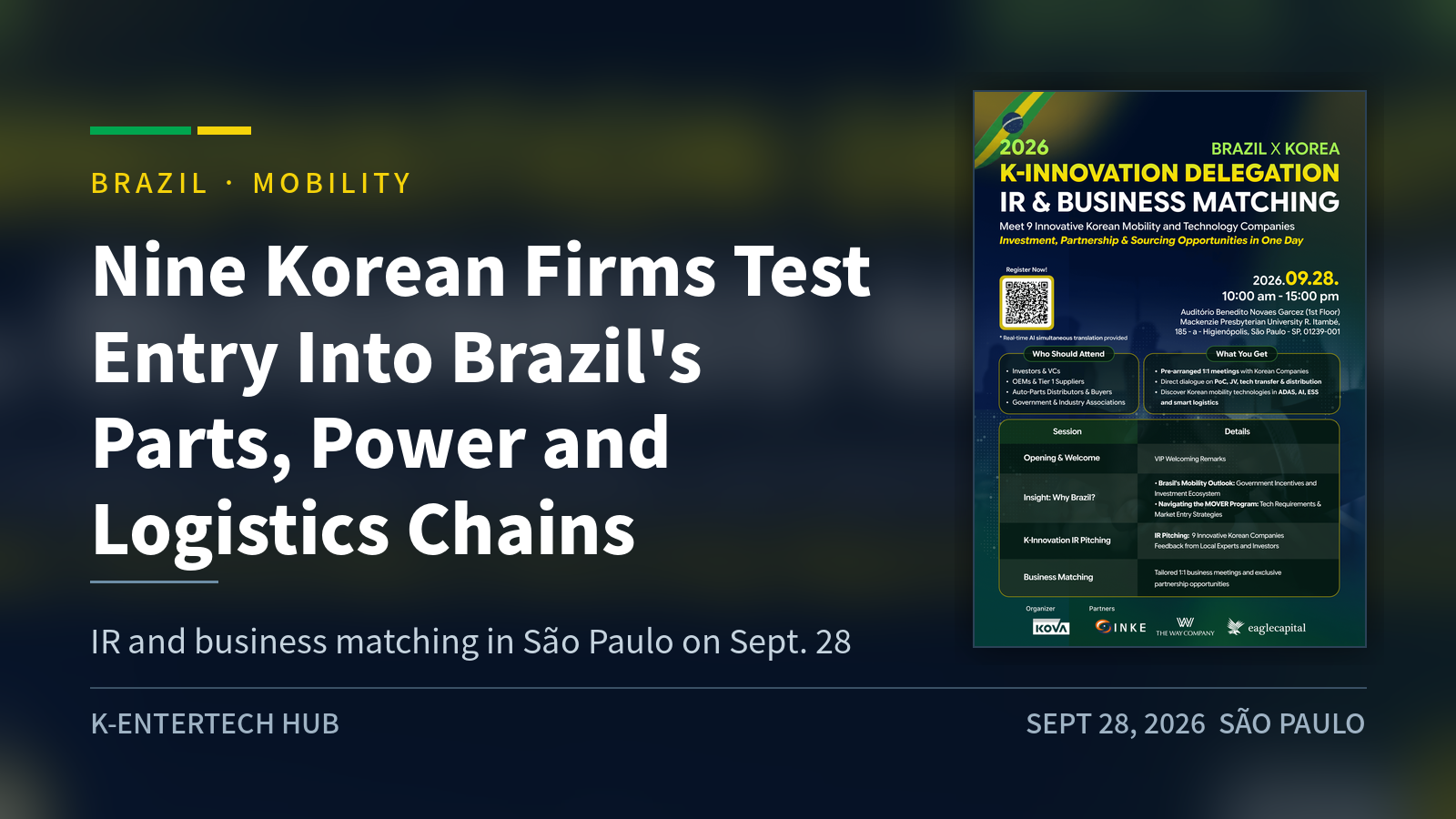
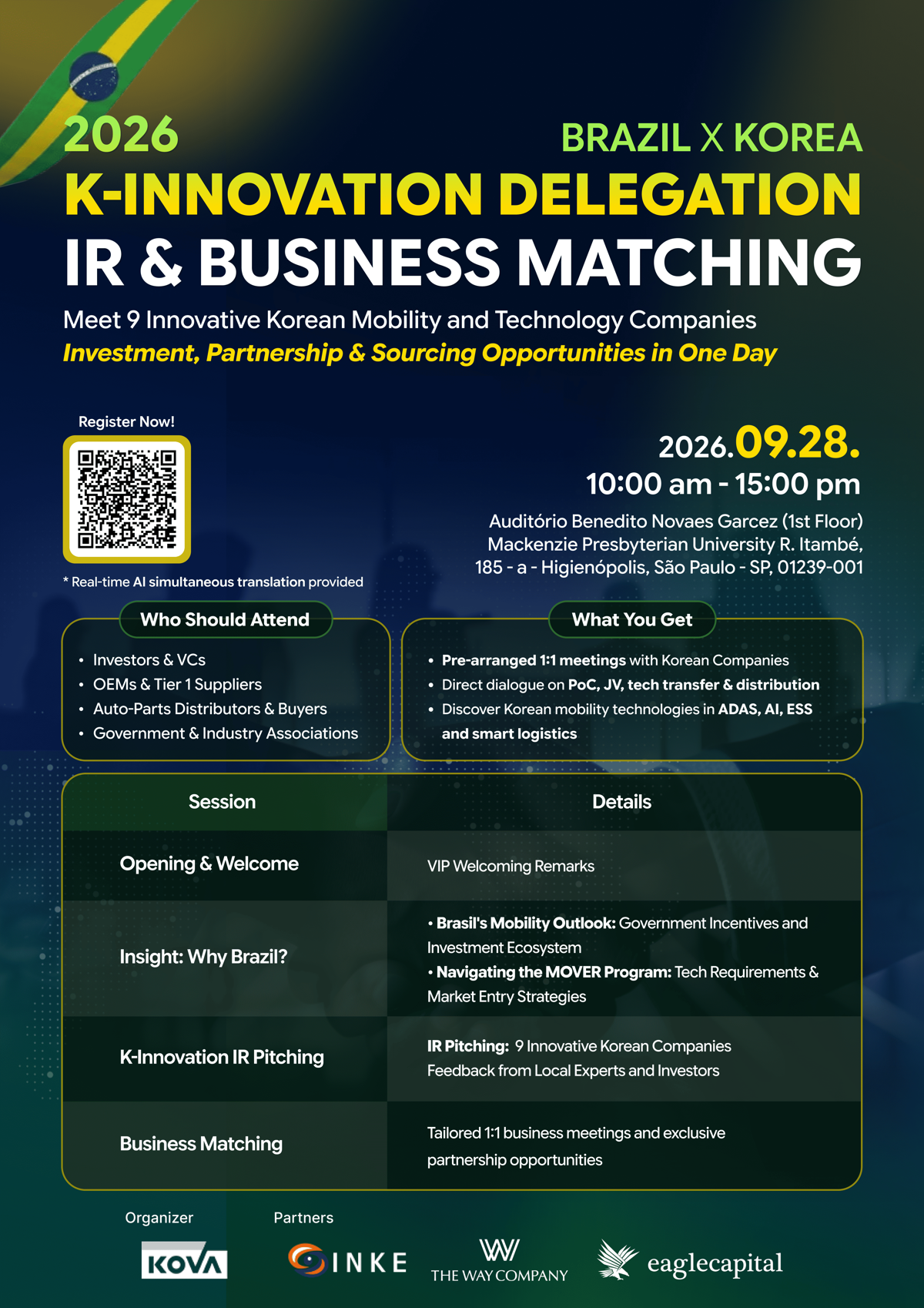
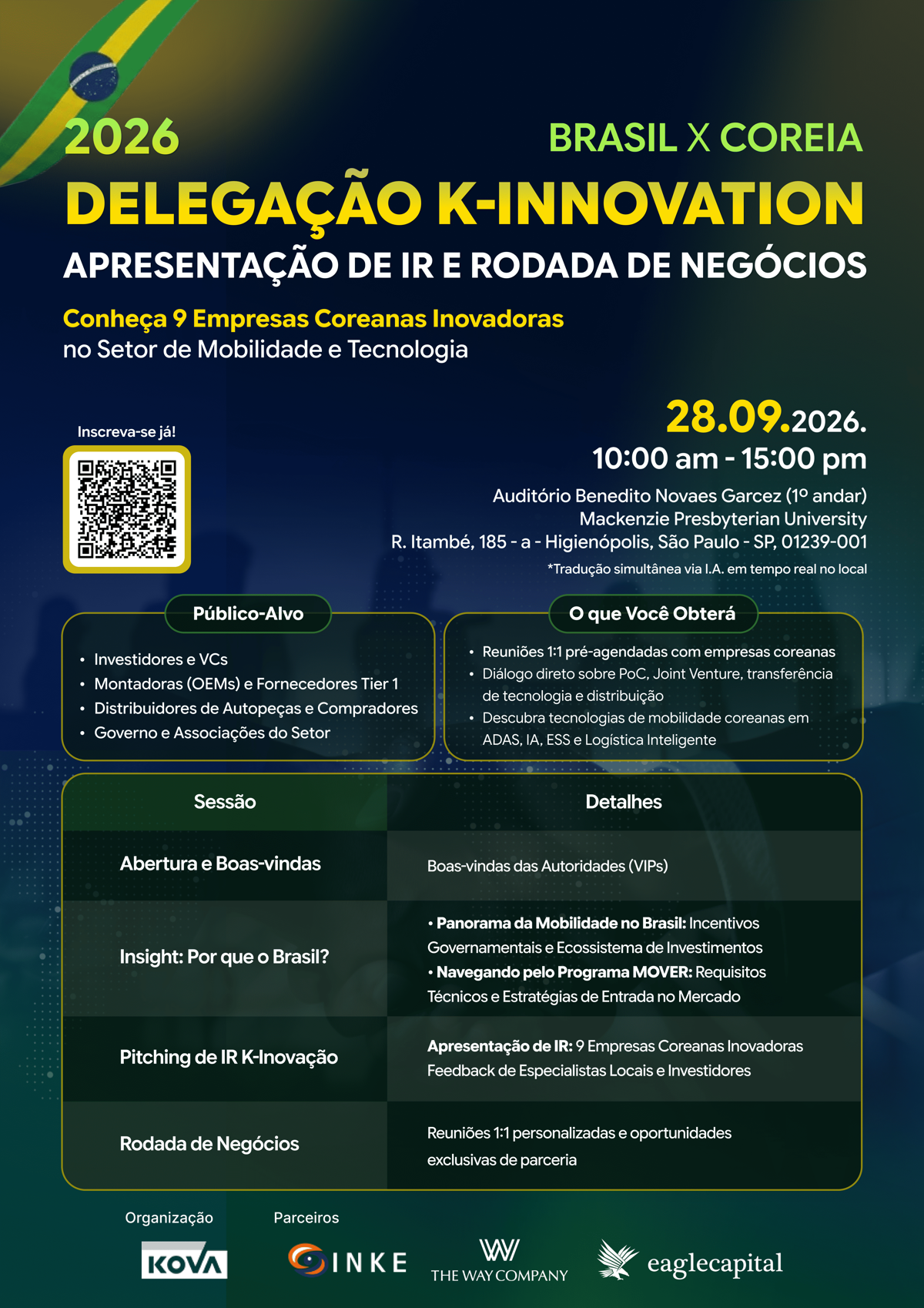
Nine Korean companies working in advanced driver assistance systems (ADAS), artificial intelligence, energy storage systems (ESS) and smart logistics will meet local companies and investors in São Paulo on Sept. 28. The venue is the Benedito Novaes Garcez auditorium on the first floor of Mackenzie Presbyterian University, at an event billed as Brazil × Korea | K-Innovation IR & Business Matching 2026.
The agenda for the one-on-one meetings covers proof of concept (PoC), joint ventures, technology transfer and local distribution. The organizer is the Korea Venture Business Association (벤처기업협회, KOVA), with INKE (International Network of Korean Entrepreneurs), The Way Company and Eagle Capital as partners.
The reason the briefing lands in São Paulo on that date is MinasParts 2026, the auto-parts trade fair that opens two days later in Belo Horizonte. The 2026 Brazil Eco-Friendly and Future Mobility K-Innovation Delegation, run by the Korea Federation of SMEs (중소기업중앙회) and KOVA under a Ministry of SMEs and Startups (중소벤처기업부) program, bundles the São Paulo briefing, the MinasParts Korea Pavilion, one-on-one buyer and investor matching, and post-event follow-up into a single package.
Doors open at 10 a.m. at Mackenzie… pitching first, then one-on-ones
The program runs from 10 a.m. to 3 p.m., opening with welcoming remarks from officials. The session that follows, “Insight: Why Brazil?”, covers government support policy and the investment environment for Brazilian mobility, along with the technical requirements of the MOVER program and market entry strategies.
In the K-Innovation IR pitching block, the nine Korean companies present their businesses and technologies, and Brazilian experts and investors respond with feedback. Tailored one-on-one meetings between the Korean companies and Brazilian attendees follow, limited to those who requested them in advance.
The event targets investors and venture capital firms, automakers (OEMs) and Tier 1 suppliers, auto-parts distributors and buyers, and government bodies and industry associations. Organizers will provide AI-powered real-time simultaneous interpretation among Portuguese, English and Korean on site.
Admission is free and registration runs through Sept. 27 via Google Form. Attendees who want one-on-one meetings must request them separately when registering. The venue is Mackenzie Presbyterian University in the Higienópolis district of São Paulo (R. Itambé, 185 - a, Higienópolis, São Paulo - SP, 01239-001).
MinasParts opens two days later in Belo Horizonte… sixth edition, 250 exhibitors expected
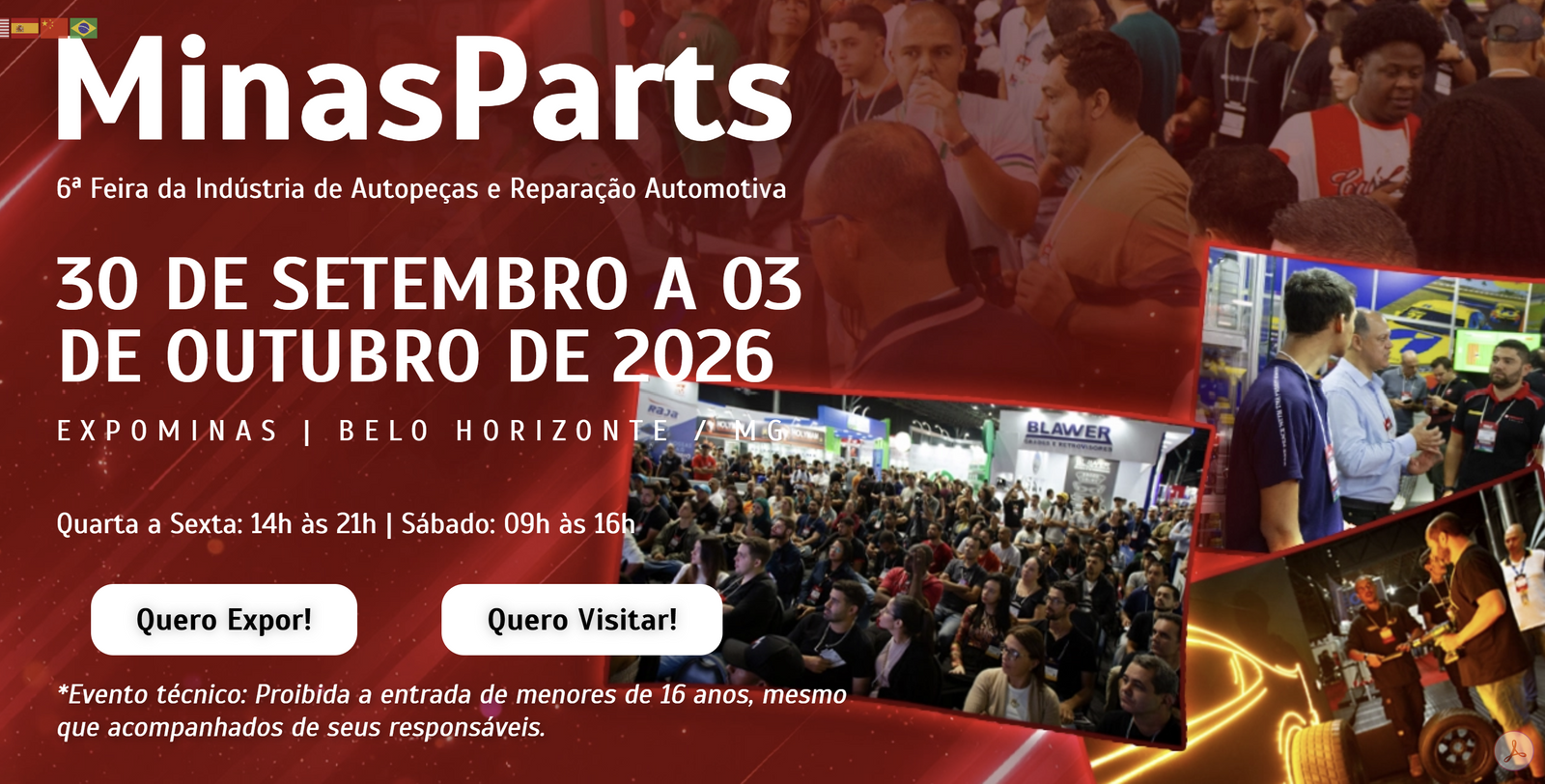
MinasParts 2026 runs from Sept. 30 to Oct. 3 at Expominas in Belo Horizonte. The biennial auto-parts and vehicle-repair fair is in its sixth edition, and organizer Diretriz Feiras e Eventos told the Brazilian outlet Portal Radar it expects 250 exhibitors and more than 30,000 visitors. Minas Gerais holds the second-largest registered vehicle fleet in Brazil, with a dense network of repair shops and parts distributors.
The second call for delegation participants ran from July 8 to 22. Eligible fields included mobility (autonomous driving, drones, micromobility, car sharing), future vehicles (eco-friendly and hydrogen), fleet control and operations management, smart logistics, vehicle electronics, charging, and EV-related solutions. Selected companies receive the São Paulo briefing, the MinasParts Korea Pavilion and session pitching, interpretation for exhibition and consultations, visits to local institutions, and one-on-one buyer and investor matching.
Partner The Way Company moves from Toronto to São Paulo… CEO Kim Min-kyung now INKE senior vice chair
Among the partners, The Way Company is a Toronto-based accelerator. Kim Min-kyung (김민경), who also goes by Michelle Kim, founded it in July 2023, and its work covers local customer validation, connecting Korean firms to North American buyers and investors, IR pitching consultancy, links to government agencies and community networks, and building local distribution and partnerships. Its signature programs are the K-GLOBE startup summit in Toronto and the 2026 CANADA X KOREA Forum held in Seoul in May.

Kim has framed the firm’s role as beginning where market entry ends. In an interview published by the Vancouver Joongang Ilbo (밴쿠버 중앙일보) on June 2, she described that role as designing, together with the client, “not just entry but how the market actually works — market fit and operations.” In the same interview, according to the outlet, she compared overseas expansion to a marathon rather than a sprint and stressed the importance of setting direction early.
Kim was elected senior vice chair of the International Network of Korean Entrepreneurs at the 2026 INKE Spring meeting in Ulaanbaatar, Mongolia, on May 18. Speaking to KoA Times at the event, she said INKE “needs to get younger, and I want to be the bridge.” INKE is listed as a partner of the São Paulo event.
This event moves that work from North America to South America. In the program distributed by the organizers, The Way Company appears as a partner alongside INKE and Eagle Capital, and the agenda is built around IR pitching and pre-assigned one-on-one meetings.
MOVER extends incentives to technology firms… IPI rate gap of up to 5 percentage points
Brazil promulgated and enacted the MOVER green mobility innovation law on June 28, 2024. It sets out R&D investment incentives for the auto industry, mandatory vehicle requirements, green taxation, and the creation of a national industrial technology development fund.
Eligibility is not confined to makers of eco-friendly vehicles and their parts suppliers. According to the program summary published by the Embassy of the Republic of Korea in Brazil, technology companies integrated into the automotive value chain also qualify. The budget was set at roughly 3.5 billion reais (about $670 million, or 920 billion won) in 2024, scaling to around $800 million (about 1.1 trillion won) by 2027. The financial credits can be applied not only to technology development and production technology but also to tax payments.
Compliance is priced through the industrial products tax (IPI). The rate gap between compliant and non-compliant vehicles is 2 percentage points on energy efficiency (tank-to-wheel), 2 points on recyclability (effective Jan. 1, 2025), and 1 point on structure and driver-assistance technology. Ethanol and flex hybrid vehicles carry a 3-point gap against conventional internal combustion vehicles from Dec. 31, 2026.
The mandatory requirements include data obligations separate from emissions. Carbon inventory and carbon footprint registration for vehicles sold domestically is required by Dec. 31, 2026, and rules for measuring carbon output across the full production process are due to be established by 2027. Because driver-assistance technology sits inside the rate-differential criteria, ADAS and measurement and data software connect directly to what an automaker pays in tax.
Market size: 2.69 million sold and 2.64 million built in 2025… 3 million forecast this year
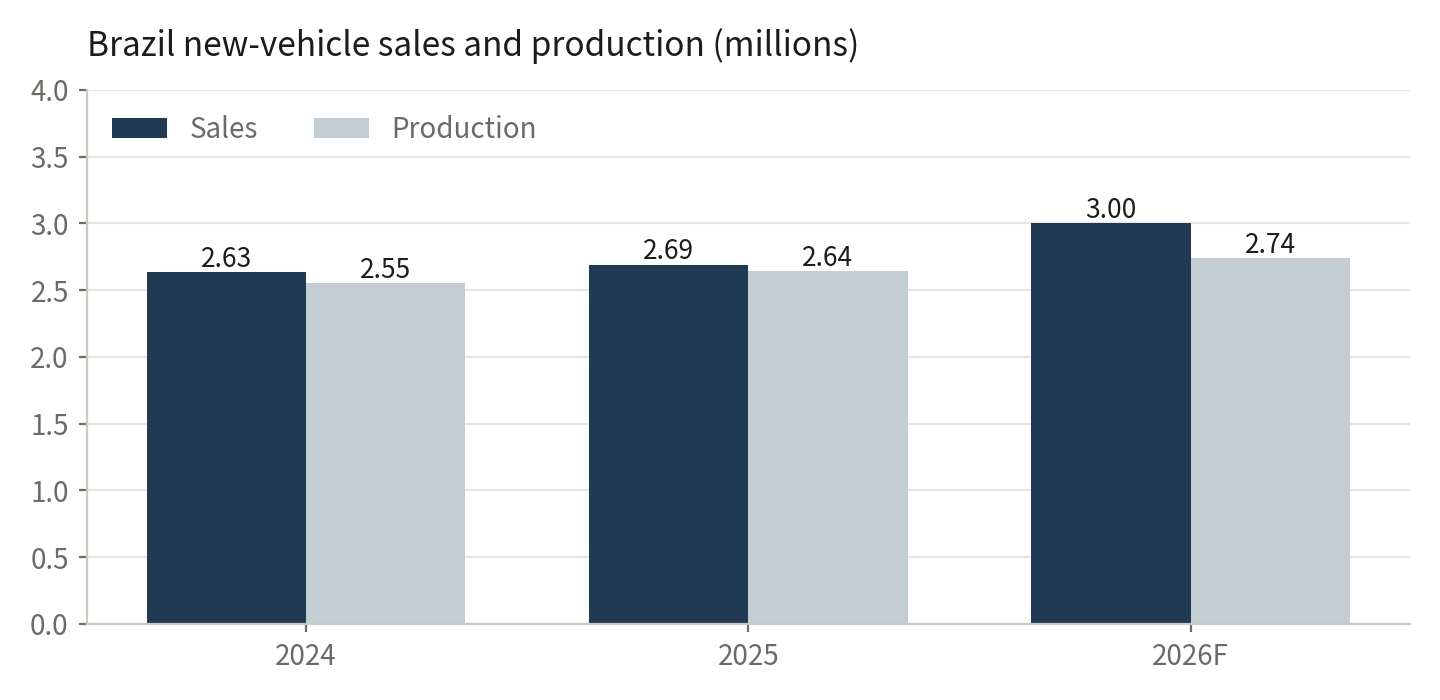
New-vehicle registrations in Brazil reached 2.69 million units in 2025, up 2.1% year on year, while production rose 3.5% to 2.644 million. Anfavea, the Brazilian automakers association, said the result kept Brazil sixth in the world by market size and eighth by production. The association had opened the year forecasting 6.3% sales growth and 7.8% production growth, and attributed the shortfall to high benchmark interest rates and intensifying competition from imports. Exports rose 32.1% to 529,000 units.
In January, Anfavea projected 2026 production at 2.74 million units, up 3.7%. After domestic demand ran ahead of expectations in the first half, it raised its sales forecast on July 7 to more than 3 million units, an increase of 11.7%. Production from January to April reached 872,600 units, up 4.9% and ahead of the full-year forecast. July sales rose 14.9% to 279,544 units and production rose 5.9% to 253,860, while exports fell 18.4% that month.
Electrified share hit a record 18.3% in April… 420,000 to 450,000 forecast for the year
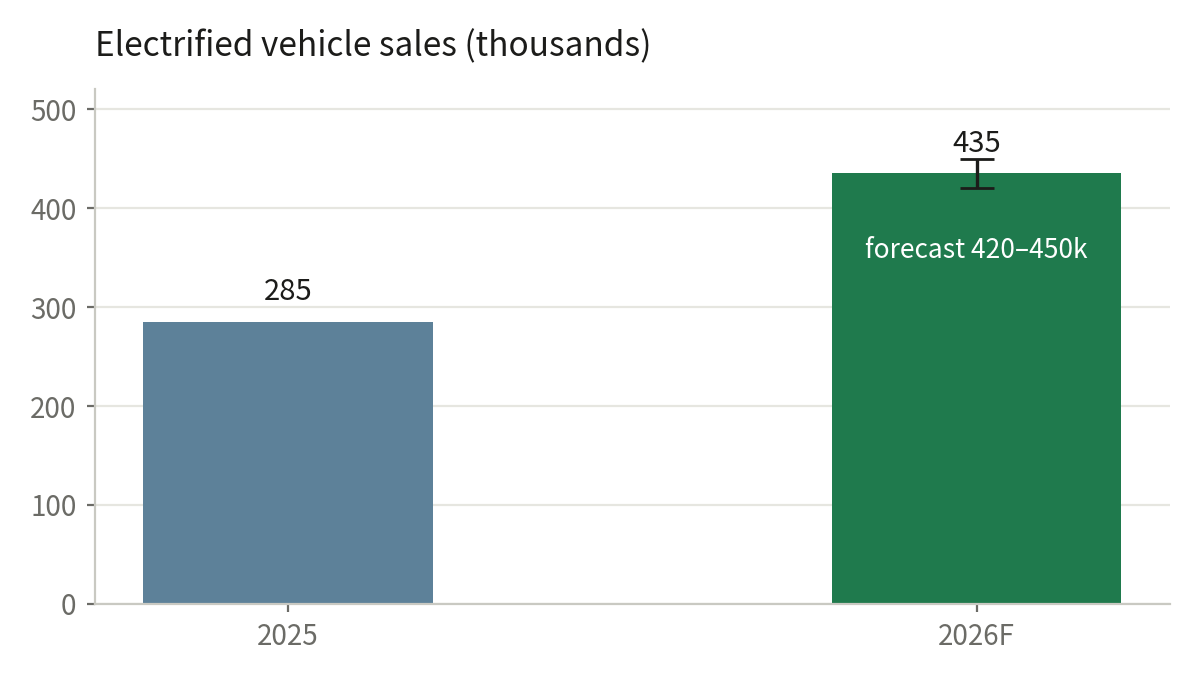
Electrified vehicle sales totaled 285,400 units in 2025, and Anfavea forecasts 420,000 to 450,000 for 2026. Electrified models took a record 18.3% of light-vehicle sales in April, made up of 17,500 battery electric vehicles, 13,200 plug-in hybrids and 12,700 conventional hybrids. The association also said 40% of the electrified vehicles sold in Brazil are now assembled locally.
Set against an electric share of 0.9% of new car sales in 2023, the mix has shifted within three years. The best-selling models are still largely flex-fuel vehicles — the Fiat Strada, Volkswagen Polo, Chevrolet Onix and Hyundai HB20.
Chinese vehicles take 52.4% of imports… the pressure to localize rises
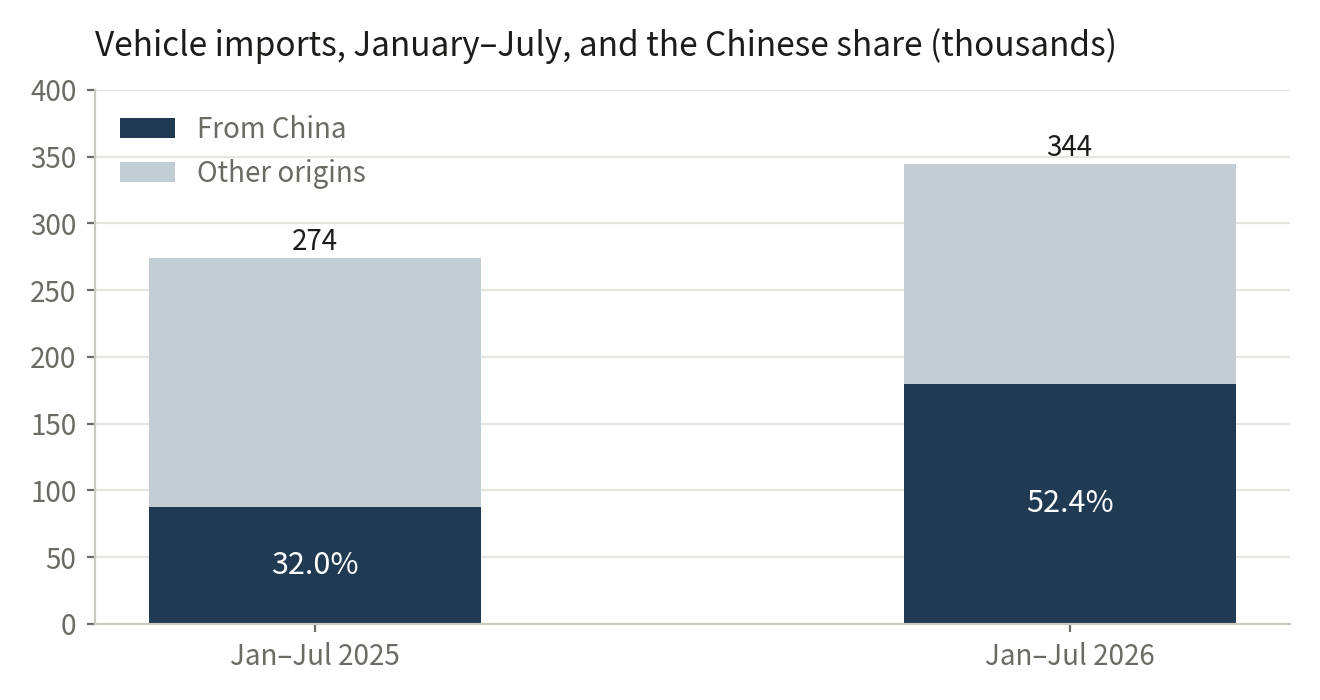
The Brazilian outlet G1 reported on Aug. 7, citing figures from the Brazilian automotive industry association, that vehicle imports from January through July reached 344,100 units, up 25.7% year on year. More than 180,000 of those came from China, or 52.4% of all imports, a 105.4% jump from the same period last year. The increase was concentrated in electrified vehicles, including battery electric and hybrid models.
Coverage citing International Council on Clean Transportation (ICCT) data puts BYD alone at 63% of all electric vehicle sales in Brazil. Brazil has also restored the tariff on eco-friendly vehicles from zero to 35%, the same level applied to internal combustion vehicles, raising the weight of local production and local R&D.
Hyundai Motor (현대차) operates a plant in Piracicaba, São Paulo state, and a regional R&D center for Latin America, and is developing a flex hybrid powertrain running on an ethanol-gasoline blend. Chairman Chung Euisun visited the site in July alongside the state-visit business delegation to review local production and sales strategy.
Auto-parts revenue at 275.8 billion reais… the aftermarket takes 23.5%
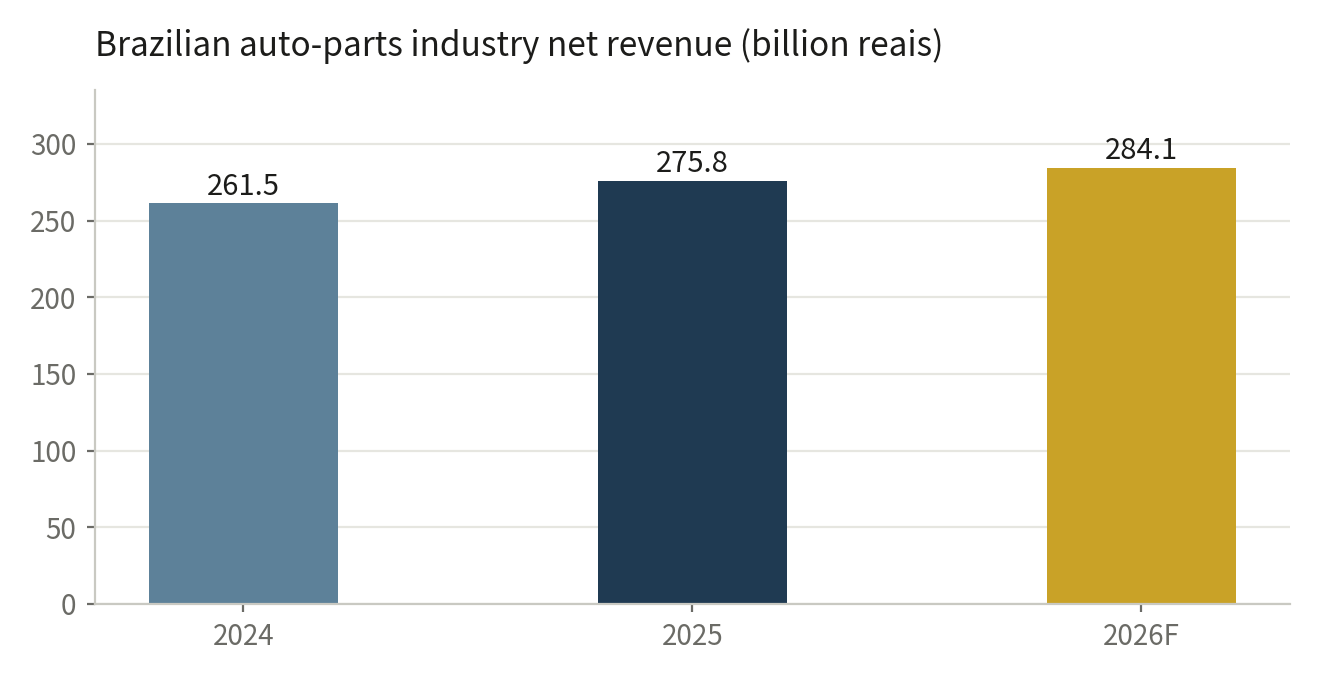
Net revenue in Brazil’s auto-parts industry reached 275.8 billion reais (about $52.4 billion, or 72.3 trillion won) in 2025, up 6.5% year on year. Sindipeças, the parts industry association, forecasts 284.1 billion reais (about $54 billion, or 74.5 trillion won) for 2026, a 3% increase. Capital investment is projected to hold at 6.6 billion reais, the same as 2025, and the association credits MOVER’s R&D incentives and local production of new hybrid models as the drivers.
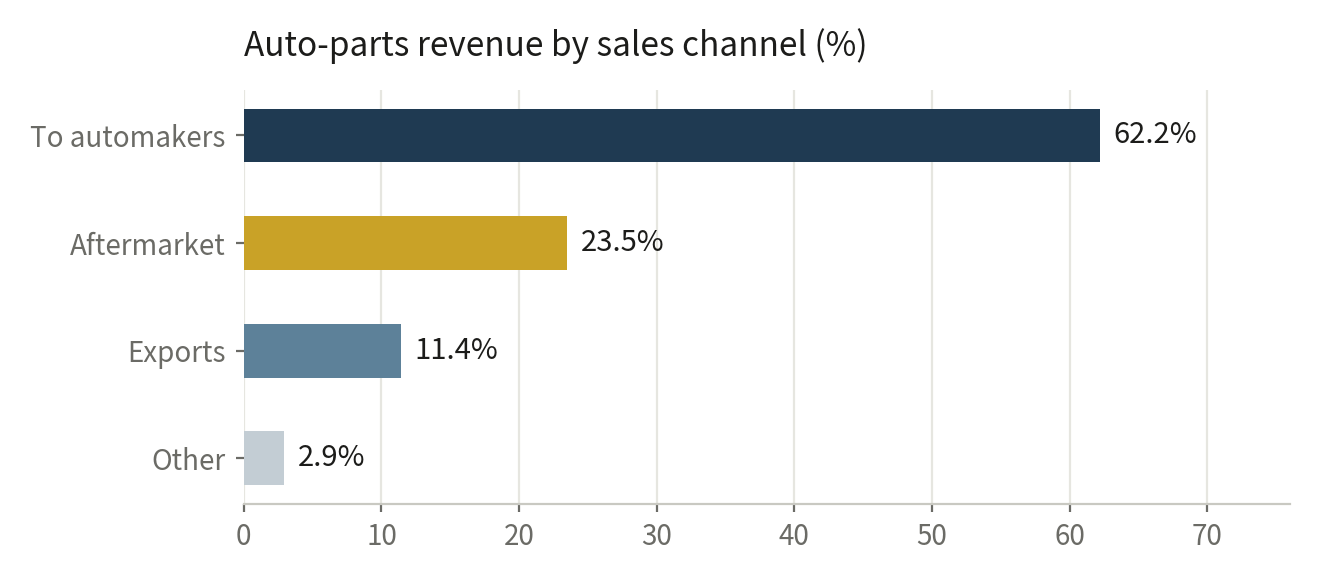
By sales channel, supply to automakers accounts for 62.2% of revenue, the replacement aftermarket for 23.5% and exports for 11.4%. The automaker share fell from 62.8%, while the aftermarket and export shares rose from 23.1% and 11.1%. Employment is projected at 308,900 in 2026.
The parts trade balance runs a deficit. On Sindipeças projections, 2025 imports came to $23.86 billion against $8.28 billion in exports; for 2026, imports rise 10% to $26.25 billion while exports fall 4.7% to $7.89 billion, widening the deficit to $18.4 billion. The association flags the 50% U.S. tariff on Brazilian-made commercial vehicle parts and conditions for exports to Argentina as risks.
The aftermarket rests on the size of the registered fleet. Parts distribution trade data put Brazil’s registered fleet — cars, motorcycles, trucks and buses — above 70 million vehicles, and used-vehicle transactions passed 9 million units in the first half of this year alone. That is the market MinasParts addresses in drawing parts distributors and repair shops as its audience.
First battery storage auctions in December… a separate lot for locally made systems
Brazil’s Ministry of Mines and Energy issued Normative Ordinance No. 136 on June 3, setting the rules for the country’s first capacity reserve auction (LRCAP) dedicated to battery energy storage systems. The national electricity agency ANEEL and the power trading chamber CCEE will run two separate online auctions on Dec. 2 and Dec. 4. The Dec. 2 auction (No. 05/2026) is open only to systems using batteries manufactured in Brazil, with local content verified by the development bank BNDES. The Dec. 4 auction (No. 06/2026) carries no localization requirement.
Entry requirements include a minimum of 30 MW, at least four hours of continuous discharge per day, round-trip efficiency of at least 85% and full recharge within six hours. Contracts run 10 years, with commercial operation starting Aug. 1, 2028. Demand in the first auction is estimated at about 1.7 GW. The energy research agency EPE projects 7 GW of storage in Brazil by 2035, and Deloitte puts the battery storage market at 57 billion reais (about $10.8 billion, or 15 trillion won) over the same period.
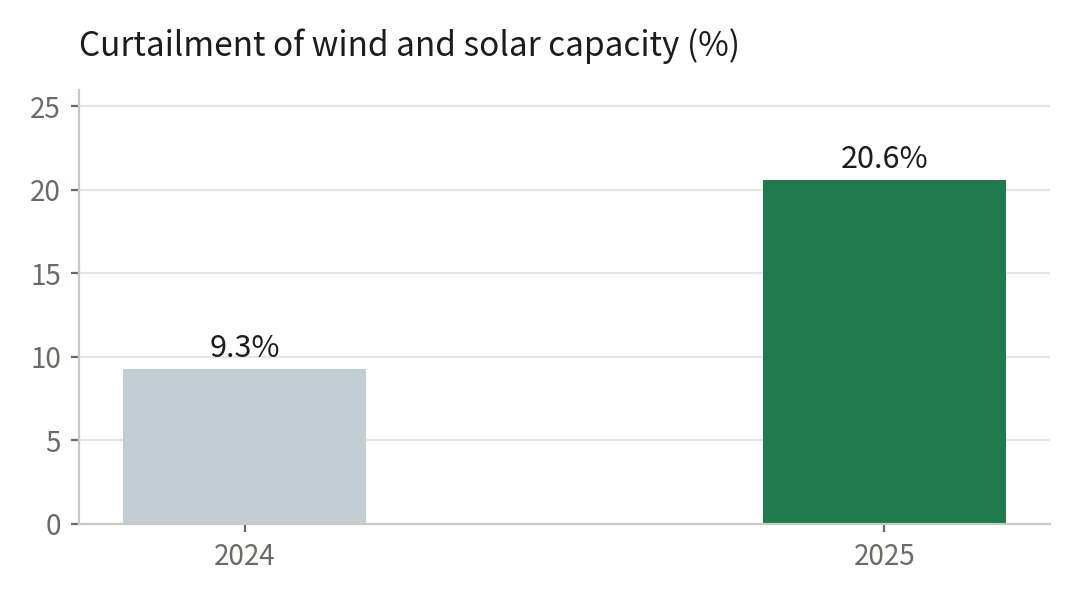
The push behind the auctions is renewable curtailment. In 2025, curtailment reached 20.6% of the wind and solar capacity connected to the national grid, more than double the 9.3% recorded a year earlier. In 2024 the Northeast accounted for 75% of national curtailment, with more than 330,000 hours of suspended generation and losses above 1.6 billion reais, according to Volt Robotics figures cited in local reporting. Energy storage is one of the fields the Korean delegation recruited for.
E-commerce forecast at 259.8 billion reais… logistics costs run at 15.5% of GDP
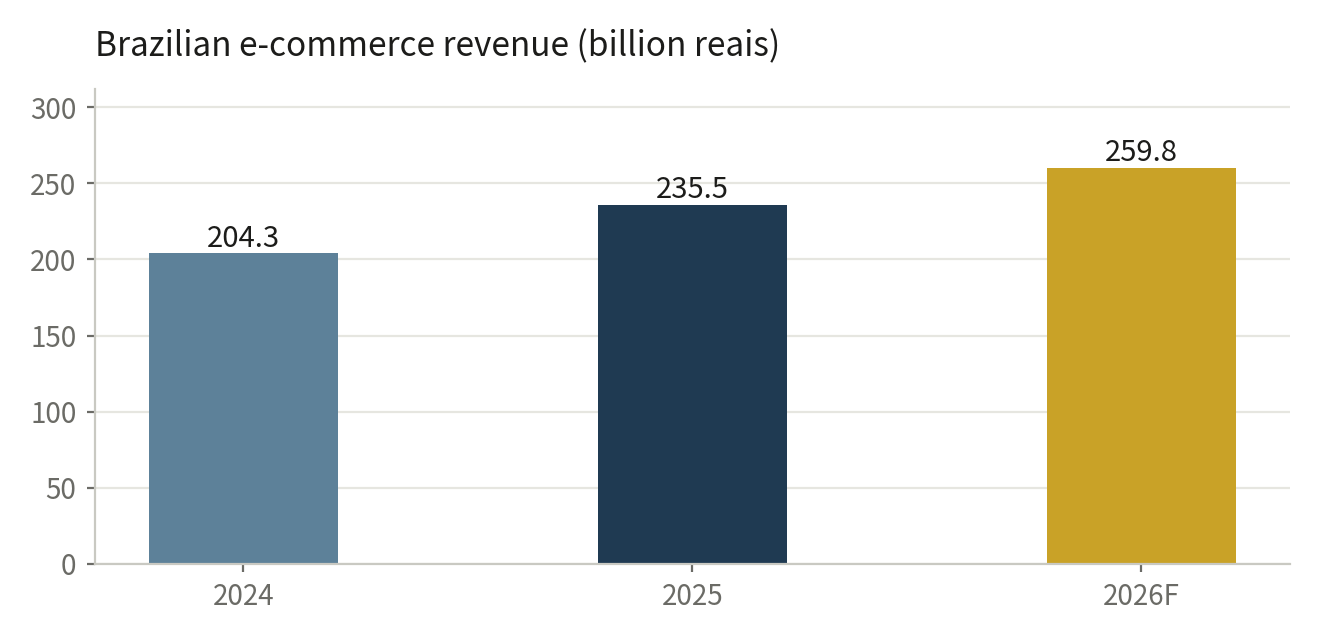
Brazilian e-commerce revenue rose 15.3% in 2025 to 235.5 billion reais (about $44.8 billion, or 61.8 trillion won), on 438.9 million orders from 94.2 million buyers, at an average ticket of 536.6 reais. ABIACOM forecasts 259.8 billion reais for 2026; ABComm puts it at 258 billion reais on 461 million orders. The Southeast accounts for more than 55% of digital transactions and the state of São Paulo alone for 32%.
The order volume has pushed the load onto logistics. The national employment bank BNE counted 173,122 new logistics jobs from January to April, and 168,000 logistics companies were opened in the same year, lifting active registrations past 1.5 million. A study by Hillos puts Brazilian logistics costs at about 15.5% of GDP. Port throughput hit a record 1.4 billion tonnes in 2025 and containerized cargo grew more than 7%, according to the waterway transport agency Antaq.
What this means for Korean companies
— The entry point is not the finished vehicle but the parts and software that satisfy the requirements. MOVER splits the IPI rate by 1 to 5 percentage points across energy efficiency, recyclability, structure and driver assistance. For a local automaker, that gap becomes a procurement argument.
— The party that collects the incentive is the one with a legal entity and production or R&D functions inside Brazil. That the meeting agenda is framed around PoC, joint ventures and technology transfer rather than straight export contracts follows from how the program pays out.
— Carbon inventory and footprint registration obligations translate into orders in measurement and data. Where automakers and Tier 1 suppliers cannot build that capability in house, it becomes a software supply contract.
— The competition is not local firms but the Chinese supply chain already in place. In a market where more than half of imports are Chinese, competing on price leaves little room. Certification support, compliance data and local after-sales service are what remain as points of separation.
— Demand is not confined to new vehicles. The aftermarket accounts for 23.5% of parts revenue and the registered fleet exceeds 70 million units. For products that take years to win a place on a new-car bill of materials, replacement distribution is the earlier opening.
— Electrification has already moved to local assembly. Forty percent of electrified vehicles sold in Brazil are assembled there, and parts investment is holding up on the back of new hybrid model production. Battery, vehicle electronics and charging components sit in the segment where import substitution is actively discussed.
— For battery storage, the Dec. 2 auction is reserved for locally manufactured systems, with BNDES verifying local content. That makes a local manufacturing partner closer to an entry condition than an export contract. The Dec. 4 auction carries no such requirement, so the two routes diverge.
— The finding that logistics costs run at about 15.5% of GDP is usable as a sales argument for fleet-control and last-mile software. Converting a savings rate into Brazilian logistics cost terms carries further than a feature list.
— The São Paulo briefing and MinasParts sit two days apart. One trip can cover the investor and OEM channel and the parts distribution and repair channel separately. Because one-on-one meetings are assigned only to those who ask in advance, the request has to go in before the Sept. 27 deadline.
Event at a glance
Sources
· Embassy of the Republic of Korea in Brazil, “Brazil enacts the MOVER green mobility innovation law,” June 28, 2024 — https://overseas.mofa.go.kr/br-ko/brd/m_6116/view.do?seq=1159978
· Embassy of the Republic of Korea in Brazil, “Brazil advances the MOVER program,” Jan. 16, 2024 — https://overseas.mofa.go.kr/br-ko/brd/m_6116/view.do?seq=1159969
· Bizinfo (Ministry of SMEs and Startups), second call for the 2026 Brazil Eco-Friendly and Future Mobility K-Innovation Delegation, July 10, 2026 — https://www.bizinfo.go.kr/sii/siia/selectSIIA200Detail.do?pblancId=PBLN_000000000124203
· Bizinfo, first call for the same delegation — https://www.bizinfo.go.kr/sii/siia/selectSIIA200Detail.do?pblancId=PBLN_000000000123597
· Portal Radar, “MinasParts 2026 tem projeção de 30 mil visitantes e 250 expositores” — https://portalradar.com.br/minasparts-2026-tem-projecao-de-30-mil-visitantes-e-250-expositores/
· tradefairdates, “MinasParts Belo Horizonte 2026” (Sept. 30 – Oct. 3, Expominas) — https://www.tradefairdates.com/MinasParts-amp-M14430/Belo-Horizonte.html
· Global Economic, “Chinese vehicles pass half of Brazil’s import market,” Aug. 8, 2026 (citing G1 and the Brazilian automotive industry association) — https://www.g-enews.com/article/Global-Biz/2026/08/2026080816280771162bd56fbc3c_1
· Danawa Auto, “Global plug-in EV share passes 25%” (citing ICCT) — https://auto.danawa.com/news/?Tab=N1&Work=detail&no=6012902
· Kyungje Times, on Brazil market size and the restored tariff, July 2026 — https://www.ket.kr/news/article.html?no=39396
· Business Post, on MOVER’s scale and Brazil’s flex-fuel structure, March 2024 — https://m.businesspost.co.kr/BP?command=mobile_view&num=344973
· Anfavea, January 2026 press release (2025 production, sales and exports) — https://anfavea.com.br/site/wp-content/uploads/2026/01/Release-Janeiro-2026-final.pdf
· Agência Brasil, “Vehicle production up 3.5% in 2025,” Jan. 15, 2026 — https://agenciabrasil.ebc.com.br/economia/noticia/2026-01/producao-de-veiculos-cresce-35-em-2025
· Diário do Grande ABC, on Anfavea’s 3.7% production forecast for 2026, Jan. 16, 2026 — https://www.dgabc.com.br/Noticia/4279729/
· MarkLines, “ANFAVEA raises 2026 Brazilian automotive industry outlook, up 11.7%,” July 2026 — https://www.marklines.com/en/news/347556
· Rio Times, “Brazil vehicle production climbs 4.9% in first four months of 2026,” May 2026 — https://www.riotimesonline.com/brazil-vehicle-production-record-jan-apr-2026-anfavea-china-imports-may-2026/
· AutoIndústria, “Sindipeças projeta crescimento de apenas 3% em 2026,” Oct. 20, 2025 — https://www.autoindustria.com.br/2025/10/20/sindipecas-projeta-crescimento-de-apenas-3-em-2026/
· AutoData, “Sindipeças estima crescimento de 3% para o ano que vem,” Oct. 20, 2025 — https://www.autodata.com.br/noticias/2025/10/20/sindipecas-estima-crescimento-de-3-para-o-ano-que-vem/95608/
· Abipeças–Sindipeças Yearbook 2025 (auto-parts revenue series) — https://virapagina.com.br/sindipecas2025/
· Brazilian Ministry of Mines and Energy, guidelines for the first battery storage auction (Normative Ordinance 136), June 3, 2026 — https://www.gov.br/mme/pt-br/assuntos/noticias/mme-publica-diretrizes-para-leilao-inedito-de-armazenamento-de-energia-em-baterias-no-brasil
· ANEEL, public consultation on the first storage auction notices (Dec. 2 and Dec. 4), July 28, 2026 — https://www.gov.br/aneel/pt-br/assuntos/noticias/2026-defeso-eleitoral/primeiros-leiloes-de-armazenamento-de-energia-do-brasil-entram-em-consulta-publica
· EPE, LRCAP Armazenamento 2026 auction materials — https://www.epe.gov.br/pt/leiloes-de-energia/leiloes/leilao-de-reserva-de-capacidade-na-forma-de-potencia-armazenamento-2026
· Movimento Econômico, on the Deloitte 57-billion-real estimate and the EPE 7 GW projection, July 5, 2026 — https://movimentoeconomico.com.br/economia/energia/2026/07/05/leilao-abre-caminho-para-mercado-bilionario-de-baterias-no-brasil/
· Movimento Econômico, on the first battery auction and 2025 curtailment (Volt Robotics, cited), May 22, 2026 — https://movimentoeconomico.com.br/economia/energia/2026/05/22/brasil-fara-1o-leilao-de-baterias-para-guardar-energia-solar-e-eolica-do-ne/
· Central do Varejo, on ABIACOM’s 259.8-billion-real e-commerce forecast, Feb. 16, 2026 — https://centraldovarejo.com.br/e-commerce-deve-faturar-r-2598-bilhoes-em-2026-projeta-abiacom/
· Logweb, on BNE logistics hiring data and the 15.5%-of-GDP logistics cost figure, May 2026 — https://logweb.com.br/vagas-logistica-2026-bne-empregos-setor-logistico/
· AF News, on Antaq port throughput, August 2026 — https://afnews.com.br/competitividade-crescimento-e-o-papel-estrategico-da-logistica-no-brasil/
· Vancouver Joongang Ilbo, interview with Kim Min-kyung of The Way Company, June 2, 2026 — https://joinsmediacanada.com/bbs/board.php?bo_table=news&wr_id=52283
· KoA Times, on-site interview with Kim Min-kyung, May 29, 2026 — https://www.koatimes.net/2026/05/29/
· Herald Business, on The Way Company and the 2026 CANADA X KOREA Forum, April 17, 2026 — https://biz.heraldcorp.com/article/10719446
· Venture Square, interview with Kim Min-kyung of The Way Company, Aug. 21, 2025 — https://www.venturesquare.net/1000618
· Event poster and program (materials distributed by the organizers)
Currency note: $1 = 1,380 won; 1 real = $0.19 (about 262 won), as of August 2026. Won figures are rounded. Real-denominated amounts are the figures announced at the time of the original reporting.
-