“콘텐츠만 팔던 시대는 끝났다”: 스트리밍 3강 시대, 지능형 콘텐츠 패키저만 살아남는다
by
2026년 3월 5일

SAG-AFTRA launches early negotiations ahead of June contract expiry — AI replica compensation, streaming royalty reform, and the creator economy all converge at the bargaining table
Hollywood's actors and writers unions are facing an existential crisis. AI is reproducing performers' faces and voices at will, while independent creators on YouTube and TikTok are pulling hundreds of millions of viewers away from studios entirely — dismantling the traditional Hollywood labor ecosystem from two directions at once.
 Jung Han
The fact that SAG-AFTRA has come to the negotiating table months ahead of its June contract deadline is itself a measure of how urgent the threat has become. Whatever emerges from these talks will set the terms not just for wages, but for how the value of creative labor is defined in the age of AI.
Negotiations between SAG-AFTRA and AMPTP (the Alliance of Motion Picture and Television Producers) quietly began in February 2026 — months ahead of the June contract expiry. Both sides have agreed to a media blackout, with no public statements from either party. According to multiple industry sources cited in the U.S. press, the unusually early start reflects a shared determination to avoid a repeat of the 148-day strike that crippled Hollywood in 2023.
IATSE (International Alliance of Theatrical Stage Employees), which represents behind-the-scenes workers including hair and makeup artists, animators, and lighting and sound technicians, set a precedent by reaching its own AI rights agreement with studios in 2024.
Georgetown University adjunct professor Steven Schiffman, former head of National Geographic TV channels, told Axios: "All the disputes that SAG-AFTRA had with major companies have always been with technological changes and how consumers ultimately consume content." For streaming, actors already secured a performance-based model: any project watched by 20% or more of a platform's subscriber base triggers royalty payments.
Some AI protections are already in place. Studios must make additional contributions to pension and health funds when using digital replicas of performers. Commercials contracts ban the use of synthetic performers purely to cut costs. The 2024 Sound Recordings Code went further still.
SAG-AFTRA 2024 Sound Recordings Code — Key Provisions
Under the 2024 Sound Recordings Code Contract Summary, record labels must obtain written consent from performers before using AI-generated digital replicas of their voice or likeness, and must provide separate compensation for such use. The agreement explicitly prohibits presenting AI-generated synthetic performances as originals by the artist. This is widely regarded as one of the first major contracts to establish enforceable consent and compensation standards for voice replication.
Source: SAG-AFTRA
— https://www.sagaftra.org/sites/default/files/2025-05/2025 Commercials Contract MOA.pdf
What complicates the unions' position even more than AI is the explosive growth of the creator economy. Independent creators on YouTube and TikTok are capturing audience share at scale — entirely outside SAG-AFTRA's jurisdiction. Schiffman notes: "The significance in the role of SAG-AFTRA becomes smaller because attention is shifting to individual contributors that are non-studio-based."
The scale of this shift is quantified in the chart below. Research by IAB and Harvard Business School professor emeritus John Deighton shows that the commercial internet — the engine powering the creator economy — supported just 3 million jobs in 2008, representing 2% of U.S. GDP. By 2024, that figure had grown to 28.4 million jobs and 18% of GDP. The creator economy is no longer a sideshow to Hollywood; it is a parallel industry of comparable economic weight.
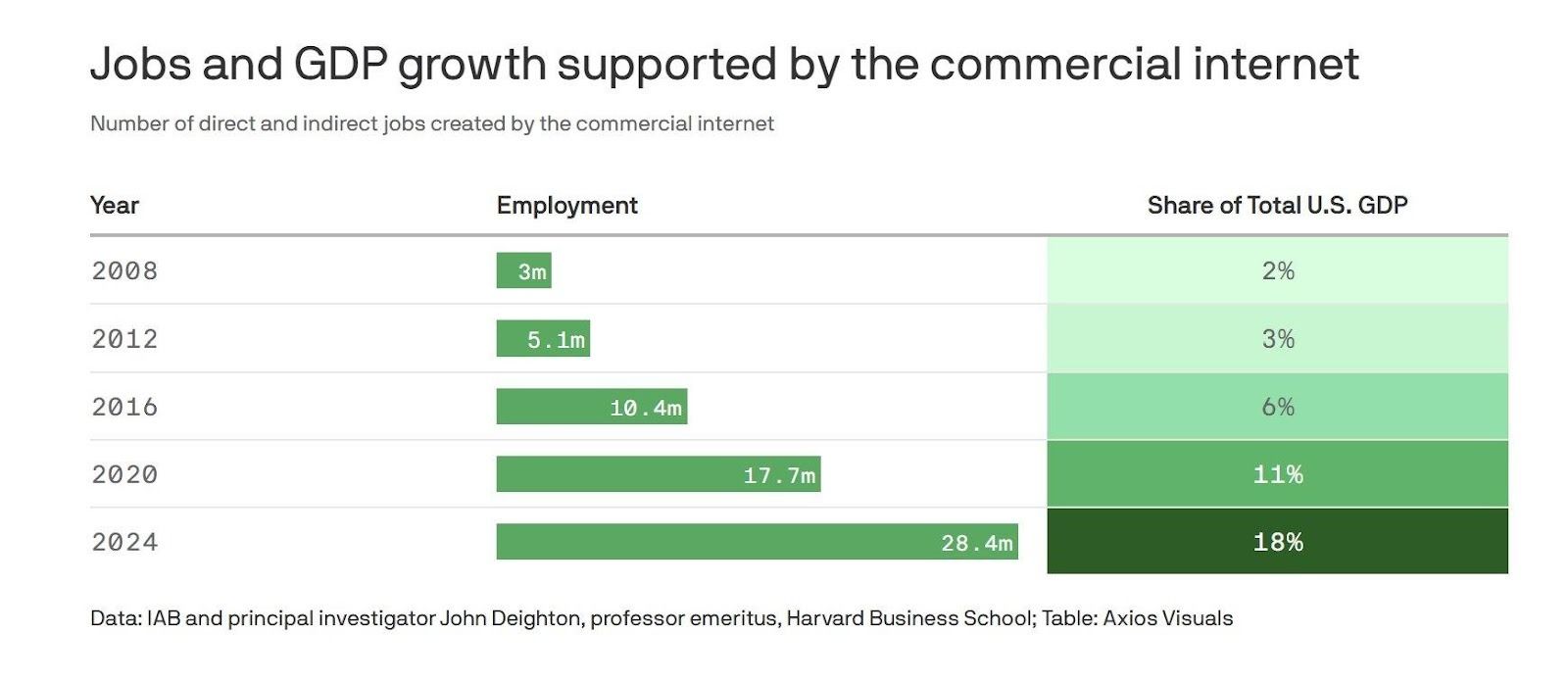
Data: IAB and principal investigator John Deighton, professor emeritus, Harvard Business School; Table: Axios Visuals
Approximately 1.5 million Americans are now estimated to work as full-time digital creators — a workforce that operates entirely outside traditional union structures. For Hollywood's labor movement, the challenge is not just negotiating better terms within the existing system, but reckoning with a parallel economy that has no use for that system at all.
■ Why Hollywood's Negotiations Send Ripples to K-Content
Hollywood's AI and labor agreements are not a purely American affair. With Netflix, Disney+, Apple TV+ and other global streaming platforms producing and distributing Korean dramas and films at scale, any shift in AI-related rules or royalty structures on those platforms directly affects Korean producers and performers.
Netflix in particular has drawn criticism for generating enormous global revenue from Korean IP — Squid Game (seasons 1 and 2), All of Us Are Dead, K-Pop Demon Hunters — while providing virtually no performance-based compensation to the cast and crew behind those projects. Should Hollywood negotiations raise royalty standards, pressure to revisit Korean content contracting norms will intensify.
■ AI Replicas and Synthetic Performers — Already a Korean Reality
Korea's entertainment industry is not immune to the AI replica issue. Several domestic agencies and production companies have already used digital replicas of deceased actors in advertisements and content, or debuted AI-generated virtual idols. SM Entertainment's aespa concept and HYBE's use of AI music tools have both triggered debates about the rights of human creators.
The consent-and-compensation framework established by SAG-AFTRA's 2024 Sound Recordings Code — the first major contract to mandate 'clear and conspicuous consent' for voice replication — is a strong benchmark candidate for reforming Korea's standard contracts. The Korea Creative Content Agency (KOCCA) and the Ministry of Culture, Sports and Tourism are developing AI content guidelines, but concrete compensation and distribution frameworks remain at the design stage.
At the government level, a 'use first, compensate later' model for AI training data is under active discussion — drawing sharp pushback from the copyright community. Academic and policy reports consistently note that the IP and compensation structures for AI-generated content remain legally ambiguous, and that legislation and standard contract reform are urgently needed.
■ The Creator Economy — K-Influencers as Proof of Structural Shift
The independent creator wave eroding Hollywood unions is playing out even more dramatically in Korea. The IAB/Deighton data — showing the commercial internet now accounts for 18% of U.S. GDP and 28.4 million jobs — has a clear Korean parallel. As Korea's three major terrestrial broadcasters face structurally declining ratings and revenues, K-influencers with millions of subscribers and MCN operators have built independent monetization models entirely outside traditional broadcasters and agencies.
Korean actors', directors', and writers' unions are growing increasingly concerned that the shift to streaming and AI-driven production will further weaken their bargaining power — and are intensifying calls for residuals and fair compensation frameworks.
■ Impact on K-Content's U.S. Market Strategy
Changes to Hollywood labor agreements will also reshape Korea's content export strategy for the U.S. market. If SAG-AFTRA's jurisdiction expands, the conditions for Korean producers co-producing with American talent will become more complex. On the upside, Korean performers could gain a new legal basis for protecting their likenesses from digital replication in the U.S. market — a benefit with significant long-term implications for the Hallyu industry.
■ Conclusion: What No Contract Can Contain
This is not a negotiation about wages. It is the arena in which Hollywood's labor unions must redesign their own reason for existence — confronting the speed at which AI replaces human creative labor, the structures through which platforms capture all the value, and the steady dissolution of the boundaries that once defined union membership.
SAG-AFTRA's 2024 Sound Recordings Code was a meaningful first step, establishing consent and compensation rights for AI voice replication. But the pace of technological change will turn any contract into a historical document faster than the ink dries. And as the IAB data makes clear, the commercial internet — and the creator economy it powers — now rivals Hollywood in economic scale.
The real question is no longer about which clauses to insert, but about how to design the right and the governance to renegotiate continuously as new technologies and platforms emerge. That question has already crossed the Pacific. Hollywood's true challenge, and Korea's as well, is not filling in the terms on the current bargaining table. It is figuring out who builds the next table, and how.
Sources & References
① Axios (original article)
https://www.axios.com/media-trends-membership/2026/03/07/hollywood-union-contract-ai
② SAG-AFTRA (official document)
③ IAB / John Deighton "The Economic Significance of the Internet" — IAB & Harvard Business School (2025). Chart: Axios Visuals
④ Translation · Analysis · Editing: K-EnterTech Hub


![[보고서]전통 언론사의 크리에이터 전략 대전환](https://cdn.media.bluedot.so/bluedot.kentertechhub/2026/02/0nwc9z_202602100212.png)