
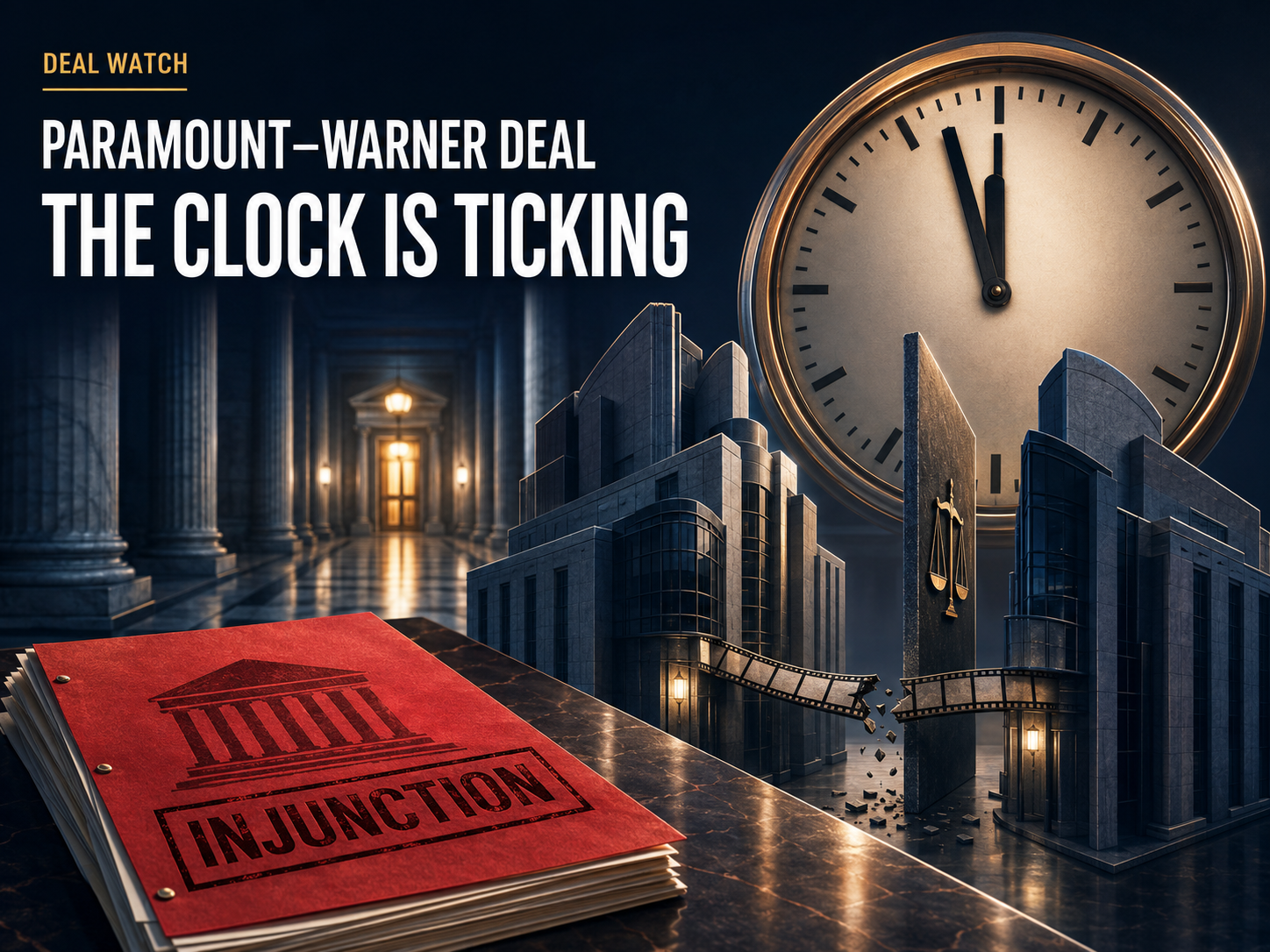
Paramount–Warner Deal Faces a Legal Countdown as States and Writers Move to Block It

The WGA and 12 U.S. states are seeking to block the Paramount–Warner merger, making a preliminary injunction and the Sept. 30 deadline decisive tests for the $110 billion deal.

Paramount–Warner Deal Faces a Legal Countdown as States and Writers Move to Block It

A preliminary injunction could push the merger beyond its Sept. 30 deadline, trigger hundreds of millions of dollars in additional payments and give opponents new leverage over one of Hollywood’s largest proposed combinations.

At a glance

  • The Writers Guild of America sued in federal court to stop Paramount’s acquisition of Warner Bros. Discovery, arguing that the combination would reduce writing jobs, suppress pay and narrow creative choice.
  • A coalition of 12 state attorneys general, led by California Attorney General Rob Bonta, filed a separate antitrust challenge and asked the court to halt the transaction temporarily.
  • The pivotal near-term decision is whether the U.S. District Court for the Northern District of California grants a preliminary injunction. A delay beyond Sept. 30 could activate a “ticking fee” estimated at about $650 million per quarter.
  • Paramount says the merger would strengthen a legacy film-and-television competitor against Netflix, Amazon and YouTube, create jobs and support a commitment to release at least 30 theatrical films annually.
파라마운트–워너 합병, 주정부와 작가들의 소송으로 ‘법적 카운트다운’
미국작가조합(WGA) 파라마운트의 워너브러더스 디스커버리 인수를 막기 위한 소송 제기. 810억 달러 규모의 초대형 미디어 합병, 법무부 승인 후 중대한 사법적 위기 직면

Hollywood’s megadeal has entered its most dangerous phase

Paramount’s proposed acquisition of Warner Bros. Discovery has moved from a regulatory contest into a high-stakes courtroom countdown. The Writers Guild of America, representing roughly 18,000 writers nationwide, filed suit Tuesday in the Northern District of California seeking to block the transaction. The union’s complaint followed a challenge from 12 Democratic-led states, which asked the same federal court to prevent the companies from closing while their case is litigated.

The two challenges attack the deal from related but distinct directions. The states focus primarily on competition in theatrical film distribution and basic cable, arguing that the combined company would possess greater leverage over movie theaters and television distributors and that those costs could ultimately reach consumers. The WGA emphasizes the labor market, alleging that the largest combined employer of film and television writers would have both the incentive and ability to reduce jobs and hold down compensation.

The transaction is described as an $81 billion acquisition in The Wall Street Journal and as a $110 billion merger in TheWrap. The difference reflects the valuation measure used in coverage of the transaction rather than two separate deals; reports may distinguish the purchase or equity value from a broader enterprise-value figure that includes assumed debt and other obligations.

The preliminary injunction is the fulcrum

The states’ case may ultimately take months or longer to resolve, but its immediate effect could be determined much sooner. The coalition first sought a short temporary restraining order and then moved toward a preliminary injunction—a court order that would keep the companies from closing until the merits of the antitrust challenge can be decided.

That timing matters because Paramount has set Sept. 30 as its closing deadline. If the deal remains open beyond that date, Paramount would begin paying Warner shareholders a daily “ticking fee” that TheWrap estimates at roughly $650 million per quarter. For a buyer already assuming substantial debt to finance the transaction, even one or two quarters of additional payments could materially alter the economics of the acquisition.

A preliminary injunction would not automatically kill the merger. It would, however, impose delay, raise financing and integration uncertainty and strengthen the states’ position in any settlement talks. It could also affect employee retention, production decisions and relationships with distribution partners while the two companies remain in limbo.

Why legal observers see a credible state case

The states characterize the deal as a horizontal merger: one major film and television studio buying another direct competitor. Abiel Garcia, an antitrust attorney at Kesselman Brantly Stockinger, told TheWrap that this structure makes the theory of harm comparatively straightforward. Bryan M. Sullivan, an entertainment attorney and partner at Early Sullivan Wright Gizer & McRae, said both sides have credible arguments but suggested the states may have shown enough potential harm to justify an injunction.

According to the states’ allegations, the combination would leave three film distributors controlling about 75% of the theatrical distribution market. They also contend that Paramount and WBD together would account for approximately 27% of basic cable channels, increasing the merged company’s bargaining power in carriage negotiations. The complaint warns that consolidation could mean fewer releases, higher distribution charges and ultimately higher consumer prices.

The states point to the decline in film output after Walt Disney acquired 21st Century Fox as a cautionary precedent. Paramount counters that its own plan is expansionary, not contractionary, and has reiterated a commitment to release at least 30 theatrical films each year.

Writers turn the merger into a labor-market case

The WGA’s intervention broadens the case beyond ticket prices, cable fees and consumer choice. The union argues that studio consolidation also creates monopsony risk: when fewer powerful buyers employ creative labor, writers have fewer places to sell their work and less leverage over compensation and contract terms.

The complaint further alleges that consolidation could weaken creative diversity. A larger company under pressure to service debt and deliver predictable returns may favor established franchises and lower-risk properties, leaving fewer openings for unconventional films, emerging writers and ambitious original series. WGA East President Tom Fontana said the union would not stand by while the merger deepened a contraction already affecting entertainment workers.

The labor argument could be particularly significant because modern antitrust enforcement increasingly recognizes harm to workers and suppliers—not only higher prices paid by consumers. The WGA is effectively asking the court to treat writers as participants in a market for creative labor where the number and independence of employers matter.

Paramount says delay would hurt the industry it is meant to protect

Paramount has rejected the states’ legal theory as a flawed application of antitrust law. The company says a combined Paramount–WBD would have the scale and resources to compete with technology-driven platforms such as Netflix, Amazon and Google-owned YouTube, while reversing employment losses in California’s entertainment sector.

Jeffrey Kessler, Paramount’s lead trial counsel, told CNBC that he did not expect the states to secure an injunction and argued that the transaction would produce a stronger theatrical and linear television company. Paramount also maintains that delaying the merger would harm workers whose livelihoods have already been disrupted by technological change and years of production contraction.

The company has meaningful regulatory support. The U.S. Department of Justice allowed the transaction to proceed, and regulators in markets including Australia and China have approved it. Yet federal clearance does not prevent states, unions or private plaintiffs from pursuing separate claims in court.

A wider shift in U.S. antitrust enforcement

The lawsuit also illustrates a larger institutional shift. State attorneys general have become more aggressive merger enforcers at a time when critics say the federal government has reduced scrutiny. State-led actions helped stop the Kroger–Albertsons grocery merger in 2024, and state officials have pointed to the April injunction involving Nexstar and Tegna as evidence that local enforcers can disrupt major media combinations even after federal review.

Rob Bonta has openly criticized the Trump administration’s handling of the Paramount transaction. The states deliberately filed in the Northern District of California, a venue Garcia described as relatively receptive to plaintiffs but staffed by judges experienced in complex antitrust disputes. The court is likely to move quickly because the closing timetable creates a concrete risk that the transaction could be completed before the underlying claims are heard.

Market reaction has so far suggested that investors still see a path to resolution. On the Monday following the states’ filing, Paramount shares rose 1.5% to $9.55 and WBD shares gained 1.9% to $27.09. Paul Nary, a mergers-and-strategy professor at the University of Pennsylvania’s Wharton School, told TheWrap that the response indicated some uncertainty had been reduced once investors could evaluate the actual shape of the case.

What the case could mean for Korean content companies

The outcome will matter beyond Hollywood. Korean studios, producers, webtoon platforms and rights holders increasingly negotiate with global media companies for co-production, remake, licensing and distribution deals. A Paramount–WBD combination would alter both the number of buyers and the scale of the remaining ones.

Issue

Potential impact on Korea

Buyer concentration

One fewer independent global studio could reduce bidding competition for Korean formats, finished programs and underlying webtoon or web-novel rights.

Proven IP premium

A debt-conscious combined company may prioritize globally tested franchises and recognizable Korean properties, benefiting established IP owners while making entry harder for new creators.

Production terms

Centralized procurement could place downward pressure on production budgets, backend participation, rights retention and creative fees in local-language projects.

Theatrical opportunity

If Paramount’s 30-film commitment produces genuine incremental output, Korean co-productions and international theatrical titles could gain new financing and distribution routes.

Contract standards

A U.S. ruling that takes labor-market concentration seriously could strengthen Korean debates over fair contracts, IP ownership and compensation for writers and independent producers.

Analysis based on the competitive structure described in the cited reports; outcomes will depend on the final scope of the combined company and its international commissioning strategy.

What happens next

The court’s first consequential task is likely to be an expedited review of the requested restraint and preliminary injunction. Judges generally consider the plaintiffs’ likelihood of success, the risk of irreparable harm, the balance of hardships and the public interest. Paramount will emphasize the cost of delay and the competitive threat from Big Tech; the states will argue that closing first would make later remedies far more difficult.

If the injunction is denied, Paramount could move toward closing while the litigation continues, subject to any other regulatory conditions. If it is granted, the ticking fee and financing burden could force Paramount to renegotiate, seek a settlement with the states or reconsider the transaction. The WGA’s parallel complaint ensures that writer employment, wages and creative diversity remain part of the dispute even if the states’ consumer-market claims are narrowed.

The central question is no longer simply whether two legacy studios need greater scale. It is whether that scale creates a more credible competitor to global technology platforms—or concentrates too much power over theaters, distributors, creative workers and audiences. The answer may shape not only the future of Paramount and Warner Bros. Discovery, but also the bargaining environment for content companies around the world.

Sources

  • Molly Reinmann, “Hollywood Writers Sue to Block Paramount-Warner Deal,” The Wall Street Journal, July 14, 2026. https://www.wsj.com/business/media/hollywood-writers-sue-to-block-paramount-warner-deal-008b627e
  • Roger Cheng, “Paramount-Warner Bros. May Face Devastating Delay With State Antitrust Suit | Analysis,” TheWrap, July 14, 2026. https://www.thewrap.com/industry-news/deals-ma/paramount-warner-bros-what-happens-next-after-ags-lawsuit/
  • The Wall Street Journal, “California, Other State AGs Sue to Block Paramount-Warner Megadeal,” July 2026. https://www.wsj.com/business/media/california-other-state-ags-sue-to-block-paramount-warner-megadeal-0b46fb98

Note: The Korea-impact section is forward-looking analysis based on the reported transaction structure and industry dynamics, not a claim about announced company policy.