
Washoe County nears its first $500 million in room tax revenue — conventions and youth sports pulled, price competitiveness pushed
A four-day immersive U.S. West market-entry camp for Korean and Asian startups — online information session in July
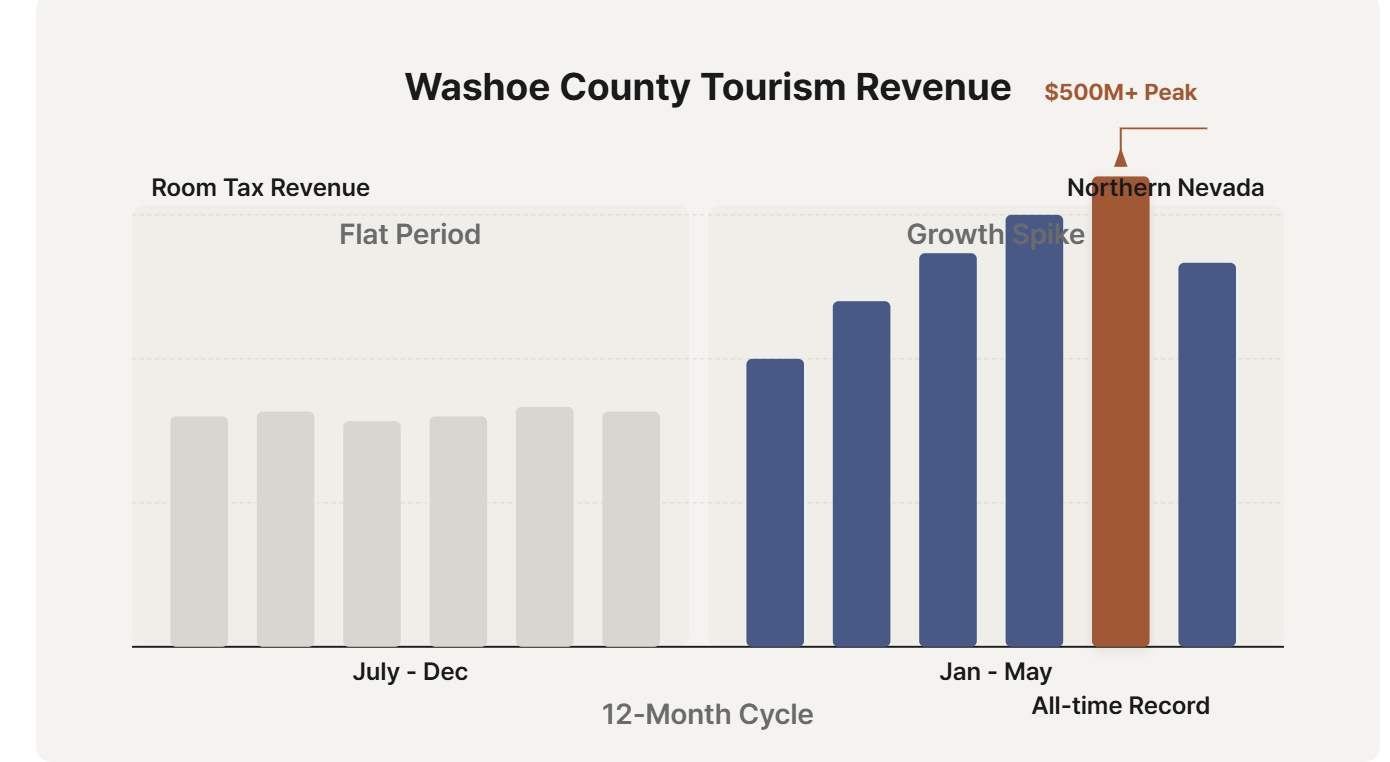
The Reno-Tahoe region of Northern Nevada is posting the strongest tourism results in its history. Washoe County's room tax revenue is set to cross $500 million for the first time this fiscal year, and April and May of 2026 delivered monthly figures the market had never produced. The direction runs opposite to the national picture, where rising living costs and record credit card debt are cutting into travel spending.
 Jung Han
Behind the numbers is a decade of structural change. Conventions and sports events have become the center of visitor demand, non-casino hotels have grown into a pillar of room supply, and lower costs of stay relative to major cities are winning bids for events.
That combination has turned Reno from a casino town into a convention city that competes with Dallas and Denver. K-Nevada Gateway 2026, held in Reno from September 28 to October 1, takes place in the middle of this growth phase.
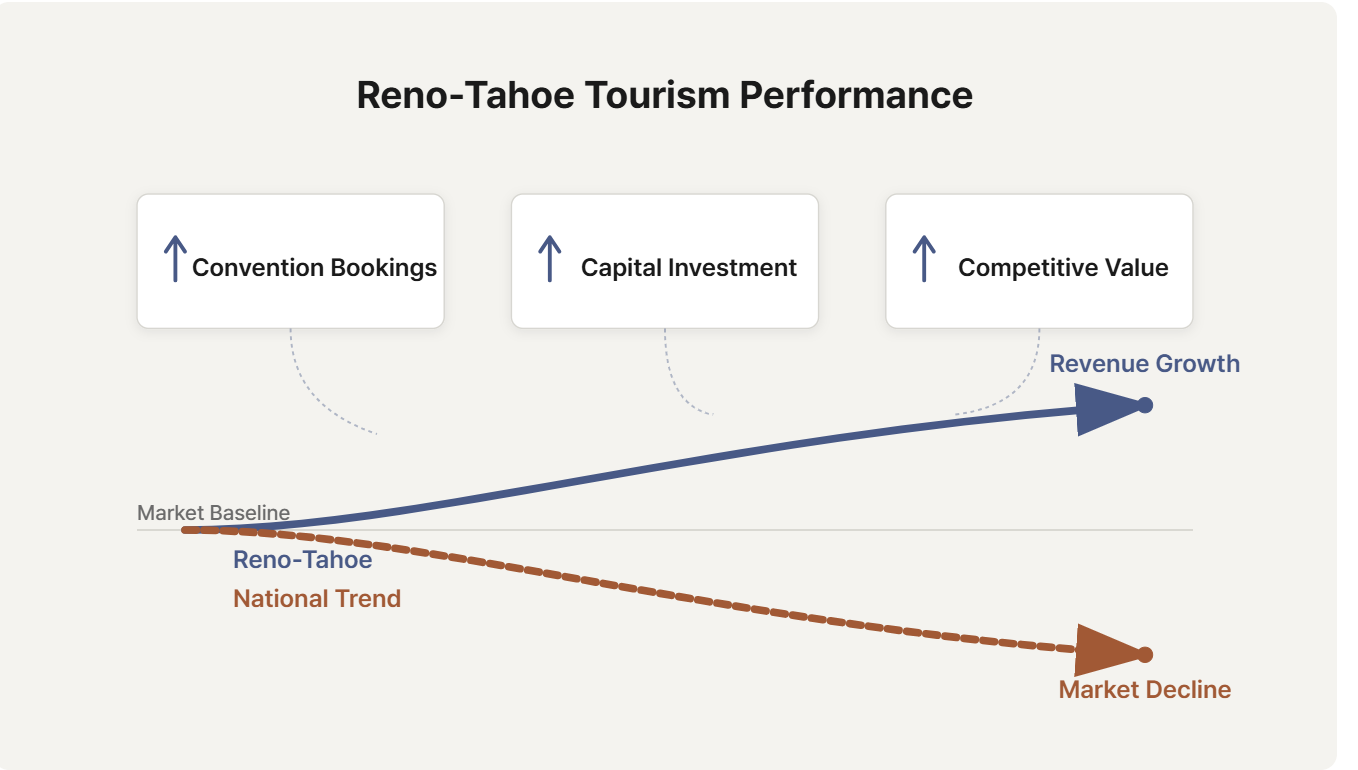
Reno-Tahoe moved against the national tourism trend (Graphic: NotebookLM report)
“Tourism in Northern Nevada Is Hotter Than It's Ever Been”

Mike Larragueta, President and CEO of Visit Reno Tahoe, described the state of the region's tourism industry on KTVN's public affairs program 'Face the State.' Asked whether troubling economic indicators made a downturn in travel seem inevitable, he answered with the past twelve months of numbers. On the organization's July-to-June fiscal year, results ran roughly level with the prior year through December — and then demand took hold in January. “Tourism in Northern Nevada is hotter than it's ever been,” he said, adding that April and May produced figures never before seen in this market.
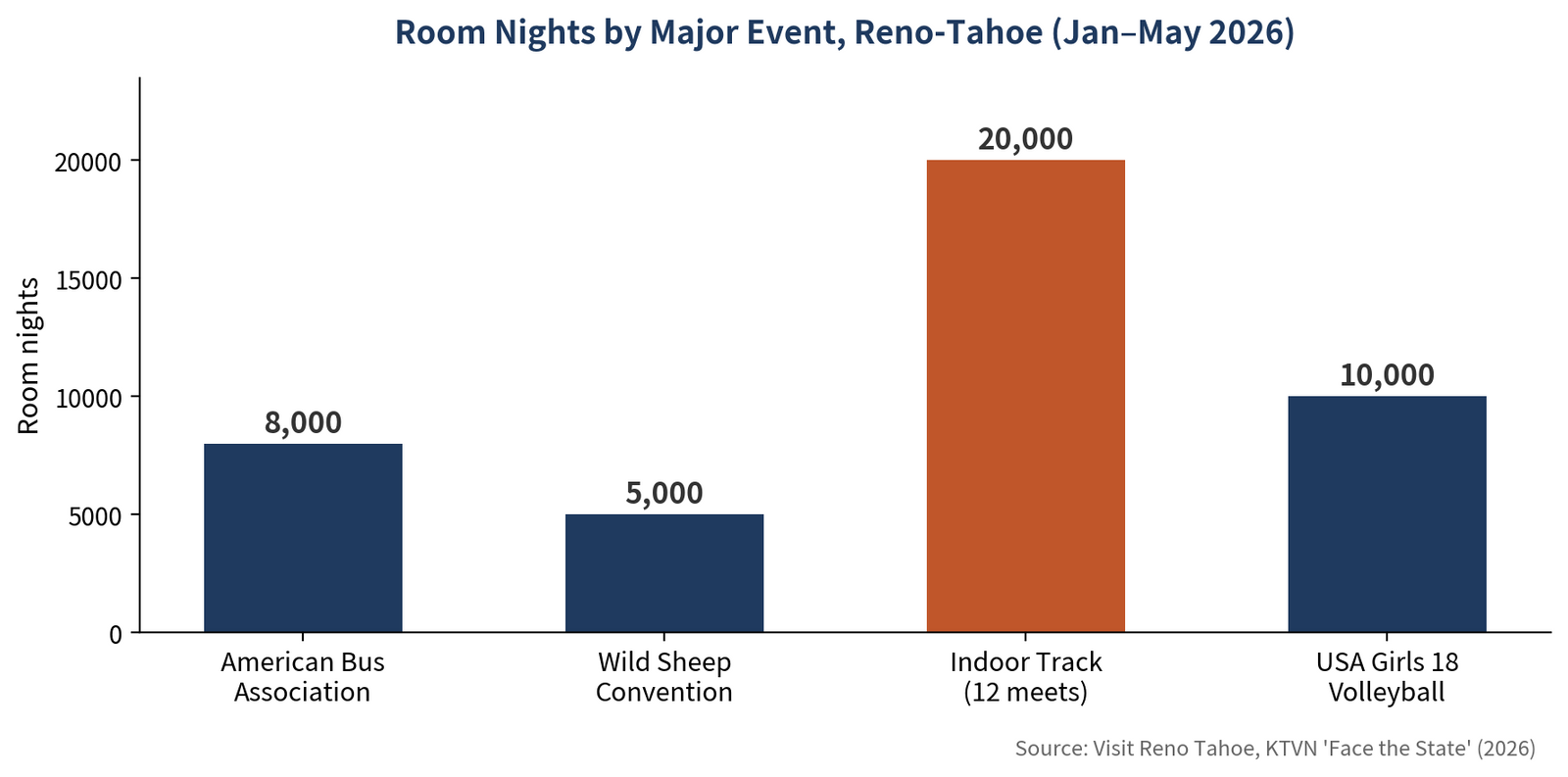
A run of conventions from January through May drove the climb. The American Bus Association, which opened the season, generated about 8,000 rooms. Larragueta put more weight on who filled them than on the count: tour operators from around the world visiting the West for the first time in thirty years, whose firsthand look at Reno is expected to return as tour products routed through the region for years. The Wild Sheep convention, a Reno fixture for decades, logged more than 5,000 room nights. The indoor track season, in its second year, passed 20,000 room nights across 12 meets and two conference championships, and the volleyball season that followed added another 10,000 through the USA Girls 18 tournament.
A City That Competed with Tucson Now Competes with Dallas
What Reno brings to the bidding table is investment — and even so, its costs stay low. Larragueta pointed to facility reinvestment underway across gaming resorts and smaller hotels alike: “I've been in this market for thirty years, and the properties have never looked better.” A single-level, 600,000-square-foot convention center and 15,000 hotel keys form the hardware, and compared with the cities Reno now bids against, he called the market “still a tremendous bargain.” Food and beverage costs widen the gap further.
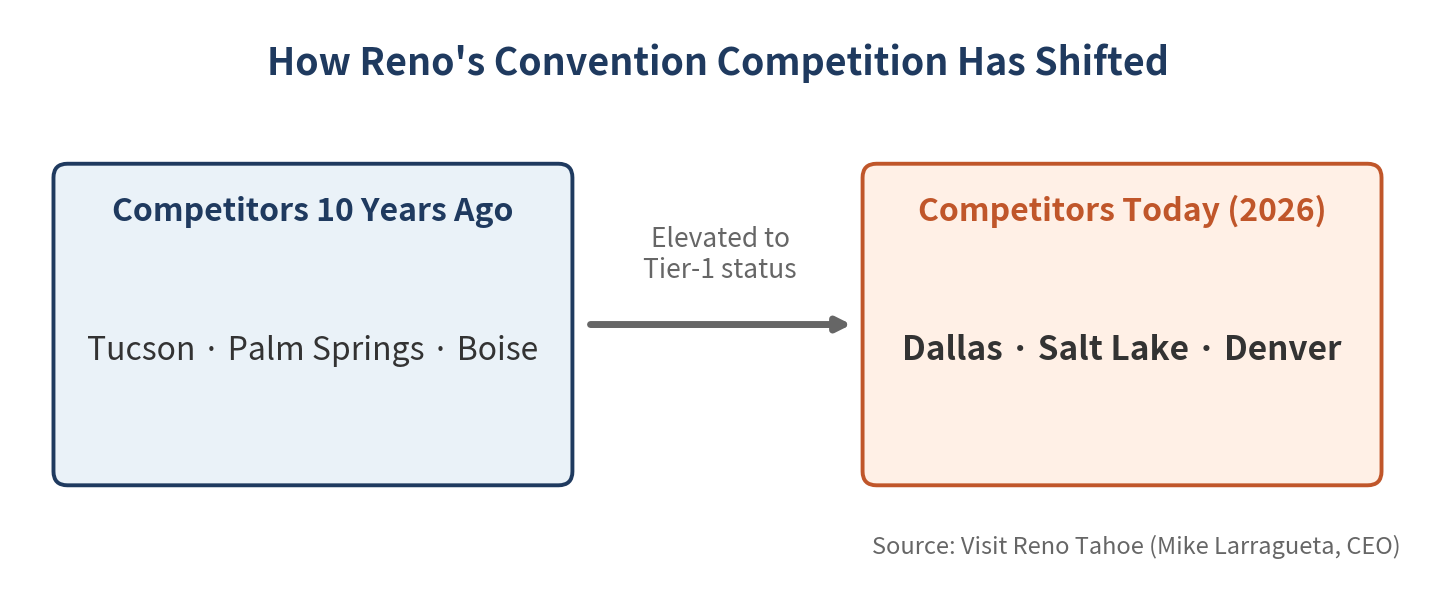
Asked who those competitors are, Larragueta said, “If you'd asked me ten years ago, I would have said Tucson, Palm Springs, Boise. But today we're competing with Dallas, Salt Lake, Denver — tier-one cities.”
The generation of meeting planners who remember what he calls “our father's Reno, or grandfather's Reno” is leaving the industry, and a new generation that knows little about the city is taking its place. That is why Visit Reno Tahoe concentrates on bringing decision-makers to see the destination in person. By his account, more than 50 percent of the event planners who visit end up signing.
A Third of Room Revenue Now Comes from Non-Gaming Hotels
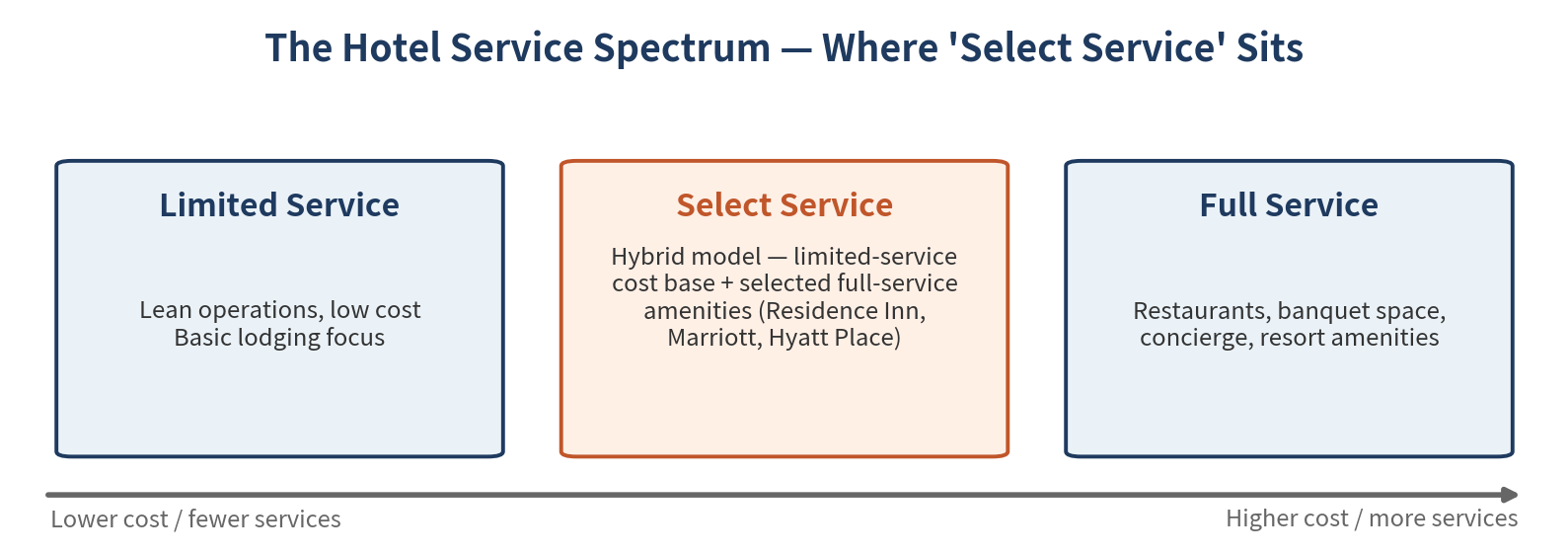
Gaming remains the foundation of Nevada's tourism industry. The revenue mix, however, has changed. Over the past five years, select-service hotels such as Residence Inn, Marriott, and Hyatt Place have multiplied, and these non-casino properties now account for more than a third of Washoe County's room inventory and room tax revenue.
Select service occupies the middle of the hotel industry's three-tier service spectrum, between full service and limited service. It is a hybrid model: the lean cost structure of limited service, with a selected set of amenities and services once found only at full-service properties layered on top.
Two demand streams fill Nevada's hotel rooms today: business travel generated by companies relocating to the state, and youth sports, which books roughly 150,000 room nights a year.
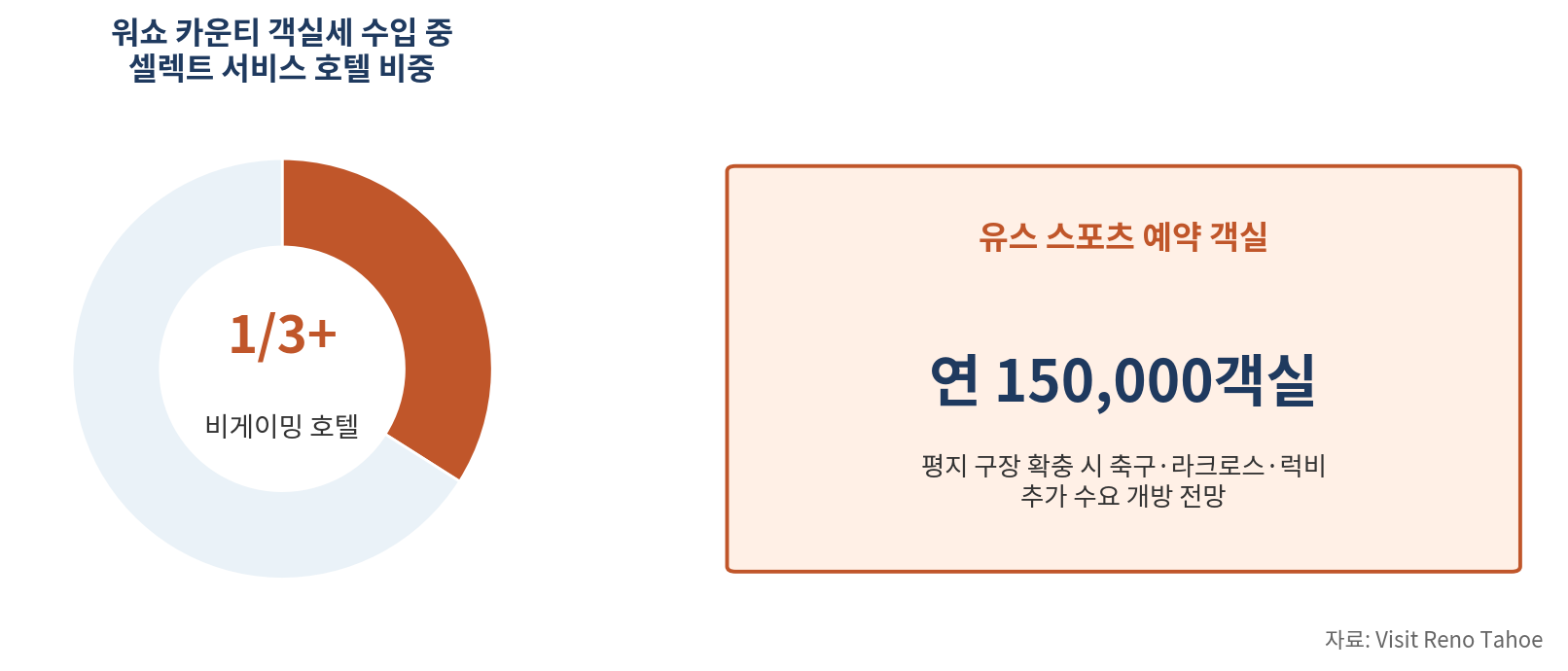
Larragueta sees substantial room to grow in youth sports, along with a practical constraint. The region performs well in indoor events, but lacks the flat fields needed for soccer, lacrosse, and rugby. “If we had more inventory, there's more demand,” he said.
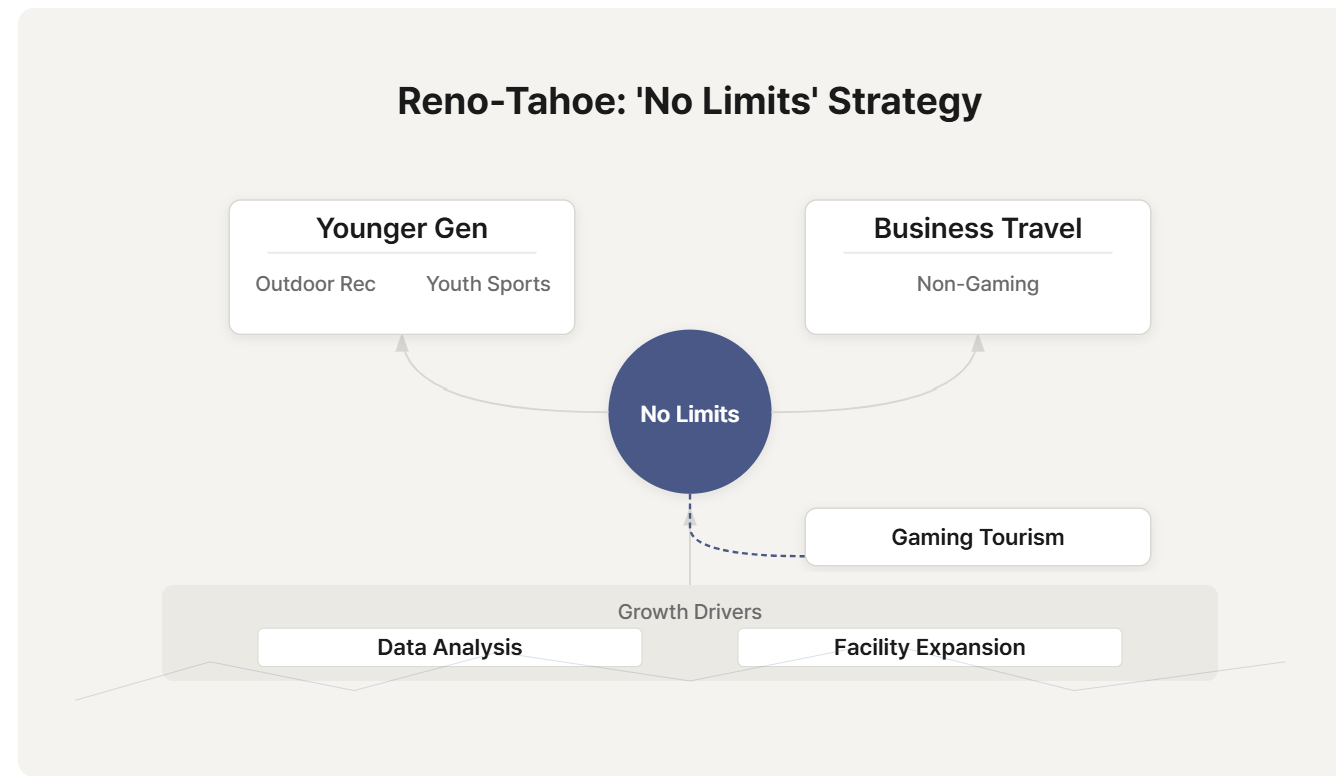
Reno's near-constant sunshine, which keeps outdoor tournaments from washing out, also works in its favor. Marketing has been consolidated under the tagline 'No Limits' — a product lineup meant to accommodate everything from tight-budget groups to top-tier events, with free or affordable outdoor recreation as the main draw for younger generations.
On the overtourism debate at Lake Tahoe, he acknowledged the problem while drawing a line. Day-trippers who park on freeway shoulders and carry coolers to the beach create safety hazards and add little to local spending, critics note. “I understand that frustration,” he said, “but there's a reason Tahoe is in our name. Tahoe is an asset that drives tourism into Northern Nevada.”
The Next Decade: $32 Million in Facility Upgrades, Bowling Locked In Through 2038
In the program's second segment, Larragueta turned to what comes next. Reno-Tahoe International Airport is in the middle of a major renovation — “your first sense of arrival and your last sense of departure,” as he put it — and airlines respond to that kind of investment.
On the facilities side, a $32 million, roughly two-year capital improvement plan has been approved for the venues Visit Reno Tahoe manages: the National Bowling Stadium, funded through a state-legislature-approved surcharge fund with the City of Reno; the Reno Events Center, where about $7 million will replace twenty-year-old seating with the kind found at T-Mobile Arena or Allegiant Stadium in Las Vegas; and the convention center, the organization's core meetings product with five exhibit halls, more than fifty meeting rooms, and 600,000 square feet. Technology cycles that once ran three to five years now turn over every six months to a year, he said, and his team is touring recently upgraded facilities elsewhere to make sure nothing is missed.
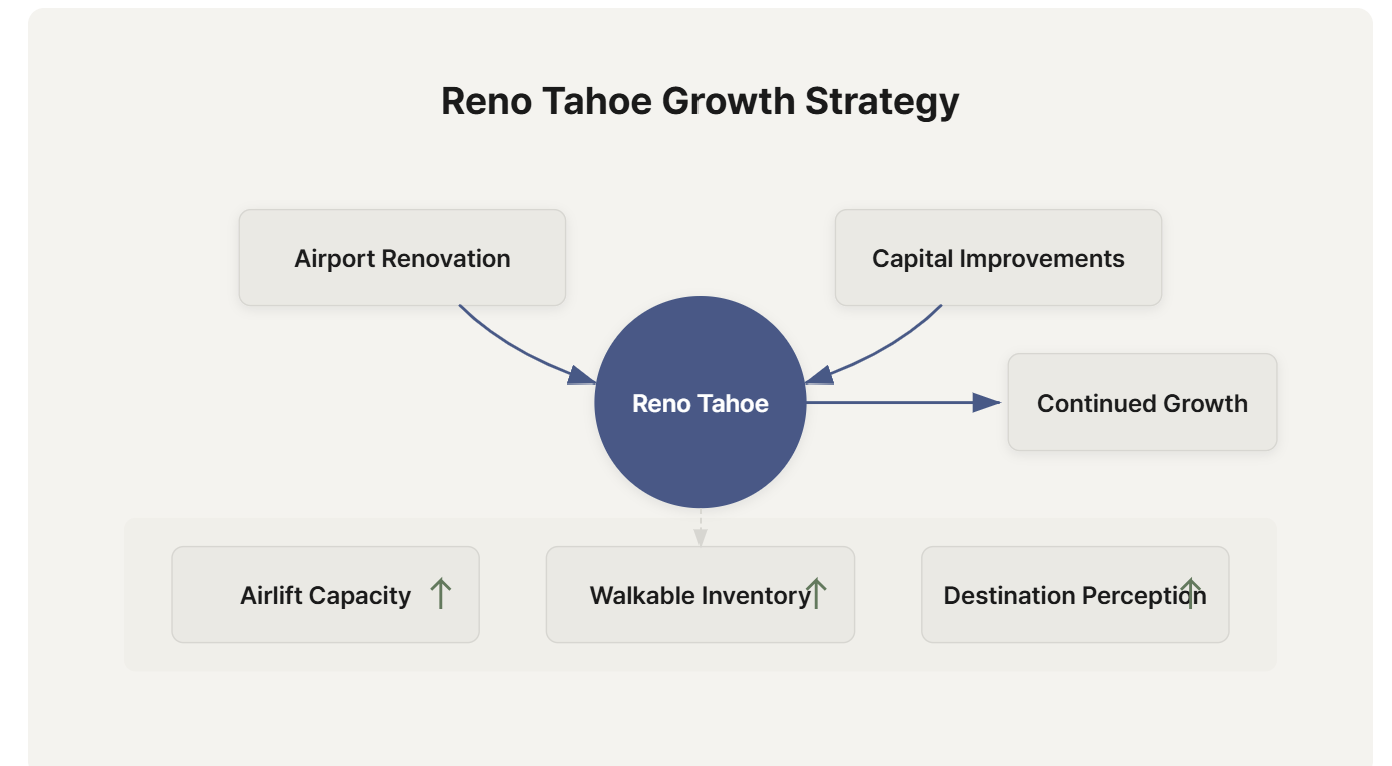
The constraints he named are airlift, walkable inventory, and perception. Eight regional convention sales offices — from Washington, D.C. and Atlanta to Chicago and Dallas — report that clients who visit Reno come away sold, but the ease and price of flying attendees in from across the country still counts against the city.
Around the convention center, more restaurants, retail, and hotel rooms within walking distance remain on the wish list, which is why the organization supports the proposed Boulevard district and professional soccer stadium nearby — a venue that could also host youth soccer, lacrosse, and rugby. The arena project at the Grand Sierra Resort draws the same support: a 10,000-seat facility would house University of Nevada basketball and open the door to boxing, martial arts, and UFC-class entertainment that Reno currently has no venue to hold.
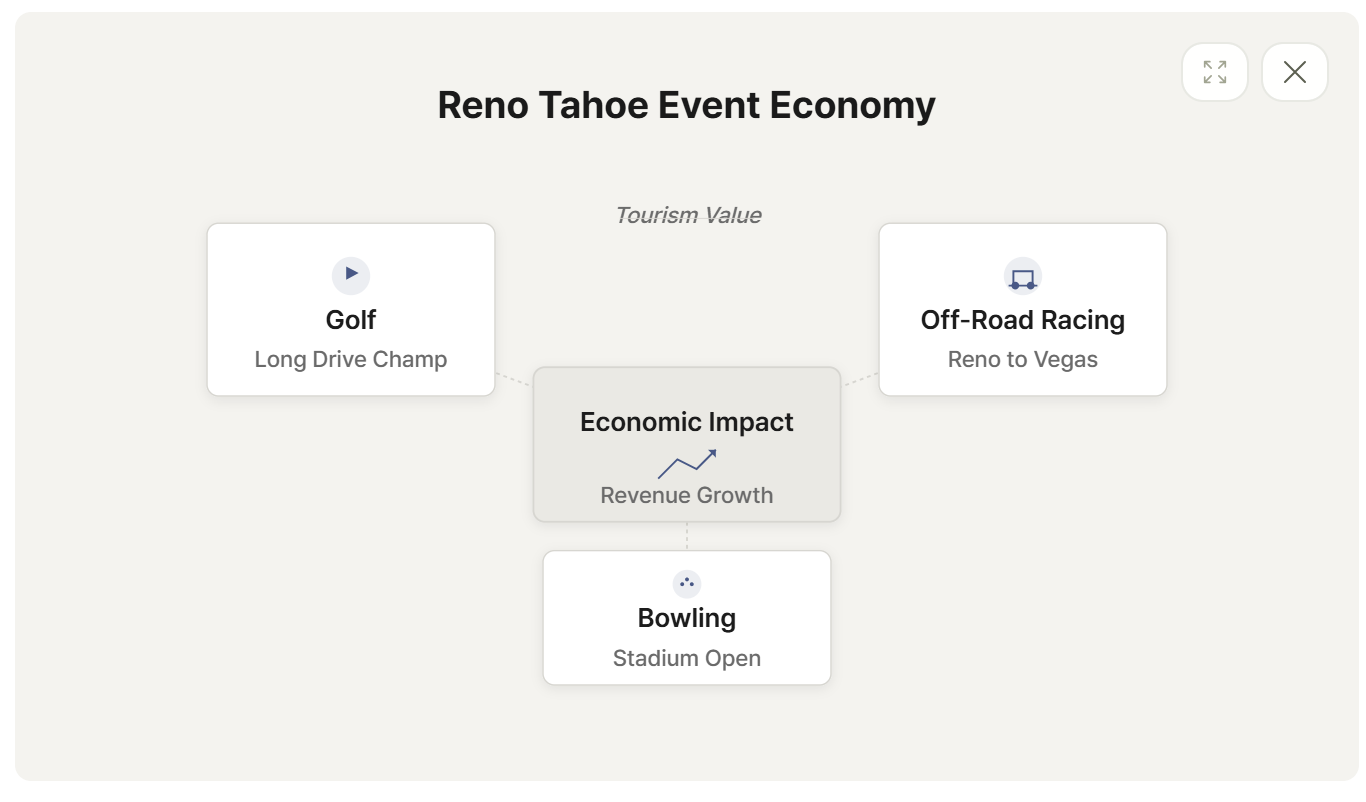
New events are already signed. The World Long Drive Championship comes to Wildcreek Golf Course in October on a three-year deal — 200 contestants across four divisions, filmed for the Golf Channel with the downtown Reno skyline behind 400-plus-yard drives.
The longest off-road race in the United States reverses its 30-year route this year to run Reno to Las Vegas, a 500-mile race with a festival and a parade through downtown. And bowling, the region's largest recurring convention since 1977, is mid-tournament: the Open Championship, extended two weeks on demand, is drawing more than 11,000 teams and 55,000 bowlers, generating 140,000 room nights and an estimated economic impact above $84 million — figures Reno had not seen since 2009 — with the tournament now contracted to return through 2038.
K-Nevada Gateway 2026 Opens September 28 in Reno
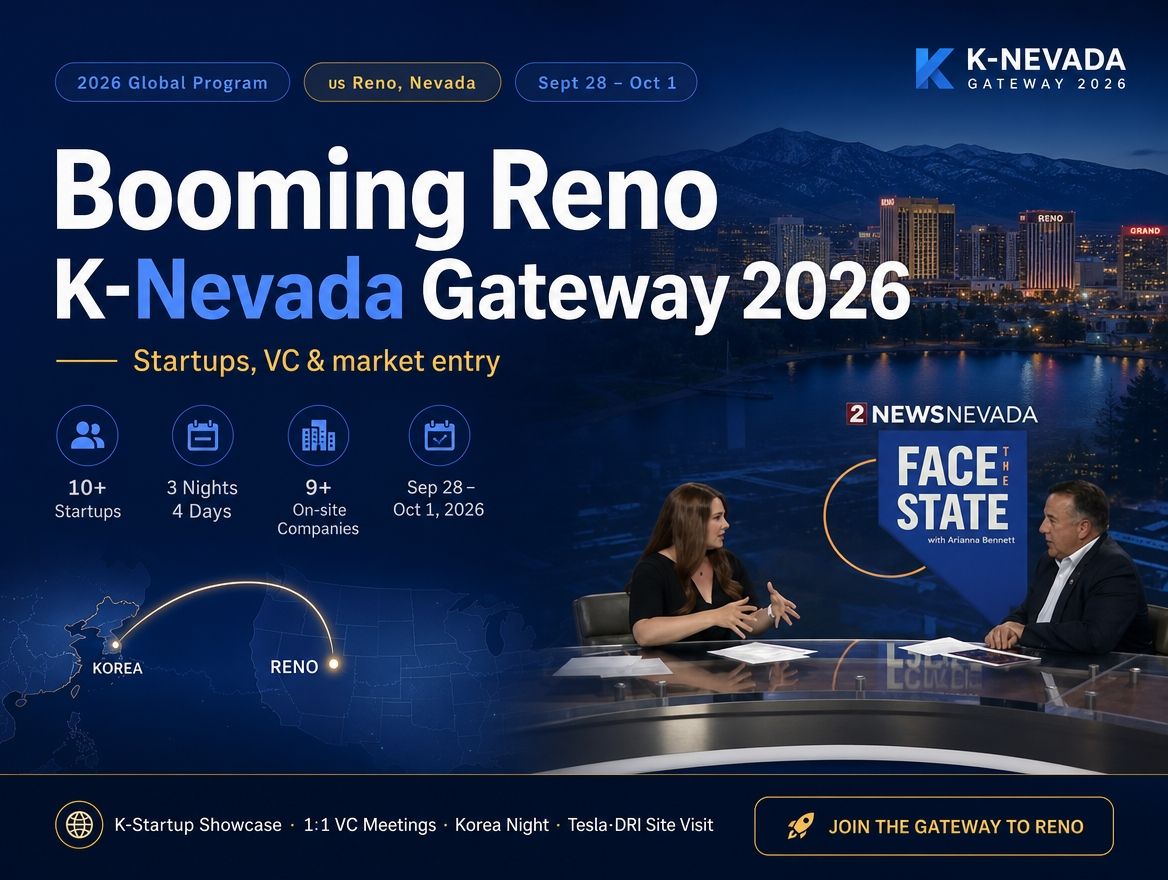
With Reno emerging as a hub for business and networking, K-EnterTechHub — together with Pacemakers, The Way Company, and Mediontech — is staging an immersive K-startup market-entry camp on the ground in Reno.
Over three nights and four days, the program packs in U.S. industry education, pitching, investor meetings, partner networking, and meetings with key local figures. It is designed so that innovative startups from Korea and Asia build their U.S. West market entry together with the institutions that run the region.
On the Nevada side, the UNR Ozmen Center for Entrepreneurship (Director: Dr. Mehmet Tosun) hosts the core program as Main Partner, joined by the region's principal economic institutions — EDAWN, GOED, NCAR, Nevada Autonomous, DRI, StartUpNV, and the KSEA Nevada Chapter.
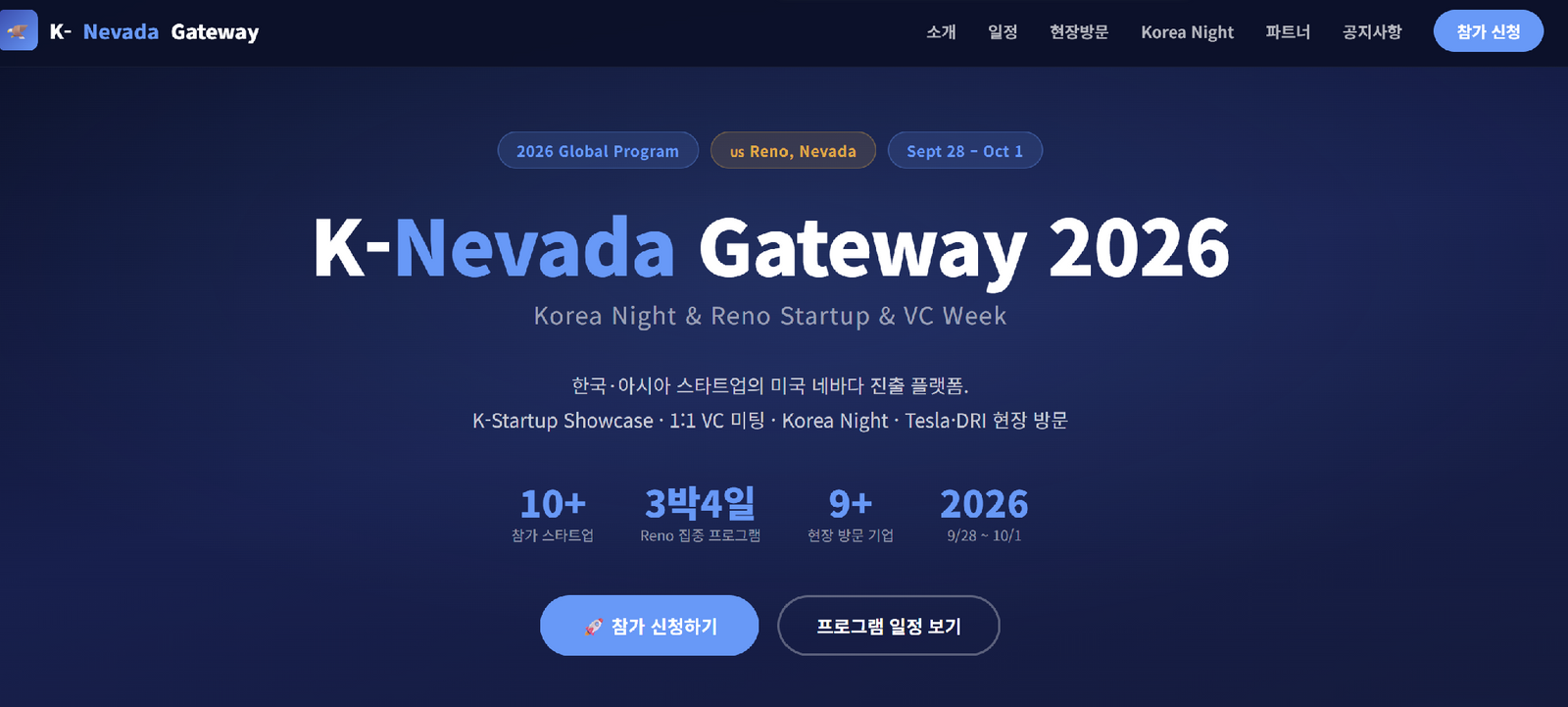
The official K-Nevada Gateway 2026 website (knevada.com)
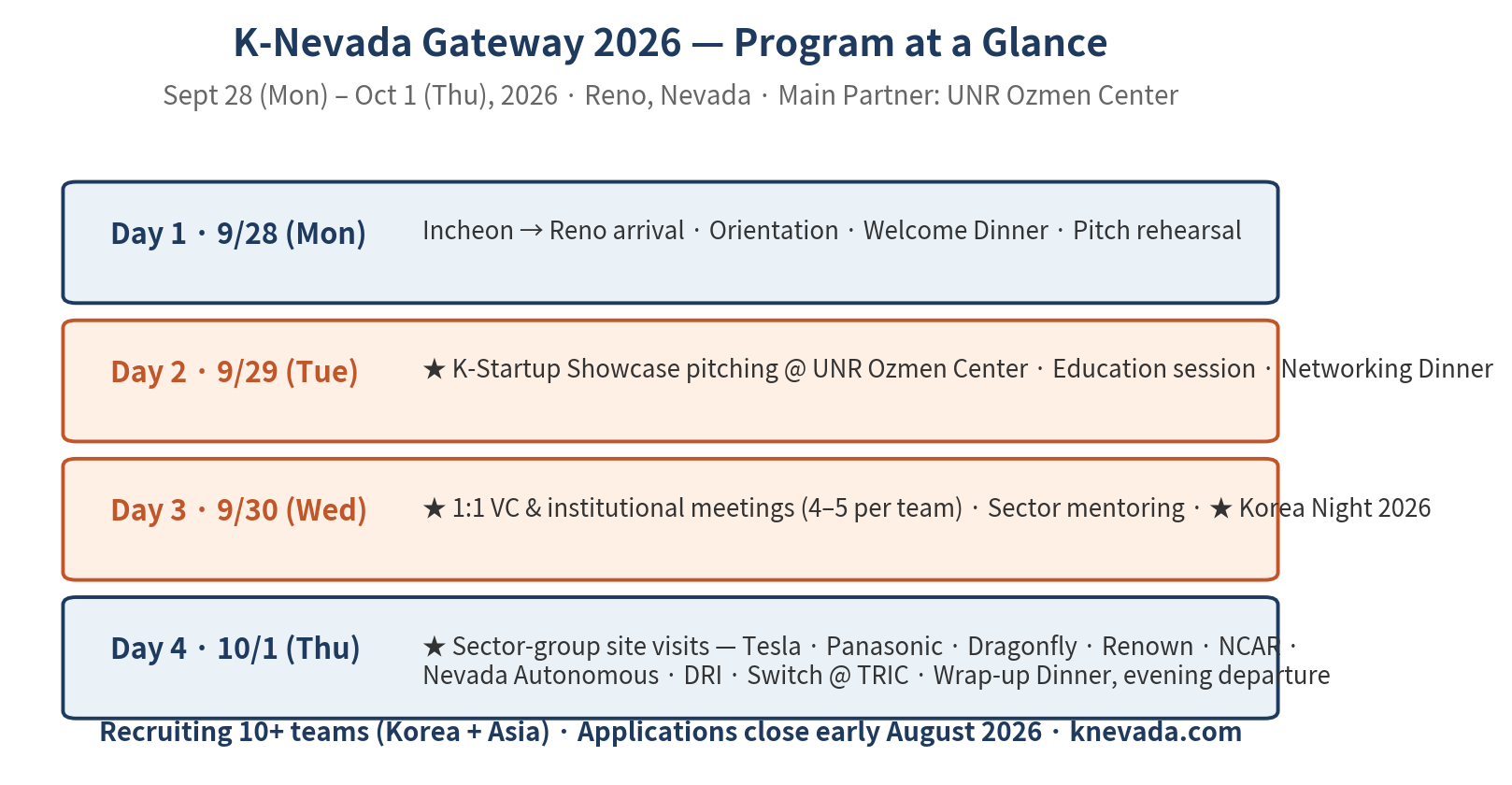
K-Nevada Gateway 2026 program at a glance (Graphic: K-EnterTech Hub)
The schedule runs four days. September 28 covers arrival in Reno, orientation, a welcome dinner, and pitch rehearsal. On the 29th, the K-Startup Showcase takes place at the UNR Ozmen Center: ten or more teams pitch by sector before EDAWN, GOED, NCAR, StartUpNV, and local venture investors, followed in the afternoon by an education session on UNR industry-academic collaboration and IP policy and a legal clinic with Mission Law Firm. The morning of the 30th holds four to five one-on-one VC and institutional meetings per team, with free meetings and sector mentoring in the afternoon. Korea Night 2026 that evening brings together Korean Consulates and Cultural Centers, Nevada state government, and local VC and angel investors.
On October 1, participants split into sector groups for site visits across TRIC and the greater Reno area — Tesla Gigafactory, Panasonic Energy of North America, Dragonfly Energy, Renown Health, NV Energy, NCAR, Nevada Autonomous, DRI, and the Switch Citadel Campus — closing with a wrap-up dinner before departure. Afterward, The Way Company's one-on-one setup consulting, POC and pilot matching, investment follow-up, and a CES 2027 roadmap carry support forward for three months.
Focus Sectors and How to Apply
Recruitment centers on six tracks with direct touchpoints in Nevada industry: energy, battery, and cleantech reaching the Tesla Gigafactory ecosystem and DRI research; semiconductors and AI chips using NCAR equipment and UNR research; medical and healthtech connected to the NCAR Biosciences Incubator and Renown Health; AI, content, media, and entertainment tech with UNR's VARI Core (VR/AR) and potential Korean content studios collaboration; drones, mobility, and physical AI on the FAA-designated test airspace; and sports tech, agtech, and space and defense. A dedicated government and municipal track runs alongside, built for Korean public agencies, local governments, and their affiliated companies, including cooperation programs with Nevada state government and Reno-area economic organizations.
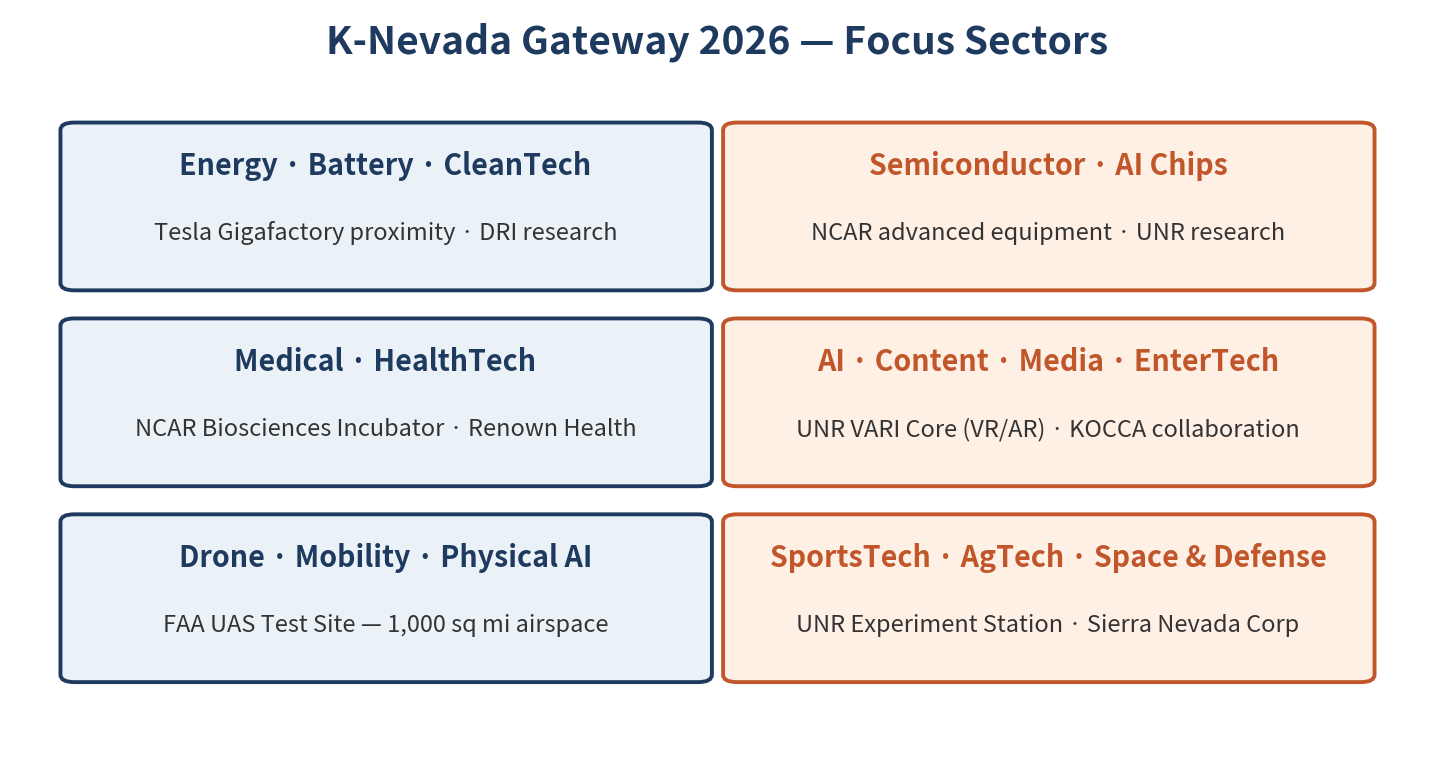
Six focus sectors and their Nevada touchpoints (Graphic: K-EnterTech Hub)
The participation fee is $9,000 per two-person team at the standard rate, with a $7,000 Asia Tech rate for companies from markets such as Malaysia, Taiwan, Singapore, and Vietnam; companies referred by government agencies or municipalities can negotiate terms using matching funds. The fee covers showcase pitching, one-on-one VC meetings, sector site visits, Korea Night, two rounds of online pitch coaching, the legal clinic, local transportation, networking meals, three months of follow-up support, and a results report. Round-trip airfare and three nights of lodging in Reno are borne by participants. Ten or more teams will be selected, with applications closing in early August; roughly ten companies are currently in review.
An online information session for prospective participants will be held in July, covering the detailed schedule, an overview of the Nevada market, and pitch preparation — companies can decide whether to apply after attending. Details and applications are available at knevada.com or by email at newsroom@kentertechhub.com.
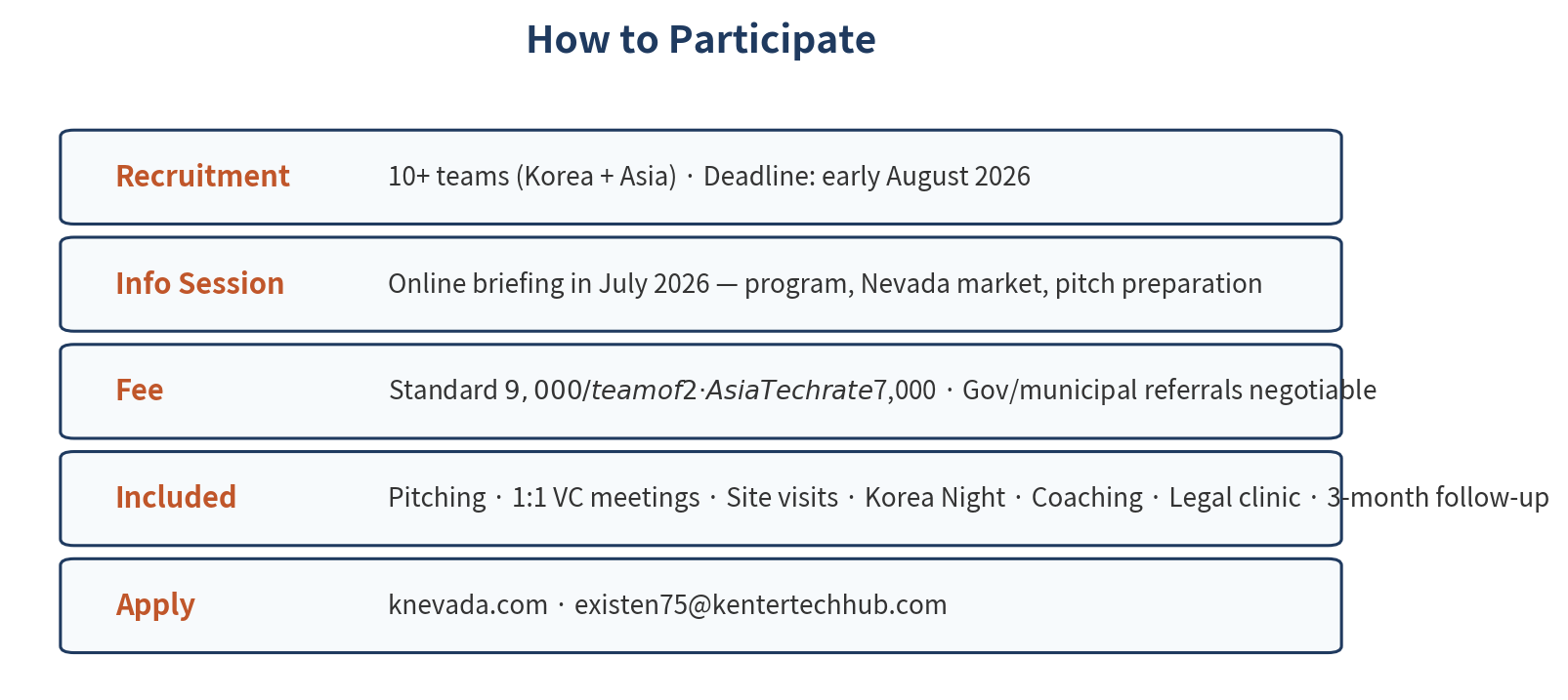
K-Nevada Gateway 2026 — participation summary (Graphic: K-EnterTech Hub)
While most American cities worry about shrinking travel demand, Reno has been resetting its records — and at the end of September, the city's convention infrastructure and economic development institutions will be receiving Korean startups. As Larragueta put it, Reno is a city where more than half of the people who come and see it sign. K-Nevada Gateway 2026 fills that first visit with four days of pitching, investor meetings, site diligence, and networking.
What the Tourism Boom Means for the September Event
Reno's tourism and convention boom carries particular weight for companies joining K-Nevada Gateway. First, the range of people they will meet has widened. Convention demand has drawn national-level companies and investors to Reno in greater numbers, and Reno Startup Week (September 29–October 2), held the same week as the Gateway, is scaling up on that current. Participants gain access, in a single trip, to both the Gateway's Korea-U.S. network and Startup Week's global investor network.
It is also worth noting that an institution from the interview overlaps with the Gateway's partners. Explaining the business travel that fills non-gaming hotels, Larragueta credited the region's economic development organization for its company recruitment — that organization, EDAWN, is the Gateway's U.S.-side partner. More business travel means more companies newly established in Reno, which for participants translates into a larger pool of counterparts for POC and partnership discussions. The 150,000 annual youth sports room nights and the push for more flat fields are, for sportstech applicants, market intelligence in themselves.
There are practical effects as well. Room demand is pushing average rates upward, and late September sits in a stretch of back-to-back convention and sports schedules — lodging is best secured early, and the growth of select-service hotels means more options across budgets than before. On the air side, seat capacity at Reno-Tahoe International Airport is growing, but with no direct service from Incheon, itineraries typically route through San Francisco or Los Angeles. The inclusion of local transportation in the Gateway fee reflects these conditions.
Currents outside the tourism industry also shape what participants will find: a tax structure with no corporate or personal income tax, the Tahoe-Reno Industrial Center (TRIC) anchored by the Tesla Gigafactory, Panasonic Energy, and Switch data centers, the FAA-designated 1,000-square-mile UAS test airspace (Nevada Autonomous), and the research capacity of the University of Nevada, Reno and the Desert Research Institute. While tourism raises the city's external profile, industry keeps drawing companies and talent at costs below Silicon Valley.
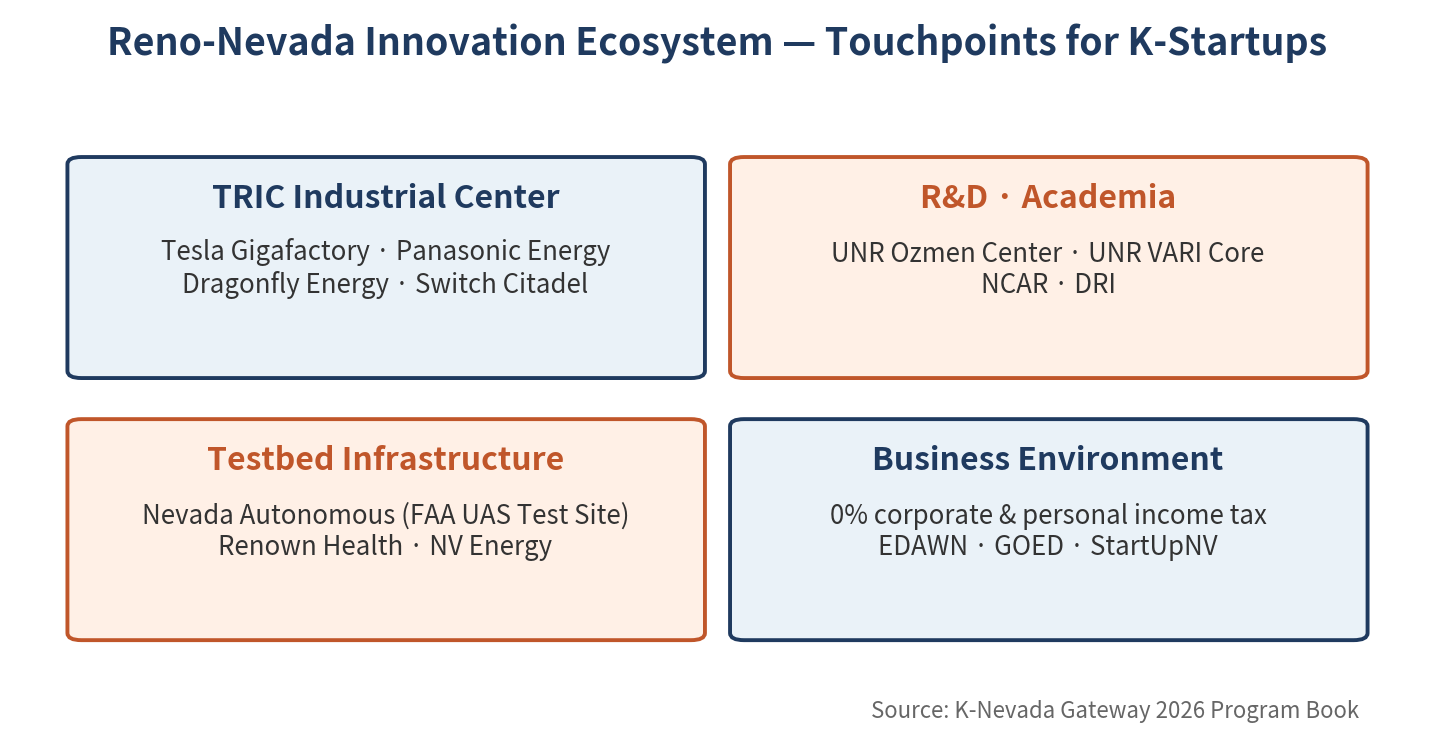
The Reno-Nevada innovation ecosystem (Graphic: K-EnterTech Hub)