![[보고서]전통 언론사의 크리에이터 전략 대전환](https://cdn.media.bluedot.so/bluedot.kentertechhub/2026/02/0nwc9z_202602100212.png)
"The Era of Entertainment Roll-Ups Is Over" What Choices Lie Ahead for K-Entertainment Companies
NDUSTRY DEEP DIVE
The collective delusion of becoming the "Next Disney" is collapsing in the age of the creator economy and fandom economics
Candle Media Signals Portfolio Unwinding by Returning Majority Stake in ATTN: to Its Founders
The $2 billion media empire that once dreamed of becoming the "Next Disney" has begun to rewind. Candle Media, once hailed as the "new empire of the streaming era" and backed by Disney veterans and Blackstone capital, has started its diet.
‘엔터 롤업’ 시대는 끝났다..볼륨이 아닌 주목이 필요한 시대에 K엔터에 주는 메시지
캔들미디어, 디지털 스튜디오 ATTN: 재매각. 이번 거래는 저금리 시대에 성립했던 ‘엔터 롤업’ 모델이 고금리·스트리밍 둔화 국면에서 한계에 봉착. K-엔터테크 기업의 성패가 특정 카테고리서 정의된 슈퍼팬 집단의 관심을 얼마나 깊게 붙잡고 이를 스트리밍·숏폼·스마트TV·FAST 같은 S-환경 위서 얼마나 효과적으로 확장하느냐에 따라 갈릴 것
 Jung Han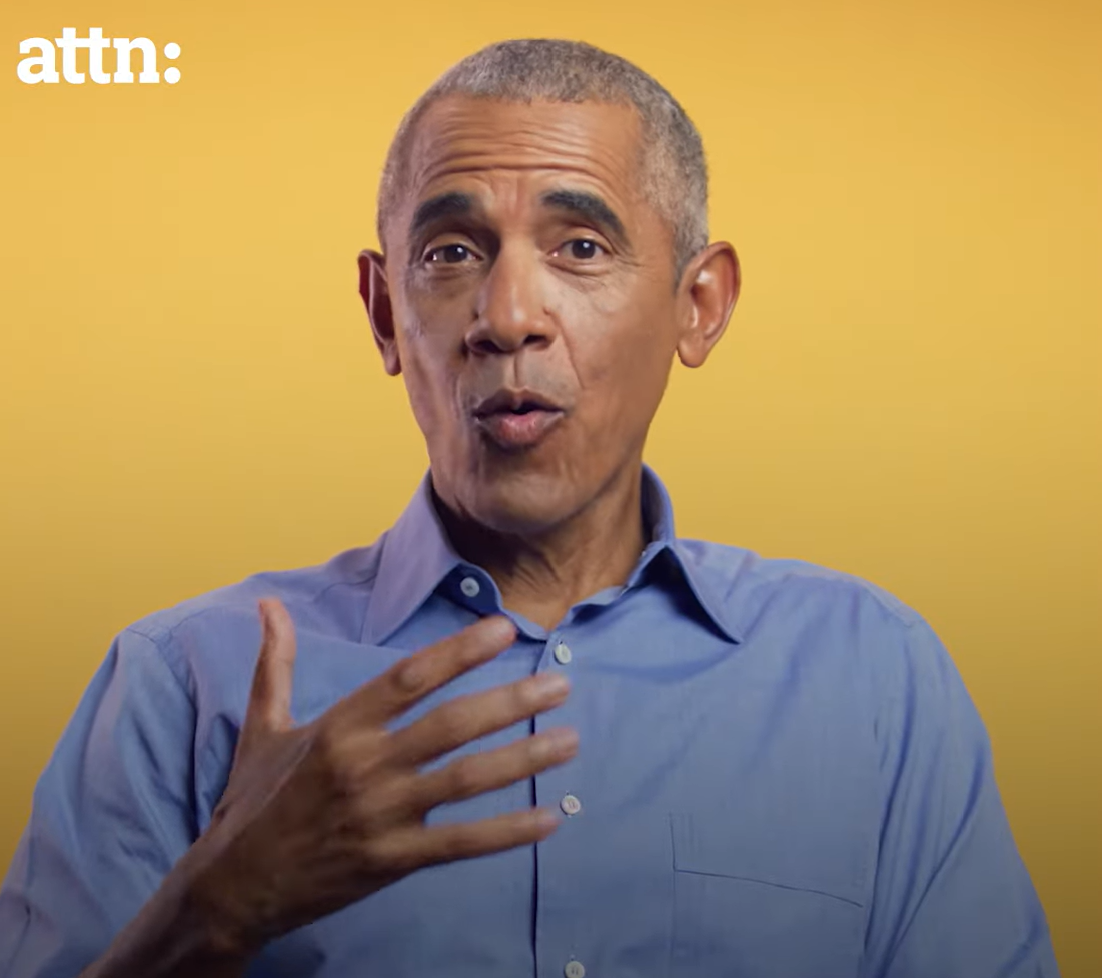
The company, which owned a portfolio of content studios including Hello Sunshine, Moonbug, Westbrook, and ATTN:, announced the resale of ATTN: to its co-founders. The roll-up strategy fueled by low interest rates and the streaming boom is shifting. Under the dual headwinds of high interest rates and slowing growth, Candle Media’s strategy has changed from "a game of collecting brands" to "a question of how to unbundle them."
Candle Media’s sale of ATTN: is not a simple portfolio adjustment. In the Netflix era, when becoming a component of a giant platform once seemed like the logical next step, digital-native studios are now returning to the narrative of independent studios that focus on the attention economy, superfans, and creator fandom. The large media companies that once acquired these digital-native studios to build economies of scale and pursue "multi-platform" strategies are now choosing to dismantle.
The empire’s logo is coming down, and the collective delusion of becoming the "Next Disney" is ending.
Candle Media Sells Back Its ATTN: Stake
On February 10, Candle Media, the media roll-up platform funded by major investor Blackstone, announced the sale of its majority stake in digital media company ATTN: back to co-founders Matthew Segal and Jarrett Moreno. According to Axios and other outlets, this is the first executed case since Candle Media pivoted to a strategy of "selling individual brands."
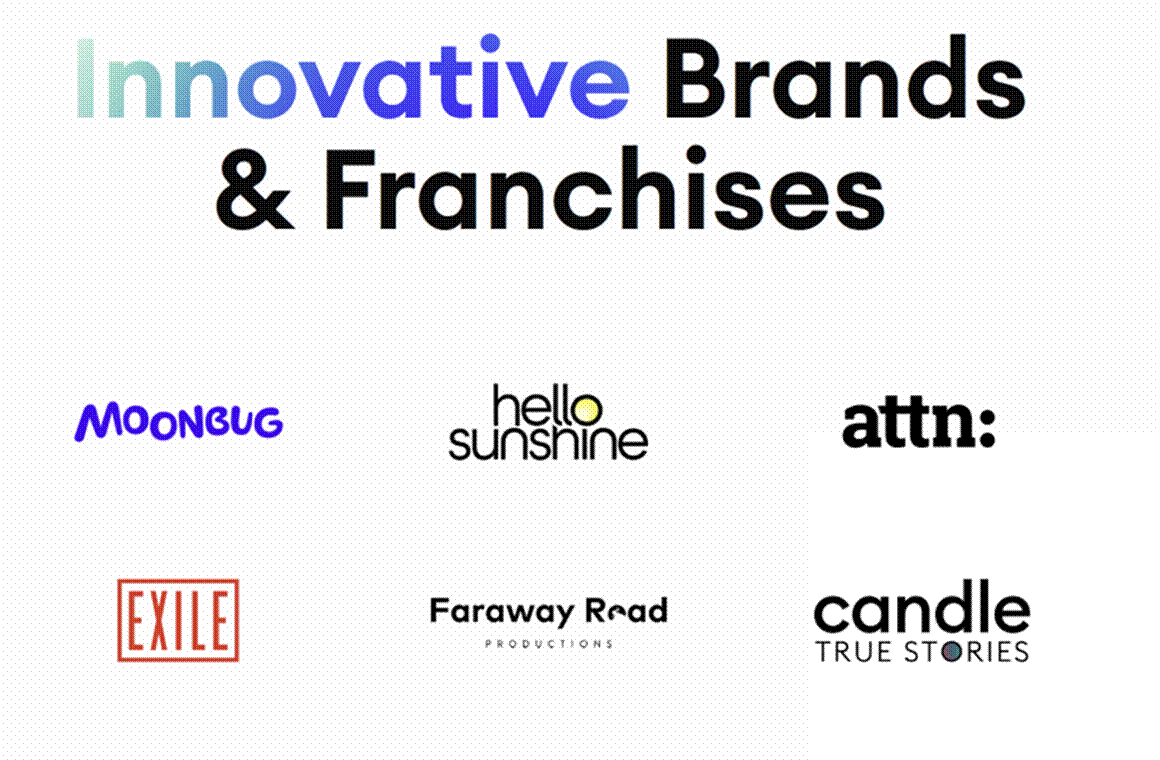
Candle Media’s Innovative Brands & Franchises Portfolio
This deal goes far beyond a simple asset sale. It marks the beginning of a process where content assets aggressively accumulated during the low-interest-rate era are being released one by one under the dual pressure of high rates and the end of the streaming boom. Candle Media’s ATTN: deal sits at the intersection of the structural turning point in the U.S. media industry, following Vice Media’s bankruptcy, BuzzFeed News’ closure, and Recurrent Ventures’ brand-by-brand sell-off.
What Is ATTN:?
To understand ATTN:, we first need to look at the market it helped create. Founded in LA in 2014, ATTN: is a digital media company focused on social change and political issues targeting millennials and Gen Z. Its core format involves breaking down complex policy and social issues into 1–3 minute short-form videos, made accessible through captions, graphics, and infographics.
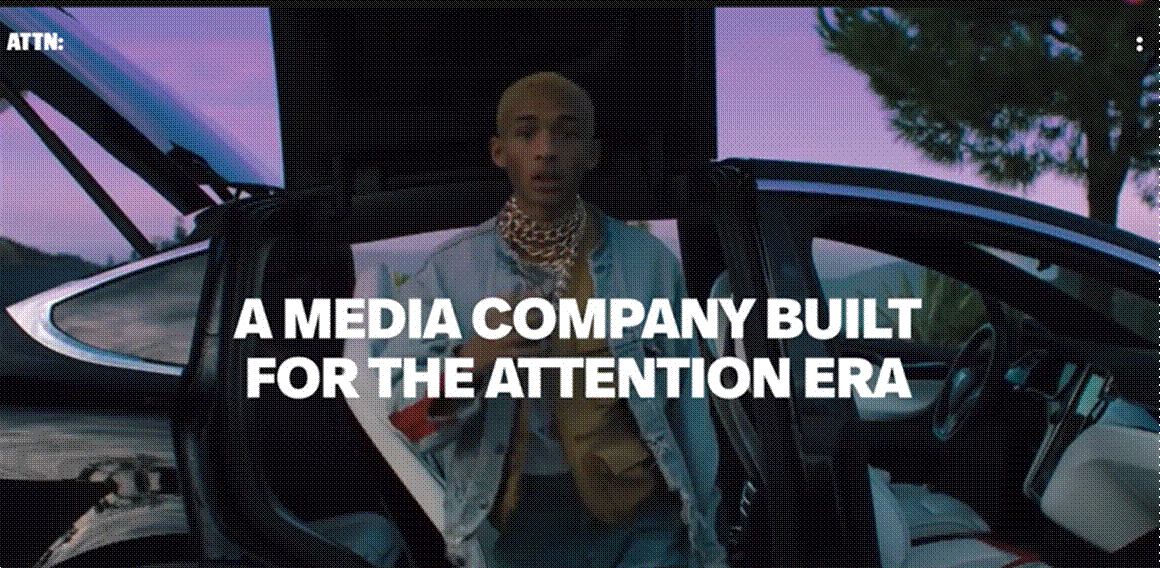
ATTN: — A Media Company Built for the Attention Era
ATTN: built its brand through viral videos featuring celebrities like Michelle Obama and Arnold Schwarzenegger, as well as current and former politicians. According to The Wrap, ATTN: also produced video shows for former Presidents Barack Obama and Joe Biden, and has collaborated with major platforms like TikTok on branded content.
Turning Voter Registration PSAs into Business: ATTN:’s Hybrid Model
ATTN: built on the voter engagement PSA (Public Service Announcement) format pioneered by initiatives like "When We All Vote" and "NowThis," combining powerful opening hooks, high-profile celebrity appearances, and clear calls to action like "Register here now" or "Click this link" in short-form videos produced at scale.
By reframing this format not as mere public interest messaging but as a modular template that combines specific issues with brand imagery, ATTN: opened a path to selling campaign design, production, and distribution as a single packaged product.
The result was a hybrid model combining a brand studio and impact media, weaving together traditional advertising, branded content (where brands sponsor messages), and licensing of formats, characters, and IP into a single value chain.
The brand studio functions as a creative hub that designs and produces messages in partnership with advertisers, while the impact media arm operates as a journalism and campaign platform that drives attitudinal and behavioral change on social and political issues. What ATTN: ultimately sells is a new type of product: a "content factory that does good while designing the political and social voice that brands couldn’t articulate themselves."
ATTN:’s core competitive advantage lies in its ability to simultaneously operate as a social media agency and brand studio, with campaign planning capabilities serving corporations, government agencies, and foundations. At the time of its acquisition by Candle Media in 2022, ATTN: was already profitable, and co-founders Segal and Moreno continued to lead operations post-acquisition.
Industry observers view the essence of this deal not as "restructuring a struggling company" but as "a reset that returns a proven digital asset to its founders." The estimated 2022 acquisition price was approximately $150 million.
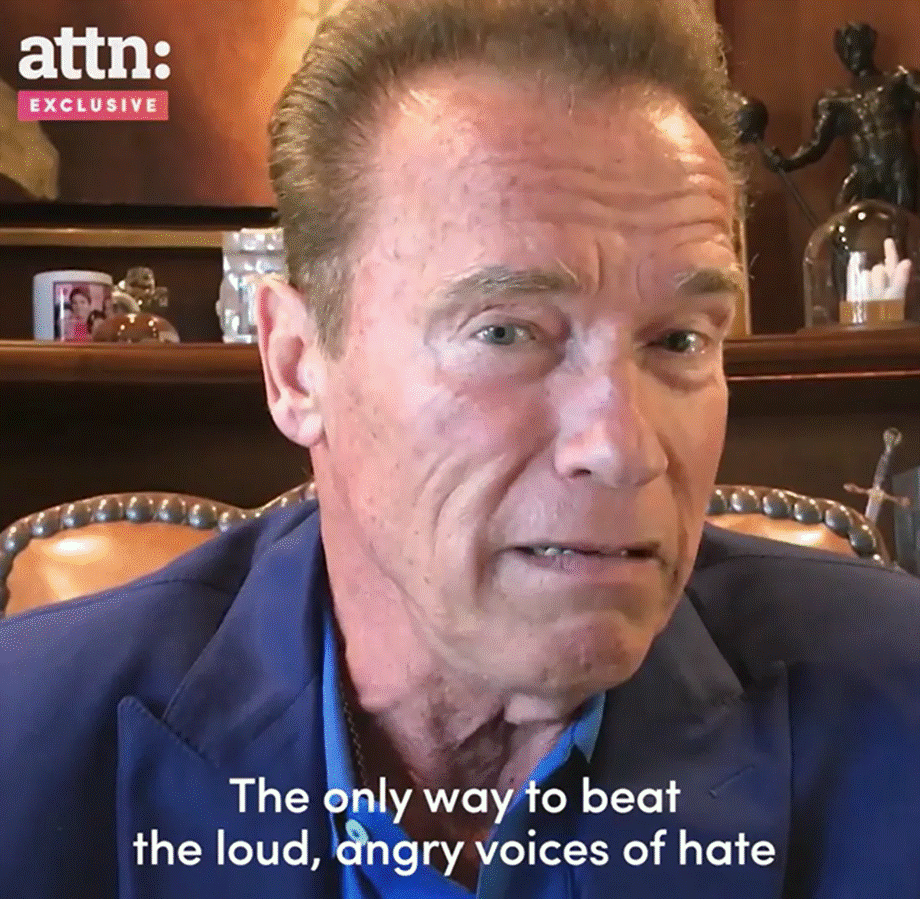
ATTN: Exclusive Content — Celebrity-Driven Advocacy Video
Who Funded It: The Return of Founders + Strategic LPs
The investor composition in this resale represents a combination of "founder leadership + industry veteran LPs."
At the center of the acquisition are co-founders Segal and Moreno, joined by early ATTN: investors: Fenway Sports Group Chairman Tom Werner and Main Street Advisors CEO Paul Wachter. The re-participation of investors who were there from the beginning demonstrates long-term confidence in ATTN:’s business model.
Among new investors, the participation of former Paramount Global Chair Shari Redstone stands out. After completing Paramount’s merger with Skydance last year and stepping back from active management, this U.S. media industry titan made a personal investment bet on a Gen Z-focused digital advocacy media company. A traditional media authority placing money on the future of digital natives. Andell Holdings Chairman Andrew Hauptman also joined as a new investor.
ATTN: Acquisition Investor Composition
|
Category |
Investor |
Role /
Significance |
|
Founders |
Matthew Segal & Jarrett
Moreno |
Co-founders; regaining
majority stake |
|
Returning LP |
Tom Werner (Fenway Sports
Group) |
Original ATTN: investor;
long-term trust signal |
|
Returning LP |
Paul Wachter (Main Street
Advisors) |
Original investor; strategic
advisory |
|
New Investor |
Shari Redstone |
Former Paramount Global
Chair; personal bet on digital media |
|
New Investor |
Andrew Hauptman (Andell
Holdings) |
New strategic capital |
|
Minority Holder |
Candle Media |
Retains minority stake with
upside option |
Candle Media will retain a minority stake, securing an option to share in any future upside if ATTN:’s value rises again. Co-CEOs Kevin Mayer and Tom Staggs stated that they "have valued the partnership with the ATTN: team and wish them continued success in their new chapter." Both executives served long tenures at Disney and were instrumental in launching Disney+.
Why Is Candle Media Unwinding: The Limits of Media Roll-Ups
The more important question is why Candle Media is reselling a profitable company.
In short, Candle Media’s roll-up strategy is being recalibrated for the age of AI, short-form content, micro-dramas, and the creator economy. Instead of accumulating, they are dismantling. Instead of platforms, they are choosing attention.
To properly understand this deal, we need to first examine the mechanics of the "roll-up" investment strategy. A roll-up involves serial acquisitions of multiple smaller companies within a specific industry under a single platform, creating economies of scale and integration premiums before exiting through an IPO or large-scale sale. It’s a private equity strategy that has long been effective in fragmented markets like healthcare, veterinary services, and property management.
During the 2020–2022 streaming wars, this strategy made its way into the media and entertainment industry. In an environment where content asset valuations were soaring, the logic was that bundling production companies, digital media, and IP holders could create a "whole greater than the sum of its parts" through ad bundling, cross-selling, and back-office integration. Candle Media’s launch and growth followed this same logic. Streaming platform investment peaked in 2022.
Candle Media aspired to become a roll-up studio that would supply diverse content en masse to these platforms. The ATTN: acquisition was the most ambitious experiment in this thesis.
Media Roll-Up Strategy Flow
|
Phase |
Action |
Objective |
|
Phase 1: Capital |
Raise leveraged capital
(PE/Blackstone) |
Build acquisition war chest |
|
Phase 2: Acquire |
Serial M&A of content
studios & IP |
Scale + integration premium |
|
Phase 3: Integrate |
Ad bundling, cross-sell,
shared operations |
"Whole > sum of
parts" |
|
Phase 4: Exit |
IPO or strategic sale |
Return capital at premium
valuation |
|
Phase 5:
Reality |
High rates + streaming
slowdown = unwind |
Debt
pressure > integration synergies |
At the time, Candle Media raised $2 billion (approximately KRW 2.7 trillion) from Blackstone in 2021 and went on an aggressive acquisition spree. It secured Reese Witherspoon’s Hello Sunshine for female narrative IP, Moonbug (CoComelon, Blippi) for global kids’ IP, Faraway Road Productions (‘Fauda’) for premium scripted drama, and ATTN: for digital media and branded content.
Candle Media Core Portfolio
|
Brand |
Category |
Key IP /
Strength |
|
Hello Sunshine |
Female Narrative IP |
Reese Witherspoon-driven;
book-to-screen pipeline |
|
Moonbug |
Global Kids’ IP |
CoComelon, Blippi; massive
YouTube + streaming reach |
|
Faraway Road |
Premium Scripted Drama |
‘Fauda’ franchise;
international co-productions |
|
ATTN: |
Digital Media / Branded
Content |
Millennial & Gen Z
advocacy; brand studio hybrid |
However, the glory of this strategy was short-lived. After the emergence of streaming services and FAST, the media market changed too rapidly.
From 2023 onward, as streaming growth decelerated and the advertising market contracted, content asset valuations broadly declined. In the high-interest-rate environment, large leveraged acquisitions amplified interest costs and debt repayment pressure. Profits from high-performing assets like ATTN: and Moonbug flowed not into growth reinvestment but into debt service. For Candle Media, this created a structural trap that eroded investment capacity for brand innovation, hiring, and marketing.
Last year, Kevin Mayer effectively acknowledged at an Axios event at Cannes Lions that Candle Media’s roll-up strategy had not worked as planned. He stated that "Candle’s original vision was to build a single integrated operating company across multiple audience segments, but in reality, it became closer to three independently operating companies." He added that "going forward, liquidity will be secured through individually listing or selling brands like Hello Sunshine, Moonbug, and ATTN:." This was effectively a declaration of strategic revision, acknowledging that the content companies gathered under the Candle umbrella had failed to generate integration synergies and continued to function as independent creator-content entities.
According to The Wrap, Candle Media has also been restructuring by splitting its animation and live-action divisions and cutting costs. The co-CEOs, former Disney CSO Mayer and former COO Staggs, designed this platform based on their Disney-era content integration experience, but strategic correction has become inevitable in the post-streaming-boom reality.
It’s Not Just Candle Media: The Serial Failure of Media Roll-Ups
The failure of the media roll-up strategy is not unique to Candle Media.
Vice Media integrated video, news, and digital agency operations before filing for bankruptcy in 2023. Recurrent Ventures acquired niche media brands including Popular Science, Domino, and Saveur before proceeding with individual brand sell-offs.
LeBron James’ digital content studio, SpringHill Company, has also experienced growth slowdowns and restructuring. Last year, SpringHill merged with UK digital studio Fulwell 73 to create Fulwell Entertainment, pivoting toward simultaneously monetizing fandom, data, and commerce by integrating sports and music IP with brand consulting and creator-type digital labels.
The common thread in these developments is clear: while integration has advantages, companies that aggressively acquired through leverage in the low-interest environment faced debt repayment pressure before "integration premiums" could materialize, as interest rate reversals and advertising downturns compounded.
Major Media Roll-Up Cases Comparison
|
Company |
Strategy |
Outcome |
|
Candle Media |
Rolled up Hello Sunshine,
Moonbug, ATTN: under Blackstone |
Selling brands individually;
ATTN: returned to founders |
|
Vice Media |
Integrated video, news,
digital agency |
Filed for bankruptcy in 2023 |
|
Recurrent Ventures |
Acquired Popular Science,
Domino, Saveur |
Individual brand sell-offs
in progress |
|
SpringHill Company |
LeBron James’ digital
content studio |
Merged with Fulwell 73;
pivot to fandom monetization |
|
BuzzFeed |
Acquired HuffPost, news
operations |
BuzzFeed News shut down;
ongoing contraction |
The Superfan Era: How Does Media Survive?
In their press release, Segal and Moreno repeatedly emphasized the "contraction of the attention economy." The message: as ATTN:’s approach became mainstream, it lost the advantages of the attention economy.
They returned to fundamentals, stating: "Through this new chapter, we will continue to grow ATTN: with the same focus and values that have defined it since Day One. Our mission is to deliver category expertise to a population with contracting attention."
The restoration of the attention economy. This is a framework that precisely identifies the structural reality of today’s media industry.
The concept of the ‘attention economy,’ first proposed by economist Michael Goldhaber in 1997, starts from the premise that in an age of information abundance, what becomes scarce is not information but human ‘attention.’

"The Age of Superfans" — Content Economy 2.0 Driven by Fans, Technology & Platforms
In 2026, with AI-generated content exploding in volume, the era of content scarcity is definitively over.
The attention economy and the age of superfans represent the most critical media strategy in the AI era for content companies. In an environment where content supply grows infinitely while people’s attention spans continue to shrink, "general portal"-type media finds it increasingly difficult to retain users.
Structural Impact of the Attention Economy on Media Business
|
Dimension |
Old Paradigm |
New Reality |
|
Content Supply |
Scarcity-driven pricing
power |
AI-driven infinite supply;
near-zero marginal cost |
|
Audience Behavior |
Passive consumption; loyalty
to platforms |
Fragmented attention;
loyalty to creators & categories |
|
Value Driver |
Scale of reach (MAU, views) |
Depth of engagement
(superfan attachment capital) |
|
Business Model |
Broad ad reach; subscription
bundles |
Category-specific premium;
fandom-driven commerce |
|
Competitive Moat |
Library size; distribution
deals |
Creator relationships;
trust-based advocacy |
It is no coincidence that ATTN: has put "the contraction of the attention economy" front and center.
In an environment where AI content is exploding, we must find our survival strategy in the ‘warm human touch’ that AI cannot replicate.
ATTN:’s advocacy content, created through direct collaboration with politicians, experts, and activists, has always been an area difficult for AI to replace. Advocacy content, which involves publicly supporting and calling for change on specific policies, agendas, and values, required designing messages with politicians and experts, calibrating the context, emotion, and political risk of issues. This was never about simple automated generation but about relationships, trust, and political acumen—placing it among the hardest layers for AI to replicate.
This is the fundamental reason ATTN: has been able to maintain premium pricing and long-term partnerships even amid the advertising slowdown. Segal and Moreno’s preview that they are "excited to incubate new digital brands to be announced soon" also reads in this context—a plan to independently operate a full pipeline from political and social short-form content to branded content and long-form streaming/TV projects.
Strategic Implications: Four Takeaways from This Deal
1. Restoring "Identity" Over "Scale"
Roll-ups have advantages in economies of scale, but they come with side effects: blurred brand identity and slower decision-making. Brands like ATTN: with a clear focus on "youth + social change" can create more long-term value under a founder-led system that prioritizes audience and advertiser relationships over PE’s financial demands.
2. The Structural Risk of Leveraged Roll-Ups
In a high-interest-rate environment, the trade-off between debt repayment and brand reinvestment is lethal. Candle had to channel profits from prime assets into debt service, ultimately choosing the compromise of returning ATTN: to its founders while retaining only a minority stake. It reduces financial burden while maintaining upside optionality—a pragmatic compromise.
3. The Strategic Premium of Advocacy Content
Brands increasingly outsource sensitive messaging around ESG, DEI, and civic engagement to trust-based studios like ATTN: rather than creating it themselves. This strategic premium remains highly important even in the short-form era. This is why advocacy media can maintain premiums even amid advertising downturns. Even in an environment where digital media broadly struggles, studios specialized in specific categories receive separate valuations.
4. The Combination of Founders + Strategic LPs
The judgment here is that a small, agile independent company combined with an industry-connected board is better suited for brand building than residing within a giant platform or PE portfolio. It’s a declaration of regaining the speed and flexibility that were impossible within Candle Media’s massive structure—by boarding a smaller vessel.
3Key Points for the K-Entertainment tech Industry
1. Global M&A Is Being Restructured at the "Brand/IP Unit" Level
Candle Media’s dismantling signals that deal units in the global M&A market are being sliced ever finer. K-content companies should not simply wait for "whole-company sale opportunities" but should be capable of designing JVs, partial divestitures, and strategic equity investments at the level of individual digital brands, channels, and studios.
K-Content Brand-Level Exit Scenarios
|
Asset Type |
Exit Format |
Example
Scenario |
|
K-Drama Studio |
JV with global streamer |
Genre-specific studio
co-venture with Netflix/Amazon |
|
K-Pop Label / Channel |
Strategic minority
investment |
Equity investment from
CTV/FAST platform operator |
|
K-News Short-Form |
Independent spin-off |
Stand-alone advocacy media
brand for Asian markets |
|
K-Beauty / Fashion IP |
Licensing + Commerce JV |
IP licensing to DTC platform
with revenue share |
|
K-Esports / Gaming |
Partial divestiture |
Selling minority stake to
global gaming conglomerate |
2. A Korean Version of ATTN: Can Be Built
ATTN: is a studio that translated political and social issues through an entertainment lens. From a K-EnterTech perspective, a separate label could be cultivated to cover short-form, live, and documentary content addressing young voters, youth policy, and climate/gender/labor issues in their 20s–30s, while simultaneously executing campaigns for domestic companies, institutions, local governments, and international organizations. This could be scaled into a multilingual advocacy hub targeting the Asian region. Such an asset becomes category-specific IP that can be priced and transacted separately in the future.
3. Where to Build an "ATTN:-Class Reference Brand": The FAST Strategy
In an era where attention is scarce, the slogan "we do all K-content" no longer works. The key question is where to establish irreplaceability—the sense that "no other brand can do this"—whether in K-pop live experiences, K-drama global fandom, K-game/esports, K-beauty/fashion, or K-political/social issues.
Add FAST (Free Ad-Supported Streaming TV) to this equation, and the reference brands built this way can be extended into category-specific channels like K-Drama FAST or K-Pop FAST on global CTV platforms, cultivated as independent assets, and connected to long-term scenarios involving JVs, partial divestitures, and strategic equity investments.
Conclusion: From the Era of Accumulation to the Era of Choosing Superfans and Attention
The scene of Candle Media—which invested $2 billion to build a tower of media assets—returning one of them, ATTN:, to its founders’ hands is not a simple portfolio adjustment.
It demonstrates that the "entertainment roll-up" model, which was premised on low interest rates and the streaming boom, has reached its structural limits in the new environment of high interest rates, low growth, and the explosion of AI-generated content. The era of competing through scale and leverage is fading, and a transition is underway toward evaluating brand value based on superfan loyalty and the intensity of attention economics.
The Blackstone-style roll-up model has long explained value by asking "how many IPs, studios, and digital brands have you accumulated?" This approach was not inherently wrong. Netflix integrating Warner Bros. to secure IP and coverage, or Nexstar acquiring Tegna to expand its footprint in U.S. broadcasting, follow the same logic.
But not everyone can be Netflix. Especially for K-content companies that have expanded into global markets based on powerful fandom, this strategy is particularly difficult to adopt.
Moreover, in today’s world where AI has made quantitative content supply virtually infinite, the market is asking an entirely different question.
What matters now is: which category does this brand dominate with which superfan base, and what advertiser, political, and social networks is it connected to through that fandom? If it stops there, it’s no different from the mass media era.
We need to add several more elements. The core question becomes: does the company possess distribution lines—FAST, CTV, social media services—that can circulate and expand its content?
ATTN: already possessed a clearly defined category (political and social issues), a defined fan base (millennials and Gen Z), a pool of advertisers and institutions that need advocacy content, and a digital platform pipeline to amplify it. That’s why, even as the roll-up structure was dismantled, ATTN: could have its logic as an "independent studio" reaffirmed.
This shift clearly shows that valuation standards across the K-content and EnterTech industry are moving from "total scale" to "concentrated fandom assets." The broad identity of being a "K-content, K-culture company" alone no longer carries market credibility. Each company must first declare the genre, format, and target fandom category it intends to occupy. Particularly, areas like K-news and commerce—where information and transactions intersect—have strong potential to become the core battleground of the next cycle, as they can create repeated touchpoints with global fandom.
Accordingly, the basic unit of strategy must also be disaggregated—not at the company level, but at the level of individual brands, IPs, and channels. Each asset must define "in which category, for which superfan, and for what reason it is essential," and portfolios should be rearranged toward cultivating these as ATTN:-class reference brands. This means the core competitive advantage lies in how many deeply bonded superfan groups a company can secure, across how many diverse categories.
Platform strategy also needs realignment. Rather than business models premised on single-platform dependency, the key question becomes how to hierarchically layer the same fandom assets across windows with different roles—YouTube, short-form, community, FAST, CTV. FAST and other global free streaming windows in particular serve as levers that simultaneously expand brand awareness and ad-based revenue, becoming testing grounds for amplifying the superfan economy to TV scale.
Ultimately, the K-content and EnterTech companies selected in the next cycle will not be those that say "We are a K-culture company," but those that can clearly answer: "We are expanding a brand that monopolizes the attention of Y-type superfans in X category, across a Z platform combination."Only assets with concrete, brand-IP-channel-level answers to this question will earn premiums rather than discounts even in a high-interest-rate environment, securing their entry ticket to the next investment, acquisition, and partnership round.
The S-5 Era: Global Survival Execution Strategy for K-Entertainment Companies
S-Five: Smart Brain (AI), Short-Form, Streaming, Smart TV, Superfans
1. Shift in Perspective: From ‘K-Culture Company’ to ‘Category Reference Brand’
This shift applies equally to K-content and EnterTech companies. Strategies can no longer be built solely on the premise of being a "K-content, K-culture specialist." The question must shift from "Are we a K-culture company?" to "In which category do we hold brand leadership, and for which fandom?"
2. Genre/Fandom Clarity: Finding ‘Focus’ From Within
Even under the broad umbrella of K-content, each player must have its own focus. Clarity in genre and fandom is competitive advantage itself. K-news and commerce are inherently powerful weapons. Beyond music, drama, and entertainment, each company must clearly segment its strengths within K-content—whether in news, live commerce, vertical communities, or other domains.
3. Redesign Around the Superfan-Based ‘Fandom Economy’
Future growth engines will come from the fandom economy built on superfans. Rather than accumulating broadly, a small number of deeply engaged superfans create greater revenue and brand equity. Superfans are core assets that demonstrate significantly higher spending, retention, and participation than average fans. Their ‘attachment capital’ becomes the brand’s true valuation.
4. Disaggregate Brands, IPs, and Channels into ‘Asset Units’
The unit of strategy must also shift from the entire company to individual brands, IPs, and channels. Treat each brand, IP, and channel as an independent asset and first define: "In which category can this asset become an ATTN:-class reference?" Categories should be specified by genre (e.g., K-drama thriller), format (e.g., K-news short-form), or target (e.g., global Gen Z K-pop superfans).
An ‘ATTN:-class reference brand’ here means the one or two representative brands that automatically come to mind for a specific topic or category.
5. FAST/Platform Strategy: Where to Expand
The question of where and how to expand superfans must be addressed simultaneously through window design. FAST and similar global free streaming services are the core pathway for scaling brands and IP to TV reach. YouTube, TikTok, and short-form serve as discovery and engagement layers, while FAST provides the ‘TV presence’ and advertising revenue layer. For each asset, the design question becomes: "On which FAST/platform, and in what format, will we expand?"
6. Shift in Metrics: From ‘Scale’ to ‘Concentrated Attention’
"How much you’ve accumulated" is already a number melting away alongside interest costs. Going forward, the market asks:
"Which category does your brand dominate with which superfans’ attention, and on which FAST/platform combination are you prepared to expand it?"
Category market share, superfan proportion, and platform-specific expansion readiness become more important metrics than simple subscriber or view counts. Only assets with clear answers to this question will regain options in the next investment, acquisition, and partnership cycle.
Sources & References
[1] Sara Fischer, "Exclusive: Candle Media sells ATTN: back to its co-founders," Axios, 2026.02.10
[2] Corbin Bolies, "Candle Media Sells ATTN: Back to Co-Founders," The Wrap, 2026.02.10
[3] Sara Fischer, "Candle Media pivots to selling brands individually," Axios, 2025.06
[4] Corbin Bolies, "Candle Media to Split Animation, Live-Action Businesses, Cut Costs," The Wrap, 2025
[5] Michael Goldhaber, "The Attention Economy and the Net," First Monday, 1997
[6] Variety, "Vice Media Files for Bankruptcy," 2023
[7] K-EnterTech Hub Industry Analysis DB (FAST Market: $5.8B → $10.6B by 2030)
This analysis was produced by K-EnterTech Hub for industry reference purposes. All rights reser
Newsletter
디지털 시대, 새로운 정보를 받아보세요!

SHOP