With streaming at 47.6% of Nielsen’s Gauge, Samsung is pivoting from channel aggregator to original studio
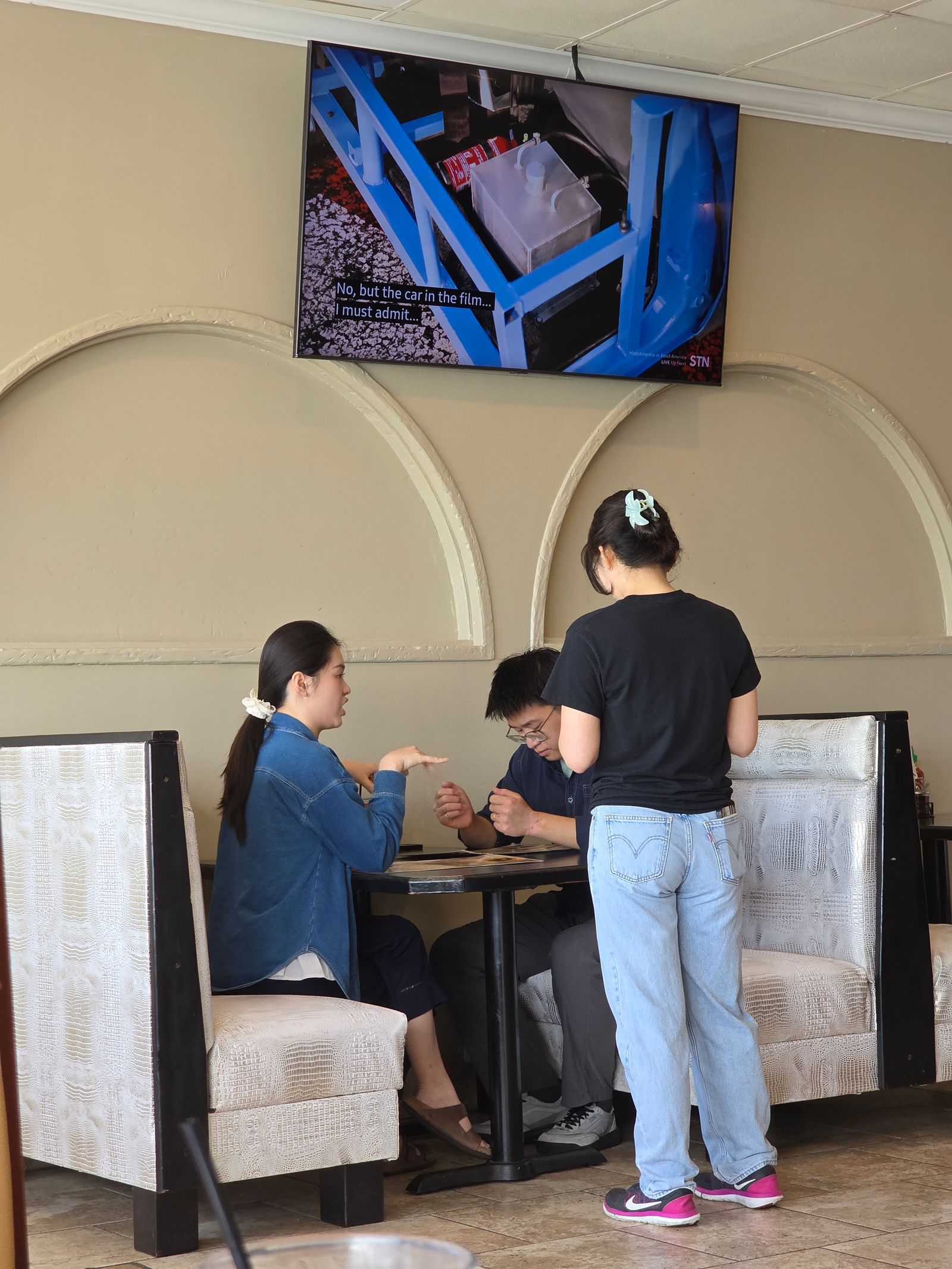
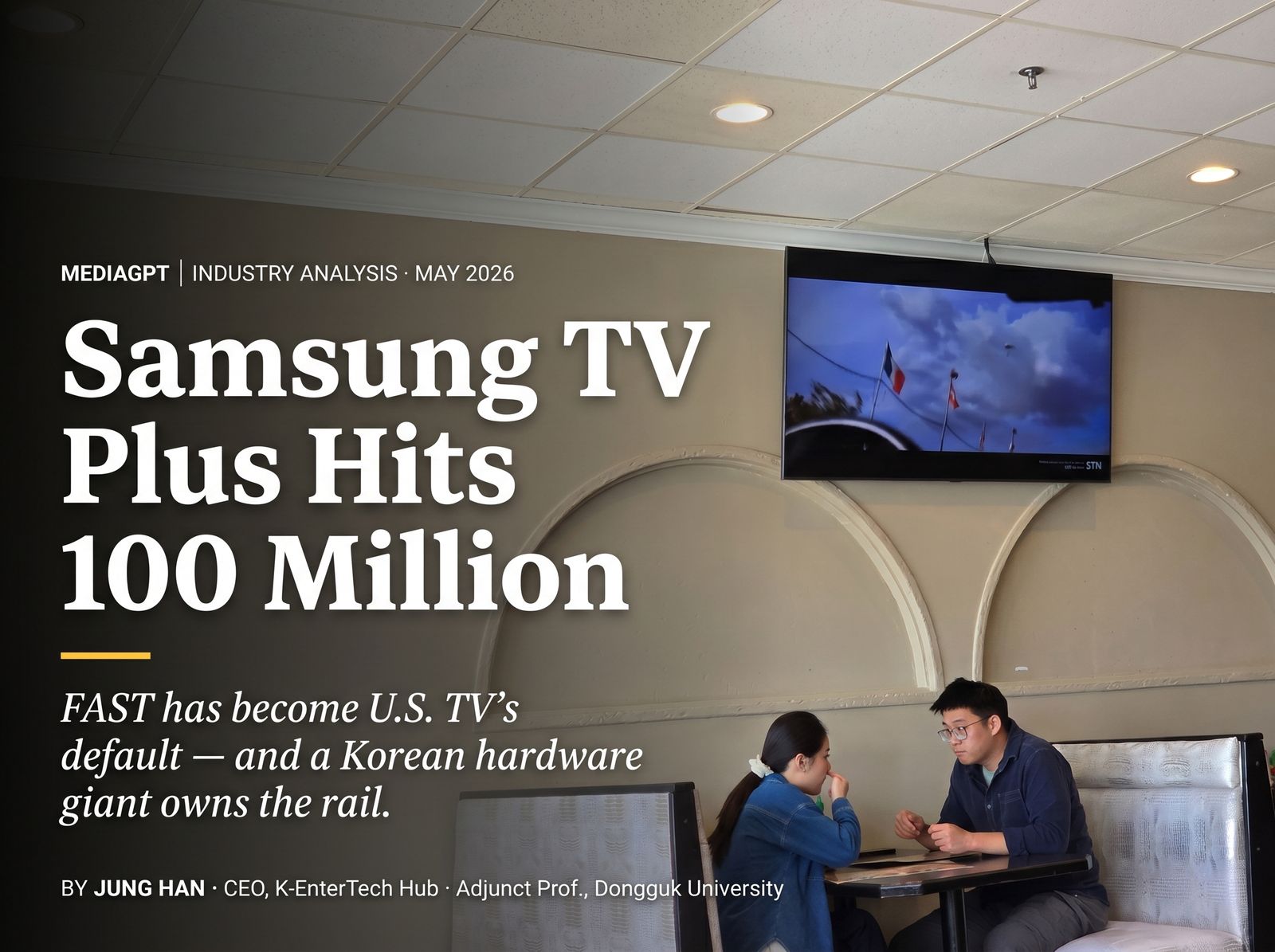
At a Vietnamese restaurant in Fishers, Indiana, none of the lunch guests chose a channel—yet the Samsung set near the ceiling was streaming a Samsung TV Plus feed. No set-top box, no login. This ordinary scene captures a larger shift in the U.S. media market: free ad-supported streaming TV (FAST) is no longer a “alternative” to cable but the underlying infrastructure carrying American television viewing.

Three forces lifted FAST. Cord-cutting has passed a tipping point; rising subscription prices at Netflix, Disney+ and others have stoked demand for free viewing; and hardware makers such as Samsung have pre-installed their services on their own devices, creating a frictionless environment where content simply flows the moment the set powers on. What gets turned on is decided before the viewer chooses what to watch.

A ceiling-mounted Samsung TV runs Samsung TV Plus at a restaurant in Fishers, Indiana. (Photo by the author)
The Field Nielsen’s Gauge Reveals: Streaming at 47.6%, and FAST Growing on Top of It
Nothing shows the soil FAST grows in better than Nielsen’s The Gauge. In the March 2026 data released May 19, streaming held the largest category position at 47.6% of U.S. TV. Time fell 7% month over month as February’s Olympics rolled off, but the figure still rivals cable (21.4%) and broadcast (20.3%) combined. FAST is the sub-segment growing inside that single largest slice—streaming.

Cable was the only category to rise in March, reaching its highest share since October 2025 (+1.4 pts), thanks to the NCAA basketball tournaments—“March Madness.” Paramount and Warner Bros. Discovery took 8.1% and 6.1% on tournament coverage, and cable viewing among 18–24-year-olds jumped 8%. That pattern—live events pulling viewing upward—helps explain why Samsung TV Plus is drawing live sports such as MotoAmerica onto its own channels, as discussed below.
By Platform: YouTube at 13.2%, and What Roku’s +27% Tells Us
Split by distributor rather than category, FAST’s position comes into view. Even as total streaming time fell in March, YouTube reclaimed the top distributor spot at 13.2%; Disney took second at 10.5% (+0.6 pts) on the Oscars (over 17 million viewers) plus Grey’s Anatomy and Bluey; and Netflix posted 8.2%, led by Bridgerton at 7.8 billion minutes.

The telling line is at the bottom of the chart. The Roku Channel—a pure-play FAST distributor—reached 3.0% of TV and grew 27% year over year, the highest annual increase of any distributor Nielsen tracks. Its absolute share trails the major networks, but its growth rate leads them. Samsung TV Plus and many FAST services are grouped as one category in the Gauge and aren’t broken out by brand, yet FAST collectively has already reached the high single digits of total TV viewing, by industry consensus. The more the Gauge’s big circle tilts toward streaming, the more the FAST slice inside it grows in turn.
Ad-Supported TV at 74.2%—The Wave FAST Is Riding
Because FAST monetizes through advertising, the size of ad-supported viewing is effectively FAST’s addressable market. Nielsen’s separate Ad Supported Gauge shows ad-supported viewing reached 74.2% of all U.S. TV in Q4 2025, with streaming at 45.6%—ahead of broadcast (29.6%) and cable (24.8%). Among adults 18–49, 66.7% of ad-supported TV time occurs on streaming.
Break ad-supported streaming time down further and the ad tiers of SVODs—YouTube, Hulu, Prime Video, Peacock—account for roughly 81%, with pure-play FAST such as Samsung TV Plus at about 19%. FAST is still a fifth of that sub-structure, but it is riding a wave in which ad-supported viewing has grown to three-quarters of all TV. Its free, frictionless nature makes FAST the lowest-barrier entry point into that ad-supported viewing.
The Competitive Map: Roku Leads on Households, Samsung on Channel Breadth
FAST competition is converging from individual channels onto a battle for households among platform operators. Per FASTMaster Intelligence, The Roku Channel leads U.S. engaged households at roughly 21 million, with Samsung TV Plus second at about 17 million and Paramount’s Pluto TV third at 13.5 million. Prime Video and Peacock (10 million each), LG Channels (9.5 million) and Xumo (7 million) follow.

Rankings shift by metric. Roku leads on household reach thanks to its own boxes and sticks, but Samsung TV Plus offers the most channels—around 700 in the U.S. alone. Roku owns the count of households; Samsung owns the breadth of channels, and the two split the top tier. These figures include viewing overlap across services, so they are not additive into a total household figure.
Samsung TV Plus: 100 Million MAU Worldwide, 92% Return Rate
Globally, Samsung’s footprint is larger still. In January 2026 the company said Samsung TV Plus had surpassed 100 million monthly active users (MAU) worldwide—up 12 million from 88 million in October 2024 in roughly 14 months, with streaming time rising 25% year over year.

The service runs more than 4,300 free channels and some 66,000 VOD titles across 30 countries. Loyalty stands out, too: Samsung reports a 92% return rate in the fourth month after three months of use. The numbers show a hardware leader—No. 1 in global TV for 19 straight years—converting that base into a full-fledged media platform.
From Channel Bundle to Studio: Sports, Originals, Creators
Samsung has moved past being a venue that merely aggregates channels. In February 2026 it struck an exclusive deal with V10 Entertainment to carry the 2026–27 seasons of MotoAmerica, North America’s premier motorcycle road-racing series. Live coverage began March 6 with the Daytona 200 on its flagship Samsung Television Network (STN), alongside a dedicated 24-hour MotoAmerica TV channel.
It has also entered original production. In May, Samsung TV Plus unveiled the trailer for its first original scripted series, Unlikely Romances—a four-part anthology written and executive-produced by creator Dhar Mann, who counts roughly 170 million followers. Episodes roll out weekly from June 5, on STN in the U.S. and via the dedicated Dhar Mann TV channel across 12 other countries. It is the service’s first creator-led original deal. A six-part documentary series, Hooligans: The ARCH Racing Project, featuring Keanu Reeves, joins this summer.

The Samsung TV Plus home screen, with live channels and VOD alongside creator channels such as Mark Rober TV and Dhar Mann TV. (Photo: Samsung Electronics)
Live events round out the strategy. Samsung TV Plus exclusively livestreamed the Jonas Brothers’ JONAS 20 tour with a real-time “FanVote,” and runs dedicated Letterman and Conan O’Brien channels—broadening its identity from a free-channel operator into a content platform spanning sports, originals and live.
A Leading North American Hub for K-Content on FAST
Korean content is another pillar of the strategy. In 2024 Samsung TV Plus added roughly 4,000 hours of free K-content in the U.S., becoming one of the country’s largest premium K-content sources. Following CJ ENM, NEW ID and KT Alpha, it signed KT Studio Genie in 2025, running multiple dedicated K-drama, K-variety and film channels. K-content has thus secured a new distribution path—free linear channels—on top of theaters, OTT and YouTube.
Revenue Is Advertising—A FAST Ad Market Growing Double Digits
FAST’s business model is simple: advertising. Drawing on 100 million MAU and rising viewing time, Samsung TV Plus sells targeting sliced by channel, daypart and device. Analysts expect U.S. FAST ad revenue to grow from about $5.8 billion in 2025 at a 15–17% annual rate to roughly $7.8 billion by 2027; on a global basis, the market is projected to top $9 billion in 2026.

Per-service ad revenue already approaches major-network scale. MoffettNathanson estimates The Roku Channel drew about $1.42 billion and Tubi about $1.23 billion in 2025. In a structure where free-viewing scale converts directly into ad inventory, Samsung’s “100 million viewers” is itself platform value—and leverage.
What the Upfronts Signal: Ad Dollars Are Migrating to CTV and Streaming
Marketer sentiment in this year’s Upfront season confirms the trend. In iSpot’s May survey of 300 brands, agencies and publishers for its 2026 TV Video & Ad Strategy report, economic caution left the largest group—41.5%—planning to keep total ad budgets flat versus last year, with fewer than a third intending to raise video ad spend. When budgets stay flat, national and local linear TV take the first hit.

Sentiment toward national streaming, CTV and social video, by contrast, was “overwhelmingly more bullish.” Some 51% of marketers said they plan to increase spend on those channels, and more than a quarter expect streaming ad investment to grow by 10% or more. The buying route is shifting too: purchasing through smart-TV OEMs jumped from 25% in 2025 to 55% in 2026—a change that directly favors operators like Samsung that hold both the device and the OS.
Ad-supported viewing itself has become the default. Antenna estimates U.S. ad-supported premium SVOD subscriptions reached 110 million in Q1 2026, roughly double the 53 million of two years earlier. Disney+ and Hulu each drew 70% of Q1 gross additions from ad tiers. As Antenna put it, the ad-supported tier has shifted from a secondary option to the primary way consumers enter streaming.

In short, viewing and ad budgets are moving in the same direction. The ad-supported streaming market is growing, and within it free, frictionless FAST is the lowest-barrier entry point—precisely where Samsung TV Plus stands.
What It Means for Korea: Design the Distribution Rail, Not Just the Content
Here lies the point Korea’s media industry should note: the entity that laid the bundle of free channels filling American living rooms and storefronts is not a content company but a Korean hardware maker, Samsung. Samsung built a distribution rail—its own TVs—and runs channels, ads and now originals over it, claiming the position that decides what turns on before the viewer decides what to watch.
K-content’s global expansion has long emphasized “supplying good content to global platforms.” But who controls the platform layer—laying channels, attaching ads, gathering viewing data—is a different contest from content quality. That the U.S. FAST top tier narrows to Roku, Samsung, LG and Vizio—mostly device makers or OS operators—bears this out. Samsung TV Plus’s 100 million is less a figure of content prowess than the result of commanding the structure linking device, channel and advertising.
The screen someone left on at that restaurant ceiling in Fishers leaves Korea’s media industry one question: beyond “where will our content sit,” what will it flow on top of? Now the default of American TV, FAST points—quietly but unmistakably—to why Korean media must move from content supplier to platform architect.
Sources: Nielsen The Gauge · Media Distributor Gauge (Mar 2026) · Ad Supported Gauge · 2026 Upfront Guide; Samsung Newsroom (Jan/Feb/May 2026); FASTMaster Intelligence; Variety; MotoAmerica; Dhar Mann Studios; MoffettNathanson; S&P Global Market Intelligence; Statista · Reporting: Fishers, Indiana