
Based on announcements made in the United States on 14 September 2026
SACA launches under TechNet: a US$14.2bn sports streaming market, and the clash between rising investment and viewing access
Netflix, Amazon and YouTube have set up a joint policy body in Washington. As the migration of sports rights to streaming raises questions about what fans pay and how easily they can watch, the largest platforms have begun to speak with one voice in the regulatory debate.
The three launched the Streaming Access and Choice Alliance (SACA) on 14 September. TechNet, a technology trade group, runs it, and Mike Ward, senior vice-president of federal policy and government relations, leads it. The alliance says it will support content investment and consumer choice through policies that do not favour any particular delivery technology.
The launch shows that competition in sports has widened from acquiring rights to managing policy. For a platform, exclusive coverage is an asset that wins subscribers and strengthens its advertising products. For fans, the more the games are split across services, the more they have to track subscription costs and viewing routes. SACA's task is to demonstrate that rising investment turns into a benefit viewers can feel.
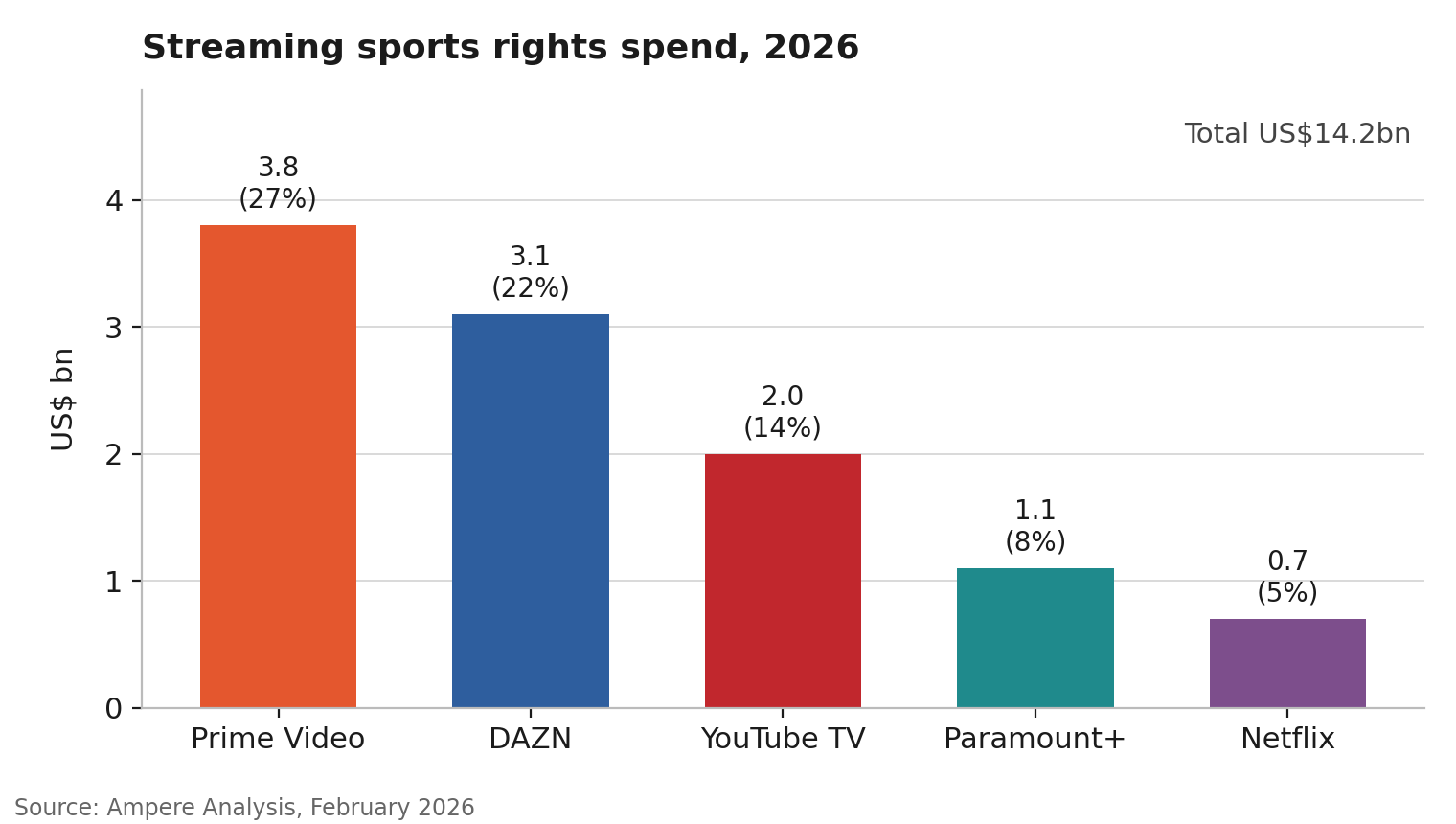
Investment concentrates on sports: streaming spend forecast at US$14.2bn
Ampere Analysis forecast in February that streaming services would spend US$14.2bn (about 19.11 trillion won) on sports rights in 2026. Amazon Prime Video is projected to account for 27% of the total, making it the largest single investor. The figure is an annual forecast and should be read as distinct from completed outlays.
Source: Ampere Analysis forecast reported by TheWrap, February 2026 — thewrap.com/culture-lifestyle/sports/streaming-service-sports-rights-spend-ampere-analysis-forecast/
Netflix's expanded NFL schedule shows the direction of travel. From the 2026 season it carries five regular-season games: an opening-week game, the Thanksgiving Eve game, two on Christmas Day and a Saturday game in Week 18, the final week of the regular season. NFL coverage that was once a year-end special has spread across the season.
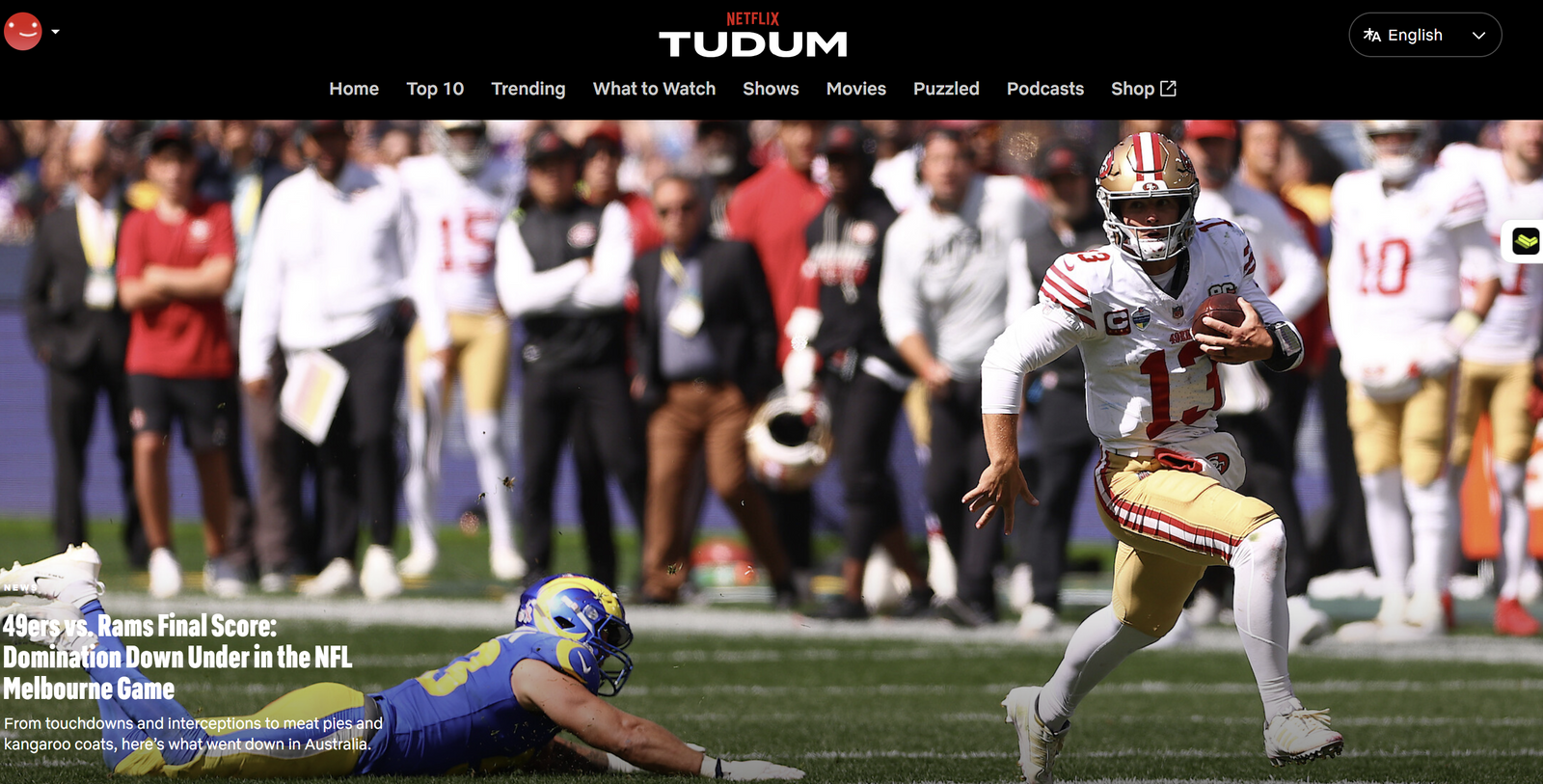
Audience figures for the opening-week game have also been released. The Los Angeles Rams against the San Francisco 49ers, played in Melbourne on 10 September U.S. time, averaged 18.5m viewers in the United States and 21.7m globally, according to Netflix and Nielsen. It ranks among the three most-streamed Thursday primetime NFL games, and U.S. viewing peaked at 21.3m between 9.30pm and 9.45pm Eastern. Among 18- to 34-year-olds the game averaged 4m viewers, the highest streaming delivery for an NFL regular-season game outside Christmas.
The comparison is Netflix's two games last Christmas. Detroit Lions vs Minnesota Vikings averaged 27.5m in the U.S., then the most-streamed game in U.S. history, and Dallas Cowboys vs Washington Commanders averaged 19.9m. Among 18- to 34-year-olds, Netflix now holds the four highest-rated streamed NFL regular-season games. In Australia it was the most-watched game of American football on record, with official attendance at the Melbourne Cricket Ground of 100,021.
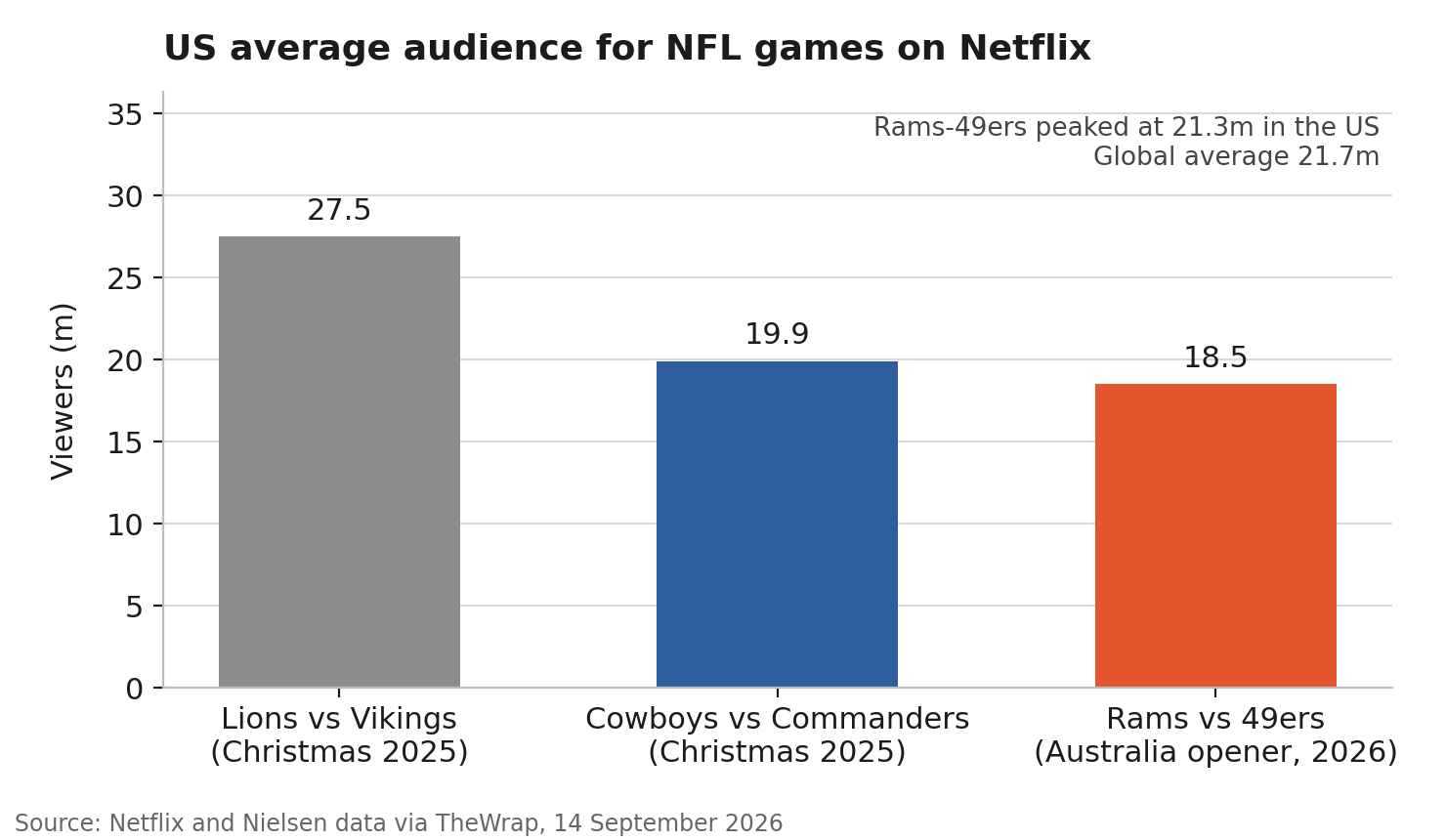
In industrial terms, the value of sports is that it gathers an audience at a fixed time. Repeat visits tied to a fixture list can be used to sell advertising and hold subscriptions. But the larger the rights fee, the more the pricing and advertising strategy needed to recover it matters. The profitability of exclusivity and the cost borne by viewers are locked into the same business structure.
Washington's question is how easily people can watch
The Federal Communications Commission opened a public consultation on the sports broadcasting market on 25 February. The notice set out for review the dispersal of sports across broadcast and online services, consumer costs and access, and the role of local stations. The document is DA 26-188, and the consultation itself does not establish any new obligation or prohibition.
Source: FCC public notice DA 26-188 — docs.fcc.gov/public/attachments/DA-26-188A1.pdf
A separate process is under way in Congress. Senator Tammy Baldwin introduced the For the Fans Act on 15 April. Its core provisions would end blackouts on league-operated paid streaming services and guarantee local fans a free route to watch. This is a proposed bill and should be distinguished from rules currently in force.
Source: Office of Senator Tammy Baldwin, 15 April 2026 — baldwin.senate.gov
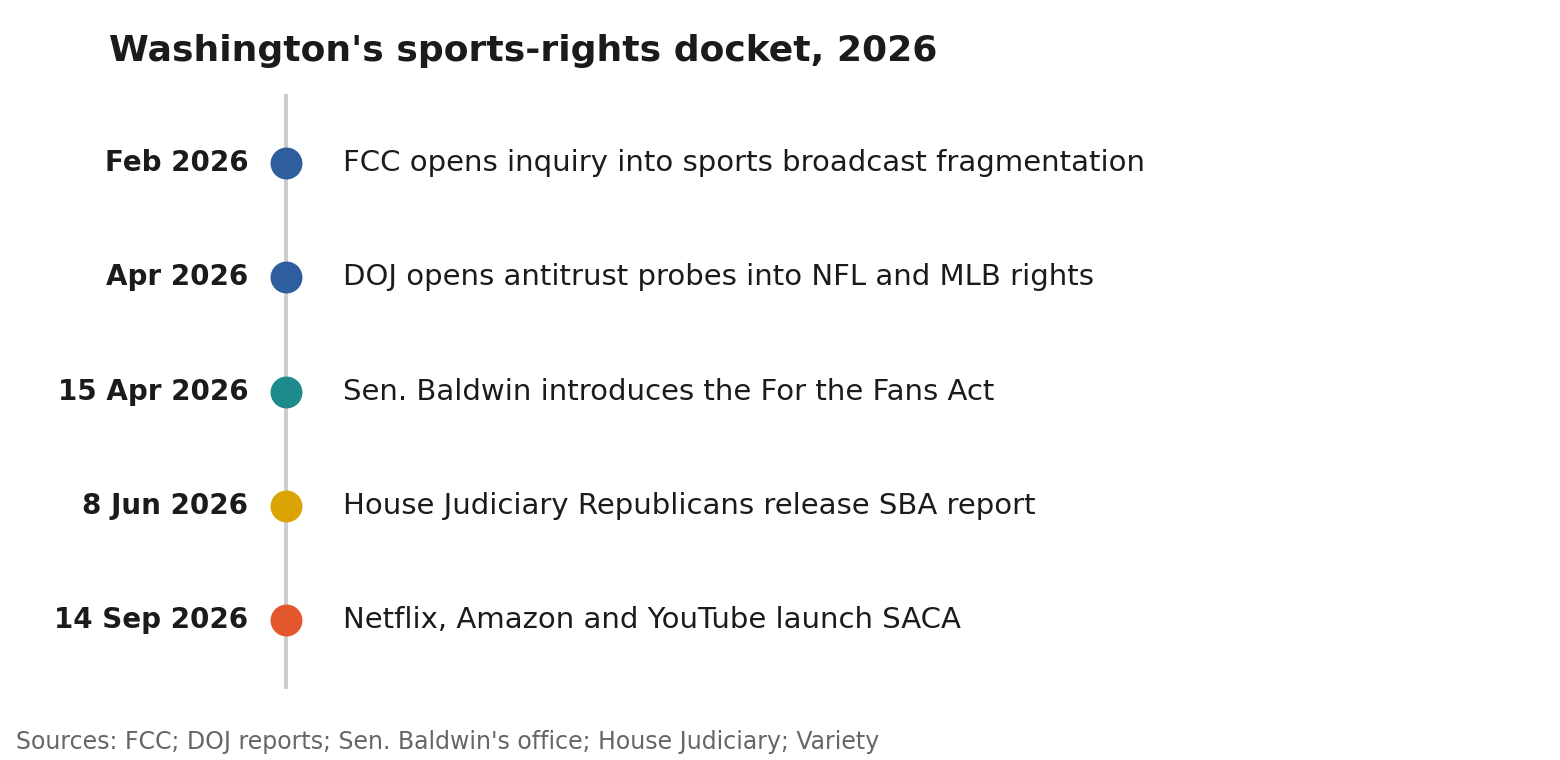
The platforms' investment case and the regulators' access case look at different measures. Operators point to volume of content, service features and new subscribers. The access debate turns on whether a fan can actually watch the game they want, and how many services they must subscribe to in order to do so. More content does not by itself make the act of watching simpler.
Sunday Ticket at US$480: the package's scope is harder to read than its price
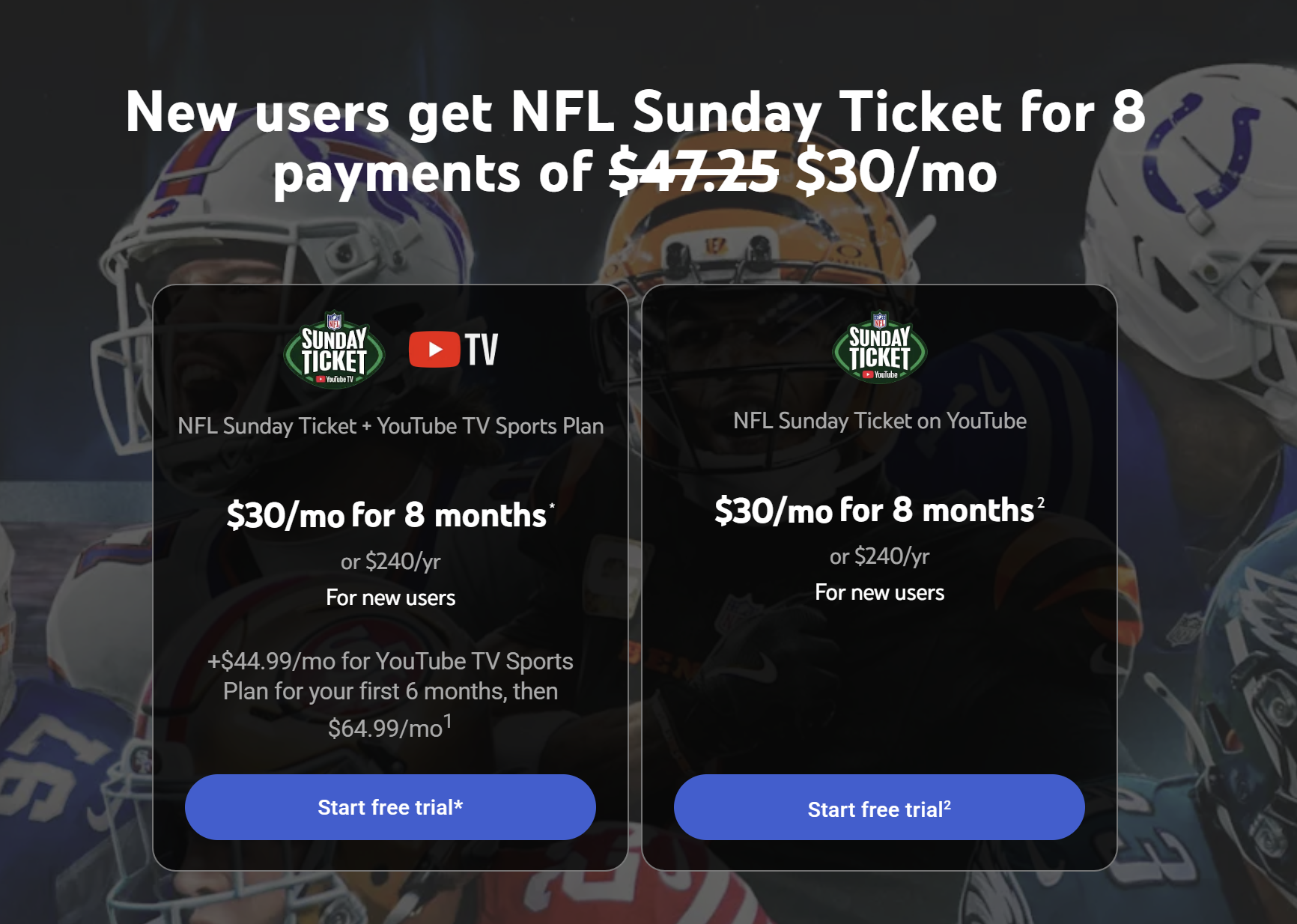
YouTube's NFL Sunday Ticket illustrates the gap. According to YouTube's own listing, the standard price of Sunday Ticket alongside a YouTube TV plan is US$378 (about 508,600 won) for the season, and US$480 (about 646,000 won) bought on its own. The YouTube TV subscription is charged separately, and new-subscriber discounts vary by condition.
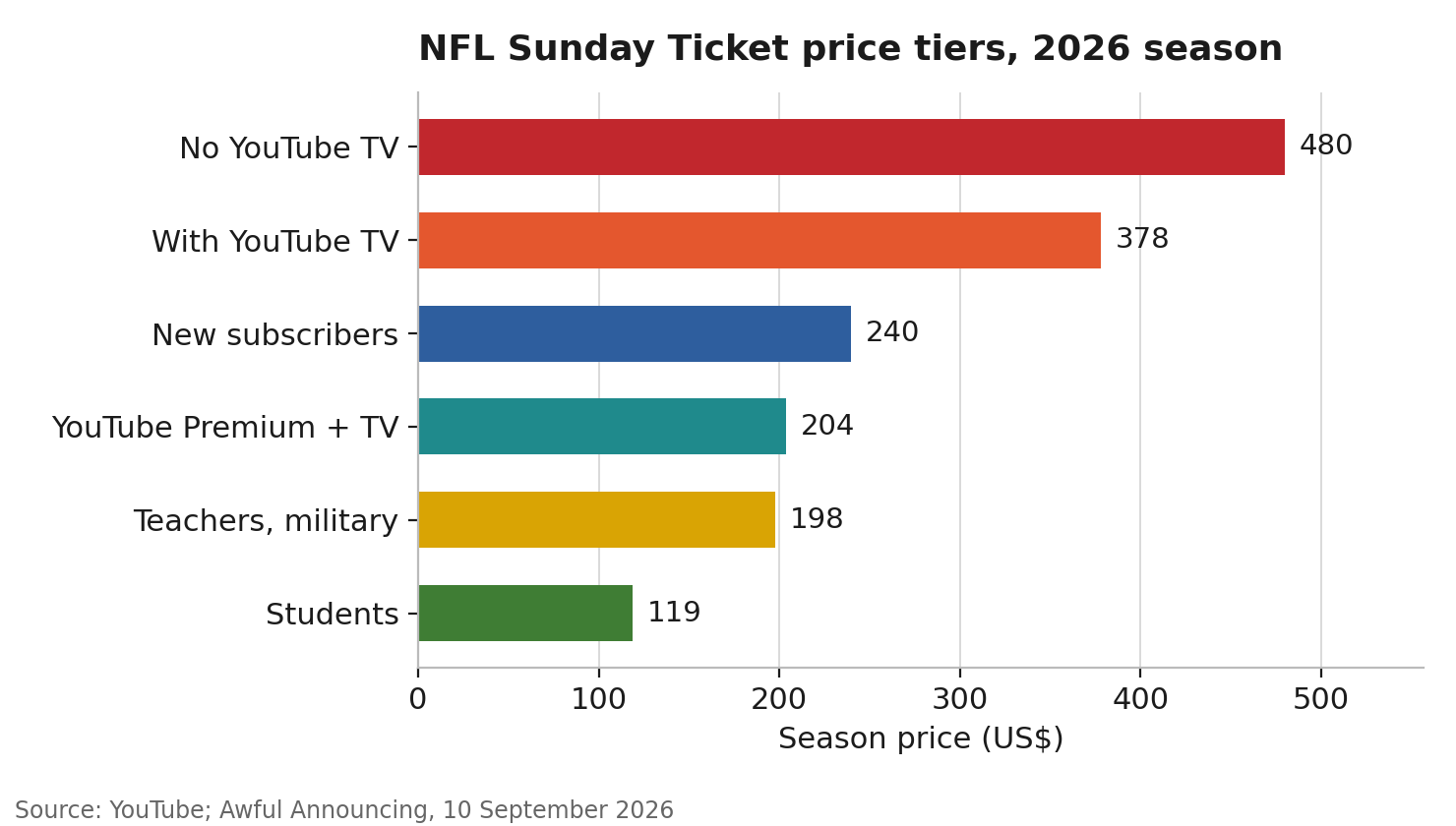
Sunday Ticket does not carry every NFL game. It covers out-of-market games, mostly those played on Sunday afternoons. The price of one package therefore cannot describe a fan's full cost for a season. Once local games, national coverage and games exclusive to other platforms are added, the required combination of services changes.
The same commercial question applies to Korean streaming services. Beyond the size of a discount, consumers can compare real costs only when a service states clearly which games a package includes, which it excludes, and when an additional subscription is required. Holding many rights and making it easy for fans to find the game they want are two different competitive strengths.
A different line-up from the earlier streaming group
SACA is not the streaming industry's first joint body. In 2023 the Streaming Innovation Alliance (SIA) launched with content-led companies including Netflix and Disney. Amazon was not among its founding members. SACA is a separate coalition, with Amazon, Netflix and YouTube taking part together.
The difference between the two groups shows that policy interests are not uniform even within the category of streaming. As film and television production, online distribution and sports coverage overlap, companies form different alliances depending on the issue. SACA is best read as a channel through which its founders push a shared agenda, rather than as the single voice of the streaming industry.
Korea debates universal viewing rights; contract design is the next task
In Korea, legislative debate is under way on universal viewing rights (보편적 시청권) for major sports events. The amendment to the Broadcasting Act (방송법) that cleared the National Assembly's Legislation and Judiciary Committee (국회 법제사법위원회) on 9 September would let viewers watch major events such as the Olympics and the World Cup live, at no additional cost, through terrestrial broadcasters such as KBS or MBC.
It also provides that the duty applies to contracts signed after the law takes effect. The amendment still has to clear the floor and the remaining legislative steps.
It would be a stretch to read this as a simultaneous terrestrial carriage obligation covering all domestic professional league rights. Judging the actual business impact requires the final text: which events are covered, when it applies, and the detailed rules needed to implement it. The U.S. debate on sports streaming and Korea's debate on universal viewing rights share a concern with consumer access, but the systems and their scope are not the same.
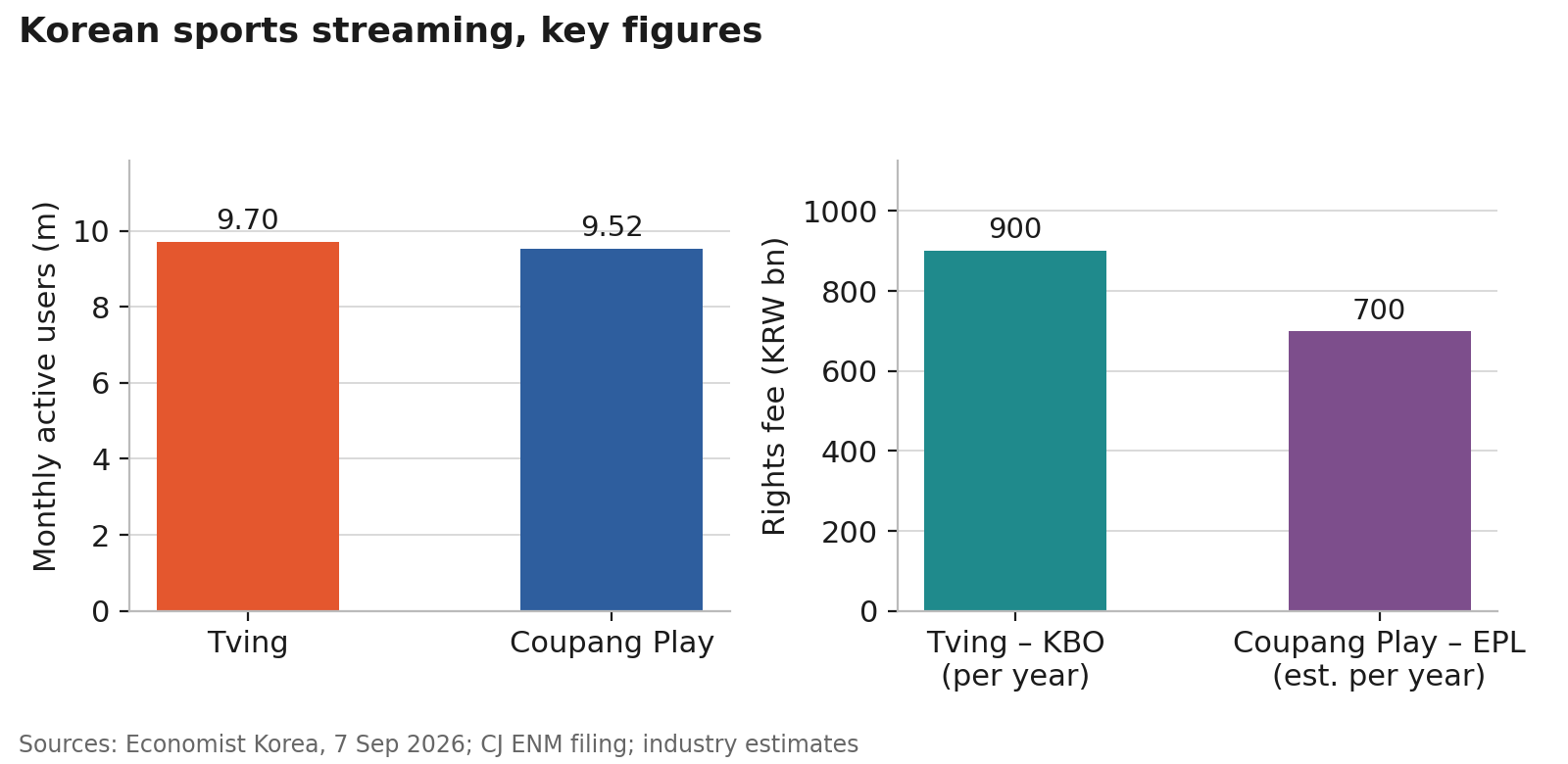
What Korean operators need to prepare is the design of viewing routes at the point of rights negotiation. How the contract and the service policy treat the scope of exclusivity, free-to-air games, resale, surcharges and games excluded from each package may become the decisive question. This is not a legal obligation attached to every contract today, but a commercial task of weighing investment recovery and viewing access together.
That is also what SACA's launch signals. Competitiveness in sports coverage can no longer be explained by the number of games held or the amount invested. To keep raising investment, a platform has to present both a cost fans can bear and a viewing route they can understand. The joint body in Washington is the channel through which that case will be made in the language of policy.
Sources
1. Variety, Todd Spangler, “Netflix, Amazon and YouTube Form D.C. Lobbying Group Amid Backlash Over Cost of Sports on Streaming”, 14 September 2026 — https://variety.com/2026/tv/news/netflix-amazon-youtube-dc-lobbying-group-1236861316/
2. Axios, Sara Fischer, “Exclusive: Netflix, Amazon, YouTube launch new streaming coalition”, 14 September 2026 — https://www.axios.com/2026/09/14/netflix-amazon-youtube-streaming-coalition
3. The Hollywood Reporter, “New Streaming Policy Group SACA Launches from Netflix and YouTube”, 14 September 2026 — https://www.hollywoodreporter.com/business/digital/netflix-youtube-amazon-launch-streaming-public-policy-saca-1236700459/
4. TheWrap, Loree Seitz, “Netflix’s Rams-49ers Australia Game Touches Down With 18.5 Million US Viewers”, 14 September 2026 — https://www.thewrap.com/media-platforms/tv/rams-49ers-australia-nfl-game-netflix-ratings/
5. TheWrap, “Streamers Will Spend $14.2 Billion on Sports Rights in 2026, New Projections Show” (Ampere Analysis forecast) — https://www.thewrap.com/culture-lifestyle/sports/streaming-service-sports-rights-spend-ampere-analysis-forecast/
6. TheWrap, “Netflix’s Lions-Vikings Christmas Day NFL Game Breaks All-Time US Streaming Record With 27.5 Million Viewers” — https://www.thewrap.com/media-platforms/tv/netflix-christmas-day-nfl-games-ratings/
7. Federal Communications Commission, public notice DA 26-188, 25 February 2026 — https://docs.fcc.gov/public/attachments/DA-26-188A1.pdf
8. Office of U.S. Senator Tammy Baldwin, “Baldwin Introduces New Bill to Stop Sports Blackouts, Slash Pricey Streaming Costs”, 15 April 2026 — https://www.baldwin.senate.gov/news/press-releases/news-baldwin-introduces-new-bill-to-stop-sports-blackouts-slash-pricey-streaming-costs
9. House Judiciary Committee Republicans, “The Sports Broadcasting Act: A Special-Interest Antitrust Exemption Gone Awry”, 8 June 2026 — https://judiciary.house.gov/media/press-releases/new-report-sports-broadcasting-act-special-interest-antitrust-exemption-gone
10. Netflix Tudum, “NFL Games on Netflix” — https://www.netflix.com/tudum/articles/nfl-games-on-netflix
11. YouTube, NFL Sunday Ticket product page — https://tv.youtube.com/learn/nflsundayticket/
12. Awful Announcing, “Your 2026 NFL Sunday Ticket pricing guide”, 10 September 2026; 9to5Google, same date
13. Ampere Analysis, reported by World Screen, Deadline and SportsPro, 2 February 2026
14. Streaming Access and Choice Alliance website — https://www.streamingaccessandchoicealliance.com/
15. TweakTown, “YouTube, Netflix, Amazon form SACA coalition to represent streaming industry”, 14 September 2026 (full Mike Ward quote)
16. YTN (와이티엔), report on the Broadcasting Act amendment clearing the Legislation and Judiciary Committee, 9 September 2026 — https://www.ytn.co.kr/_ln/0101_202609091827060444
17. Kukmin Ilbo (국민일보), 9 September 2026
18. Economist Korea (이코노미스트), “Tving and Coupang Play’s off-season war”, 7 September 2026