
LUMINATE DATA · U.S. TV PRODUCTION
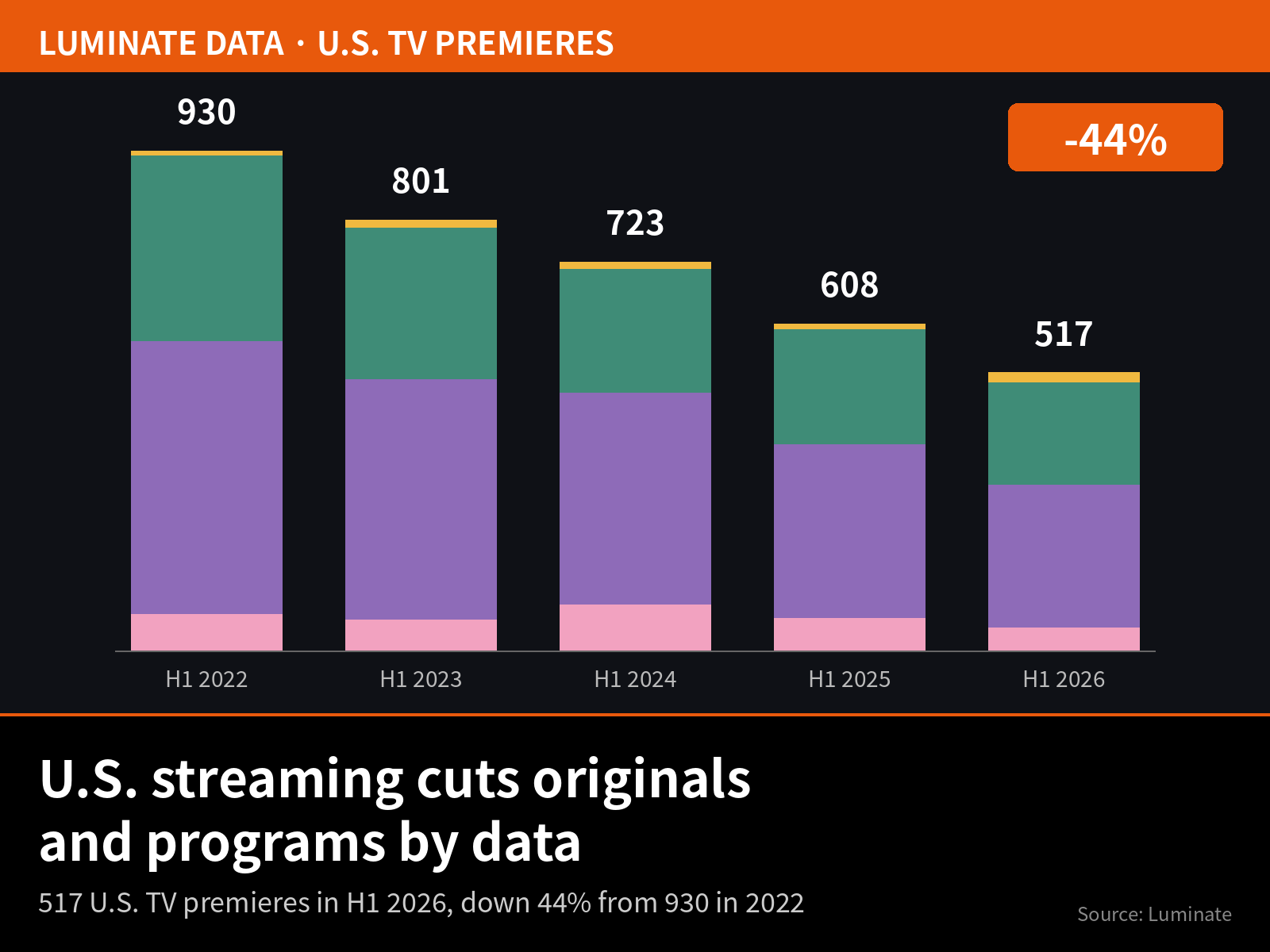
Luminate counts 517 U.S.-produced TV premieres in the first half of 2026, down 44% from 930 in 2022; free streaming is the only platform that grew, from 8 titles to 18
A total of 517 U.S.-produced TV programs premiered in the first half of 2026. The figure comes from Luminate Film & TV data published in a Luminate newsletter on September 17. It is 44% below the 930 premieres of the first half of 2022. The half-year count has fallen every year since: 801 in 2023, 723 in 2024 and 608 in 2025, a decline of 10% to 15% a year.
No platform was spared. Cable premieres fell from 508 to 267, a 47% drop and the steepest of the four categories. Subscription streaming (SVOD) premieres fell from 346 to 189, or 45%; against the first half of 2025 alone, SVOD was down 12% from 214. Broadcast fell from 68 to 43, or 37%. Free streaming (FAST and AVOD) moved the other way, from 8 premieres to 18, double the 9 recorded in the first half of 2025.
Andrew Wallenstein, Luminate's chief insights officer, describes the decline as the hangover from Peak TV. Early streaming services promised subscribers an endless volume of choice and expanded their slates to keep that promise. Once subscriber bases were established, the reason to produce at that volume disappeared. The element Luminate identifies as allowing services to hold up on fewer originals is data. Data teams at streaming services and studios numbered a handful of people in the late 2010s and now run to hundreds or thousands across the industry.
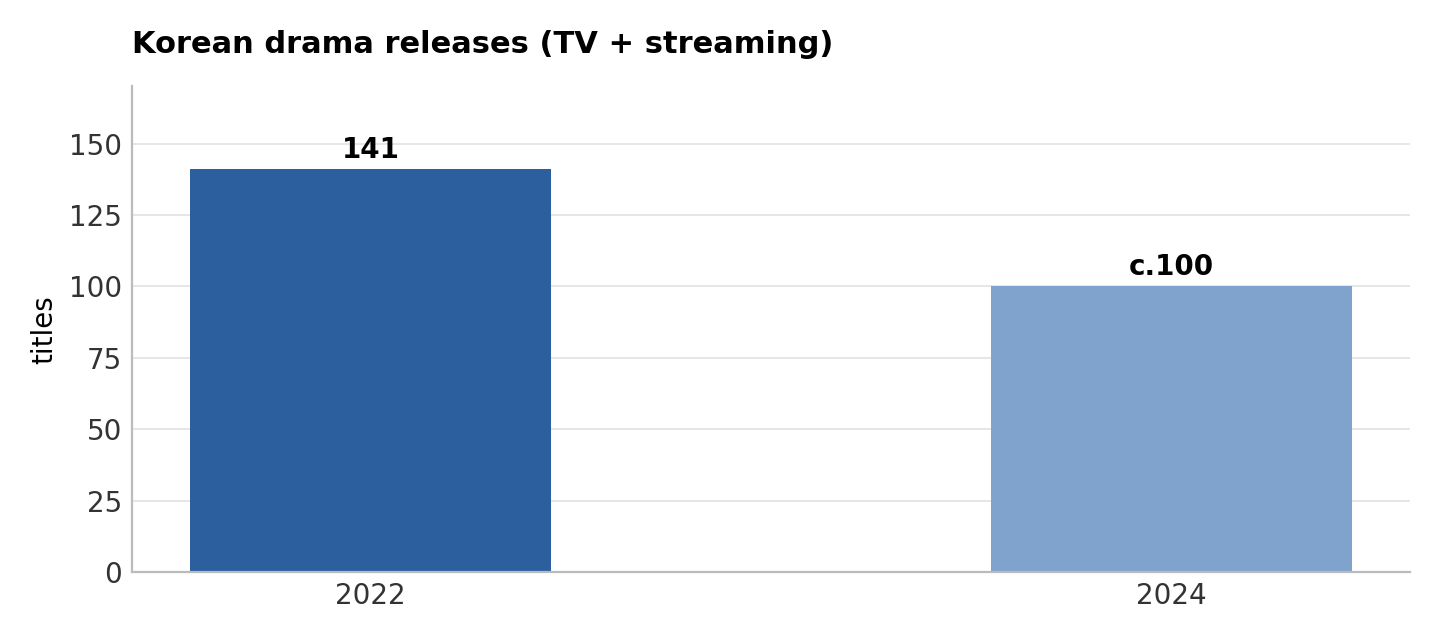
Korean drama output shrank over the same period. According to the Korea Drama Production Association (한국드라마제작사협회), K-drama releases across TV and streaming fell from 141 titles in 2022 to about 100 in 2024, a decline of more than 30%. Where the U.S. cut slates through data, Korea's cut came from rising per-episode costs and shrinking TV advertising, a different cause.
517 premieres in the first half... cable down 47%, the steepest fall
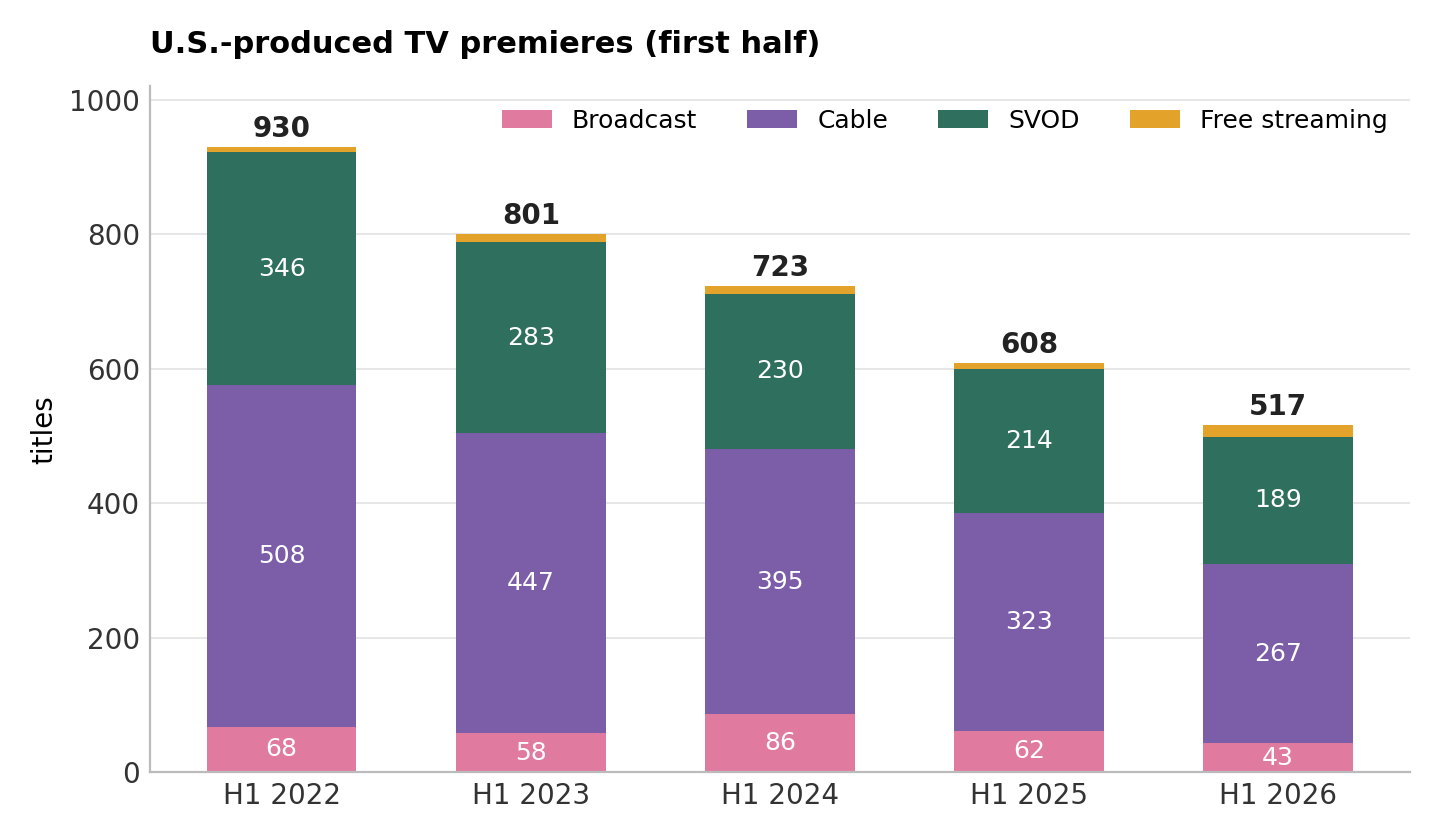
Cable lost the most titles. Cable premieres went from 508 in the first half of 2022 to 447 in 2023, 395 in 2024, 323 in 2025 and 267 in 2026, a loss of 50 to 70 titles a year. Cable's share of all premieres slipped only slightly, from 55% to 52%. Cable channels still account for half of new programming, but that half is itself half the size it was four years ago.
SVOD premieres fell from 346 in the first half of 2022 to 283 in 2023 and 230 in 2024, two consecutive drops of more than 50 titles. The count then eased to 214 in 2025 and 189 in 2026, declines of 16 and 25 titles. The 2023 and 2024 drops overlap with the writers' and actors' strikes that ran from May to November 2023. Luminate has noted that the strikes pushed a number of programs scheduled for fall 2023 into 2024.
Broadcast premieres rose once, to 86 in the first half of 2024, before falling to 62 in 2025 and 43 in 2026. The 2024 bump is the strike backlog landing. Free streaming is small in absolute terms but points the other way: 8 titles in 2022, 13 in 2023, 12 in 2024, 9 in 2025 and 18 in the first half of 2026.
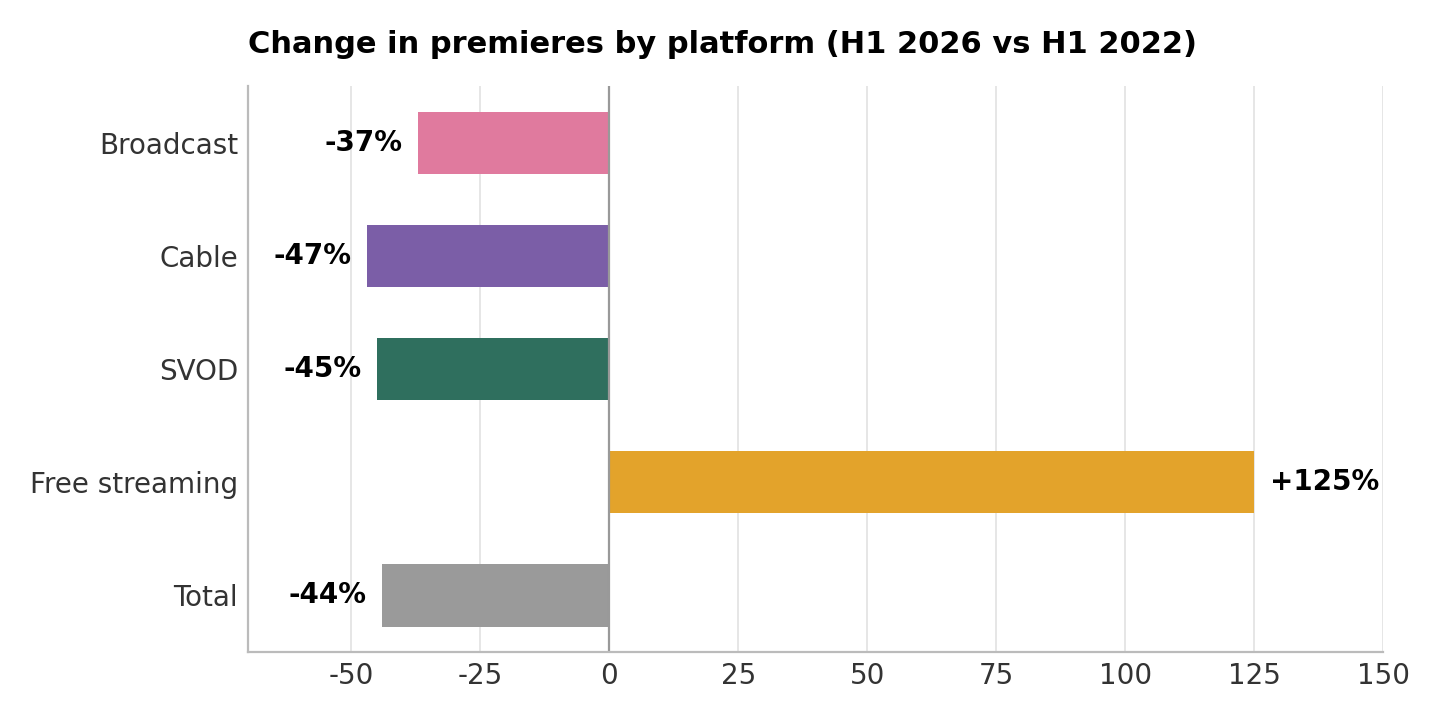
Change in premieres by platform, H1 2026 versus H1 2022. Calculated from Luminate Film & TV data
1,122 premieres for full-year 2025, a third below 2022... L.A.'s share of filming under 25%
The full-year trend matches. Luminate's year-end report put U.S.-produced TV premieres at 1,122 in 2025, down 11% from 1,266 in 2024. The peak was 1,695 in 2022, and the slate excluding sports and news has shrunk by a third in three years. The Hollywood Reporter reported on January 21 that 2025 declines ranged from 8% to 21% by platform, with broadcast falling furthest, from 196 titles to 154, or 21%.
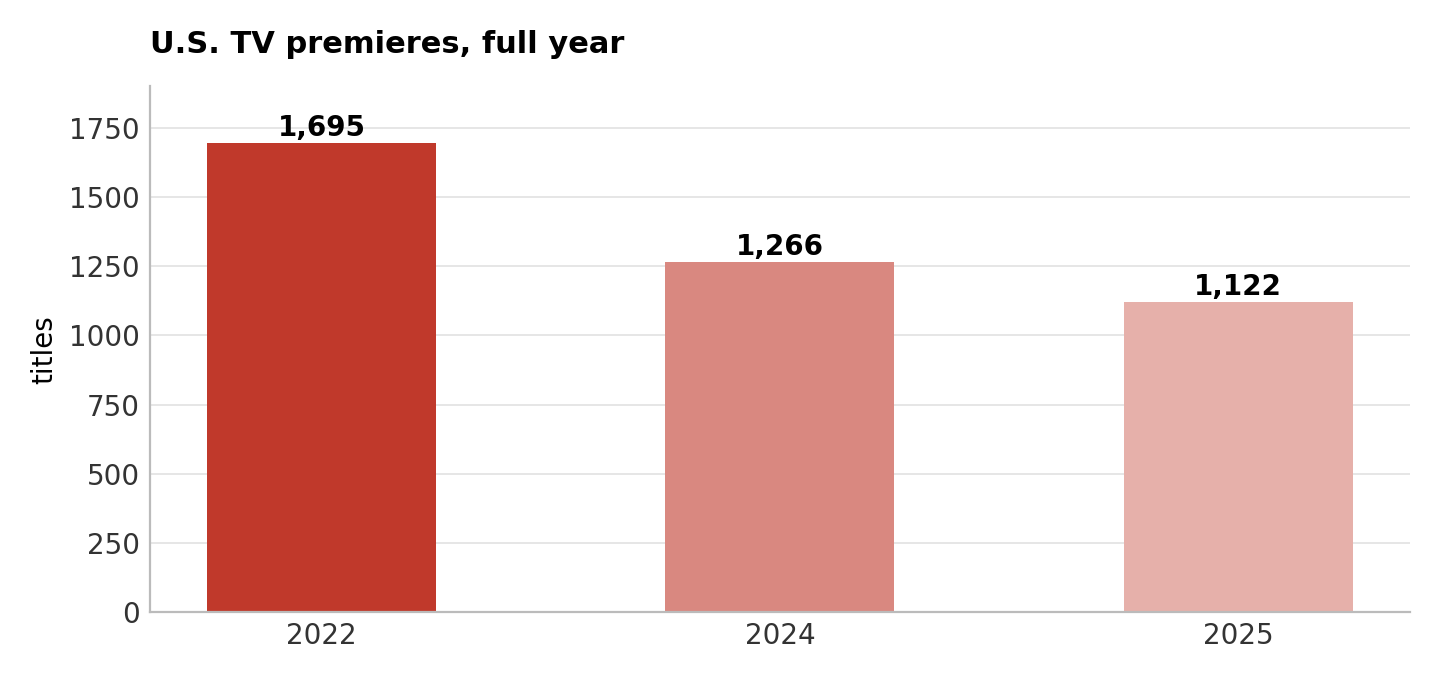
U.S. TV premieres, full year. Source: Luminate year-end report, as reported by The Hollywood Reporter, January 21, 2026
The production decline has fed the loss of filming in Los Angeles. A Luminate analysis on May 22 found that 40% of U.S. scripted series released in the first quarter of 2019 filmed in the city, against less than 25% in the first quarter of 2026. In its special report Hollywood Exodus 2026, Luminate frames L.A.'s problem as two declines at once: less content being made overall, and a smaller share of it made in the city. California has expanded its film and TV tax credit, but how far a local incentive can work while the total slate keeps shrinking has not been established.
SVOD premieres down 12%... Netflix takes 57% of original viewing
Fewer SVOD premieres has not meant less streaming viewing. Luminate's 2026 Midyear Report, published July 15, found that Netflix (넷플릭스) accounted for 57% of original viewing time on U.S. streaming. The same report found that seven of the ten most-streamed films in the first half of 2026 were streaming originals, reversing the pattern in which theatrical releases dominated the top of the SVOD chart.
Licensed programming and library have filled the space left by fewer originals. The Midyear Report noted that the CBS series Marshals and Tracker surpassed season 2 of HBO Max's The Pitt in minutes watched during the first half of 2026. Two programs still airing on broadcast television out-streamed a streaming original on SVOD. Luminate contrasted this with the persistent narrative of broadcast decline, pointing out that newer broadcast originals are performing on streaming platforms.
Release strategy has also been tuned to the data. A Luminate analysis in early September found that more than 80% of Netflix's original TV seasons from 2024 through the first half of 2026 dropped all episodes at once, and that nearly 40% of premieres at the seven other major U.S.-based SVODs in the first half of 2026 were also binge releases, including The Bear at Hulu (훌루) and The 'Burbs at Peacock (피콕). The number of premieres has fallen, but the timing and cadence of each one is set by viewing data.
The end of the "endless choice" promise... data teams grow from a few people to thousands
Luminate's explanation for the contraction rests on the growth of data organizations. Violaine Roussel, author of Data-Driven Hollywood: The New Data Professionals in the Age of Streaming, laid out the logic of expansion and contraction on a recent episode of Luminate's In the Lab podcast: "They needed to have a lot of content made so they could fulfill that promise that they're making an endless volume of content on these platforms that the users, the subscribers, are going to be able to choose from. But after a while, you don't need to make that much content anymore."
Roussel's research drew on interviews with 75 industry professionals over seven years ending in 2023. When she began, data teams in Hollywood were small, often a few people per company. By the end, they had grown to hundreds or thousands of people across the entertainment business. The view among producers that data was secondary to creative instinct had largely faded by the early 2020s, and even the most influential producers had come to treat data specialists as essential to a streaming-oriented studio.
Roussel describes the relationship between data teams and creative producers as having moved from tension to a negotiated order. Streaming services held proprietary viewing data that created an information gap in talks with talent representatives, a period she calls asymmetrical warfare. Tech-native services such as Netflix and Amazon (아마존) adopted data first; traditional studios such as Disney (디즈니) and Warner Bros. (워너브러더스) built comparable data organizations as they moved into streaming.
Roussel names artificial intelligence as the next phase. Luminate's July special report AI & Media found U.S. consumers growing uneasy with AI use in music, film and television, with AI-generated tracks proliferating on music streaming services while film and TV apply AI mainly to production efficiency. Roussel said AI is the next potentially disruptive change for both producers and data specialists and is the subject of her next book.
Korean drama output from 141 titles to about 100... broadcaster commissions at 78
Korea's slate has also shrunk. The Korea Drama Production Association counts 141 K-drama releases across TV and streaming in 2022, a record, falling to about 100 in 2024. A separate count in the Korea Communications Agency (한국방송통신전파진흥원, KCA) publication Media Issue & Trend puts drama commissions by terrestrial broadcasters, general-programming cable channels and CJ ENM channels at more than 120 a year in 2017–2019, falling to 87 in 2022 and 78 in 2023. The three terrestrial networks alone went from 91 dramas in 2012 to 32 in 2023.
The cause differs from the U.S. The KCA report set the advertising a Korean broadcaster can earn from one drama episode at 300 million to 400 million won (about US$223,000 to US$297,000) when fully sold, against per-episode production costs that now exceed 1 billion won (about US$743,000).
In a PD Journal (PD저널) report on December 3, 2025, a production company adviser said that once an episode costs more than 1.2 billion won (about US$892,000), selling to Netflix is the only way to recover labor costs, and pointed to lead actors' fees taking 30% of total budgets. As broadcasters cut drama slots and filled them with cheaper unscripted programming, Netflix and Disney+ (디즈니+) also increased their share of large-scale unscripted shows.
In the U.S., data and library absorbed the loss of originals. Korean broadcasters and domestic streaming services have neither. Asia Economy (아시아경제) reported on January 14 that Netflix's US$2.5 billion (about 3.36 trillion won) Korean content commitment, announced in 2023, reaches its end point in 2026. For Korean producers to turn a shrinking slate into data-driven selection is difficult under the current structure, in which the party holding the viewing data and the party making the programs are separate companies. The asymmetrical warfare Roussel describes applies directly between Korean production companies and global streaming services.
The one U.S. platform that added premieres, free streaming, also bears on Korean operators. The 18 FAST-channel premieres are 3.5% of the U.S. total, but they are the only line item that grew in a market four years into contraction. Korean broadcasters' libraries are the raw material of FAST programming, and Luminate's finding that broadcast series out-streamed SVOD originals gives a basis for recalculating what those libraries are worth in streaming distribution.
Exchange rate: US$1 = 1,345 won (approximate Seoul interbank reference rate, third week of September). Quotation policy: text in double quotation marks is a statement published in a report or podcast; unquoted text summarizes reporting. Roussel's remarks are quoted as carried in the Luminate newsletter.
Sources
Luminate, newsletter 'How Do Streamers Subsist on Fewer Originals? More Data' (Andrew Wallenstein), September 17, 2026 — U.S.-produced TV premieres by platform, H1 2022–H1 2026, and the Violaine Roussel interview
Luminate, '2026 Midyear Report: Trends in Music, Television & Film', July 15–16, 2026 — https://luminatedata.com/blog/luminate-2026-midyear-report-trends-in-music-television-film/
Luminate, 2026 Midyear Report download page (Netflix 57% of original viewing time) — https://luminatedata.com/reports/midyear-music-ftv-report-2026/
Luminate, 'The Data Behind L.A.'s Lagging TV Production', May 22, 2026 — https://luminatedata.com/blog/the-data-behind-l-a-s-lagging-tv-production/
Luminate, 'The Binge Release Is Alive and Well, and Not Just on Netflix', September 2026 — https://luminatedata.com/blog/the-binge-release-is-alive-and-well-and-not-just-on-netflix
The Hollywood Reporter, 'The Number of TV Shows Available in the U.S. Fell Again in 2025', January 21, 2026 — https://www.hollywoodreporter.com/tv/tv-news/no-more-peak-tv-series-total-falls-2025-1236479596/
Violaine Roussel, Data-Driven Hollywood: The New Data Professionals in the Age of Streaming
Korea Journalists Association (한국언론인협회), 'Korean drama production freezes: 2024 output down 30% to about 100 titles', January 13, 2025 — https://akj.or.kr/article/?cate=22&id=2476
Korea Communications Agency (KCA), Media Issue & Trend Vol. 63, 'Changes in the Korean drama market under soaring production costs' — https://www.kca.kr/Media_Issue_Trend/vol63/KCA63_23_trend.html
PD Journal (PD저널), '70 years of Korean drama: is there an exit?', December 3, 2025 — https://www.pdjournal.com/news/articleView.html?idxno=81046
Asia Economy (아시아경제), '[2026 K-drama] From export to production base', January 14, 2026 — https://www.asiae.co.kr/article/2026011320384789765