“The Best Day Is When No One Knows I Was There”: What Disneyland Has Been Selling for 71 Years Is Operations

Disney shifted its core from screen to space—$10B in Experiences operating income and a parks chief as next CEO. Disneyland's power, 71 years and one billion guests on, lies not in IP but in running a small city. K-content's next test: the operations to turn viewers into repeat visitors

“The Best Day Is When No One Knows I Was There”: What Disneyland Has Been Selling for 71 Years Is Operations

Experiences hits a record $10 billion in operating income and the parks chief becomes CEO — the core business of a content company has changed

A 'city-running business' with 17 million annual guests and 36,000 employees poses the question: can K-content turn viewers into visitors — and build a 'K-Culture Land'?

The core business of Disney, a content company, is no longer the screen — it is physical space. The Walt Disney Company's Experiences segment surpassed $10 billion in operating income in fiscal 2025 for the first time in the company's history, and in February 2026, Josh D'Amaro, the executive who has led that segment, was named successor to CEO Bob Iger.

“최고의 하루는 아무도 내가 있었는지 모르는 날”…디즈니가 71년째 파는 것은 ‘운영’이다
디즈니 체험 부문 영업이익 100억 달러 돌파와 파크 총괄의 CEO 승계로 본업을 스크린에서 공간으로 이동. 71년 만에 방문객 10억 명을 넘긴 디즈니랜드의 힘은 IP가 아니라 ‘작은 도시‘를 굴리는 운영 역량. 시청을 방문으로 이어온 K-콘텐츠의 다음 과제는 ‘보는 사람‘을 다시 찾는 ‘오는 사람‘으로 바꿀 상시 운영 인프라, 곧 ‘엔터테크 공진화’
Korean Version

Not a studio chief, not a streaming executive — a theme park leader now sits atop the content empire. Disney has committed $60 billion to parks and cruise investment over the next decade. The judgment that offline experience is the final monetization stage of content IP has now been confirmed in both succession and capital allocation.

Josh D'Amaro, incoming CEO of The Walt Disney Company. The former head of the Experiences segment was named Bob Iger's successor in February 2026. (Photo: The Walt Disney Company)

As the streaming market matures, subscriber growth has plateaued and returns on content investment have come under pressure — while the experience business off-screen has absorbed fandom's willingness to pay at far higher price points.

Disney's Experiences segment posted record quarterly revenue of $10.0 billion and operating income of $3.3 billion in the first quarter of fiscal 2026, remaining the company's largest profit engine. The prototype of this profit machine sits in Anaheim, California: Disneyland, which opened on July 17, 1955, is approaching its 71st birthday — and on July 3 welcomed its one billionth guest.

A recently released Wall Street Journal documentary follows a day at the park through three of its people — Mary Cobb, a senior duty manager who oversees park opening; Melvin Hernandez, attractions lead at Big Thunder Mountain Railroad; and Emo O'Brien, the Imagineer leading the Avengers Campus expansion. The conclusion is compressed into the title: operating Disneyland is like running a small city.

Not an Amusement Park but a 'Theme Park' — the Industry Category Walt Disney Invented

Amusement parks existed before Disneyland. What Disneyland created was the very concept of the theme park: not an assortment of Ferris wheels and roller coasters, but a fully immersive experience that transports visitors to another time and place. The starting point was Walt Disney's idea of “a family park where parents and children could have fun together.” This is why experts in the film call Disneyland an almost perfect embodiment of American entrepreneurship, and why many argue Walt himself would have named the park — not his films — as the pinnacle of his career.

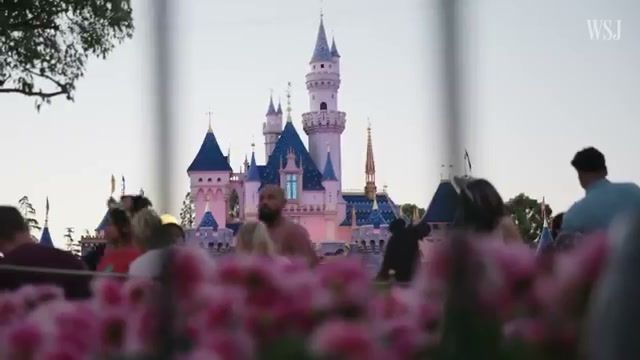
The 'Partners' statue — Walt Disney hand in hand with Mickey Mouse — at the end of Main Street, with Sleeping Beauty Castle behind. It is the symbol of the original park, opened in 1955. (Image: WSJ video capture)

Inside Disney, the park's standing is that of the crown jewel of the entire portfolio. To the symbolism of being the original park that launched the theme park industry, add a brand woven into the American middle-class lifestyle. A built-in audience returns generation after generation; children grow up wanting to visit. The standard for a successful Disney space is singular: a place guests want to come back to, time and time again.

One Billion Guests — the Theme Park That Became a City of a Billion

Those seven decades of accumulation were confirmed in a single number on July 3, when Disneyland Resort officially announced it had welcomed its one billionth guest — on the eve of America's 250th-anniversary Independence Day weekend.

The honorary guest was Andres Robles, an eight-year-old from Arizona celebrating his birthday with his parents, Alejandra and Jose Robles.

Joined by Mickey Mouse and Minnie Mouse at a ceremony on the Main Street U.S.A. train station platform, the family helped unveil a newly updated park sign reading 'Population 1,000,000,000,' then received a VIP tour guide for the day, visiting Walt Disney's private apartment and the newly opened Soarin' Across America.

The Robles family, Disneyland's one billionth guests, unveil the 'Population 1,000,000,000' sign with Mickey, Minnie, Donald, and Daisy at the Main Street U.S.A. train station, July 3, 2026. (Image: Disneyland Resort)

Jill Estorino, president of Disneyland Resort, described the milestone as “a testament to the generations of guests” who have made the park part of their lives — a place where, for more than 70 years, Disney storytelling has been symbolized and memories made and shared, a legacy the resort intends to carry forward for generations to come.

What began as a single park in Anaheim has grown into two theme parks (Disneyland Park and Disney California Adventure), three hotels, and the Downtown Disney District — and became the inspiration for Disney parks around the world.

Map of the Disneyland Resort — two theme parks (Disneyland Park and Disney California Adventure), three hotels (Disneyland Hotel, Grand Californian Hotel & Spa, Pixar Place Hotel), and the Downtown Disney District form a 'small city' within a single block of Anaheim. (Source: Disneyland Resort)

Disneyland has been celebrating its 70th anniversary since May 2025, extending the festivities — including $59 promotional tickets — through this August. The WSJ's 'small city' metaphor has now become literal: in a little over 70 years, a number of people equal to one-eighth of the world's population has passed through this city's gates.

Walt Disney famously said that “Disneyland will never be completed” — that it would keep growing as long as imagination remained in the world — and the resort's announcement pointed explicitly to 'the next billion visitors.' A child who became the billionth guest on his eighth birthday, growing up to bring his own children someday: that is the park's generational-revisit business model opening its next 70 years.

The 4 a.m. Roll Call — How 'Backstage' Produces the 8 a.m. Opening

The substance of Disneyland operations is compressed into the four hours before opening. The day of Mary Cobb, a senior duty manager with 39 years at the park, begins at 4 a.m. Until the 8 a.m. opening, she checks for variables — a broken cash register, a stopped attraction — and runs a roll call to align staffing and issues for the day. The goal of operations is not spectacle but minimizing disruption and resolving problems responsibly.

Mary Cobb, senior duty manager at Disneyland Resort. A 39-year veteran, her day begins at 4 a.m. — four hours before the park opens. (Image: WSJ video capture)

The core device of Disney's operating philosophy is the theatricalization of space and people. Its 36,000 workers are not employees but cast members, and the workplace is divided into backstage and onstage. Stepping off the shuttle into the park is the moment of walking onto the stage. Even the 'rope drop' — holding guests at the main entrance just before opening — is designed as a staged moment, distinctive enough that some fans visit just for it.

Before dawn, Mary Cobb arrives at the park by shuttle. From backstage to onstage — the moment just before a cast member 'walks onto the stage.' (Image: WSJ video capture)

This theatrical model is not rhetorical branding; it functions as a service quality management system. Big Thunder Mountain alone carries roughly 30,000 guests a day — about 2,100 an hour — with five trains running almost continuously. The operator's role goes beyond safety checks and dispatch. As Hernandez puts it, opening that gate feels like starting a performance — but one more genuine than acting, because you actually care about the guest's experience.

Disneyland's operating structure — 36,000 cast members connect Main Street (guest services), attraction zones (ride operations), and backstage (logistics and maintenance) like a single city.

The Economics of 'Pixie Dusting' — the Emotional Infrastructure Behind Per-Guest Spending

The end goal of Disney's operations training is not button-pushing but the creation of personalized moments known as pixie dusting: micro-interactions such as spotting a birthday badge or celebration pin and speaking first. Hernandez sums up the weight of each touchpoint simply: you can make someone's day, or break it.

Melvin Hernandez, attractions lead at Big Thunder Mountain Railroad, on the front line of an attraction that carries 30,000 guests a day. (Image: WSJ video capture)

One episode from the film shows how the concept works on the ground. At Big Thunder Mountain, Hernandez noticed a guest wearing a badge reading 'Celebrating Sue' — the name of a wife who passed away in 2020. Their first date, 58 years of marriage ago, had been on this very ride. The widower still visits the park more than 25 times a month; better to be here, he says, than home watching TV. Hernandez's takeaway: what the park provides is a sense of home, of safety, of being cared for.

This emotional infrastructure connects directly to Disney's revenue strategy. Since the pandemic, Disney has shifted from maximizing attendance to maximizing per-guest spending, using paid line-skipping products and dynamic pricing. The reason guests do not defect as prices rise — the source of premium willingness to pay — is the accumulation of pixie dusting repeated thousands of times a day. In a structure where each touchpoint converts into the next visit plan, emotion becomes the most powerful driver of return visits, one that no dataset fully captures.

The standard new CEO Josh D'Amaro offered in March, responding to criticism of park price increases, points to the same place. According to Deadline, he acknowledged that a Disney park visit is a meaningful investment for families, and said the goal is for the experience to be “the best day of a guest's life.”

He also named the metrics: guest experience ratings and intent to return after a visit — both, he said, very high across all of the parks. The logic is to justify the per-guest spending strategy not by ticket prices but by intent to return — and what produces that intent is pixie dusting on the ground.

Imagineering — an R&D Organization of 500–800 Annual Projects and 150 Disciplines

Disneyland's other pillar is Imagineering. The organization that designs every experience in the park — attractions, themed elements, restaurant concepts — is defined as people who combine science and imagination to create emotional experiences. The Imagineering team supporting the Disneyland Resort handles 500 to 800 projects a year and spans more than 150 disciplines. Its guiding question converges on one line: if it doesn't exist, can we invent it?

Emo O'Brien, portfolio executive creative producer at Walt Disney Imagineering. She started as an intern 29 years ago and now leads the Avengers Campus expansion. (Image: WSJ video capture)

O'Brien points to a cash wrap she designed as an intern that still stands in the park today — and now leads the Avengers Campus expansion. What stands out is how construction proceeds: guests enjoy the park on one side of a wall while expansion work continues on the other. Continuous renewal without stopping operations is the mechanism that keeps a 71-year-old park from aging.

Concept art for the Avengers Campus expansion, displayed for guests, showing new attractions and themed spaces. (Image: WSJ video capture)

The Avengers Campus expansion under construction, just beyond the wall where guests enjoy the park. (Image: WSJ video capture)

“One Foot in Nostalgia, One Foot in Innovation” — Why a 71-Year-Old Park Doesn't Age

Disneyland's self-defined balance is captured in a single line from the film: one foot in nostalgia and tradition, and one foot in innovation. The park must keep growing and evolving — without damaging the attachment guests hold for what O'Brien calls its own unique and very precious park, the original.

This is not sentiment; it is asset management. Nostalgia is the source of return visits across generations, and innovation is the channel that absorbs new IP fandoms. Under the $60 billion investment plan, new IP spaces like the Avengers Campus expansion coexist with classic attractions — a constant weighing of what has been against how to move it forward. That is the maintenance philosophy of a 71-year-old park.

The evolution structure of Imagineering — between nostalgia (the existing park, classic icons) and innovation (Avengers Campus, future concepts), Imagineers cycle invention and experience through blueprints and 3D models.

The Expansion of Content — IP Leaves the Screen for Spaces, Cruises, and Consumer Products

What Disneyland demonstrates is not the success story of a single park but the restructuring of the content industry's revenue model. A single IP no longer ends its life with a theatrical release and a streaming window. The Avengers became a 'campus' inside a park; Frozen and Avatar are expanding into new lands at parks worldwide and into onboard experiences on Disney Cruise Line. Disney was the first entertainment company to operate its own cruise line: since the Disney Magic first set sail in 1998, the fleet has grown through ships themed on Disney, Pixar, Marvel, and Star Wars IP, culminating in the Disney Destiny's maiden voyage in November 2025 — plus a private island destination, Disney Lookout Cay at Lighthouse Point in the Bahamas. Recovering the emotional assets built on screen at premium prices in physical space: this is the operating principle behind $10 billion in Experiences operating income.

And the loop turns once more. On June 24, Disney+ released season 3 of the docuseries 'Behind the Attraction,' executive produced by Dwayne Johnson among others. The new two-episode season covers the history of Disney Cruise Line and the making of its newest ships, turning the shipbuilding process itself into content through Imagineer interviews and behind-the-scenes footage — alongside National Geographic documentaries on the making of the Disney Treasure and Disney Wish. IP becomes experience, and the making of that experience becomes streaming content that generates demand for the next visit: a completed cycle in which content and experience sell each other.

Competitors are moving in the same direction. Universal opened its new Epic Universe park in Orlando in 2025, and Netflix is experimenting with the physical extension of IP through its 'Netflix House' venues. Global media companies are converging on the same bet: the next front of the streaming war is not subscriber counts, but spaces fans travel to in order to spend their time and money.

The Future of K-Content — From Viewer to Visitor

This trend is both an opportunity and a test for K-content. K-dramas and K-pop have already secured global audiences, and the powerful fandoms built through viewing are producing real visits — visits that amount to the force with which to build a 'K-Culture Land' of Disneyland's kind. The numbers back this up. Inbound arrivals to Korea hit a record 18.94 million in 2025 and set a new quarterly high of 4.76 million in Q1 2026.

Intent to visit Korea stands at 72% among K-content viewers, roughly double that of non-viewers (37%), and per-capita K-content viewing time correlates strongly with visit intent by country (r = 0.82). 'OTT tourism' — viewing converting directly into travel demand — has become a constant of Korean tourism.

This conversion was documented in quantitative terms at the 'K-Culture Explained' conference held at Yonsei University on June 30, co-hosted by Yonsei and K-EnterTech Hub. A five-country survey (US, UK, Singapore, Japan, Philippines; n=105) by I&I Research, unveiled at the conference, found that 98% of respondents first encountered K-content on Netflix and 99% named it their primary platform.

Content's influence on the decision to visit scored 6.04 out of 7; even on short stays, one in five (22%) visited actual filming locations; and 100% shared their Korea experience on social media. Individual titles register measurable impact: 'K-Pop Demon Hunters' lifted flight bookings to Korea by 146% in Spain and 122% in Germany within four weeks of release, and 'Culinary Class Wars' drove a 148% jump in reservations at featured chefs' restaurants within a week of airing.

Indicator

Figure

First OTT for K-drama/film

Netflix 98%

Current Netflix usage

100%

Primary OTT for Korean content

Netflix 99%

Heavy viewing (5+ hours/week)

70%

[Table] Hallyu consumption converging on a single platform — why viewing-to-visiting can now be measured as one flow. (Source: I&I Research, five-country survey, n=105)

[Chart 1] Key K-content tourism indicators: viewing converts into food spending (74%), high-spend tourism (74%), and social sharing (100%).

The same research also exposed the weak links. Of 100 viewers, 85 reach the search stage and 72 form intent to visit — but bookings collapse to 38, and only 11 reach long-term revisits. Two bottlenecks: intent-to-booking, and visit-to-revisit. Proposed remedies at the conference included a 'One-Stop K-Tourism Pass' — a multilingual interface for booking flights and lodging on one screen — and a 'Content Trail' network keeping filming locations open as permanent routes. The screen is not the end but the start of the journey; what carries the journey to its end is not content but an operating system.

[Chart 2] The OTT-tourism conversion funnel — retention per stage per 100 viewers. The two bottlenecks, intent-to-booking and visit-to-revisit, are the central challenge for K-content's experience industry.

[Data] Korea Screen Tourism Map
Discover the actual filming locations of Korea’s hit streaming series, which have captivated audiences worldwide, via an interactive map. K-Screen Tour Map — From viewer to visitor.

These two bottlenecks are precisely the problem Disneyland has spent 71 years solving. Compared with the Disneyland model, K-content's decisive gap emerges: permanently operating immersive experience infrastructure, and the operational capability honed to run it. The Disneyland case offers three implications for the Korean content industry.

First, the essence of the experience business is operations, not IP. Disneyland's magic comes not from character licensing but from 4 a.m. shifts, roll calls, the capacity to move 2,100 guests an hour, and thousands of daily acts of pixie dusting. Experience venues built on K-pop and K-drama IP are being launched at home and abroad, but without operational assets like 39-year veterans and a 150-discipline Imagineering organization, they struggle to move beyond one-off pop-ups. Holding IP and operating space are separate industries, and building the latter takes time and organization.

Second, emotional infrastructure sustains premium pricing. What creates a guest who visits 25 times a month for the memory of his wife is not attraction specs but the sense of being cared for. K-pop fandom already holds some of the most powerful emotional assets in the world. The next stage is designing systems that convert those assets beyond one-off concerts and merchandise into always-on spatial experiences — operations that recognize and respond to each fan's personal story.

Third, K-content also needs its own balance of nostalgia and innovation. Disneyland's 71 years have been a coexistence of preserving the original and grafting on new IP. Three decades of Hallyu have accumulated generational fandom nostalgia — from first-generation idols to today — that is itself raw material for the experience industry; designing it into permanently operating assets is the next task.

'Entertainment Tech Co-Evolution' — the Design Principle for K-Content's Next 30 Years

In an era when a content company's core business has moved from the screen to physical space, the next question for K-content — with its global audiences and fandoms already in hand — narrows to one: is it ready to receive the force that has turned viewers into visitors, in a 'K-Culture Land' guests want to come back to, time and time again?

One concept threads the three implications together: Entertainment Tech co-evolution. EnterTech(Entertainment Tech) is technology — streaming, AI — that creates revenue sources that did not previously exist, raising the value of entertainment, and that widens its boundaries by letting people experience content without being physically there. Co-evolution is the design of relationships built on that technology, in which content and technology, audiences and places, evolve together, reshaping one another.

The concept was presented on June 22 at the inaugural 'Team Korea New York' forum, hosted by the Consulate General of the Republic of Korea in New York.

“The sustainable future of the Korean Wave rests on 'Entertainment Tech' — the fusion of entertainment and technology — and on 'co-evolution,' whose core values are empathy and sharing,” said Samseog Ko, Distinguished Chair Professor at Dongguk University's College of Advanced Convergence.

Samseog Ko, Distinguished Chair Professor at Dongguk University, speaking at the 'Team Korea New York' forum. (Photo: Consulate General of the Republic of Korea in New York)

Entertainment tech co-evolution is, in effect, the grammar of the experience industry. Raising the value of experience by fusing storytelling with technology is precisely what Imagineering's 150 disciplines have done at Disneyland for 71 years. Streaming and AI, likewise, become engines of the experience industry only when they turn viewing from a substitute for being there into the starting point of the journey — working not to make the visit unnecessary, but to make people want to go, and to go deeper once there.

The 'watch → visit → spend → share' loop confirmed in the K-EnterTech Hub survey is the evidence. K-content has moved past the stage of one-way 'export' into a phase in which content, technology, audiences, and places evolve together, reshaping one another.

The task is to design this loop not as winner-takes-all but as an 'altruistic co-evolution' that turns zero-sum into plus-sum. When Korea moves beyond content export to building an ecosystem — expanding K-culture into a 'lifestyle public good' — the Korean Wave's next thirty years open.

Disneyland is a 71-year proof of this principle. If Imagineering's weaving of storytelling and technology is Entertainment Tech, then the process by which the park, its guests, Anaheim's local economy, and the IP grew one another into a 'city of a billion' is co-evolution. Disney's decision to elevate parks chief Josh D'Amaro to group CEO is a defining example of where a content company's future competitiveness lies.

A 'K-Culture Hub Land,' too, gains persuasiveness and economic viability only on the same design principle: a plus-sum structure in which filming locations and fandoms, regions and technology grow one another — the path that turns the watch-visit-spend-share loop into a 71-year asset.

Mary Cobb's measure of a good day compresses the essence of this industry: “A successful day is when everything appeared seamless, and the best day is when no one knows I was there.” And at closing time, guests walking out the gates a little sad, already planning their next visit — that is the completion of a business model repeated for 71 years, all the way to one billion guests.

In an era when a content company's core business has moved from the screen to physical space, the next question for K-content — with its global audiences and fandoms already in hand — narrows to one: is it ready to receive the force that has turned viewers into visitors, in a 'K-Culture Land' guests want to come back to, time and time again?